Exclusive Citizenship Act of 2025: What Florida...
Dive into the discussions surrounding the proposed Exclusive Citizenship Act of 2025 and its potential implications for Florida immigrants. This comprehensive guide clarifies the current U.S. citizenship process, detailing eligibility, required documents, timelines, and costs. Learn how to navigate the USCIS naturalization journey effectively, avoid common mistakes, and understand when expert legal assistance from a Florida immigration lawyer is crucial. Despite legislative proposals, current laws offer clear pathways to citizenship. Florida Immigration Lawyers provides vital support and free consultations for residents in Jacksonville and across the state, ensuring you have the accurate information and advocacy needed for a successful application. Protect your future and secure your American dream with trusted legal guidance.

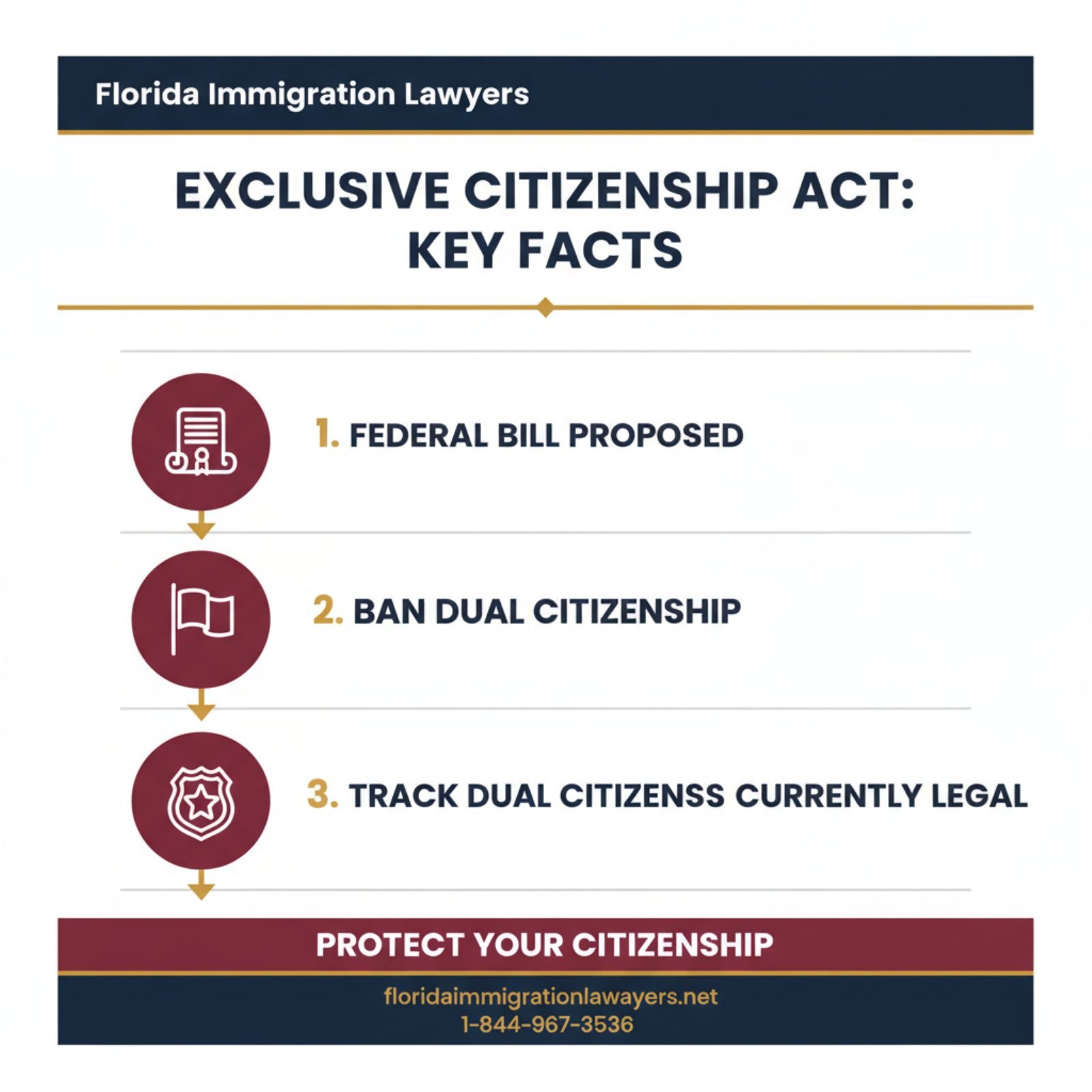
The Exclusive Citizenship Act of 2025 was a proposed federal bill (like S.3283) that aimed to significantly alter U.S. citizenship laws, potentially impacting dual nationality and voter verification. While it generated discussion, it was a legislative proposal and did not become law. Current U.S. citizenship requirements remain governed by the Immigration and Nationality Act. Florida residents should understand existing pathways to naturalization and potential future legislative changes.
- The Exclusive Citizenship Act of 2025 was a proposed bill, not enacted law.
- Current U.S. citizenship is governed by existing federal statutes.
- Proposed legislation often seeks to change dual nationality or voter proof requirements.
- Navigating citizenship requires understanding complex federal regulations.
- Consulting a Florida immigration lawyer is crucial for accurate guidance.
Are you a Florida resident concerned about your immigration status or the future of U.S. citizenship? Perhaps you've heard discussions about proposed changes, like the Exclusive Citizenship Act of 2025, and wonder how they might affect you or your family. The landscape of immigration law is constantly evolving, and understanding potential legislative shifts is vital for anyone on the path to becoming a U.S. citizen.
This article will demystify the discussions surrounding the Exclusive Citizenship Act of 2025, clarify the current process for obtaining U.S. citizenship in Florida, and highlight key considerations for immigrants in Jacksonville and across the state. We will provide you with a comprehensive guide to naturalization, essential documents, expected timelines, and cost factors. Do not navigate these complex waters alone. Call Florida Immigration Lawyers at 1-844-967-3536 for a free consultation today to ensure your journey is handled with expert care.
Understanding the Exclusive Citizenship Act of 2025 and its Florida Implications
The Exclusive Citizenship Act of 2025, often referenced by proposed bill numbers like S.3283, was a piece of federal legislation introduced in Congress that generated significant debate. While it did not pass into law, its proposals aimed to introduce more stringent requirements for U.S. citizenship and potentially impact the concept of dual nationality. Understanding what this proposed act sought to achieve can help you grasp the ongoing discussions in immigration policy.
Generally, such legislative proposals aim to reinforce the idea of singular allegiance to the United States. This could involve requiring individuals to renounce previous citizenships or establishing stricter verification processes for citizenship, especially in contexts like voter registration. For immigrants and dual nationals in Florida, these discussions can naturally cause concern and uncertainty about their future status.
Florida has a dynamic and diverse immigrant population, and state-level actions often reflect national immigration debates. Recent news, such as Governor DeSantis's announcements regarding Operation Tidal Wave and increased law enforcement partnerships with ICE (like 287(g) agreements), highlights Florida's proactive stance on immigration enforcement. While these are distinct from federal citizenship laws, they create an environment where federal legislative proposals like the Exclusive Citizenship Act of 2025 resonate deeply with local communities.
Distinguishing Proposed Legislation from Current Law
It is crucial to differentiate between proposed legislation and existing law. The Exclusive Citizenship Act of 2025 was a bill, a legislative proposal, and not an enacted statute. As of 2026, the requirements for U.S. citizenship are primarily governed by the Immigration and Nationality Act (INA), which has been established for decades. Any changes to these laws must go through a rigorous legislative process in Congress.
Our firm, Florida Immigration Lawyers, closely monitors all legislative developments to provide our clients with the most accurate and up-to-date information. We understand that rumors or proposals can cause distress. We are here to clarify what is law and what is merely a proposal, helping you make informed decisions about your immigration journey.
The Landscape of Citizenship in Jacksonville, Florida
Jacksonville, Florida, like many other vibrant cities in the state, is home to a significant immigrant community. Residents here, whether they are long-term green card holders or recent arrivals, often look to achieve U.S. citizenship as a pathway to full participation in American society. The process is federal, but the impact is profoundly local, touching families and communities throughout Jacksonville and surrounding areas.
Our team at Florida Immigration Lawyers serves clients across Florida, including Jacksonville. We are familiar with the specific challenges and resources available in the region. Understanding how federal laws are applied at the local level, particularly through the USCIS field offices that serve Florida, is key to a successful naturalization application.
The Path to U.S. Citizenship in Florida: A Step-by-Step Guide
The process of becoming a U.S. citizen through naturalization is a significant milestone for many immigrants. While the Exclusive Citizenship Act of 2025 was a proposal, the current path to citizenship is well-defined. Here is a general step-by-step guide to help you understand what to expect when pursuing USCIS naturalization process in Florida:
-
Determine Your Eligibility: Before applying, you must meet specific requirements. Generally, you must be at least 18 years old, be a lawful permanent resident (green card holder) for at least five years (or three years if married to a U.S. citizen), demonstrate continuous residence and physical presence in the U.S., show good moral character, and have a basic understanding of English and U.S. civics. These requirements are outlined in the Immigration and Nationality Act, specifically INA Section 316 (8 U.S.C. § 1427) and 8 CFR Part 316.
-
Prepare and File Form N-400, Application for Naturalization: This is the primary form you will submit to USCIS. It requires detailed personal information, immigration history, and answers to questions about your background, moral character, and eligibility. Accuracy and completeness are paramount to avoid delays or denials. We can assist you with this complex form.
-
Attend Your Biometrics Appointment: After filing Form N-400, USCIS will send you an appointment notice to visit an Application Support Center (ASC). Here, your fingerprints, photograph, and signature will be collected. This information is used for background checks and to verify your identity.
-
Complete the Naturalization Interview: USCIS will schedule an interview for you with an immigration officer. During this interview, the officer will review your N-400 application, ask questions about your eligibility, and test your English proficiency (reading, writing, and speaking) and knowledge of U.S. civics. Preparing thoroughly for this interview is critical for success.
-
Receive a Decision from USCIS: After your interview, the USCIS officer will either make a decision, continue your case for further review (e.g., if more documents are needed), or deny your application. If approved, you will typically receive a notice for the Oath of Allegiance Ceremony.
-
Take the Oath of Allegiance: This is the final step to becoming a U.S. citizen. At the Oath Ceremony, you will pledge your allegiance to the United States and receive your Certificate of Naturalization. This official document proves your U.S. citizenship.
For more detailed information on the naturalization process and eligibility, you can visit the official U.S. Citizenship and Immigration Services (USCIS) website. Our experienced Florida immigration lawyers specialize in citizenship applications and can guide you through each stage, ensuring all requirements are met.
Essential Documents for Your Naturalization Application
Gathering the correct documents is a critical part of the USCIS naturalization process. Missing or incorrect documentation can significantly delay your application or even lead to a denial. While individual cases may require specific additional evidence, here is a general list of documents you will typically need for your N-400 application:
- Your Permanent Resident Card (Green Card).
- All passports (U.S. and foreign) you have held during the eligibility period.
- State-issued identification (e.g., driver's license).
- Marriage certificate (if applicable, especially if applying based on marriage to a U.S. citizen).
- Divorce decrees or death certificates for previous spouses (if applicable).
- Birth certificates for your children (if applicable).
- Proof of selective service registration (for males who lived in the U.S. between ages 18-26).
- Tax returns for the past five years (or three years if applying based on marriage).
- Evidence of continuous residence and physical presence (e.g., utility bills, leases, employment records).
- Certified copies of arrest records, court dispositions, or police reports for any arrests or citations, even if charges were dropped or expunged.
- Proof of payment for any child support or alimony obligations.
- Documentation for any trips outside the U.S. lasting six months or more.
It is essential to provide certified English translations for any documents not in English. Our team at Florida Immigration Lawyers can help you organize your paperwork and ensure you have everything required for a strong application.
Navigating Timelines and Processing Expectations for Florida Naturalization
Understanding the potential timeline for your naturalization application can help manage your expectations. The processing times for USCIS naturalization process vary significantly based on the USCIS field office jurisdiction, current caseloads, and the complexity of your individual case. For Florida residents, applications are processed by USCIS field offices such as those in Miami, Orlando, and Tampa, which serve various parts of the state, including Jacksonville.
Typically, the entire naturalization process, from filing Form N-400 to taking the Oath of Allegiance, can take anywhere from 8 to 24 months, or sometimes even longer. Factors that can influence this timeline include:
- USCIS Caseload: High volumes of applications can lead to longer waiting times.
- Requests for Evidence (RFEs): If USCIS needs more information, they will send an RFE, which adds time to the process.
- Interview Backlogs: Scheduling interviews can sometimes be delayed.
- Background Checks: Extensive background checks can prolong the process.
- Response Time: How quickly you respond to any USCIS requests.
You can check estimated processing times for your specific field office on the USCIS website. While these are estimates, they provide a general idea. Our attorneys can help you track your case status and respond promptly to any USCIS inquiries, potentially minimizing delays in your citizenship requirements Florida journey.
Understanding the Costs of U.S. Citizenship in Florida
The cost of applying for U.S. citizenship involves several components. It is important to budget for these expenses to avoid any unexpected financial hurdles. The primary costs associated with the USCIS naturalization process include:
-
USCIS Filing Fee: This is the fee for submitting Form N-400, Application for Naturalization. Please note that USCIS fees are subject to change, so it is crucial to check the most current fee schedule on the official USCIS website or consult with an attorney. In some cases, you may be eligible for a fee waiver (Form I-912) if you meet specific income guidelines.
-
Biometrics Services Fee: This fee covers the cost of your biometrics appointment. Sometimes, this fee is combined with the N-400 filing fee. Again, verify the current fee structure on the USCIS website.
-
Legal Fees: While you can file for naturalization on your own, many applicants choose to hire an experienced Florida immigration lawyer. Legal fees cover the attorney's services in preparing your application, gathering documents, advising you on eligibility, preparing you for the interview, and representing you if any issues arise. Investing in legal counsel can significantly increase your chances of a smooth and successful application.
-
Translation and Document Fees: If any of your supporting documents are not in English, you will need to pay for certified translations. You may also incur costs for obtaining copies of vital records or other necessary paperwork.
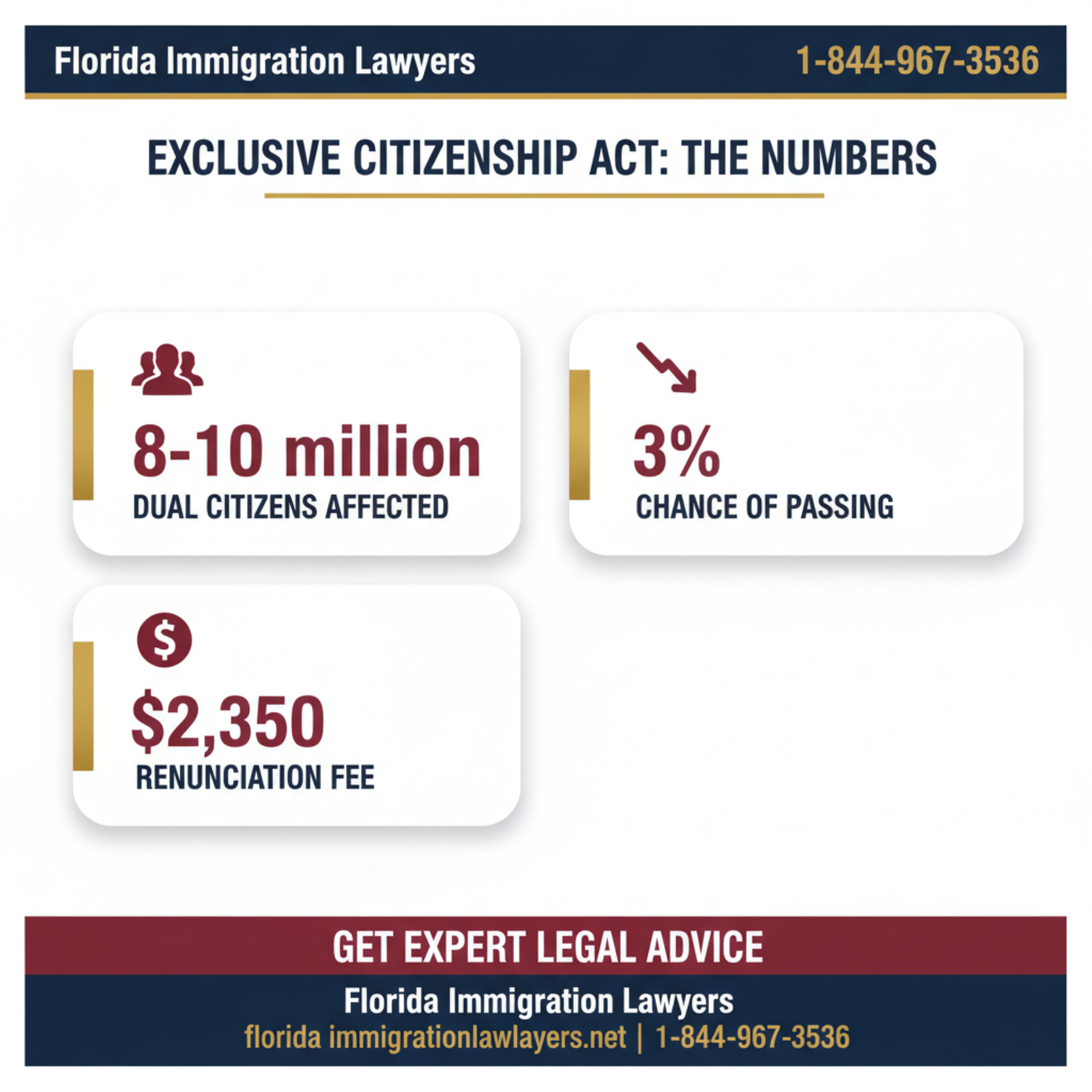
Key Statistics & Data
These costs can add up, so planning is essential. Florida Immigration Lawyers offers transparent fee structures and can discuss your options during a free consultation. We believe that access to legal guidance should not be a barrier to achieving your American dream.
Do not navigate this complex process alone. Contact Florida Immigration Lawyers today for expert guidance and to ensure your application is handled correctly from start to finish. We are here to support you every step of the way.
Frequently Asked Questions About U.S. Citizenship
Many individuals have questions about the U.S. citizenship process, especially in light of legislative discussions like the Exclusive Citizenship Act of 2025. Here, we address some common inquiries to provide clarity.
What is the Exclusive Citizenship Act of 2025?
The Exclusive Citizenship Act of 2025 refers to proposed federal legislation, such as S.3283, that was introduced in Congress. Its primary goal was to strengthen the concept of singular U.S. citizenship, potentially by limiting or altering the recognition of dual nationality and by imposing stricter requirements for verifying citizenship, particularly for voting purposes. It's important to remember that this was a legislative proposal and did not pass into law. Current U.S. citizenship laws remain in effect, and dual citizenship is generally permitted under existing federal policy.
What is the Citizenship Amendment Bill 2025?
Similar to the Exclusive Citizenship Act, the term "Citizenship Amendment Bill 2025" likely refers to various legislative proposals debated in Congress around that time. These bills often aimed to amend sections of the Immigration and Nationality Act (INA) to either tighten eligibility requirements, streamline processes, or address specific immigration challenges. As of 2026, no major "Citizenship Amendment Bill 2025" that fundamentally altered the naturalization process has been enacted into law. The core requirements for U.S. citizenship remain consistent with long-standing federal statutes.
What is the Passport Law 2025?
The term "Passport Law 2025" generally refers to regulations governing the issuance and use of U.S. passports. While there might be minor administrative updates to passport application procedures or security features, there was no specific "Passport Law 2025" enacted that drastically changed who is eligible for a U.S. passport or how one obtains it. U.S. passport eligibility is directly tied to U.S. citizenship. If proposals like the Exclusive Citizenship Act of 2025 had passed, they could have indirectly impacted passport eligibility by changing citizenship rules, but this did not occur. For current passport information, always refer to travel.state.gov.
How much does it cost to get your citizenship in Florida?
The cost to obtain U.S. citizenship in Florida is primarily composed of the USCIS filing fee for Form N-400 and, if applicable, the biometrics fee. These government fees are standardized across the U.S. but are subject to change, so always check the official USCIS website for the most current amounts. Additionally, many applicants choose to invest in legal representation from a Florida immigration lawyer, which incurs separate legal fees. Other potential costs include document translation services or fees for obtaining supporting vital records. Florida Immigration Lawyers offers free consultations to discuss your specific case and associated costs transparently.
Common Mistakes to Avoid When Seeking U.S. Citizenship
The naturalization process can be complex, and even small errors can lead to significant delays or even denial. Avoiding these common mistakes is crucial for a smooth journey to U.S. citizenship:
-
Incomplete or Inaccurate Application Forms: Failing to answer all questions truthfully and completely on Form N-400 can lead to Requests for Evidence (RFEs) or even accusations of misrepresentation. Always double-check every entry.
-
Failing to Disclose All Arrests or Citations: Even minor infractions, arrests that led to no conviction, or expunged records must be disclosed. USCIS conducts thorough background checks, and non-disclosure can be seen as a lack of good moral character, leading to denial.
-
Not Meeting Continuous Residence and Physical Presence Requirements: Spending too much time outside the U.S. can break your continuous residence, making you ineligible. Carefully track your travel dates and consult an attorney if you have extended absences.
-
Lack of Good Moral Character: Certain criminal offenses, failure to pay taxes, or child support can disqualify you. Ensure your record reflects good moral character throughout the statutory period.
-
Poor Preparation for the Interview: Failing the English or civics test, or being unable to answer questions about your application, can result in a denial or a need for re-testing. Thorough preparation is essential.
-
Missing Deadlines or Ignoring USCIS Notices: USCIS provides specific deadlines for responding to RFEs or attending appointments. Missing these can lead to case abandonment or denial without further review.
-
Not Updating Your Address with USCIS: If you move, you must update your address with USCIS promptly. Failure to do so can result in missed notices, interview appointments, or decisions, severely jeopardizing your case.
-
Assuming Dual Citizenship is Prohibited: While the Exclusive Citizenship Act of 2025 proposed changes, under current U.S. law, dual citizenship is generally permitted. However, some countries may require renunciation. Understand the laws of all relevant countries.
-
Failing to Provide Certified Translations: Any document submitted to USCIS that is not in English must be accompanied by a complete and certified English translation. Incorrect translations can cause delays.
-
Not Seeking Legal Counsel for Complex Cases: If you have a criminal record, previous immigration violations, or complex travel history, attempting to navigate the process alone is a significant risk. An attorney can identify potential issues and strategize solutions.
When to Call a Florida Immigration Lawyer
While the naturalization process may seem straightforward for some, many situations warrant the expertise of an experienced Florida immigration lawyer. The discussions around proposals like the Exclusive Citizenship Act of 2025 underscore the importance of staying informed and having expert legal guidance.
You should consider contacting Florida Immigration Lawyers if you encounter any of the following scenarios:
-
Complex Eligibility: If your continuous residence has been interrupted by long trips abroad, or if you have questions about your good moral character due to past issues, an attorney can assess your eligibility accurately.
-
Criminal History: Any arrest, charge, or conviction, no matter how minor or old, requires careful legal review. Our deportation defense expertise ensures your past does not jeopardize your future citizenship.
-
Previous Denials or Immigration Issues: If you've had previous visa denials, green card issues, or other immigration challenges, an attorney can help address these complexities.
-
Concerns about Dual Citizenship: If you hold citizenship in another country and are unsure about its implications for your U.S. naturalization, especially in light of past legislative proposals, seek legal advice.
-
Difficulty with English or Civics: While accommodations exist, an attorney can help you prepare or determine if you qualify for exemptions.
-
Receiving a Request for Evidence (RFE) or Notice of Intent to Deny (NOID): These notices require a timely and comprehensive response. A lawyer can help you gather the necessary documentation and craft a compelling argument.
-
Fear of Deportation: If you have any concerns that your application might expose you to deportation proceedings, immediate legal counsel is essential. Contact us for confidential advice.
Our dedicated attorneys at Florida Immigration Lawyers provide personalized legal services throughout Florida, including Jacksonville. We are committed to protecting your rights and guiding you through every step of your journey to U.S. citizenship. We understand the nuances of federal immigration law and how it applies to residents in Florida.
About Florida Immigration Lawyers
Florida Immigration Lawyers is a leading immigration law firm dedicated to serving individuals and families across the entire state of Florida. With years of experience and a deep understanding of U.S. immigration law, our firm is committed to providing compassionate, effective, and results-oriented legal representation.
We specialize in a wide range of immigration matters, including general immigration services, citizenship and naturalization, family-based visas, business immigration, asylum claims, and deportation defense. Our mission is to empower our clients by providing clear legal guidance and strong advocacy.
Why choose Florida Immigration Lawyers? We pride ourselves on our client-focused approach, our unwavering dedication to justice, and our ability to navigate complex legal challenges. We are available 24/7 to address your urgent needs and offer free consultations to help you understand your options without financial commitment. Your future in America is our priority.
Contact us today at 1-844-967-3536 or visit our website at https://www.floridaimmigrationlawyers.net to schedule your free consultation. Let us be your trusted partner on your immigration journey.
Sources and References
- U.S. Citizenship and Immigration Services (USCIS)
- Executive Office for Immigration Review (EOIR)
- U.S. Department of State - Travel.State.Gov
- 8 U.S.C. Chapter 12 - Immigration and Nationality Act (INA)
- INA Section 316 (8 U.S.C. § 1427) - Requirements for Naturalization
- 8 CFR Part 316 - Eligibility for Naturalization
This article provides general legal information and is not intended as legal advice. Every case is unique, and outcomes depend on specific facts and circumstances. Contact an attorney for advice about your particular situation.
Navigating the path to U.S. citizenship requires careful attention to detail and a thorough understanding of immigration law. While legislative proposals like the Exclusive Citizenship Act of 2025 may cause uncertainty, remember that current laws provide clear pathways. Do not leave your future to chance.
For personalized guidance and to ensure your naturalization application is handled with precision and care, contact Florida Immigration Lawyers today. We offer free, confidential consultations to discuss your specific needs. Call us at 1-844-967-3536. Se Habla Español - Estamos aquí para ayudarle.
Do Not Navigate This Process Alone
Our experienced immigration attorneys are ready to fight for you. Get a free, confidential consultation today.
Se Habla Español
Frequently Asked Questions
Florida Immigration Lawyers
Immigration Attorney | Founder, Vasquez Law Firm
U.S. Air Force veteran and immigration attorney with thousands of cases resolved. J.D., NCCU School of Law. AILA member. Admitted to the 4th, 5th, and 11th Circuit Courts.
Available 24/7 - Free Evaluations
Related Legal Services
Our Florida immigration attorneys can help you with citizenship and naturalization, family immigration services and immigration practice areas. Call today at 1-844-967-3536 for a free consultation.
Related Links
Related Topics
Free Legal Consultation
Discuss your case with our experienced attorneys. We're available 24/7.
Se Habla Español - Estamos aquí para ayudarle.
Related Articles
Stokes Interview: Navigating Marriage Fraud in Florida
A Stokes interview is a specialized, separate interview conducted by USCIS when there are suspicions of marriage fraud in a green card application. This rigorous process involves individual questioning of spouses, focusing on inconsistencies in their testimonies to determine the authenticity of their marital bond. For couples in Florida, navigating this high-stakes interview requires meticulous preparation, extensive documentation, and often the strategic guidance of an experienced immigration lawyer. Understanding the process, preparing for detailed questions, and presenting a strong case are crucial for overcoming marriage fraud allegations and securing your immigration future. Florida Immigration Lawyers stands ready to assist you.
Immigration Attorney Gainesville: North Florida Legal Help
For those in Gainesville, Alachua County, and throughout North Florida, navigating U.S. immigration law requires expert guidance. An experienced immigration attorney can simplify complex processes, from family-based petitions and employment visas to critical asylum claims and deportation defense. This comprehensive guide outlines the essential services provided by an immigration attorney, details necessary documentation, clarifies processing timelines, and discusses associated costs. We also highlight common mistakes to avoid and crucial scenarios where legal counsel is indispensable. Florida Immigration Lawyers serves all of Florida, including Gainesville and St. Petersburg, providing dedicated legal support to help you achieve your immigration goals. Contact us for a free consultation to discuss your specific needs.
Military Naturalization Expedited at Florida Bases
Explore expedited military naturalization processes for service members at Florida bases like MacDill. Learn about eligibility, steps, and common mistakes. Contact Florida Immigration Lawyers for a free consultation.
Protect Yourself from Immigration Scams in Florida
Learn how to protect against immigration scams in Florida, focusing on St. Petersburg. This guide covers identifying scams, verifying credentials, and getting legal help. Call Florida Immigration Lawyers at 1-844-967-3536 for assistance.
