Dual Citizenship Lawyer in Florida: Your 2026 Guide
For many residents of Florida, achieving dual citizenship offers unparalleled freedom and opportunity. However, navigating the intricate landscape of immigration law, particularly the U.S. naturalization process, is complex. This guide demystifies dual nationality in Florida for 2026, covering eligibility, the step-by-step application (Form N-400), essential documentation, typical timelines, and associated costs. We also explore the significant benefits and responsibilities that come with holding two passports. Understanding these nuances is crucial to avoid common pitfalls. Florida Immigration Lawyers provides expert guidance, ensuring your application is meticulously prepared and your journey to dual citizenship is successful. Contact us at 1-844-967-3536 for a free case review.

Dual citizenship, or dual nationality, is the legal status of being a citizen of two countries simultaneously. In Florida, achieving dual citizenship typically involves becoming a U.S. citizen through naturalization while retaining citizenship in your country of origin. The U.S. generally permits dual nationality, but specific eligibility requirements, complex application procedures, and varying laws of other nations make the process intricate. It offers benefits like increased mobility and property rights, but also carries responsibilities like potential tax obligations. Consulting a dual citizenship lawyer in Florida is crucial to navigate the federal naturalization process and understand the implications for both nationalities.
- Eligibility: Most individuals obtain dual citizenship by naturalizing as U.S. citizens after meeting specific residency, moral character, and language requirements.
- Process: The primary path involves applying for U.S. naturalization (Form N-400) through USCIS, which includes biometrics, an interview, and an oath ceremony.
- Legal Status: The U.S. does not explicitly prohibit dual nationality, but it expects primary allegiance from its citizens.
- Other Country's Laws: Your ability to hold dual citizenship also depends entirely on the laws of your country of origin; some countries automatically revoke citizenship upon naturalization elsewhere.
- Expert Guidance: A qualified immigration attorney can provide vital assistance, ensuring compliance with all U.S. and relevant international laws.
The dream of global mobility, maintaining strong ties to your heritage, and enjoying the benefits of two nations is a powerful one. For many residents of Florida, achieving dual citizenship represents the pinnacle of their immigration journey, offering unparalleled freedom and opportunity. However, the path to holding two passports is often complex, fraught with legal nuances that can vary significantly between countries and even within U.S. federal law. Understanding your eligibility, the meticulous naturalization process, and the potential implications is paramount.
Navigating the intricate landscape of immigration law requires precise knowledge and strategic planning. Whether you are a long-term permanent resident in Orlando or elsewhere in Central Florida considering naturalization, or an individual born with dual nationality seeking to clarify your status, expert legal guidance is indispensable. This comprehensive guide will demystify dual citizenship in Florida, outlining the steps, requirements, and crucial considerations for 2026.
We will delve into the U.S. government's stance on dual nationality, walk you through the naturalization application process, detail the necessary documentation, and discuss the associated timelines and costs. Our goal is to equip you with the knowledge to make informed decisions and avoid common pitfalls. For personalized advice and unwavering support, do not hesitate to contact Florida Immigration Lawyers. Call us today at 1-844-967-3536 for a free case review and let our experienced team help you achieve your dual citizenship aspirations.
What is Dual Citizenship and How Does it Work in Florida?
Dual citizenship, also known as dual nationality, is the legal recognition of being a citizen of two countries at the same time. The United States generally permits dual nationality, meaning that a person can be a citizen of both the U.S. and another country without having to renounce their original citizenship. This status is typically achieved when a U.S. citizen acquires foreign citizenship or when a foreign citizen naturalizes as a U.S. citizen while their home country's laws allow them to retain their original nationality. Florida, as a state, does not grant citizenship; rather, the process is governed by federal U.S. immigration and nationality law.
The U.S. Immigration and Nationality Act (INA) does not explicitly prohibit dual nationality. However, when an individual naturalizes as a U.S. citizen, they are required to take an Oath of Allegiance, which includes renouncing allegiance to any foreign state. Despite this oath, the U.S. Supreme Court has recognized that a person can simultaneously be a citizen of two countries. The key factor is often the intent of the individual and the laws of the other country. For instance, INA 349(a) outlines conditions under which U.S. nationality can be lost, but simply acquiring foreign citizenship does not automatically lead to loss of U.S. citizenship unless there is a specific intent to relinquish it.
For individuals in Florida, the journey to dual citizenship primarily involves the U.S. naturalization process administered by U.S. Citizenship and Immigration Services (USCIS). USCIS field offices in cities like Orlando, Miami, and Tampa handle naturalization interviews for applicants across the state. While Florida itself does not have unique dual citizenship laws, its diverse population and proximity to international travel hubs make it a common location for individuals pursuing this status. Understanding the specific laws of your country of origin regarding dual nationality is just as critical as navigating U.S. federal requirements, as some countries have strict prohibitions against their citizens holding a second nationality, leading to automatic loss of citizenship upon naturalization elsewhere. Our experienced attorneys can help you understand these complex interactions.
How Do I Become a U.S. Citizen in Florida to Achieve Dual Nationality?
Becoming a U.S. citizen through naturalization is the most common pathway for permanent residents in Florida to achieve dual nationality, provided their country of origin also permits it. This process is governed by federal law and requires meeting several stringent eligibility criteria before filing Form N-400, Application for Naturalization.
To be eligible for naturalization, you must generally meet the following requirements as outlined in 8 U.S.C. § 1427:
- Be at least 18 years old.
- Be a lawful permanent resident (Green Card holder) for at least 5 years (or 3 years if married to a U.S. citizen).
- Have continuous residence in the U.S. for at least 5 years (or 3 years if applicable) immediately preceding the filing of the application.
- Be physically present in the U.S. for at least half of that continuous residence period.
- Demonstrate good moral character for the statutory period.
- Be able to read, write, and speak basic English.
- Have a basic understanding of U.S. history and government (civics).
- Be willing to take the Oath of Allegiance to the United States.
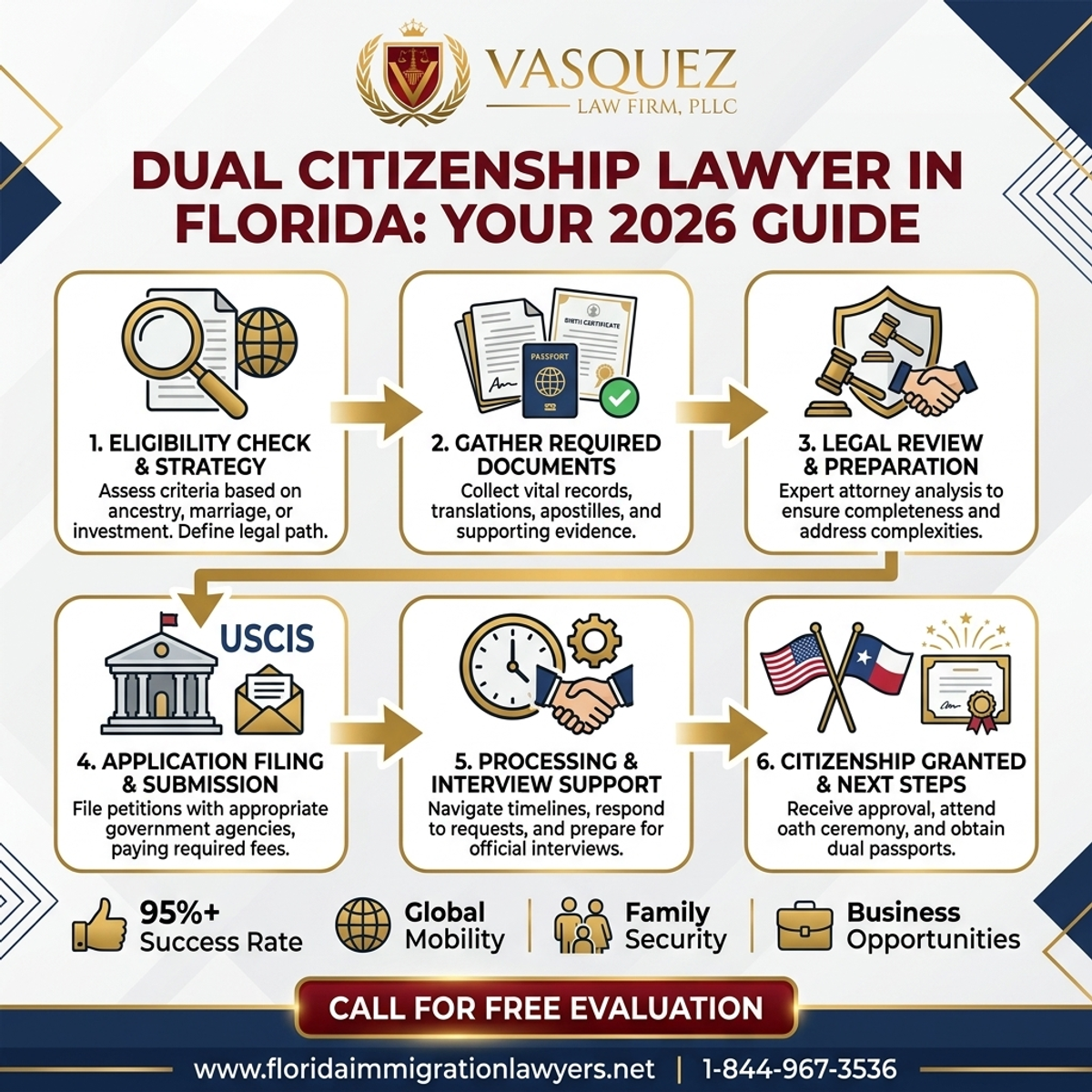
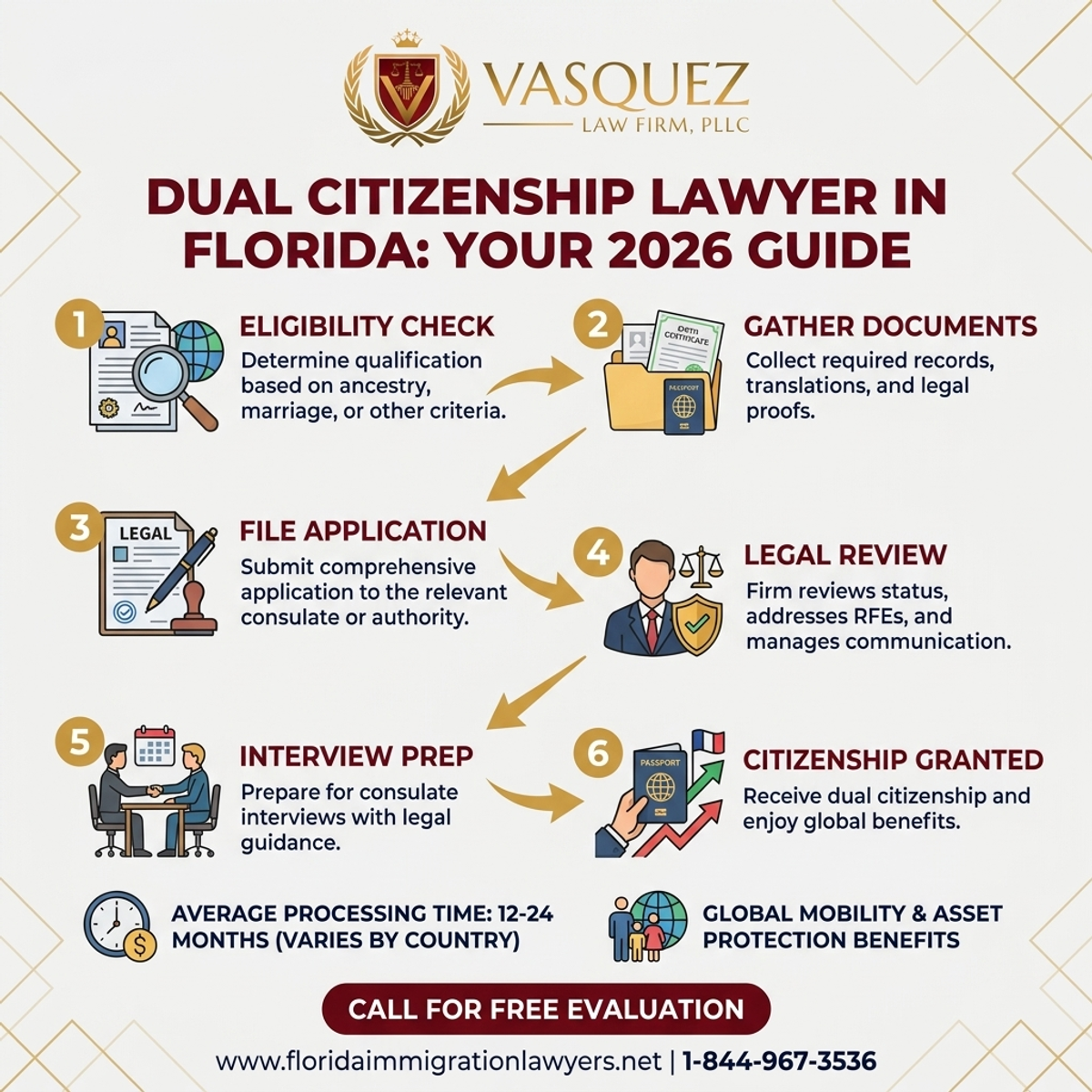
The naturalization process in Florida, whether you reside in Orlando, Tampa, or South Florida, involves a series of detailed steps:
- Determine Eligibility: Carefully review all requirements. Any criminal history, lengthy absences from the U.S., or issues with tax compliance can impact your eligibility. An attorney specializing in U.S. Citizenship can help you assess your unique situation.
- Prepare Form N-400: Complete the Application for Naturalization thoroughly and accurately. This form is extensive and requires detailed personal, residential, employment, and travel history.
- Gather Supporting Documents: Collect all required evidence, such as your Green Card, marriage certificates, tax returns, and any court or arrest records.
- File Application: Submit Form N-400 and all supporting documents, along with the appropriate filing fee, to USCIS.
- Biometrics Appointment: Attend a biometrics appointment at a local Application Support Center (ASC), such as the one serving Central Florida residents in Orlando, where your fingerprints and photograph will be taken for background checks.
- Interview: Attend an interview with a USCIS officer. During the interview, you will be tested on your English proficiency and knowledge of U.S. civics. The officer will also review your application and ask questions about your eligibility.
- Decision: USCIS will issue a decision on your application. If approved, you will typically receive a notice for an Oath of Allegiance ceremony.
- Oath Ceremony: Attend the Oath of Allegiance ceremony, where you will officially become a U.S. citizen and receive your Certificate of Naturalization. This is the final step in becoming a U.S. citizen and, for many, achieving dual nationality.
Each step requires meticulous attention to detail. Errors or omissions can lead to delays or even denial. Our legal team at Florida Immigration Lawyers is dedicated to guiding you through every stage, ensuring your application is robust and well-prepared.
What Documents Do I Need to Apply for U.S. Naturalization in 2026?
To successfully apply for U.S. naturalization in 2026, you will need to gather a comprehensive set of documents that prove your identity, eligibility, and good moral character. Accuracy and completeness in your submission are paramount to avoid delays or requests for additional evidence from USCIS. Missing or incorrectly translated documents are common reasons for application setbacks.
Here is a general checklist of documents you will typically need for your N-400 application:
- Lawful Permanent Resident Card (Green Card): Original and a copy of both sides.
- State-Issued Identification: A copy of your driver's license or state ID.
- Passports: Copies of all passports (U.S. and foreign) you have held since becoming a permanent resident.
- Birth Certificate: A copy of your birth certificate.
- Marriage Certificate: If applicable, a copy of your current marriage certificate.
- Divorce Decrees or Death Certificates: If applicable, copies of documents proving termination of any previous marriages (for yourself or your spouse).
- Tax Returns: Copies of your federal income tax returns for the last five years (or three years if applying based on marriage to a U.S. citizen).
- Proof of Selective Service Registration: If you are a male applicant between the ages of 18 and 26, proof of registration is required.
- Travel Records: Documentation of all trips outside the U.S. since becoming a permanent resident, including dates of departure and return.
- Court and Arrest Records: If you have ever been arrested, cited, or detained by any law enforcement officer, you must provide certified copies of all arrest reports, court dispositions, and sentencing records, even if charges were dropped or expunged.
- Child Support/Alimony Orders: If applicable, proof of compliance with any child support or alimony obligations.
- Translations: Any documents not in English must be accompanied by a certified English translation.
- Photographs: Two identical passport-style photos (if required by current USCIS instructions).
Step-by-Step Process — Dual Citizenship Lawyer in Florida: Your 2026 Guide
It is crucial to follow the official USCIS instructions for Form N-400 precisely, as requirements can be updated. Organize your documents carefully, making copies for your records and submitting only copies unless USCIS specifically requests originals. An experienced dual citizenship lawyer can help you compile this extensive list, ensuring nothing is overlooked and all documents are properly prepared and submitted.
How Long Does the Naturalization Process Take in Florida as of 2026?
The naturalization process timeline in Florida, as of 2026, can vary significantly depending on several factors, including the specific USCIS field office handling your case, the volume of applications, and the complexity of your individual circumstances. While there's no fixed duration, applicants typically experience processing times ranging from 8 to 18 months, though some cases may take longer. USCIS regularly updates its processing times, which can be checked on their website.
Factors influencing the timeline include the efficiency of the USCIS Service Center where your application is initially processed, the workload of your local USCIS field office (such as Orlando, Miami, or Tampa), and whether your application requires additional review or a Request for Evidence (RFE). For example, field offices in densely populated areas like South Florida may experience longer wait times compared to those in less populated regions. Any issues such as criminal history, prolonged absences from the U.S., or inconsistencies in your application can also extend the processing period considerably. It's important to monitor the USCIS processing times tool for the most current estimates specific to your field office.
Here is a typical breakdown of the naturalization timeline:
| Stage | Typical Timeframe | Notes |
|---|---|---|
| Filing N-400 to Biometrics Appointment | 2-6 months | Varies by USCIS Service Center workload. Fingerprints and photo taken at a local ASC. |
| Biometrics to Interview Scheduling | 4-12 months | Depends heavily on the specific Florida USCIS Field Office (e.g., Orlando, Miami, Tampa). |
| Interview to Decision | Immediately to 3 months | Often decided at the interview; sometimes requires follow-up, extending decision time. |
| Decision to Oath Ceremony | 1-4 months | Can be same-day if approved at interview, or several weeks for scheduled ceremonies. |
| Total Estimated Time (as of 2026) | 8-18+ months | Highly variable; consult USCIS website and an attorney for current estimates. |
While these are typical estimates, individual cases can deviate. Working with a skilled immigration attorney can help ensure your application is complete and accurate, potentially minimizing delays. We keep abreast of the latest USCIS policies and processing trends to provide you with the most accurate expectations for your naturalization journey in Florida.
What Are the Costs Associated with Dual Citizenship and Naturalization in Florida?
Pursuing dual citizenship through U.S. naturalization in Florida involves several financial considerations, primarily consisting of government filing fees and potential legal fees. It is important to budget for these costs to ensure a smooth application process. The fees charged by U.S. Citizenship and Immigration Services (USCIS) are subject to change, so always verify the most current amounts on the official USCIS website before filing.
As of 2026, the primary government fee is for filing Form N-400, Application for Naturalization. This fee typically includes the cost for the biometrics services. USCIS offers fee waivers for certain low-income applicants who meet specific federal poverty guidelines or receive means-tested benefits. It is crucial to determine if you qualify for a fee waiver, as this can significantly reduce your upfront costs. An experienced dual citizenship lawyer can help you assess your eligibility for a fee waiver and prepare the necessary documentation.
Beyond government fees, legal representation constitutes another significant cost. While not mandatory, retaining an immigration attorney is highly recommended, especially for complex cases or if you wish to ensure accuracy and efficiency. Attorney fees can vary based on the complexity of your case, the services required, and the firm's fee structure (e.g., flat fee for the entire naturalization process, or hourly rates for specific consultations). Investing in legal counsel can save you time, stress, and potential costs associated with errors or delays.
Here is a breakdown of typical costs associated with naturalization and dual citizenship:
Key Statistics — Dual Citizenship Lawyer in Florida: Your 2026 Guide
| Item | Typical Fee (as of 2026) | Notes |
|---|---|---|
| USCIS Form N-400 Filing Fee | (Subject to change) | Check USCIS website for current fee. Fee waivers may be available for eligible applicants. |
| Biometrics Services Fee | (Often included in N-400 fee) | This fee covers fingerprinting and background checks. |
| Immigration Attorney Fees | Varies widely | Depends on case complexity, firm, and services. Flat fees are common for naturalization. |
| Document Translation Fees | Varies by document/provider | Required for any non-English documents submitted to USCIS. |
| Travel Costs | Varies by location | For attending biometrics appointments and interviews at USCIS offices (e.g., Orlando, Miami). |
| Passport Application Fees | (U.S. and foreign, if applicable) | Separate fees for obtaining new passports once citizenship is granted. |
It is important to remember that these costs are estimates and can fluctuate. A free initial consultation with Florida Immigration Lawyers can help you understand the specific costs relevant to your unique dual citizenship journey and explore payment options.
Understanding the Implications and Benefits of Holding Two Passports
Holding two passports, a direct result of achieving dual citizenship, comes with a range of significant benefits and some important responsibilities. For many in Florida, especially those with strong ties to their country of origin, dual nationality offers a unique blend of advantages, from increased travel flexibility to deeper cultural and economic engagement.
Benefits of Dual Citizenship
- Increased Mobility: With two passports, you can often enter and exit both countries more easily, sometimes without needing visas for either. This can simplify international travel for business or leisure.
- Property and Business Rights: Dual citizens may have the right to own property, establish businesses, and invest freely in both countries, often without the restrictions faced by foreign nationals.
- Voting and Political Rights: You may be able to vote and participate in the political processes of both nations, strengthening your connection to your heritage and allowing you to influence policy.
- Cultural and Family Ties: Dual citizenship formally recognizes and strengthens your connection to your ancestral homeland, making it easier to maintain family relationships and cultural heritage.
- Educational and Employment Opportunities: Access to educational institutions and job markets in both countries can open up new avenues for personal and professional growth.
- Consular Protection: You can seek consular assistance from either country's embassy or consulate when traveling abroad, providing an additional layer of security.
Potential Challenges and Responsibilities
While the benefits are substantial, dual citizenship also entails certain responsibilities and potential complexities that should be carefully considered. The U.S. government expects its citizens, including dual nationals, to provide primary allegiance to the United States. This means U.S. dual nationals are generally expected to use their U.S. passport when entering or exiting the United States. The U.S. Department of State provides guidance on these matters.
- Tax Obligations: U.S. citizens, including dual nationals, are subject to U.S. tax laws on their worldwide income, regardless of where they reside. This may require filing U.S. tax returns even if you live abroad and pay taxes in another country.
- Military Service: Some countries may require military service from their citizens. If you are a dual national, you could potentially be subject to military obligations in both countries, though waivers or exemptions may apply.
- Allegiance and Loyalty: In times of conflict between the two countries, dual nationals may face difficult choices regarding their loyalty. The U.S. expects primary allegiance from its citizens.
- Complex Legal Situations: Legal issues, such as inheritance or family law matters, can become more complicated when dealing with two distinct legal systems.
Understanding these aspects is critical before embarking on the journey to dual citizenship. Our attorneys are adept at explaining the full scope of rights and responsibilities that come with holding two passports, ensuring you are fully prepared for this significant life change. We also assist with other critical immigration matters such as family immigration and business immigration.
Do not navigate this complex process alone. Contact Florida Immigration Lawyers today to discuss your dual citizenship goals and receive expert guidance tailored to your unique circumstances. Our dedicated team is ready to provide the comprehensive support you need for a successful outcome.
Common Mistakes to Avoid When Pursuing Dual Citizenship in Florida
The path to dual citizenship, particularly through U.S. naturalization, is paved with potential pitfalls that can lead to significant delays, denials, or even unintended consequences. Being aware of these common mistakes is crucial for a successful outcome. Our role as experienced immigration attorneys is to help you avoid these errors and ensure a smooth process.
- Miscalculating Continuous Residence or Physical Presence: Many applicants mistakenly believe any time spent outside the U.S. counts towards their residency. Long absences (typically over six months) can break continuous residency or reduce physical presence, jeopardizing eligibility. Failing to properly document all international travel is a major oversight.
- Failing to Disclose All Criminal History: Even minor offenses, expunged records, or arrests without conviction must be disclosed to USCIS. Hiding or omitting any part of your criminal record, however old, is considered misrepresentation and can lead to a denial, accusations of fraud, and even deportation proceedings.
- Providing Inaccurate or Inconsistent Information: All information on your N-400 application must be consistent with previous immigration filings (e.g., Green Card application). Discrepancies, even minor ones, can raise red flags and lead to extensive questioning, requests for evidence, or a finding of a lack of good moral character.
- Neglecting Tax Obligations: Failure to file income taxes or pay child support/alimony can be seen as a lack of good moral character. USCIS will scrutinize your financial history, and any outstanding obligations can lead to a denial of your naturalization application.
- Ignoring the Laws of Your Other Country: Assuming your home country automatically allows dual nationality is a critical error. Some countries mandate the renunciation of their citizenship upon acquiring another. Failing to understand these laws can lead to an unintended loss of your original nationality, which may not be reversible.
- Improper Document Translation or Certification: Any foreign language document submitted to USCIS must be accompanied by a complete and accurate English translation, certified by the translator. Incorrect translations or missing certifications can cause significant processing delays.
- Missing Deadlines or Appointments: Failing to respond to Requests for Evidence (RFEs), attend biometrics appointments, or appear for your naturalization interview can result in the denial of your application without further review.
- Attempting the Process Without Legal Counsel: While not legally required, navigating the complex naturalization process without an experienced dual citizenship lawyer, especially if you have a complicated history, significantly increases the risk of errors and denials.
- Lack of Preparation for the Interview: Underestimating the importance of the English and civics test or failing to review your application thoroughly before the interview can lead to poor performance and a potential denial.
Avoiding these common mistakes requires diligence and a deep understanding of immigration law. Our team at Florida Immigration Lawyers provides comprehensive support to ensure your application is flawless and your journey to dual citizenship is successful.
When to Call a Dual Citizenship Lawyer in Florida
While the idea of applying for naturalization might seem straightforward, the intricacies of dual citizenship, combined with the strict requirements of U.S. immigration law, mean that legal counsel is often invaluable. If you are considering pursuing dual citizenship in Florida, knowing when to engage a dual citizenship lawyer can save you time, stress, and potential heartbreak.
You should strongly consider contacting Florida Immigration Lawyers if any of the following scenarios apply to you:
- Complex Eligibility Issues: If you have questions about your continuous residency, physical presence, or good moral character due to past events, criminal history, or lengthy absences from the U.S., a lawyer can assess your eligibility and advise on potential waivers or strategies.
- Prior Denials or Immigration Issues: If you have had any previous immigration applications denied, or if you have been in deportation proceedings, an attorney is essential to address these issues and present a strong case.
- Criminal Record: Even minor arrests or citations can impact your good moral character determination. An attorney can help you gather necessary court documents and prepare explanations for USCIS.
- Uncertainty About Your Country of Origin's Laws: If you are unsure whether your home country permits dual nationality or what steps you need to take to retain it, a lawyer can help you research and understand these international laws.
- Language Barriers or Learning Disabilities: If you struggle with English or have a medical condition that affects your ability to learn English or civics, an attorney can help you explore potential waivers for the language and civics tests.
- Expedited Processing Needs: In rare cases, naturalization can be expedited. A lawyer can advise if your circumstances qualify and assist with the special procedures.
- Desire for Peace of Mind: Even with a seemingly straightforward case, the process can be overwhelming. A lawyer provides reassurance, ensures accuracy, and handles communication with USCIS, allowing you to focus on your daily life in Orlando or elsewhere in Florida.
Our attorneys at Florida Immigration Lawyers are deeply familiar with the nuances of naturalization and dual nationality. We can provide clear guidance, prepare a meticulous application, and represent you effectively at your USCIS interview. Do not take chances with your future; let our experience work for you.
About Florida Immigration Lawyers
Florida Immigration Lawyers is a leading immigration law firm dedicated to serving individuals and families across the entire state of Florida. With a deep understanding of the complexities of U.S. immigration law, our experienced attorneys provide compassionate, knowledgeable, and effective legal representation. Located in Orlando, we are committed to helping our clients navigate their immigration journeys, from initial applications to complex litigation.
Our comprehensive range of immigration practice areas includes U.S. Citizenship and Naturalization, Family-Based Immigration, Employment-Based Immigration, Asylum, Deportation Defense, and more. We understand that every case is unique, and we pride ourselves on offering personalized strategies tailored to meet each client's specific needs and goals. Whether you are seeking to obtain a Green Card, become a U.S. citizen, or defend against removal, our firm is equipped to provide the highest caliber of legal support.
Why choose Florida Immigration Lawyers? We offer a client-centered approach, ensuring you are informed and empowered throughout your legal process. Our team is available 24/7, providing accessible and responsive communication. We offer free case reviews, allowing you to discuss your situation without financial commitment. Our commitment to excellence and our track record of success make us the trusted choice for immigration matters in Florida. Let us be your dedicated advocates. Call us at 1-844-967-3536 or schedule a free consultation with our experienced attorneys today.
Sources and References
- U.S. Citizenship and Immigration Services (USCIS)
- Executive Office for Immigration Review (EOIR)
- U.S. Department of State - Dual Nationality
- 8 U.S.C. Chapter 12 - Immigration and Nationality Act (INA)
- 8 U.S.C. § 1427 - Requirements for Naturalization
- 8 CFR Part 316 - General Requirements for Naturalization
- INA 349(a) - Loss of Nationality
Related services: citizenship test preparation, dual citizenship guidance, citizenship test resources.
This article provides general legal information and is not intended as legal advice. Every case is unique, and outcomes depend on specific facts and circumstances. Contact an attorney for advice about your particular situation.
The journey to dual citizenship is a significant life step that can open doors to new opportunities and strengthen your ties to multiple nations. With the complexities of U.S. immigration law and the specific requirements of naturalization, having a knowledgeable and dedicated legal team by your side is essential. Florida Immigration Lawyers is here to guide you through every stage of this process, providing clarity, confidence, and unwavering support.
Do not leave your future to chance. Take the first step towards achieving your dual citizenship goals today. Contact Florida Immigration Lawyers for a free, confidential case review. Call us at 1-844-967-3536. Se Habla Espanol - Estamos aqui para ayudarle.
Do Not Navigate This Process Alone
Our experienced immigration attorneys are ready to fight for you. Get a free, confidential consultation today.
Se Habla Español
Or leave your details and we’ll call you:
Free Evaluation in 24 Hours
Or talk to us right now

AI voice assistant — available 24/7
FreeFrequently Asked Questions

William J. Vásquez
Founding Attorney · Vasquez Law Firm
U.S. Air Force veteran and immigration attorney with years of hands-on U.S. immigration experience. J.D., NCCU School of Law. AILA member. Admitted to the 4th, 5th, and 11th Circuit Courts.
Available 24/7 - Free Evaluations
Reviewed for legal accuracy by William J. Vásquez
Licensed in North Carolina; U.S. immigration is federal practice.
Related Legal Services
Our Florida immigration attorneys can help you with family immigration services, immigration lawyer cost in Florida and experienced immigration attorneys. Call today at 1-844-967-3536 for a free consultation.
Related Links
Related Topics
Free Legal Case Review
Discuss your case with our experienced attorneys. We're available 24/7.
Se Habla Español - Estamos aquí para ayudarle.
Related Articles
Immigration Lawyer Orlando Free Consultation in Florida
For individuals and families in Orlando, Florida, navigating the complexities of U.S. immigration law requires expert guidance. An immigration lawyer in Orlando offers crucial support for everything from visa applications and green card processes to naturalization and deportation defense. This comprehensive guide details what a free consultation covers, providing a step-by-step overview of immigration pathways, essential document checklists, and expected timelines in 2026. We also highlight common mistakes to avoid, discuss the critical role of legal counsel in deportation and asylum cases, and explain why choosing a local Orlando immigration attorney is beneficial. Florida Immigration Lawyers is dedicated to serving the diverse community of Orlando with compassionate, effective legal solutions, ensuring you receive personalized advice and robust representation for a successful immigration journey.
H-1B Visa Florida Employers: Comprehensive Guide 2026
For Florida employers, the H-1B visa program is a vital tool for attracting skilled foreign professionals to specialty occupations. As of 2026, the process involves intricate steps such as Labor Condition Application (LCA) certification with the Department of Labor, H-1B cap registration and lottery participation (if applicable), and filing Form I-129 with USCIS. This comprehensive guide outlines eligibility criteria, a detailed step-by-step application process, essential documentation, and critical timelines. We also cover the associated costs, potential challenges like Requests for Evidence (RFEs), and common mistakes to avoid. Understanding these elements is crucial for businesses in Orlando and across Florida to successfully navigate H-1B sponsorship. Florida Immigration Lawyers is dedicated to assisting employers through every stage, ensuring compliance and maximizing the chances of a successful outcome.
Work Permit Application in Florida 2026
For many non-citizens in Florida, an Employment Authorization Document (EAD) or work permit is essential for legal employment. This comprehensive guide from Florida Immigration Lawyers details the application process for 2026, covering who is eligible, the step-by-step procedure for filing Form I-765, and the critical documents required. Learn about current processing times, associated costs, and common mistakes to avoid. Whether you're an asylum seeker, adjusting your status, or an international student, understanding these requirements is vital. Our firm, serving all of Florida from Orlando, offers expert legal assistance, free case reviews, and bilingual support to help you navigate the complexities of obtaining and maintaining your work authorization.
Investor Visa Immigration Services Florida in 2026
Florida is a prime destination for foreign investors seeking U.S. immigration opportunities. This guide from Florida Immigration Lawyers explores the two primary investor visa categories: the EB-5 Immigrant Investor Program and the E-2 Treaty Investor Visa. The EB-5 offers a path to a Green Card through substantial investment and job creation in Florida's diverse economy, with options for reduced investment in Targeted Employment Areas. The E-2 visa provides a renewable non-immigrant status for entrepreneurs from treaty countries looking to operate a business in the state. We detail the rigorous eligibility requirements, the multi-stage application processes, the extensive documentation needed, and the typical timelines and costs involved for both visa types. Crucially, we highlight common mistakes to avoid, such as issues with source of funds or inadequate business plans, and emphasize when professional legal counsel is indispensable. Florida Immigration Lawyers provides expert guidance for investor visa immigration services in Florida, ensuring compliance and maximizing your chances of success. Contact us for a free case review.