Work Permit Application in Florida 2026
For many non-citizens in Florida, an Employment Authorization Document (EAD) or work permit is essential for legal employment. This comprehensive guide from Florida Immigration Lawyers details the application process for 2026, covering who is eligible, the step-by-step procedure for filing Form I-765, and the critical documents required. Learn about current processing times, associated costs, and common mistakes to avoid. Whether you're an asylum seeker, adjusting your status, or an international student, understanding these requirements is vital. Our firm, serving all of Florida from Orlando, offers expert legal assistance, free case reviews, and bilingual support to help you navigate the complexities of obtaining and maintaining your work authorization.

Obtaining a work permit, officially known as an Employment Authorization Document (EAD) or Form I-765, in Florida allows eligible non-citizens to legally work in the United States. The application process involves determining your specific eligibility category, accurately completing Form I-765, gathering all required supporting documentation, and submitting it to USCIS. Processing times can vary significantly based on your eligibility category and USCIS caseload, often ranging from several months to over a year. Consulting with an experienced immigration attorney in Florida is highly recommended to ensure a correct and timely application, avoiding common pitfalls that could delay or deny your work authorization.
- Eligibility is Key: Not all non-citizens qualify for an EAD; eligibility depends on your immigration status.
- Form I-765: This is the primary application form for employment authorization.
- Documentation: Accurate and complete supporting documents are crucial for approval.
- Processing Times Vary: Be prepared for significant wait times, which can be checked on the USCIS website.
- Legal Guidance: An attorney can help navigate complex rules and prevent costly mistakes.
Applying for a Work Permit (EAD) in Florida: A Comprehensive Guide for 2026
Navigating the complexities of U.S. immigration law to secure the legal right to work can be one of the most significant challenges for non-citizens in Florida. An Employment Authorization Document (EAD), commonly known as a work permit, is a crucial document for many individuals seeking to build a life and career in the Sunshine State. Without a valid EAD, employment opportunities are severely limited, and unauthorized work can lead to serious immigration consequences.
For those residing in Orlando, Central Florida, or anywhere across the state, understanding the specific requirements and procedures for obtaining an EAD is essential. The process, governed by U.S. Citizenship and Immigration Services (USCIS), involves detailed forms, specific eligibility criteria, and often, significant waiting periods. Whether you are an asylum seeker, an adjustment of status applicant, or a student with specific employment needs, securing your employment authorization is a critical step.
This comprehensive guide will walk you through the entire process of applying for a work permit (EAD) in Florida in 2026. We will cover eligibility, the application steps, required documents, expected timelines, and associated costs. Our goal is to provide clear, actionable information to help you understand your options and prepare a strong application. Do not navigate this complex process alone. Call Florida Immigration Lawyers at 1-844-967-3536 for a free case review and expert guidance tailored to your unique situation.
What is an Employment Authorization Document (EAD) in Florida?
An Employment Authorization Document (EAD), often referred to as a work permit, is a card issued by USCIS that provides temporary authorization for certain eligible non-citizens to work legally in the United States. For individuals living in Florida, having a valid EAD is indispensable for securing lawful employment, enabling them to contribute to the state's vibrant economy and support themselves and their families. The EAD card typically contains your photo, name, category of eligibility, and an expiration date, similar to a driver's license.
The legal basis for employment authorization is found in 8 CFR § 274a.12, which outlines the various categories of non-citizens who may be eligible to receive an EAD. These categories are diverse and include individuals with pending asylum applications, those applying for adjustment of status to lawful permanent resident, certain students with specific employment needs, and beneficiaries of Temporary Protected Status (TPS), among others. It is critical to understand that an EAD is not a visa itself, nor does it grant any particular immigration status. Instead, it is a benefit granted to individuals who already hold a specific underlying immigration status or have a pending application for one that allows for employment authorization.
For many immigrants and non-immigrants in Florida, particularly in bustling cities like Orlando, Tampa, and Miami, obtaining an EAD is a gateway to financial independence and integration into the community. It allows individuals to secure jobs, obtain Social Security numbers, and often, driver's licenses, making daily life much more manageable. Understanding your eligibility and the specific category under which you can apply is the first and most crucial step in this process. Without a clear understanding, applicants risk delays or outright denials, which can have significant consequences for their ability to work and live in Florida.
Who is Eligible for a Work Permit (EAD) in Florida?
Eligibility for a work permit (EAD) in Florida is strictly defined by USCIS regulations and depends entirely on your current immigration status or the status of a pending application. Not all non-citizens are eligible, and understanding your specific category is paramount before filing Form I-765. As of 2026, the primary categories of individuals who may be eligible for an EAD in Florida include asylum applicants, adjustment of status applicants, certain non-immigrants, and beneficiaries of specific humanitarian programs.
Common EAD Categories
There are numerous categories of eligibility for an EAD, each with its own specific requirements. Some of the most common categories include:
- Asylum Applicants (C08): Individuals who have filed Form I-589, Application for Asylum and for Withholding of Removal, and whose application has been pending for at least 150 days (and not been denied by an Immigration Judge or the Board of Immigration Appeals). This is a significant pathway for many in Florida seeking protection.
- Applicants for Adjustment of Status (C09): Those who have filed Form I-485, Application to Register Permanent Residence or Adjust Status, based on family petitions, employment petitions, or other avenues. This category is widely used by individuals seeking a Green Card.
- DACA Recipients (C33): Individuals who have been granted deferred action under the Deferred Action for Childhood Arrivals program. DACA recipients must renew their EADs periodically.
- Students with Specific Employment Needs (C03): F-1 students seeking Optional Practical Training (OPT) or Curricular Practical Training (CPT) for employment directly related to their field of study.
- Spouses of Certain Non-immigrants (C17, C26): This includes spouses of E-1/E-2 treaty traders/investors, L-1 intracompany transferees, and certain H-1B specialty occupation workers.
- Temporary Protected Status (TPS) Beneficiaries (A12, C19): Individuals from designated countries who cannot return safely due to armed conflict, environmental disaster, or other extraordinary conditions. Many individuals in Florida benefit from TPS.
- Parolees (C11): Individuals granted parole into the U.S. for humanitarian reasons or significant public benefit.
Special Considerations for Florida Residents
Florida's diverse population means that many different EAD categories are relevant. For instance, the presence of various international communities and a large number of asylum seekers means that categories like C08 and those related to family-based adjustment of status are frequently utilized. Furthermore, Florida's universities attract many international students, making OPT and CPT applications common. Understanding which category applies to your specific circumstances is the foundational step. An error in identifying your eligibility category can lead to significant delays or even denial of your application, wasting time and filing fees. It is always best to consult with an immigration attorney to confirm your eligibility before proceeding with the application.
How Do I Apply for an EAD (Form I-765) in Florida?
Applying for an EAD (work permit) in Florida involves a specific set of steps centered around filing Form I-765, Application for Employment Authorization, with USCIS. This process requires meticulous attention to detail and adherence to all instructions to ensure a successful outcome. As of 2026, the general procedure remains consistent, though specific filing addresses and processing times can change. Successfully navigating this process is critical for anyone seeking employment authorization.
The application journey begins with confirming your eligibility, as discussed in the previous section. Once you are confident about your category, you can proceed with gathering documents and completing the form. The instructions for Form I-765 are comprehensive, but they can be complex, especially for those unfamiliar with immigration terminology. It is important to remember that any inaccuracies or omissions can cause significant delays or even lead to a Request for Evidence (RFE) or a denial. Taking the time to prepare thoroughly will save you considerable stress and potential re-filing costs.
Step-by-Step Guide for Form I-765 Application
- Determine Your Eligibility Category: Carefully review the USCIS website or consult an attorney to identify the correct eligibility category (e.g., C08 for asylum applicants, C09 for adjustment of status). This is the most crucial first step, as it dictates the required supporting documents and filing fees.
- Gather Required Documents: Collect all necessary supporting evidence. This typically includes identification, proof of your underlying immigration status or pending application, photos, and any previous EADs. (See the document checklist section for more details).
- Complete Form I-765 Accurately: Fill out Form I-765 completely and honestly. Ensure all questions are answered, and pay close attention to sections requesting your eligibility category. Use black ink if completing by hand, or type directly into the PDF. Double-check all dates, names, and addresses.
- Prepare the Filing Package: Assemble your application package in the correct order as specified in the Form I-765 instructions. This usually means placing the check or money order on top, followed by Form I-765, and then all supporting documents. Make a copy of the entire package for your records before mailing.
- Submit Your Application to the Correct USCIS Lockbox: The filing address for Form I-765 depends on your eligibility category and sometimes your state of residence. USCIS provides specific lockbox addresses on their website. For Florida residents, it's crucial to send your application to the correct address to avoid processing delays. Always use a trackable mailing service.
- Attend Biometrics Appointment (if required): After filing, USCIS will send you an appointment notice for a biometrics (fingerprints, photos, signature) appointment at an Application Support Center (ASC), such as the one in Orlando. Attending this appointment is mandatory.
- Respond to Requests for Evidence (RFEs) or Notices of Intent to Deny (NOIDs): If USCIS needs more information, they will send an RFE. If they intend to deny your application, they will send a NOID. It is critical to respond promptly and thoroughly to these notices.
- Receive Decision: USCIS will mail you a decision notice. If approved, your EAD card will be sent separately.
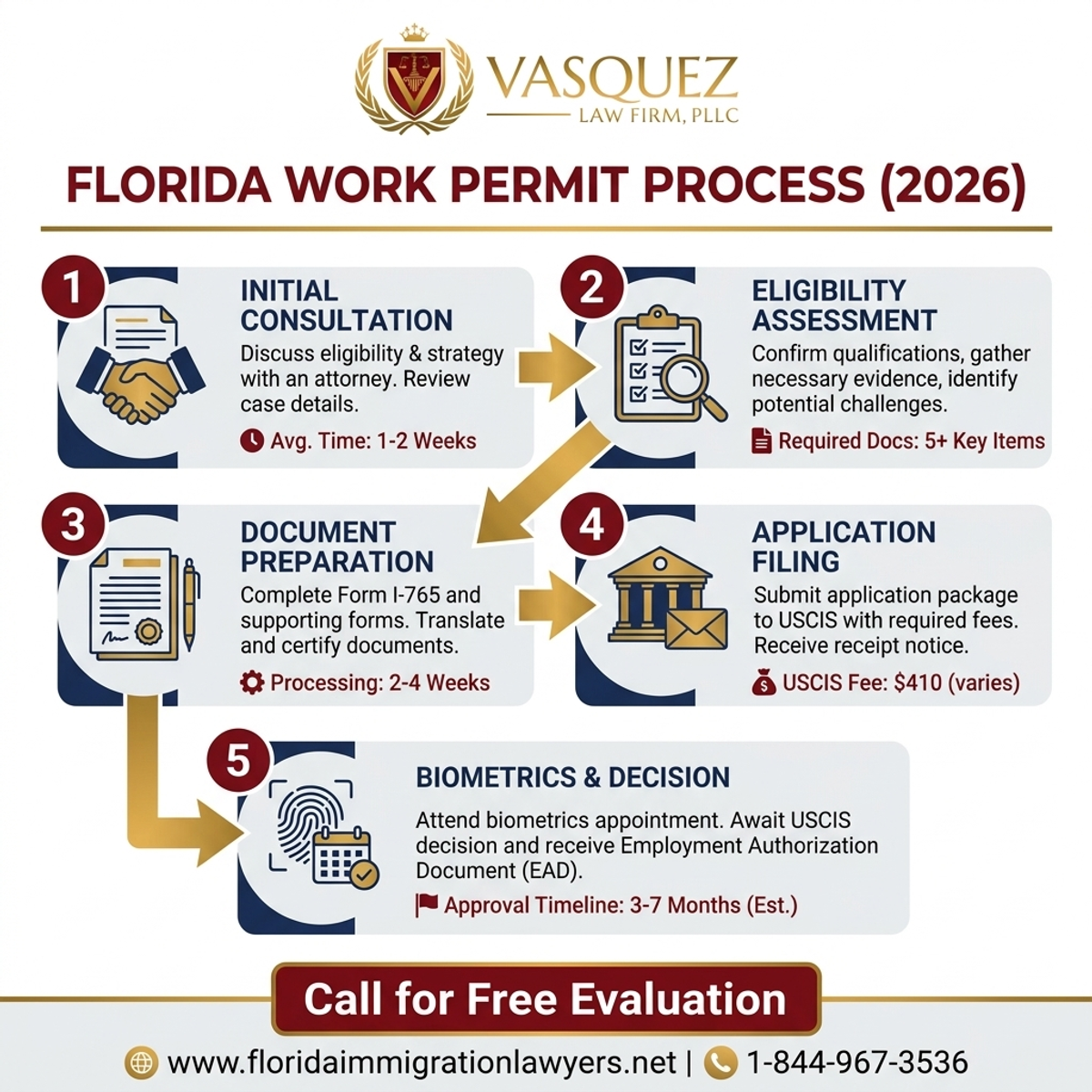
Step-by-Step Process — Work Permit Application in Florida 2026
For many individuals, especially those in Central Florida, the local USCIS Field Office in Orlando handles specific appointments or interviews, although initial filing is typically done via mail to a lockbox. Seeking assistance from an experienced family immigration lawyer can significantly streamline this process, ensuring all forms are correctly filled and all necessary documents are included, minimizing the risk of delays or denials.
What Documents Do I Need for My Florida Work Permit Application?
A well-prepared EAD application package includes a comprehensive set of documents that prove your eligibility and identity. Missing or incorrect documentation is one of the most common reasons for delays or denials in the work permit application process in Florida. As of 2026, the general requirements remain stringent, emphasizing accuracy and completeness. Gathering these documents ahead of time will greatly assist in a smooth application process.
The specific documents required will vary slightly depending on your eligibility category. However, there is a core set of documents that almost all applicants will need to submit. It is essential to ensure that all copies are clear and legible. If any documents are not in English, they must be accompanied by a certified English translation. This translation must include a statement from the translator certifying their competence and that the translation is accurate.
Essential Document Checklist for Form I-765
- Form I-765, Application for Employment Authorization: The original, completed, and signed form.
- Two Passport-Style Photos: Recent photos (taken within 30 days of filing), unmounted, full-face, passport-style. Write your name and Alien Registration Number (A-Number) lightly on the back of each photo.
- Copy of Government-Issued Photo Identification: Such as your foreign passport identity page, Form I-94 Arrival/Departure Record, or driver's license (front and back).
- Copy of Your Last EAD (if applicable): If you have previously been issued an EAD, provide a copy of the front and back.
- Proof of Eligibility: This is the most critical component and varies by category:
- For Asylum Applicants (C08): Copy of Form I-589 filing receipt or other proof of filing.
- For Adjustment of Status Applicants (C09): Copy of Form I-485 filing receipt or a copy of the Form I-797, Notice of Action, showing your I-485 is pending.
- For F-1 Students (C03) (OPT/CPT): Copy of your Form I-20, Certificate of Eligibility for Nonimmigrant Student Status, endorsed by your Designated School Official (DSO), and a copy of any previous EADs issued for OPT/CPT.
- For TPS Beneficiaries (A12/C19): Copy of your Form I-797, Notice of Action, showing approval of TPS or a copy of your most recent TPS EAD.
- Copy of Birth Certificate (if requested): Or other proof of birth.
- Copy of Visa (if applicable): From your passport.
- Marriage Certificate (if applicable): For spouses applying based on their spouse's status.
- Fee Payment: A check or money order for the filing fee (unless eligible for a fee waiver).
Ensuring that every piece of documentation is correct and complete can be overwhelming. Many individuals in Florida, from Fort Lauderdale to Jacksonville, find it beneficial to contact our firm for assistance in preparing their EAD application. Our experienced attorneys can review your specific case, help compile the necessary documents, and ensure everything is submitted correctly, significantly increasing your chances of a smooth approval process.
How Long Does it Take to Get a Work Permit (EAD) in Florida in 2026?
The processing time for an Employment Authorization Document (EAD) in Florida can vary significantly, often causing considerable anxiety for applicants. As of 2026, USCIS processing times are subject to fluctuations based on the applicant's eligibility category, the specific USCIS service center handling the application, and the overall volume of applications. It is crucial to manage expectations and understand that wait times can range from several months to well over a year in some cases. USCIS provides estimated processing times online, which should be regularly checked for the most current information.
Factors influencing these timelines include the complexity of your case, whether you respond promptly to any Requests for Evidence (RFEs), and any policy changes at USCIS. For instance, EAD applications filed concurrently with an adjustment of status application (Form I-485) may sometimes be processed differently than standalone EAD applications. Similarly, certain humanitarian categories, such as asylum-based EADs, may have different processing priorities. The COVID-19 pandemic also created backlogs, and while USCIS is working to reduce them, some delays persist.
EAD Application Processing Timeline (As of 2026)
| Stage | Typical Timeframe | Notes |
|---|---|---|
| Form I-765 Submission & Receipt | 1-3 weeks | USCIS sends a Form I-797C, Notice of Action, confirming receipt. |
| Biometrics Appointment Scheduling | 3-8 weeks after receipt | Appointment notice sent for an Application Support Center (ASC) in Florida (e.g., Orlando, Miami). |
| Application Review & Adjudication | 6-18 months (highly variable) | Varies significantly by eligibility category and service center workload. Check USCIS processing times online. |
| Decision & EAD Card Production | 1-3 weeks after approval | Once approved, the EAD card is mailed. |
| Premium Processing (Limited Categories) | 15-30 calendar days | Available for certain EAD categories (e.g., specific H-4 spouses) for an additional fee. Not available for most EAD applications. |
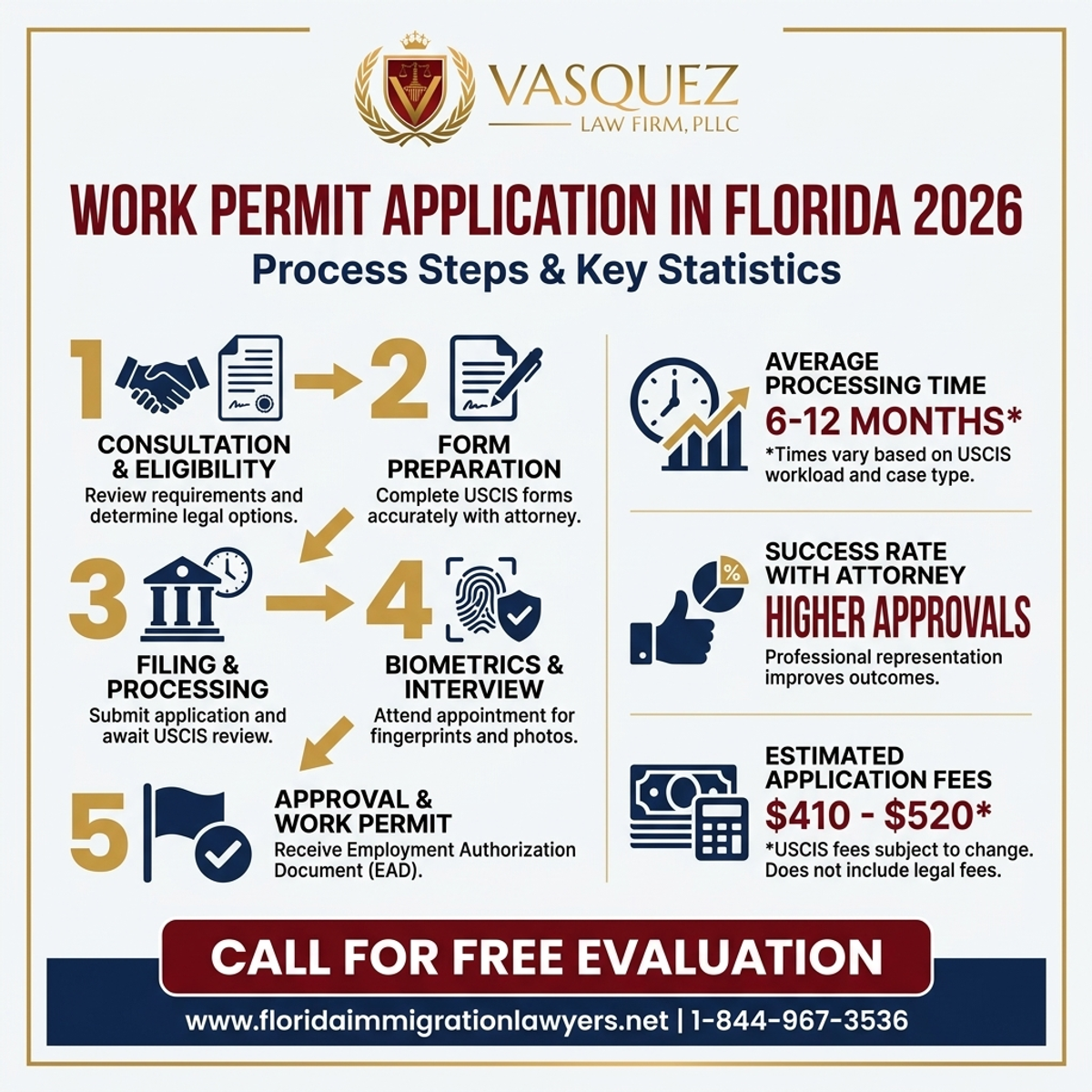
Key Statistics — Work Permit Application in Florida 2026
It is important to remember that these are general estimates. Some cases may be processed faster, while others may take longer, especially if an RFE is issued or if there are complexities related to your background check or underlying immigration status. Staying informed about your case status through the USCIS online tools and contacting your attorney for updates is advisable. For those with expiring EADs, timely renewal is crucial to avoid gaps in employment authorization, often requiring filing several months before expiration. This proactive approach is especially important for individuals in Florida who rely on continuous employment.
What Are the Costs Associated with a Florida EAD Application?
The cost of applying for a work permit (EAD) in Florida primarily involves the USCIS filing fee for Form I-765, Application for Employment Authorization. As of 2026, these fees are subject to change and depend on whether you are filing alone or concurrently with another application, as well as your specific eligibility category. It is crucial to verify the current fees directly on the official USCIS website before submitting your application, as incorrect payment can lead to rejection and delays.
Beyond the direct USCIS filing fee, applicants should also budget for other potential costs. These can include fees for passport-style photos, postage for sending the application, and the cost of obtaining certified translations for any non-English documents. For many, the most significant additional cost will be legal fees if they choose to hire an immigration attorney to assist with the application. While not mandatory, legal representation can be invaluable in ensuring the application is prepared correctly and submitted efficiently, potentially saving money and time in the long run by avoiding errors.
EAD Application Cost Factors (As of 2026)
| Item | Typical Fee | Notes |
|---|---|---|
| Form I-765 Filing Fee | Varies by category (e.g., $470 to $555) | Always check the USCIS website for the most current fee. Some categories may have different fees or be exempt. |
| Biometrics Fee | $85 (often included in I-765 fee or waived for certain categories) | Required for identity verification. Included in some I-765 fees, or sometimes covered by an associated I-485 fee. |
| Passport-Style Photos | $10-$20 per set | Typically requires two recent photos. |
| Certified Document Translations | Varies by document/length | Required for any non-English documents. |
| Attorney Fees | Varies widely by complexity and firm | Optional, but highly recommended for complex cases or to ensure accuracy. |
| Premium Processing (if applicable) | $1,500-$2,500 (additional) | Available for limited EAD categories to expedite processing. |
Fee Waivers and Exemptions
It is important to note that some applicants may be eligible for a fee waiver. USCIS offers fee waivers to individuals who can demonstrate an inability to pay the filing fees. Eligibility for a fee waiver is typically based on income falling below 150% of the Federal Poverty Guidelines, receipt of a means-tested benefit, or experiencing financial hardship. For example, most asylum applicants (C08 category) are exempt from the I-765 filing fee. If you believe you might qualify for a fee waiver, you must submit Form I-912, Request for Fee Waiver, along with your EAD application and supporting documentation for your financial situation. Successfully obtaining a fee waiver can significantly reduce the financial burden of the application process. For residents of Florida, understanding these cost factors and potential exemptions is crucial for planning their immigration journey effectively.
Understanding EAD Renewals and Replacements in Florida
Maintaining continuous employment authorization in Florida requires a clear understanding of the EAD renewal process. An EAD is typically issued for a specific period, often one or two years, and it is crucial to apply for renewal well in advance of its expiration date to avoid any gaps in your legal ability to work. Similarly, if your EAD card is lost, stolen, or damaged, you will need to apply for a replacement. Both renewal and replacement applications involve filing Form I-765, though with specific instructions for these scenarios. Proactive planning is key to preventing disruptions in employment and ensuring compliance with immigration laws.
The renewal process for an EAD is largely similar to an initial application. You will need to submit a new Form I-765, along with the required fees and supporting documentation, including a copy of your expiring EAD. USCIS generally recommends filing for renewal at least 120 days before your current EAD expires, although some categories may allow filing up to 180 days in advance. Due to potential processing delays, filing as early as possible within the allowable window is always advisable. For certain categories, USCIS may automatically extend the validity of an expiring EAD for a period of up to 540 days if a renewal application is timely filed, helping to prevent employment gaps. This automatic extension typically applies to categories where the underlying status or application continues to be valid.
For a replacement EAD, the process is also straightforward. You would file Form I-765 and indicate that you are requesting a replacement for a lost, stolen, or damaged card. You will need to provide evidence of your previous EAD and explain the circumstances of its loss or damage. The fees for a replacement EAD are generally the same as for an initial application, unless you qualify for a fee waiver. Whether you are renewing or replacing your EAD, ensuring that your underlying eligibility for employment authorization still exists is paramount. For example, if your asylum application has been denied, or your adjustment of status application withdrawn, you may no longer be eligible for an EAD. Consulting with an attorney is vital, especially if your immigration status has changed or if you face any issues that could impact your eligibility. For those in Florida facing deportation defense or other complex immigration challenges, continuous employment authorization can be a critical factor in their case.
Common Mistakes to Avoid When Applying for a Work Permit (EAD) in Florida
Applying for an EAD in Florida can be a detailed process, and even minor errors can lead to significant delays or even denial. Avoiding these common mistakes is crucial for a successful application:
- Incorrect Eligibility Category: Selecting the wrong eligibility category on Form I-765 can lead to an immediate denial. Each category has specific requirements, and misidentifying yours means your application will not match the criteria. Always double-check your category based on your current immigration status or pending application.
- Incomplete or Missing Documentation: Failing to include all required supporting documents, such as copies of your I-94, photos, or proof of your underlying status, is a primary reason for RFEs or denials. Review the instructions meticulously and use a checklist.
- Failure to Sign the Form: A simple oversight, but an unsigned Form I-765 will be rejected by USCIS and returned to you, causing significant delays. Ensure all required signatures are present and in the correct places.
- Incorrect Filing Fee or Missing Fee Waiver: Submitting the wrong fee amount or failing to include a valid fee waiver request (Form I-912) will result in your application being returned. Always verify the current fee on the USCIS website and ensure your check or money order is made out correctly.
- Expired or Poor-Quality Photos: Photos that do not meet USCIS specifications (e.g., outdated, incorrect size, poor quality background) can lead to requests for new photos, delaying processing. Ensure they are recent, passport-style, and meet all guidelines.
- Inaccurate Information on the Form: Any inconsistencies between the information on Form I-765 and your supporting documents (e.g., name spellings, dates of birth, A-Number) can raise red flags and lead to further scrutiny, delays, or denial. Double-check all personal data.
- Submitting to the Wrong USCIS Lockbox: USCIS has different lockbox addresses depending on your eligibility category and sometimes your state of residence. Sending your application to the incorrect address will cause it to be rerouted, significantly delaying processing.
- Not Responding to RFEs or NOIDs: If USCIS sends a Request for Evidence (RFE) or a Notice of Intent to Deny (NOID), failing to respond by the deadline or providing an inadequate response will almost certainly result in a denial. These notices are time-sensitive and require a thorough reply.
- Waiting Too Long to Renew: Allowing your current EAD to expire before filing for renewal can lead to a gap in employment authorization, potentially causing job loss or legal issues. File for renewal well within the recommended timeframe (e.g., 120-180 days before expiration).
- Not Keeping Copies of Your Application: Failing to retain a complete copy of your submitted application and all supporting documents means you won't have a record to reference if USCIS requests further information or if you need to re-file.
When to Call a Florida Immigration Lawyer for Your EAD Application
While some EAD applications may seem straightforward, the intricacies of immigration law often warrant the expertise of a qualified attorney. For residents of Florida, from the bustling streets of Orlando to the quiet coasts, knowing when to seek legal counsel can be the difference between a smooth approval and frustrating delays or denials. Florida Immigration Lawyers are here to provide the guidance you need, ensuring your application is robust and compliant with all current regulations.
You should consider calling an immigration lawyer if you encounter any of the following scenarios:
- Complex Eligibility: If your eligibility category is not straightforward, or if you have a unique immigration history (e.g., previous denials, arrests, or multiple statuses), an attorney can help determine your true eligibility and strategize the best approach.
- Previous Denials or Immigration Issues: If you have had an EAD application denied in the past, or if you have any past immigration violations, an attorney can help address these issues and present your case effectively.
- Uncertainty About Required Documents: If you are unsure which documents are needed for your specific category, or if you have difficulty obtaining certain records, a lawyer can guide you and help gather the necessary evidence.
- Language Barriers or Difficulty Understanding Instructions: Immigration forms and instructions are in English and use complex legal terminology. If English is not your first language, or if you find the forms confusing, an attorney can ensure accurate completion.
- Facing a Request for Evidence (RFE) or Notice of Intent to Deny (NOID): These notices indicate a problem with your application. Responding correctly and comprehensively is critical, and an attorney is best equipped to formulate a strong response.
- Expiring EAD and Need for Timely Renewal: If your EAD is nearing expiration and you need to ensure continuous work authorization without a gap, an attorney can help expedite the renewal process and address any potential complications.
- Concurrent Filings: If you are filing your EAD application concurrently with other complex forms, such as an adjustment of status (I-485) or asylum (I-589), an attorney can ensure all applications are consistent and properly linked.
- Concerns About Travel: If you plan to travel internationally while your EAD application is pending, an attorney can advise you on the potential risks and whether you need to apply for advance parole (Form I-131).
At Florida Immigration Lawyers, we specialize in helping individuals throughout Florida successfully navigate their EAD applications. We offer comprehensive services, from initial eligibility assessment and document preparation to filing and responding to USCIS inquiries. Our goal is to provide peace of mind and maximize your chances of approval. Do not hesitate to seek professional assistance when your ability to work and live legally in the U.S. is at stake.
About Florida Immigration Lawyers
Florida Immigration Lawyers is a leading law firm dedicated to providing comprehensive and compassionate immigration legal services to individuals and families across the entire state of Florida. With an unwavering commitment to our clients, we understand the profound impact immigration matters have on lives, and we strive to offer personalized, effective representation. Our experienced attorneys are well-versed in the complexities of U.S. immigration law, including the nuanced requirements for obtaining work permits (EADs), applying for asylum, securing Green Cards, and defending against deportation.
Based in Orlando, our firm serves clients from all corners of Florida, offering accessible and reliable legal support. We pride ourselves on our client-focused approach, ensuring that each individual receives the attention and strategic advice necessary for their unique situation. Whether you are seeking employment authorization, family-based visas, naturalization, or business immigration solutions, our team is equipped to guide you through every step of the process.
Choosing Florida Immigration Lawyers means partnering with a team that is available 24/7 to address your concerns and provide timely assistance. We offer free case reviews, allowing you to discuss your immigration needs without financial commitment. Our bilingual staff ensures that language is never a barrier to receiving high-quality legal representation. Trust Florida Immigration Lawyers to be your advocate in the challenging world of immigration law. Call us today at 1-844-967-3536 to schedule a free consultation and discover how we can help you achieve your immigration goals.
Sources and References
- U.S. Citizenship and Immigration Services (USCIS)
- Executive Office for Immigration Review (EOIR)
- U.S. Department of State
- 8 U.S.C. Chapter 12 - Immigration and Nationality Act (INA)
- 8 CFR § 274a.12 - Classes of aliens authorized to accept employment
- USCIS Policy Manual - Volume 10, Employment Authorization
Related services: work visas for professionals, investment and entrepreneur visas.
This article provides general legal information and is not intended as legal advice. Every case is unique, and outcomes depend on specific facts and circumstances. Contact an attorney for advice about your particular situation.
Securing your work permit (EAD) is a monumental step towards achieving your dreams in Florida. Do not let the complexities of immigration law deter you. Florida Immigration Lawyers are here to offer expert legal guidance and support throughout your application process. We are committed to helping you gain your employment authorization efficiently and correctly. For a free case review and dedicated assistance, call us today at 1-844-967-3536. Se Habla Espanol - Estamos aqui para ayudarle.
Do Not Navigate This Process Alone
Our experienced immigration attorneys are ready to fight for you. Get a free, confidential consultation today.
Se Habla Español
Or leave your details and we’ll call you:
Free Evaluation in 24 Hours
Or talk to us right now

AI voice assistant — available 24/7
FreeFrequently Asked Questions

William J. Vásquez
Founding Attorney · Vasquez Law Firm
U.S. Air Force veteran and immigration attorney with years of hands-on U.S. immigration experience. J.D., NCCU School of Law. AILA member. Admitted to the 4th, 5th, and 11th Circuit Courts.
Available 24/7 - Free Evaluations
Reviewed for legal accuracy by William J. Vásquez
Licensed in North Carolina; U.S. immigration is federal practice.
Related Legal Services
Our Florida immigration attorneys can help you with immigration practice areas, free immigration consultation and business immigration. Call today at 1-844-967-3536 for a free consultation.
Related Links
Related Topics
Free Legal Case Review
Discuss your case with our experienced attorneys. We're available 24/7.
Se Habla Español - Estamos aquí para ayudarle.
Related Articles
Immigration Lawyer Orlando Free Consultation in Florida
For individuals and families in Orlando, Florida, navigating the complexities of U.S. immigration law requires expert guidance. An immigration lawyer in Orlando offers crucial support for everything from visa applications and green card processes to naturalization and deportation defense. This comprehensive guide details what a free consultation covers, providing a step-by-step overview of immigration pathways, essential document checklists, and expected timelines in 2026. We also highlight common mistakes to avoid, discuss the critical role of legal counsel in deportation and asylum cases, and explain why choosing a local Orlando immigration attorney is beneficial. Florida Immigration Lawyers is dedicated to serving the diverse community of Orlando with compassionate, effective legal solutions, ensuring you receive personalized advice and robust representation for a successful immigration journey.
Investor Visa Immigration Services Florida in 2026
Florida is a prime destination for foreign investors seeking U.S. immigration opportunities. This guide from Florida Immigration Lawyers explores the two primary investor visa categories: the EB-5 Immigrant Investor Program and the E-2 Treaty Investor Visa. The EB-5 offers a path to a Green Card through substantial investment and job creation in Florida's diverse economy, with options for reduced investment in Targeted Employment Areas. The E-2 visa provides a renewable non-immigrant status for entrepreneurs from treaty countries looking to operate a business in the state. We detail the rigorous eligibility requirements, the multi-stage application processes, the extensive documentation needed, and the typical timelines and costs involved for both visa types. Crucially, we highlight common mistakes to avoid, such as issues with source of funds or inadequate business plans, and emphasize when professional legal counsel is indispensable. Florida Immigration Lawyers provides expert guidance for investor visa immigration services in Florida, ensuring compliance and maximizing your chances of success. Contact us for a free case review.
Employment Immigration Attorney Florida: Your 2026 Guide
For foreign nationals seeking to work in the U.S. or Florida businesses hiring international talent, navigating employment immigration can be complex. An employment immigration attorney in Florida provides essential guidance on various work visas like H-1B, L-1, E-2, and O-1, as well as employment-based green cards (EB-1 to EB-5). This comprehensive 2026 guide covers eligibility criteria, the multi-step application process, required documentation, and typical costs involved. It also highlights common mistakes to avoid, such as incomplete forms or missed deadlines, which can lead to significant delays or denials. Whether you're an employer in Central Florida or a skilled professional, understanding the nuances of immigration law is crucial. Florida Immigration Lawyers offers expert legal support, ensuring compliance with federal regulations and providing strategic advice for successful outcomes. We offer free case reviews and serve clients across all of Florida.
I-539 H-4 Change of Status Processing Time 2026
Considering a change of status from a B-2 tourist visa to an F-1 student visa in Florida? This comprehensive guide, from Florida Immigration Lawyers, details the I-539 application process, eligibility requirements, necessary documentation, and estimated processing times for 2026. Learn how to transition smoothly from visitor to student, avoid common mistakes, and understand the financial implications. We cover everything from securing your I-20 to maintaining F-1 status post-approval, with a specific focus on navigating USCIS procedures while in Florida. Discover when professional legal assistance is crucial for a successful outcome.