H-1B Visa Florida Employers: Comprehensive Guide 2026
For Florida employers, the H-1B visa program is a vital tool for attracting skilled foreign professionals to specialty occupations. As of 2026, the process involves intricate steps such as Labor Condition Application (LCA) certification with the Department of Labor, H-1B cap registration and lottery participation (if applicable), and filing Form I-129 with USCIS. This comprehensive guide outlines eligibility criteria, a detailed step-by-step application process, essential documentation, and critical timelines. We also cover the associated costs, potential challenges like Requests for Evidence (RFEs), and common mistakes to avoid. Understanding these elements is crucial for businesses in Orlando and across Florida to successfully navigate H-1B sponsorship. Florida Immigration Lawyers is dedicated to assisting employers through every stage, ensuring compliance and maximizing the chances of a successful outcome.

The H-1B visa program allows U.S. employers, including those in Florida, to temporarily employ foreign workers in specialty occupations. These occupations generally require a bachelor's degree or higher in a specific field. For Florida employers, sponsoring an H-1B visa involves several stages, including Labor Condition Application (LCA) certification, H-1B cap registration (if applicable), filing Form I-129 with USCIS, and then either adjustment of status or consular processing. The H-1B visa is crucial for Florida's diverse industries, enabling businesses to attract highly skilled talent from around the globe to fill critical roles.
- H-1B visas are for specialty occupations requiring a bachelor's degree or equivalent.
- Employers in Florida must sponsor the foreign worker, not the individual directly.
- The process typically involves LCA, cap registration, I-129 petition, and final visa processing.
- Annual numerical limitations (the H-1B cap) often require participation in a lottery system.
- Legal guidance is highly recommended due to the complexity and strict deadlines involved.
Florida's vibrant economy, driven by sectors like technology, healthcare, and tourism, constantly seeks specialized talent to innovate and grow. For many businesses in Orlando and across Central Florida, the H-1B visa program is a vital pathway to securing highly skilled foreign professionals. However, navigating the intricate landscape of U.S. immigration law, particularly the H-1B visa process, can be a daunting challenge for even the most established Florida employers. Understanding the requirements, timelines, and potential pitfalls is essential for a successful petition.
This comprehensive guide is designed to provide Florida employers with a clear roadmap for the H-1B visa process in 2026. We will delve into the eligibility criteria, the step-by-step application procedure, necessary documentation, and important considerations like costs and timelines. Our goal is to empower you with the knowledge needed to confidently pursue H-1B sponsorship, ensuring your business can access the global talent pool it needs to thrive. The H-1B visa is a powerful tool for growth, and with proper guidance, you can leverage it effectively. If you have immediate questions or need assistance, do not hesitate to call Florida Immigration Lawyers at 1-844-967-3536 for a free case review.
What is the H-1B Visa and Who is it For in Florida?
The H-1B visa is a nonimmigrant visa that allows U.S. employers to temporarily employ foreign workers in specialty occupations. A specialty occupation is defined by immigration law as an occupation that requires the theoretical and practical application of a body of highly specialized knowledge, and a bachelor's degree or higher in a specific field, or its equivalent, as a minimum for entry into the occupation. In Florida, this visa category is particularly relevant for industries experiencing rapid growth and a demand for skilled professionals that cannot always be met by the domestic workforce. This includes technology companies in Orlando, biomedical research firms, engineering companies, and even specialized roles within the hospitality sector that require unique international expertise.
To qualify for an H-1B visa, the foreign worker must hold a bachelor's or higher degree, or its equivalent, in the specific specialty occupation field, or possess a license to practice in a specialty occupation, or have work experience equivalent to a bachelor's degree. The employer in Florida must demonstrate that the position itself qualifies as a specialty occupation and that they intend to pay the H-1B worker at least the prevailing wage for that occupation in the geographic area of employment. This is a critical aspect of compliance, ensuring fair labor practices. The H-1B visa is initially granted for up to three years and can be extended for a maximum total of six years, with potential for further extensions under specific circumstances related to green card processing. (See 8 U.S.C. § 1101(a)(15)(H)(i)(b) and 8 CFR § 214.2(h)(4) for detailed definitions and regulations.)
For Florida employers, understanding these fundamental criteria is the first step in determining if the H-1B program is suitable for their hiring needs. It's not just about finding a skilled worker; it's about ensuring the role itself meets the stringent definition of a specialty occupation. Many Florida businesses, particularly those in the tech hubs around Orlando and Tampa, rely on the H-1B program to bring in software developers, data scientists, engineers, and healthcare professionals who possess specialized skills vital for their operations. This visa is designed to bridge the gap between U.S. talent supply and demand in high-skill areas, fostering innovation and economic development across the state.
How Does the H-1B Visa Application Process Work for Florida Employers?
The H-1B visa application process for Florida employers involves a series of meticulously coordinated steps, beginning with initial labor condition attestations and culminating in the foreign worker receiving their visa or adjusting their status. This multi-stage process requires careful attention to detail and adherence to strict deadlines, especially concerning the annual H-1B cap and lottery.
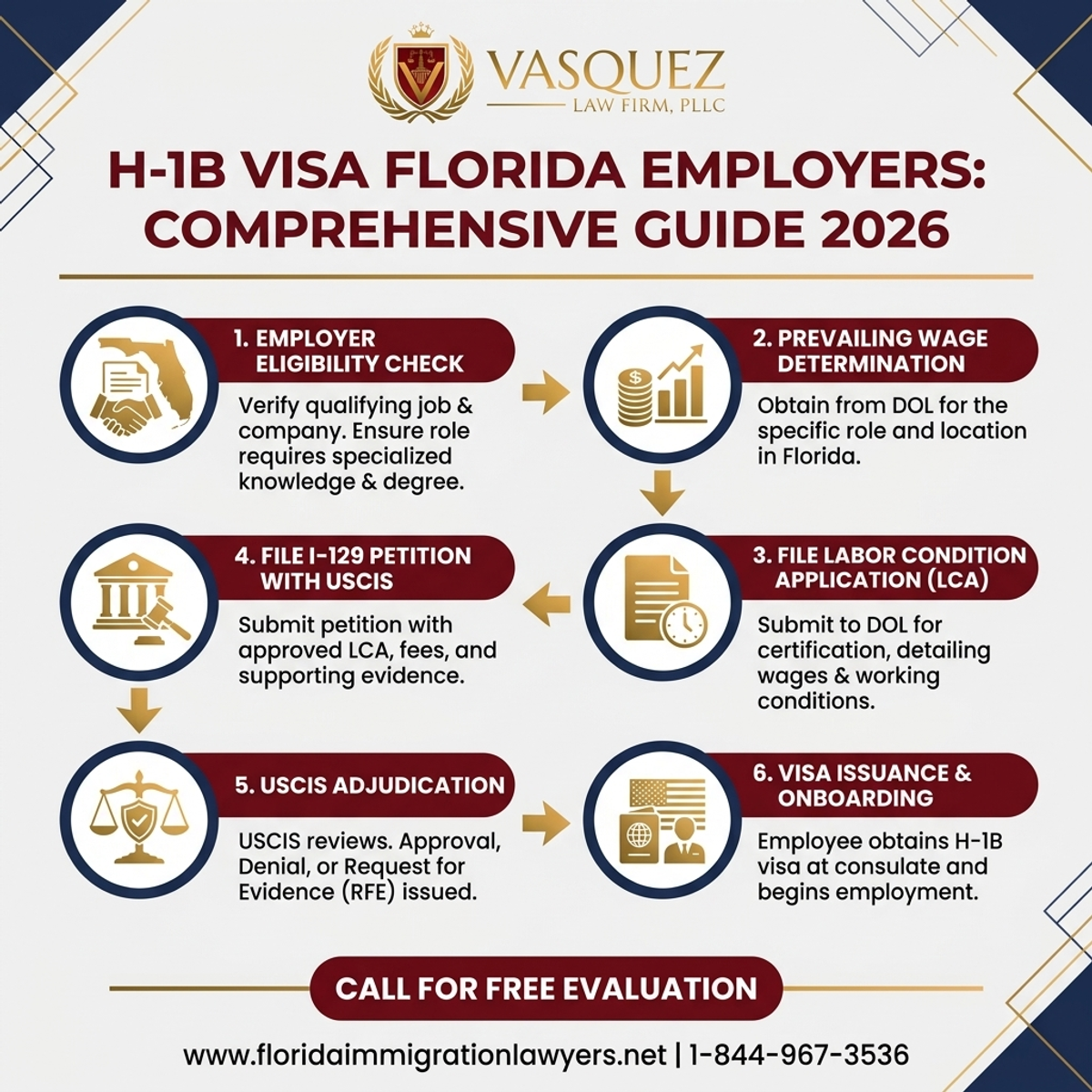
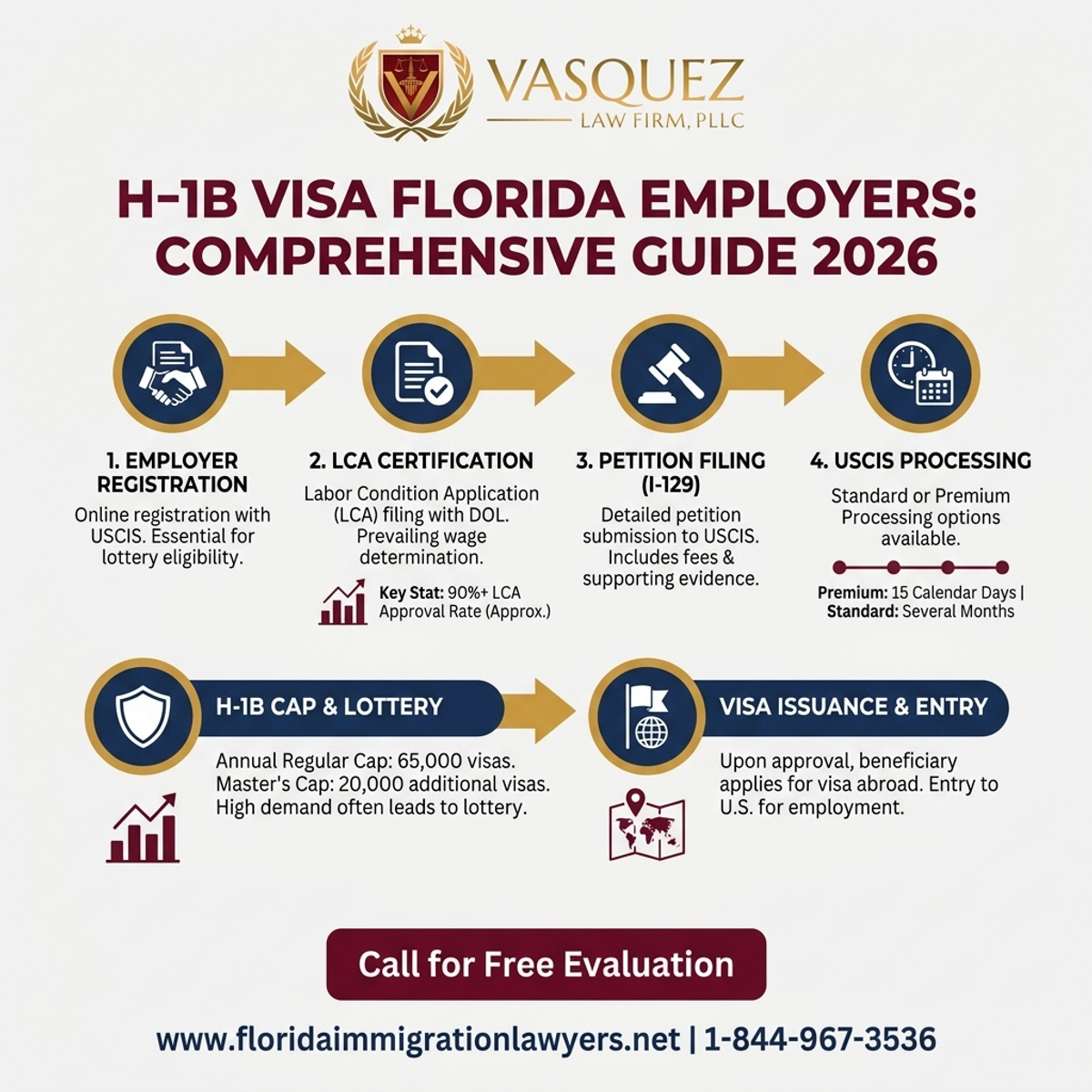
As of 2026, the process typically starts with the employer filing a Labor Condition Application (LCA) with the U.S. Department of Labor (DOL). This LCA attests that the employer will pay the H-1B worker at least the prevailing wage or the actual wage paid to other employees with similar experience and qualifications, and that the employment of the H-1B worker will not adversely affect the working conditions of U.S. workers. Once certified by the DOL, the employer can proceed with the H-1B cap registration, which is usually held in March for the fiscal year starting October 1st. If selected in the lottery, the employer then files Form I-129, Petition for a Nonimmigrant Worker, with USCIS, along with all supporting documentation and required fees. Upon approval, the foreign national either applies for the H-1B visa at a U.S. embassy or consulate abroad (consular processing) or, if already in the U.S. in another valid nonimmigrant status, applies to change their status to H-1B with USCIS. This structured approach helps maintain the integrity of the program and protect both U.S. and foreign workers.
- Determine Eligibility and Prevailing Wage: Before initiating the process, the Florida employer must confirm that the position qualifies as a specialty occupation and research the prevailing wage for that occupation in the specific geographic area using resources like the DOL's Foreign Labor Certification Data Center. This step is foundational.
- File Labor Condition Application (LCA) with DOL: The employer files Form ETA-9035/9035E with the Department of Labor. This form outlines the terms and conditions of employment, including salary, location, and job title. The DOL typically processes LCAs within 7 business days.
- H-1B Cap Registration (If Applicable): For cap-subject H-1B petitions, the employer must register the prospective H-1B employee electronically with USCIS during the designated registration period, typically in March. Only those selected in the lottery will be invited to file a full H-1B petition. This is a critical step for many Florida businesses seeking new H-1B workers.
- File Form I-129 Petition with USCIS: If selected in the lottery (or if the employer is cap-exempt), the employer files Form I-129, Petition for a Nonimmigrant Worker, with U.S. Citizenship and Immigration Services (USCIS). This petition must include the certified LCA, evidence of the specialty occupation, the beneficiary's qualifications, and other supporting documents. Internal link: For comprehensive assistance with this stage, explore our business immigration services.
- USCIS Processing and Adjudication: USCIS reviews the I-129 petition. This stage can involve Requests for Evidence (RFEs) if more information is needed. Employers can opt for Premium Processing for an expedited decision.
- Visa Interview or Adjustment of Status: If the petition is approved, the foreign worker will either attend a visa interview at a U.S. embassy or consulate in their home country (consular processing) or, if already in the U.S., file Form I-485 to adjust their status to H-1B. For those undergoing consular processing, the U.S. Department of State oversees this stage.
- Commence Employment: Once the visa is issued or status is adjusted, the H-1B worker can begin employment with the sponsoring Florida employer on the start date specified in the petition.
What Documents Are Required for an H-1B Petition in Florida?
A successful H-1B petition hinges on submitting a complete and accurate set of documents to USCIS. For Florida employers, gathering all necessary paperwork for both the company and the prospective employee is a crucial, time-consuming phase that requires meticulous organization. Missing or incorrect documents are common reasons for delays or Requests for Evidence (RFEs) from USCIS, which can significantly prolong the adjudication process. It's imperative to prepare these materials thoroughly to demonstrate compliance with all H-1B regulatory requirements.
The documentation requirements are extensive and cover various aspects, including the employer's legitimacy, the nature of the specialty occupation, and the beneficiary's qualifications. Employers must be prepared to submit evidence proving their ability to pay the proffered wage and the bona fide nature of the job offer. For the beneficiary, academic credentials, professional licenses, and prior work experience are key. As of 2026, USCIS scrutinizes these submissions rigorously, making a comprehensive and well-organized package essential for a smooth process. Working with an experienced immigration attorney can help ensure that all required documents are correctly prepared and submitted, minimizing potential issues.
- Employer-Specific Documents:
- Federal Employer Identification Number (EIN) confirmation.
- Company financial statements, tax returns, or annual reports to demonstrate ability to pay the proffered wage.
- Business license or articles of incorporation/organization.
- Detailed company brochure, website printouts, or other marketing materials.
- Organizational chart showing the H-1B worker's position within the company.
- Lease agreement for office space in Florida.
- Contracts or statements of work with clients (if applicable, especially for consulting firms).
- Position-Specific Documents:
- Certified Labor Condition Application (LCA), Form ETA-9035/9035E.
- Detailed job description outlining duties, responsibilities, and specific educational requirements for the specialty occupation.
- Evidence that the position requires a bachelor's degree or higher in a specific field (e.g., industry standards, prior hiring practices).
- Letter from an authorized company official confirming the job offer and terms of employment.
Step-by-Step Process — H-1B Visa Florida Employers: Comprehensive Guide 2026
- Beneficiary (Employee)-Specific Documents:
- Copy of passport (biographical page and any previous U.S. visas/stamps).
- Copies of all prior U.S. visa documents (I-94, I-797 approval notices).
- Foreign educational degrees, diplomas, and academic transcripts.
- Educational equivalency evaluation for foreign degrees (if applicable).
- Professional licenses required for the occupation (e.g., Florida professional engineering license).
- Detailed resume/CV.
- Letters from previous employers demonstrating relevant work experience.
- Any other certifications or professional qualifications.
What is the Typical H-1B Visa Processing Timeline in 2026?
Understanding the H-1B visa processing timeline is critical for Florida employers who need to plan their hiring strategies and for foreign nationals eager to begin their careers. The entire process, from initial LCA filing to final visa approval, can span several months, and it's heavily influenced by the annual H-1B cap and USCIS processing backlogs. As of 2026, careful planning and early preparation are more important than ever to navigate these timelines effectively. Premium Processing is an option for the I-129 petition stage, offering a faster decision but at an additional cost.
The H-1B cap, which limits the number of H-1B visas issued each fiscal year, significantly impacts the timeline for most petitions. The fiscal year begins on October 1st, but cap-subject petitions can only be filed after selection in the lottery, typically in April, for employment to commence in October. This means there's a substantial waiting period even after lottery selection. Cap-exempt organizations, such as universities or non-profits affiliated with higher education, are not subject to these cap-related delays and can file petitions year-round. For all petitioners, USCIS processing times can vary based on the service center and current caseload, which are regularly updated on the USCIS website.
| Stage | Typical Timeframe (As of 2026) | Notes |
|---|---|---|
| Prevailing Wage Determination (if needed) | 2-3 months | Can be lengthy, crucial for LCA. |
| Labor Condition Application (LCA) Certification | 7 business days | Filed with U.S. Department of Labor. |
| H-1B Cap Registration | Early-to-mid March | Electronic registration period. |
| Lottery Selection Notification | Late March / Early April | Only selected registrations proceed. |
| Form I-129 Petition Filing Period | April 1st - June 30th | For selected registrations, employment start date is typically October 1st. |
| USCIS I-129 Processing (Regular) | 3-6 months (can vary) | Varies by service center; check USCIS website for current estimates. |
| USCIS I-129 Processing (Premium) | 15 calendar days | Expedited processing for an additional fee. |
| Consular Processing (Visa Interview) | 1-4 weeks post-I-129 approval | Varies by embassy/consulate; includes scheduling and processing. |
| Adjustment of Status (I-485) | 6-12 months (if applicable) | For beneficiaries already in the U.S. and eligible to adjust status. |
How Much Does Sponsoring an H-1B Visa Cost for Florida Employers?
Sponsoring an H-1B visa for a foreign worker involves several mandatory fees and potential legal costs that Florida employers must budget for. These costs can vary based on the size of the company, whether premium processing is utilized, and the complexity of the case. It's important to understand that these fees are typically the responsibility of the employer, particularly the statutory fees associated with the petition, to ensure compliance with Department of Labor regulations and prevent any issues during the application process. Attempting to pass certain fees onto the employee can lead to serious legal repercussions and even denial of the petition.
As of 2026, the primary components of H-1B visa costs include USCIS filing fees, fraud prevention and detection fees, and potentially ACWIA (American Competitiveness and Workforce Improvement Act) fees. Additionally, employers often incur legal fees for the expert assistance of an immigration attorney, which is highly recommended due to the intricate nature of the H-1B process. There may also be costs associated with educational credential evaluations or advertising for the position if required. These fees are subject to change by government agencies, so it is always advisable to consult the latest fee schedules on the official USCIS website. A clear understanding of these financial obligations from the outset helps Florida businesses plan effectively and avoid unexpected expenses.
| Item | Typical Fee (As of 2026) | Notes |
|---|---|---|
| USCIS Filing Fee (Form I-129) | Varies by petition type | Mandatory fee for all H-1B petitions. |
| Fraud Prevention and Detection Fee | Fixed amount | Mandatory for initial H-1B petitions and employer changes. |
| ACWIA Fee (American Competitiveness and Workforce Improvement Act of 1998) | Varies by employer size | Mandatory for most employers, fee depends on number of employees. |
| Public Law 114-113 Fee (if applicable) | Fixed amount | Applies to employers with 50+ employees where 50% are H-1B or L-1. |
| Premium Processing Fee (Form I-907) | Fixed amount | Optional fee for expedited 15-day processing. |
| Attorney Fees | Varies widely | Highly recommended for expert guidance and case preparation. |
| Educational Credential Evaluation | Varies | If foreign degree needs U.S. equivalency. |
Key Statistics — H-1B Visa Florida Employers: Comprehensive Guide 2026
Note: All government fees are subject to change without notice. Please refer to the official USCIS website for the most current fee schedule.
Addressing H-1B RFEs and Denials: What Florida Employers Need to Know
Receiving a Request for Evidence (RFE) or, worse, a denial for an H-1B petition can be a significant setback for Florida employers and their prospective employees. An RFE from USCIS indicates that the initial petition lacked sufficient evidence or clarity on certain points, requiring the petitioner to provide additional documentation or explanations. Common reasons for RFEs include insufficient proof of a specialty occupation, questions about the beneficiary's qualifications, or issues with the employer's ability to pay the proffered wage. A denial, on the other hand, means USCIS has determined the petition does not meet the legal requirements and will not be approved. Both scenarios demand immediate and strategic action to protect the employer's investment and the foreign worker's immigration prospects.
When an RFE is issued, it's crucial to understand precisely what information USCIS is requesting and to provide a comprehensive, well-supported response within the given deadline. This is not the time for guesswork; a poorly prepared RFE response can easily lead to a denial. For Florida employers, particularly those who might find themselves in a situation where we just received an RFE and our current firm has gone quiet on us. I need a firm that can take the case over and respond within the deadline. What is the best law firm for H-1B?, it's paramount to seek experienced legal counsel immediately. An attorney can analyze the RFE, identify the underlying issues, and craft a compelling response. In the event of a denial, options may include filing a motion to reconsider or reopen the case, or appealing the decision to the Administrative Appeals Office (AAO). These avenues are complex and require a deep understanding of immigration law. Engaging a skilled immigration lawyer is essential to navigate these challenges, whether it's responding to an RFE or appealing an unfavorable decision. For specific guidance, you can always contact us immediately.
Do not navigate this process alone. Contact Florida Immigration Lawyers today.
Common Mistakes to Avoid in the H-1B Process
The H-1B visa process is complex, and even minor errors can lead to significant delays, Requests for Evidence (RFEs), or outright denials. Florida employers should be aware of these common pitfalls:
- Failing to File a Timely and Accurate LCA: Incorrect prevailing wage determinations, omissions, or errors in the Labor Condition Application (LCA) can invalidate the entire petition, leading to delays or denials from the Department of Labor.
- Missing the H-1B Cap Registration Deadline: For cap-subject petitions, failing to register during the designated March window means missing the opportunity to file for that fiscal year, delaying employment by at least a year.
- Inadequate Proof of Specialty Occupation: Submitting insufficient evidence that the job duties genuinely require a bachelor's degree or higher in a specific field is a leading cause of RFEs and denials.
- Insufficient Documentation of Beneficiary's Qualifications: Failing to provide clear, evaluated academic credentials or sufficient work experience to meet the specialty occupation requirements can jeopardize the petition.
- Not Responding Adequately to RFEs: A vague, incomplete, or untimely response to a Request for Evidence from USCIS almost always results in a denial. Each point in the RFE must be addressed thoroughly.
- Underpaying the Prevailing Wage: Paying the H-1B worker less than the certified prevailing wage or the actual wage paid to similarly situated U.S. workers can lead to severe penalties for the employer and jeopardize the worker's status.
- Improper Employer-Employee Relationship: USCIS scrutinizes situations where the H-1B worker is placed at a third-party worksite, requiring clear evidence of the employer's control over the worker.
- Not Filing Amendments for Material Changes: If there are significant changes to the H-1B worker's employment terms (e.g., job duties, work location in Florida), a new or amended H-1B petition may be required. Failing to do so can result in unauthorized employment.
- Assuming Cap Exemption: Incorrectly assuming an organization is cap-exempt (e.g., believing an affiliated non-profit qualifies without proper ties to higher education) can lead to a rejected petition.
- Ignoring Public Access File Requirements: Employers must maintain a Public Access File (PAF) for each H-1B worker, containing specific documents. Failure to do so can result in DOL penalties.
When to Call a Florida Immigration Lawyer for H-1B Assistance
The H-1B visa process is fraught with complexities, strict deadlines, and evolving regulations, making legal counsel invaluable for Florida employers. While some businesses may attempt to navigate the process independently, the potential for costly errors, delays, or denials is high. You should consider contacting Florida Immigration Lawyers if you are a Florida employer planning to sponsor an H-1B visa for the first time, especially if you are unfamiliar with the nuances of prevailing wage determinations or specialty occupation definitions. Our experienced attorneys can ensure your initial petition is robust and compliant.
Moreover, if your company operates in a rapidly changing industry or has unique business structures, such as a startup or a consulting firm that places employees at client sites, legal guidance is critical. These scenarios often attract greater scrutiny from USCIS, making expert preparation essential. When you receive a Request for Evidence (RFE) or a Notice of Intent to Deny (NOID), immediate legal intervention is paramount. An attorney can analyze the agency's concerns and formulate a comprehensive and timely response to protect your petition. If you are considering transferring an H-1B worker from another employer or if there are significant changes to an existing H-1B employee's job duties or work location within Florida, consulting with an attorney ensures proper amendments are filed. Finally, if you are an employer facing compliance audits from the Department of Labor regarding your H-1B workers, legal representation can safeguard your business interests. Our firm, with its deep understanding of immigration law, is here to help.
About Florida Immigration Lawyers
Florida Immigration Lawyers is a leading law firm dedicated to providing comprehensive immigration services to individuals and businesses across the entire state of Florida. With a strong focus on the unique needs of our clients in Orlando and Central Florida, our team of experienced attorneys offers unparalleled expertise in navigating the complexities of U.S. immigration law. We understand the critical role that skilled foreign talent plays in Florida's economic growth and are committed to helping employers successfully secure the necessary visas, including the H-1B, to meet their workforce demands.
Our firm provides tailored legal strategies for a wide range of immigration matters, from family-based petitions and naturalization to business immigration and deportation defense. We pride ourselves on offering empathetic, client-focused representation, ensuring that you are informed and supported at every stage of your immigration journey. We are available 24/7, offer free case reviews, and provide bilingual services (English and Spanish) to better serve Florida's diverse population. When you choose Florida Immigration Lawyers, you gain a dedicated advocate committed to achieving the best possible outcome for your case. Schedule a free consultation with us today.
Sources and References
- U.S. Citizenship and Immigration Services (USCIS)
- Executive Office for Immigration Review (EOIR)
- U.S. Department of State
- 8 U.S.C. Chapter 12 - Immigration and Nationality Act (INA)
- 8 CFR § 214.2(h) - Regulations for Nonimmigrant Classes
- U.S. Department of Labor (DOL) - Foreign Labor Certification Data Center
- USCIS Policy Manual
Related services: H-1B specialty occupation visas, L-1 intracompany transfer visas, work visas for professionals, investment and entrepreneur visas.
This article provides general legal information and is not intended as legal advice. Every case is unique, and outcomes depend on specific facts and circumstances. Contact an attorney for advice about your particular situation.
Navigating the H-1B visa process requires diligent preparation and a thorough understanding of immigration law. For Florida employers, securing the right talent is crucial for continued success, and we are here to help you achieve that. Don't let the complexities of the system deter you. Contact Florida Immigration Lawyers at 1-844-967-3536 for a free case review and let our expertise guide you. Se Habla Espanol - Estamos aqui para ayudarle.
Do Not Navigate This Process Alone
Our experienced immigration attorneys are ready to fight for you. Get a free, confidential consultation today.
Se Habla Español
Or leave your details and we’ll call you:
Free Evaluation in 24 Hours
Or talk to us right now

AI voice assistant — available 24/7
FreeFrequently Asked Questions

William J. Vásquez
Founding Attorney · Vasquez Law Firm
U.S. Air Force veteran and immigration attorney with years of hands-on U.S. immigration experience. J.D., NCCU School of Law. AILA member. Admitted to the 4th, 5th, and 11th Circuit Courts.
Available 24/7 - Free Evaluations
Reviewed for legal accuracy by William J. Vásquez
Licensed in North Carolina; U.S. immigration is federal practice.
Related Legal Services
Our Florida immigration attorneys can help you with business immigration, deportation defense and family immigration services. Call today at 1-844-967-3536 for a free consultation.
Related Links
Related Topics
Free Legal Case Review
Discuss your case with our experienced attorneys. We're available 24/7.
Se Habla Español - Estamos aquí para ayudarle.
Related Articles
Immigration Lawyer Orlando Free Consultation in Florida
For individuals and families in Orlando, Florida, navigating the complexities of U.S. immigration law requires expert guidance. An immigration lawyer in Orlando offers crucial support for everything from visa applications and green card processes to naturalization and deportation defense. This comprehensive guide details what a free consultation covers, providing a step-by-step overview of immigration pathways, essential document checklists, and expected timelines in 2026. We also highlight common mistakes to avoid, discuss the critical role of legal counsel in deportation and asylum cases, and explain why choosing a local Orlando immigration attorney is beneficial. Florida Immigration Lawyers is dedicated to serving the diverse community of Orlando with compassionate, effective legal solutions, ensuring you receive personalized advice and robust representation for a successful immigration journey.
Work Permit Application in Florida 2026
For many non-citizens in Florida, an Employment Authorization Document (EAD) or work permit is essential for legal employment. This comprehensive guide from Florida Immigration Lawyers details the application process for 2026, covering who is eligible, the step-by-step procedure for filing Form I-765, and the critical documents required. Learn about current processing times, associated costs, and common mistakes to avoid. Whether you're an asylum seeker, adjusting your status, or an international student, understanding these requirements is vital. Our firm, serving all of Florida from Orlando, offers expert legal assistance, free case reviews, and bilingual support to help you navigate the complexities of obtaining and maintaining your work authorization.
Investor Visa Immigration Services Florida in 2026
Florida is a prime destination for foreign investors seeking U.S. immigration opportunities. This guide from Florida Immigration Lawyers explores the two primary investor visa categories: the EB-5 Immigrant Investor Program and the E-2 Treaty Investor Visa. The EB-5 offers a path to a Green Card through substantial investment and job creation in Florida's diverse economy, with options for reduced investment in Targeted Employment Areas. The E-2 visa provides a renewable non-immigrant status for entrepreneurs from treaty countries looking to operate a business in the state. We detail the rigorous eligibility requirements, the multi-stage application processes, the extensive documentation needed, and the typical timelines and costs involved for both visa types. Crucially, we highlight common mistakes to avoid, such as issues with source of funds or inadequate business plans, and emphasize when professional legal counsel is indispensable. Florida Immigration Lawyers provides expert guidance for investor visa immigration services in Florida, ensuring compliance and maximizing your chances of success. Contact us for a free case review.
Employment Immigration Attorney Florida: Your 2026 Guide
For foreign nationals seeking to work in the U.S. or Florida businesses hiring international talent, navigating employment immigration can be complex. An employment immigration attorney in Florida provides essential guidance on various work visas like H-1B, L-1, E-2, and O-1, as well as employment-based green cards (EB-1 to EB-5). This comprehensive 2026 guide covers eligibility criteria, the multi-step application process, required documentation, and typical costs involved. It also highlights common mistakes to avoid, such as incomplete forms or missed deadlines, which can lead to significant delays or denials. Whether you're an employer in Central Florida or a skilled professional, understanding the nuances of immigration law is crucial. Florida Immigration Lawyers offers expert legal support, ensuring compliance with federal regulations and providing strategic advice for successful outcomes. We offer free case reviews and serve clients across all of Florida.