Dual Citizenship Florida Immigration: Your Complete 2026
Considering dual citizenship in Florida? Our 2026 guide breaks down the naturalization process, eligibility requirements, and vital considerations for individuals aiming to hold two passports. Learn about the benefits, challenges, and critical steps to take. We cover everything from document checklists to common mistakes, offering essential insights for residents in Kissimmee, Orlando, and across Florida. Understand how U.S. law interacts with your home country's policies, and why expert legal guidance is indispensable. Contact Florida Immigration Lawyers for a free consultation and personalized assistance with your immigration journey.

Dual citizenship in Florida allows individuals to hold citizenship in both the United States and another country simultaneously. This status is generally achieved through naturalization in the U.S. while retaining the citizenship of one's birth country, provided both nations permit it. The U.S. does not prohibit dual nationality, but it does require U.S. citizens to uphold their allegiance to the U.S. first. Understanding the complex requirements and potential implications is crucial for anyone considering this path, especially for residents in areas like Kissimmee and across Florida, where diverse populations often seek clarity on their immigration options.
- Dual citizenship is permitted by the U.S. but requires allegiance to the U.S.
- Often achieved through naturalization while retaining original citizenship.
- Both countries must recognize and allow dual nationality.
- Consulting an attorney is vital due to complex legal frameworks.
Dual Citizenship Florida Immigration: Your Complete 2026 Guide
Navigating the complexities of immigration law can be challenging, especially when considering a significant step like acquiring dual citizenship. For many individuals and families living in Florida, particularly in vibrant communities such as Kissimmee, Orlando, and Miami, the idea of holding two passports offers a unique blend of opportunities and responsibilities. Whether you're a long-term resident considering naturalization or someone with strong ties to your home country, understanding the nuances of dual nationality is essential.
This comprehensive guide from Florida Immigration Lawyers will walk you through what dual citizenship means in the U.S. context, the pathways to achieving it in Florida, and the critical factors to consider. We aim to clarify the process, address common concerns, and highlight the importance of expert legal guidance. Our goal is to empower you with the knowledge needed to make informed decisions about your immigration future.
Do you have questions about your specific situation or how to begin the journey toward dual citizenship? Don't hesitate to reach out. Call Florida Immigration Lawyers at 1-844-967-3536 for a free consultation. Our experienced team is ready to assist you.
Understanding Dual Citizenship in Florida and the U.S.
Dual citizenship, also known as dual nationality, refers to a person's legal status of being a citizen of two countries simultaneously. The United States generally permits its citizens to hold citizenship in another country. Unlike some nations that require renunciation of prior citizenship upon naturalization, the U.S. does not explicitly prohibit dual nationality. This means that if you become a naturalized U.S. citizen, you may not be required to give up your previous citizenship, provided your home country also allows you to retain it.
For residents of Florida, a state known for its diverse population and international connections, understanding this policy is particularly relevant. Many individuals from Latin American, Caribbean, and European countries, where dual nationality is common, find themselves exploring this option. The U.S. government's stance is that a U.S. citizen who is also a citizen of another country owes allegiance to both. However, when in the United States, U.S. law takes precedence, and U.S. citizens must always fulfill their obligations to the U.S. government.
The process often involves becoming a lawful permanent resident (green card holder) first, then meeting the requirements for U.S. naturalization. This path enables many individuals, including those in Kissimmee and the wider Central Florida area, to secure their future in the U.S. while maintaining cultural and economic ties abroad. It is crucial to remember that while the U.S. permits dual nationality, it does not actively endorse it. This distinction is important for managing expectations and understanding potential implications.
Legal Framework for Dual Nationality
The concept of dual nationality in the United States is rooted in various legal precedents and interpretations rather than a single definitive statute. While the Immigration and Nationality Act (INA) outlines the requirements for U.S. citizenship, it does not explicitly address dual citizenship. However, court decisions and policy statements from the U.S. Department of State and U.S. Citizenship and Immigration Services (USCIS) confirm its permissibility. For instance, INA Section 349 (8 U.S.C. 1481) outlines acts that can lead to loss of U.S. nationality, but merely acquiring foreign citizenship is not automatically one of them, unless there is an intent to relinquish U.S. citizenship.
This legal flexibility means that individuals can often naturalize in the U.S. without being forced to renounce their original citizenship, assuming their birth country also allows it. It is vital to research the laws of your home country regarding dual nationality, as some nations automatically revoke citizenship upon acquiring another. This complex interplay of international and domestic laws makes legal counsel indispensable for anyone pursuing dual citizenship in Florida.
Eligibility and Requirements for Dual Citizenship Through Naturalization in Florida
For most foreign nationals residing in Florida, achieving dual citizenship with the U.S. involves successfully completing the naturalization process. Naturalization is the process by which a foreign citizen or national becomes a citizen of the United States. Meeting the strict eligibility criteria set forth by USCIS is paramount. These requirements are uniform across the U.S., including Florida, but the processing offices and local resources available in areas like Kissimmee can impact the experience.
Typically, applicants must be at least 18 years old, be a lawful permanent resident (green card holder) for a specified period (usually five years, or three years if married to a U.S. citizen), and demonstrate continuous residency and physical presence in the U.S. They must also show good moral character, an attachment to the principles of the U.S. Constitution, and the ability to read, write, and speak basic English. Passing a civics test on U.S. history and government is also required. Exemptions to the English and civics requirements may apply for older applicants or those with certain disabilities.
Furthermore, applicants must reside for at least three months in the state or USCIS district where they apply. For Florida residents, this often means filing with the USCIS field offices in Miami, Orlando, or Tampa, depending on their specific location. The interview process will also take place at one of these offices. Gathering all necessary documentation and preparing thoroughly for the interview are critical steps in this journey, ensuring a smooth application process for your aspiration of dual citizenship.
The Naturalization Process for Dual Citizens
The naturalization process, which can lead to dual citizenship, is a multi-step journey. It begins with filing Form N-400, Application for Naturalization, with USCIS. After filing, applicants will typically receive a notice for a biometrics appointment, where fingerprints and photos are taken for background checks. Following this, an interview with a USCIS officer will be scheduled. During the interview, the officer will review your application, test your English proficiency, and administer the civics test. If approved, you will attend an Oath of Allegiance ceremony, where you officially become a U.S. citizen. At this point, your U.S. citizenship is conferred, and your dual citizenship status is established, provided your other country allows it.
Countries That Allow Dual Citizenship
While the U.S. permits dual nationality, the laws of other countries vary significantly. Many nations, particularly in Europe and Latin America, have modernized their citizenship laws to allow for dual citizenship. Countries like Mexico, Canada, the United Kingdom, France, Italy, and the Philippines are among those that generally permit their citizens to hold another nationality. However, some countries, such as China, India, and Japan, typically do not. It is imperative to verify the specific laws of your country of origin before proceeding with U.S. naturalization if your goal is to maintain two passports.
Step-by-Step Guide to Pursuing Dual Citizenship Through Naturalization
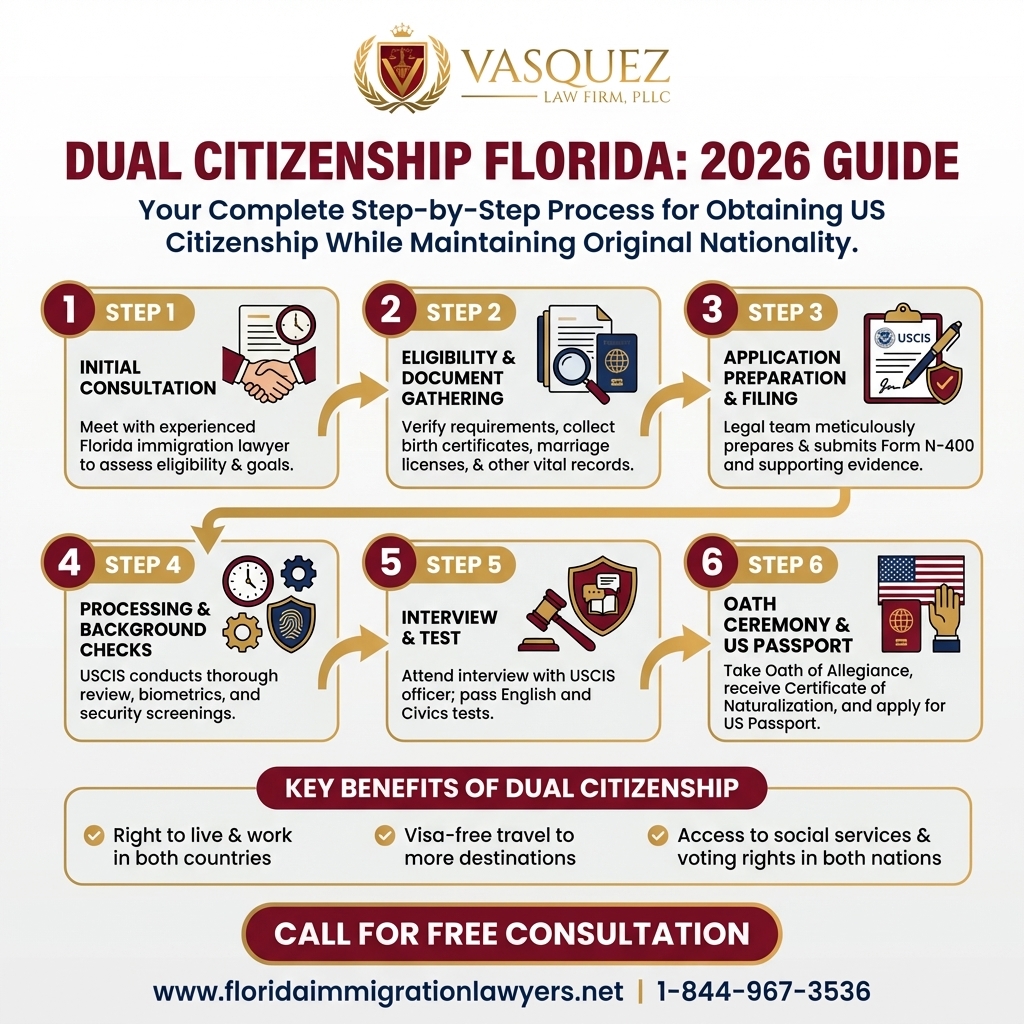
For Florida residents, the path to dual citizenship typically involves becoming a U.S. citizen through naturalization while retaining your original nationality. Here is a simplified step-by-step guide to the naturalization process:
-
Determine Your Eligibility: Ensure you meet all the basic requirements for naturalization, including age, continuous residency, physical presence, good moral character, English proficiency, and civics knowledge. For most, this means holding a green card for at least five years (or three years if married to a U.S. citizen) and meeting the physical presence requirements within that period. Verify that your home country also permits dual nationality.
-
Prepare and File Form N-400: Complete Form N-400, Application for Naturalization, accurately and thoroughly. This form requires detailed personal information, residency history, and declarations about your moral character. Attach all required supporting documents, such as copies of your green card, marriage certificate (if applicable), and travel history. You can find the latest forms and instructions on the USCIS website.
-
Attend Biometrics Appointment: After USCIS accepts your N-400 application, you will receive an appointment notice for biometrics. At this appointment, your fingerprints, photograph, and signature will be collected for background and security checks. This is a standard procedure for all naturalization applicants.
-
Attend the Naturalization Interview: USCIS will schedule an interview for you at a local field office, such as the ones in Orlando or Miami, Florida. During this interview, a USCIS officer will review your application, ask questions about your eligibility, test your English reading, writing, and speaking abilities, and administer the civics test. Be prepared to answer questions truthfully and provide any additional requested documentation.
-
Receive a Decision from USCIS: After your interview, the USCIS officer will issue a decision. This could be an approval, a continuance (if more information is needed), or a denial. If approved, you will typically receive a notice for the Oath of Allegiance ceremony.
-
Take the Oath of Allegiance: The final step in becoming a U.S. citizen is taking the Oath of Allegiance at a naturalization ceremony. Upon taking the oath, you officially become a U.S. citizen. You will receive your Certificate of Naturalization, which serves as proof of your U.S. citizenship. At this point, you effectively hold two passports if your original country allows it.
-
Apply for a U.S. Passport: Once you have your Certificate of Naturalization, you can apply for a U.S. passport, which is your primary travel document as a U.S. citizen. Information on applying for a passport can be found on the U.S. Department of State website.
Key Documents Checklist for Naturalization in Florida
A thorough and accurate submission of documents is critical for a successful naturalization application, paving the way for dual citizenship. Missing or incorrect documentation can lead to delays or even denial. Here is a general checklist of documents you will likely need to prepare:
- Your Permanent Resident Card (Green Card).
- State-issued identification, such as a Florida driver's license.
- All passports (current and expired) from all countries.
- Two passport-style photos (if required by current N-400 instructions).
- Evidence of your current marital status (marriage certificate, divorce decrees, spouse's death certificate, if applicable).
- Proof of termination of prior marriages for both you and your spouse.
- Birth certificates for all children.
- Tax returns or IRS tax transcripts for the past five years (or three years if applying based on marriage to a U.S. citizen).
- Proof of selective service registration (for males aged 18-26).
- Court disposition records for any arrests or citations, even if expunged or dismissed.
- Proof of payment for child support or alimony (if applicable).
- Travel records, including dates of all trips outside the U.S. since becoming a permanent resident.
- Any other documents requested by USCIS during the application process or interview.
It is important to provide certified translations for any documents not in English. Always keep original documents secure and only submit copies unless USCIS specifically requests an original. An immigration attorney can help you organize and review your documents to ensure completeness and accuracy.
Timeline and Processing Expectations for Florida Naturalization
The timeline for achieving U.S. citizenship through naturalization, and thus potentially dual citizenship, can vary significantly. Processing times are influenced by several factors, including the volume of applications, the specific USCIS field office handling your case, and the complexity of your individual application. While it is challenging to provide an exact timeframe, understanding the general expectations can help you plan.
As of 2026, USCIS processing times for Form N-400 applications at Florida field offices (e.g., Miami, Orlando, Tampa) typically range from 8 to 18 months from the date of filing to the Oath of Allegiance ceremony. This estimate can fluctuate, and it is always advisable to check the most current processing times on the USCIS website for your specific field office. The journey usually breaks down into several stages:
- Initial Filing & Receipt: A few weeks to receive confirmation that your application has been accepted.
- Biometrics Appointment: Typically scheduled 3-5 weeks after filing.
- Interview Scheduling: Can take several months after biometrics, depending on the field office workload.
- Interview & Decision: The interview itself is usually 20-30 minutes, with a decision often given on the same day or shortly thereafter.
- Oath Ceremony: If approved, the ceremony could be scheduled within a few weeks to a few months after the interview.
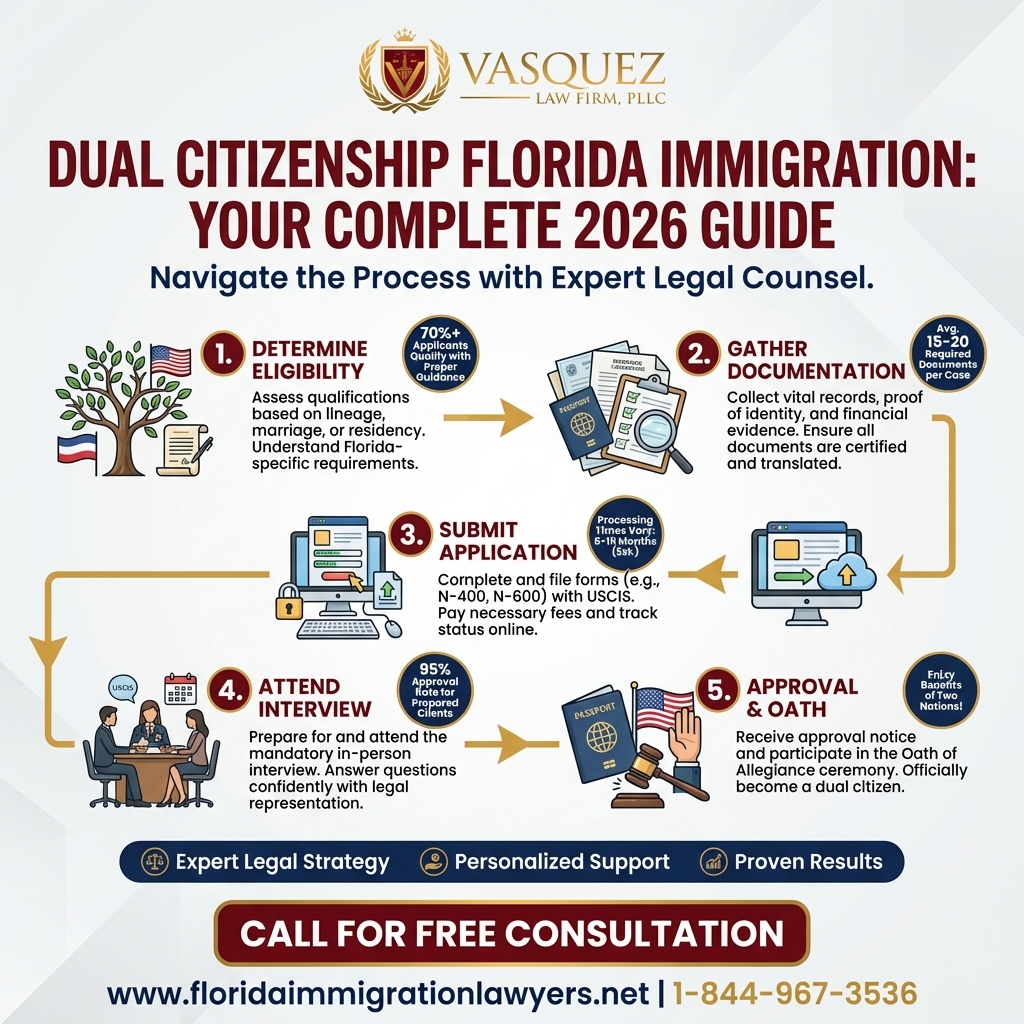
Factors that can cause delays include incomplete applications, requests for additional evidence (RFE), or issues with background checks. Being proactive and organized, especially with the help of an experienced attorney, can help minimize potential delays. Residents of Kissimmee and surrounding areas can expect their cases to be processed through the Orlando or Tampa field offices, each with its own specific processing trends.
Cost Factors and Fee Breakdown for Naturalization
The financial aspect of pursuing dual citizenship through naturalization is an important consideration for applicants in Florida. While government filing fees are standardized across the U.S., other costs can vary. It's important to budget for all potential expenses associated with the naturalization process.
The primary cost is the USCIS filing fee for Form N-400, Application for Naturalization. This fee is subject to change, so it is crucial to check the most current fee schedule on the USCIS website before submitting your application. There may also be a separate biometrics services fee, though sometimes this is included in the N-400 fee. Fee waivers may be available for eligible applicants who can demonstrate financial hardship.
Beyond government fees, applicants should consider other potential costs:
- Legal Fees: Hiring an experienced immigration attorney, such as those at Florida Immigration Lawyers, is a significant investment that can greatly improve your chances of success. Attorney fees vary based on the complexity of the case and the services provided, but they cover legal advice, document preparation, representation, and interview preparation.
- Document Translation Fees: If any of your supporting documents are not in English, you will need to pay for certified translations.
- Travel Expenses: You may incur costs for traveling to the biometrics appointment, interview, and oath ceremony, especially if you live in a more remote part of Florida or if your designated field office is not nearby. For residents of Kissimmee, travel to Orlando or Tampa will be necessary.
- Passport Application Fees: Once naturalized, there will be a separate fee to apply for your U.S. passport.
While the costs can seem substantial, viewing them as an investment in your future and the stability of your immigration status can be helpful. A clear understanding of all potential expenses from the outset allows for better financial planning and reduces unexpected burdens during the process.
Benefits and Challenges of Holding Two Passports
Holding two passports through dual citizenship offers a range of advantages, particularly for individuals in a globally connected state like Florida. However, it also comes with certain responsibilities and potential complexities. Understanding both sides is crucial for anyone considering this path.
Benefits of Dual Citizenship:
- Increased Travel Freedom: You can travel more easily between your two countries of citizenship, often without needing visas, and use the passport that is most convenient for your destination. This is especially beneficial for Floridians with family or business ties abroad.
- Expanded Rights and Opportunities: Dual citizens enjoy full rights in both countries, including the right to live, work, own property, vote, and receive social benefits. For example, a U.S. citizen with dual nationality in a European Union country could live and work freely across the EU.
- Protection by Two Governments: You can seek consular assistance and protection from either country's government when traveling internationally.
- Cultural and Family Ties: It allows individuals to maintain strong cultural identity and legal ties to their country of origin while fully participating in U.S. society. This is particularly meaningful for the diverse communities in Kissimmee and other Florida cities.
- Business and Economic Advantages: Dual nationality can open doors for international business ventures, investment opportunities, and easier access to markets in both countries.
Challenges of Dual Citizenship:
- Potential for Conflicting Laws: You are subject to the laws of both countries, which can sometimes conflict, especially regarding military service, taxation, or political obligations. For instance, U.S. citizens are generally subject to worldwide taxation, regardless of where they live.
- Allegiance Issues: While the U.S. permits dual nationality, it expects primary allegiance from its citizens. In times of international conflict, this can create dilemmas.
- Complexities in Travel: While generally easier, there can be complexities. For example, U.S. law generally requires U.S. citizens to enter and exit the U.S. using their U.S. passport.
- Administrative Burden: Managing two sets of documents, complying with two legal systems, and potentially filing taxes in two countries can be administratively burdensome.
Weighing these factors carefully with an immigration expert can help you determine if dual citizenship is the right choice for your personal and professional circumstances.
Common Mistakes to Avoid When Pursuing Dual Citizenship
The journey to dual citizenship through U.S. naturalization is filled with specific requirements. Even minor errors can lead to significant delays or even denial. Avoiding these common mistakes is crucial for a successful outcome:
-
Failing to Verify Home Country's Stance on Dual Nationality: Many applicants assume their birth country allows dual citizenship. Some countries automatically revoke citizenship upon acquiring another, which can negate your goal of holding two passports. Always research your home country's laws thoroughly before applying.
-
Inaccurate or Incomplete Form N-400: The naturalization application is detailed and requires meticulous accuracy. Missing information, inconsistent dates, or failure to disclose all relevant history (e.g., arrests, even minor ones) can trigger Requests for Evidence (RFEs) or lead to denial based on misrepresentation or lack of good moral character.
-
Not Meeting Continuous Residency or Physical Presence Requirements: Strict rules govern how long you must have been a green card holder and how much time you can spend outside the U.S. Extended trips abroad can break your continuous residency or reduce your physical presence below the required threshold, making you ineligible.
-
Lack of Good Moral Character: USCIS scrutinizes an applicant's moral character for the statutory period. Undisclosed criminal history, tax evasion, or false statements can all lead to denial. Even minor infractions should be disclosed and properly documented.
-
Inadequate Preparation for the English and Civics Tests: Many applicants underestimate the difficulty of these tests. While basic, they require preparation. Failing either test can result in a delay and a second interview, or even denial if the second attempt is also unsuccessful.
-
Failing to Provide Certified Translations: Any document not in English must be accompanied by a certified English translation. Submitting untranslated documents or non-certified translations will cause delays.
-
Incorrectly Calculating Travel Days: Keeping precise records of all international travel is vital. Miscalculating days spent outside the U.S. can lead to a finding that you do not meet the physical presence requirement, especially if you have traveled frequently from Florida to your home country.
-
Ignoring Requests for Evidence (RFEs) or Notices of Intent to Deny (NOIDs): If USCIS sends an RFE or NOID, it means they need more information or are considering denying your case. Failing to respond comprehensively and on time will almost certainly lead to denial.
-
Representing Yourself in Complex Cases: While some straightforward cases might be manageable, if you have any criminal history, prolonged absences, or other complicating factors, attempting to navigate the process without legal counsel significantly increases the risk of errors and denial. An attorney can help present your case effectively to the Executive Office for Immigration Review (EOIR) or USCIS.
-
Not Updating USCIS with Address Changes: You are legally required to notify USCIS of any address change within 10 days of moving. Failure to do so can result in missed notices, appointments, and potentially the abandonment of your application.
When to Call a Florida Immigration Lawyer for Dual Citizenship
While the prospect of dual citizenship is appealing, the path to achieving it through U.S. naturalization can be fraught with legal complexities. Knowing when to seek professional legal assistance is crucial to protect your rights and ensure a smooth process. Florida Immigration Lawyers are here to help you navigate these challenges.
You should consider contacting an attorney if any of the following scenarios apply to you:
- You Have a Criminal Record: Even minor arrests or convictions can impact your good moral character requirement. An attorney can assess the impact of your record and advise on the best course of action.
- You Have Had Extended Absences from the U.S.: If you have spent significant time outside the U.S. as a green card holder, calculating continuous residency and physical presence can be complicated. Legal counsel can help determine your eligibility.
- Your Application Has Been Denied or You Received an RFE/NOID: If USCIS has requested additional evidence, sent a Notice of Intent to Deny, or denied your application, an attorney can help you understand the reasons and formulate a strong response or appeal.
- You Have Concerns About Your Home Country's Laws: If you are unsure whether your country of origin permits two passports, an attorney can help you understand the implications and risks.
- You Have Changed Your Name or Have Complicated Marital History: These situations often require additional documentation and careful explanation to USCIS.
- You Simply Want Peace of Mind: Even in seemingly straightforward cases, having an expert guide you through the process, review your application, and prepare you for the interview can alleviate stress and prevent unforeseen issues.
Florida Immigration Lawyers has extensive experience assisting individuals across Florida, including Kissimmee, with their naturalization and citizenship goals. We understand the specific concerns of our diverse community and are dedicated to providing personalized and effective legal representation. Our team stays current with immigration policy changes, such as those that impact foreign professionals or broader demographic trends, ensuring our advice is always timely and relevant.
About Florida Immigration Lawyers
Florida Immigration Lawyers is a leading law firm dedicated to providing exceptional immigration legal services to individuals and families throughout Florida. With a deep understanding of U.S. immigration law and a commitment to our clients' success, we offer comprehensive legal representation for a wide range of immigration matters, including general immigration, asylum, deportation defense, citizenship, family immigration, and business immigration. Our attorneys are passionate advocates who believe in providing compassionate, client-focused service.
We pride ourselves on our accessibility and responsiveness, offering free consultations and being available 24/7 to address urgent concerns. Our firm is proud to offer bilingual services, with a dedicated team that speaks both English and Spanish, ensuring clear communication and understanding for all our clients. Whether you are in Kissimmee, Miami, Orlando, Tampa, or anywhere else in the Sunshine State, Florida Immigration Lawyers is here to be your trusted partner on your immigration journey. Visit our attorneys page to learn more about our team, or our contact page to reach out directly.
Sources and References
- U.S. Citizenship and Immigration Services (USCIS)
- U.S. Department of State - Travel.State.Gov
- Executive Office for Immigration Review (EOIR)
- 8 U.S.C. Chapter 12 - Immigration and Nationality Act (INA)
- INA Section 349 (8 U.S.C. 1481) - Loss of Nationality
- 8 CFR Part 316 - General Requirements for Naturalization
Related services: citizenship test preparation, dual citizenship guidance, citizenship test resources.
This article provides general legal information and is not intended as legal advice. Every case is unique, and outcomes depend on specific facts and circumstances. Contact an attorney for advice about your particular situation.
Are you ready to explore your options for dual citizenship and secure your future in Florida? Don't leave your immigration status to chance. Our dedicated team at Florida Immigration Lawyers is here to offer the guidance and support you need. Call us today at 1-844-967-3536 for a free, confidential consultation. Se Habla Espanol - Estamos aqui para ayudarle.
Do Not Navigate This Process Alone
Our experienced immigration attorneys are ready to fight for you. Get a free, confidential consultation today.
Se Habla Español
Frequently Asked Questions

William J. Vásquez
Founding Attorney · Vasquez Law Firm
U.S. Air Force veteran and immigration attorney with thousands of cases resolved. J.D., NCCU School of Law. AILA member. Admitted to the 4th, 5th, and 11th Circuit Courts.
Available 24/7 - Free Evaluations
Related Legal Services
Our Florida immigration attorneys can help you with free immigration consultation, experienced immigration attorneys and business immigration. Call today at 1-844-967-3536 for a free consultation.
Related Links
Related Topics
Free Legal Consultation
Discuss your case with our experienced attorneys. We're available 24/7.
Se Habla Español - Estamos aquí para ayudarle.
Related Articles
DED Venezuela Haiti Eligibility in Florida | VLF Florida
Deferred Enforced Departure (DED) offers temporary protection for Venezuelans and Haitians in Florida. Discover eligibility, application steps, and common pitfalls in our comprehensive guide. Contact Florida Immigration Lawyers at 1-844-967-3536 for assistance.
H-4 EAD Rules for Florida Spouses | FL Immigration Lawyers
Discover the rules for obtaining an H-4 EAD in Florida, allowing spouses of H-1B visa holders to work legally. Our detailed guide covers eligibility, timelines, costs, and common mistakes. Contact Florida Immigration Lawyers for assistance.
H-2A Visa for Agricultural Workers in Florida | VLF Florida
Discover how the H-2A visa helps Florida growers meet seasonal labor needs. Learn about the application process, common pitfalls, and how Florida Immigration Lawyers can assist you.
H-2A Visa Florida: Guide for Agricultural Growers 2026
Florida's agricultural sector relies heavily on a stable workforce, making the H-2A visa program a critical solution for growers facing labor shortages. This comprehensive guide for 2026 details the H-2A application process, document requirements, and expected timelines for Florida agricultural employers, including those in Hialeah. Learn about the multi-agency process involving the Department of Labor and USCIS, and understand your responsibilities regarding wages, housing, and transportation. We also highlight common mistakes to avoid and explain when legal counsel is essential to ensure compliance and a successful outcome. Florida Immigration Lawyers provides expert guidance to help you navigate these complexities and secure the temporary farm labor your operations need.
