Citizenship Interview Tips for Florida Residents
Prepare for your citizenship interview in Florida with these essential tips. From understanding the interview process to practicing civics questions, our guide ensures you're ready. Contact Florida Immigration Lawyers for personalized support.

Preparing for your citizenship interview in Florida is crucial for a successful naturalization process. Here are key tips to help you prepare: understand the interview process, review your application, practice English and civics questions, bring required documents, and stay calm. For personalized assistance, call Florida Immigration Lawyers at 1-844-967-3536.
- Understand the USCIS interview process
- Review your N-400 application
- Practice English and civics questions
- Bring necessary documents
- Stay calm and composed
Introduction
Facing a citizenship interview in Florida can be a daunting experience, especially in Fort Lauderdale where the stakes feel high. The naturalization interview is a critical step in becoming a U.S. citizen, and proper preparation can make all the difference. This article will guide you through essential tips for your citizenship interview, ensuring you're well-prepared and confident. Call Florida Immigration Lawyers at 1-844-967-3536 for a free consultation.
For many, the journey to U.S. citizenship represents the culmination of years of hard work, dedication, and a deep desire to fully integrate into American society. It's not just about passing a test; it's about demonstrating your commitment to the country's values and laws. Understanding the nuances of the interview process, from the initial application review to the civics and English tests, is paramount to achieving this dream.
Florida, with its diverse population and bustling USCIS offices in cities like Fort Lauderdale, sees countless individuals embark on this path annually. While the process is standardized across the nation, local office procedures can vary slightly, making localized advice invaluable. Our goal is to empower you with the knowledge and strategies needed to approach your interview with confidence, knowing you've done everything possible to prepare for this life-changing event. Remember, expert legal guidance from Florida Immigration Lawyers is always within reach at 1-844-967-3536.
Understanding the Citizenship Interview Process
The citizenship interview conducted by USCIS is a key component of the naturalization process. It typically involves verifying your application, testing your English skills, and assessing your knowledge of U.S. civics. In Fort Lauderdale, interviews are usually held at local USCIS offices, with officers trained to evaluate each applicant's readiness for citizenship. Understanding the process helps alleviate stress and allows you to focus on what matters most: demonstrating your eligibility and commitment to becoming a U.S. citizen.
During the interview, the USCIS officer will meticulously review your N-400, Application for Naturalization, asking questions about every section to ensure accuracy and consistency with the information you provided. This includes details about your personal history, family, employment, residences, travel outside the U.S., and any interactions with law enforcement. It's crucial to remember that honesty and consistency are key, as any discrepancies could lead to further scrutiny or delays. The officer is looking for an applicant who is truthful and whose application accurately reflects their life.
Beyond the application review, your English proficiency will be assessed through a speaking and understanding test, a reading test, and a writing test. For the civics portion, you will be asked up to 10 questions from a list of 100 civics questions, and you must answer at least 6 correctly to pass. These tests are designed to ensure that new citizens have a basic understanding of the English language and the fundamental principles of American democracy. Preparing thoroughly for these components is not just about passing; it's about demonstrating your readiness to participate fully in civic life.
The atmosphere of the interview is generally professional, and officers are trained to be fair. However, it is your responsibility to present yourself clearly and confidently. Understanding that the officer's role is to determine your eligibility under immigration law, and not to trick you, can help manage anxiety. Should you have any concerns about specific aspects of your case or require clarification on the process, consulting with an experienced attorney from Florida Immigration Lawyers can provide invaluable peace of mind and strategic advice.
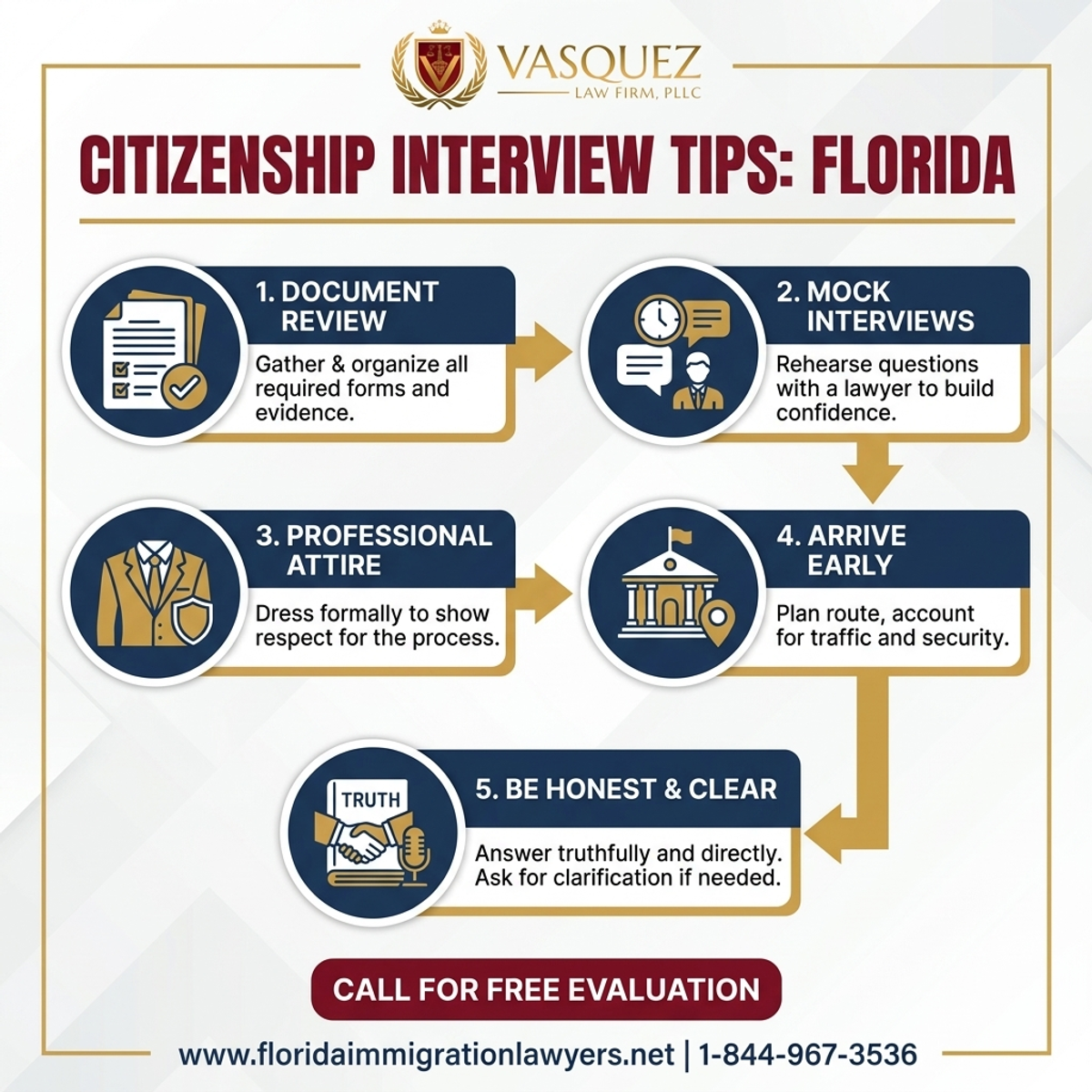
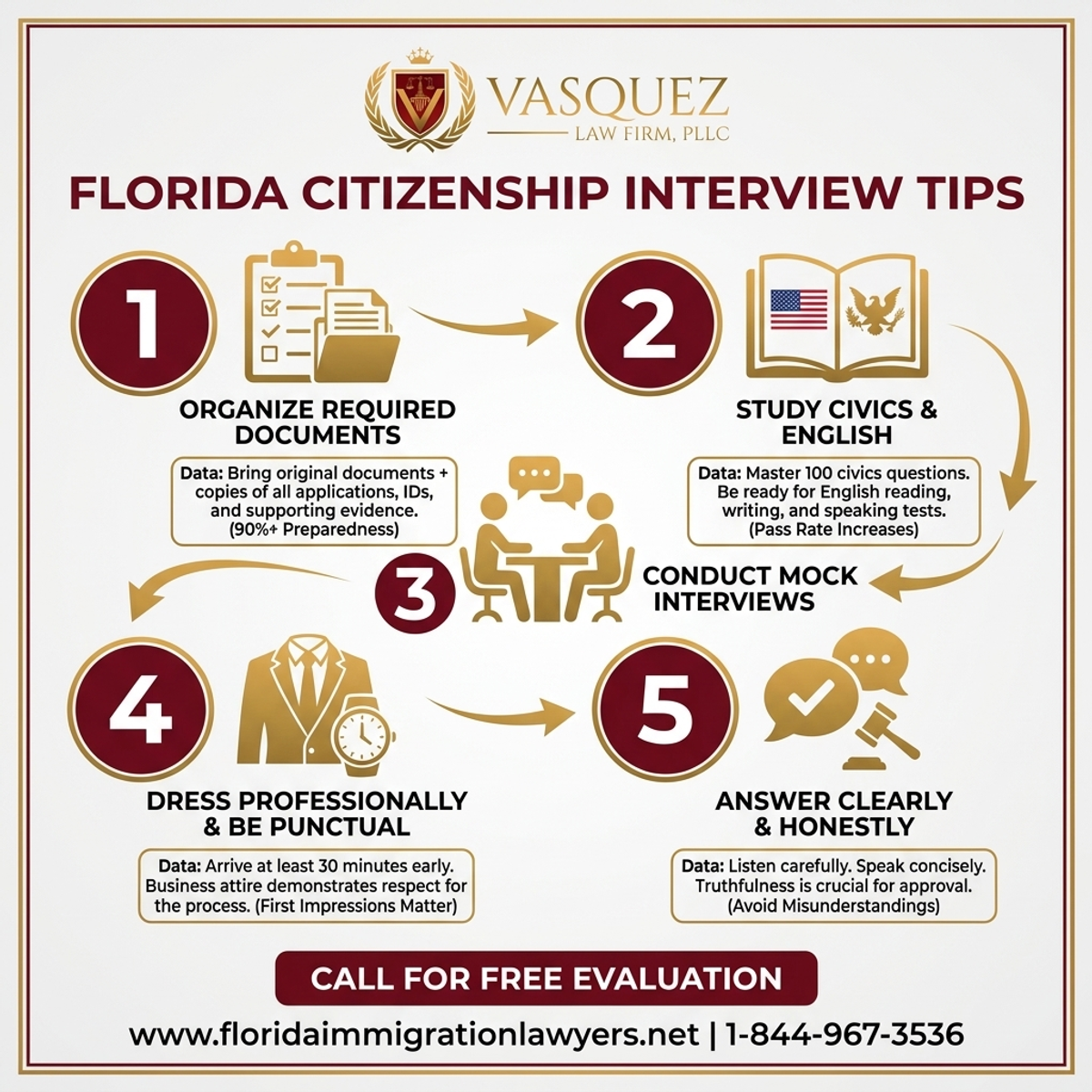
Step-by-Step Guide to Preparing for Your Interview
- Review your N-400 form: Thoroughly go over the information you submitted, as USCIS officers will ask questions based on your application.
- Study English and civics: Utilize resources like the USCIS website and community classes to improve your language skills and civic knowledge.
- Gather documents: Ensure you have all necessary documents, including your green card, passport, and state-issued ID.
- Practice interview questions: Conduct mock interviews to become comfortable with typical questions asked during the process.
- Plan your visit: Know the location and time of your interview, and plan to arrive early to avoid any last-minute stress.
Each step in this guide is a building block for a successful interview. When reviewing your N-400, don't just skim it. Read it line by line, recalling specific dates, addresses, and events. If anything has changed since you filed your application, such as a new job, a change of address, or a new trip abroad, make a note of it and be prepared to explain it clearly to the officer. Having a copy of your filed N-400 and any supporting documents readily available for review is a powerful preparation tool.
For English and civics, consistency is key. Dedicate a specific time each day to study the 100 civics questions and answers. Use flashcards, online quizzes, and practice reading and writing simple sentences in English. Many community centers and libraries in Florida offer free or low-cost citizenship classes which can be incredibly beneficial. Engaging in daily conversations in English, watching local news, and reading newspapers can significantly boost your confidence and comprehension skills for the English portion of the interview.
Practicing interview questions goes beyond just memorizing answers. It involves understanding the intent behind the questions and being able to articulate your responses clearly and confidently. Ask a friend, family member, or an immigration attorney to conduct mock interviews with you. This practice will help you become comfortable with the format, manage your nerves, and refine your answers. Focus on questions about your good moral character, your understanding of the oath, and your willingness to support and defend the U.S. Constitution.
Finally, planning your visit meticulously can prevent unnecessary anxiety on interview day. Confirm the exact address of the USCIS office in Fort Lauderdale, check for parking availability or public transport routes, and consider doing a test run if you're unfamiliar with the area. Aim to arrive at least 30 minutes before your scheduled appointment to allow for security checks and to settle your nerves. Being punctual and prepared demonstrates respect for the process and the USCIS officer.
Step-by-Step Process — Citizenship Interview Tips for Florida Residents
Document Checklist for the Citizenship Interview
- Permanent Resident Card (Green Card)
- Passport (even if expired)
- State-issued ID (e.g., Driver's License)
- All travel documents since becoming a permanent resident
- Any court or legal documents if applicable
- Proof of Selective Service registration (if applicable)
Having all your required documents organized and readily accessible is a non-negotiable aspect of interview preparation. The USCIS officer will need to verify your identity and confirm the information provided in your N-400 application. This means bringing original documents, not just copies, unless specifically instructed otherwise. A well-organized folder with clearly labeled sections for each document type can significantly streamline the interview process and demonstrate your preparedness.
Beyond the core documents listed, consider bringing any supporting evidence for information that might have changed or requires further explanation. For instance, if you've had a name change, bring your marriage certificate or court order. If you've been married multiple times, bring all divorce decrees or death certificates for previous spouses. For any children, bring their birth certificates. If you have a criminal record, even for minor offenses, ensure you have certified court dispositions. It is always better to over-prepare than to be caught without a crucial piece of evidence.
Remember to also bring your interview notice, as this serves as your official invitation and contains important details like the date, time, and location. If you have received any Requests for Evidence (RFEs) from USCIS, be sure to bring those documents as well. For complex situations or if you are unsure about what specific documents apply to your unique case, contacting Florida Immigration Lawyers at 1-844-967-3536 for a personalized document review can prevent potential delays or issues during your interview.
Timeline and Processing Expectations
The timeline for the citizenship interview process can vary. Generally, applicants in Florida can expect to receive an interview notice 3-5 months after submitting their N-400 application. The interview itself usually lasts about 20-30 minutes. If successful, you may receive a decision on the same day or shortly thereafter. Keep in mind that processing times are subject to change, often based on local USCIS office workloads.
Several factors can influence the overall processing time, including the volume of applications at your specific USCIS field office (e.g., Fort Lauderdale, Miami, Orlando), the complexity of your individual case, and how quickly you respond to any requests for additional evidence. While the 3-5 month estimate for an interview notice is a general guideline, some cases may take longer, especially if there are security checks or background investigations that require more time to complete. It is advisable to regularly check the USCIS website for current processing times specific to your field office.
After the interview, the officer might make a decision on the spot, or they might tell you that a decision will be mailed to you. If your application is approved, the next step is typically the Oath of Allegiance ceremony, which could be scheduled on the same day or a few weeks later. If your case is not immediately approved, you might receive a Request for Evidence (RFE) or a Notice of Continuance (N-14), indicating that more information is needed or further review is required. Understanding these potential outcomes helps manage expectations and allows for proactive planning. Should you face any unexpected delays or receive an RFE, Florida Immigration Lawyers are ready to assist you in navigating these complexities.
Key Statistics — Citizenship Interview Tips for Florida Residents
Cost Factors and Fee Breakdown
While there is a fee for filing the N-400 application, there are no additional charges for the interview itself. However, costs may arise from preparatory classes or legal consultations. It's important to budget for these potential expenses as part of your naturalization journey. For a detailed understanding of costs, consider speaking with an immigration lawyer who can provide guidance tailored to your situation.
The primary cost associated with naturalization is the USCIS filing fee for Form N-400, which typically includes the application fee and the biometrics services fee. These fees are subject to change, so always check the official USCIS website for the most current amounts. It's important to note that certain low-income applicants may be eligible for a fee waiver, which can significantly reduce the financial burden of the application process. Eligibility for a fee waiver is based on specific income guidelines or receipt of certain public benefits, and requires filing Form I-912, Request for Fee Waiver.
Beyond the direct USCIS fees, applicants should also consider potential indirect costs. These can include expenses for obtaining necessary documents like birth certificates or marriage licenses from foreign countries, translation services for non-English documents, transportation to and from the USCIS office for biometrics appointments and the interview, and potentially lost wages from taking time off work. Investing in high-quality study materials, citizenship classes, or legal advice can also be a wise expenditure, as it significantly increases your chances of success and can prevent costly errors or delays down the line.
Navigating the fee structure and understanding fee waiver eligibility can be complex. An immigration attorney can help you determine if you qualify for a fee waiver and assist with the necessary paperwork. While legal fees represent an additional cost, the expertise and support provided by Florida Immigration Lawyers can prove invaluable, particularly for cases with unique challenges or those requiring meticulous preparation, ultimately saving you time and potential re-filing fees in the long run. Do not navigate this process alone. Contact Florida Immigration Lawyers today.
Common Mistakes to Avoid in Your Citizenship Interview
- Not reviewing your N-400 form: Failing to remember details from your application can lead to misunderstandings during the interview.
- Insufficient English proficiency: Struggling with English during the interview can impact your ability to communicate effectively.
- Inadequate civics preparation: Not studying U.S. history and government can result in failing the civics test.
- Arriving late: Being late can cause unnecessary stress and potentially reschedule your interview.
- Forgetting required documents: Missing documents can delay your interview process.
- Providing inconsistent information: Inconsistencies between your application and interview responses can lead to denial.
- Not seeking legal advice when needed: Complex cases may require legal assistance to navigate the process effectively.
Avoiding these common pitfalls is just as crucial as thorough preparation. Many applicants underestimate the importance of reviewing their N-400 form, assuming that since they filled it out months ago, they'll remember everything. However, life changes, and forgetting a specific date of travel or an old address can raise red flags for the USCIS officer. Take the time to re-read your application multiple times, even highlighting key dates and facts, to ensure your verbal responses align perfectly with your written submission.
English and civics proficiency are fundamental pillars of the naturalization process. A common mistake is relying solely on passive learning or last-minute cramming. Instead, integrate English practice into your daily routine by listening to English news, reading simple books, and practicing speaking with native speakers. For civics, don't just memorize answers; try to understand the concepts behind them. For example, instead of just knowing 'freedom of speech,' understand what it means for American society. Failing either test often results in a re-interview, prolonging your journey to citizenship.
Beyond the substantive aspects, logistical errors like arriving late or forgetting documents can significantly disrupt your interview. Arriving late, even by a few minutes, can sometimes lead to automatic rescheduling, causing significant delays and frustration. Similarly, failing to bring all requested original documents means the officer cannot verify your information, potentially leading to a Request for Evidence (RFE) or a continuance. Always double-check your interview notice and the USCIS website for the most
Sources and References
- U.S. Citizenship and Immigration Services (USCIS)
- Executive Office for Immigration Review (EOIR)
- U.S. Department of State - Bureau of Consular Affairs
- Immigration and Nationality Act (INA), 8 U.S.C. Chapter 12
Do Not Navigate This Process Alone
Our experienced immigration attorneys are ready to fight for you. Get a free, confidential consultation today.
Se Habla Español
Frequently Asked Questions

William J. Vásquez
Founding Attorney · Vasquez Law Firm
U.S. Air Force veteran and immigration attorney with thousands of cases resolved. J.D., NCCU School of Law. AILA member. Admitted to the 4th, 5th, and 11th Circuit Courts.
Available 24/7 - Free Evaluations
Related Legal Services
Our Florida immigration attorneys can help you with deportation defense, citizenship and naturalization and family immigration services. Call today at 1-844-967-3536 for a free consultation.
Related Links
Related Topics
Free Legal Consultation
Discuss your case with our experienced attorneys. We're available 24/7.
Se Habla Español - Estamos aquí para ayudarle.
Related Articles
Biometrics Appointment in Florida: What to Expect in 2026
Navigating a biometrics appointment in Florida is crucial for your USCIS process. Learn what to expect, how to prepare, and common pitfalls to avoid. Florida Immigration Lawyers are here to help with personalized guidance and support.
Withholding of Removal Explained: Florida Defense in 2026
For those in Florida facing deportation and fearing persecution or torture in their home country, understanding withholding of removal is critical. This form of protection prevents removal to a dangerous country, though it differs significantly from asylum in its eligibility criteria and benefits. It requires proving a "more likely than not" chance of persecution based on protected grounds or torture, a higher standard than asylum's "well-founded fear." While withholding of removal does not lead to a Green Card, it offers mandatory protection if the stringent criteria are met, even for some individuals barred from asylum. The process involves complex legal proceedings before an immigration judge, often in Miami or Orlando immigration courts. A comprehensive application, detailed testimony, and robust supporting evidence, including country conditions reports and affidavits, are essential. Given the high stakes and intricate legal requirements, securing the expertise of a Florida immigration lawyer is paramount to building a strong defense and navigating the path to safety.
US Visa Policy Changes July 2026: What Students in Florida
As of July 2026, international students in Florida seeking a change of status to an F-1 student visa must prepare for potential adjustments to U.S. visa policies. This comprehensive guide from Florida Immigration Lawyers explores the anticipated policy changes, detailing their potential impact on application requirements, processing times, and eligibility criteria. We provide a step-by-step overview of the change of status process, including a document checklist, expected timelines, and cost considerations. Understanding these complexities and avoiding common mistakes is crucial for a successful application. With potential changes approaching, proactive planning and expert legal guidance are more important than ever. Our firm is dedicated to helping students in Tampa and across Florida navigate these challenges, offering tailored advice and robust representation. Learn how to protect your academic future and ensure a smooth transition to F-1 student status.
Dual Citizenship Lawyer: Your 2026 Guide to Naturalization
Achieving U.S. citizenship is a profound milestone, but the path to naturalization, especially with dual citizenship in mind, is fraught with legal intricacies and a critical interview process. This comprehensive guide from Florida Immigration Lawyers demystifies the journey, offering essential citizenship interview tips and highlighting the invaluable role of a dual citizenship lawyer. We cover eligibility, document preparation, timelines, and common pitfalls, all tailored for Florida residents in areas like Pembroke Pines. Discover how expert legal counsel can prepare you for your naturalization interview, address dual nationality concerns, and ensure a smooth, successful application. From initial assessment to interview representation, we provide the support needed to navigate USCIS requirements confidently. Call Florida Immigration Lawyers for a free consultation to start your journey.