RFE Response Guide for Florida Immigration
Learn how to respond effectively to a Request for Evidence from USCIS for your immigration case in Florida. This guide provides step-by-step instructions, tips, and common mistakes to avoid. Contact Florida Immigration Lawyers for a free consultation.

- Understand the specifics of what is being requested.
- Gather all necessary documents carefully.
- Meet the deadline specified by USCIS.
Introduction
Receiving a Request for Evidence (RFE) from USCIS can be daunting, especially if you're navigating the complexities of immigration in Homestead, Florida. An RFE does not mean your application is denied; rather, it's an opportunity to provide additional information to support your case. This guide will walk you through the RFE response process, helping you understand what’s required and how to ensure a successful outcome. Call Florida Immigration Lawyers at 1-844-967-3536 for a free consultation.
Many applicants experience a moment of panic when an RFE arrives, but it's essential to view it as a procedural step, not a setback. USCIS often issues RFEs to clarify ambiguities, address missing pieces of evidence, or ensure that all eligibility criteria are met according to the latest regulations. Your ability to provide a clear, comprehensive, and timely response is paramount to keeping your immigration journey on track.
For residents of Homestead and the broader Florida region, understanding the nuances of immigration law and the RFE process is critical. While the general guidelines are national, local processing centers and specific case types can sometimes present unique challenges. Florida Immigration Lawyers are here to demystify this process, offering expert guidance to transform a potentially stressful situation into a manageable one, leading to a favorable decision.
Understanding the RFE Process
The Request for Evidence is a formal request by USCIS for more information to make a decision on your immigration application. Common reasons for RFEs include missing evidence, inconsistencies in your application, or the need for further clarification on specific points.
In Florida, particularly in the Homestead area, understanding local immigration offices and their processes can be beneficial. Familiarize yourself with the offices in Miami and other nearby locations to streamline your process.
According to the USCIS, responding to an RFE accurately and promptly can significantly impact the outcome of your immigration journey.
RFEs can arise for a multitude of reasons, ranging from simple administrative oversights, like a missing signature or an outdated form, to more substantive issues, such as questions about the bona fides of a marriage, the legitimacy of a job offer, or the specialized nature of an applicant's skills. Sometimes, USCIS may request additional evidence to confirm a petitioner's financial ability to support an immigrant, or to verify an applicant's continuous residence in the U.S. It’s crucial to recognize that an RFE is not a punitive measure but rather an administrative tool to ensure the integrity and completeness of all applications.
For instance, in a family-based petition, an RFE might request more proof of a marital relationship, such as joint bank statements, utility bills, or affidavits from friends and family. For employment-based petitions, it could involve providing additional evidence of the employer's ability to pay the proffered wage, or demonstrating the applicant's specific qualifications for a specialized position. Each RFE is unique, tailored to the specifics of your case, making a precise understanding of its demands absolutely essential. Florida Immigration Lawyers possess the expertise to help you decipher these complex requests and formulate an effective strategy.
Step-by-Step Guide to Responding to an RFE
- Read the RFE Carefully: Understand every detail of what USCIS is requesting. This will help you gather the correct documents and information.
- Gather Necessary Documents: Collect all the evidence requested. This may include financial records, identification documents, or additional affidavits.
- Organize Your Response: Clearly label each piece of evidence and provide a cover letter summarizing your response.
- Check for Completeness: Ensure no documents are missing and that all have been properly filled out.
- Submit Before the Deadline: Timely submission is crucial. Late responses could lead to denial of your application.
When you receive an RFE, your first action should be to meticulously read every page. Highlight key phrases, specific document types, and any regulations cited. It's not uncommon for RFEs to be several pages long, detailing multiple requests. Create a checklist based on the RFE's demands to ensure nothing is overlooked. This initial thorough review is the foundation of a successful response and can prevent further delays or potential denials. If any part of the RFE is unclear, seeking immediate legal counsel from Florida Immigration Lawyers can clarify ambiguities.
Gathering documents can be time-consuming, so start immediately. For financial requests, this might mean obtaining certified tax transcripts from the IRS, not just copies of your filed returns. For identity or relationship proof, ensure all documents are current and match the names on your application. If affidavits are requested, ensure they are notarized and include specific details as outlined by USCIS. Remember to provide primary evidence whenever possible; if primary evidence is unavailable, strong secondary evidence with an explanation for the lack of primary evidence is crucial.
Your response package should be a model of clarity and organization. Use tabs or dividers to separate each requested item, matching them to the RFE's numbered or bulleted requests. The cover letter should serve as a roadmap for the USCIS officer, clearly listing each document provided and briefly explaining how it addresses the RFE's request. A well-organized submission not only makes it easier for the officer to review but also demonstrates your diligence and attention to detail, which can positively impact your case. Always keep a complete copy of everything you send, including the cover letter and the original RFE notice, for your records.
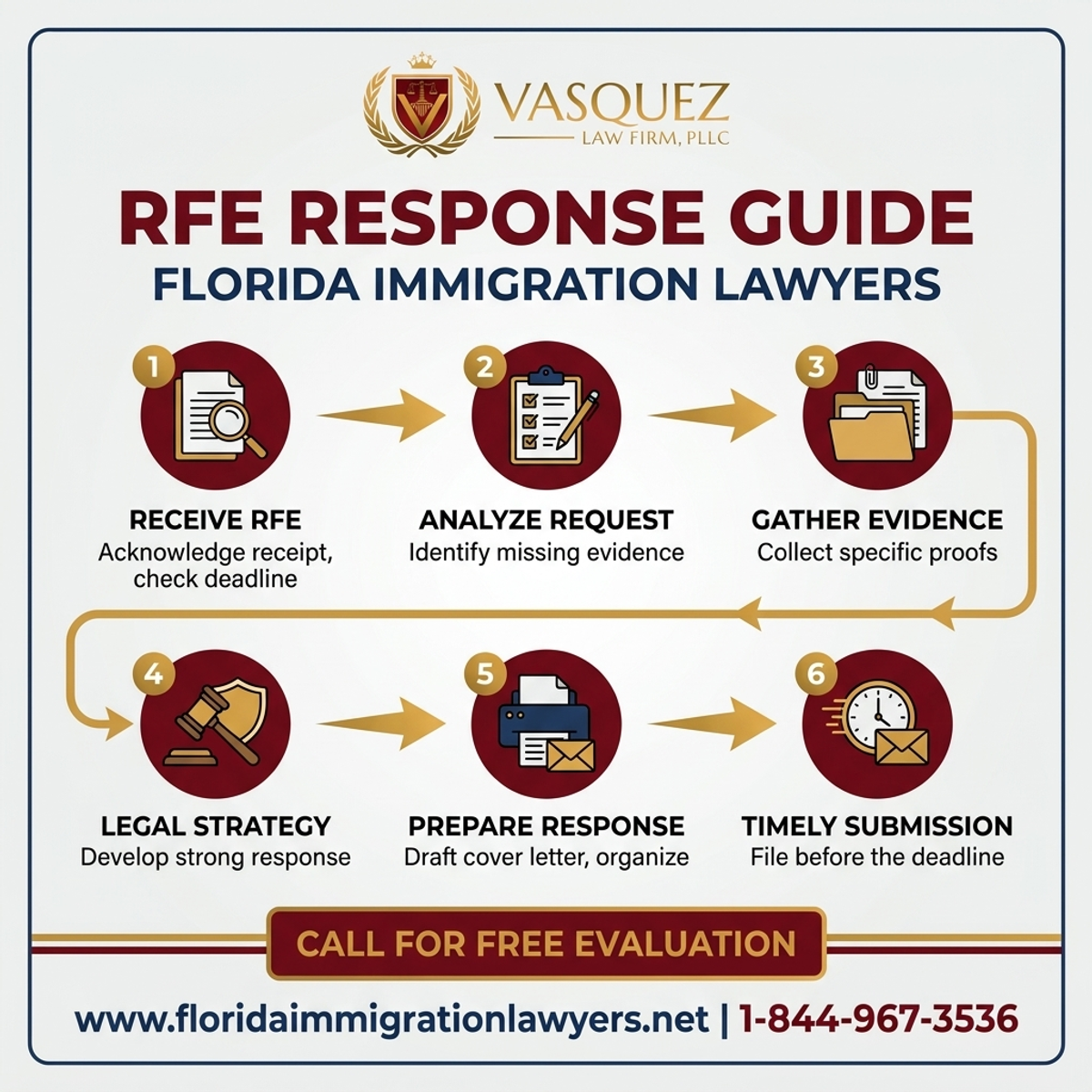
Step-by-Step Process — RFE Response Guide for Florida Immigration
Document Checklist
- Copy of the original RFE notice
- All requested documentation and evidence
- Cover letter explaining your response
- Any additional supporting documents
Beyond the primary documents, consider including a table of contents for extensive responses, especially if you're submitting dozens or hundreds of pages. This helps the USCIS officer navigate your submission efficiently. For any foreign language documents, remember that you must include a certified English translation along with a copy of the original document. The translator must provide a certification that they are competent to translate and that the translation is accurate.
Ensure that all copies of documents are clear and legible. If you are submitting original documents (which is rare and only when explicitly requested by USCIS), make sure to keep a certified copy for your own records. It's always best practice to submit copies unless an original is specifically asked for. For complex cases, consider adding an executive summary or a legal brief prepared by an attorney to articulate how the submitted evidence meets the regulatory requirements, providing a stronger argument for your case.
Timeline and Processing Expectations
Once you submit your RFE response, USCIS typically takes 60 to 90 days to process it, although this can vary. In Florida, processing times may be influenced by the volume of cases at local offices. It's important to check the USCIS processing times for the most accurate information.
While 60-90 days is a general guideline, several factors can influence the actual processing time. The specific USCIS service center handling your case, the complexity of the evidence submitted, and the current workload of that center can all cause variations. For instance, a complex RFE requiring extensive review by a specialized officer might take longer than a straightforward request for a missing document. It's also worth noting that processing times can fluctuate due to policy changes or unforeseen events.
To stay informed, regularly check the USCIS website for updated processing times for your specific form type and service center. You can also use the USCIS case status online tool with your receipt number to track the progress of your application. If your case remains pending significantly beyond the posted processing times, you may be able to submit an e-Request to USCIS for an inquiry. However, patience is often key during this stage, and Florida Immigration Lawyers can help you understand when and how to appropriately follow up without jeopardizing your application.
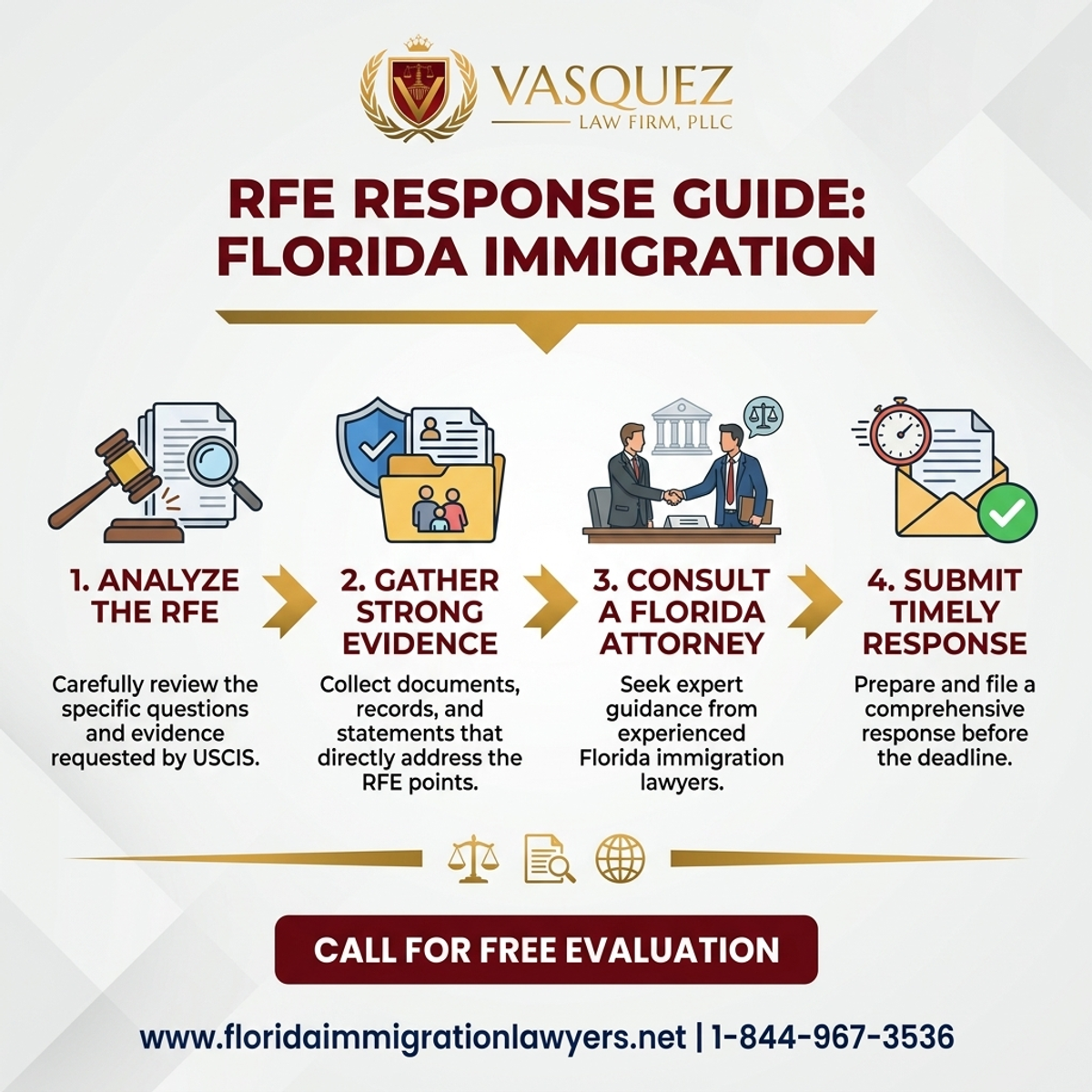
Key Statistics — RFE Response Guide for Florida Immigration
Cost Factors and Fee Breakdown
Responding to an RFE may incur costs, especially if you need to gather additional documentation or hire legal assistance. While there are no direct fees for submitting an RFE response, indirect costs can add up. Consider the potential need for expert evaluations or translations.
Do not navigate this process alone. Contact Florida Immigration Lawyers today.
The indirect costs associated with an RFE response can vary widely depending on the nature of the request. For example, if USCIS asks for a medical evaluation or a psychological assessment, you will incur fees from healthcare professionals. Similarly, if your RFE requires an expert opinion letter (e.g., from a university professor for an O-1 visa or a business valuation expert for an EB-5 petition), these services can be substantial. Obtaining certified copies of government records, such as birth certificates or marriage licenses from foreign countries, might also involve processing fees and international shipping costs.
Another significant cost factor is certified translation services. Any document submitted to USCIS that is not in English must be accompanied by a full English translation, certified by the translator as complete and accurate, and by the translator's certification that they are competent to translate from the foreign language into English. These services are typically charged per page or per word. Additionally, if you need to obtain records from previous employers or educational institutions, there might be administrative fees involved. These seemingly small costs can accumulate, making it important to budget for potential expenses when an RFE arrives.
Engaging an immigration attorney, such as Florida Immigration Lawyers, is often the most significant but also the most valuable investment. While there are legal fees, an experienced attorney can save you from costly mistakes, ensure your response is legally sound, and significantly increase your chances of approval. This investment can prevent the need for re-filing an application, which would incur new government fees and further delays, ultimately saving you time and money in the long run. Our team can discuss our fee structures during your free consultation.
Common Mistakes to Avoid
- Ignoring the RFE: Neglecting to respond will likely result in application denial.
- Missing Deadlines: Late responses are often not accepted, leading to negative outcomes.
- Incomplete Documentation: Failing to provide all requested evidence can weaken your case.
- Submitting Unclear Information: Ensure all documents are legible and well-organized.
- Not Seeking Legal Advice: Complex cases may require the expertise of an immigration attorney.
- Failing to Keep Copies: Always keep copies of everything you submit for your records.
- Overlooking Local Regulations: Be aware of specific Florida immigration guidelines that may affect your case.
Ignoring an RFE is perhaps the most critical error an applicant can make. USCIS provides a specific timeframe for response, typically between 30 to 87 days, and failure to respond within this period is almost guaranteed to result in a denial. This denial could then necessitate an appeal or a new application, both of which are time-consuming and costly. Always prioritize the RFE, even if it means temporarily postponing other tasks.
Submitting an incomplete response or providing unclear information can be just as detrimental as not responding at all. If you send only some of the requested documents, or if your evidence is disorganized and difficult for the USCIS officer to understand, it may be deemed insufficient, leading to a denial. Ensure every piece of evidence directly addresses a specific request, and that all documents are clearly labeled, legible, and properly translated if necessary. A disorganized response can frustrate the reviewing officer and lead to an unfavorable decision.
Lastly, many applicants underestimate the value of legal counsel, particularly in complex RFE situations. Attempting to interpret intricate immigration laws or gather highly specific evidence without professional guidance can lead to critical errors. An experienced immigration attorney, like those at Florida Immigration Lawyers, can help you understand the legal basis of the RFE, identify the most effective evidence, and craft a compelling response that maximizes your chances of approval. Don't hesitate to call 1-844-967-3536 for a free consultation if you feel overwhelmed or uncertain.
When to Call a Lawyer
If you receive an RFE, it may be beneficial to consult with an immigration attorney, especially if your case involves complex legal issues or if you’re unsure about the evidence required. Florida Immigration Lawyers can provide guidance and ensure that your response is comprehensive and timely.
There are several specific scenarios where engaging an immigration attorney becomes not just beneficial, but often essential. If your RFE delves into complex legal arguments, such as questions about your eligibility under a specific statute, or if it relates to a prior denial, criminal history, or a waiver application, legal expertise is crucial. Attorneys can interpret the nuanced language of immigration law, craft persuasive legal arguments, and present your case in the most favorable light, ensuring all regulatory requirements are met.
Furthermore, if the RFE requests highly specialized evidence that you find difficult to obtain or understand, or if it challenges the bona fides of your relationship or employment, a lawyer can guide you. They can advise on alternative forms of evidence, help secure expert opinions, and prepare you for potential interviews. For residents in Homestead and throughout Florida, Florida Immigration Lawyers are ready to offer a free consultation, providing clarity and strategic direction during this critical phase of your immigration journey. Don't risk a denial by navigating complex legal waters alone.
About Florida Immigration Lawyers
Florida Immigration Lawyers is dedicated to providing expert legal assistance with all immigration matters across Florida, including Homestead. Our experienced attorneys offer personalized service, ensuring each client's unique circumstances are addressed. Available 24/7, we offer free consultations to help you navigate your immigration journey. Call 1-844-967-3536 or visit our website for more information.
Our firm prides itself on a deep understanding of the ever-evolving landscape of U.S. immigration law. We handle a broad spectrum of cases, from family-based petitions and employment visas to citizenship applications and deportation defense. When it comes to RFEs, our attorneys meticulously analyze each request, develop a tailored strategy, and assist clients in gathering and organizing all necessary documentation. We aim to submit a comprehensive and compelling response that leaves no room for doubt regarding your eligibility.
We understand that the immigration process can be stressful and confusing, which is why we are committed to providing compassionate and accessible legal support. Our team ensures that you are informed at every step, offering clear explanations and proactive communication. With Florida Immigration Lawyers, you gain a dedicated advocate who will tirelessly work to protect your rights and achieve your immigration goals, turning potential challenges into successful outcomes. Reach out today for the peace of mind that comes with expert legal representation.
Sources and References
- U.S. Citizenship and Immigration Services (USCIS)
- Executive Office for Immigration Review (EOIR)
- State Department
- 8 U.S.C. Chapter 12 - Immigration and Nationality Act
Related services: immigration practice areas, family immigration services, citizenship and naturalization, deportation defense.
This article provides general legal information and is not intended as legal advice. Every case is unique, and outcomes depend on specific facts and circumstances. Contact an attorney for advice about your particular situation.
For a strong legal ally in your immigration process, call Florida Immigration Lawyers at 1-844-967-3536 for a free consultation. Se Habla Español - Estamos aquí para ayudarle.
If you need legal assistance, learn more about our immigration law practice, or call us at 1-844-967-3536 for a free consultation.
Do Not Navigate This Process Alone
Our experienced immigration attorneys are ready to fight for you. Get a free, confidential consultation today.
Se Habla Español
Frequently Asked Questions

William J. Vásquez
Founding Attorney · Vasquez Law Firm
U.S. Air Force veteran and immigration attorney with thousands of cases resolved. J.D., NCCU School of Law. AILA member. Admitted to the 4th, 5th, and 11th Circuit Courts.
Available 24/7 - Free Evaluations
Related Legal Services
Our Florida immigration attorneys can help you with family immigration services, immigration practice areas and free immigration consultation. Call today at 1-844-967-3536 for a free consultation.
Related Links
Related Topics
Free Legal Consultation
Discuss your case with our experienced attorneys. We're available 24/7.
Se Habla Español - Estamos aquí para ayudarle.
Related Articles
Biometrics Appointment in Florida: What to Expect in 2026
Navigating a biometrics appointment in Florida is crucial for your USCIS process. Learn what to expect, how to prepare, and common pitfalls to avoid. Florida Immigration Lawyers are here to help with personalized guidance and support.
Withholding of Removal Explained: Florida Defense in 2026
For those in Florida facing deportation and fearing persecution or torture in their home country, understanding withholding of removal is critical. This form of protection prevents removal to a dangerous country, though it differs significantly from asylum in its eligibility criteria and benefits. It requires proving a "more likely than not" chance of persecution based on protected grounds or torture, a higher standard than asylum's "well-founded fear." While withholding of removal does not lead to a Green Card, it offers mandatory protection if the stringent criteria are met, even for some individuals barred from asylum. The process involves complex legal proceedings before an immigration judge, often in Miami or Orlando immigration courts. A comprehensive application, detailed testimony, and robust supporting evidence, including country conditions reports and affidavits, are essential. Given the high stakes and intricate legal requirements, securing the expertise of a Florida immigration lawyer is paramount to building a strong defense and navigating the path to safety.
US Visa Policy Changes July 2026: What Students in Florida
As of July 2026, international students in Florida seeking a change of status to an F-1 student visa must prepare for potential adjustments to U.S. visa policies. This comprehensive guide from Florida Immigration Lawyers explores the anticipated policy changes, detailing their potential impact on application requirements, processing times, and eligibility criteria. We provide a step-by-step overview of the change of status process, including a document checklist, expected timelines, and cost considerations. Understanding these complexities and avoiding common mistakes is crucial for a successful application. With potential changes approaching, proactive planning and expert legal guidance are more important than ever. Our firm is dedicated to helping students in Tampa and across Florida navigate these challenges, offering tailored advice and robust representation. Learn how to protect your academic future and ensure a smooth transition to F-1 student status.
Dual Citizenship Lawyer: Your 2026 Guide to Naturalization
Achieving U.S. citizenship is a profound milestone, but the path to naturalization, especially with dual citizenship in mind, is fraught with legal intricacies and a critical interview process. This comprehensive guide from Florida Immigration Lawyers demystifies the journey, offering essential citizenship interview tips and highlighting the invaluable role of a dual citizenship lawyer. We cover eligibility, document preparation, timelines, and common pitfalls, all tailored for Florida residents in areas like Pembroke Pines. Discover how expert legal counsel can prepare you for your naturalization interview, address dual nationality concerns, and ensure a smooth, successful application. From initial assessment to interview representation, we provide the support needed to navigate USCIS requirements confidently. Call Florida Immigration Lawyers for a free consultation to start your journey.
