Derived Citizenship Through Parents in Florida: A 2026 Guide
Derived citizenship allows individuals born abroad to become U.S. citizens through their parents. Learn about eligibility, the application process, and common mistakes to avoid when applying in Florida.
Derived citizenship is a process where individuals born abroad may become U.S. citizens through their parents' citizenship status. This is particularly relevant to those in Florida looking to confirm their citizenship status. Key takeaways include:
- Eligibility depends on your parents' citizenship status and your age at the time.
- Orlando residents can apply through local USCIS offices.
- Consulting with an immigration lawyer can clarify your status.
Introduction
Have you ever wondered if you might already be a U.S. citizen through your parents? For many living in Orlando, Florida, this question can be life-changing. Derived citizenship provides an opportunity for individuals born abroad to claim U.S. citizenship through their parents. This article explores the eligibility criteria, application process, and common pitfalls to avoid. Call Florida Immigration Lawyers at 1-844-YO-PELEO for a free case review.
For countless individuals in Florida, discovering they are already U.S. citizens through their parents can unlock a world of opportunities and provide immense peace of mind. Many live for years unaware of this inherent right, navigating life as lawful permanent residents or even with uncertain immigration statuses, when in fact, they are citizens. Understanding derived citizenship is not just about legal technicalities; it's about claiming your rightful place and accessing the full benefits and protections of U.S. citizenship, from voting rights to easier travel and employment opportunities.
Given Florida's diverse population and its status as a hub for both international families and immigrants, the principles of derived citizenship are especially pertinent to residents across the state, including those in Orlando. This comprehensive guide aims to demystify the process, offering clear, actionable insights into how you can determine your eligibility and secure official proof of your U.S. citizenship. We will delve into the nuances of the law, offer practical tips, and highlight how expert legal assistance from Florida Immigration Lawyers can make a significant difference in your journey.
What is Derived Citizenship?
Derived citizenship is a legal process that allows individuals to obtain U.S. citizenship through their parents. Typically, this applies to those born outside the United States when certain conditions are met.
Derived citizenship is rooted in the principle of family unity, ensuring that children can share the nationality of their parents. It's an automatic process, meaning that once all the legal conditions are met, citizenship is conferred by law, not by an application for naturalization. The application for a Certificate of Citizenship (Form N-600) merely serves to provide official documentation of a citizenship status that already exists.
As of 2026, these conditions include:
- At least one parent is a U.S. citizen, either by birth or naturalization.
- The applicant was under 18 when the parent(s) became a citizen or when they were granted lawful permanent resident status.
- The applicant resides in the U.S. under the legal and physical custody of the citizen parent.
Understanding these requirements can help you determine your eligibility for derived citizenship.
Let's delve deeper into these critical requirements. The first condition, that at least one parent is a U.S. citizen, is foundational. This parent can be a citizen by birth in the U.S. or one of its territories, or they could have become a citizen through the naturalization process. It's important to clarify which parent holds U.S. citizenship and to have solid documentation to prove it, such as a U.S. birth certificate, Consular Report of Birth Abroad (CRBA), or a Certificate of Naturalization.
The second condition, concerning the applicant's age, is strictly enforced: the child must be under 18 years old when the qualifying event occurs. This event is typically when the parent naturalizes or, in some cases, when the child becomes a lawful permanent resident and is residing with the citizen parent. If the child turns 18 even a day before these conditions are met, they are generally not eligible for derived citizenship and would need to pursue naturalization as an adult, which involves different criteria and procedures.
Finally, the requirement of residing in the U.S. under the legal and physical custody of the citizen parent is crucial. "Legal custody" typically means that the citizen parent has been granted custody by a court order, or if the parents are married, both generally share legal custody. "Physical custody" means the child is actually living with the citizen parent in the United States. Both aspects must be proven, often through school records, medical records, or other official documents demonstrating a shared household. For families in Orlando, proving residency and custody within the U.S. is a key component of the N-600 application, and Florida Immigration Lawyers can assist in compiling the necessary evidence.
It's important to distinguish derived citizenship from "acquired citizenship" and "naturalization." Acquired citizenship refers to individuals who are U.S. citizens at birth, often born abroad to U.S. citizen parents, without needing any further action. Naturalization, conversely, is the process by which a foreign national voluntarily applies to become a U.S. citizen after meeting specific residency and other requirements as an adult. Derived citizenship sits between these two, granting automatic citizenship to a child based on their parent's status, but typically requiring an application (N-600) to obtain official proof of that status.
How to Apply for Derived Citizenship in Florida
Applying for derived citizenship involves several steps that must be carefully followed.
- Verify your eligibility based on your parents' citizenship status and your age.
- Gather necessary documents, including birth certificates, parents' citizenship documentation, and proof of residency.
- Submit Form N-600, Application for Certificate of Citizenship, to USCIS.
- Attend an interview at a local USCIS office, such as the one in Orlando.
- Receive your Certificate of Citizenship upon approval.
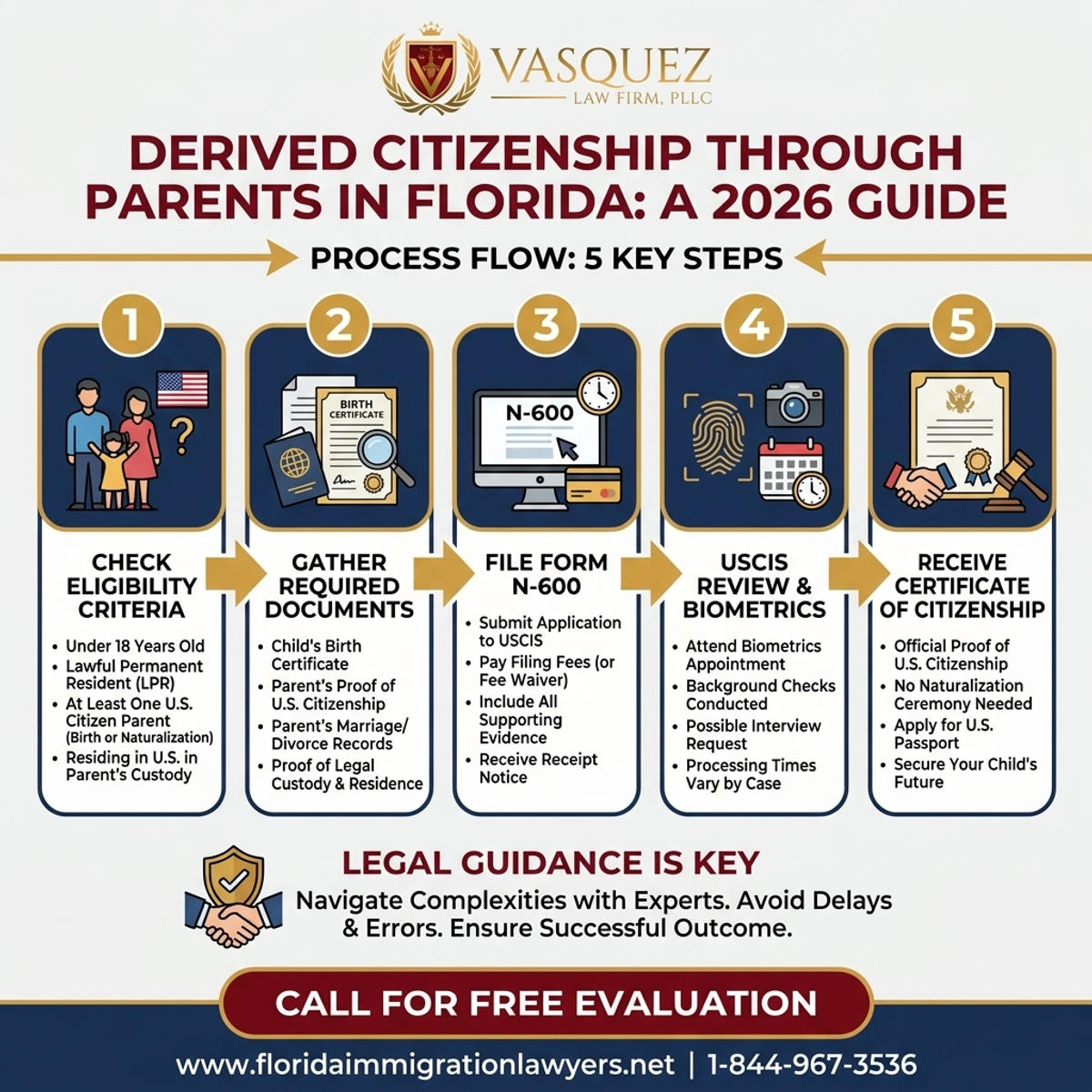
Step-by-Step Process — Derived Citizenship Through Parents in Florida: A 2026 Guide
Each step is crucial to ensure a smooth and successful application process.
The initial step, verifying eligibility, is perhaps the most critical. Before investing time and resources, you must confirm that you meet all the legal requirements. This involves reviewing your birth certificate, your parents' marriage and divorce decrees (if applicable), and crucially, your parent's U.S. citizenship documentation and your own immigration records. If there are any ambiguities or missing information, consulting with Florida Immigration Lawyers can help you clarify your standing and identify potential challenges early on.
Gathering necessary documents is often the most time-consuming part of the process. Beyond the basic birth certificates and parents' citizenship proof, you might need marriage certificates, adoption decrees, divorce judgments, school records, medical records, tax returns, and utility bills to establish legal and physical custody and continuous U.S. residency. All foreign-language documents must be accompanied by certified English translations. Organizing these documents meticulously and ensuring they are certified copies will prevent delays and requests for further evidence from USCIS.
Submitting Form N-600, Application for Certificate of Citizenship, is how you formally request official recognition of your existing citizenship. This form is detailed and requires accurate information about your family history, your parents' immigration journeys, and your own entry into the U.S. Any inconsistencies or errors can lead to significant delays or even denial. It's highly recommended to have an experienced immigration attorney review your completed N-600 form and all supporting documentation before submission to USCIS, especially for residents of Orlando and throughout Florida. This meticulous review can help ensure your application is as strong as possible.
The USCIS interview is a standard part of the N-600 process. During this interview, a USCIS officer will verify the information provided in your application and supporting documents. The applicant, and often the citizen parent, will be required to attend. The officer may ask questions about your family, your parents' citizenship, your residency, and your custody arrangements. Preparation is key: review your application thoroughly, bring all original documents, and be prepared to answer honestly and consistently. Your attorney from Florida Immigration Lawyers can help you prepare for this interview, ensuring you feel confident and ready.
Upon approval, you will receive your Certificate of Citizenship. This document is the definitive proof of your U.S. citizenship, serving the same legal purpose as a birth certificate for those born in the U.S. It is essential for obtaining a U.S. passport, voting, and demonstrating your citizenship for various legal and administrative purposes. Safeguard this document carefully, as replacing it can be another lengthy process. Maintaining accurate contact information with USCIS throughout the process is also vital to ensure you receive all correspondence, including your approval notice and certificate.
Required Documents for Derived Citizenship
To apply for derived citizenship, specific documents are necessary. These include:
- Certified birth certificate from your birth country.
- Parents’ citizenship documents (e.g., naturalization certificate).
- Proof of lawful residence in the U.S. (e.g., green card).
- Proof of parental custody and residence in the U.S.
Having these documents ready can significantly expedite the process.
Let's elaborate on why each of these documents is crucial. Your certified birth certificate from your birth country establishes your identity and your biological parentage, linking you to your parents. Parents' citizenship documents, such as a U.S. birth certificate, Consular Report of Birth Abroad (CRBA), or a Certificate of Naturalization, are fundamental to proving that at least one of your parents is a U.S. citizen. Without this, the derived citizenship claim cannot be substantiated. For those whose parents naturalized, the date on the naturalization certificate is critical for verifying the "under 18" age requirement.
Proof of lawful residence in the U.S., typically your Permanent Resident Card (green card), demonstrates that you were lawfully admitted for permanent residence. This is a prerequisite for derived citizenship to occur in most cases. Furthermore, proving parental custody and residence in the U.S. is essential. This can involve a range of documents, including court orders granting legal custody, school enrollment records, medical records, utility bills, and lease agreements or property deeds showing that you and your citizen parent lived together in the United States. For any documents not in English, a complete and certified English translation is required.
A practical tip for gathering these documents is to create a detailed checklist based on the USCIS instructions for Form N-600. Start collecting documents well in advance, as some may take time to obtain, especially from foreign governments. Make sure all copies are clear and legible, and never send original documents unless specifically requested by USCIS. Instead, provide certified copies. If you encounter difficulties in obtaining primary evidence, an experienced immigration lawyer from Florida Immigration Lawyers can advise you on what secondary evidence might be acceptable and how to present it effectively to USCIS.
Timeline and Processing Expectations for Derived Citizenship
Understanding the timeline for derived citizenship can help set realistic expectations.
| Stage | Typical Timeframe | Notes |
|---|---|---|
| Eligibility Verification | 1-2 weeks | Gather necessary documentation |
| Form N-600 Submission | 6-12 months | Depends on USCIS processing times |
| USCIS Interview | 1-2 months after submission | Preparation is key |
| Certificate Issuance | 1-2 weeks post-approval | Receive by mail |
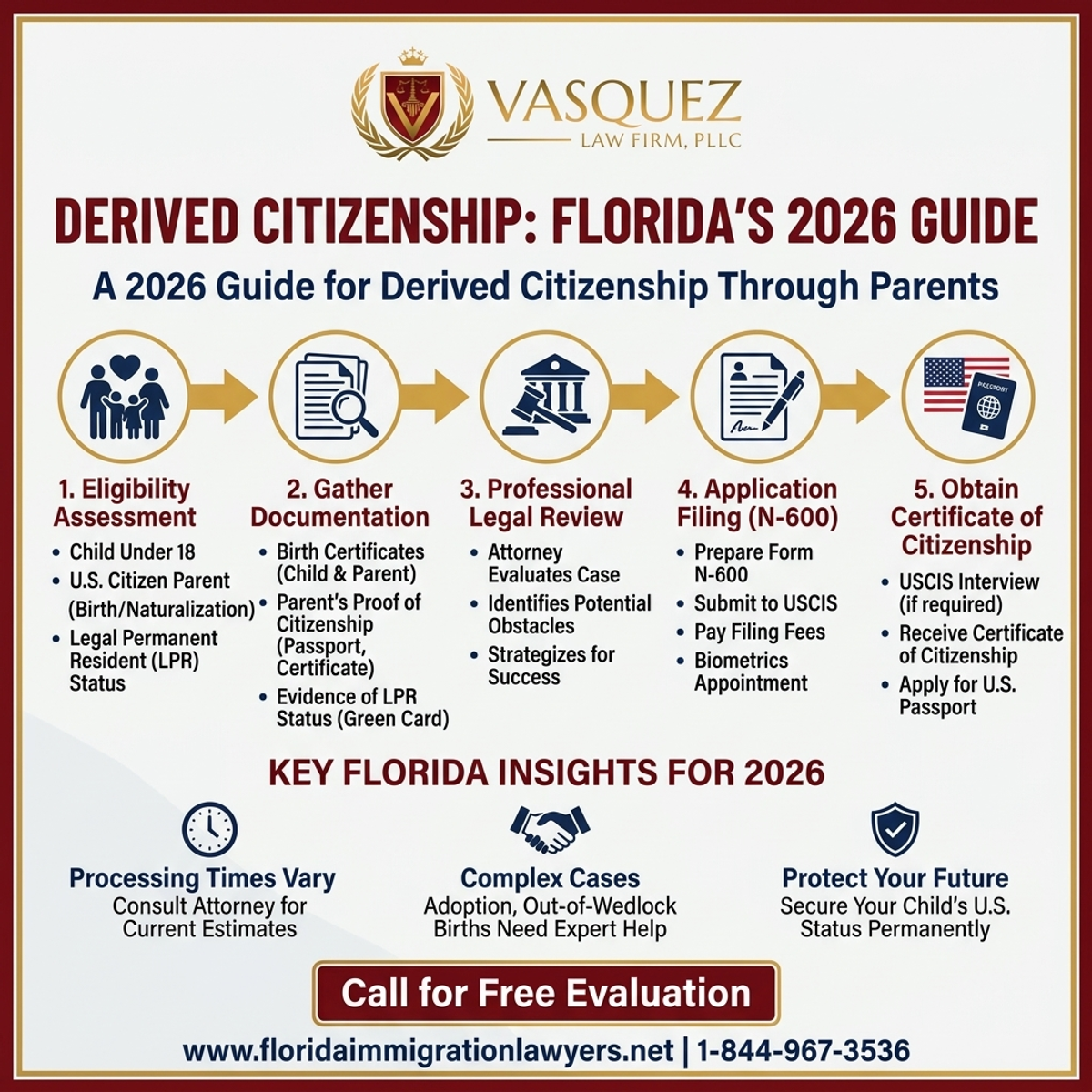
Key Statistics — Derived Citizenship Through Parents in Florida: A 2026 Guide
Processing times may vary based on individual circumstances and USCIS workload.
It's important to understand that the "Typical Timeframe" presented in the table are averages and can fluctuate significantly. USCIS processing times are influenced by various factors, including the volume of applications received, staffing levels, policy changes, and the complexity of individual cases. You can always check the most current processing times for Form N-600 on the USCIS website by selecting your field office (e.g., Orlando, Florida) and form type.
Several factors can cause delays beyond the typical timeframe. These include receiving a Request for Evidence (RFE) if your initial submission is incomplete or unclear, the need for extensive background checks, or if there are unforeseen scheduling conflicts for your interview. While patience is required, it's also important to be proactive. If your case seems to be taking an unusually long time, or if you receive an RFE, contacting Florida Immigration Lawyers can provide clarity and help you respond appropriately to keep your application moving forward efficiently.
Cost Factors and Fee Breakdown for Obtaining Derived Citizenship
While pursuing derived citizenship, it is important to consider potential costs involved.
| Item | Typical Fee | Notes |
|---|---|---|
| Form N-600 Filing Fee | Varies | Check current USCIS fees |
| Document Translation | Varies | For non-English documents |
| Legal Assistance | Varies | Optional but recommended |
Consulting with a legal expert can help manage these costs effectively.
The Form N-600 filing fee is a mandatory cost set by USCIS and is subject to change. It's crucial to check the most current fee schedule on the USCIS website before submitting your application. For individuals who meet specific income guidelines, USCIS offers a fee waiver option. If you believe you qualify for a fee waiver, you must submit Form I-912, Request for Fee Waiver, along with your N-600 application and supporting documentation. An attorney can help you determine eligibility and prepare this request.
Document translation costs can vary widely depending on the number of documents, their length, and the language pair. It's important to use certified translators, as USCIS requires a certification from the translator that the translation is complete and accurate, and that they are competent to translate from the foreign language into English. Obtaining quotes from several certified translation services can help manage this expense.
While legal assistance is listed as optional, it is highly recommended, especially given the complexities of immigration law. Attorney fees for derived citizenship cases vary based on the attorney's experience, the complexity of your case, and the scope of services provided. While it represents an upfront cost, the value of expert guidance in avoiding costly errors, ensuring a complete and accurate application, and representing your interests during the process can save significant time and money in the long run. Florida Immigration Lawyers offers a free initial consultation, allowing you to understand your options and potential costs without obligation.
Do not navigate this process alone. Contact Florida Immigration Lawyers today.
Common Mistakes to Avoid
Applying for derived citizenship can be complex. Avoid these common mistakes:
- Missing documents: Ensure all required documents are submitted to avoid delays. Even a single missing document can lead to a Request for Evidence (RFE) or outright denial, significantly prolonging your application. Tip: Create a comprehensive checklist and have an attorney review it before submission.
- Incorrect form completion: Errors on Form N-600 can result in rejection. Errors, even minor ones, can cause your application to be rejected or returned, necessitating a resubmission. Tip: Double-check all entries, and consider having a legal professional from Florida Immigration Lawyers review your N-600.
- Not checking eligibility: Verify eligibility criteria before applying. Applying without meeting all criteria wastes time and money, as the application will be denied. Tip: Thoroughly review the eligibility requirements or seek a professional assessment from an immigration lawyer.
- Ignoring deadlines: Be aware of submission timelines to avoid missing your chance. While N-600 doesn't have a strict deadline, responding to RFEs or interview notices promptly is crucial. Tip: Keep a calendar of all USCIS communications and response deadlines.
- Not preparing for the interview: Prepare thoroughly to answer USCIS questions. A lack of preparation can lead to inconsistencies in your answers, raising red flags for USCIS officers. Tip: Practice answering common questions and bring all original documents to the interview.
- Failing to update address: Keep your address updated with USCIS to receive correspondence. Missing critical notices from USCIS due to an outdated address can result in application abandonment or denial. Tip: File Form AR-11 with USCIS every time you move.
- Not consulting an attorney: Legal guidance can prevent costly errors. Navigating immigration law without expert guidance can lead to costly delays, denials, and missed opportunities. Tip: Take advantage of free consultations offered by firms like Florida Immigration Lawyers to understand your options and avoid pitfalls.
When to Call a Lawyer
Obtaining derived citizenship involves navigating complex immigration laws. You should consider calling a lawyer if:
- You are unsure about your eligibility criteria.
- You face delays or denials in your application process.
- You need assistance with legal documentation and interview preparation.
Florida Immigration Lawyers offer expert guidance to ensure your process is smooth and successful.
Beyond the general scenarios, there are specific situations where legal intervention becomes not just beneficial, but often crucial. These include complex family histories involving adoptions, step-parents, or non-traditional family structures, where proving legal and physical custody can be challenging. Similarly, if there have been previous immigration issues, such as past visa denials, deportation proceedings, or even minor criminal offenses, these could complicate your derived citizenship claim, making a lawyer's expertise indispensable.
An experienced immigration attorney from Florida Immigration Lawyers can provide invaluable assistance throughout your derived citizenship journey. They can meticulously review your case to confirm eligibility, help you gather and organize all necessary documentation, prepare a robust application, and represent you during the USCIS interview. Should your application face delays, receive a Request for Evidence (RFE), or even a denial, your attorney can advocate on your behalf, respond to USCIS inquiries, and explore all available legal remedies to protect your rights and secure your citizenship.
Frequently Asked Questions About Derived Citizenship
What is the difference between derived and acquired citizenship?
Acquired citizenship occurs automatically at birth to U.S. citizen parents, often outside the U.S., without any application needed. Derived citizenship, on the other hand, applies to children born abroad who gain citizenship through their parents' naturalization or meeting other specific conditions after their birth but before they turn 18. Both result in automatic citizenship, but the timing and circumstances differ significantly.
Can I apply for derived citizenship if my parent naturalized after I turned 18?
Unfortunately, no. A crucial requirement for derived citizenship is that you must be under 18 years old when your parent naturalizes or meets the other specific conditions. If your parent became a U.S. citizen after your 18th birthday, you would generally need to pursue naturalization yourself, assuming you meet the separate eligibility criteria for adult naturalization.
What if my parents are divorced or separated?
Derived citizenship is still possible if your parents are divorced or separated, as long as you are in the legal and physical custody of the U.S. citizen parent. USCIS will require documentation proving this custody arrangement, such as court orders or divorce decrees. Consulting with Florida Immigration Lawyers can help you navigate these complex custody situations effectively.
Do I need to take a citizenship test for derived citizenship?
No, individuals obtaining derived citizenship are generally not required to take the English and civics test that is part of the naturalization process for adults. This is because derived citizenship is based on your parents' status, not your own independent application for naturalization. The N-600 interview focuses on verifying eligibility conditions.
What if I don't have all the required documents?
If primary documents are unavailable, USCIS may accept secondary evidence, such as school records, medical records, affidavits from individuals with personal knowledge, or other official records. It's crucial to explain why primary documents are missing and provide the best available evidence. An experienced attorney can help you strategize and gather compelling secondary evidence.
Can I lose my derived citizenship?
Once you have derived U.S. citizenship, it is generally considered permanent, just like citizenship acquired through birth. However, citizenship can be revoked (denaturalized) in very rare cases, typically involving fraud or misrepresentation during the application process. This is an extremely serious matter, and legal counsel is essential if such a situation arises.
About Florida Immigration Lawyers
Florida Immigration Lawyers is a trusted firm dedicated to providing comprehensive immigration services in Orlando and throughout Florida. We specialize in family immigration, citizenship, deportation defense, and more. Our experienced attorneys are available 24/7 to assist you with your case. Call 1-844-YO-PELEO or schedule a free consultation today.
Sources and References
- U.S. Citizenship and Immigration Services (USCIS)
- Executive Office for Immigration Review (EOIR)
- 8 U.S.C. Chapter 12 - Immigration and Nationality Act
Related services: naturalization process, citizenship test preparation, dual citizenship guidance, family-based immigration.
This article provides general legal information and is not intended as legal advice. Every case is unique, and outcomes depend on specific facts and circumstances. Contact an attorney for advice about your particular situation.
Ready to take the next step? Contact Florida Immigration Lawyers at 1-844-YO-PELEO for a free consultation. Se Habla Español - Estamos aquí para ayudarle.
If you need legal assistance, learn more about how our naturalization attorneys can help, or call us at 1-844-967-3536 for a free case review.
Do Not Navigate This Process Alone
Our experienced immigration attorneys are ready to fight for you. Get a free, confidential case review today.
Se Habla Español
Or leave your details and we’ll call you:
Free Evaluation in 24 Hours
Or talk to us right now

AI voice assistant — available 24/7
FreeFrequently Asked Questions

William J. Vásquez
Founding Attorney · Vasquez Law Firm
U.S. Air Force veteran and immigration attorney with years of hands-on U.S. immigration experience. J.D., NCCU School of Law. AILA member. Admitted to the 4th, 5th, and 11th Circuit Courts.
Available 24/7 - Free Evaluations
Reviewed for legal accuracy by William J. Vásquez
Licensed in North Carolina; U.S. immigration is federal practice.
Related Legal Services
Our Florida immigration attorneys can help you with asylum protection, citizenship and naturalization and immigration practice areas. Call today at 1-844-YO-PELEO for a free case review.
Related Links
Related Topics
Free Legal Case Review
Discuss your case with our experienced attorneys. We're available 24/7.
Se Habla Español - Estamos aquí para ayudarle.
Related Articles
DUI Immigration Consequences in Florida 2026
A DUI conviction in Florida can have severe immigration consequences, potentially leading to inadmissibility, deportation, or denial of immigration benefits. For non-citizens, a DUI is not just a traffic offense but a serious criminal matter that federal immigration law scrutinizes closely. Factors like multiple offenses, injury, or property damage can escalate a simple DUI to a Crime Involving Moral Turpitude (CIMT) or even an aggravated felony, triggering mandatory detention and removal proceedings. Understanding the specific nature of your Florida conviction and its interpretation under the Immigration and Nationality Act (INA) is crucial. This article outlines how DUIs impact immigration status, the grounds for inadmissibility and deportation, a step-by-step guide to navigating the process, essential documentation, and expected timelines for 2026. We also highlight common mistakes to avoid and when to seek legal counsel from an experienced immigration attorney. Florida Immigration Lawyers offers comprehensive support for individuals facing these challenging situations, providing expert guidance through complex legal landscapes.
Immigration Lawyer Orlando Free Consultation in Florida
For individuals and families in Orlando, Florida, navigating the complexities of U.S. immigration law requires expert guidance. An immigration lawyer in Orlando offers crucial support for everything from visa applications and green card processes to naturalization and deportation defense. This comprehensive guide details what a free consultation covers, providing a step-by-step overview of immigration pathways, essential document checklists, and expected timelines in 2026. We also highlight common mistakes to avoid, discuss the critical role of legal counsel in deportation and asylum cases, and explain why choosing a local Orlando immigration attorney is beneficial. Florida Immigration Lawyers is dedicated to serving the diverse community of Orlando with compassionate, effective legal solutions, ensuring you receive personalized advice and robust representation for a successful immigration journey.
EAD Advance Parole Combo Card in Florida 2026
For individuals with a pending Form I-485, Application to Register Permanent Residence or Adjust Status, the EAD Advance Parole Combo Card is an essential document. This single card combines the authorization to work legally in the U.S. (Employment Authorization Document - EAD) with permission to travel internationally and re-enter without abandoning your green card application (Advance Parole). This guide from Florida Immigration Lawyers provides a comprehensive overview for applicants in Florida in 2026, covering eligibility, the step-by-step application process, required documents, expected processing times, and associated costs. We also highlight common mistakes to avoid and when to seek legal counsel to ensure a smooth and successful immigration journey. Understanding this vital card is key to maintaining stability while awaiting your permanent residency approval.
EAD Advance Parole Combo Card in Florida: What You Need
An EAD advance parole combo card allows individuals with pending adjustment applications to both work and travel abroad without jeopardizing their green card application. Learn how to apply in Florida, what documents you need, and common mistakes to avoid.