DED Eligibility for Venezuela and Haiti in Florida
Deferred Enforced Departure (DED) offers temporary protection for eligible Venezuelans and Haitians in Florida. Learn about eligibility, application steps, and common mistakes. Contact Florida Immigration Lawyers for guidance.

DED Eligibility for Venezuela and Haiti in Florida: A Comprehensive Guide
Deferred Enforced Departure (DED) offers a crucial lifeline for individuals from certain countries facing humanitarian crises or political instability. For many Venezuelans and Haitians residing in Florida, DED provides temporary protection from deportation and the opportunity to obtain work authorization. This comprehensive guide delves into the specifics of DED eligibility for these communities in Florida, outlining the criteria, application process, and the broader implications for their lives. Understanding DED is vital for those seeking stability and security in the United States, especially in a state like Florida, which is home to large and vibrant Venezuelan and Haitian populations. Navigating the complexities of U.S. immigration law can be daunting, but with the right information and legal support, beneficiaries can secure their status and build a more stable future.
Understanding Deferred Enforced Departure (DED)
Deferred Enforced Departure (DED) is a discretionary authority exercised by the President of the United States to provide temporary immigration benefits to individuals from designated countries. Unlike Temporary Protected Status (TPS), which is a statutory program, DED is based purely on the President's constitutional authority to conduct foreign relations. While similar in effect – offering protection from removal and work authorization – DED designations are typically made in response to specific foreign policy considerations, humanitarian concerns, or extraordinary circumstances that make it unsafe for nationals of a particular country to return home. It is a temporary measure, and its duration and conditions are determined by presidential directives.
The primary benefit of DED is the protection it offers from deportation. Individuals granted DED cannot be removed from the United States during the designated period. Additionally, DED beneficiaries are typically eligible to apply for an Employment Authorization Document (EAD), allowing them to work legally in the U.S. This provides not only economic stability but also a sense of normalcy and integration into American society. It's important to understand that DED does not grant a path to permanent residency or U.S. citizenship directly, but it provides a critical temporary reprieve. For those seeking more permanent solutions or facing complex situations, exploring other immigration pathways with a qualified legal professional is often necessary. The specific conditions and eligibility requirements for DED can vary with each designation, making it essential for applicants to stay informed about the latest announcements and directives.
DED for Venezuela: A Lifeline for Those in Crisis
Venezuela has faced a severe political, economic, and humanitarian crisis for many years, leading to a mass exodus of its citizens. Recognizing these dire conditions, the U.S. government has extended protections to eligible Venezuelans. On January 20, 2021, President Biden issued a memorandum directing the Secretary of Homeland Security to implement DED for certain Venezuelan nationals for 18 months, citing the extraordinary humanitarian crisis, economic collapse, and human rights abuses in Venezuela. This designation was subsequently extended and expanded, providing ongoing relief to a significant population.
To be eligible for DED under the Venezuelan designation, individuals generally must have been continuously residing in the United States since a specified date. They must also meet other criteria, such as not having been convicted of certain crimes (felonies or two or more misdemeanors), not posing a threat to national security, and not having voluntarily returned to Venezuela after the DED designation. The application process primarily involves filing Form I-765, Application for Employment Authorization, to obtain an EAD. It is crucial for applicants to gather all necessary supporting documentation, including proof of identity, nationality, and continuous residence in the U.S. Many Venezuelans in Florida have found this protection invaluable, allowing them to work and support their families while the situation in their home country remains unstable. Understanding the specific dates of continuous presence and the exact scope of the DED designation is paramount for successful application. Legal counsel can be instrumental in ensuring all requirements are met and the application is submitted correctly.
DED for Haiti: Addressing Humanitarian Needs
Haiti has also endured a series of devastating challenges, including natural disasters, political instability, and widespread violence, prompting the U.S. government to offer various forms of humanitarian protection. While many Haitians have been eligible for Temporary Protected Status (TPS), DED has also been utilized to provide relief during specific periods. For instance, in 2021, President Biden announced DED for certain Haitian nationals for 18 months, citing the country's ongoing security concerns, human rights abuses, and severe socioeconomic conditions exacerbated by natural disasters.
Eligibility for DED for Haitian nationals typically mirrors that of other DED designations: continuous physical presence in the U.S. since a specified date, clean criminal record, and no national security concerns. It is vital for Haitian applicants to distinguish between DED and TPS, as both programs have distinct eligibility requirements and application periods, though they offer similar benefits. Some individuals may be eligible for both, while others may only qualify for one. The application process for DED for Haitians also involves filing Form I-765 to obtain work authorization. For the large Haitian community in Florida, DED has provided a critical safety net, allowing them to rebuild their lives away from the turmoil in Haiti. Given the complex history of protections for Haitians, consulting with an experienced immigration attorney is highly recommended to determine the best course of action and ensure compliance with all requirements. This is especially true for those who may have previously held TPS or other statuses.
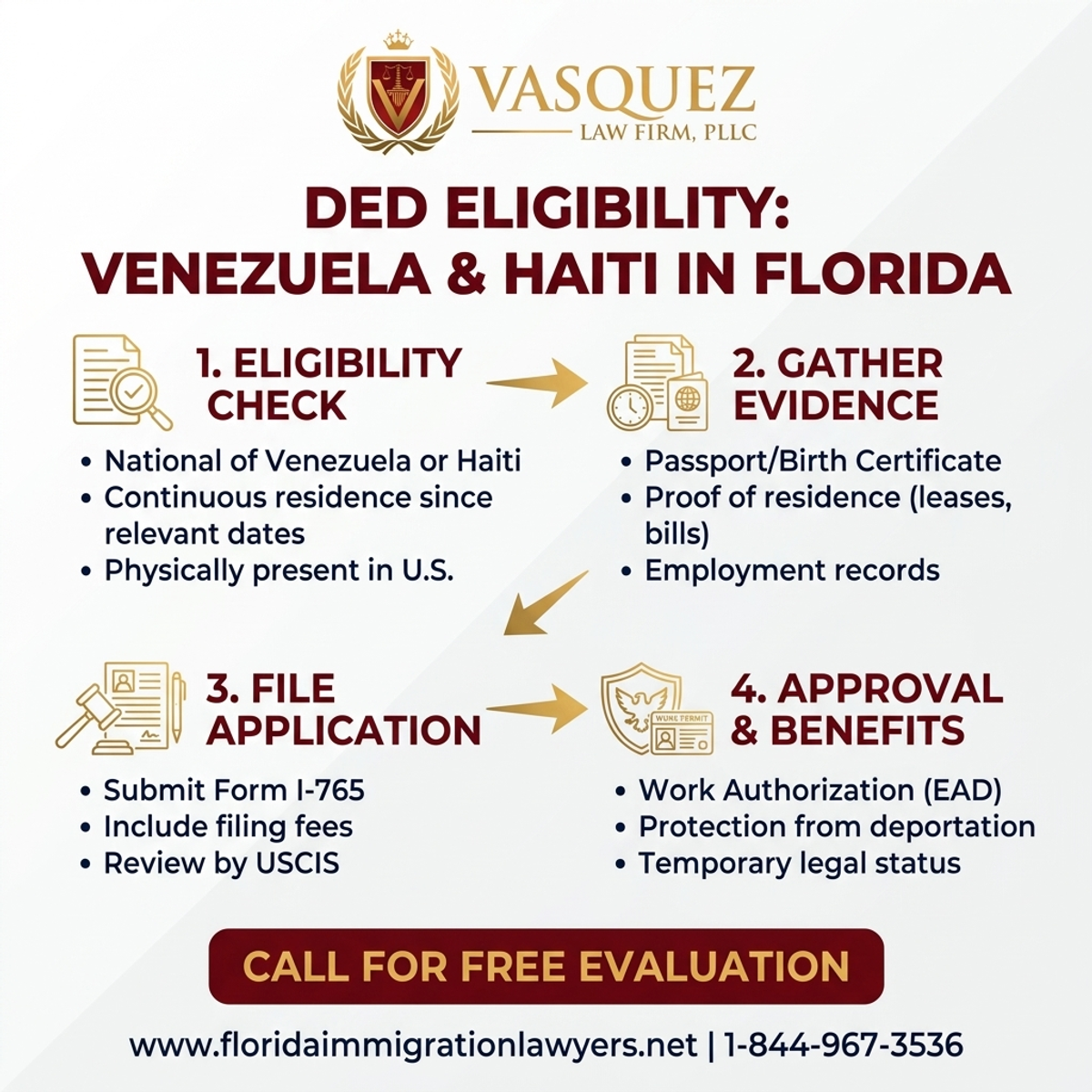
Step-by-Step Process — DED Eligibility for Venezuela and Haiti in Florida
Florida's Unique Position for DED Beneficiaries
Florida holds a unique and significant position for both Venezuelan and Haitian DED beneficiaries. The state is home to one of the largest populations of both communities in the United States, particularly in South Florida. Cities like Miami, Orlando, and Fort Lauderdale have thriving Venezuelan and Haitian diasporas, offering robust community support networks, cultural institutions, and specialized services. This concentration means that DED designations have a profound impact on thousands of families across the state, affecting their ability to work, study, and integrate into society.
The presence of these large communities also means that there are numerous legal firms, non-profit organizations, and community centers in Florida that specialize in assisting DED applicants. However, it also means that the demand for accurate information and reliable legal assistance is exceptionally high. Navigating state-specific resources and understanding local nuances can be crucial for DED beneficiaries in Florida. The state's proximity to the Caribbean and Latin America further underscores its role as a primary destination for individuals seeking refuge and opportunity. For those residing in Florida, staying informed about local resources and legal aid available for DED applications is just as important as understanding the federal guidelines. The unique demographic landscape of Florida makes it a critical hub for DED-related services and support, emphasizing the need for accessible and expert legal guidance.
Navigating the DED Application Process: A Step-by-Step Guide
Applying for Deferred Enforced Departure (DED) can seem complex, but breaking it down into manageable steps can simplify the process. The primary application for DED beneficiaries is Form I-765, Application for Employment Authorization, which allows you to obtain a work permit. Here’s a general step-by-step guide to help you navigate the process:
- Determine Your Eligibility: First and foremost, confirm that you meet all the specific criteria for the DED designation applicable to your country, including continuous physical presence in the U.S. since the designated date, nationality, and absence of disqualifying criminal records. Review the latest Federal Register notices or USCIS announcements for precise dates and requirements.
- Gather Required Documents: You will need to collect various documents to support your application. These typically include:
- Proof of identity and nationality (e.g., passport, birth certificate with photo ID).
- Proof of continuous physical presence in the U.S. since the specified date (e.g., utility bills, rental agreements, employment records, school records, medical records, bank statements, affidavits from friends/family).
- Two passport-style photos.
- Any previous EADs or immigration documents.
- If applicable, documentation related to any criminal history (even minor infractions should be disclosed and reviewed by an attorney).
- Complete Form I-765: Fill out Form I-765 accurately and completely. Pay close attention to all sections and ensure consistency with your supporting documents. For DED, you will typically select category (c)(11) for DED-related EADs.
- Prepare the Filing Fee: Check the current filing fee for Form I-765 on the USCIS website. If you cannot afford the fee, you may be eligible to apply for a fee waiver using Form I-912, Request for Fee Waiver.
- Assemble Your Application Packet: Organize all your documents neatly. It's often recommended to include a cover letter listing the contents of your application. Make copies of everything for your records before mailing.
- Mail Your Application: Send your complete application packet to the correct USCIS lockbox facility. The address depends on where you live and the form you are filing, so always check the USCIS website for the most current mailing addresses.
- Attend Biometrics Appointment: After filing, you will likely receive an appointment notice for biometrics (fingerprints and photos) at an Application Support Center (ASC). This is a mandatory step for background checks.
- Receive Decision: USCIS will process your application. You will receive a receipt notice, and eventually, a decision notice. If approved, your EAD card will be mailed to you.
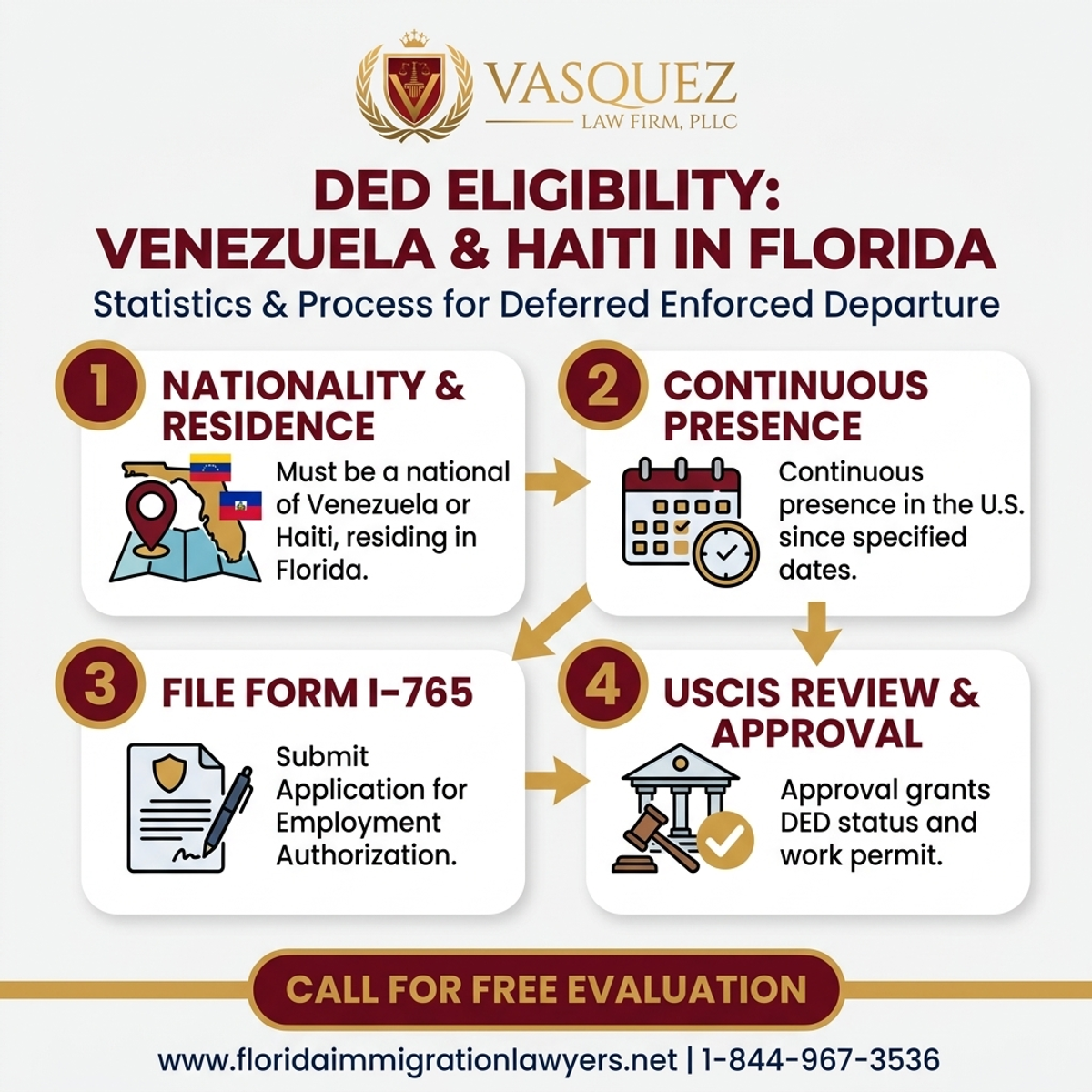
Key Statistics — DED Eligibility for Venezuela and Haiti in Florida
Common pitfalls include incomplete applications, incorrect filing fees, missing documentation, or failure to disclose relevant information. Seeking guidance from an experienced immigration attorney can significantly reduce the risk of errors and ensure a smoother process.
Beyond DED: Exploring Other Immigration Pathways and Protections
While Deferred Enforced Departure (DED) offers vital temporary protection, it’s important for beneficiaries to understand that it is not a pathway to permanent residency. For many, DED serves as a crucial bridge while they explore more long-term immigration solutions. Depending on individual circumstances, several other avenues might be available. For instance, individuals who fear persecution in their home country may be eligible to apply for asylum. Asylum provides protection to those who have suffered persecution or have a well-founded fear of persecution on account of race, religion, nationality, membership in a particular social group, or political opinion.
Another common pathway, especially for those from countries experiencing ongoing crises, is Temporary Protected Status (TPS), which is a statutory program designated by the Secretary of Homeland Security. While DED and TPS offer similar benefits, their legal bases and specific eligibility requirements differ. Family-based immigration is also a significant route for many, where U.S. citizens or lawful permanent residents can petition for eligible family members. Employment-based visas, though often more complex, can also be an option for individuals with specific skills or job offers.
Moreover, for individuals who may have overstayed their visa, entered without inspection, or are otherwise out of status, DED can provide a temporary shield. However, they might still face challenges in adjusting their status or could be placed in removal proceedings once DED expires. In such cases, robust deportation defense strategies become critical. Consulting with legal experts can help individuals understand the full spectrum of their options, assess their eligibility for various programs, and develop a comprehensive long-term immigration strategy beyond the temporary relief provided by DED.
The Indispensable Role of an Immigration Attorney
Navigating the intricate landscape of U.S. immigration law, especially concerning programs like DED, can be incredibly challenging. The regulations are constantly evolving, and the application process is fraught with potential pitfalls that can lead to delays or even denials. This is where the expertise of an immigration attorney becomes indispensable. An experienced attorney can provide invaluable guidance, ensuring that your application is meticulously prepared, all necessary documentation is included, and deadlines are met.
Attorneys specializing in immigration law can help you accurately assess your eligibility for DED, as well as identify any other potential immigration pathways that might be available to you, such as asylum or family-based petitions. They can assist in gathering complex evidence, drafting affidavits, and responding to Requests for Evidence (RFEs) from USCIS. Furthermore, if you have a criminal record, even a minor one, an attorney can evaluate its impact on your eligibility and advise on the best course of action. For those who may be facing removal proceedings, an attorney can provide critical deportation defense, representing your interests in court and fighting to protect your right to remain in the U.S.
The peace of mind that comes with knowing your case is handled by a professional is immeasurable. An attorney acts as your advocate, protecting your rights and ensuring you receive fair treatment throughout the process. When dealing with something as crucial as your immigration status, attempting to navigate the system alone can be risky. Investing in legal counsel from dedicated attorneys is an investment in your future and your ability to live and work securely in the United States. Don't hesitate to seek professional advice to ensure the best possible outcome for your DED application and any other immigration needs.
Conclusion
Deferred Enforced Departure (DED) offers a vital temporary reprieve for eligible Venezuelan and Haitian nationals in Florida, providing protection from deportation and work authorization during periods of crisis in their home countries. Understanding the specific eligibility criteria, the application process, and the nuances between DED and other protections like TPS is crucial for beneficiaries. While DED provides significant relief, it is a temporary measure, and individuals should explore long-term immigration strategies with expert guidance.
Given the complexities of immigration law and the importance of a successful application, seeking professional legal assistance is highly recommended. An experienced immigration attorney can help you navigate the process, avoid common pitfalls, and explore all available options for your unique situation. If you are a Venezuelan or Haitian national in Florida seeking DED or exploring other immigration pathways, do not hesitate to reach out for expert advice. Your future and stability depend on accurate information and skilled representation. Contact us today for a consultation to discuss your specific needs and how we can assist you.
Sources and References
- U.S. Citizenship and Immigration Services (USCIS)
- Executive Office for Immigration Review (EOIR)
- U.S. Department of State - Bureau of Consular Affairs
- Immigration and Nationality Act (INA), 8 U.S.C. Chapter 12
Do Not Navigate This Process Alone
Our experienced immigration attorneys are ready to fight for you. Get a free, confidential consultation today.
Se Habla Español
Frequently Asked Questions
Florida Immigration Lawyers
Immigration Attorney | Founder, Vasquez Law Firm
U.S. Air Force veteran and immigration attorney with thousands of cases resolved. J.D., NCCU School of Law. AILA member. Admitted to the 4th, 5th, and 11th Circuit Courts.
Available 24/7 - Free Evaluations
Related Legal Services
Our Florida immigration attorneys can help you with family immigration services, immigration practice areas and free immigration consultation. Call today at 1-844-967-3536 for a free consultation.
Related Links
Related Topics
Free Legal Consultation
Discuss your case with our experienced attorneys. We're available 24/7.
Se Habla Español - Estamos aquí para ayudarle.
Related Articles
L-1 Visa Transfer for Florida Companies | VLF Florida
Discover the intricacies of L-1 visa transfers for Florida companies. Understand eligibility, documentation, and common pitfalls. Call us for guidance.
USCIS Office Locations in Florida: St. Petersburg Guide
Finding the right USCIS office in Florida, particularly in St. Petersburg, is crucial for managing your immigration needs effectively. Discover office locations, learn how to schedule appointments, and understand the services offered to ensure your immigration process is smooth. Contact Florida Immigration Lawyers at 1-844-967-3536 for a free consultation.
Re-entry Permit for Green Card Holders in Florida | VLF Florida
If you're a lawful permanent resident in Florida planning extended travel, understanding the re-entry permit is crucial. This document protects your green card status from abandonment. Learn more about the application process, common mistakes, and when to seek legal advice. For expert guidance, contact Florida Immigration Lawyers at 1-844-967-3536.
USCIS Office Locations in Florida | FL Immigration Lawyers
Discover the various USCIS office locations in Florida, including Hollywood. Learn how to schedule appointments and what to expect during your visit. Contact Florida Immigration Lawyers for a free consultation.
