Change of Status for Student Visas in Florida
Changing your student visa status in Florida can be a challenging process. Learn the steps and avoid common pitfalls with guidance from Florida Immigration Lawyers. Call 1-844-967-3536 for a free consultation.

Change of Status for Student Visas in Florida | VLF Florida
Florida, with its vibrant culture, diverse population, and world-class educational institutions, is a prime destination for international students. Many individuals initially enter the U.S. under one nonimmigrant visa category but later find themselves wishing to pursue academic studies. In such cases, a ‘Change of Status’ (COS) becomes a critical pathway. This process allows eligible individuals already present in the United States to switch from their current nonimmigrant visa category to a student visa (typically F-1 for academic studies or M-1 for vocational studies) without having to leave the country.
Navigating the complexities of U.S. immigration law, especially when it involves changing your status, can be daunting. The rules are strict, the documentation is extensive, and any misstep can lead to significant delays or even denial. At VLF Florida, we understand the aspirations of international students and are dedicated to providing comprehensive legal guidance to ensure a smooth transition. Our experienced immigration attorneys are here to help you understand the requirements, prepare your application, and represent your best interests throughout the process.
Understanding Student Visas: F-1 and M-1 Categories
Before delving into the change of status process, it’s essential to understand the primary student visa categories:
F-1 Student Visa (Academic and Language Students)
The F-1 visa is the most common nonimmigrant visa for individuals pursuing academic studies in the U.S. This includes university programs, colleges, high schools, language training programs, and other academic institutions. Key characteristics of the F-1 visa include:
- Full-Time Enrollment: F-1 students must be enrolled in a full course of study at an institution approved by the Student and Exchange Visitor Program (SEVP).
- English Proficiency: Applicants often need to demonstrate proficiency in English or be enrolled in courses leading to such proficiency.
- Financial Resources: Proof of sufficient funds to cover tuition, living expenses, and other costs for the duration of the study program is mandatory.
- Intent to Depart: F-1 visa holders must maintain a nonimmigrant intent, meaning they intend to return to their home country upon completion of their studies.
- Optional Practical Training (OPT): F-1 students may be eligible for OPT, which allows them to work in a field related to their major for a period after graduation.
M-1 Student Visa (Vocational Students)
The M-1 visa is for individuals pursuing vocational or non-academic studies. This could include technical schools, culinary arts programs, flight schools, or other vocational training. While similar in some aspects to the F-1, there are crucial differences:
- Limited Employment: M-1 students have very limited opportunities for employment compared to F-1 students, typically only for practical training after completing their course of study and only if directly related to their field.
- Course Load: M-1 students must also maintain a full course of study.
- Duration: The duration of an M-1 visa is typically tied to the length of the vocational program, plus 30 days to depart.
Understanding which visa category is appropriate for your educational goals is the first crucial step. Our team can help you determine the best path forward based on your academic aspirations.
Eligibility Requirements for Changing Status to Student in Florida
Changing your status to an F-1 or M-1 student visa while in Florida involves meeting specific criteria set by U.S. Citizenship and Immigration Services (USCIS). Not everyone is eligible, and failing to meet even one requirement can lead to a denial. Here are the primary eligibility factors:
1. Maintaining Lawful Nonimmigrant Status
This is perhaps the most critical requirement. You must have been lawfully admitted into the U.S. and maintained your nonimmigrant status without any violations. This means:
- You did not overstay your authorized period of admission (as indicated on your I-94 Arrival/Departure Record).
- You did not engage in any unauthorized employment.
- You did not violate any other terms or conditions of your current visa (e.g., a B-2 visitor cannot enroll in a full-time course of study before changing status).
If you have overstayed your visa or violated your status, you generally cannot change status from within the U.S. In such cases, you might need to leave the U.S. and apply for a new visa at a U.S. embassy or consulate abroad, which can trigger other complexities, including potential bars to re-entry.
2. Intent to Depart (Nonimmigrant Intent)
As a student visa is a nonimmigrant visa, you must demonstrate that you have no intention of abandoning your foreign residence and that you intend to depart the U.S. upon completion of your studies. While this can be challenging to prove, especially if you have strong ties to the U.S., evidence can include:
- Ties to your home country (property, family, job prospects).
- A clear academic plan that aligns with your career goals in your home country.
3. Acceptance by an SEVP-Approved School
You must be accepted by a U.S. educational institution that is approved by the Student and Exchange Visitor Program (SEVP). Upon acceptance, the school will issue you a Form I-20, “Certificate of Eligibility for Nonimmigrant Student Status.” This document is central to your application.
4. Sufficient Financial Resources
You must prove that you have adequate funds to cover your tuition, living expenses, and other associated costs for the entire duration of your proposed course of study without resorting to unauthorized employment. This can be demonstrated through:
- Bank statements.
- Scholarship letters.
- Affidavits of support from sponsors (with their financial documentation).
5. No Preconceived Intent
This is a subtle but important point. If you entered the U.S. on a nonimmigrant visa (e.g., a B-2 visitor visa) with the primary intention of changing your status to a student visa, USCIS might view this as 'preconceived intent' and deny your application. It’s generally advisable to wait at least 60-90 days after entry before filing a change of status application, although this is not a strict rule but rather a guideline to avoid suspicion.
Understanding these intricate requirements is paramount. Our attorneys at VLF Florida provide personalized assessments to help you determine your eligibility and strengthen your application.
The Application Process: Steps to Change Status to F-1/M-1
The process for changing your nonimmigrant status to an F-1 or M-1 student involves several key steps and meticulous documentation:
1. Get Accepted by an SEVP-Approved School
This is the foundational step. You must apply to and be accepted by an academic or vocational institution that is authorized to enroll international students. Once accepted, the Designated School Official (DSO) will issue you a Form I-20, “Certificate of Eligibility for Nonimmigrant Student Status.” Ensure all information on your I-20 is accurate and matches your passport details.
2. Pay the SEVIS I-901 Fee
The Student and Exchange Visitor Information System (SEVIS) fee is mandatory for all F-1 and M-1 students. You must pay this fee and obtain a receipt before filing your change of status application. The fee is typically paid online.
3. Prepare Form I-539, Application to Extend/Change Nonimmigrant Status
This is the primary form for your change of status application. You will need to accurately fill out all sections, providing details about your current status, your requested status, and your personal information. If you have dependents (spouse or children) who also wish to change to F-2 or M-2 status, they can be included on the same Form I-539.
4. Gather Supporting Documentation
A robust application package includes a variety of supporting documents. These typically include:
- Copy of your current passport (biographical page and visa stamp).
- Copy of your I-94 Arrival/Departure Record (print from CBP website).
- Original Form I-20 from your SEVP-approved school.
- SEVIS I-901 fee payment receipt.
- Proof of financial ability (bank statements, scholarship letters, affidavits of support).
- Copies of previous visa stamps and I-797 approval notices (if applicable).
- A personal statement or cover letter explaining your reasons for changing status and your academic goals.
- Evidence of ties to your home country (optional, but can strengthen your case).
- Any other documents requested by USCIS or relevant to your specific situation.
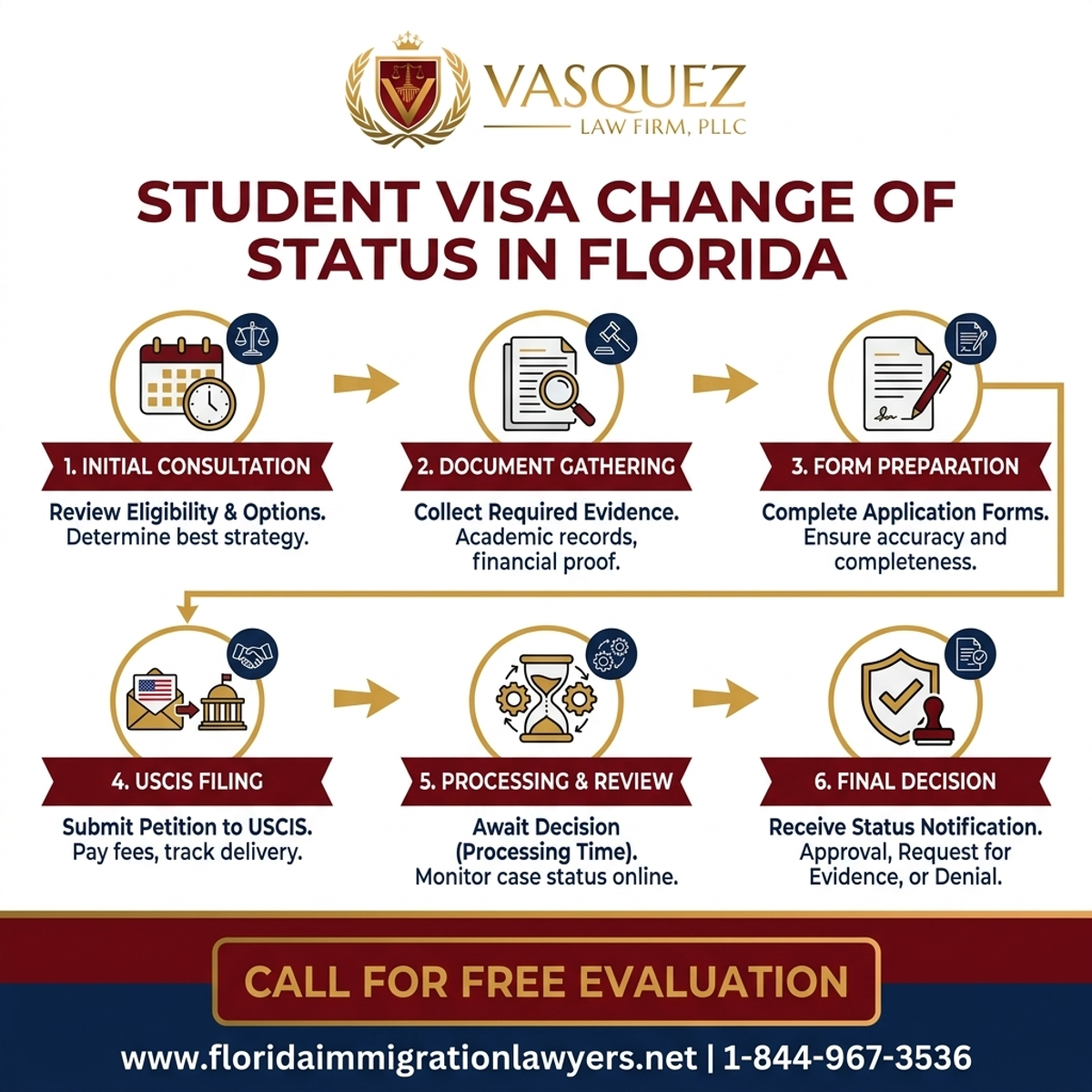
Step-by-Step Process — Change of Status for Student Visas in Florida | VLF Florida
5. File Your Application with USCIS
Once all forms are completed and documents gathered, you will mail your application package to the appropriate USCIS lockbox facility. Ensure you include the correct filing fee for Form I-539. It is highly recommended to send your application via certified mail with a return receipt or a courier service that provides tracking.
6. Biometrics Appointment (If Required)
USCIS may require you to attend a biometrics appointment at an Application Support Center (ASC) to have your fingerprints and photograph taken. You will receive a notice with the date, time, and location if this is required.
7. Await Decision
Processing times for change of status applications can vary significantly, often taking several months. During this period, you must maintain your lawful status and not begin your studies until your change of status is approved. USCIS will mail you a decision notice (Form I-797, Approval Notice) once your application is processed.
Given the meticulous nature of this process, seeking professional legal assistance is highly advisable. Our team ensures that your application is complete, accurate, and submitted correctly, minimizing the risk of Request for Evidence (RFE) or denial. Should your application be denied, and you find yourself in a precarious situation, our firm also specializes in deportation defense, offering crucial support during challenging times.
Maintaining Status While Your Application is Pending
A critical aspect of the change of status process is understanding your legal standing while your application is pending with USCIS. It’s a common misconception that simply filing the application automatically grants you student status or permission to begin studying. This is not the case.
Continuing Your Current Lawful Status
You must continue to maintain your current lawful nonimmigrant status until USCIS approves your change of status. For example, if you are in the U.S. on a B-2 visitor visa, you must adhere to the terms of your B-2 visa, which means you cannot enroll in a full course of study or work, even if your change of status application is pending. If your current status is set to expire before USCIS makes a decision, you may need to file an extension of your current status (if permissible) to avoid accruing unlawful presence.
The 240-Day Rule (Not Applicable to All)
For some nonimmigrant categories (e.g., H-1B, L-1, O-1), if an extension of stay is filed before the current I-94 expiration, the individual may continue working for up to 240 days beyond the I-94 expiration while the extension is pending. However, this rule typically does NOT apply to change of status applications to F-1 or M-1 from categories like B-1/B-2. It is crucial to consult with an attorney to understand how this applies to your specific situation.
Beginning Studies Only After Approval
You cannot begin your F-1 or M-1 course of study until your change of status application is officially approved by USCIS. Starting classes before receiving an approval notice can be considered a violation of your nonimmigrant status and could lead to your application being denied, and potentially put you at risk of deportation.
Travel While Application is Pending
If you travel outside the U.S. while your change of status application is pending, USCIS will consider your application abandoned. This means you would need to apply for an F-1 or M-1 visa at a U.S. embassy or consulate abroad to re-enter the U.S. as a student. It is generally advisable to remain in the U.S. until your change of status is approved.
Understanding these nuances is vital to avoid jeopardizing your immigration future. Our legal team can provide detailed advice tailored to your situation, ensuring you remain compliant with all regulations while your application is under review.
Navigating Post-Completion Options and Future Immigration Paths for Students
Obtaining an F-1 or M-1 student visa is often just the beginning of a longer immigration journey for many international students. Florida's robust economy and diverse industries offer numerous opportunities for graduates. Understanding the pathways available after completing your studies is crucial for long-term planning and can significantly impact your career trajectory in the U.S.
Optional Practical Training (OPT) and STEM OPT Extension
For F-1 students, Optional Practical Training (OPT) is a highly sought-after benefit. It allows students to work in a field directly related to their major area of study for up to 12 months after graduation. This provides invaluable real-world experience and a bridge between academic life and professional careers. To be eligible, students must apply for an Employment Authorization Document (EAD) through USCIS. The application process requires careful timing and coordination with your Designated School Official (DSO).
Furthermore, students who graduate with a degree in a Science, Technology, Engineering, or Mathematics (STEM) field from an accredited U.S. institution may be eligible for a 24-month STEM OPT extension, bringing their total OPT eligibility to 36 months. This extension is a critical pathway for many international students, offering a longer period to gain experience and potentially secure sponsorship for a work visa.
Transitioning to Work Visas (e.g., H-1B)
For many F-1 students, the ultimate goal after OPT is to transition to a nonimmigrant work visa, most commonly the H-1B visa for specialty occupations. The H-1B visa allows U.S. employers to temporarily employ foreign workers in occupations that require theoretical or technical expertise. The H-1B program is subject to an annual cap, making it highly competitive and often requiring participation in a lottery system. Employers typically sponsor H-1B petitions on behalf of their employees. Navigating the H-1B lottery, understanding employer requirements, and preparing a strong petition are complex processes that often necessitate expert legal guidance.
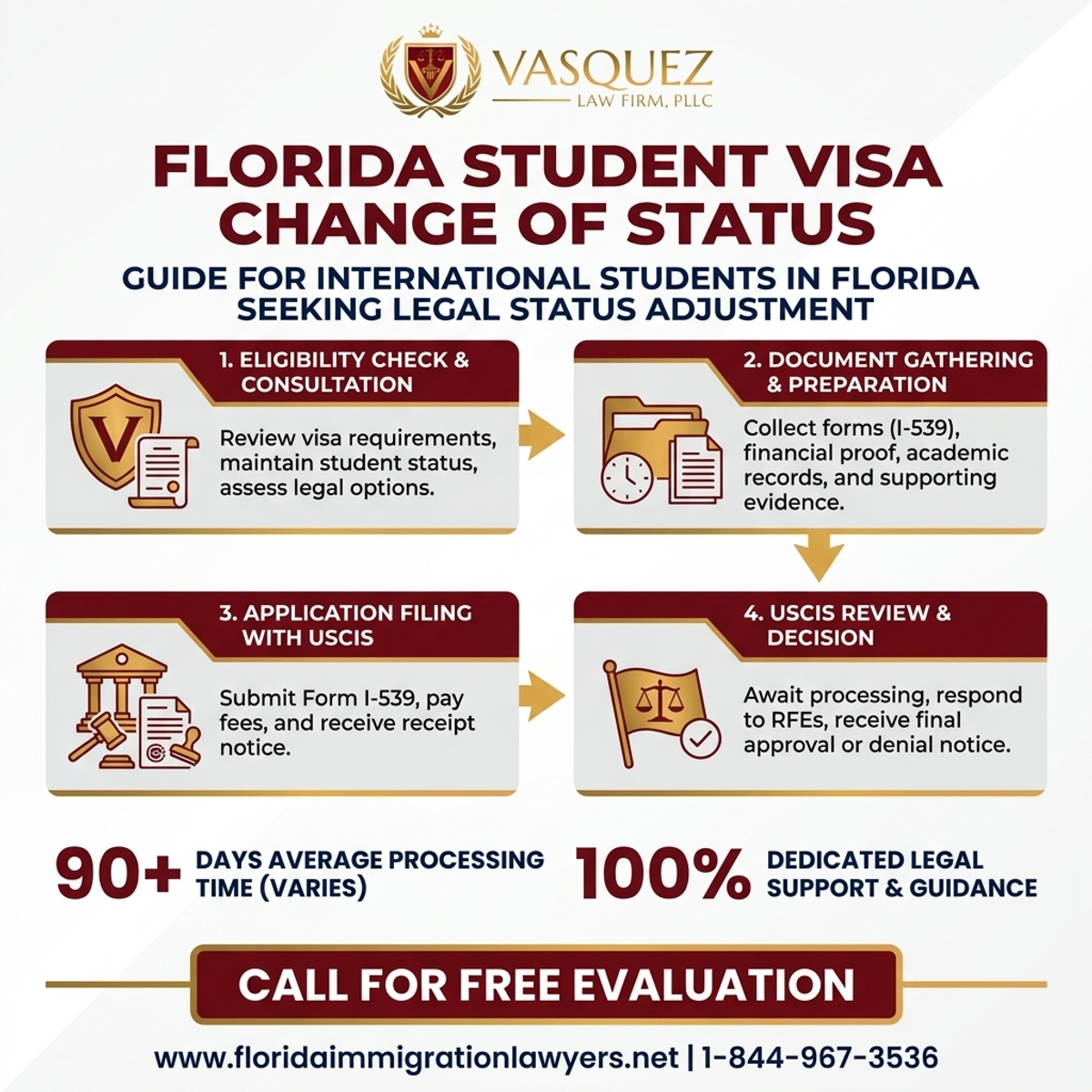
Key Statistics — Change of Status for Student Visas in Florida | VLF Florida
Other Nonimmigrant and Immigrant Options
Beyond the H-1B, other nonimmigrant visa options may be available depending on your qualifications and the nature of your employment, such as O-1 visas for individuals with extraordinary ability, L-1 visas for intra-company transferees, or E-2 visas for treaty investors. For those with long-term aspirations in the U.S., various immigrant visa (green card) categories exist, including employment-based petitions (EB-1, EB-2, EB-3), family-sponsored petitions, or even humanitarian options like asylum if circumstances warrant. Each pathway has its own stringent requirements and application process.
Importance of Early Planning and Legal Counsel
Planning your post-completion strategy while you are still a student is paramount. Understanding the deadlines for OPT applications, the H-1B cap season, and the requirements for other visa categories will position you for success. A proactive approach, coupled with the advice of an experienced immigration attorney, can help you identify the most suitable options, prepare necessary documentation, and navigate potential challenges. Our firm is dedicated to assisting students not only with their initial change of status but also with their long-term immigration goals, providing comprehensive support every step of the way.
Common Challenges and How to Avoid Them
While a change of status to a student visa offers a fantastic opportunity, the process is not without its challenges. Being aware of potential pitfalls can help you avoid costly mistakes:
1. Overstaying Your Current Visa
Accruing even a single day of unlawful presence can severely impact your eligibility for a change of status and future immigration benefits. Always file your application before your current I-94 expiration date.
2. Unauthorized Employment
Engaging in work without proper authorization is a serious violation of nonimmigrant status and will almost certainly lead to a denial of your change of status application and potential future immigration issues.
3. Insufficient Funds
Failing to provide clear and convincing evidence of sufficient financial resources to cover your education and living expenses is a common reason for denial. Ensure your financial documentation is robust and clearly demonstrates your ability to pay.
4. Preconceived Intent
As mentioned, if USCIS believes you entered the U.S. with the primary intent to change status to a student, your application may be denied. It's crucial to genuinely maintain your initial nonimmigrant intent upon entry.
5. Incomplete or Incorrect Documentation
Even minor errors or missing documents can lead to Requests for Evidence (RFEs) or outright denials, causing significant delays and stress. Double-check all forms and supporting documents for accuracy and completeness.
6. Delays in Processing
USCIS processing times can be unpredictable. Plan ahead and apply well in advance of your current status expiration. If your status expires while your application is pending, you are generally in a 'period of authorized stay' but cannot violate your initial visa terms.
Working with an experienced immigration attorney can significantly mitigate these risks. Our team at VLF Florida meticulously reviews every detail of your application, ensuring compliance and addressing potential issues proactively. We are committed to providing you with the best possible chance of success.
Why Choose VLF Florida for Your Change of Status?
The decision to change your nonimmigrant status to pursue education in the U.S. is a significant one, with long-term implications for your future. The complexities of immigration law require not just knowledge, but also strategic insight and meticulous attention to detail. Here’s why VLF Florida stands out as your trusted partner:
- Expertise in Florida Immigration Law: Our attorneys possess deep knowledge of U.S. immigration laws and their specific application in Florida. We stay updated on the latest policy changes and USCIS guidelines, ensuring your application benefits from the most current legal strategies.
- Personalized Guidance: We understand that every client’s situation is unique. We take the time to listen to your story, assess your specific circumstances, and provide tailored advice that aligns with your academic and immigration goals.
- Comprehensive Support: From the initial consultation to the final decision, we guide you through every step of the process. This includes helping you gather necessary documents, accurately complete complex forms, prepare compelling personal statements, and respond to any USCIS inquiries or RFEs.
- Proactive Problem Solving: We anticipate potential challenges and address them proactively, minimizing delays and increasing the likelihood of a successful outcome. Our goal is to make the process as smooth and stress-free as possible for you.
- Commitment to Your Future: Our dedication extends beyond just your change of status application. We are committed to helping you understand your long-term immigration options, whether it’s exploring post-completion work permits, transitioning to a work visa, or other permanent residency pathways.
- Accessibility and Communication: We believe in clear and consistent communication. Our team is accessible to answer your questions, provide updates, and ensure you feel informed and confident throughout your immigration journey.
Don't navigate the intricate world of immigration law alone. A small error can have significant consequences. Let our experienced immigration lawyers provide the professional guidance you need to secure your student visa status in Florida and lay the groundwork for a successful academic and professional future in the United States. We also offer robust deportation defense services should any adverse issues arise.
Contact VLF Florida Today for a Free Consultation
Embarking on a change of status journey requires careful planning and expert legal assistance. Whether you are currently in Florida on a visitor visa, another nonimmigrant status, or have specific questions about your eligibility, our team at VLF Florida is here to help. We offer a free, no-obligation consultation to discuss your case, evaluate your options, and outline a clear path forward.
Don't let the complexities of immigration law deter you from achieving your educational dreams in Florida. Take the first step towards a brighter future by reaching out to our dedicated immigration team today. Call us at (844) 967-3536 or fill out our online contact form to schedule your free consultation. Let VLF Florida be your trusted partner in navigating the path to your student visa and beyond.
Sources and References
- U.S. Citizenship and Immigration Services (USCIS)
- Executive Office for Immigration Review (EOIR)
- U.S. Department of State - Bureau of Consular Affairs
- Immigration and Nationality Act (INA), 8 U.S.C. Chapter 12
Do Not Navigate This Process Alone
Our experienced immigration attorneys are ready to fight for you. Get a free, confidential consultation today.
Se Habla Español
Or leave your details and we’ll call you:
Free Evaluation in 24 Hours
Or talk to us right now

AI voice assistant — available 24/7
FreeFrequently Asked Questions

William J. Vásquez
Founding Attorney · Vasquez Law Firm
U.S. Air Force veteran and immigration attorney with years of hands-on U.S. immigration experience. J.D., NCCU School of Law. AILA member. Admitted to the 4th, 5th, and 11th Circuit Courts.
Available 24/7 - Free Evaluations
Reviewed for legal accuracy by William J. Vásquez
Licensed in North Carolina; U.S. immigration is federal practice.
Related Legal Services
Our Florida immigration attorneys can help you with free immigration consultation, experienced immigration attorneys and business immigration. Call today at 1-844-967-3536 for a free consultation.
Related Links
Related Topics
Free Legal Consultation
Discuss your case with our experienced attorneys. We're available 24/7.
Se Habla Español - Estamos aquí para ayudarle.
Related Articles
Immigration Lawyer Orlando Free Consultation 2026
Discover how to find an immigration lawyer in Orlando offering a free consultation. Understand the services available and why choosing Florida Immigration Lawyers can make a difference in your case.
Military Naturalization Expedited in Florida Bases
Explore military naturalization options for families at Florida bases, including parole in place benefits in Miami. Learn how to expedite your application with expert guidance from Florida Immigration Lawyers.
K-3 Visa Timeline in Florida: What to Expect
Learn the K-3 visa timeline process in Florida, including steps, costs, and documentation. Understand your options in 2026 with guidance from Florida Immigration Lawyers.
We Just Received an RFE: Alternatives in Florida
Receiving a Request for Evidence (RFE) from USCIS in Florida requires immediate attention. This guide provides detailed steps to respond effectively, including common mistakes to avoid and when to seek legal assistance. If your current firm is unresponsive, discover alternatives in Jacksonville and beyond. Call Florida Immigration Lawyers at 1-844-967-3536 for a free consultation.