TPS Honduras Latest News 2026: Florida Immigrant Update
Stay informed about the latest developments concerning Temporary Protected Status (TPS) for Honduran nationals in 2026. This comprehensive guide from Florida Immigration Lawyers provides crucial updates on eligibility, re-registration processes, required documents, and potential timelines. Learn about the impact of ongoing legal challenges and policy shifts on TPS Honduras beneficiaries, especially those residing in Florida. We also cover common mistakes to avoid and when it is essential to seek expert legal counsel to protect your immigration status and future in the United States. Ensure your application is accurate and timely with professional guidance.

As of 2026, the status of Temporary Protected Status (TPS) for Honduran nationals continues to be a critical issue, with ongoing legal challenges and potential policy shifts. While specific extensions are subject to government decisions and court rulings, beneficiaries in Florida must remain vigilant and prepared for re-registration periods or changes in eligibility criteria. Consulting with an experienced immigration attorney is essential to navigate these complexities and protect your status effectively.
- TPS for Honduras is subject to ongoing legal and policy developments in 2026.
- Beneficiaries must stay informed about re-registration deadlines and eligibility.
- Florida residents should seek legal counsel for personalized guidance.
- Prepare for potential changes to work authorization and travel documents.
For many Honduran nationals living in Florida, the Temporary Protected Status (TPS) program has provided a crucial lifeline, offering stability and the ability to work legally in the United States for decades. However, the program's future is often uncertain, marked by extensions, terminations, and legal battles. As we move into 2026, staying informed about the latest developments regarding TPS for Honduras is not just important-it's essential for your security and future in the U.S.
Florida, with its diverse immigrant communities, including a significant Honduran population, is at the forefront of these discussions. Understanding the implications of policy changes, re-registration requirements, and potential pathways to permanent residency is vital. This comprehensive guide from Florida Immigration Lawyers aims to provide clarity on the current state of TPS Honduras, particularly for those residing in Jacksonville, Miami, Orlando, and across the Sunshine State.
Navigating the complexities of immigration law can be overwhelming, especially when your status is at stake. Do not face this uncertainty alone. Call Florida Immigration Lawyers at 1-844-967-3536 for a free consultation. We are here to help you understand your options and protect your future.
Understanding Temporary Protected Status (TPS) for Honduras
Temporary Protected Status (TPS) is a humanitarian immigration benefit granted by the U.S. Secretary of Homeland Security to eligible nationals of designated countries. These designations occur when conditions in a country temporarily prevent its nationals from returning safely, or when the country is unable to handle the return of its nationals adequately. Such conditions typically include ongoing armed conflict, environmental disasters, or other extraordinary and temporary circumstances.
Honduras was initially designated for TPS on January 5, 1999, following the devastation caused by Hurricane Mitch. This designation has been extended multiple times over the years, providing protection to tens of thousands of Honduran nationals. TPS allows individuals to live and work in the U.S. legally, without fear of deportation, for the duration of the designated period. It is important to remember that TPS is a temporary benefit and does not automatically lead to permanent residency or U.S. citizenship. However, it offers a critical period of stability for beneficiaries while conditions in their home country are assessed.
The program's history for Honduras is intertwined with legal challenges and court orders that have, at times, prevented its termination. Beneficiaries must understand that while these legal protections offer temporary relief, the long-term outlook for TPS often depends on shifting political landscapes and judicial decisions. Staying updated on the specific legal injunctions and their scope is crucial for all TPS holders, especially those in Florida seeking to maintain their status.
What Are the Latest Updates for TPS Honduras in 2026?
As of 2026, the status of Temporary Protected Status (TPS) for Honduran nationals continues to be influenced by ongoing litigation and potential policy changes from the U.S. government. While a definitive, long-term extension beyond current court-mandated protections is not guaranteed, beneficiaries should anticipate re-registration periods and remain aware of any new directives issued by the Department of Homeland Security (DHS).
The primary driver of TPS Honduras's status in 2026 stems from legal challenges to previous termination decisions. Court injunctions have largely prevented the full termination of TPS for several countries, including Honduras, allowing beneficiaries to retain their status and work authorization documents. However, these injunctions are temporary, and their duration or eventual outcome could significantly impact the program. It is crucial for TPS holders in Florida to monitor official announcements from USCIS and consult legal experts for the most current information, as changes can occur rapidly. Any shift in the legal landscape or new congressional action could alter the current protections, making proactive legal counsel indispensable.
Recent news contexts often highlight the broader immigration debate, including bipartisan efforts to address various immigration challenges. While these discussions don't directly target TPS Honduras, they create an environment where comprehensive immigration reform or specific legislative solutions for long-term TPS beneficiaries could emerge. Florida Immigration Lawyers closely monitors these developments to provide timely advice to our clients.
Who Is Eligible for TPS Honduras in Florida as of 2026?
As of 2026, eligibility for Temporary Protected Status (TPS) for Honduran nationals in Florida generally extends to those who were previously granted TPS and have continuously maintained their status through timely re-registration. New applicants for TPS Honduras are typically not accepted unless there is a new designation or a re-opening of the initial registration period, which is not the current situation.
To maintain eligibility, individuals must meet several key criteria. These include continuous physical presence in the U.S. since a specified date, continuous residence in the U.S. since another specified date, and not being inadmissible under certain grounds of the Immigration and Nationality Act (INA), such as those related to criminal offenses or national security. Specifically, applicants must not have been convicted of any felony or two or more misdemeanors committed in the U.S. Additionally, they must not be found ineligible under other mandatory bars, such as participating in the persecution of others or certain severe human rights violations. Maintaining good moral character is also a general expectation, although not explicitly defined for TPS as it is for other benefits. Any changes to the designation or legal injunctions could affect these requirements, making it vital to verify your specific situation with an attorney.
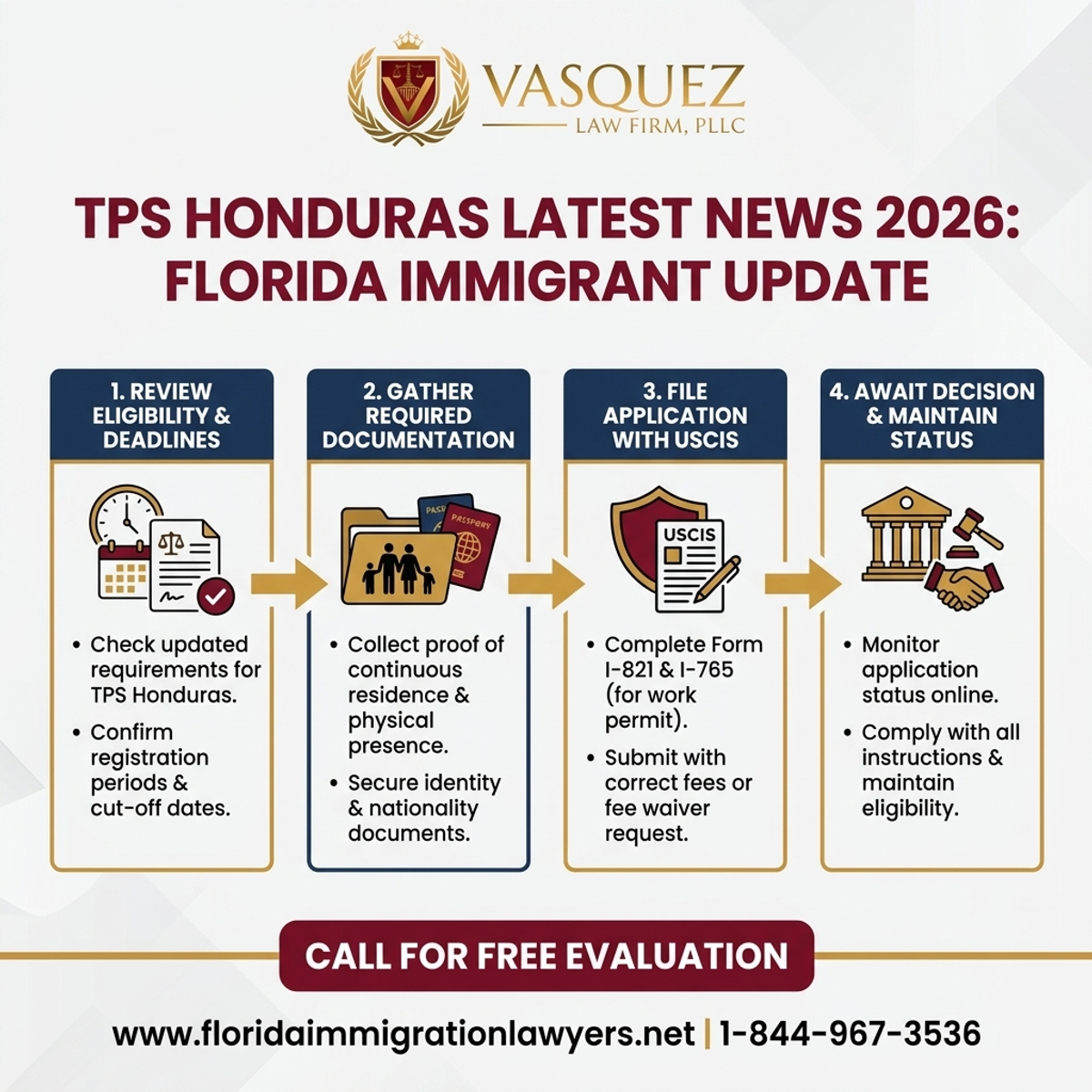
Step-by-Step Process — TPS Honduras Latest News 2026: Florida Immigrant Update
Even with court protections in place, it is vital for TPS beneficiaries in Florida to understand that failure to re-register on time, or any new criminal convictions, could lead to loss of status. If you have any doubts about your eligibility or have had legal issues since your last re-registration, it is imperative to seek legal advice immediately from Florida Immigration Lawyers to assess your situation and prevent potential complications.
How to Apply for TPS Honduras or Re-register in Florida?
As of 2026, applying for TPS Honduras primarily involves the re-registration process for existing beneficiaries, as initial registration periods are closed unless a new designation opens. Re-registration is a critical step to maintain your protected status, work authorization, and travel eligibility. Missing the re-registration deadline can lead to the loss of your TPS benefits and potentially place you in removal proceedings.
The process generally involves submitting specific forms and supporting documentation to USCIS. It is crucial to follow all instructions precisely and submit your application within the designated re-registration window. For those in Florida, submitting your application correctly and on time is paramount. Here is a general step-by-step guide for re-registration:
- Stay Informed: Regularly check the USCIS TPS webpage for official announcements regarding re-registration periods and any new guidelines for Honduran nationals.
- Complete Form I-821, Application for Temporary Protected Status: Fill out this form accurately and completely. Ensure all questions are answered, and sign the form.
- Complete Form I-765, Application for Employment Authorization (Optional): If you wish to obtain or renew your Employment Authorization Document (EAD), you must file this form along with your I-821.
- Complete Form I-601, Application for Waiver of Grounds of Inadmissibility (If Applicable): If you have any grounds of inadmissibility, you may need to file this waiver. This is a complex area and requires legal advice.
- Gather Supporting Documents: Collect all required identification documents, proof of continuous residence, and any other evidence requested by USCIS. (See Document Checklist section below).
- Pay Required Fees: Submit the correct filing fees for Form I-821 and Form I-765 (if applicable). Fee waivers may be available for eligible individuals. Do not send cash.
- Mail Your Application: Send your complete application package to the correct USCIS lockbox facility. The address will be specified in the Federal Register notice announcing the re-registration period.
- Attend Biometrics Appointment: After filing, you will likely receive a notice to attend a biometrics (fingerprinting) appointment at a local USCIS Application Support Center (ASC).
The USCIS field offices in Florida, such as those in Jacksonville, Miami, and Orlando, may handle biometrics appointments or interviews if deemed necessary. Always keep copies of everything you submit. Do not navigate this process alone. Contact Florida Immigration Lawyers today for expert assistance with your TPS re-registration.
Required Documents for TPS Honduras Re-registration
When re-registering for TPS Honduras, submitting a complete and accurate package of documents is crucial to avoid delays or denials. While specific requirements can vary slightly with each re-designation or extension, the following list outlines the commonly required documents. Always refer to the latest Federal Register notice or USCIS instructions for the most up-to-date information.
- Proof of Identity and Nationality:
- Copy of your birth certificate from Honduras.
- Copy of your Honduran passport (if available).
- Copy of your national identity document from Honduras (tarjeta de identidad).
- Any previous U.S. immigration documents (e.g., I-94 arrival/departure record, previous EADs).
- Proof of Continuous Residence in the U.S.:
- Rental receipts, utility bills, or mortgage statements covering the required period.
- Employment records (pay stubs, W-2 forms, letters from employers).
- School records (transcripts, enrollment letters).
- Medical records (hospital bills, doctor's notes).
- Bank statements showing transactions within the U.S.
- Affidavits from friends, family, or employers who can attest to your presence.
- Proof of Continuous Physical Presence in the U.S.:
- This is often covered by the same documents used for continuous residence.
- Any evidence of brief, authorized trips outside the U.S. (if applicable, with I-131 travel document).
- Photographs:
- Two passport-style photos meeting USCIS specifications.
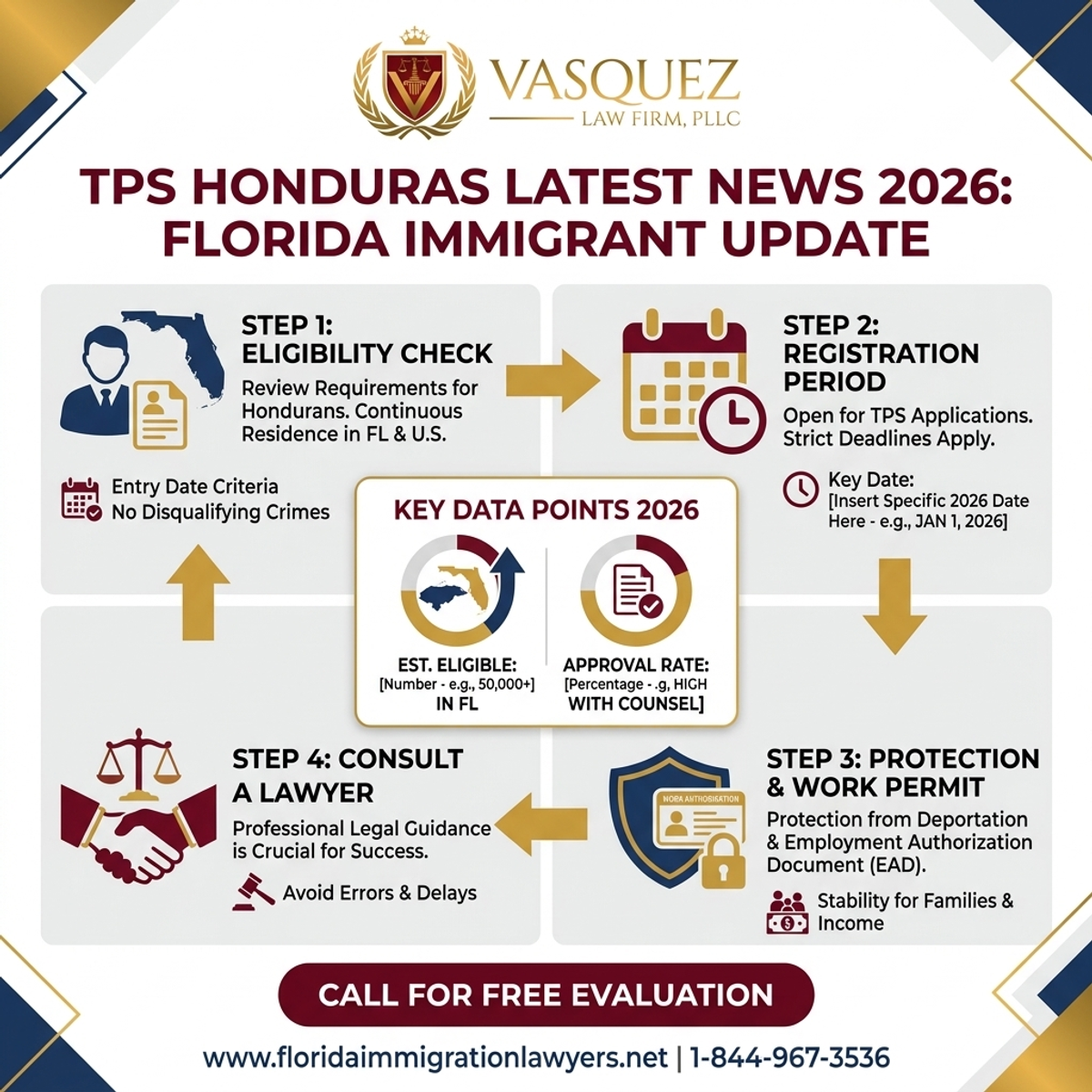
Key Statistics — TPS Honduras Latest News 2026: Florida Immigrant Update
- Proof of Prior TPS Grant:
- Copy of your previous TPS approval notice (Form I-797).
- Copy of your previous EAD issued under TPS.
It is essential to provide certified English translations for any documents not in English. Do not send original documents unless specifically requested by USCIS. Instead, submit clear copies. An immigration attorney can help you compile a comprehensive and accurate document package.
Typical Timeline for TPS Honduras Processing in 2026
The processing times for TPS Honduras re-registration in 2026 can vary significantly depending on several factors, including the volume of applications, USCIS workload, and any ongoing legal or policy changes. While it is challenging to provide exact dates, beneficiaries in Florida can generally expect the following timeline:
| Stage | Typical Timeframe | Notes |
|---|---|---|
| Application Submission | Within 60-day re-registration window | Crucial to submit before the deadline to maintain status. |
| Receipt Notice (I-797C) | 2-4 weeks after submission | Confirms USCIS received your application. Keep this notice. |
| Biometrics Appointment Notice | 4-8 weeks after submission | Scheduled at a local Application Support Center (ASC), like those serving Jacksonville or Miami. |
| Biometrics Appointment | 8-12 weeks after submission | Fingerprinting and photo. Mandatory for most applicants. |
| Request for Evidence (RFE) / Interview (Rare) | 3-6 months after submission (if issued) | USCIS may request more information or schedule an interview in complex cases. |
| Approval Notice (I-797) | 6-18 months after submission | Official notification of your TPS re-registration approval. |
| Employment Authorization Document (EAD) | 6-18 months after submission (often with I-797) | Temporary work permit. EADs are often automatically extended with Federal Register notices. |
It is important to note that these are general estimates. Some cases may be processed faster, while others may take longer. Monitoring the USCIS Processing Times webpage for your specific form and service center can provide more current estimates. For those facing critical deadlines or delays, legal intervention may be necessary.
Cost Factors and Fee Breakdown for TPS Honduras Applications
Applying for or re-registering for TPS Honduras involves several government filing fees, which are subject to change by USCIS. As of 2026, it is crucial to verify the most current fee schedule directly on the USCIS website or through an immigration attorney, as incorrect fees can lead to rejection of your application. These fees are non-refundable, regardless of the outcome of your application.
The primary costs typically associated with TPS re-registration include fees for the Application for Temporary Protected Status (Form I-821) and the Application for Employment Authorization (Form I-765). Additionally, there is a mandatory biometrics services fee. Fee waivers may be available for individuals who meet specific poverty guidelines or receive certain public benefits. It is important to carefully review the fee waiver eligibility criteria and submit Form I-912, Request for Fee Waiver, if applicable.
| Item | Typical Fee (as of 2026) | Notes |
|---|---|---|
| Form I-821, Application for TPS | $50 | Required for all TPS applicants and re-registrants. |
| Form I-765, Application for EAD | $470 | Required if you need an Employment Authorization Document. |
| Biometrics Services Fee | $85 | Mandatory for all applicants aged 14-79. |
| Attorney Fees | Varies | For legal assistance in preparing and filing your application. Essential for complex cases. |
| Translation Costs | Varies | If any supporting documents are not in English. |
It is important to remember that fee amounts can change. Always check the USCIS website for the most current fees before submitting your application. An experienced immigration lawyer can help you understand the full cost implications and determine if you are eligible for any fee waivers, ensuring your application is financially sound.
Do not navigate this process alone. Contact Florida Immigration Lawyers today for a free consultation to discuss your TPS Honduras re-registration and legal options. We are here to provide the guidance you need.
Common Mistakes to Avoid in TPS Honduras Applications
Navigating the TPS re-registration process can be complex, and even minor errors can lead to significant delays or even denial of your application. Avoiding these common mistakes is crucial for maintaining your status:
- Missing the Re-registration Deadline: This is perhaps the most critical mistake. Failure to re-register within the designated window almost always results in the loss of TPS benefits. Always mark your calendar and apply early.
- Incomplete Forms: Leaving fields blank or providing insufficient information on Forms I-821 and I-765 can cause USCIS to reject your application. Double-check every section.
- Incorrect Filing Fees: Submitting the wrong fee amount, or failing to include the correct fees, will lead to your application being returned. Always verify current fees on the USCIS website.
- Lack of Supporting Documentation: Not providing adequate proof of identity, nationality, or continuous residence can raise red flags. Ensure all required documents are included.
- Sending Original Documents: Unless specifically requested, never send original documents. Always send clear, legible copies and keep your originals safe.
- Failure to Sign Forms: An unsigned application is invalid and will be rejected. Ensure all required signatures are present and correctly placed.
- Not Disclosing All Criminal History: Even minor arrests or convictions, including those that were expunged, must be disclosed. Failure to do so can result in serious immigration consequences, including denial and potential deportation proceedings.
- Providing Inconsistent Information: Discrepancies between your current application and previous immigration filings can lead to scrutiny and requests for further evidence.
- Not Responding to RFEs on Time: If USCIS issues a Request for Evidence (RFE), you must respond promptly and comprehensively. Missing the deadline will likely lead to a denial.
- Failure to Update Address: If you move, you must notify USCIS of your new address within 10 days using Form AR-11. Failure to do so can result in missed notices and critical deadlines.
These mistakes can be costly and stressful. An immigration attorney from Florida Immigration Lawyers can help you prepare a thorough and error-free application to maximize your chances of success.
When to Call a Lawyer for TPS Honduras Assistance
While some individuals may feel comfortable navigating the TPS re-registration process on their own, there are many situations where the expertise of an immigration lawyer is not just helpful, but absolutely essential. Given the critical importance of maintaining your protected status and the potential for severe consequences if mistakes are made, seeking legal counsel is always a wise decision.
You should call Florida Immigration Lawyers immediately if any of the following apply to your situation:
- You have any criminal history, no matter how minor, including arrests, charges, or convictions. This could impact your eligibility under INA 244(c)(2)(B).
- You have previously been denied TPS or any other immigration benefit.
- You have doubts about your continuous physical presence or continuous residence in the U.S.
- You have traveled outside the U.S. since your last TPS approval.
- You have received a Request for Evidence (RFE) from USCIS or a Notice of Intent to Deny (NOID).
- You have received a notice to appear in Immigration Court or are currently in removal proceedings.
- You are unsure about which forms to file or how to accurately answer specific questions.
- You believe you may be eligible for a fee waiver but need assistance with the process.
- You are seeking to explore other immigration pathways beyond TPS, such as family-based petitions (Family Immigration) or asylum (Asylum).
The immigration landscape is constantly shifting, and an experienced attorney can provide personalized advice based on the latest laws and policies, including those affecting TPS Honduras. Our team at Florida Immigration Lawyers is dedicated to protecting your rights and ensuring your application is handled with the utmost care and precision.
About Florida Immigration Lawyers
Florida Immigration Lawyers is a leading immigration law firm dedicated to serving individuals and families across the entire state of Florida. With a deep understanding of U.S. immigration laws and a compassionate approach, we provide comprehensive legal services to help our clients achieve their immigration goals. Our team of experienced attorneys is committed to offering personalized attention and strategic representation, whether you are seeking general immigration assistance, facing deportation defense, or pursuing citizenship.
We pride ourselves on our client-focused service, ensuring that you feel supported and informed throughout your legal journey. From our offices, we serve communities in Jacksonville, Miami, Orlando, Tampa, and beyond, offering free consultations to assess your unique situation. Our bilingual staff is available 24/7 to answer your questions and provide the expert guidance you deserve. Trust Florida Immigration Lawyers to be your advocate in the complex world of immigration law.
Sources and References
- U.S. Citizenship and Immigration Services (USCIS)
- Executive Office for Immigration Review (EOIR)
- U.S. Department of State (Travel.State.Gov)
- Immigration and Nationality Act (INA) Section 244 - Temporary Protected Status
- 8 Code of Federal Regulations (CFR) Part 244 - Temporary Protected Status
- Federal Register Notices for TPS Honduras (various dates)
Related services: immigration practice areas, business immigration, experienced immigration attorneys.
This article provides general legal information and is not intended as legal advice. Every case is unique, and outcomes depend on specific facts and circumstances. Contact an attorney for advice about your particular situation.
The future of your TPS status is too important to leave to chance. For the most up-to-date information and personalized legal advice regarding TPS Honduras in 2026, contact Florida Immigration Lawyers today. We offer free consultations and are available 24/7 to assist you. Call us at 1-844-967-3536. Se Habla Español - Estamos aquí para ayudarle.
Do Not Navigate This Process Alone
Our experienced immigration attorneys are ready to fight for you. Get a free, confidential consultation today.
Se Habla Español
Or leave your details and we’ll call you:
Free Evaluation in 24 Hours
Or talk to us right now
AI voice assistant — available 24/7
FreeFrequently Asked Questions

William J. Vásquez
Founding Attorney · Vasquez Law Firm
U.S. Air Force veteran and immigration attorney with years of hands-on U.S. immigration experience. J.D., NCCU School of Law. AILA member. Admitted to the 4th, 5th, and 11th Circuit Courts.
Available 24/7 - Free Evaluations
Reviewed for legal accuracy by William J. Vásquez
Licensed in North Carolina; U.S. immigration is federal practice.
Related Legal Services
Our Florida immigration attorneys can help you with family immigration services, immigration practice areas and free immigration consultation. Call today at 1-844-967-3536 for a free consultation.
Related Links
Related Topics
Free Legal Consultation
Discuss your case with our experienced attorneys. We're available 24/7.
Se Habla Español - Estamos aquí para ayudarle.
Related Articles
Immigration Lawyer Orlando Free Consultation 2026
Discover how to find an immigration lawyer in Orlando offering a free consultation. Understand the services available and why choosing Florida Immigration Lawyers can make a difference in your case.
Military Naturalization Expedited in Florida Bases
Explore military naturalization options for families at Florida bases, including parole in place benefits in Miami. Learn how to expedite your application with expert guidance from Florida Immigration Lawyers.
K-3 Visa Timeline in Florida: What to Expect
Learn the K-3 visa timeline process in Florida, including steps, costs, and documentation. Understand your options in 2026 with guidance from Florida Immigration Lawyers.
EAD Advance Parole Combo Card: What You Need to Know in
Learn about the EAD advance parole combo card in Florida, which combines work authorization and travel permission for those with pending I-485 applications. Discover the application process, document requirements, and common mistakes to avoid.