EAD Advance Parole Combo Card: What You Need to Know in
Learn about the EAD advance parole combo card in Florida, which combines work authorization and travel permission for those with pending I-485 applications. Discover the application process, document requirements, and common mistakes to avoid.

- Combines employment authorization and travel permit.
- Beneficial for applicants with pending I-485 in Florida.
- Streamlines the process by reducing paperwork.
- Check eligibility requirements before applying.
Introduction
For many immigrants in Florida, securing the ability to work and travel while awaiting their adjustment of status is crucial. The EAD advance parole combo card provides a solution by combining employment authorization and a travel permit into a single document. This article explores how the combo card can benefit those with an I-485 pending in Jacksonville and throughout Florida. Call Florida Immigration Lawyers at 1-844-967-3536 for a free consultation to see if this option suits your needs.
Navigating the U.S. immigration system can be a complex and often lengthy process. For individuals who have filed Form I-485, Application to Register Permanent Residence or Adjust Status, the waiting period for a final decision can span many months, or even years. During this time, the need to maintain employment and the ability to visit family abroad or attend to urgent matters can become pressing concerns. The EAD advance parole combo card addresses these critical needs, offering a vital bridge for applicants.
This combined document is particularly advantageous for residents of Florida, a state with a diverse immigrant population and significant international connections. Whether you're in Miami, Orlando, Tampa, or Jacksonville, the ability to work legally and travel without jeopardizing your green card application provides immense peace of mind and stability. Understanding its benefits, application process, and potential pitfalls is essential for a smooth journey towards permanent residency.
What is an EAD Advance Parole Combo Card?
An EAD advance parole combo card is a US immigration document that combines an Employment Authorization Document (EAD) and an advance parole travel permit. As of 2026, it allows individuals with a pending I-485 application to work in the US and travel internationally without affecting their application status.
This card is particularly beneficial for applicants in Florida, including areas like Jacksonville, who wish to maintain employment and the ability to travel while awaiting permanent residency. The combo card reduces the need for multiple applications, streamlining the process significantly.
To elaborate, an Employment Authorization Document (EAD), often referred to as a work permit, grants foreign nationals temporary permission to work legally in the United States. An Advance Parole document, on the other hand, allows certain foreign nationals to travel abroad and return to the U.S. without abandoning their pending adjustment of status application. Historically, applicants would need to apply for these documents separately, leading to more paperwork, potentially different processing times, and increased administrative burden.
The innovation of the combo card is its efficiency. By merging these two crucial functionalities into a single document, USCIS simplifies the process for both applicants and the agency. This means that a single card serves as proof of your authorization to work and your permission to travel internationally. For a family in Orlando with a pending I-485, for instance, having a combo card means the primary applicant can continue their job and visit ailing relatives overseas without fear of their green card application being denied upon return, provided they meet all conditions.
How Do You Apply for a Combo Card in Florida?
To apply for an EAD advance parole combo card in Florida, start by completing and submitting Form I-765 for employment authorization and Form I-131 for advance parole alongside your Form I-485 application. As of 2026, these can be filed concurrently to simplify the process.
- Ensure you have a pending I-485 application.
- Complete Form I-765 and Form I-131 accurately.
- Submit both forms with your I-485 application to USCIS.
- Include necessary supporting documents such as identity proofs and photographs.
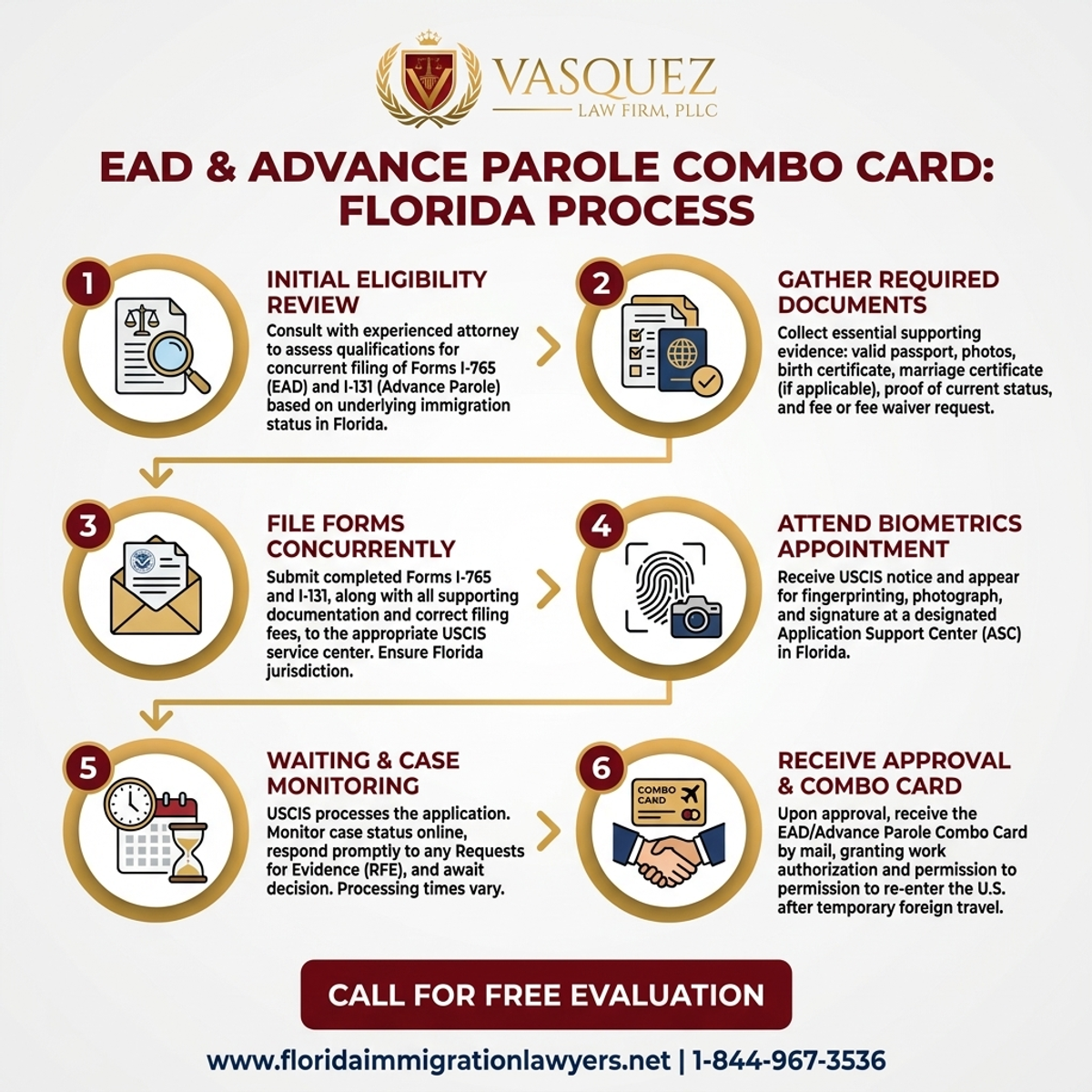
Step-by-Step Process — EAD Advance Parole Combo Card: What You Need to Know in Florida
Once submitted, USCIS will process your application. The processing time can vary, but generally, expect to wait several months for approval.
The concurrent filing of Form I-765 and Form I-131 with your I-485 is highly recommended as it often results in the issuance of the combo card. While you can file these forms separately at a later date, concurrent filing typically streamlines the process and ensures that your ability to work and travel is not interrupted for an extended period. It's crucial to meticulously review each form for accuracy and completeness, as even minor errors can lead to Requests for Evidence (RFEs) or outright denials, causing significant delays.
For applicants in Florida, preparing these applications requires attention to detail. Gather all required personal information, employment history, and travel records well in advance. A common practical tip is to create a checklist of all documents needed and to make copies of everything you send to USCIS. This organized approach can prevent oversight and provide a personal record should any questions arise during processing. If you're unsure about any part of the application, especially regarding specific eligibility criteria or complex personal histories, consulting with Florida Immigration Lawyers at 1-844-967-3536 can provide invaluable guidance and ensure your application is robust.
Document Checklist for Combo Card Application
- Completed Form I-765 and Form I-131
- Copy of your I-485 receipt notice
- Two passport-sized photos
- Copy of your passport photo page
- Any previous EAD cards, if applicable
- Proof of identity and nationality
Ensure that all documents are current and accurately reflect your current status and identity to avoid delays.
Beyond the primary forms, the supporting documents are equally critical. For instance, the two passport-sized photos must meet strict USCIS specifications regarding size, background, and recency. Submitting photos that are too old or don't meet the requirements is a common reason for application delays. Similarly, your passport photo page must be clear and legible, confirming your identity and nationality without ambiguity.
If you've previously held an EAD, including a copy of your most recent card demonstrates your history of employment authorization and can help USCIS track your immigration journey. Proof of identity and nationality can include birth certificates, national identity cards, or other official documents, especially if your passport is expired or unavailable. Always provide certified translations for any documents not in English. A well-prepared application package minimizes the chances of RFEs, which can significantly prolong the processing time. Seeking assistance from Florida Immigration Lawyers can ensure your documentation is impeccable.
Timeline and Processing Expectations
Understanding the timeline for obtaining a combo card is crucial. Here’s what you can generally expect:
| Stage | Typical Timeframe | Notes |
|---|---|---|
| Application Submission | Immediate | Submit with I-485 |
| USCIS Processing | 3-6 months | Varies by case |
| Receive Combo Card | 6-12 weeks post-approval | Check for errors |
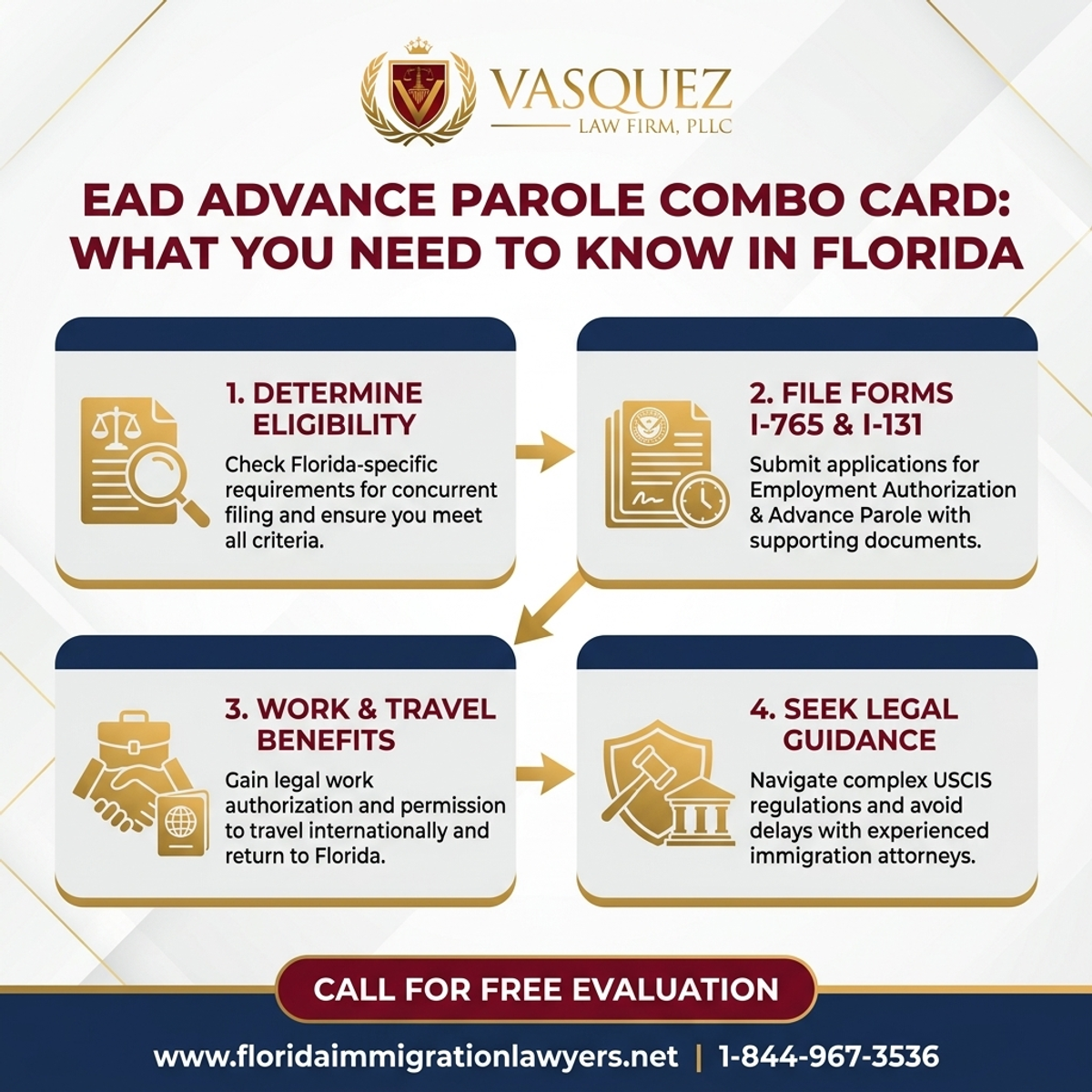
Key Statistics — EAD Advance Parole Combo Card: What You Need to Know in Florida
As of 2026, processing times are subject to change, and applicants should check the USCIS website for the most current information.
While the table provides a general overview, actual processing times can fluctuate significantly based on various factors, including the specific USCIS service center handling your case, current caseloads, and the complexity of your individual application. Economic conditions and policy changes can also impact processing speeds. It's not uncommon for some applications to be processed faster, while others might take longer than the typical timeframe. For example, during periods of high application volume, the 3-6 month estimate for USCIS processing could extend to 8-10 months or more.
A practical tip for applicants in Florida is to regularly check the USCIS website's processing times tool, which is updated monthly. You can input your form type and service center to get a more personalized estimate. Additionally, after submitting your application, you will receive a receipt notice containing a case number. This number allows you to track your application's status online through the USCIS Case Status Online tool. If your case goes beyond the posted processing times, you may be able to submit an inquiry with USCIS. However, patience is key, and avoiding unnecessary inquiries can prevent overwhelming the system. If you experience significant, unexplained delays or receive an RFE, contacting Florida Immigration Lawyers can help you understand your options and next steps.
Cost Factors and Fee Breakdown
While specific amounts can vary, here’s a general idea of the fees involved:
| Item | Typical Fee | Notes |
|---|---|---|
| Form I-765 | Varies | Check USCIS for updates |
| Form I-131 | Varies | Often included with I-485 |
| Biometrics | Varies | May be required |
It’s important to verify current fees on the USCIS website as they can change.
The fee structure for the combo card is often integrated with the I-485 application. When you file Form I-765 (EAD) and Form I-131 (Advance Parole) concurrently with your Form I-485, there is typically no separate fee for the I-765 and I-131 forms. Their fees are usually included within the larger I-485 filing fee. However, this is subject to change, and it is imperative to confirm the current fee schedule on the USCIS website or consult with an immigration attorney before filing.
Biometrics, which involve fingerprinting and a photograph, are a mandatory part of the application process and usually incur a separate fee. This fee is generally fixed and covers the cost of identity verification and background checks. Incorrect fee payments are a common reason for applications being rejected and returned, leading to significant delays. Always use the exact amount and the correct payment method specified by USCIS. A practical tip is to use a personal check or money order, as these provide a clear paper trail. If you believe you are eligible for a fee waiver due to financial hardship, you must submit Form I-912, Request for Fee Waiver, along with your application. Discussing fee requirements and potential waivers with Florida Immigration Lawyers can ensure you avoid costly mistakes.
Do not navigate this process alone. Contact Florida Immigration Lawyers today.
Common Mistakes to Avoid
Applying for an EAD advance parole combo card requires precision and adherence to strict guidelines. Overlooking details can lead to significant delays or even denial. Be mindful of these common pitfalls:
- Failing to submit all required forms together, leading to processing delays.
- Providing outdated or incorrect personal information, which can cause denials.
- Not keeping copies of submitted documents, resulting in confusion if issues arise.
- Ignoring USCIS notifications, potentially missing critical deadlines.
- Traveling outside the US without advance parole approval, risking application abandonment.
- Misunderstanding eligibility criteria, leading to ineligibility for a combo card.
- Not checking USCIS for fee updates, resulting in incorrect payments.
- Delaying application submission, which can prolong the process unnecessarily.
- Assuming prior EAD approvals ensure combo card approval, which is not always the case.
- Failing to update USCIS with new contact information, missing important correspondence.
When to Call a Lawyer
Legal assistance is crucial if you encounter complexities or potential denials during your combo card application process. If your situation involves previous immigration violations or criminal history, consult a lawyer immediately. Florida Immigration Lawyers can assist you with tailored advice and representation, ensuring your application is handled correctly from start to finish.
Beyond obvious complications like criminal history or prior immigration issues, there are many scenarios where legal counsel becomes invaluable. For example, if you have ever been out of status, worked without authorization, or had a previous visa denial, these factors can complicate your I-485 and, consequently, your combo card application. A lawyer can assess the specifics of your case, identify potential red flags, and help prepare a strategy to mitigate risks.
Consider a situation where USCIS issues a Request for Evidence (RFE) or a Notice of Intent to Deny (NOID). Responding to these notices correctly and comprehensively is critical, and a misstep can jeopardize your entire application. An experienced immigration attorney from Florida Immigration Lawyers can help you gather the necessary documentation, draft persuasive legal arguments, and ensure your response meets USCIS requirements, significantly improving your chances of approval. Don't hesitate to call 1-844-967-3536 for a free consultation if you feel overwhelmed or uncertain about any aspect of your application.
About Florida Immigration Lawyers
Florida Immigration Lawyers is dedicated to helping clients navigate the complexities of immigration law. Our team provides comprehensive services in employment-based immigration, family immigration, and deportation defense. Available 24/7, we offer free consultations to clients throughout Florida. Contact us at 1-844-967-3536 or visit our website.
Sources and References
- U.S. Citizenship and Immigration Services (USCIS)
- Executive Office for Immigration Review (EOIR)
- 8 U.S.C. Chapter 12 - Immigration and Nationality Act
Related services: immigration practice areas, family immigration services, citizenship and naturalization.
This article provides general legal information and is not intended as legal advice. Every case is unique, and outcomes depend on specific facts and circumstances. Contact an attorney for advice about your particular situation.
Contact Florida Immigration Lawyers at 1-844-967-3536 for a free consultation. Se Habla Español - Estamos aquí para ayudarle.
If you need legal assistance, learn more about Florida immigration legal team, or call us at 1-844-967-3536 for a free consultation.
Do Not Navigate This Process Alone
Our experienced immigration attorneys are ready to fight for you. Get a free, confidential consultation today.
Se Habla Español
Or leave your details and we’ll call you:
Free Evaluation in 24 Hours
Or talk to us right now

AI voice assistant — available 24/7
FreeFrequently Asked Questions

William J. Vásquez
Founding Attorney · Vasquez Law Firm
U.S. Air Force veteran and immigration attorney with years of hands-on U.S. immigration experience. J.D., NCCU School of Law. AILA member. Admitted to the 4th, 5th, and 11th Circuit Courts.
Available 24/7 - Free Evaluations
Reviewed for legal accuracy by William J. Vásquez
Licensed in North Carolina; U.S. immigration is federal practice.
Related Legal Services
Our Florida immigration attorneys can help you with business immigration, asylum protection and deportation defense. Call today at 1-844-967-3536 for a free consultation.
Related Links
Related Topics
Free Legal Consultation
Discuss your case with our experienced attorneys. We're available 24/7.
Se Habla Español - Estamos aquí para ayudarle.
Related Articles
Immigration Lawyer Orlando Free Consultation 2026
Discover how to find an immigration lawyer in Orlando offering a free consultation. Understand the services available and why choosing Florida Immigration Lawyers can make a difference in your case.
Military Naturalization Expedited in Florida Bases
Explore military naturalization options for families at Florida bases, including parole in place benefits in Miami. Learn how to expedite your application with expert guidance from Florida Immigration Lawyers.
K-3 Visa Timeline in Florida: What to Expect
Learn the K-3 visa timeline process in Florida, including steps, costs, and documentation. Understand your options in 2026 with guidance from Florida Immigration Lawyers.
Dual Citizenship Lawyer: Understanding Your Path in Florida
For many immigrants in Florida, the journey to U.S. citizenship is a profound aspiration. This comprehensive guide from Florida Immigration Lawyers delves into the naturalization process, with a focus on preparing for the critical citizenship test. We cover the N-400 application, civics test preparation, interview expectations, and cost factors. Crucially, we also explore the complexities of dual citizenship and how retaining foreign nationality impacts naturalization. Understanding these nuances is vital for a successful application. Our firm highlights common mistakes to avoid and emphasizes when to seek professional legal counsel, especially from a dual citizenship lawyer, to navigate the intricate requirements and ensure a smooth path to becoming a U.S. citizen in Florida. Get expert guidance for your naturalization journey.