Re-entry Permit for Green Card Holders in Florida
If you're a lawful permanent resident in Florida planning extended travel, understanding the re-entry permit is crucial. This document protects your green card status from abandonment. Learn more about the application process, common mistakes, and when to seek legal advice. For guidance, contact Florida Immigration Lawyers at 1-844-YO-PELEO.

- A re-entry permit helps maintain your LPR status during extended travel.
- File Form I-131 to apply for a re-entry permit.
- Florida residents should consult with a lawyer for specific advice.
- Re-entry permits are generally valid for up to two years.
- Consult Florida Immigration Lawyers at 1-844-YO-PELEO for guidance.
Introduction
Imagine planning a long-term trip outside the United States, only to realize you're at risk of losing your hard-earned green card status. For lawful permanent residents (LPRs) in Coral Springs, Florida, this scenario can become a harsh reality without a re-entry permit. This article covers the essentials of obtaining a re-entry permit, its importance, and how it protects against abandonment of LPR status. To safeguard your immigration status, call Florida Immigration Lawyers at 1-844-YO-PELEO for a free consultation.
The U.S. government presumes you intend to abandon your LPR status if you remain outside the country for more than 180 days, and especially if you exceed one year. This presumption can lead to significant challenges upon your return, including intense questioning at the port of entry and even potential removal proceedings. Understanding and proactively addressing this risk is paramount for all green card holders.
A re-entry permit acts as a crucial safeguard, officially notifying the U.S. government of your intent to return and preventing the presumption of abandonment. It provides peace of mind, allowing you to travel for extended periods for family emergencies, overseas work assignments, educational opportunities, or other personal reasons without jeopardizing your hard-won residency. For residents of Florida, a state known for its diverse population and strong international ties, the need for such a permit is particularly relevant given the frequent international travel patterns.
Understanding Re-entry Permits
A re-entry permit serves as a travel document issued by USCIS that allows LPRs to maintain their permanent resident status while traveling abroad for extended periods. Without it, you might face scrutiny upon returning to the U.S., risking the abandonment of your LPR status. This is especially crucial for residents around Coral Springs, where many families travel internationally for various reasons.
Re-entry permits are typically valid for up to two years. They are essential if you plan to be outside the U.S. for more than a year but less than two. Applying for a re-entry permit involves filing Form I-131, Application for Travel Document, with USCIS. For detailed guidance, visit the USCIS website.
This document is not merely a formality; it is a critical piece of evidence that counters the presumption of abandonment of your LPR status under U.S. immigration law. By obtaining a re-entry permit, you are effectively declaring your intent to maintain your domicile in the United States, even while temporarily residing abroad. This proactive step can save you from immense stress, legal battles, and the potential loss of your green card upon your return.
It's important to differentiate a re-entry permit from other travel documents like a visa or an advance parole document. While a visa allows foreign nationals to enter the U.S. for specific purposes, and advance parole is for those with pending adjustment of status applications, a re-entry permit is exclusively for LPRs. It explicitly confirms your status as a permanent resident, facilitating smoother re-entry into the U.S. without the need for a returning resident visa.
While generally valid for two years, specific circumstances, such as being an LPR who has been outside the U.S. for a cumulative total of more than five years since becoming an LPR, may result in a permit valid for only one year. It's crucial to understand these nuances, especially when planning long-term stays abroad for family, business, or educational pursuits. Consulting with Florida Immigration Lawyers can help clarify your specific eligibility and the appropriate validity period for your permit.
Step-by-Step Guide to Obtaining a Re-entry Permit
Securing a re-entry permit requires careful attention to detail and adherence to USCIS procedures. While the process might seem straightforward, each step has nuances that can significantly impact the success and timeliness of your application. Many LPRs in Coral Springs and across Florida find professional legal assistance invaluable in navigating these complexities and ensuring their application is robust.
- Determine Eligibility: Ensure you are an LPR intending to travel abroad for over a year. This typically means you are a lawful permanent resident who anticipates being outside the U.S. for more than one year but less than two. If you have already been outside the U.S. for an extended period or have a history of frequent, long absences, your eligibility might require closer scrutiny.
- Prepare Form I-131: Complete the application accurately. Incorrect details can delay or deny your permit. Accurate and complete information is paramount. Any discrepancies with your existing immigration records, or even minor omissions, can lead to Requests for Evidence (RFEs) or outright denial, significantly delaying your travel plans. Ensure all sections are filled out truthfully and precisely, reflecting your current situation and future intentions.
- Gather Supporting Documents: Include your green card copy, passport, and additional documents proving your intent to return. Beyond the basics, consider including additional evidence that strongly demonstrates your continued ties to the U.S. This could include property deeds, tax returns, bank statements, employment verification letters, or proof of family residing in the U.S. Such documentation reinforces your intent to return and maintain your LPR status.
- Submit the Application: File your application with the appropriate USCIS Lockbox facility. The filing location depends on your specific mailing address. Always double-check the USCIS website for the most current filing instructions and addresses to avoid misdirection and delays. It's also advisable to send your application via certified mail with a return receipt for proof of delivery.
- Attend Biometrics Appointment: You will receive a notice to provide fingerprints and photographs. This appointment is mandatory. You must attend it within the U.S. before you depart. If you leave the country before completing your biometrics, your application may be denied. Plan your travel dates accordingly to ensure you can fulfill this requirement.
- Wait for Processing: Re-entry permits typically take several months to process. Processing times can fluctuate significantly based on USCIS workload and policy changes. It's wise to monitor your case status online using the receipt number provided by USCIS. While waiting, avoid making irreversible travel plans that depend on the permit's immediate approval.
For assistance with this process, contact our team at Florida Immigration Lawyers.
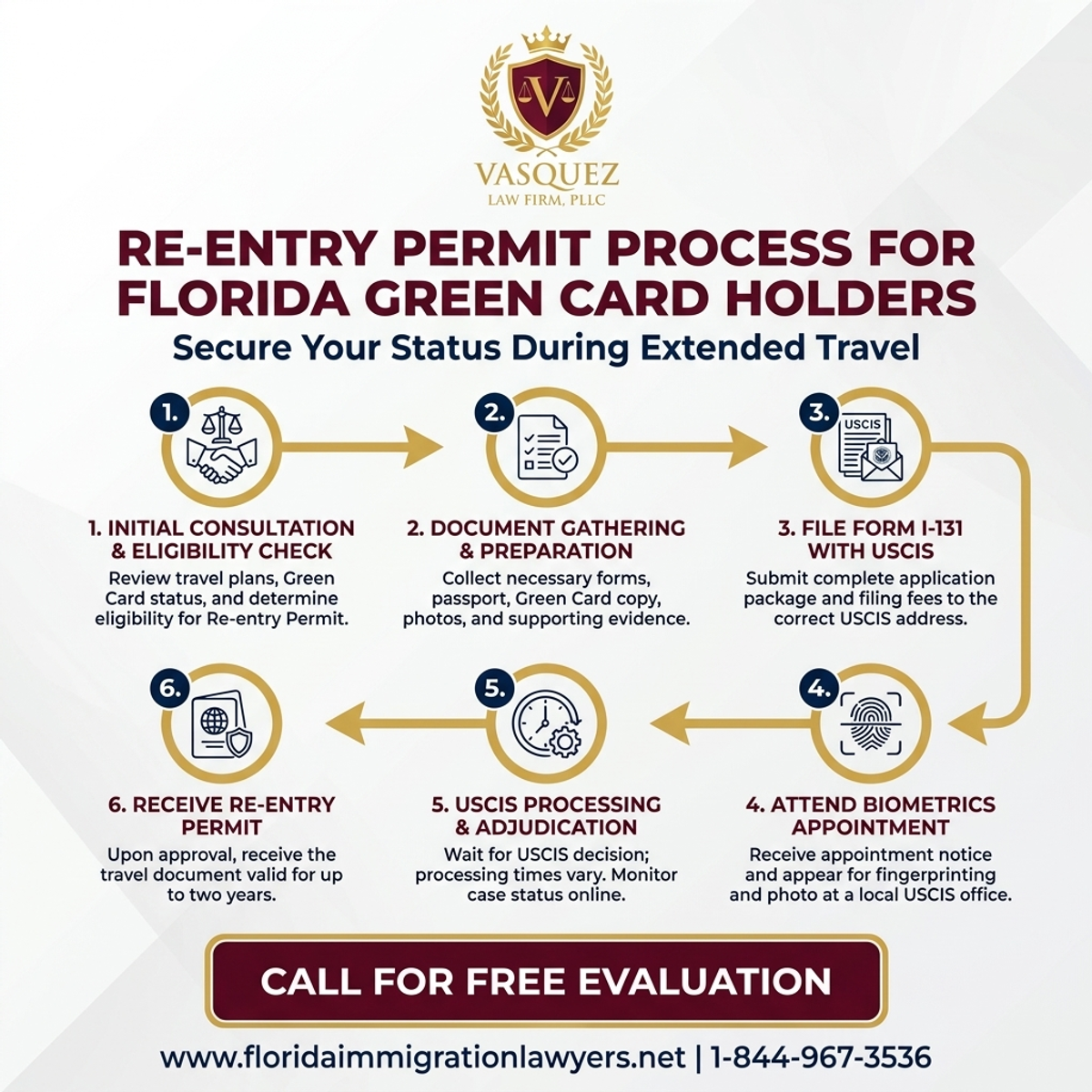
Step-by-Step Process — Re-entry Permit for Green Card Holders in Florida
Document Checklist for Re-entry Permit Application
A thorough and well-organized submission of supporting documents is critical to a successful re-entry permit application. Each item on this checklist serves to verify your identity, status, and intent to return to the U.S., thereby strengthening your case against any presumption of abandonment. Missing or incorrect documentation is a common reason for delays or denials, highlighting the importance of meticulous preparation.
- Completed Form I-131: Ensure all questions are answered, and the form is signed and dated correctly. An unsigned form is an automatic rejection.
- Copy of Permanent Resident Card (Green Card): This proves your current LPR status.
- Copy of Passport: Include copies of all biographical pages and any pages with U.S. entry/exit stamps. This helps USCIS verify your travel history and identity.
- Two passport-sized photographs: These must meet specific USCIS requirements, including size, background, and recentness. Incorrect photos are a common reason for RFEs, so ensure they comply with all guidelines.
- Evidence of the need for extended travel (e.g., employment letter, family obligations): This is crucial. Examples include a letter from an employer detailing an overseas assignment, medical records requiring long-term care abroad, or documents proving care for an ailing family member. The more compelling your reason, and the better documented, the stronger your application.
Timeline and Processing Expectations
The processing time for a re-entry permit can vary, generally taking several months. It's crucial to apply well in advance of your planned travel. Once your application is filed, expect to receive a biometrics appointment notice within weeks. After attending your biometrics appointment, the final decision on your re-entry permit usually arrives within 3 to 6 months.
Several factors can influence the processing duration, including the volume of applications USCIS is receiving, the complexity of your individual case, and whether you receive a Request for Evidence (RFE). For example, if your application is missing information or requires clarification, an RFE will add several weeks or even months to the timeline. Planning your application strategically can mitigate these potential delays.
It's highly recommended to submit your application at least 6-9 months before your intended departure date, if possible. This allows ample time for processing, attending the biometrics appointment, and receiving the permit before you need to leave. You can track your case status online through the USCIS website using the receipt number provided after filing. If you have an urgent, unforeseen travel need, consulting with Florida Immigration Lawyers can help explore any expedited processing options, though these are rare for re-entry permits and typically reserved for extreme humanitarian situations.
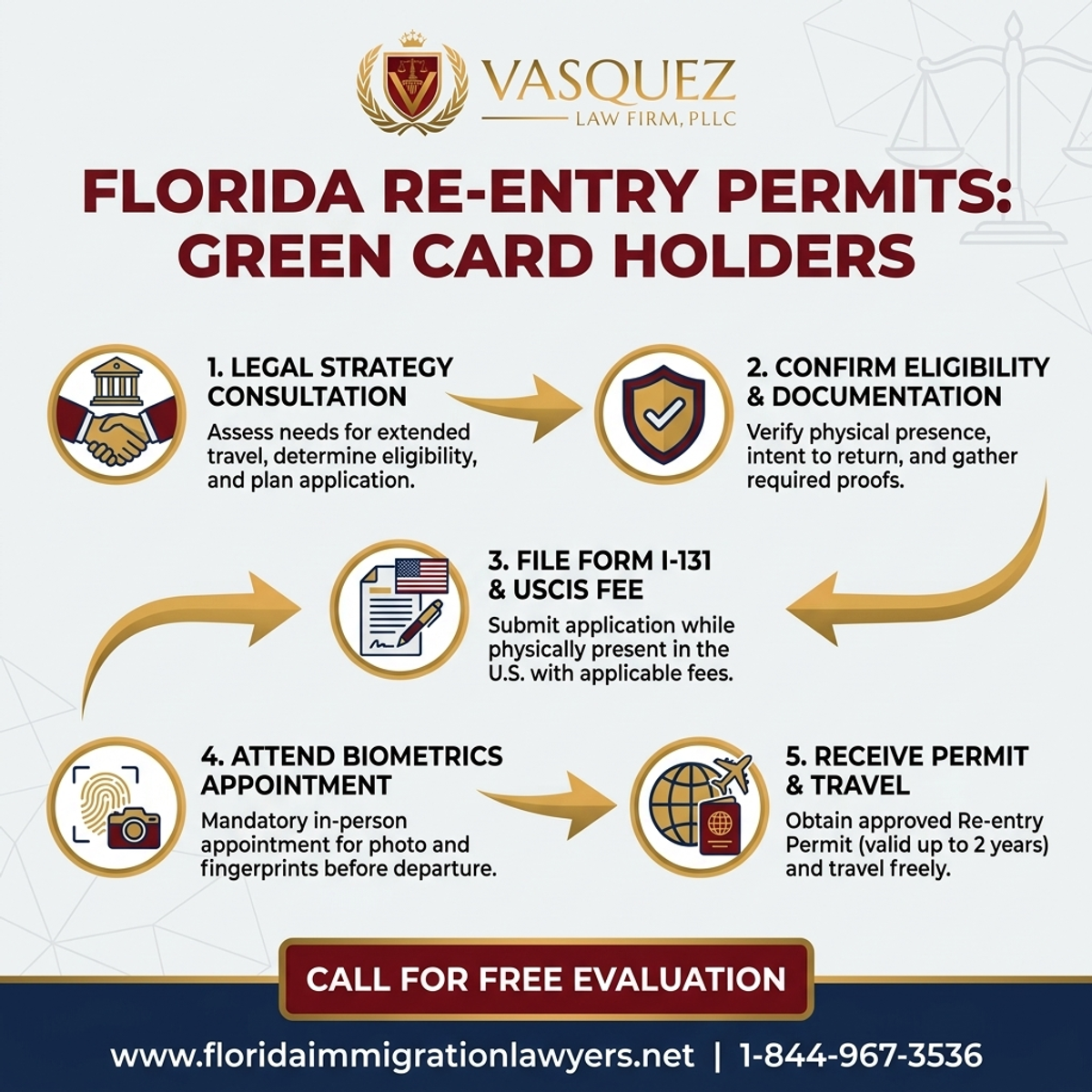
Key Statistics — Re-entry Permit for Green Card Holders in Florida
Cost Factors and Fee Breakdown
While specific fees for the re-entry permit application fluctuate, being aware of potential costs is essential. Fees typically include the application processing fee and biometric service fee. For current fee structures, refer to the USCIS website. Legal representation fees vary based on case complexity and attorney expertise.
The primary costs associated with a re-entry permit application are the filing fee for Form I-131 and the biometric services fee. These fees are non-refundable, even if your application is denied or withdrawn. It's imperative to always verify the most current fees directly on the official USCIS website before submitting your application, as they are subject to change without prior notice. Incorrect fee submissions are a common cause for application rejection or delays.
Beyond the government fees, individuals often choose to invest in legal representation. While not mandatory, the expertise of an immigration attorney, like those at Florida Immigration Lawyers, can be invaluable. Legal fees cover professional assistance in preparing the application, gathering supporting documents, responding to RFEs, and ensuring overall compliance, significantly reducing the risk of errors and delays. This investment can provide peace of mind and protect your LPR status, which is far more valuable than the cost of legal services in the long run.
Do not navigate this process alone. Contact Florida Immigration Lawyers today for guidance and support.
Common Mistakes to Avoid
Even a seemingly minor oversight in the re-entry permit application process can lead to significant delays, rejections, or even jeopardize your lawful permanent resident status. Being aware of these common pitfalls and actively working to avoid them is crucial for a smooth application process and successful international travel. Proactive preparation can save you considerable time, money, and anxiety.
- Delaying the Application: Applying too close to your travel date can result in not receiving your permit in time. Many LPRs underestimate the processing times, which can sometimes extend beyond six months. This often leads to a dilemma: either postpone crucial travel plans or depart without the permit, risking abandonment of status. Always apply well in advance, ideally 6-9 months before your planned departure.
- Incomplete Form I-131: Missing information can lead to application rejection. Ensure every question is answered accurately and completely. Even a blank field can trigger an RFE or outright denial.
- Ignoring Biometrics Appointment: Missing this step can delay or cancel your application. This appointment is mandatory and must be completed within the U.S. before you travel. Failure to attend will almost certainly lead to denial of your re-entry permit application.
- Not Providing Evidence of Intent to Return: Failing to prove ties to the U.S. can result in denial. USCIS needs to be convinced that your extended stay abroad is temporary and that you genuinely intend to maintain your U.S. residency. Failing to submit documents like U.S. property ownership, family ties, U.S. bank accounts, or U.S. tax filings can weaken your case.
- Traveling Without a Permit: Leaving the U.S. without a re-entry permit or valid documentation can jeopardize your LPR status. Leaving the U.S. for more than one year without a valid re-entry permit can trigger the presumption of abandonment of your green card. While you might still be able to return, you could face intense questioning at the port of entry, potentially leading to removal proceedings. A re-entry permit provides a clear, official intent to return.
- Incorrect Fee Submission: Ensuring the correct fee is submitted is crucial to avoid delays. Always check the USCIS website for the most current fees before filing.
- Not Consulting an Attorney: Professional guidance can prevent costly mistakes. Immigration law is complex and constantly evolving. An experienced attorney can identify potential issues, ensure all documentation is correct, and provide strategic advice tailored to your unique circumstances, saving you time, stress, and potential legal complications. Florida Immigration Lawyers are adept at guiding clients through this intricate process.
- Overlooking Expiry of Permit: Ensure your permit is valid for the entirety of your travel. If your plans change and you need to stay longer, you must apply for a new permit before the current one expires, and you must do so while physically present in the U.S.
- Assuming Automatic Approval: Every application is subject to USCIS scrutiny. Do not make irreversible travel plans until you have the approved re-entry permit in hand.
- Not Keeping Copies of Documents: Always keep copies of your application and supporting documents. This is vital for your records and in case USCIS requests additional information or if your original documents are lost.
When to Call a Lawyer
Navigating the complexities of re-entry permits and maintaining your LPR status can be daunting. Consider consulting a lawyer if:
While the re-entry permit application process has a defined structure, individual circumstances can introduce complexities that warrant professional legal guidance. An immigration attorney can offer invaluable assistance, ensuring that your application is robust and that your LPR status remains secure, protecting your long-term goals in the U.S. from unforeseen complications.
- You plan to travel for extended periods.
- Your application has been delayed or denied.
- You have complex travel circumstances or family situations.
- There's a risk of abandonment of your LPR status.
- You have a history of frequent or long absences from the U.S.: USCIS may scrutinize your application more closely if there's a pattern of extended stays abroad, and a lawyer can help articulate your intent to maintain residency effectively.
- You previously faced issues at a U.S. port of entry: If you've ever been questioned about your intent to abandon your green card, legal counsel is essential to address these prior concerns and prepare for future re-entry.
- You are unsure about which supporting documents are most relevant: An attorney can help you identify and organize the most compelling evidence to support your application, preventing RFEs and delays.
- You need to travel urgently and explore potential expedited options: While rare, a lawyer can assess if your situation qualifies for any form of expedited processing and guide you through that specific procedure.
- You are concerned about potential impacts on your path to U.S. citizenship: Extended absences, even with a re-entry permit, can affect your eligibility for naturalization. A lawyer can advise on these long-term implications and help you plan accordingly.
Florida Immigration Lawyers are skilled in handling these cases, offering personalized advice tailored to your situation. Our team is dedicated to protecting your LPR status and ensuring your international travel plans proceed without unnecessary complications.
Frequently Asked Questions About Re-entry Permits
Q: Can I apply for a re-entry permit if my green card is expired? A: Yes, you can. Your LPR status does not expire even if your physical green card does. As long as you remain a lawful permanent resident, you are eligible to apply for a re-entry permit. However, it's advisable to also file Form I-90 to renew your green card concurrently, as having a valid card can simplify other aspects of your travel and re-entry process. Consult Florida Immigration Lawyers for guidance on both applications. Q: What happens if my re-entry permit expires while I'm still abroad? A: If your re-entry permit expires while you are outside the U.S., you may need to apply for a returning resident (SB-1) visa at a U.S. embassy or consulate abroad to re-enter the country. This process is often complex and requires proving that your extended stay was due to circumstances beyond your control and that you did not intend to abandon your residency. It's a challenging path, making timely application for or renewal of your permit crucial. Q: Can I apply for a re-entry permit from outside the U.S.? A: Generally, no. You must be physically present in the United States when you file Form I-131, and you must remain in the U.S. to attend your biometrics appointment. Leaving the country before completing biometrics will likely result in the denial of your application. Plan your application and biometrics appointment carefully around your travel schedule to avoid this common issue. Q: How does a re-entry permit affect my eligibility for U.S. citizenship? A: While a re-entry permit protects your LPR status, it does not automatically preserve your continuous residency for naturalization purposes if you are outside the U.S. for more than six months. Absences exceeding six months but less than one year break the continuity of residence unless you can prove otherwise. An absence of one year or more automatically breaks continuous residency. Consult an attorney at Florida Immigration Lawyers to understand the specific impact on your naturalization timeline. Q: What if USCIS issues a Request for Evidence (RFE) for my application? A: An RFE means USCIS requires more information or clarification to process your application. It's crucial to respond promptly and thoroughly with all requested documents and explanations. Failing to respond or submitting an incomplete response can lead to denial. This is a common situation where legal counsel from Florida Immigration Lawyers can be extremely beneficial in crafting a comprehensive and persuasive response. Q: Is there an interview required for a re-entry permit? A: Generally, an interview is not required for a re-entry permit application. The primary in-person requirement is the biometrics appointment, where your fingerprints and photographs are taken. However, USCIS reserves the right to request an interview in certain complex cases or if there are questions about your eligibility or intent. Such a request would be rare but underscores the importance of a well-prepared application.About Florida Immigration Lawyers
Florida Immigration Lawyers is an immigration law firm serving all of Florida, including Coral Springs. Our experienced attorneys focus on various immigration matters, including re-entry permits, asylum, deportation defense, citizenship, family, and business immigration. Available 24/7, we offer free consultations to address your immigration needs. Visit our website at floridaimmigrationlawyers.net or call 1-844-YO-PELEO today.
Our firm is built on a foundation of deep legal experience, unwavering client advocacy, and a comprehensive understanding of U.S. immigration law. We pride ourselves on offering compassionate yet aggressive representation, ensuring that each client receives personalized attention and strategic advice tailored to their unique needs. Our commitment extends to providing clear communication and transparent processes, so you are always informed and confident in your immigration journey.
Beyond re-entry permits, our attorneys are proficient in a wide array of immigration services, including family-based petitions, employment visas, asylum claims, and naturalization applications. We understand the profound impact immigration matters have on individuals and families, and we are committed to achieving the strongest possible outcomes for our clients throughout Florida, from Coral Springs to Miami, Orlando, and beyond. Contact us today to experience the difference legal guidance can make.
Sources and References
- U.S. Citizenship and Immigration Services (USCIS)
- U.S. Department of State
- Executive Office for Immigration Review (EOIR)
- 8 U.S.C. Chapter 12 - Immigration and Nationality Act
Related services: immigration practice areas, family immigration services.
This article provides general legal information and is not intended as legal advice. Every case is unique, and outcomes depend on specific facts and circumstances. Contact an attorney for advice about your particular situation.
For personalized assistance with your immigration needs, call Florida Immigration Lawyers at 1-844-YO-PELEO. Se Habla Español - Estamos aquí para ayudarle.
If you need legal assistance, learn more about our immigration law practice, or call us at 1-844-YO-PELEO for a free consultation.
Do Not Navigate This Process Alone
Our experienced immigration attorneys are ready to fight for you. Get a free, confidential case review today.
Se Habla Español
Or leave your details and we’ll call you:
Free Evaluation in 24 Hours
Or talk to us right now

AI voice assistant — available 24/7
FreeFrequently Asked Questions

William J. Vásquez
Founding Attorney · Vasquez Law Firm
U.S. Air Force veteran and immigration attorney with years of hands-on U.S. immigration experience. J.D., NCCU School of Law. AILA member. Admitted to the 4th, 5th, and 11th Circuit Courts.
Available 24/7 - Free Evaluations
Reviewed for legal accuracy by William J. Vásquez
Licensed in North Carolina; U.S. immigration is federal practice.
Related Legal Services
Our Florida immigration attorneys can help you with business immigration, deportation defense and family immigration services. Call today at 1-844-YO-PELEO for a free case review.
Related Links
Related Topics
Free Legal Case Review
Discuss your case with our experienced attorneys. We're available 24/7.
Se Habla Español - Estamos aquí para ayudarle.
Related Articles
Immigration Lawyer Orlando Free Consultation in Florida
For individuals and families in Orlando, Florida, navigating the complexities of U.S. immigration law requires expert guidance. An immigration lawyer in Orlando offers crucial support for everything from visa applications and green card processes to naturalization and deportation defense. This comprehensive guide details what a free consultation covers, providing a step-by-step overview of immigration pathways, essential document checklists, and expected timelines in 2026. We also highlight common mistakes to avoid, discuss the critical role of legal counsel in deportation and asylum cases, and explain why choosing a local Orlando immigration attorney is beneficial. Florida Immigration Lawyers is dedicated to serving the diverse community of Orlando with compassionate, effective legal solutions, ensuring you receive personalized advice and robust representation for a successful immigration journey.
EAD Advance Parole Combo Card in Florida 2026
For individuals with a pending Form I-485, Application to Register Permanent Residence or Adjust Status, the EAD Advance Parole Combo Card is an essential document. This single card combines the authorization to work legally in the U.S. (Employment Authorization Document - EAD) with permission to travel internationally and re-enter without abandoning your green card application (Advance Parole). This guide from Florida Immigration Lawyers provides a comprehensive overview for applicants in Florida in 2026, covering eligibility, the step-by-step application process, required documents, expected processing times, and associated costs. We also highlight common mistakes to avoid and when to seek legal counsel to ensure a smooth and successful immigration journey. Understanding this vital card is key to maintaining stability while awaiting your permanent residency approval.
Special Immigrant Juvenile Status Florida: Your 2026 Guide
Special Immigrant Juvenile Status (SIJS) offers a crucial pathway to lawful permanent residency for vulnerable children in Florida who have experienced abuse, neglect, or abandonment. This 2026 guide explains the eligibility criteria, highlighting the vital role of a Florida state court order, which must find the child dependent and unable to reunite with their parents due to the aforementioned hardships. The article details the multi-step application process, from obtaining the predicate order to filing federal petitions with USCIS and ultimately adjusting status to a Green Card. It also covers typical timelines, potential costs, and the life-changing benefits SIJS provides, such as protection from deportation and access to education. For families and guardians navigating this complex process, understanding the requirements and avoiding common pitfalls is essential. Florida Immigration Lawyers stands ready to provide expert legal guidance.
Fiance Visa Lawyer in Florida 2026: Your K-1 Guide
For U.S. citizens in Florida, the K-1 fiance visa is the primary path to bring their foreign partners to the U.S. to marry. This comprehensive guide from Florida Immigration Lawyers details the intricate K-1 process, from initial petition to adjustment of status, for 2026. We cover eligibility, a step-by-step application guide, essential document checklists, typical timelines, and associated costs. Learn about common pitfalls to avoid and crucial scenarios when legal counsel is indispensable. Our firm focuses on family-based immigration, offering guidance to navigate USCIS and Department of State requirements. Ensure a smooth and successful journey to reunite with your loved one in Florida with the help of a dedicated immigration attorney.