DACA Work Permit & Employment Authorization in Florida 2026
Learn how to navigate the DACA work permit process in Florida in 2026. Understand costs, timelines, and common pitfalls. Contact Florida Immigration Lawyers for guidance.
DACA Work Permit & Employment Authorization in Florida 2026: A Comprehensive Guide
For Deferred Action for Childhood Arrivals (DACA) recipients in Florida, understanding the nuances of work permits and employment authorization is crucial. As we look towards 2026, the landscape for DACA continues to evolve, making it essential to stay informed about application processes, renewal procedures, and legal considerations. This comprehensive guide aims to provide clarity and empower Dreamers in Florida to navigate their path to employment authorization with confidence. We understand the unique challenges and aspirations of DACA recipients, and our goal is to offer up-to-date information and resources to support your journey. If you have broader questions about your legal standing or other immigration matters, our immigration practice area offers extensive resources and expert guidance.
Eligibility Criteria for DACA in Florida
To be eligible for DACA in Florida, applicants must meet a stringent set of criteria established by USCIS. These include having been under the age of 31 as of June 15, 2012; having come to the United States before reaching your 16th birthday; having continuously resided in the U.S. since June 15, 2007, up to the present time; having been physically present in the U.S. on June 15, 2012, and at the time of making your request for DACA; having no lawful status on June 15, 2012; and currently being in school, having graduated or obtained a certificate of completion from high school, having obtained a general education development (GED) certificate, or being an honorably discharged veteran of the Coast Guard or Armed Forces of the United States. Furthermore, applicants must not have been convicted of a felony, a significant misdemeanor, or three or more other misdemeanors, and must not pose a threat to national security or public safety. Each of these criteria requires specific documentation and proof, making the application process complex. For instance, demonstrating continuous residence often involves submitting a variety of documents such as school records, medical records, employment records, and utility bills from throughout the specified period. Any gaps or inconsistencies in documentation can lead to requests for evidence or even denial. Understanding these detailed requirements and how to properly document them is paramount for a successful application. Consulting with an experienced attorney can help you assess your eligibility accurately and identify any potential issues before you apply, ensuring all criteria are met precisely.
The DACA Application Process: Step-by-Step in 2026
The DACA application process involves several critical steps, each requiring careful attention to detail. First, applicants must complete Form I-821D, Consideration of Deferred Action for Childhood Arrivals, and Form I-765, Application for Employment Authorization, along with Form I-765WS, Worksheet. These forms require comprehensive personal information, details about your entry to the U.S., educational history, and any criminal record. Along with the forms, you must submit extensive supporting documentation to prove your eligibility. This includes proof of identity (e.g., passport, birth certificate with photo ID), proof of entry to the U.S. before age 16, proof of continuous residence in the U.S. since June 15, 2007, and proof of educational status or military service. All documents not in English must be accompanied by a certified English translation. The application also requires a filing fee, which can be a significant financial consideration, though fee waivers are rarely granted for DACA. After submitting your application, you will typically receive a receipt notice, followed by an appointment notice for biometrics (fingerprints, photograph, and signature) at an Application Support Center (ASC). This appointment is mandatory. Following biometrics, USCIS will review your application. The processing times can vary, ranging from several months to over a year. It is crucial to ensure all information is accurate and consistent across all documents to avoid delays or requests for evidence (RFEs). For complex cases or if you're unsure about any part of the process, seeking advice from experienced attorneys is highly recommended to ensure a smooth and successful application.
DACA Renewal Process: Maintaining Your Status
Maintaining your DACA status in Florida requires diligent attention to the renewal process. USCIS strongly recommends filing your DACA renewal application 120 to 150 days before your current DACA and Employment Authorization Document (EAD) expire. This timeframe allows sufficient processing time and helps prevent any lapse in your employment authorization. The renewal process is similar to the initial application, requiring updated Forms I-821D, I-765, and I-765WS, along with the associated filing fees. While you may not need to resubmit all the extensive supporting documentation from your initial application if your information has remained consistent, it is still crucial to provide any documents that demonstrate continued eligibility, such as updated school records, employment history, or proof of residence. Any changes in your criminal history or residence must be disclosed. Missing the renewal window can have severe consequences, including a lapse in your work authorization, potential loss of employment, and even the risk of falling out of deferred action status, which could expose you to removal proceedings. If your DACA expires before you file for renewal, or if your renewal is denied, you could face significant challenges. Setting multiple reminders for your renewal deadline and preparing your documents well in advance are critical proactive steps. If you anticipate any issues with your renewal or have experienced changes in your circumstances, consulting with an immigration attorney is advisable to navigate the process effectively and ensure uninterrupted protection.
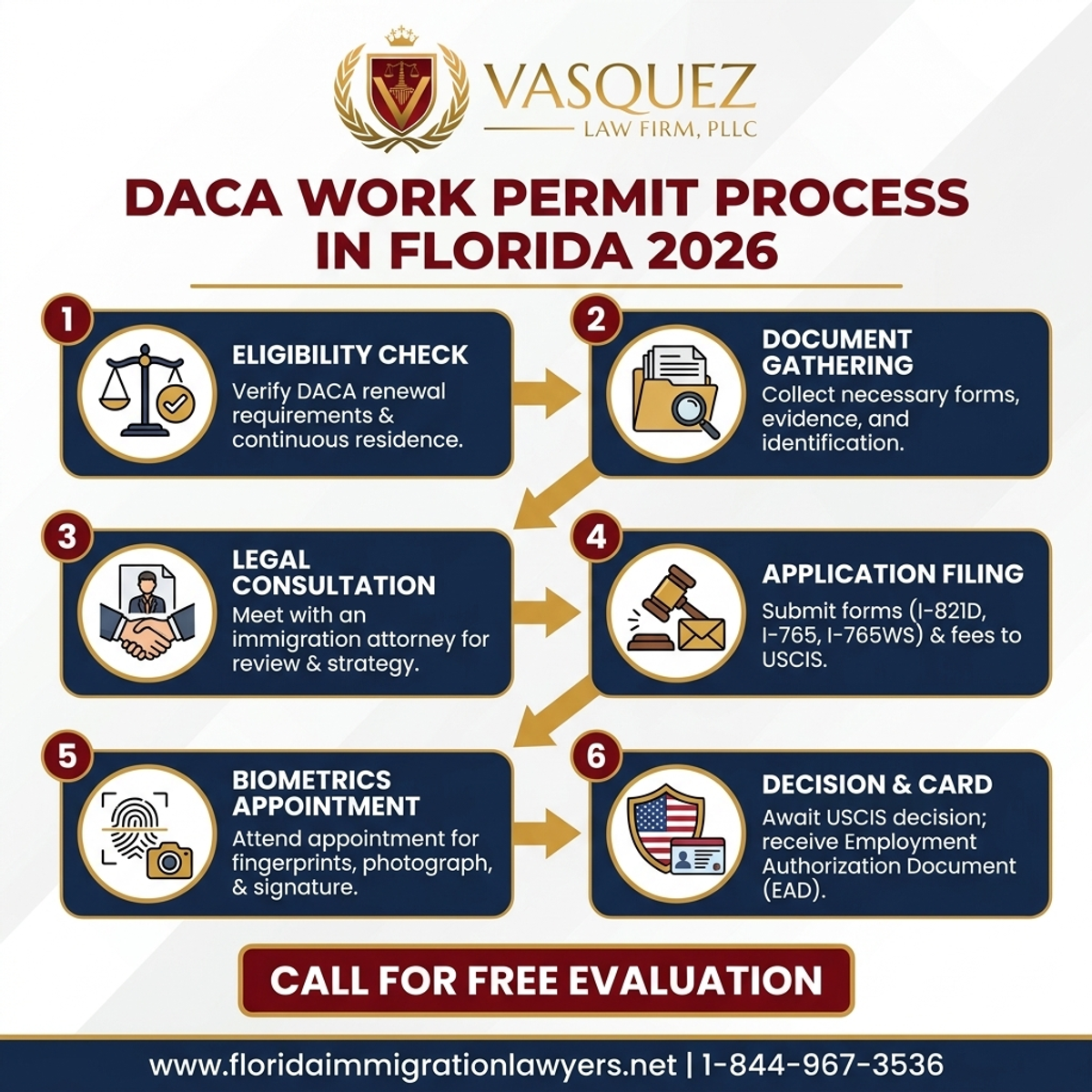
Step-by-Step Process — DACA Work Permit & Employment Authorization in Florida 2026
Understanding Employment Authorization Documents (EADs) for DACA Recipients
The Employment Authorization Document (EAD), often referred to as a work permit, is the physical card that allows DACA recipients to legally work in the United States. For DACA recipients in Florida, possessing a valid EAD is paramount to securing and maintaining employment. This card serves as proof of your authorization to work and is typically valid for two years, aligning with your DACA approval period. Upon receiving your DACA approval, USCIS will issue your EAD. It's crucial to understand that the EAD is not a visa or a green card; it is solely an authorization to work and does not confer permanent legal status or a pathway to citizenship on its own. Employers are legally required to verify your employment eligibility using Form I-9, and your EAD is a primary document for this verification. It's important to keep your EAD safe and to understand its expiration date to ensure timely renewal. Losing your EAD can lead to complications, including potential employment interruptions, so it's advisable to make copies and keep them in a secure location separate from the original. If your EAD is lost, stolen, or damaged, you will need to apply for a replacement by filing Form I-765 again, along with the associated fees. This process can take several months, so proactive measures are best. Furthermore, understanding the scope of your EAD is important; it allows you to work for any employer in the U.S. and does not restrict you to specific industries or job types. However, it does not grant you the right to hold certain federal jobs that require U.S. citizenship. Always present your EAD to employers as proof of your work authorization and be aware of your rights as an employee. This document is a cornerstone of economic stability for DACA recipients, enabling them to contribute meaningfully to the Florida economy and their communities. Ensure you understand its importance and how to manage it effectively throughout your DACA journey, including the implications for social security numbers and state-issued identification.
Travel Considerations for DACA Recipients in Florida
For DACA recipients in Florida, understanding travel restrictions and permissions is vital. Domestic travel within the United States is generally permitted without issue. DACA recipients can fly on domestic flights and travel across state lines, but it is always advisable to carry your DACA approval notice, your valid Employment Authorization Document (EAD), and a valid government-issued photo ID (such as a state driver's license or ID card). While not strictly required for domestic travel, these documents can help clarify your status if you encounter any questions from authorities. However, international travel is a much more complex matter. DACA does not automatically grant permission to travel outside the U.S. and re-enter. To travel internationally, DACA recipients must apply for and be granted Advance Parole (Form I-131) by USCIS before departing the country. Advance Parole is typically granted only for humanitarian, educational, or employment purposes, and the criteria are strict. Traveling outside the U.S. without an approved Advance Parole document can lead to severe consequences, including being denied re-entry into the United States and the termination of your DACA status. Even with Advance Parole, re-entry is not guaranteed, as Customs and Border Protection (CBP) officers retain final authority. It is highly recommended to consult with an immigration attorney before planning any international travel, even with Advance Parole, to understand the risks and ensure all procedures are followed correctly. For any questions regarding travel, especially if it involves leaving the U.S., seeking legal counsel is a critical step to protect your DACA status and ability to return.
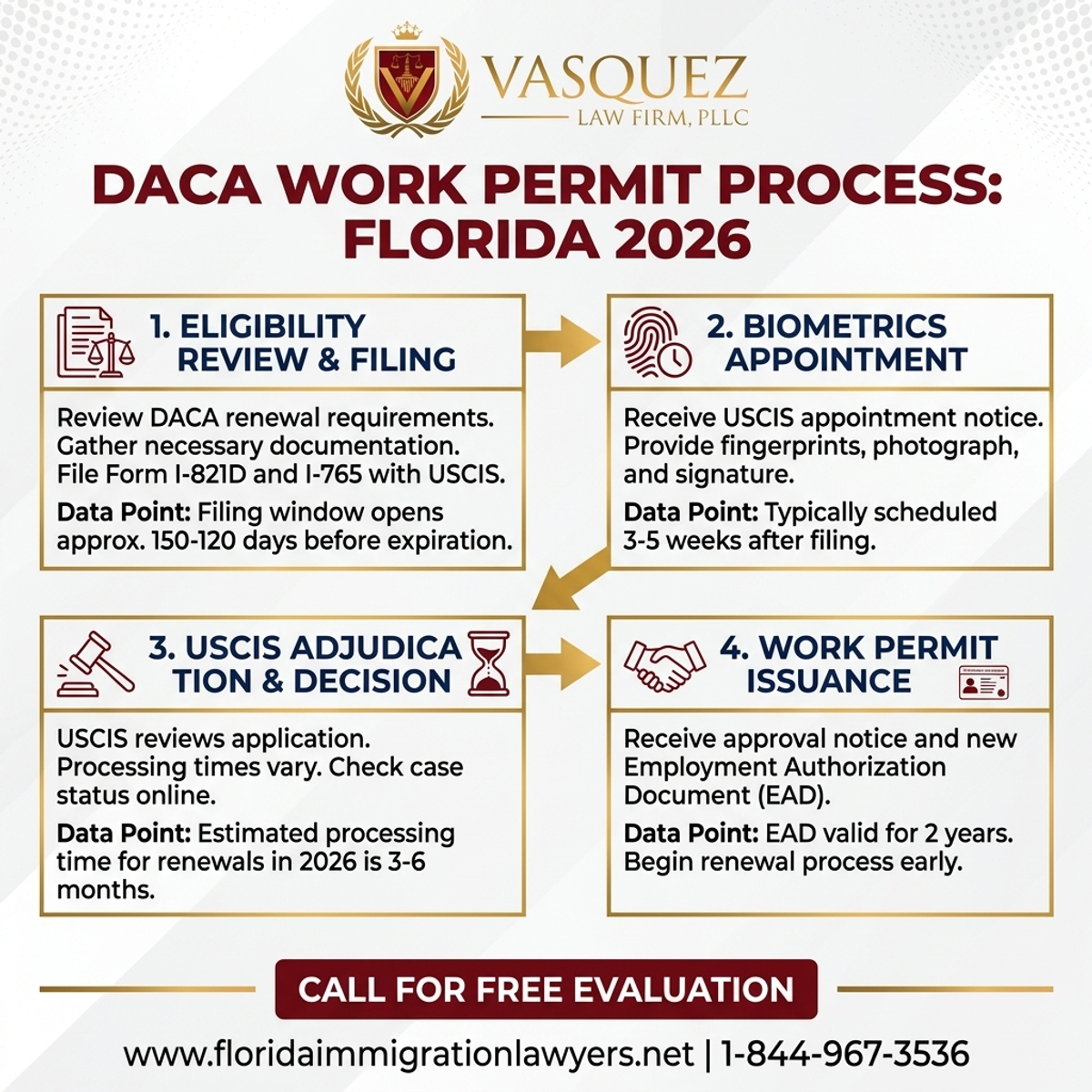
Key Statistics — DACA Work Permit & Employment Authorization in Florida 2026
What If Your DACA Application or Renewal is Denied?
A denial of your DACA application or renewal can be a disheartening and stressful experience, but it is not necessarily the end of the road. Understanding the reasons for denial is the first crucial step. Common reasons include incomplete applications, failure to meet eligibility criteria (such as continuous residence or age requirements), issues with criminal history, or inconsistencies in documentation. Upon receiving a denial notice, it is imperative to seek legal counsel immediately. An experienced immigration attorney can review the denial letter, assess the specific reasons for the decision, and advise you on potential next steps. Depending on the grounds for denial, options might include filing a motion to reopen or a motion to reconsider with USCIS, which essentially asks the agency to review its decision based on new facts or a legal error. In some cases, if the denial is based on a fundamental eligibility issue that cannot be resolved, an attorney can explore alternative immigration pathways that might be available to you. This could include exploring eligibility for asylum, U visas, T visas, or family-based petitions, depending on your unique circumstances. A denial can also escalate into potential deportation defense issues if you no longer have deferred action protection, making immediate legal intervention critical. Do not attempt to navigate a denial without professional legal guidance, as the consequences can be severe and long-lasting. Prompt and informed action is key to addressing a DACA denial effectively.
Beyond the Work Permit: DACA's Broader Impact and Future Considerations
While the DACA work permit is a critical component, its impact extends far beyond just employment authorization. DACA has allowed hundreds of thousands of young people to pursue higher education, obtain driver's licenses, open bank accounts, and integrate more fully into American society. In Florida, DACA recipients contribute significantly to the state's economy and cultural fabric, serving in essential roles across various industries, starting businesses, and enriching their communities. The stability offered by DACA empowers individuals to plan for their futures, invest in their education, and build careers without the constant fear of immediate deportation. This sense of security, though often precarious due to ongoing legal challenges, is invaluable. However, the future of DACA remains a subject of intense legal and political debate. Court challenges continue to shape the program's parameters, with significant rulings from federal courts, including the Fifth Circuit Court of Appeals, impacting who can apply and how the program operates. The lack of a permanent legislative solution from Congress means DACA's existence is continually vulnerable to legal challenges and changes in administration policy. This uncertainty can be a source of significant stress and anxiety for DACA recipients and their families, affecting long-term planning for education, careers, and family life. It underscores the importance of staying informed about legal developments and advocating for permanent protections. While DACA currently provides temporary relief, many hope for a more definitive legislative solution that offers a pathway to permanent residency and citizenship, allowing Dreamers to fully realize their potential without fear. Understanding the broader context of DACA, including its societal benefits and political vulnerabilities, is crucial for every recipient. It also highlights the need for continued engagement with advocacy groups and legal experts. If you are concerned about the future of DACA or exploring other legal options, our firm specializes in various immigration services and our dedicated attorneys are here to provide guidance. We encourage you to reach out to us for a consultation to discuss your specific situation and potential strategies to secure your future.
Seeking Legal Assistance for Your DACA Journey in Florida
Navigating the complexities of DACA applications, renewals, and related immigration matters can be challenging. The legal landscape is constantly shifting, and even minor errors in an application can lead to significant delays or denials. Seeking professional legal assistance from an experienced immigration attorney is highly recommended for all DACA recipients in Florida. An attorney can help you:
- Assess your eligibility accurately and identify potential issues.
- Gather and organize all necessary documentation efficiently.
- Complete application forms correctly and thoroughly, minimizing errors.
- Prepare for biometric appointments and understand what to expect.
- Respond effectively to Requests for Evidence (RFEs) from USCIS.
- Represent you in case of a denial or other legal challenges, advocating on your behalf.
- Explore alternative immigration pathways if DACA is not an option or if you seek a more permanent solution for your status.
Sources and References
- U.S. Citizenship and Immigration Services (USCIS)
- Executive Office for Immigration Review (EOIR)
- U.S. Department of State
- Immigration and Nationality Act (INA), 8 U.S.C. Chapter 12
Do Not Navigate This Process Alone
Our experienced immigration attorneys are ready to fight for you. Get a free, confidential case review today.
Se Habla Español
Or leave your details and we’ll call you:
Free Evaluation in 24 Hours
Or talk to us right now
AI voice assistant — available 24/7
FreeFrequently Asked Questions

William J. Vásquez
Founding Attorney · Vasquez Law Firm
U.S. Air Force veteran and immigration attorney with years of hands-on U.S. immigration experience. J.D., NCCU School of Law. AILA member. Admitted to the 4th, 5th, and 11th Circuit Courts.
Available 24/7 - Free Evaluations
Reviewed for legal accuracy by William J. Vásquez
Licensed in North Carolina; U.S. immigration is federal practice.
Related Legal Services
Our Florida immigration attorneys can help you with citizenship and naturalization, immigration practice areas and free immigration consultation. Call today at 1-844-YO-PELEO for a free case review.
Related Links
Related Topics
Free Legal Case Review
Discuss your case with our experienced attorneys. We're available 24/7.
Se Habla Español - Estamos aquí para ayudarle.
Related Articles
DUI Immigration Consequences in Florida 2026
A DUI conviction in Florida can have severe immigration consequences, potentially leading to inadmissibility, deportation, or denial of immigration benefits. For non-citizens, a DUI is not just a traffic offense but a serious criminal matter that federal immigration law scrutinizes closely. Factors like multiple offenses, injury, or property damage can escalate a simple DUI to a Crime Involving Moral Turpitude (CIMT) or even an aggravated felony, triggering mandatory detention and removal proceedings. Understanding the specific nature of your Florida conviction and its interpretation under the Immigration and Nationality Act (INA) is crucial. This article outlines how DUIs impact immigration status, the grounds for inadmissibility and deportation, a step-by-step guide to navigating the process, essential documentation, and expected timelines for 2026. We also highlight common mistakes to avoid and when to seek legal counsel from an experienced immigration attorney. Florida Immigration Lawyers offers comprehensive support for individuals facing these challenging situations, providing expert guidance through complex legal landscapes.
Dual Citizenship Lawyer in Florida: What You Need to Know
For Florida residents, the concept of dual citizenship, or holding two passports, offers a compelling blend of opportunities and challenges. While the U.S. generally permits dual nationality, the path to achieving this status requires a meticulous understanding of both U.S. immigration laws and the citizenship policies of your country of origin. This guide explores the definition of dual citizenship, the detailed step-by-step process for U.S. naturalization, and the significant benefits and potential pitfalls involved. We cover essential documentation, typical timelines, and cost considerations for 2026, providing crucial insights for anyone in Orlando, Miami, or across Florida considering this important legal step. Learn about common mistakes to avoid and understand when to seek professional legal counsel to navigate this complex process successfully. Florida Immigration Lawyers is here to provide expert, bilingual support for your dual citizenship journey.
EAD Advance Parole Combo Card in Florida 2026
For individuals with a pending Form I-485, Application to Register Permanent Residence or Adjust Status, the EAD Advance Parole Combo Card is an essential document. This single card combines the authorization to work legally in the U.S. (Employment Authorization Document - EAD) with permission to travel internationally and re-enter without abandoning your green card application (Advance Parole). This guide from Florida Immigration Lawyers provides a comprehensive overview for applicants in Florida in 2026, covering eligibility, the step-by-step application process, required documents, expected processing times, and associated costs. We also highlight common mistakes to avoid and when to seek legal counsel to ensure a smooth and successful immigration journey. Understanding this vital card is key to maintaining stability while awaiting your permanent residency approval.
Immigration Lawyer Orlando Free Consultation in Florida
For individuals and families in Orlando, Florida, navigating the complexities of U.S. immigration law requires expert guidance. An immigration lawyer in Orlando offers crucial support for everything from visa applications and green card processes to naturalization and deportation defense. This comprehensive guide details what a free consultation covers, providing a step-by-step overview of immigration pathways, essential document checklists, and expected timelines in 2026. We also highlight common mistakes to avoid, discuss the critical role of legal counsel in deportation and asylum cases, and explain why choosing a local Orlando immigration attorney is beneficial. Florida Immigration Lawyers is dedicated to serving the diverse community of Orlando with compassionate, effective legal solutions, ensuring you receive personalized advice and robust representation for a successful immigration journey.