DACA Renewal Guide for Florida Dreamers 2026 | VLF Florida
Renew your DACA status in Florida for 2026 with our comprehensive guide. Learn key steps, document requirements, and common mistakes to avoid. Call Florida Immigration Lawyers at 1-844-967-3536 for a free consultation today.

- Start your renewal process 120-150 days before expiration.
- Ensure all documents are up-to-date and accurate, reflecting any life changes.
- Consider legal assistance to navigate new policies and complex situations.
- Proactively track your application status to address any issues promptly.
Introduction
Living in Gainesville, Florida, as a DACA recipient, means you have certain protections and opportunities. However, these benefits hinge on timely and successful renewal of your DACA status. As we approach 2026, understanding the renewal process is more important than ever, especially with recent changes in USCIS policies. This article will provide a detailed guide on how to renew your DACA status, tailored specifically for Florida residents. Call Florida Immigration Lawyers at 1-844-967-3536 for a free consultation and ensure you're fully prepared.
The DACA program, while facing continuous legal challenges, remains a vital pathway for hundreds of thousands of young people across the United States to live and work without fear. In Florida alone, thousands of DACA recipients contribute significantly to our communities, economy, and culture. Their ability to pursue higher education, establish careers, and build families is directly tied to the successful renewal of their deferred action status.
Given the fluctuating nature of immigration laws and the specific requirements set forth by USCIS, staying informed and proactive is paramount. This guide aims to demystify the renewal process, providing clear, actionable steps and expert advice to help you navigate it successfully. Whether you are renewing for the first time or have been through the process before, new updates or personal circumstances might require a fresh look at your application strategy. Our goal is to empower you with the knowledge needed to secure your future in Florida.
Understanding DACA and Its Importance
DACA, or Deferred Action for Childhood Arrivals, provides temporary protection from deportation and eligibility for a work permit to eligible immigrants who came to the United States as children. For many in Florida, DACA has been a lifeline, offering a chance to study, work, and live without fear of removal. Given the dynamic nature of immigration policies, staying informed about your DACA status and renewal is imperative.
Beyond the immediate protection from deportation and the ability to legally work, DACA status opens doors to numerous opportunities. DACA recipients can obtain a Social Security number, apply for a driver's license in Florida, pursue higher education without fear of their status, and contribute to their communities in meaningful ways. These benefits are not just practical; they foster a sense of stability and belonging for individuals who have known no other home than the U.S.
However, the DACA program has faced significant legal and political challenges since its inception in 2012. While currently upheld, its future remains uncertain, underscoring the critical importance of maintaining your status without any lapse. Any delay or error in renewal could lead to a temporary loss of work authorization and protection, creating immense stress and disruption. This is why a meticulous and timely renewal process is not merely a bureaucratic task but a crucial step in safeguarding your future.
Step-by-Step Guide to DACA Renewal
- Start Early: Begin your renewal process 120-150 days before your current DACA expires to avoid any lapse. It is highly recommended to mark your calendar and set reminders as soon as you receive your initial DACA approval or previous renewal notice. Procrastination can lead to significant stress and potential loss of work authorization.
- Gather Documentation: Ensure you have up-to-date identification, previous DACA notices, and any required forms. This includes your most recent Employment Authorization Document (EAD), previous DACA approval notices (Form I-797), and any valid government-issued identification.
- Complete Forms: Fill out the latest USCIS forms, including Form I-821D (Consideration of Deferred Action for Childhood Arrivals), Form I-765 (Application for Employment Authorization), and Form I-765WS (Worksheet). Always download the most current versions directly from the USCIS website to avoid using outdated forms, which will lead to rejection. Pay close attention to every question, ensuring all information is accurate and consistent with previous applications. Any discrepancies could trigger requests for evidence or even a denial.
- Submit Application: Double-check for accuracy and completeness before sending your application to the USCIS lockbox. Make copies of your entire application packet for your records before mailing. It's advisable to send your application via certified mail with a return receipt requested, providing proof of mailing and delivery.
- Receive Receipt: USCIS will send a receipt notice (Form I-797C) confirming they have received your application. This notice is important for tracking your application status online. Keep this notice in a safe place.
- Attend Biometrics Appointment: Follow any instructions for biometric screening if required. You will receive an appointment notice (Form I-797C) with the date, time, and location. Missing this appointment without rescheduling can delay your application significantly.
- Await Decision: USCIS will notify you of the decision. Keep track by creating an account on the USCIS website. You can use the receipt number from your I-797C notice to check your case status online. If you have not heard anything within the typical processing timeframe, you may contact USCIS or consult with Florida Immigration Lawyers for assistance.
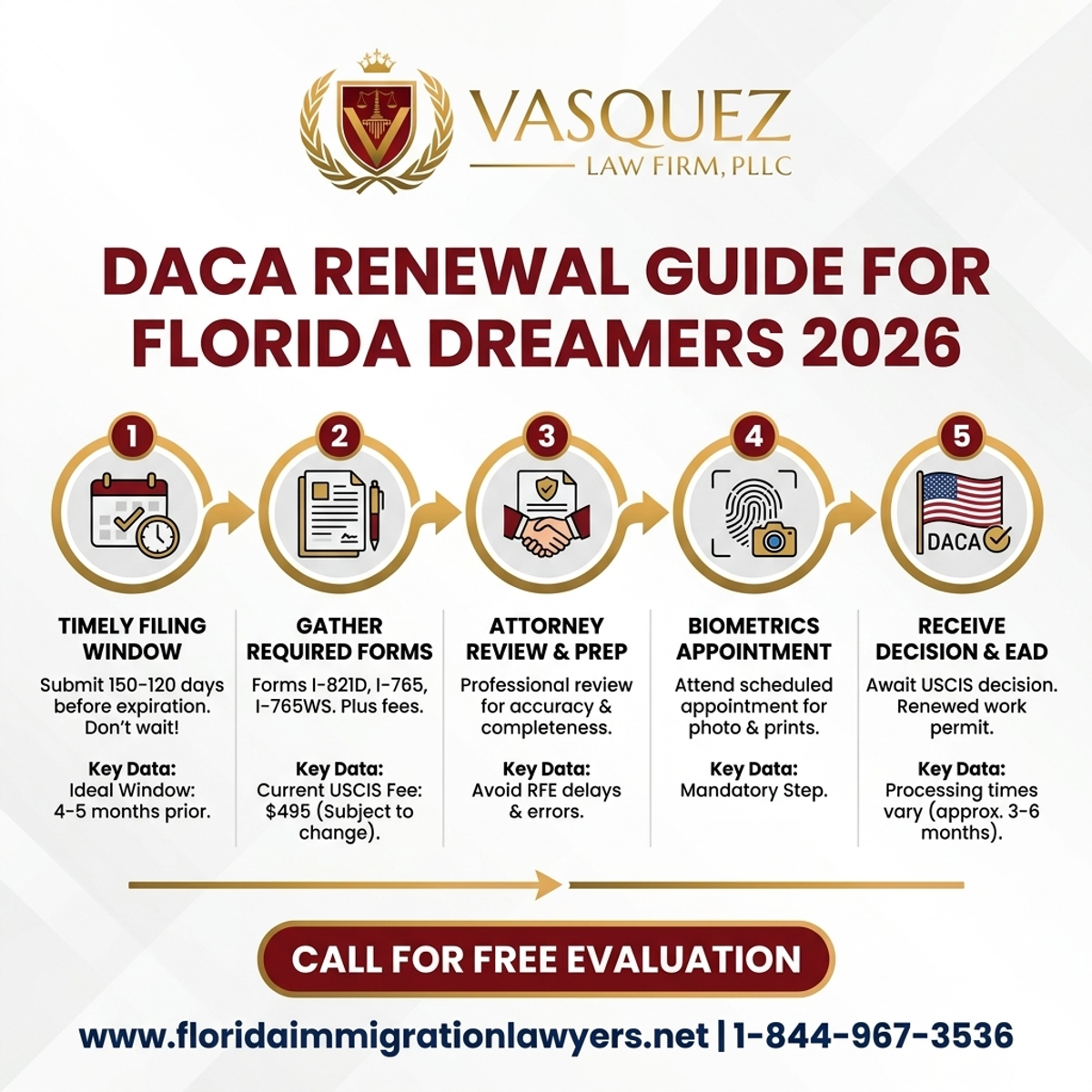
Step-by-Step Process — DACA Renewal Guide for Florida Dreamers 2026
Document Checklist for DACA Renewal
Preparing a thorough and accurate set of documents is paramount for a successful DACA renewal. Missing or outdated documents are a leading cause of delays and rejections. Below is a comprehensive checklist of what you'll need, along with additional guidance to ensure your application is complete.
- Valid passport or other government-issued ID: This could include a state ID, driver's license (if applicable), or a birth certificate with photo ID. Ensure it is current and clearly shows your identity.
- Current Employment Authorization Document (EAD): Submit a clear photocopy of both sides of your most recent EAD card. This proves your current work authorization status.
- Previous DACA approval notices (Form I-797): Include copies of all previous DACA approval notices. These documents serve as proof of your past deferred action grants and help USCIS track your history with the program.
- Completed Form I-821D: This is the primary form for DACA renewal. Fill it out completely and accurately, providing all requested information about your continuous residence, education, and any criminal history.
- Completed Form I-765 and Form I-765WS: Form I-765 is your application for a work permit, and Form I-765WS is a worksheet explaining your economic need for employment. Both must be filled out meticulously.
- Two passport-style photographs: These photos must meet USCIS specifications (2x2 inches, color, white background, taken within 30 days of filing). Write your name and A-number lightly in pencil on the back of each photo.
- Filing fee payment: As of 2026, verify the current amount on the USCIS website. The fee usually covers the I-765 application and biometrics. Payment must be made by money order, personal check, or cashier's check payable to "U.S. Department of Homeland Security."
In addition to these core documents, if your personal information has changed (e.g., name change due to marriage), you must include supporting legal documentation. If you have had any encounters with law enforcement, even minor ones, it is critical to include certified court dispositions. When in doubt about any document, or if you lack a specific item, consulting with Florida Immigration Lawyers at 1-844-967-3536 can save you from potential headaches and delays.
Timeline and Processing Expectations
Typically, the DACA renewal process takes about 90-120 days. However, with recent policy changes, some delays might occur. It's crucial to apply well before your DACA expires to prevent any disruption in your status or employment. Stay updated on new processing times through the USCIS website.
Several factors can influence the processing time of your DACA renewal application. These include the volume of applications USCIS is receiving, the complexity of your individual case (e.g., if you have a criminal record or have traveled outside the U.S.), and any unforeseen policy shifts or government shutdowns. While the 90-120 day estimate is a general guideline, it's always safer to assume it could take longer, reinforcing the advice to apply 120-150 days in advance.
What happens if your DACA expires while your renewal is pending? While USCIS aims to process renewals before expiration, it's not always guaranteed. If your EAD expires, you will temporarily lose your work authorization, which can have serious financial implications. In such cases, you cannot legally work until your new EAD is approved. This scenario highlights the importance of timely submission and maintaining open communication with USCIS, or better yet, having legal counsel like Florida Immigration Lawyers monitor your case status and intervene if necessary.
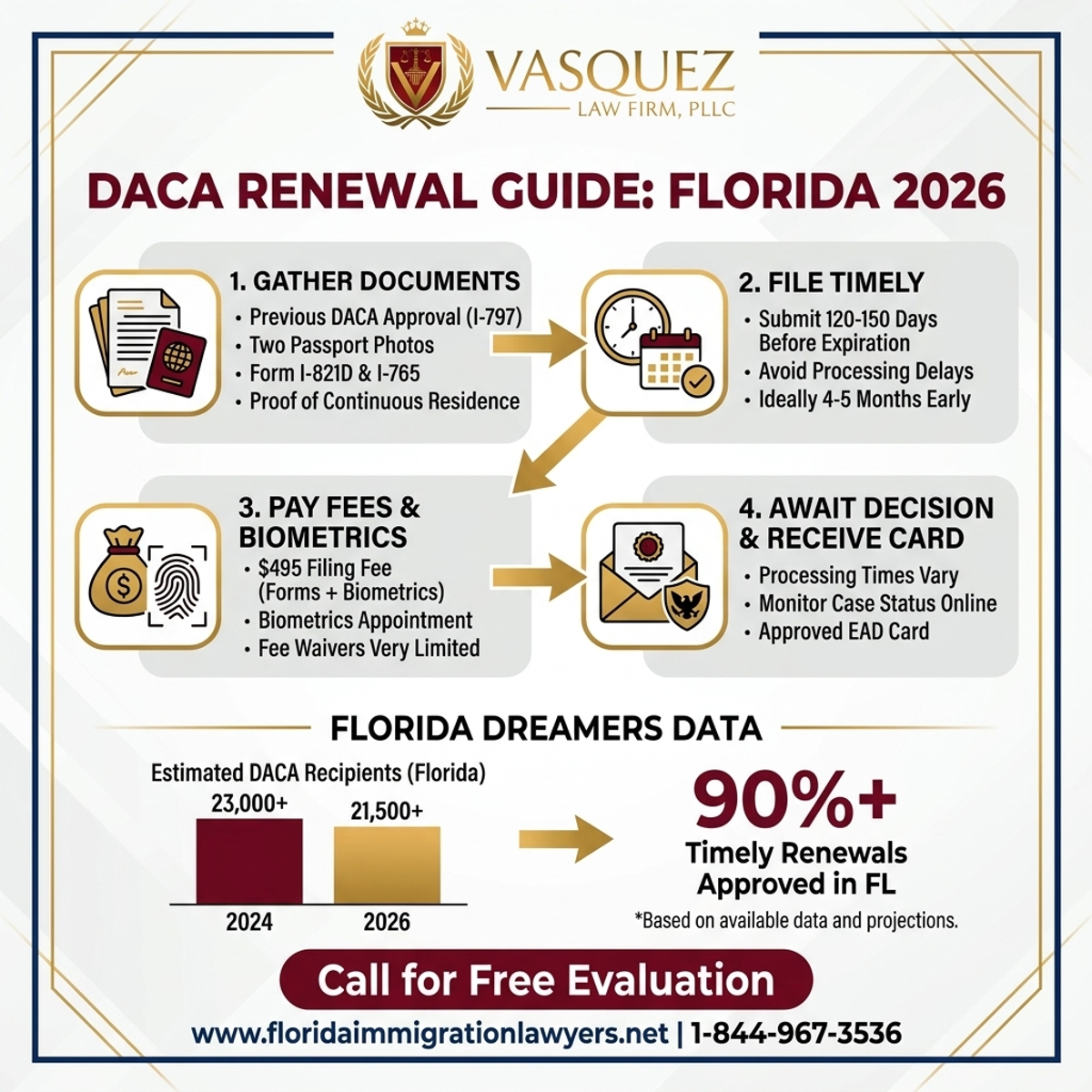
Key Statistics — DACA Renewal Guide for Florida Dreamers 2026
Cost Factors and Fee Breakdown
The cost of renewing DACA includes filing fees for Form I-765, which covers the Employment Authorization Document (EAD). While fees are subject to change, as of 2026, it is crucial to verify the current amount on the official USCIS website. Additionally, consider costs for legal assistance, which can provide invaluable support to ensure a smooth process.
Currently, the total filing fee for a DACA renewal application is typically $495, which includes $410 for Form I-765 (Application for Employment Authorization) and $85 for biometrics services. It is important to note that Form I-821D (Consideration of Deferred Action for Childhood Arrivals) does not have a separate filing fee. These fees must be paid in a single payment. USCIS does not accept cash, and personal checks, money orders, or cashier's checks should be made payable to "U.S. Department of Homeland Security."
For DACA recipients facing significant financial hardship, USCIS offers limited fee waivers. However, DACA renewal applications are generally not eligible for fee waivers unless the applicant meets very specific, stringent criteria, which are rarely granted. In most cases, applicants are expected to pay the full fee. If you believe you might qualify for a fee waiver or are exploring options for financial assistance, it is highly recommended to consult with Florida Immigration Lawyers. They can assess your eligibility and guide you through the process, helping you avoid potential pitfalls or delays associated with incorrect fee submissions.
Common Mistakes to Avoid in DACA Renewal
Renewing your DACA status requires meticulous attention to detail. Even minor errors can lead to significant delays or even denial of your application. Being aware of these common pitfalls can help you navigate the process more smoothly and safeguard your protected status and work authorization.
- Failing to renew on time, which can lead to a lapse in protection. This is perhaps the most critical mistake. A lapse means you lose your work authorization and are no longer protected from deportation, even temporarily. Always apply within the 120-150 day window before expiration.
- Submitting incomplete forms, resulting in delays or denials. Every question on every form must be answered truthfully and completely. If a question doesn't apply, write "N/A." Double-check that all required signatures are present where indicated.
- Using outdated forms not accepted by USCIS. USCIS frequently updates its forms. Always download the latest versions directly from the USCIS website to ensure compliance. Using an old form will result in your application being rejected.
- Not providing sufficient evidence of continuous residence. While DACA renewals typically don't require extensive initial evidence of continuous residence, USCIS may request it, especially if there are gaps in your record or if you've had issues. Keep records of utility bills, school transcripts, employment records, and tax documents.
- Overlooking the need for biometrics appointments. After submitting your application, you will receive a notice for a biometrics appointment. This is mandatory. Failure to attend or reschedule promptly can lead to rejection of your application.
- Ignoring changes in personal information without notifying USCIS. If you've moved, changed your name, or had any significant life events, you must update USCIS. Failing to do so can cause mail to be misdirected, leading to missed notices and critical deadlines.
- Underestimating the impact of legal issues on your renewal application. Even minor arrests or citations can complicate your DACA renewal. It is crucial to disclose all legal issues and provide certified court dispositions. Consulting with Florida Immigration Lawyers is essential if you have any criminal history, no matter how minor it seems.
- Failing to check the USCIS website for updated fees or forms. Immigration policies and fees are subject to change without much notice. Regularly check the official USCIS website before preparing and submitting your application to ensure you have the most current information.
When to Call a Lawyer
If you encounter any issues during your DACA renewal process, such as a criminal record, legal disputes, or complicated immigration history, it is crucial to seek legal advice. Florida Immigration Lawyers offer expert guidance to ensure your application is correctly submitted and that you understand any implications of recent policy changes. Contact us today to discuss your case.
You should consider contacting an attorney even if your case seems straightforward. An experienced immigration lawyer can review your application for completeness and accuracy, ensuring no critical details are missed. They can also provide invaluable advice on how to best present your case, especially in light of the evolving legal landscape surrounding DACA. Proactive legal consultation can prevent future complications and provide peace of mind.
Specific scenarios that warrant immediate legal consultation include any arrests or criminal charges (even dismissed ones), travel outside the U.S. without advance parole, significant gaps in your continuous residence, or if you've ever been placed in removal proceedings. These situations can significantly jeopardize your DACA eligibility, and attempting to navigate them without expert legal guidance from a firm like Florida Immigration Lawyers could lead to denial. Don't hesitate to call 1-844-967-3536 for a free consultation to protect your future.
About Florida Immigration Lawyers
Florida Immigration Lawyers is dedicated to serving the immigrant community across Florida. Our experienced attorneys specialize in DACA renewals, asylum, deportation defense, family and business immigration, and more. With a commitment to offering compassionate and comprehensive legal support, we are available 24/7 to assist you. Call us at 1-844-967-3536 or visit our website for a free consultation.
Our team understands the unique challenges faced by DACA recipients and their families in Florida. We pride ourselves on staying abreast of the latest legal developments and policy changes, ensuring that our advice is always current and tailored to your specific situation. From initial consultation to final approval, we guide our clients through every step of the complex immigration process with professionalism and empathy.
Beyond DACA renewals, Florida Immigration Lawyers offers a full spectrum of immigration services designed to meet diverse needs. Whether you are seeking to adjust your status, petition for family members, or require robust defense against deportation, our skilled attorneys are here to advocate for your rights and help you achieve your immigration goals. We believe everyone deserves high-quality legal representation, and we are committed to providing accessible and effective solutions for our community.
Frequently Asked Questions (FAQs) About DACA Renewal
Navigating the DACA renewal process often brings up various questions. Here are some common inquiries and practical advice to help you understand your situation better.
Sources and References
- U.S. Citizenship and Immigration Services (USCIS)
- Executive Office for Immigration Review (EOIR)
- 8 U.S.C. Chapter 12 - Immigration and Nationality Act
Related services: immigration practice areas, family immigration services.
This article provides general legal information and is not intended as legal advice. Every case is unique, and outcomes depend on specific facts and circumstances. Contact an attorney for advice about your particular situation.
For assistance with your DACA renewal, contact Florida Immigration Lawyers at 1-844-967-3536. Se Habla Espanol - Estamos aquí para ayudarle.
If you need legal assistance, learn more about immigration lawyers in Florida, or call us at 1-844-967-3536 for a free consultation.
Do Not Navigate This Process Alone
Our experienced immigration attorneys are ready to fight for you. Get a free, confidential consultation today.
Se Habla Español
Frequently Asked Questions
Florida Immigration Lawyers
Immigration Attorney | Founder, Vasquez Law Firm
U.S. Air Force veteran and immigration attorney with thousands of cases resolved. J.D., NCCU School of Law. AILA member. Admitted to the 4th, 5th, and 11th Circuit Courts.
Available 24/7 - Free Evaluations
Related Legal Services
Our Florida immigration attorneys can help you with family immigration services, immigration practice areas and free immigration consultation. Call today at 1-844-967-3536 for a free consultation.
Related Links
Related Topics
Free Legal Consultation
Discuss your case with our experienced attorneys. We're available 24/7.
Se Habla Español - Estamos aquí para ayudarle.
Related Articles
Special Immigrant Juvenile Status in Florida | VLF Florida
SIJS offers a pathway to legal residency for minors in Florida who have faced abuse, abandonment, or neglect. Learn how SIJS can provide legal protection and a brighter future. Call us for a free consultation.
Asylum Interview Preparation in Florida: Key Steps
Prepare for your asylum interview in Florida with expert guidance. Learn about key steps, document requirements, common mistakes, and when to seek legal help.
EB-5 Investor Green Card in Florida: Key Insights | VLF Florida
Explore how the EB-5 investor green card program can help you start a new life in Florida. Learn about the benefits, processes, and common pitfalls of this investment immigration path. Call 1-844-967-3536 for expert guidance.
E-2 Visa for Florida Business Investors | VLF Florida
Learn how the E-2 investor visa can help you start a business in Naples, Florida. We cover eligibility, application steps, common mistakes, and when to seek legal help. Contact Florida Immigration Lawyers for a free consultation.
