DACA Renewal Florida 2026 Guide for Dreamers | VLF Florida
For thousands of young individuals, Deferred Action for Childhood Arrivals (DACA) provides a vital pathway to live and work legally in the United States. If you are a DACA recipient in Florida, preparing for your 2026 renewal is a critical step to maintain your protected status. This comprehensive guide from Florida Immigration Lawyers details the step-by-step process, essential documents, timelines, and cost factors. We also highlight common mistakes to avoid and specific scenarios when legal counsel is indispensable. Our aim is to provide clarity and empower you with the necessary information for a successful DACA renewal. Do not navigate this complex process alone; our experienced team is ready to assist you every step of the way.

DACA renewal in Florida for 2026 requires careful attention to deadlines and document submission. Eligible individuals, often referred to as Dreamers, must file Form I-821D (Consideration of Deferred Action for Childhood Arrivals), Form I-765 (Application for Employment Authorization), and Form I-765WS (Worksheet). It is crucial to submit your application 120 to 150 days before your current DACA expiration date to avoid a lapse in protection and employment authorization. Consulting with experienced immigration attorneys, like Florida Immigration Lawyers, can help ensure your application is complete and accurate, minimizing potential delays or denials.
- Submit DACA renewal applications 120-150 days before expiration.
- Required forms include I-821D, I-765, and I-765WS.
- Gather comprehensive supporting documents, including proof of continuous residence and identity.
- Be prepared for biometric appointments and potential interview waivers.
- Seek legal guidance from Florida Immigration Lawyers to navigate complex cases or avoid common errors.
Navigating the complexities of immigration law can feel overwhelming, especially when your future depends on it. For thousands of young individuals across Florida, Deferred Action for Childhood Arrivals (DACA) provides a vital pathway to live and work legally in the United States. If you are a DACA recipient in St. Petersburg, Orlando, Miami, or anywhere else in the Sunshine State, preparing for your DACA renewal Florida 2026 is a critical step to maintain your protected status.
The DACA program, while facing ongoing legal challenges, continues to offer temporary relief from deportation and eligibility for an Employment Authorization Document (EAD). Ensuring a timely and accurate renewal application is paramount. This comprehensive guide from Florida Immigration Lawyers will walk you through everything you need to know about the DACA renewal process for 2026, offering crucial insights and practical advice specifically tailored for Florida Dreamers.
We understand the anxiety and uncertainty that can accompany this process. Our goal is to provide clarity and empower you with the information needed to successfully renew your DACA. From understanding eligibility criteria to compiling the necessary documents and anticipating timelines, we are here to help. Do not risk your status by attempting to navigate this intricate process alone. Call Florida Immigration Lawyers at 1-844-967-3536 for a free consultation and let our experienced team assist you.
Understanding DACA and Its Importance for Florida Dreamers
Deferred Action for Childhood Arrivals (DACA) was established in 2012, offering a renewable two-year period of deferred action from deportation and eligibility for a work permit to certain undocumented immigrants who arrived in the U.S. as children. While not a path to permanent residency or citizenship, DACA provides a significant measure of stability for hundreds of thousands of individuals, often referred to as Dreamers, who have grown up in the United States and consider it their home. For Florida's vibrant immigrant communities, particularly in areas like St. Petersburg, Tampa, and Orlando, DACA has been a lifeline, enabling recipients to pursue higher education, secure stable employment, and contribute meaningfully to the state's economy and culture.
The program operates under the executive authority of prosecutorial discretion, allowing the Department of Homeland Security to defer removal proceedings for eligible individuals. This executive action is rooted in the broader principles of the Immigration and Nationality Act (INA), specifically regarding the discretion afforded to immigration authorities. While DACA has faced legal scrutiny, current policy allows for renewals for those who previously held DACA status. Understanding the nuances of this program and its current legal standing is crucial for every DACA recipient in Florida. The ability to work legally and live without immediate fear of deportation profoundly impacts an individual's quality of life and future prospects.
For Florida Dreamers, DACA means more than just a work permit; it represents an opportunity to fully integrate into the society they have always known. It allows them to obtain driver's licenses, pursue professional careers, and plan for their futures with greater certainty. The economic contributions of DACA recipients in Florida are substantial, bolstering local economies through taxes, consumer spending, and entrepreneurship. Florida Immigration Lawyers are dedicated to helping these individuals maintain their DACA status, recognizing the profound positive impact it has on their lives and our communities. We provide expert immigration legal services to ensure your status is protected.
Step-by-Step DACA Renewal Process for 2026
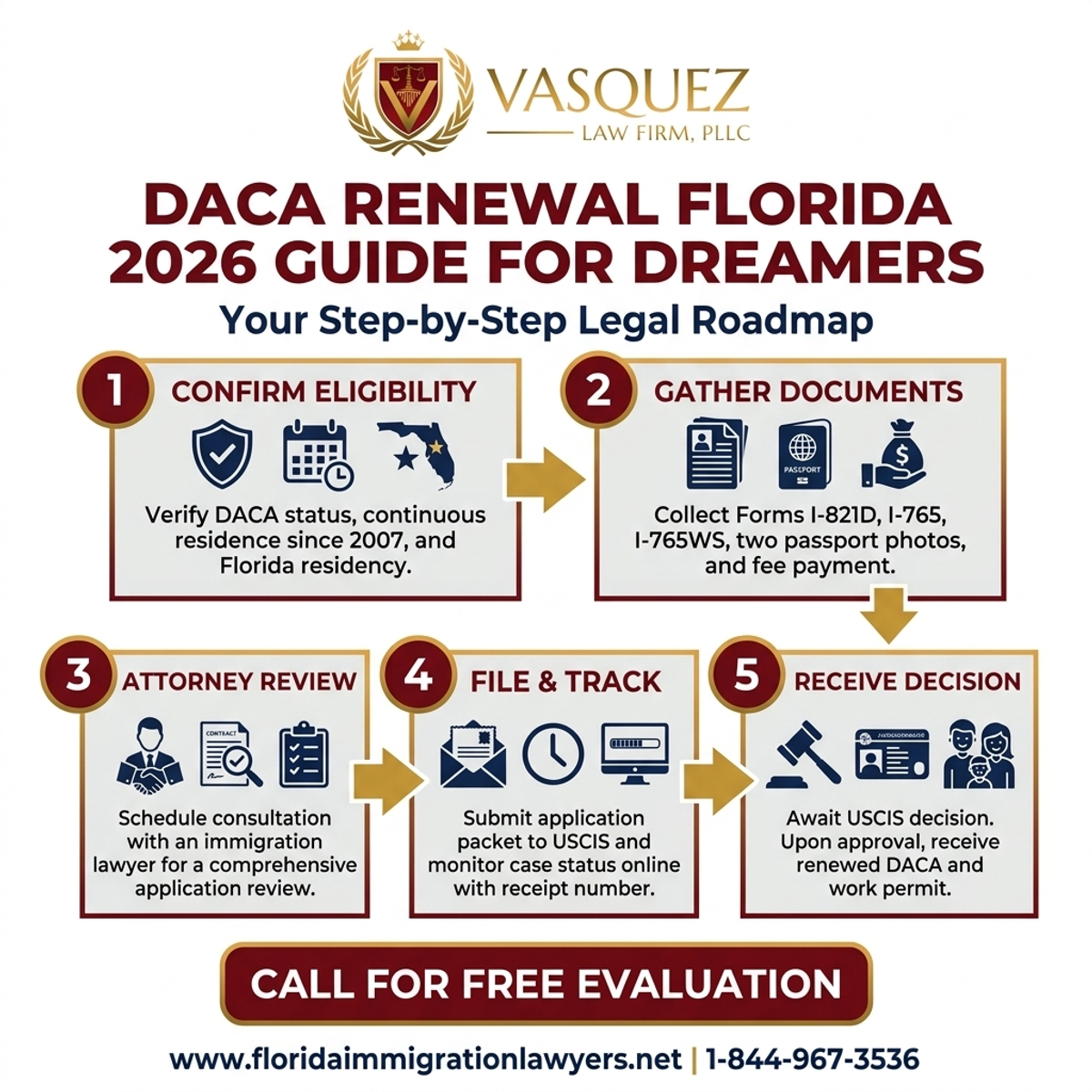
Renewing your DACA status requires a methodical approach and strict adherence to U.S. Citizenship and Immigration Services (USCIS) guidelines. For DACA recipients in Florida preparing for their 2026 renewal, understanding each step is vital. The process typically involves submitting three specific forms, along with supporting documentation and applicable fees. It is highly recommended to begin preparing your renewal application 120 to 150 days before your current DACA expiration date to prevent any gaps in your protection or employment authorization. This timeframe allows for potential processing delays and ensures you remain protected.
-
Review Your Eligibility: Before beginning the renewal process, ensure you still meet the DACA eligibility criteria. This primarily means you have not departed the United States since August 15, 2012, without advance parole, have continuously resided in the U.S. since your last DACA approval, and have not been convicted of a felony, a significant misdemeanor, or three or more other misdemeanors. Any changes to your criminal record, even minor ones, should be discussed with an attorney immediately.
-
Gather Required Documents: Collect all necessary supporting documents, which typically include copies of your previous DACA approval notices, your current Employment Authorization Document (EAD), identity documents (passport, birth certificate), and any documents proving continuous residence in the U.S. since your last DACA approval. This might include utility bills, school records, employment records, or bank statements. Ensure all documents are clear and legible.
-
Complete Forms I-821D, I-765, and I-765WS: These are the core forms for your DACA renewal. Form I-821D, the Request for Deferred Action for Childhood Arrivals, is where you reaffirm your eligibility. Form I-765, Application for Employment Authorization, is for your work permit. Form I-765WS, the Worksheet for Form I-765, provides additional information regarding your economic need for employment. Fill out all sections completely and accurately, ensuring consistency with previous applications. Do not leave any sections blank; if a question does not apply, write "N/A." You can find the latest versions of these forms on the USCIS DACA page.
-
Pay the Filing Fees: As of the current guidelines, there are specific filing fees for Form I-765 and biometric services. While fees are subject to change, typically, one combined payment covers both. USCIS does not accept fee waivers for Form I-821D, but you may be eligible for a fee exemption in rare circumstances if you meet specific poverty guidelines. We strongly advise checking the most current fee schedule on the USCIS website or consulting with an attorney to confirm the exact amounts and payment methods.
-
Submit Your Application Package: Organize your application forms and supporting documents neatly. Create a cover letter listing all included items. Mail your complete package to the USCIS Lockbox Facility designated for DACA applications. The correct mailing address depends on your state of residence; for Florida residents, this information is available on the USCIS website. Always send your application via certified mail with a return receipt requested to have proof of submission.
-
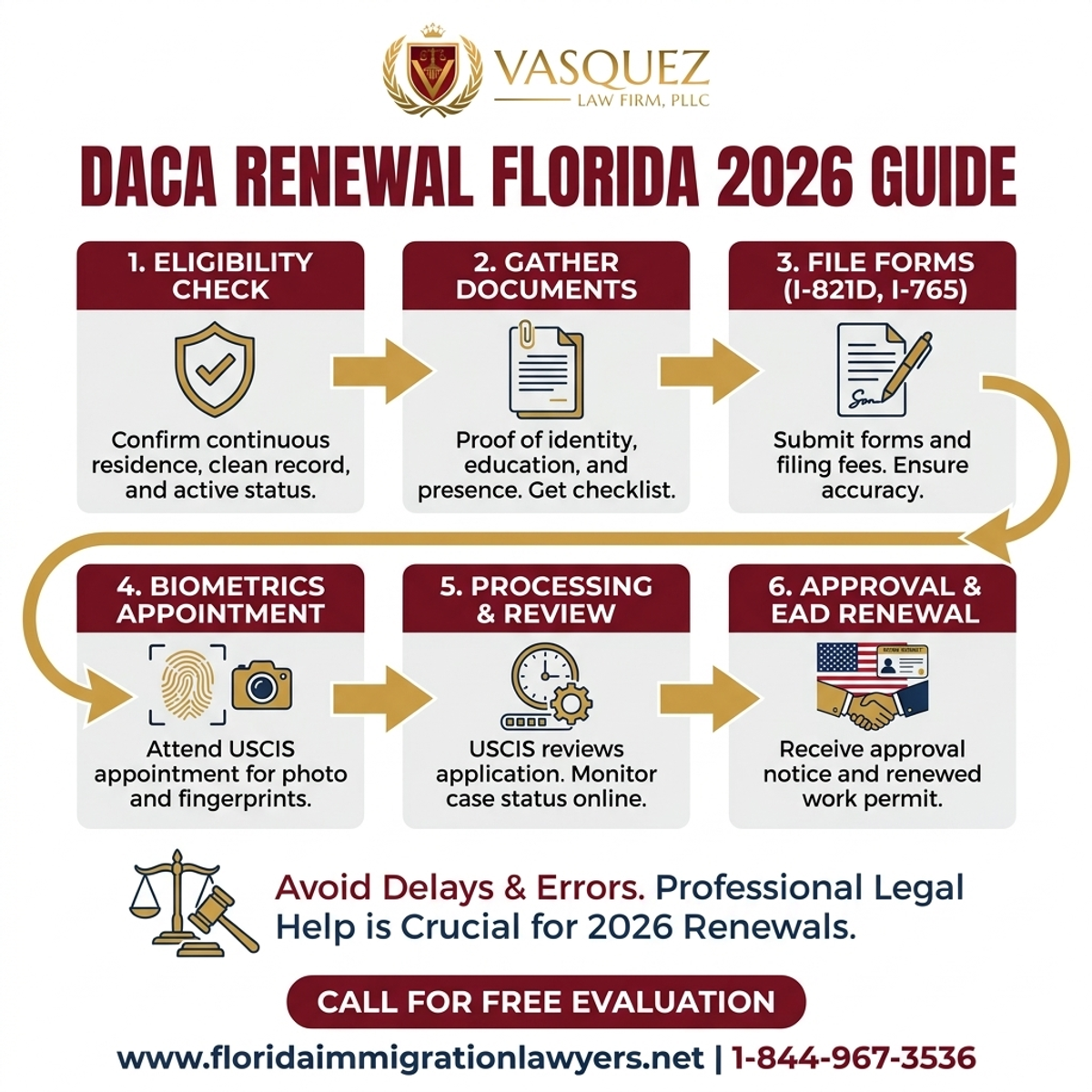
Attend Biometrics Appointment: After USCIS receives your application, you will typically receive a receipt notice and then an appointment notice for a biometrics (fingerprinting and photo) appointment at a local Application Support Center (ASC). For Florida residents, this could be in cities like Orlando, Tampa, or Miami. It is mandatory to attend this appointment. Failure to do so without rescheduling may lead to your application being denied.
-
Receive a Decision: USCIS will process your application and mail you a decision notice. If approved, you will receive a new I-797 approval notice and your new Employment Authorization Document (EAD) card. If USCIS requires additional information, they will send a Request for Evidence (RFE). If your application is denied, it is crucial to consult with an immigration attorney immediately to understand the reasons and explore any potential remedies. The entire process can take several months, so patience and proactive monitoring are key.
Essential Document Checklist for Your DACA Renewal Application
A complete and well-organized document package is critical for a smooth DACA renewal process. Missing even a single required document can lead to delays, Requests for Evidence (RFEs), or even a denial of your application. For Florida Dreamers renewing their DACA in 2026, take the time to meticulously gather and prepare all necessary paperwork. This checklist will help ensure you have everything in order before submission.
- Completed Forms:
- Form I-821D, Consideration of Deferred Action for Childhood Arrivals (signed and dated).
- Form I-765, Application for Employment Authorization (signed and dated).
- Form I-765WS, Worksheet for Form I-765 (signed and dated).
- Identification Documents:
- Copy of your current Employment Authorization Document (EAD) card (front and back).
- Copy of your most recent DACA approval notice (Form I-797).
- Copy of your birth certificate with a certified English translation (if original is not in English).
- Copy of your passport (if available) or other government-issued photo identification.
- Proof of Continuous Residence:
- Since your last DACA approval, you must demonstrate continuous residence in the U.S. Provide documents for each year.
- School records (transcripts, diplomas, attendance records).
- Employment records (pay stubs, W-2 forms, employment letters).
- Bank statements showing transactions within the U.S.
- Utility bills (electricity, water, gas, internet) in your name.
- Medical records (doctor's visits, hospital bills).
- Rent receipts or lease agreements.
- Tax returns.
- Any other reliable documents proving your physical presence in Florida and the U.S.
- Photographs:
- Two identical passport-style photographs taken within 30 days of filing. Write your name and A-number lightly on the back of each photo.
Step-by-Step Process — DACA Renewal Florida 2026 Guide for Dreamers
- Payment:
- Check or money order for the exact filing fees, payable to "U.S. Department of Homeland Security." Do not send cash. Write your A-number on the memo line.
- Criminal History Documents (if applicable):
- Certified court dispositions for any arrests, citations, or convictions, even if expunged or dismissed. Failure to disclose can lead to severe consequences.
Organize your documents clearly, preferably with tabs or separators for each section. Keep a complete copy of your entire application package for your records. This meticulous approach will significantly enhance your chances of a smooth renewal process. Our team at Florida Immigration Lawyers can help you compile and review this critical checklist.
DACA Renewal Timeline and Processing Expectations in Florida
Understanding the typical DACA renewal timeline is essential for planning and avoiding potential gaps in your work authorization. While processing times can vary, USCIS generally recommends filing your application 120 to 150 days before your current DACA expiration date. This window provides ample time for USCIS to process your application, schedule your biometrics appointment, and issue a decision before your current status expires. Filing too early (more than 150 days) may result in USCIS rejecting your application, while filing too late risks a lapse in your DACA protection.
After filing, you can expect the following general timeline:
- Day 1-30: Receipt Notice. USCIS will send you a Form I-797C, Notice of Action, confirming receipt of your application. This notice will include a receipt number, which you can use to track your case status online via the USCIS website.
- Day 30-90: Biometrics Appointment Notice. You will receive an appointment notice for your biometrics services at a local Application Support Center (ASC). For Florida residents, ASCs are located in various cities, including St. Petersburg, Tampa, Orlando, and Miami. It is crucial to attend this appointment as scheduled.
- Day 90-150+: Application Processing and Decision. After your biometrics appointment, USCIS reviews your application. Processing times can fluctuate based on caseloads and policy changes. Some applications are approved relatively quickly, while others may take longer. USCIS aims to process renewals within 120-150 days, but delays are possible.
- Potential for RFEs or Interviews: In some cases, USCIS may issue a Request for Evidence (RFE) if they need more information or clarification. Responding promptly and thoroughly to an RFE is critical. While rare for renewals, USCIS reserves the right to request an interview.
It is important to note that these are general expectations. External factors, such as government shutdowns, changes in immigration policy, or high volumes of applications, can impact processing times. For Florida residents, there isn't a specific regional processing advantage; DACA applications are processed centrally. If your DACA expires while your renewal is pending, you may experience a temporary lapse in work authorization. This could impact your employment and even your ability to drive in Florida. Therefore, proactive filing and diligent monitoring of your case status are essential. If your case is taking longer than expected or you receive an RFE, consulting with Florida Immigration Lawyers can provide peace of mind and expert assistance.
Navigating DACA Renewal Costs and Fee Breakdown
The financial aspect of DACA renewal is an important consideration for many Dreamers in Florida. As of the latest guidance, there are specific fees associated with filing the necessary forms. While USCIS fees are subject to change, it is crucial to be aware of the current costs to avoid delays or rejection of your application due to incorrect payment. Generally, the DACA renewal process involves two main fees: the fee for the Application for Employment Authorization (Form I-765) and the biometric services fee. These are typically paid as a single combined amount.
It is important to emphasize that USCIS does not accept fee waivers for Form I-821D, the Request for Deferred Action for Childhood Arrivals. However, in extremely limited circumstances, you may be eligible for a fee exemption for the I-765 and biometrics fees. To qualify for a fee exemption, applicants must demonstrate extreme financial hardship, such as being homeless, having an income below 150% of the Federal Poverty Guidelines, or having received public assistance. These exemptions are rare and require substantial documentation. If you believe you may qualify, it is highly advisable to consult with an immigration attorney to assess your eligibility and prepare the necessary evidence.
Payment for the DACA renewal fees must be made by check or money order, payable to "U.S. Department of Homeland Security." Do not send cash. Ensure the check or money order is for the exact amount and includes your A-number in the memo line. Incorrect payment amounts or improper payment methods are common reasons for application rejection. For Florida Dreamers, budgeting for these fees is a necessary part of the renewal planning. If financial constraints are a concern, exploring options with community organizations that offer assistance or legal aid groups in Florida might be beneficial, though resources can be limited.
Key Statistics — DACA Renewal Florida 2026 Guide for Dreamers
Always verify the most current fee schedule directly on the USCIS website or with an immigration attorney before submitting your application. Fees can change without extensive prior notice, and using outdated information could jeopardize your renewal. Florida Immigration Lawyers can provide up-to-date information on DACA fees and help you understand your options for payment or potential fee exemptions, ensuring your application is financially compliant.
Common Mistakes to Avoid During Your DACA Renewal
The DACA renewal process, while seemingly straightforward, is fraught with potential pitfalls that can lead to delays, Requests for Evidence (RFEs), or even denial. For Florida Dreamers, avoiding these common mistakes is crucial to ensure a successful and timely renewal of your deferred action status and employment authorization. Even minor errors can have significant consequences, potentially impacting your ability to work, drive, and remain protected from deportation.
-
Filing Too Late: One of the most common and critical errors is failing to submit your application within the recommended 120-150 day window before your current DACA expiration. This can lead to a lapse in your DACA status and work authorization, causing employment disruption and increased vulnerability to immigration enforcement. Plan ahead to ensure timely submission.
-
Filing Too Early: While less common than filing late, submitting your renewal application more than 150 days before your DACA expiration date can also lead to rejection by USCIS. They may return your application, forcing you to resubmit later and potentially causing delays.
-
Incomplete or Incorrect Forms: Leaving fields blank, providing inconsistent information, or making typographical errors on Forms I-821D, I-765, or I-765WS can trigger RFEs or denials. Review every section carefully and ensure all responses are accurate and up-to-date.
-
Missing or Insufficient Supporting Documents: Failing to include all required documents, such as copies of previous DACA notices, EAD cards, or comprehensive proof of continuous residence, is a common reason for delays. Ensure all documents are clear, legible, and properly organized.
-
Incorrect Filing Fees or Payment Method: Submitting the wrong fee amount or using an unacceptable payment method (like cash) will result in your application being rejected. Always confirm the current fees on the USCIS website and use a check or money order payable to "U.S. Department of Homeland Security."
-
Not Disclosing Criminal History: Even minor arrests, citations, or convictions, including those that were expunged or dismissed, must be disclosed. Failure to report any interaction with law enforcement can be considered misrepresentation and lead to severe consequences, including DACA denial and potential deportation proceedings.
-
Not Attending Biometrics Appointment: Missing your scheduled biometrics appointment without properly rescheduling can lead to the denial of your application. Attend the appointment promptly or follow USCIS procedures for rescheduling if absolutely necessary.
-
Ignoring Requests for Evidence (RFEs): If USCIS sends an RFE, it means they need more information. Failing to respond by the deadline or providing an inadequate response will likely result in a denial. Address RFEs thoroughly and promptly, ideally with legal assistance.
-
Lying or Misrepresenting Information: Providing false information or misrepresenting facts on your application is a serious offense that can lead to permanent bars from immigration benefits and even criminal charges. Always be truthful and accurate.
-
Not Keeping Copies: Failing to keep a complete copy of your submitted application package, including all forms, documents, and proof of mailing, can create significant problems if USCIS loses your file or requests additional information. Always maintain thorough records.
-
Not Seeking Legal Counsel: Attempting to navigate the DACA renewal process without legal guidance, especially if you have a complex case (e.g., criminal history, travel issues), can lead to costly errors. An experienced immigration attorney can identify potential problems and ensure your application is robust.
When to Call a Lawyer for Your DACA Renewal
While some DACA renewals may appear straightforward, certain situations warrant the immediate attention and expertise of an immigration attorney. Attempting to manage these complex scenarios alone can lead to severe complications, including delays, denials, or even the initiation of removal proceedings. Florida Immigration Lawyers are here to provide crucial support and guidance for DACA recipients facing challenging circumstances, ensuring your rights are protected and your application is handled with the utmost care.
You should consider calling an immigration lawyer if:
- You Have a Criminal Record: Any arrest, citation, or conviction, no matter how minor or old, can significantly impact your DACA eligibility. Even expunged records must be disclosed. An attorney can assess your criminal history, advise on its impact, and help prepare necessary documentation to mitigate potential issues. This is especially vital for avoiding deportation defense scenarios.
- You Have Traveled Outside the U.S. Without Advance Parole: If you left the U.S. without a valid advance parole document since August 15, 2012, you may have broken continuous residence and could be ineligible for DACA renewal. An attorney can evaluate your travel history and advise on potential remedies or alternative strategies.
- You Are Unsure About Continuous Residence: If you have gaps in your documentation proving continuous residence or have moved frequently within Florida or across states, an attorney can help you compile the necessary evidence to satisfy USCIS requirements.
- Your Previous DACA Application Was Denied: If you have previously been denied DACA or DACA renewal, it is critical to consult an attorney to understand the reasons for denial and determine if a new application has a chance of success.
- You Have Received a Request for Evidence (RFE): An RFE from USCIS indicates that your application is incomplete or lacks sufficient proof. Responding to an RFE accurately and comprehensively is vital, and an attorney can help you gather and present the required information effectively.
- You Are Approaching Your DACA Expiration Date Rapidly: If your DACA is expiring soon (within 90 days) and you haven't filed, an attorney can help expedite the process and advise on the best course of action to minimize a lapse in status.
- You Have Experienced Identity Theft or Fraud: If you believe your identity has been compromised or you are a victim of immigration fraud, an attorney can help you navigate these sensitive issues while protecting your DACA status.
- You Have Changed Your Name or Other Personal Information Significantly: While not always requiring legal help, significant changes in personal information should be carefully handled to ensure consistency across all immigration documents.
In any of these situations, or if you simply feel overwhelmed or uncertain about any aspect of the DACA renewal process, contacting Florida Immigration Lawyers can provide invaluable assistance. Our team is experienced in handling complex DACA cases for Dreamers across Florida, from St. Petersburg to Jacksonville. We are committed to providing personalized, compassionate, and effective legal representation.
About Florida Immigration Lawyers
Florida Immigration Lawyers is a leading immigration law firm dedicated to serving the diverse needs of individuals and families throughout Florida. With a deep understanding of U.S. immigration laws and policies, our experienced attorneys provide comprehensive legal services, specializing in areas such as DACA renewals, asylum, deportation defense, family immigration, and citizenship. We pride ourselves on offering personalized, compassionate, and results-driven representation to every client.
Our firm is committed to empowering immigrants and helping them achieve their American dreams. We understand the unique challenges faced by Dreamers and other non-citizens in Florida, and we work tirelessly to protect their rights and advocate for their best interests. Our team is available 24/7, offering free consultations to assess your case and provide clear, actionable legal advice. We serve clients across all of Florida, including major metropolitan areas like Miami, Orlando, Tampa, and St. Petersburg, ensuring accessible and expert legal support no matter where you are in the state.
Choosing Florida Immigration Lawyers means choosing a partner who will stand by you every step of the way. We are known for our meticulous attention to detail, proactive communication, and unwavering dedication to our clients. When your future and status are on the line, trust the firm that genuinely cares and has the expertise to make a difference. Call us today at 1-844-967-3536 or visit our website at https://www.floridaimmigrationlawyers.net to schedule your free consultation.
Sources and References
- U.S. Citizenship and Immigration Services (USCIS) - Deferred Action for Childhood Arrivals (DACA)
- Executive Office for Immigration Review (EOIR)
- U.S. Department of State
- 8 U.S.C. Chapter 12 - Immigration and Nationality Act (INA)
- 8 CFR § 274a.12(c)(14) - Employment Authorization Document eligibility for DACA recipients.
Related services: immigration practice areas, family immigration services, citizenship and naturalization.
This article provides general legal information and is not intended as legal advice. Every case is unique, and outcomes depend on specific facts and circumstances. Contact an attorney for advice about your particular situation. Laws are subject to change.
Your DACA status is too important to leave to chance. Ensure your future in Florida is secure by entrusting your renewal to experienced professionals. Contact Florida Immigration Lawyers today at 1-844-967-3536 for your free, confidential consultation. Se Habla Espanol - Estamos aqui para ayudarle.
Do Not Navigate This Process Alone
Our experienced immigration attorneys are ready to fight for you. Get a free, confidential consultation today.
Se Habla Español
Frequently Asked Questions
Florida Immigration Lawyers
Immigration Attorney | Founder, Vasquez Law Firm
U.S. Air Force veteran and immigration attorney with thousands of cases resolved. J.D., NCCU School of Law. AILA member. Admitted to the 4th, 5th, and 11th Circuit Courts.
Available 24/7 - Free Evaluations
Related Legal Services
Our Florida immigration attorneys can help you with experienced immigration attorneys, business immigration and asylum protection. Call today at 1-844-967-3536 for a free consultation.
Related Links
Related Topics
Free Legal Consultation
Discuss your case with our experienced attorneys. We're available 24/7.
Se Habla Español - Estamos aquí para ayudarle.
Related Articles
DACA Renewal Guide for Dreamers in Florida 2026 | VLF Florida
Renew your DACA in Florida for 2026 with our comprehensive guide. From gathering documents to understanding costs, we cover it all. Contact Florida Immigration Lawyers for a free consultation and support through this process.
Know Your Immigration Rights in Florida | VLF Florida
Explore your immigration rights in Florida and learn how to protect yourself during ICE encounters. Florida Immigration Lawyers can help you navigate these challenges. Call 1-844-967-3536 for a free consultation.
Consular Processing for Florida Immigrant Visa Applicants
Learn about consular processing for Florida immigrant visa applicants, key steps, and common pitfalls. For assistance, contact Florida Immigration Lawyers.
Immigration Services in Jacksonville, Florida | VLF Florida
Explore immigration services in Jacksonville, Florida, including visa applications, citizenship processes, and more. Contact Florida Immigration Lawyers for expert guidance and support.