DACA Renewal in Florida 2026: A Comprehensive Guide
Discover how DACA recipients can travel within the U.S. in 2026 and what you need to know about renewing your status in Florida. Learn about the renewal process, documents needed, and common mistakes to avoid. For personalized legal assistance, contact Florida Immigration Lawyers at 1-844-YO-PELEO.
Can DACA recipients travel within the U.S. in 2026? Yes, they can, but it's crucial to adhere to specific guidelines. DACA recipients need to ensure their status is active and any travel does not violate immigration laws. Key takeaways include:
- DACA recipients can travel domestically without Advance Parole.
- Ensure your DACA status is current before traveling.
- Always carry your DACA documentation when traveling.
- Consult with an attorney before making travel plans.
Introduction
Living in Orlando or any part of Central Florida as a DACA recipient brings with it unique challenges and opportunities. In 2026, DACA recipients, also known as Dreamers, continue to face uncertainties surrounding their status and rights, including the ability to travel within the U.S. Despite ongoing legal challenges and political debates, DACA remains a vital program for nearly 600,000 individuals nationwide, with a significant number residing in Florida. This guide provides a detailed overview of the DACA renewal process in Florida, addressing travel rights, renewal steps, common mistakes, and when to seek legal help. Our aim is to empower DACA recipients with accurate and up-to-date information, ensuring they can navigate their status confidently. For a personalized review of your case, call Florida Immigration Lawyers at 1-844-YO-PELEO for a free case review. We understand the complexities and are here to offer expert guidance.
What is DACA and Who Are the Dreamers?
Deferred Action for Childhood Arrivals (DACA) is a policy that offers temporary protection from deportation and work authorization to eligible immigrants who came to the U.S. as children. Instituted in 2012, DACA was a response to the legislative stalemate over comprehensive immigration reform, providing a lifeline to young individuals who grew up in the U.S. and consider it their home. As of 2026, Dreamers are those who have benefited from DACA, allowing them to work, study, and live in the U.S. without fear of immediate deportation. This program has enabled hundreds of thousands of young people to pursue higher education, build careers, and contribute significantly to the American economy and society, including countless individuals right here in Florida.
DACA does not provide permanent residency, but it offers a renewable two-year deferment from deportation. This temporary status means that DACA recipients must diligently renew their protection every two years to maintain their legal work authorization and deferred action. Dreamers must meet certain criteria to renew their status, including continuous residence in the U.S., lack of a significant criminal record, and certain educational or military service requirements. The program's future remains a subject of legal and political debate, underscoring the critical importance of understanding renewal procedures and staying informed about policy changes. For comprehensive details and official updates, always refer to the USCIS website.
Can DACA Recipients Travel Within the U.S. in 2026?
Yes, DACA recipients can travel within the U.S. in 2026. Domestic travel is permitted without the need for Advance Parole. However, it is essential to carry your DACA documentation at all times and ensure your status is active to avoid complications. When traveling by air, remember that TSA may request a valid government-issued ID, such as a driver's license, alongside your Employment Authorization Document (EAD) and DACA approval notice. For road travel, especially near border patrol checkpoints, carrying these documents is equally crucial. While DACA grants protection from deportation, it does not confer citizenship, so demonstrating your legal presence is key.
It's advisable to avoid international travel without Advance Parole, as re-entry into the U.S. could be denied. Advance Parole is a document issued by USCIS that grants DACA recipients permission to travel outside the U.S. for specific humanitarian, educational, or employment purposes and then return lawfully. Traveling internationally without it can lead to being barred from re-entry, effectively ending your DACA status and potentially leading to removal proceedings. Even with Advance Parole, careful planning and legal consultation are paramount.
Before making any travel arrangements, particularly if you have any past immigration issues, criminal history, or have ever been placed in deportation proceedings, consult with an immigration attorney to understand any risks associated with your specific circumstances. An attorney from Florida Immigration Lawyers can assess your individual situation and provide tailored advice, helping you navigate potential pitfalls and ensuring your travel plans align with your DACA status.
Step-by-Step Process — DACA Renewal in Florida 2026: A Comprehensive Guide
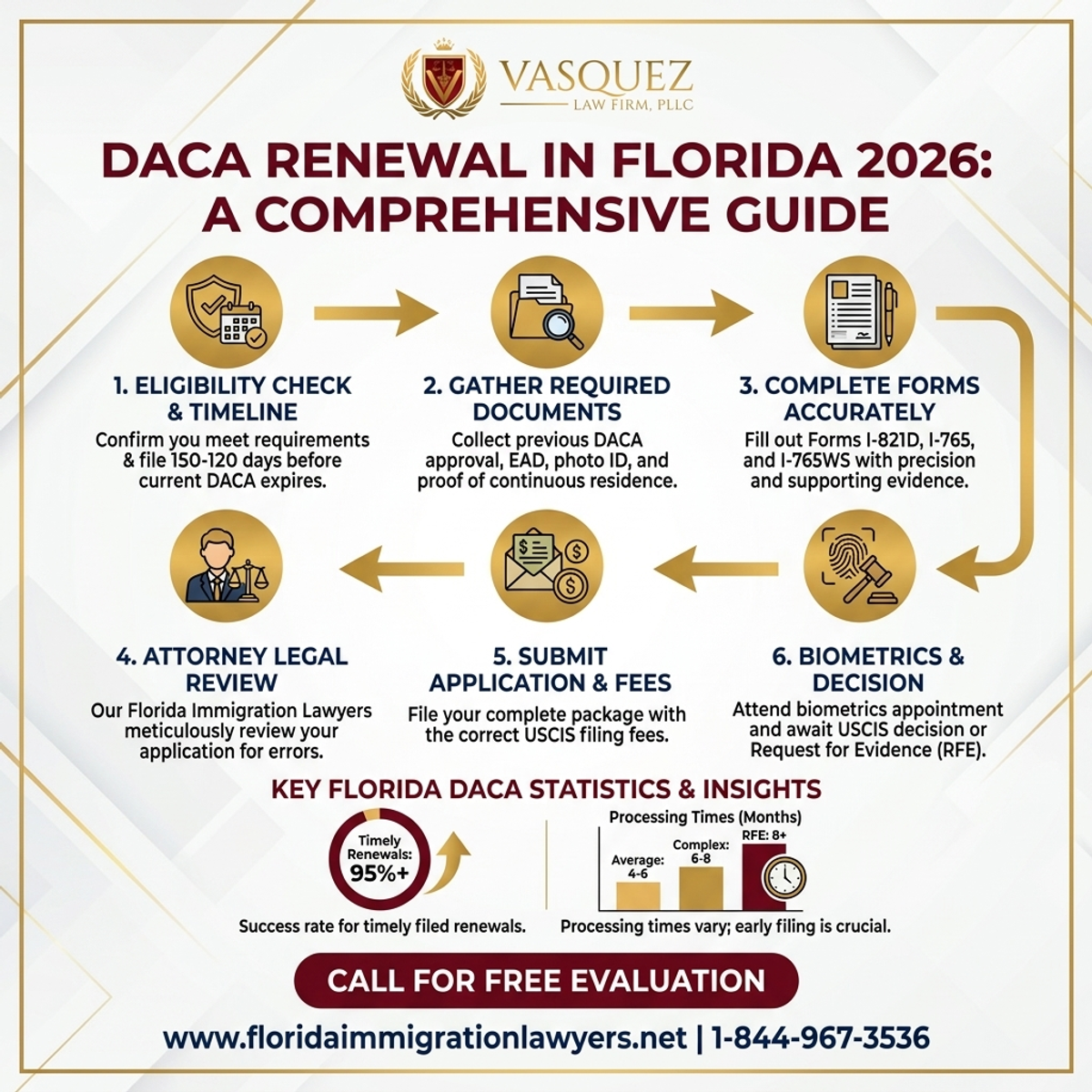
How to Renew Your DACA in Florida: Step-by-Step
Renewing your DACA status is a critical process that requires attention to detail. Missing deadlines or submitting incomplete information can lead to gaps in your work authorization and protection from deportation. Here's how you can renew your DACA in Florida in 2026, with practical advice for each stage:
- Check Your Eligibility: Ensure you meet all renewal criteria, including continuous residence in the U.S. since your last DACA approval and lack of significant criminal history. Even minor infractions or prolonged absences from the U.S. can impact your eligibility, so it's vital to be honest and thorough in your self-assessment. If you're unsure about any aspect of your eligibility, seek legal counsel immediately.
- Gather Required Documents: Collect all necessary documentation, such as past DACA approvals, proof of continuous residence (utility bills, bank statements, school records, employment records), and government-issued identification. Organize these documents meticulously, making copies of everything you plan to submit. This step is crucial for building a strong, complete application.
- Complete the Application: Fill out Form I-821D (Consideration of Deferred Action for Childhood Arrivals), Form I-765 (Application for Employment Authorization), and the I-765WS (Worksheet). Ensure all forms are the most current versions available on the USCIS website. Double-check for accuracy, legibility, and completeness. Any errors or omissions can cause significant delays or even rejection.
- Submit Your Application: Mail your completed application package to the correct USCIS address. Always use a mailing service that provides tracking and delivery confirmation, such as USPS Certified Mail. Keep a complete copy of your entire application package, including all supporting documents, for your personal records. This serves as proof of submission and is invaluable if any issues arise.
- Biometric Appointment: After submitting your application, you will receive a notice for a biometric services appointment. Attend your scheduled appointment to provide fingerprints and photos. This is a mandatory step, and failure to attend or reschedule promptly can lead to the denial of your application. Bring the appointment notice and a valid photo ID.
- Wait for Approval: Processing times can vary significantly, typically ranging from 3 to 6 months. Stay updated by checking your case status online using the receipt number provided by USCIS on their website. Avoid making travel plans or changing jobs without confirming your renewal status, especially if your current DACA and EAD are nearing expiration. Proactive renewal, 120-150 days before expiration, is key to avoiding gaps in protection.
What Documents Are Needed for DACA Renewal?
Submitting a complete set of accurate documents is paramount for a successful DACA renewal. Here’s a detailed look at what you’ll need and why:
- Copy of your previous DACA approval notice: This document verifies your prior DACA status and helps USCIS track your immigration history.
- Proof of continuous residence in the U.S.: This can include school transcripts, employment records, utility bills, bank statements, medical records, and rent receipts. These documents demonstrate that you have continuously resided in the U.S. since your last DACA approval.
- Government-issued identification (e.g., passport, driver's license): A valid ID confirms your identity.
- Completed Form I-821D, I-765, and I-765WS: These are the core application forms. Ensure they are the latest versions from the USCIS website and filled out accurately.
- Two recent passport-sized photos: These are for your new Employment Authorization Document (EAD).
- Filing fees (check current amounts with USCIS): The correct fee must be submitted; incorrect amounts can lead to rejection.
When gathering these documents, create a checklist and organize them systematically. It's highly recommended to make photocopies of all documents, submitting the copies and keeping the originals for your records unless USCIS specifically requests an original. Keeping digital backups can also be beneficial. If you have any difficulty obtaining certain documents or proving continuous residence, consulting with Florida Immigration Lawyers can help you explore alternative forms of evidence.
Key Statistics — DACA Renewal in Florida 2026: A Comprehensive Guide
DACA Renewal Timeline and Processing Expectations
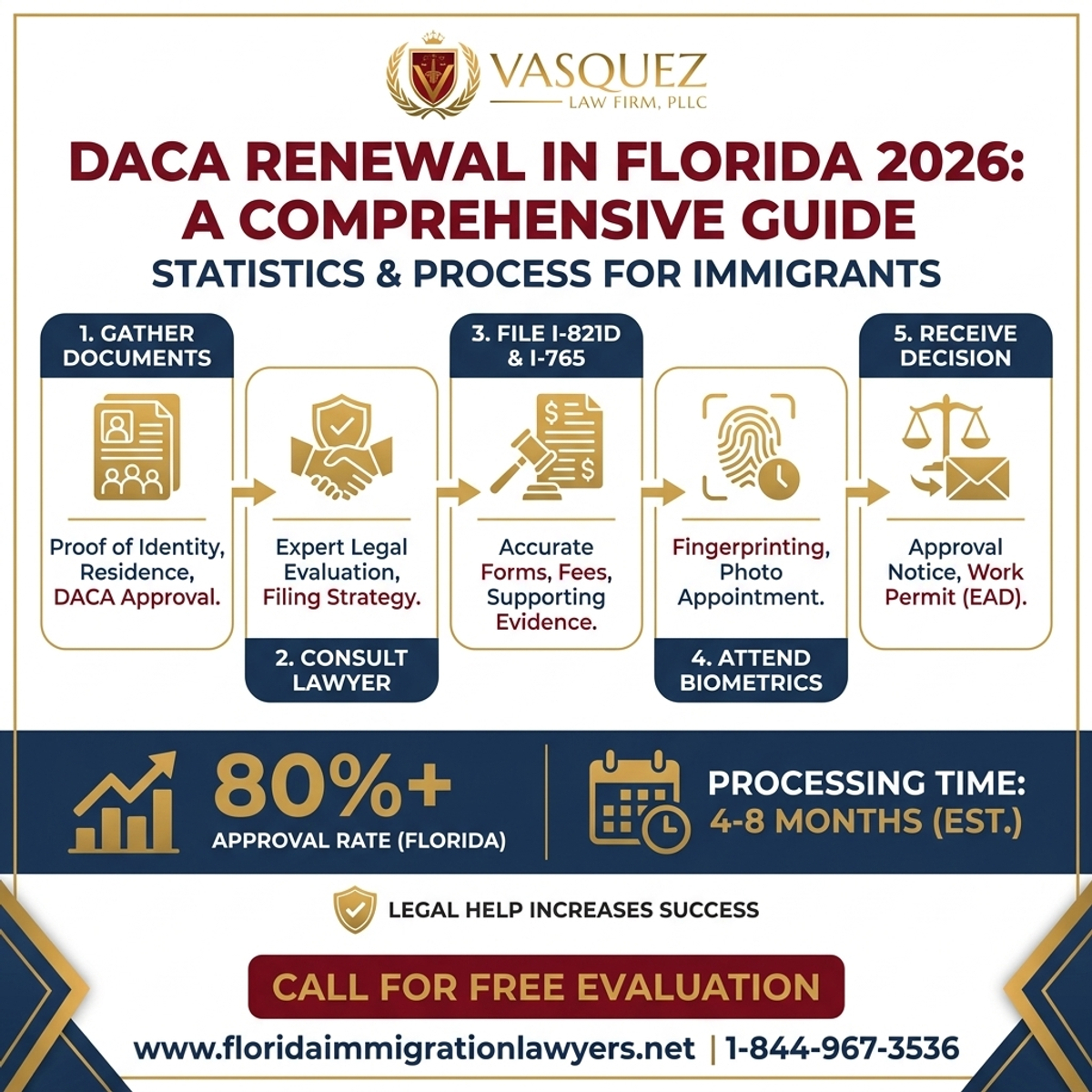
Understanding the timeline for DACA renewal in Florida can help you plan effectively and minimize stress. While the following table provides typical timeframes, it's important to remember that USCIS processing times can fluctuate due to various factors, including the volume of applications, national policy changes, and the completeness of your submission.
| Stage | Typical Timeframe | Notes |
|---|---|---|
| Submit Application | 1-3 weeks | Ensure all documents are complete to avoid delays. Use a trackable mailing service. |
| Biometrics Appointment | 4-8 weeks | Attend as scheduled; rescheduling can cause significant delays. Bring your appointment notice and valid ID. |
| Decision | 3-6 months | USCIS processing times may vary; check online for updates. Renewing 120-150 days before expiration is crucial to prevent gaps in work authorization. |
During the waiting period, regularly check your case status on the USCIS website using your receipt number. If your processing time significantly exceeds the typical timeframe, or if your current DACA status is nearing expiration without a decision, it may be beneficial to contact USCIS directly or consult with an immigration attorney. Proactive monitoring and timely follow-up can help address potential issues before they become critical. It's important to have a strategy in place, especially if your Employment Authorization Document (EAD) is set to expire, to avoid any disruption to your employment.
Cost Factors and Fee Breakdown for DACA Renewal
Understanding the costs involved in renewing DACA is crucial for budgeting and ensuring a smooth application process. The fees are typically a combination of the application for deferred action (Form I-821D) and the application for employment authorization (Form I-765), which includes the biometrics service fee.
| Item | Typical Fee | Notes |
|---|---|---|
| Form I-821D | Check USCIS | Fee subject to change; verify current amount on the official USCIS website before submitting. |
| Form I-765 | Check USCIS | Includes biometrics fee; verify current amount. This fee covers the processing of your work permit and the biometric services appointment. |
It's essential to always verify the most current fee amounts directly on the USCIS website, as they can change without prior notice. Payment must be made in the exact amount and in the acceptable format (e.g., money order, personal check, cashier's check, or credit card using Form G-1450). Incorrect payment amounts or unacceptable payment methods are common reasons for application rejection. While fee waivers are generally not available for DACA applications, some community organizations in Florida may offer financial assistance or legal aid to help cover costs. Planning ahead and saving for the renewal fees is a vital part of the process.
Middle CTA
Do not navigate this process alone. Contact Florida Immigration Lawyers today.
Common Mistakes to Avoid When Renewing DACA
- Missing Deadlines: Late renewals can lead to gaps in protection from deportation and work authorization, potentially affecting your employment. USCIS recommends filing 120 to 150 days before your current DACA and EAD expire.
- Incomplete Applications: Missing information or unsigned forms are frequent reasons for rejection. Always use the USCIS checklist and double-check every section before submission.
- Incorrect Fee Payment: Ensure correct amounts are paid to avoid rejections. Verify the current fees on the USCIS website and use an acceptable payment method.
- Mistakes on Forms: Typos, incorrect dates, or inconsistent information can raise red flags. Carefully review all forms, and consider having a trusted friend or legal professional review them as well.
- Ignoring Biometric Appointments: Missing these can lead to denial of your application. If you absolutely cannot attend, contact USCIS immediately to reschedule, providing a valid reason.
- Not Updating Address: Failing to update USCIS on address changes can result in lost notices, including your biometric appointment letter or approval notice. Update your address promptly online or by mail.
- Submitting Without Proof of Residence: Always include clear, consistent evidence of your continuous residence in the U.S. since your last DACA approval. Lack of sufficient proof is a common reason for RFEs (Requests for Evidence) or denials.
Avoiding these common mistakes can significantly increase the likelihood of a smooth and timely DACA renewal. When in doubt, seeking professional guidance from Florida Immigration Lawyers can provide peace of mind and ensure your application is robust.
When to Call a Lawyer
While renewing DACA can be straightforward for many, certain situations warrant immediate legal assistance. An experienced immigration attorney can provide invaluable guidance, protect your rights, and help navigate complex legal waters:
- Changes in your criminal record: Even minor arrests, citations, or convictions, regardless of the outcome, can impact your DACA eligibility. A lawyer can assess the severity and advise on the best course of action.
- Complex immigration history: If you have prior deportation orders, multiple entries into the U.S., or any other previous immigration complications, an attorney can help clarify your status and potential risks.
- Possible deportation proceedings: If you or a family member receive a Notice to Appear (NTA) in immigration court, immediate legal representation is critical to defend your rights.
- Questions about travel permissions: Especially if you are considering international travel or if you have concerns about domestic travel through specific checkpoints, an attorney can provide tailored advice on Advance Parole and potential risks.
- Difficulty gathering documents: If you struggle to obtain proof of continuous residence or other required documents, a lawyer can help identify alternative forms of evidence.
- Concerns about eligibility: If you are unsure whether you meet all DACA renewal criteria, a legal expert can provide a clear assessment.
Consulting with an experienced attorney ensures you navigate the process smoothly and stay informed of any policy changes. Florida Immigration Lawyers offer comprehensive support for DACA recipients, from initial eligibility assessments to preparing and submitting renewal applications, and representing clients in more complex scenarios. Don't take chances with your DACA status. Call us today at 1-844-YO-PELEO for a free case review and expert assistance.
About Florida Immigration Lawyers
Florida Immigration Lawyers, based in Orlando, offers dedicated legal services for immigrants across Florida. Our experienced attorneys specialize in all aspects of immigration law, from DACA renewals to deportation defense, family immigration, and citizenship applications. We are deeply committed to serving the diverse immigrant communities of Central Florida and beyond, understanding the unique challenges and aspirations of each client. Our firm provides personalized service and free case reviews, available 24/7, ensuring that you have access to expert legal advice when you need it most. We pride ourselves on our client-focused approach, clear communication, and unwavering dedication to achieving the best possible outcomes. Choose us for your immigration needs—visit our immigration practice areas to learn more about how we can assist you with your DACA renewal or any other immigration matter. Se Habla Español, and we are always here to help.
Sources and References
- U.S. Citizenship and Immigration Services (USCIS)
- Executive Office for Immigration Review (EOIR)
- U.S. Department of State
- Immigration and Nationality Act (INA), 8 U.S.C. Chapter 12
Do Not Navigate This Process Alone
Our experienced immigration attorneys are ready to fight for you. Get a free, confidential case review today.
Se Habla Español
Or leave your details and we’ll call you:
Free Evaluation in 24 Hours
Or talk to us right now
AI voice assistant — available 24/7
FreeFrequently Asked Questions

William J. Vásquez
Founding Attorney · Vasquez Law Firm
U.S. Air Force veteran and immigration attorney with years of hands-on U.S. immigration experience. J.D., NCCU School of Law. AILA member. Admitted to the 4th, 5th, and 11th Circuit Courts.
Available 24/7 - Free Evaluations
Reviewed for legal accuracy by William J. Vásquez
Licensed in North Carolina; U.S. immigration is federal practice.
Related Legal Services
Our Florida immigration attorneys can help you with business immigration, deportation defense and family immigration services. Call today at 1-844-YO-PELEO for a free case review.
Related Links
Related Topics
Free Legal Case Review
Discuss your case with our experienced attorneys. We're available 24/7.
Se Habla Español - Estamos aquí para ayudarle.
Related Articles
DUI Immigration Consequences in Florida 2026
A DUI conviction in Florida can have severe immigration consequences, potentially leading to inadmissibility, deportation, or denial of immigration benefits. For non-citizens, a DUI is not just a traffic offense but a serious criminal matter that federal immigration law scrutinizes closely. Factors like multiple offenses, injury, or property damage can escalate a simple DUI to a Crime Involving Moral Turpitude (CIMT) or even an aggravated felony, triggering mandatory detention and removal proceedings. Understanding the specific nature of your Florida conviction and its interpretation under the Immigration and Nationality Act (INA) is crucial. This article outlines how DUIs impact immigration status, the grounds for inadmissibility and deportation, a step-by-step guide to navigating the process, essential documentation, and expected timelines for 2026. We also highlight common mistakes to avoid and when to seek legal counsel from an experienced immigration attorney. Florida Immigration Lawyers offers comprehensive support for individuals facing these challenging situations, providing expert guidance through complex legal landscapes.
Immigration Lawyer Orlando Free Consultation in Florida
For individuals and families in Orlando, Florida, navigating the complexities of U.S. immigration law requires expert guidance. An immigration lawyer in Orlando offers crucial support for everything from visa applications and green card processes to naturalization and deportation defense. This comprehensive guide details what a free consultation covers, providing a step-by-step overview of immigration pathways, essential document checklists, and expected timelines in 2026. We also highlight common mistakes to avoid, discuss the critical role of legal counsel in deportation and asylum cases, and explain why choosing a local Orlando immigration attorney is beneficial. Florida Immigration Lawyers is dedicated to serving the diverse community of Orlando with compassionate, effective legal solutions, ensuring you receive personalized advice and robust representation for a successful immigration journey.
EAD Advance Parole Combo Card in Florida: What You Need
An EAD advance parole combo card allows individuals with pending adjustment applications to both work and travel abroad without jeopardizing their green card application. Learn how to apply in Florida, what documents you need, and common mistakes to avoid.
Dual Citizenship Lawyer in Florida: What You Need to Know
For Florida residents, the concept of dual citizenship, or holding two passports, offers a compelling blend of opportunities and challenges. While the U.S. generally permits dual nationality, the path to achieving this status requires a meticulous understanding of both U.S. immigration laws and the citizenship policies of your country of origin. This guide explores the definition of dual citizenship, the detailed step-by-step process for U.S. naturalization, and the significant benefits and potential pitfalls involved. We cover essential documentation, typical timelines, and cost considerations for 2026, providing crucial insights for anyone in Orlando, Miami, or across Florida considering this important legal step. Learn about common mistakes to avoid and understand when to seek professional legal counsel to navigate this complex process successfully. Florida Immigration Lawyers is here to provide expert, bilingual support for your dual citizenship journey.