DACA News 2026 Florida: Renewals, Eligibility & Your Rights
Stay current with DACA news 2026 in Florida, including crucial updates for renewals and eligibility. As of February 23, 2026, DACA continues to face legal challenges, impacting new applicants while renewals generally proceed. This guide provides a step-by-step renewal process, a document checklist, timeline expectations, and common mistakes to avoid. Florida DACA recipients, particularly in Gainesville, need to understand these developments to protect their status and work authorization. Florida Immigration Lawyers offers expert guidance and free consultations to help you navigate these complexities, ensuring your application is accurate and timely. Do not risk a lapse in your DACA status—learn how to stay informed and protected.

As of February 23, 2026, DACA remains a complex and evolving immigration policy. While new applications are generally not being accepted, eligible individuals in Florida can typically continue to renew their DACA status and employment authorization. Staying informed about court decisions and USCIS updates is crucial to protecting your deferred action status.
- DACA renewals are generally still processed for eligible individuals.
- New DACA applications are largely halted due to ongoing litigation.
- Constant monitoring of USCIS announcements is essential.
- Consulting an immigration lawyer is highly recommended for personalized guidance.
- Florida residents must be aware of specific state-level impacts and resources.
Navigating the ever-changing landscape of immigration law can feel overwhelming, especially when your future and stability depend on programs like Deferred Action for Childhood Arrivals (DACA). If you are a DACA recipient or an aspiring applicant in Florida, particularly in areas like Gainesville, you are likely seeking clarity on the latest developments. As of early 2026, the DACA program continues to face legal challenges, making it vital for you to understand your rights and obligations.
This comprehensive guide from Florida Immigration Lawyers aims to provide you with the most current DACA news 2026, focusing on what these updates mean for individuals across Florida. We will cover renewal processes, eligibility considerations, potential legal challenges, and crucial steps you can take to protect your status. Do not face these complexities alone. Call Florida Immigration Lawyers at 1-844-967-3536 for a free consultation to discuss your specific situation and how we can help.
Understanding DACA News 2026 in Florida: An Overview
Deferred Action for Childhood Arrivals (DACA) has been a lifeline for hundreds of thousands of young people, often referred to as Dreamers, who were brought to the U.S. as children. This program grants recipients temporary protection from deportation and eligibility for work authorization. However, its legal standing has been consistently challenged since its inception.
As of February 23, 2026, the DACA program continues to operate under the shadow of court injunctions. While the U.S. Department of Homeland Security (DHS) has sought to solidify DACA through formal regulations, judicial rulings have largely prevented USCIS from approving new initial DACA requests. This means that if you have never held DACA before, your path to obtaining it remains significantly restricted.
For current DACA recipients in Florida, including those residing in Gainesville and surrounding communities, the focus remains on timely renewals. USCIS generally continues to accept and process DACA renewal requests and accompanying applications for employment authorization documents (EADs). However, the legal environment can shift rapidly, underscoring the need for vigilance and expert legal counsel.
The State of Florida, with its significant immigrant population, has been particularly affected by the DACA program's uncertainties. Many Dreamers contribute significantly to Florida's economy and culture. We understand the stress and anxiety that ongoing legal battles create for you and your family. Our firm is committed to keeping you informed of all relevant DACA news 2026 that may impact your life in Florida.
It is important to remember that DACA is a form of prosecutorial discretion, not a path to permanent legal status or citizenship. Its future depends heavily on ongoing legal cases, potential legislative action, and shifts in federal policy. For instance, the Fifth Circuit Court of Appeals has previously ruled against the legality of DACA, sending the case back to lower courts, which continues to create uncertainty. You can learn more about general immigration pathways on our immigration practice area page.
Current Legal Status of DACA
The DACA program's legal challenges primarily stem from arguments that it was not lawfully created. Federal courts have issued injunctions that block USCIS from accepting new DACA applications. This legal limbo means that while renewals proceed, the program's long-term future remains uncertain, impacting thousands of Floridians.
The Department of Homeland Security (DHS) has published a final rule on DACA, aiming to codify the program. However, federal court orders have largely kept this rule from fully taking effect for initial applications. This complex legal situation highlights why expert guidance is indispensable for DACA recipients navigating 2026 and beyond.
Impact on Florida Dreamers
Florida is home to a substantial number of DACA recipients who contribute significantly to our communities and economy. The uncertainty surrounding DACA affects their ability to plan for their education, careers, and families. Without DACA, many would lose their work authorization and face the threat of deportation, impacting sectors across the state.
For DACA recipients in Gainesville and other Florida cities, staying updated on USCIS policy changes and court rulings is paramount. The state's Department of Education, for example, may have specific policies regarding tuition or financial aid for DACA holders, which can also be subject to change based on federal immigration policies. We are here to help you understand these interconnected issues.
Step-by-Step DACA Renewal Process for 2026
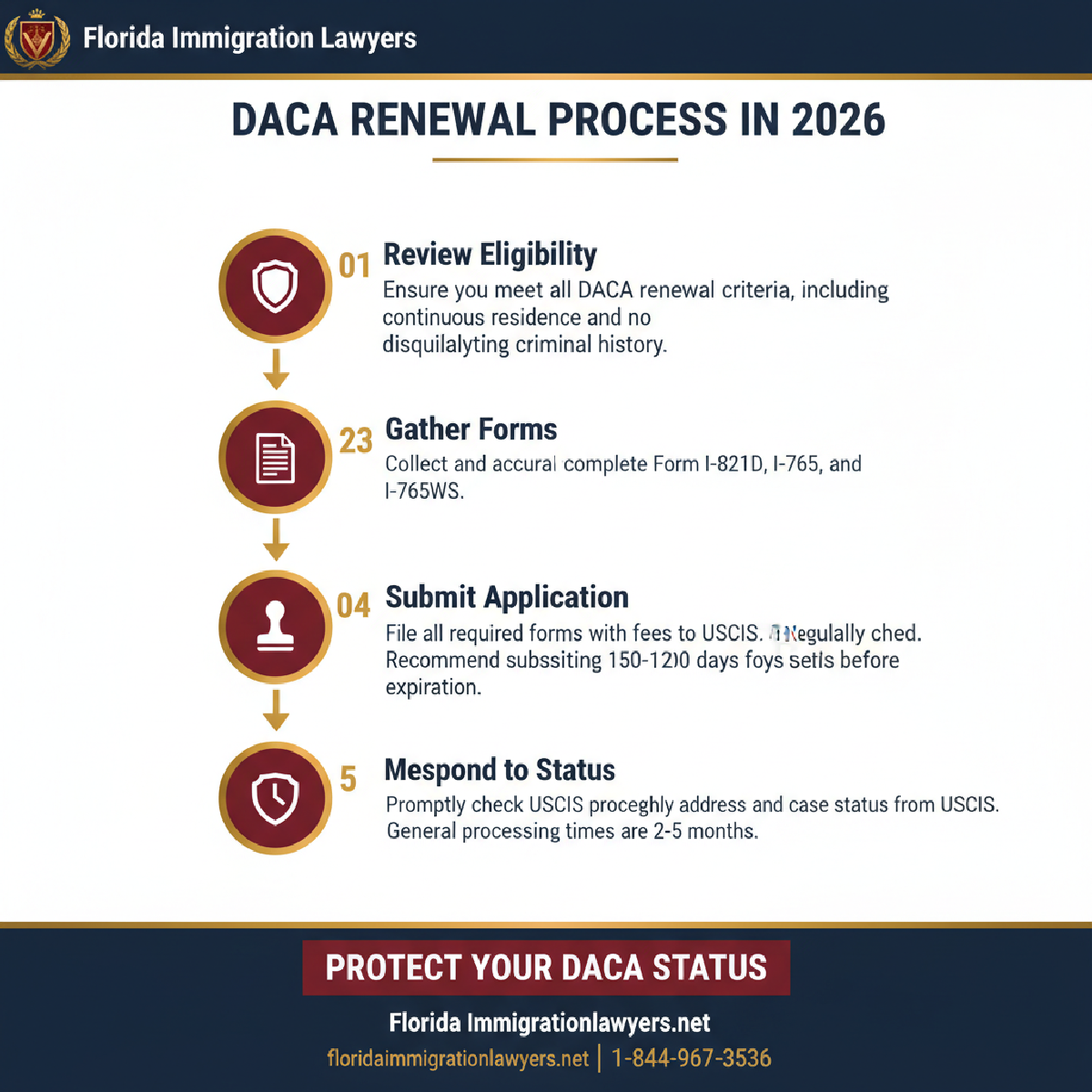
If you are a current DACA recipient, renewing your status is critical to maintaining your protection and work authorization. The process, while similar to previous years, requires careful attention to detail and timely submission. Here is a step-by-step guide for DACA renewal in 2026:
- Monitor Your Expiration Date: Begin preparing your renewal application approximately 120 to 150 days before your current DACA and Employment Authorization Document (EAD) expire. Filing too early or too late can lead to complications.
- Gather Required Documents: Collect all necessary documentation, including previous DACA approval notices, EADs, proof of continuous residence, and any updated biographical information. We will detail these in the next section.
- Complete Forms I-821D, I-765, and I-765WS: These are the primary forms for DACA renewal. Form I-821D is the Consideration of Deferred Action for Childhood Arrivals, Form I-765 is the Application for Employment Authorization, and Form I-765WS is the Worksheet for Form I-765. Ensure all sections are filled out completely and accurately.
- Pay Filing Fees: As of 2026, there are fees associated with DACA renewal and the employment authorization application. While specific amounts can change, these typically include fees for Form I-765 and biometrics. USCIS generally does not accept fee waiver requests for DACA renewals, though limited exceptions may apply.
- Attend Biometrics Appointment: After submitting your application, you will typically receive a notice for a biometrics appointment at a local Application Support Center (ASC). This appointment is mandatory for fingerprinting and photographs.
- Respond to Requests for Evidence (RFE): If USCIS requires additional information or documentation, they will send you an RFE. It is crucial to respond promptly and thoroughly to avoid delays or denials.
- Receive Decision: USCIS will mail you a decision notice regarding your DACA renewal and EAD. If approved, you will receive a new EAD card.
For more information on employment authorization, you can refer to 8 CFR Part 274a regarding employment of aliens. This ensures you understand the regulations governing your work permit. We also encourage you to visit our business immigration page for related insights.
Essential Document Checklist for DACA Renewal
A complete and accurate application package is essential for a smooth DACA renewal process. Missing documents or incorrect information can lead to significant delays or even a denial. Use this checklist to prepare your application:
- ✓ Current DACA Approval Notice (Form I-797): Proof of your previously approved DACA status.
- ✓ Current Employment Authorization Document (EAD): Your most recent DACA work permit.
- ✓ Copy of Previous DACA Application: If available, this can help ensure consistency.
- ✓ Two Passport-Style Photos: Taken within 30 days of filing, meeting USCIS specifications.
- ✓ Proof of Continuous Residence: Documentation showing you have continuously resided in the U.S. since your last DACA approval. This might include:
- ✓ School records (transcripts, diplomas)
- ✓ Employment records (pay stubs, W-2s)
- ✓ Bank statements
- ✓ Medical records
- ✓ Rent receipts or utility bills
- ✓ Tax returns (Form 1040)
- ✓ Proof of Identity: Copy of your birth certificate, passport, or other government-issued ID.
- ✓ Any New Criminal History Records: If you have had any arrests or convictions since your last DACA approval, you must include certified court dispositions. Failure to disclose this can lead to serious consequences.
- ✓ Filing Fees: Check the current USCIS website for the exact fee amounts for Form I-821D and Form I-765.
It is always a good practice to make copies of your entire application package before mailing it. For official forms and instructions, always refer to the USCIS DACA page.
DACA Renewal Timeline and Processing Expectations in 2026
Understanding the typical timeline for DACA renewals can help manage your expectations and prevent unnecessary stress. While processing times can vary, USCIS generally aims to process renewals efficiently.
You should aim to file your DACA renewal application between 120 and 150 days (approximately 4 to 5 months) before your current DACA and EAD expire. Filing too early may result in a rejection, while filing too late could lead to a lapse in your work authorization and DACA protection.
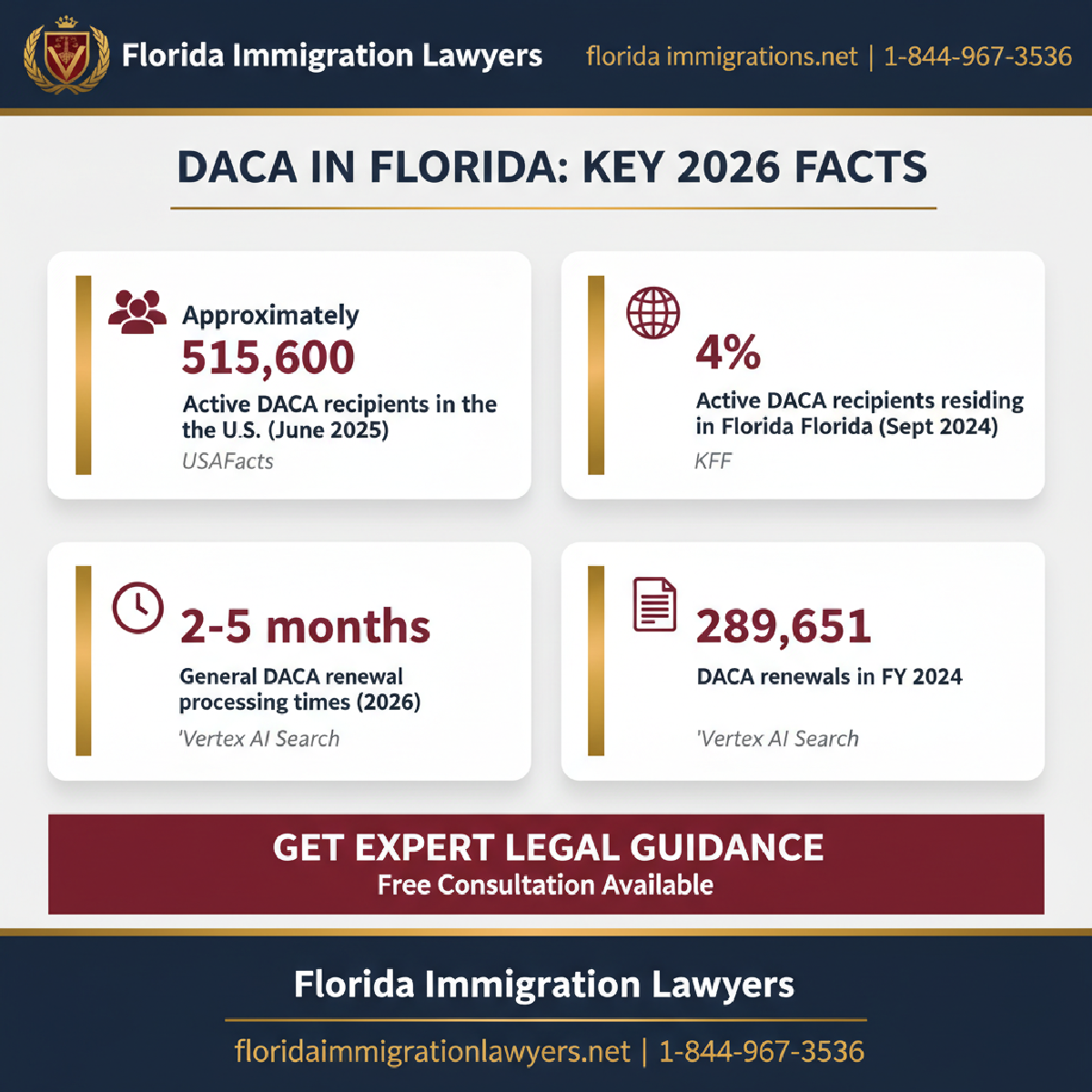
After filing, you can generally expect to receive a receipt notice from USCIS within a few weeks. A biometrics appointment notice typically follows within 3-8 weeks. The actual processing time for the DACA renewal and EAD can range from 3 to 6 months, or sometimes longer, depending on the volume of applications and specific case complexities. You can check current processing times on the USCIS website.
Delays can occur due to incomplete applications, Requests for Evidence (RFEs), or unforeseen backlogs. To minimize delays, ensure your application is meticulously prepared and submitted well in advance. If you are approaching your expiration date and have not heard back, contacting an attorney to inquire with USCIS may be beneficial.
Do not navigate this process alone. The complexities of DACA and the potential for delays demand careful handling. Contact Florida Immigration Lawyers today to ensure your renewal application is robust and submitted correctly. We are here to provide the support you need.
Cost Factors and Fee Breakdown for DACA Applications
Understanding the financial aspects of your DACA renewal is an important part of the planning process. There are specific government filing fees associated with the DACA program that you must pay to USCIS. These fees are subject to change, so always check the most current information directly on the USCIS website before filing.
Typically, the DACA renewal application involves two main fees: one for the Form I-765 (Application for Employment Authorization) and another for biometrics services. USCIS generally requires these fees to be paid by money order, personal check, cashier's check, or credit card using Form G-1450, Authorization for Credit Card Transactions. It's crucial to ensure your payment method is correct and the amount is accurate to avoid rejection of your application.
While USCIS generally does not provide fee waivers for DACA renewals, there are extremely limited circumstances under which an exemption might be considered. These are rare and typically involve severe financial hardship or humanitarian concerns. Discussing your financial situation with an experienced immigration attorney can help determine if you meet any exceptional criteria.
Beyond government fees, you should also consider potential costs for legal assistance. While not mandatory, hiring an immigration lawyer can significantly increase the likelihood of a successful and timely renewal. An attorney can help you gather documents, complete forms accurately, and respond to any RFEs. Investing in legal counsel can save you time, stress, and potential complications in the long run.
Our firm, Florida Immigration Lawyers, offers free consultations to help you understand the process and associated costs. We believe in transparency and empowering you with the knowledge needed to make informed decisions about your DACA renewal in Florida.
Common Mistakes to Avoid in DACA Renewal
Renewing your DACA status is a critical process, and even minor errors can lead to significant delays or even denial. Being aware of these common pitfalls can help you avoid them:
- Filing Too Late: Submitting your application after the recommended 120-150 day window before expiration can lead to a lapse in your work authorization and DACA protection. This can impact your employment and even put you at risk of deportation.
- Incomplete Forms: Leaving fields blank or failing to answer all questions truthfully and thoroughly is a common mistake. USCIS will likely issue a Request for Evidence (RFE) or deny your application outright.
- Incorrect Information: Providing inaccurate or inconsistent information, even if unintentional, can raise red flags with USCIS. Always double-check all dates, addresses, and personal details.
- Not Disclosing Criminal History: Any arrests, citations, or convictions, no matter how minor, must be fully disclosed. Failure to do so is considered misrepresentation and can result in DACA denial or termination.
- Incorrect Filing Fees: Submitting the wrong fee amount or an expired payment method will lead to your application being rejected and returned, causing significant delays.
- Mailing to the Wrong Lockbox: USCIS has specific mailing addresses (lockboxes) for DACA applications based on your state of residence. Sending your application to the wrong address will cause delays.
- Not Keeping Copies: Always make and retain copies of your entire application package, including all forms, supporting documents, and proof of payment, before mailing it.
- Traveling Without Advance Parole: DACA does not automatically grant the right to travel internationally. Leaving the U.S. without approved advance parole can result in your DACA status being revoked and inability to re-enter the U.S.
- Ignoring RFEs: Failing to respond to a Request for Evidence (RFE) within the specified timeframe will almost certainly lead to a denial of your DACA renewal.
- Not Seeking Legal Advice: Attempting to navigate complex DACA renewals, especially with a complicated history, without legal counsel can lead to critical errors.
When to Call a Lawyer for DACA Assistance
While some DACA renewals may seem straightforward, certain situations warrant the immediate attention of an experienced immigration attorney. Florida Immigration Lawyers is here to provide the expert guidance you need to protect your status.
You should consider contacting our firm if:
- You have any criminal history: Even minor arrests or citations since your last DACA approval can complicate your renewal. An attorney can assess the impact and advise on proper disclosure.
- You have a significant travel history outside the U.S. since your last DACA approval: This could raise questions about continuous residence or potentially impact your eligibility.
- Your previous DACA application was denied or terminated: Understanding the reasons for past issues is crucial for a successful renewal attempt.
- You have concerns about your eligibility criteria: If you are unsure whether you meet all DACA requirements, especially regarding continuous residence or age, an attorney can clarify.
- You have received a Request for Evidence (RFE) or Notice of Intent to Deny (NOID): These require precise and timely responses, which an attorney can expertly prepare.
- You need to update your personal information due to marriage, divorce, or name change: Ensuring all records are consistent is important.
- You are confused by the forms or supporting documentation requirements: We can help ensure your application is complete and accurate.
- You are facing an immigration court proceeding: DACA recipients, while protected, can still face deportation defense issues.
Our team at Florida Immigration Lawyers understands the nuances of DACA and the broader immigration landscape. We serve clients throughout Florida, including Gainesville, and are dedicated to providing personalized legal strategies to protect your future. Contact us for a free consultation to discuss your unique circumstances.
Frequently Asked Questions About DACA News 2026
Will I be able to renew my DACA in 2026?
Yes, as of February 23, 2026, eligible DACA recipients are generally able to renew their DACA status and associated Employment Authorization Documents (EADs). USCIS continues to accept and process renewal applications. However, the program's long-term future remains subject to ongoing legal challenges and potential legislative changes. It is crucial to file your renewal application well within the recommended timeframe of 120-150 days before your current DACA and EAD expire to avoid a lapse in your protection and work authorization.
Is DACA allowed in Florida?
Yes, DACA is a federal program, and its provisions apply to eligible individuals across all U.S. states, including Florida. DACA recipients in Florida can generally renew their status, obtain employment authorization, and benefit from deferred action. While state laws in Florida may have specific impacts on immigrants, the DACA program itself is administered federally by USCIS. However, the state's political climate can sometimes influence local perceptions and resources available to immigrant communities, making legal guidance even more important for Florida residents.
Will DACA be approved again?
The approval of DACA refers to two main aspects: renewals for current recipients and the acceptance of new initial applications. For current recipients, renewals are generally being approved by USCIS, provided all eligibility criteria are met. However, the approval of new initial DACA applications is largely paused due due to federal court injunctions. The future of DACA, particularly regarding new applicants, depends on the outcome of ongoing legal battles and potential legislative action by Congress. There is no guarantee that new applications will be accepted again without a significant change in law or court rulings.
Is it safe to go to Florida with DACA?
Generally, DACA recipients are protected from deportation and can travel within the United States, including to Florida, without issues related to their DACA status. DACA provides deferred action, meaning immigration enforcement agencies typically do not prioritize DACA recipients for removal. However, it's always wise to carry your DACA approval notice and valid EAD. Be aware that state laws and local enforcement practices can vary, and while DACA offers federal protection, it does not grant permanent legal status. For specific concerns, especially if you have any past legal issues, consulting an attorney is recommended before traveling.
What are the eligibility requirements for DACA renewal in 2026?
To renew your DACA in 2026, you must generally meet the original DACA requirements, including having been under the age of 31 as of June 15, 2012; having come to the U.S. before your 16th birthday; continuously residing in the U.S. since June 15, 2007; being physically present in the U.S. on June 15, 2012, and at the time of filing; and not having been convicted of certain felonies or significant misdemeanors. Additionally, you must have previously been granted DACA and continue to meet the requirements for deferred action. Any changes in your criminal or travel history since your last approval must be carefully reviewed.
How long does DACA renewal take in Florida?
The processing time for DACA renewals can vary, but typically ranges from 3 to 6 months. This timeline includes the period from when USCIS receives your application until they issue a decision and mail your new Employment Authorization Document (EAD). Factors such as the volume of applications, the completeness of your submission, and whether USCIS issues a Request for Evidence (RFE) can all influence the actual processing time. It is highly recommended to file your renewal application 120-150 days before your current DACA and EAD expire to minimize the risk of a gap in your work authorization.
What happens if my DACA expires before I can renew?
If your DACA expires before USCIS processes your renewal, you will lose your deferred action status and your employment authorization. This means you will no longer be legally authorized to work, and you will be considered unlawfully present in the U.S., potentially making you subject to deportation. While USCIS may still accept a renewal application after expiration, it's crucial to consult an attorney if this occurs. A lapse in DACA status can have serious consequences, emphasizing the importance of timely filing.
Can DACA recipients apply for a green card in 2026?
DACA itself does not provide a direct pathway to a green card or U.S. citizenship. However, DACA recipients may be eligible for a green card through other immigration avenues, such as marriage to a U.S. citizen, through certain family petitions, or through employment-based visas, if they meet the specific requirements of those programs. The key challenge for many DACA recipients is proving lawful entry or obtaining advance parole to adjust status. It is essential to consult with an immigration attorney to explore potential green card options specific to your circumstances, as eligibility is highly individualized.
About Florida Immigration Lawyers
Florida Immigration Lawyers is a leading immigration law firm dedicated to serving individuals and families across the entire state of Florida. We understand the profound impact that immigration matters have on your life and are committed to providing compassionate, effective, and results-driven legal representation.
Our experienced attorneys specialize in a wide range of immigration services, including DACA renewals, family-based immigration, business immigration, asylum claims, deportation defense, and citizenship applications. We pride ourselves on offering personalized attention, clear communication, and strategic advice tailored to your unique situation.
Why choose Florida Immigration Lawyers? We are available 24/7 to address your urgent needs, offer free consultations to help you understand your options, and are fluent in both English and Spanish to ensure effective communication. Our deep knowledge of Florida-specific immigration challenges and federal laws makes us your trusted partner in navigating the U.S. immigration system. Visit our attorneys page to learn more about our dedicated team.
Do not let complex immigration laws intimidate you. Let Florida Immigration Lawyers be your advocate. Call us today at 1-844-967-3536 or visit our website at https://www.floridaimmigrationlawyers.net to schedule your free consultation.
This article is for general informational purposes only and does not constitute legal advice. Immigration laws change frequently. For advice specific to your situation, please consult with a qualified immigration attorney.
Protecting your DACA status in 2026 is paramount. The legal landscape is constantly shifting, and proactive steps are essential. Whether you are in Gainesville or anywhere else in Florida, understanding the latest DACA news 2026 and your renewal options is vital. Do not risk your future by attempting to navigate these complex processes alone. Contact Florida Immigration Lawyers today for a free, confidential consultation at 1-844-967-3536. Let us help you secure your deferred action and peace of mind.
Do Not Navigate This Process Alone
Our experienced immigration attorneys are ready to fight for you. Get a free, confidential consultation today.
Se Habla Español
Frequently Asked Questions
Florida Immigration Lawyers
Immigration Attorney | Founder, Vasquez Law Firm
U.S. Air Force veteran and immigration attorney with thousands of cases resolved. J.D., NCCU School of Law. AILA member. Admitted to the 4th, 5th, and 11th Circuit Courts.
Available 24/7 - Free Evaluations
Related Legal Services
Our Florida immigration attorneys can help you with business immigration, asylum protection and deportation defense. Call today at 1-844-967-3536 for a free consultation.
Related Links
Related Topics
Free Legal Consultation
Discuss your case with our experienced attorneys. We're available 24/7.
Se Habla Español - Estamos aquí para ayudarle.
Related Articles
Stokes Interview: Navigating Marriage Fraud in Florida
A Stokes interview is a specialized, separate interview conducted by USCIS when there are suspicions of marriage fraud in a green card application. This rigorous process involves individual questioning of spouses, focusing on inconsistencies in their testimonies to determine the authenticity of their marital bond. For couples in Florida, navigating this high-stakes interview requires meticulous preparation, extensive documentation, and often the strategic guidance of an experienced immigration lawyer. Understanding the process, preparing for detailed questions, and presenting a strong case are crucial for overcoming marriage fraud allegations and securing your immigration future. Florida Immigration Lawyers stands ready to assist you.
Immigration Attorney Gainesville: North Florida Legal Help
For those in Gainesville, Alachua County, and throughout North Florida, navigating U.S. immigration law requires expert guidance. An experienced immigration attorney can simplify complex processes, from family-based petitions and employment visas to critical asylum claims and deportation defense. This comprehensive guide outlines the essential services provided by an immigration attorney, details necessary documentation, clarifies processing timelines, and discusses associated costs. We also highlight common mistakes to avoid and crucial scenarios where legal counsel is indispensable. Florida Immigration Lawyers serves all of Florida, including Gainesville and St. Petersburg, providing dedicated legal support to help you achieve your immigration goals. Contact us for a free consultation to discuss your specific needs.
Military Naturalization Expedited at Florida Bases
Explore expedited military naturalization processes for service members at Florida bases like MacDill. Learn about eligibility, steps, and common mistakes. Contact Florida Immigration Lawyers for a free consultation.
Protect Yourself from Immigration Scams in Florida
Learn how to protect against immigration scams in Florida, focusing on St. Petersburg. This guide covers identifying scams, verifying credentials, and getting legal help. Call Florida Immigration Lawyers at 1-844-967-3536 for assistance.