DACA News 2026 Florida: What Dreamers Need to Know
As we navigate 2026, the Deferred Action for Childhood Arrivals (DACA) program remains a critical topic for thousands of young Floridians. Understanding the latest DACA news 2026 is essential for Dreamers and their families. This comprehensive guide from Florida Immigration Lawyers provides crucial updates on policy changes, renewal processes, and what to expect. We cover everything from eligibility requirements to common pitfalls, ensuring you have the knowledge to protect your status. Our firm is dedicated to helping you navigate these complex immigration challenges with confidence.

Quick Answer: DACA in 2026 continues to present a complex landscape for eligible individuals in Florida. While new initial applications generally remain paused due to ongoing legal challenges, renewals are still being processed. Understanding the latest policy shifts, court decisions, and specific DACA news 2026 is vital for maintaining your deferred action status. Florida Immigration Lawyers is here to guide you through these evolving regulations.
Key Takeaways:
- DACA renewals are generally still available for eligible individuals.
- New initial DACA applications are currently not being accepted.
- Legal challenges continue to shape the program's future in 2026.
- Understanding DACA eligibility requirements is crucial for all applicants.
- Expert legal advice is highly recommended for navigating USCIS DACA news.
Table of Contents
- Understanding DACA News 2026 in Florida
- Navigating DACA Renewals and Potential New Applications in 2026
- Essential Documents for DACA Applications and Renewals
- DACA Processing Times and Future Outlook for 2026
- Financial Considerations for DACA Applicants in Florida
- Common Mistakes to Avoid in Your DACA Application
- When to Seek Expert Legal Guidance for DACA Matters
- Frequently Asked Questions About DACA in Florida
- About Florida Immigration Lawyers
- Legal Disclaimer
- Contact Us for DACA Guidance
For thousands of young individuals across Florida, the Deferred Action for Childhood Arrivals (DACA) program represents hope, stability, and the chance to contribute more fully to our communities. As we move further into 2026, the landscape surrounding DACA continues to evolve, shaped by court decisions, policy adjustments, and ongoing legislative debates.
Understanding the latest DACA news 2026 is not just beneficial, it is absolutely essential. This guide from Florida Immigration Lawyers aims to provide you with the most current and relevant information. We want to empower you with the knowledge needed to navigate this complex legal area, especially here in Florida, from Jacksonville to Miami.
The challenges faced by Dreamers are unique and often daunting. Our firm recognizes the profound impact that DACA has on your lives, your families, and your future. We are committed to offering clear, compassionate, and effective legal support.
If you have questions about your DACA status, renewal, or potential future options, do not hesitate. Call Florida Immigration Lawyers at 1-844-967-3536 for a free consultation. We are here to help you understand the latest USCIS DACA news and protect your rights.
Understanding DACA News 2026 in Florida
The Deferred Action for Childhood Arrivals (DACA) program, established in 2012, has provided temporary relief from deportation and work authorization to hundreds of thousands of eligible young people. These individuals, often called Dreamers, were brought to the U.S. as children and have grown up contributing to American society. In Florida, DACA recipients are integral parts of our diverse communities, working, studying, and raising families.
However, DACA has faced continuous legal and political challenges since its inception. The program's future has often been uncertain, leading to significant anxiety for recipients and their families. The DACA news 2026 landscape is no different, marked by ongoing litigation that impacts who can apply and what protections are available.
The Current Landscape of DACA in 2026
As of early 2026, the primary legal challenge to DACA stems from a federal court ruling in Texas. This ruling generally holds that DACA is unlawful. As a direct result, U.S. Citizenship and Immigration Services (USCIS) is currently prohibited from approving new initial DACA requests. This means that individuals who have never before received DACA are typically unable to apply for it.
However, it is crucial to understand that this ruling generally allows USCIS to continue accepting and processing DACA renewal requests. This means if you are a current DACA recipient, you may still be able to renew your deferred action and employment authorization. Staying informed about USCIS DACA news directly from official sources like uscis.gov is vital.
The legal battle is expected to continue through appeals, potentially reaching the Supreme Court again. Any new developments could significantly alter the program's status. For Floridians, these national legal decisions have direct implications for their ability to work, study, and live without constant fear of deportation. Our firm actively monitors these changes to provide accurate advice.
DACA's Impact on Florida's Communities
Florida is home to a significant number of DACA recipients. These individuals contribute billions of dollars to our state's economy annually through taxes and consumer spending. They work in essential sectors, including healthcare, education, and agriculture. Losing DACA protections would have a devastating effect on these individuals and on Florida's economy as a whole.
From Jacksonville to Orlando, Tampa, and Miami, DACA recipients are your neighbors, colleagues, and friends. Their presence strengthens our communities. Florida Immigration Lawyers understands the unique circumstances of immigrants in our state and is dedicated to protecting the rights of DACA recipients. We encourage you to learn more about immigration law and how it affects our state by visiting our immigration practice area page.
Navigating DACA Renewals and Potential New Applications in 2026
Even with legal challenges, renewing your DACA status remains a priority for many. The renewal process is similar to the initial application, requiring careful attention to detail and timely submission. While new applications are largely on hold, understanding the historical DACA eligibility requirements is important should the policy change.
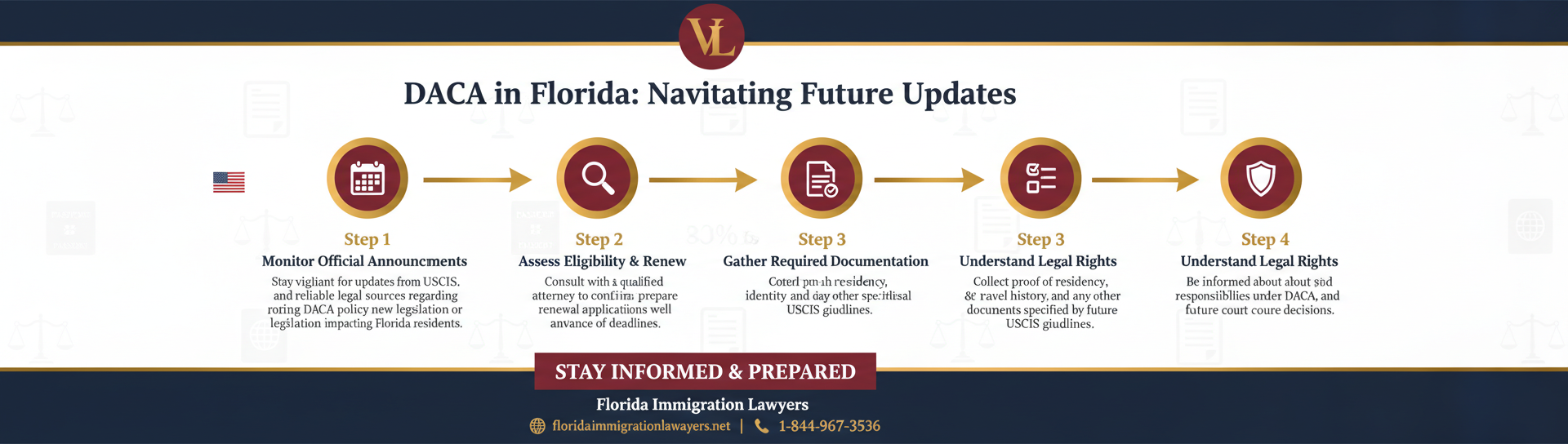
Here is a step-by-step guide for DACA renewals, which generally applies in 2026:
- Monitor DACA News 2026 Closely: Stay updated on any changes from USCIS or federal courts. The legal landscape is fluid, and new announcements can impact your eligibility or application process. Regularly check official USCIS channels and consult with a knowledgeable Florida immigration lawyer.
- Determine Your Eligibility for Renewal: To renew DACA, you must generally meet the original DACA requirements and not have departed the U.S. without advance parole since August 15, 2012. You must also not have been convicted of a felony, a significant misdemeanor, or three or more other misdemeanors, and not pose a threat to national security or public safety.
- Gather Required Documentation: Collect all necessary documents, including proof of identity, past DACA approvals, and evidence of continuous residence in the U.S. since your last DACA approval. This includes school records, employment records, and utility bills. We detail these further in the next section.
- Complete Forms I-821D, I-765, and I-765 Worksheet: These are the primary forms for DACA renewal and employment authorization. Ensure all information is accurate and consistent with your previous applications. Any discrepancies could lead to delays or denials.
- Prepare Your Filing Fee: The application requires a specific filing fee, which generally includes the fee for Form I-765 (Application for Employment Authorization) and the biometric services fee. Always verify the current fee amounts on USCIS website before submitting.
- Submit Your Application: Mail your complete application package to the correct USCIS lockbox facility. It is generally recommended to submit your renewal application 120 to 150 days before your current DACA expiration date. This allows ample time for processing and avoids any lapse in your work authorization.
- Attend Biometrics Appointment: After submitting your application, USCIS will typically send you a notice to attend a biometrics appointment at an Application Support Center (ASC). This appointment is mandatory for fingerprinting and photographs.
- Respond to Requests for Evidence (RFE): If USCIS needs more information, they will send an RFE. Respond promptly and thoroughly to avoid delays or a denial. This is where legal counsel can be particularly helpful.
For those hoping for a reopening of initial DACA applications, the situation is more complex. While the future remains uncertain, it is wise to consult with a Florida immigration lawyer to understand potential pathways. This includes exploring other forms of relief you might be eligible for, such as asylum or family-based immigration, if circumstances allow.
Essential Documents for DACA Applications and Renewals
A successful DACA application or renewal hinges on submitting a complete and accurate set of supporting documents. Missing or incorrect documentation is a common reason for delays or denials. We recommend organizing these documents meticulously.
Here is a general checklist of documents you will typically need for a DACA renewal:
- ✓ Proof of Identity:
- Copy of your birth certificate with photo identification.
- Copy of your passport or national identity document from your country of origin.
- Copy of any government-issued identification, such as a state ID or driver's license.
- ✓ Proof of Entry Before Age 16:
- School records (transcripts, report cards).
- Medical records.
- Travel records (I-94, passport stamps).
- ✓ Proof of Continuous Residence:
- School records (transcripts, enrollment letters).
- Employment records (pay stubs, W-2s).
- Utility bills, bank statements, rental agreements.
- Affidavits from individuals who can attest to your presence.
- ✓ Proof of Educational Enrollment or Completion:
- High school diploma or GED certificate.
- Transcripts from U.S. high school or college.
- Enrollment verification for current schooling.
Step-by-Step Process Guide - ✓ Proof of No Criminal Record:
- Certified copies of court dispositions for any arrests or convictions (even minor ones).
- Driving records.
- Police clearance certificates, if applicable.
- ✓ Previous DACA Approval Notices:
- Copies of your previous I-797 Approval Notices for Form I-821D and Form I-765.
- Copy of your most recent Employment Authorization Document (EAD).
- ✓ Two Passport-Style Photos:
- Recent, unmounted, color photographs taken within 30 days of filing.
This list is not exhaustive, and individual circumstances may require additional documentation. Always consult with a Florida immigration lawyer to ensure you submit a complete and compelling application. They can help you identify any potential issues and strengthen your case.
DACA Processing Times and Future Outlook for 2026
Understanding processing times is crucial for DACA recipients, especially when planning for renewals. USCIS processing times can vary significantly based on the service center, the volume of applications, and the complexity of individual cases. In 2026, these times are influenced by ongoing policy changes and staffing levels.
Typically, DACA renewal applications may take anywhere from a few weeks to several months to process. USCIS generally recommends filing your renewal application 120 to 150 days before your current DACA and EAD expire. This helps prevent a lapse in your work authorization and deferred action status.
You can check the general processing times for Form I-821D and Form I-765 on the USCIS website. Remember that these are estimates, and individual cases may differ. If your application is pending beyond the estimated timeframe, an attorney can help inquire about its status.
The Future Outlook for DACA in 2026
The long-term future of DACA remains uncertain due to unresolved legal challenges. While renewals continue, the inability for new applicants to gain DACA status leaves many young people in limbo. There is ongoing advocacy for a permanent legislative solution, such as the Dream Act, which would provide a pathway to lawful permanent residency and eventually citizenship for eligible Dreamers.
The political climate in 2026 will undoubtedly influence any potential legislative action. Both federal and state-level discussions often touch upon the future of DACA recipients. For example, discussions in Florida's legislature regarding higher education access for undocumented students can indirectly relate to the DACA population. While these discussions are important, they do not currently provide a direct federal pathway to DACA status or a green card.
Staying informed about DACA latest news and advocating for comprehensive immigration reform are important. However, for immediate legal needs, consulting with a Florida immigration lawyer is the most effective step. They can help you understand your current options and prepare for potential future changes, including deportation defense strategies if necessary. Refer to INA Section 237 (8 U.S.C. § 1227) for grounds of deportability, which DACA helps to mitigate.
Financial Considerations for DACA Applicants in Florida
Applying for DACA, or renewing it, involves specific government filing fees. These fees are subject to change, so it is crucial to verify the most current amounts directly on the USCIS website. The main fees typically associated with a DACA renewal include:
- Form I-765, Application for Employment Authorization: This fee covers the processing of your work permit.
- Biometric Services Fee: This fee covers the cost of your fingerprinting and photograph appointment.
It is important to note that Form I-821D, Consideration of Deferred Action for Childhood Arrivals, generally does not have a separate fee. However, the total cost for the application package, including the I-765 and biometrics, can be a significant expense for many individuals and families.
USCIS generally does not offer fee waivers for DACA applications. However, in very limited circumstances, an exemption from the biometric services fee may be possible. This is rare and typically requires proof of severe financial hardship. Always consult with a Florida immigration lawyer to understand if you might qualify for any fee exemptions, though it's uncommon for DACA.
Beyond government fees, you should also consider legal fees if you choose to hire an attorney. While it is possible to file DACA renewals on your own, the complexity of immigration law and the specific challenges surrounding DACA make legal representation highly advisable. An experienced attorney can help ensure your application is accurate, complete, and submitted correctly, potentially saving you time and avoiding costly mistakes. This investment can provide peace of mind and significantly increase your chances of a successful outcome.
Many law firms, including Florida Immigration Lawyers, offer payment plans or flexible fee structures. During your free consultation, we can discuss our fees and how we can assist you financially. We believe everyone deserves access to quality legal representation, especially when their future is at stake.
Do not navigate this process alone. The complexities of DACA news 2026 and immigration law require expert guidance. Contact Florida Immigration Lawyers today to secure your future and protect your rights. We are ready to assist you.
Common Mistakes to Avoid in Your DACA Application
Even for renewals, the DACA application process can be fraught with potential pitfalls. Making a mistake could lead to delays, requests for evidence, or even a denial. Avoiding these common errors is crucial for a smooth process.
- Filing Too Late or Too Early: Submitting your renewal application too close to your expiration date risks a lapse in your work authorization. Filing too early (more than 150 days before expiration) can also cause issues. Aim for the 120-150 day window.
- Incomplete or Incorrect Forms: Every question on Forms I-821D and I-765 must be answered accurately and completely. Leaving fields blank or providing inconsistent information can trigger RFEs or denials. Review everything meticulously.
- Insufficient Supporting Documentation: Failing to provide all required evidence of identity, continuous residence, and educational history is a major cause of delays. Ensure every bullet point on your checklist is addressed with strong evidence.
- Not Disclosing All Criminal History: Even minor arrests, traffic tickets (beyond parking), or interactions with law enforcement must be disclosed. Failure to do so, even if the charges were dropped, can be considered misrepresentation and lead to serious consequences, including deportation defense issues.
- Submitting Incorrect Filing Fees: USCIS fees change periodically. Always verify the current fee amounts on the official USCIS website before sending your application. An incorrect fee will result in your application being rejected.
- Ignoring USCIS Requests for Evidence (RFEs): If you receive an RFE, it means USCIS needs more information. Failing to respond by the deadline, or providing an inadequate response, will likely lead to a denial.
- Not Keeping Copies of Your Application: Always make a complete copy of your entire application package, including all forms and supporting documents, before mailing it to USCIS. This copy is vital for your records and if issues arise.
- Assuming Eligibility Without Review: Your eligibility for DACA renewal may be impacted by new criminal issues, travel outside the U.S. without advance parole, or other changes in your circumstances. Always re-evaluate your eligibility before filing.
- Not Seeking Legal Counsel for Complex Cases: If you have any criminal history, prior immigration issues, or questions about your eligibility, attempting to file without an attorney is a significant risk. A Florida immigration lawyer can provide crucial guidance.
When to Seek Expert Legal Guidance for DACA Matters
While some DACA renewals may seem straightforward, the program's precarious legal standing and the ever-changing immigration landscape make legal counsel invaluable. You should strongly consider contacting a Florida immigration lawyer if any of the following scenarios apply to you:
- You have any criminal history: Even minor infractions can jeopardize your DACA eligibility. An attorney can assess the impact and advise on the best course of action.
- You have traveled outside the U.S. without advance parole: This can have severe consequences for your DACA status and future immigration prospects.
- You have had any prior negative immigration history: This includes previous deportation orders, periods of unlawful presence, or denials of other immigration benefits.
- You are unsure about your continuous residence or entry before age 16: Proving these elements can be challenging, and an attorney can help gather and present compelling evidence.
- You received a Request for Evidence (RFE) or Notice of Intent to Deny (NOID) from USCIS: These require a precise and timely response, which an attorney can expertly craft.
- You wish to explore other immigration pathways: DACA is temporary. An attorney can help you understand if you qualify for other, more permanent relief, such as family-based visas or employment-based options.
- You are concerned about the latest DACA news 2026 and its impact: Attorneys stay updated on legal challenges and policy shifts, offering you the most current advice.
Florida Immigration Lawyers has extensive experience assisting DACA recipients throughout Florida, including in Jacksonville and surrounding areas. We understand the specific nuances of immigration court proceedings and USCIS policies that affect our clients. Our dedicated team is ready to provide the clear, strategic advice you need to protect your status and plan for your future. We also offer robust deportation defense services for those facing removal proceedings.
Frequently Asked Questions About DACA in Florida
What will happen to DACA recipients in 2026?
As of early 2026, the DACA program continues to face significant legal uncertainty. While a federal court ruling has generally halted the approval of new initial DACA applications, USCIS is currently permitted to process renewal requests for existing DACA recipients. The long-term future of DACA depends heavily on ongoing litigation and potential legislative action in Congress. It is crucial for DACA recipients in Florida to stay informed about DACA news 2026 and consult with an experienced Florida immigration lawyer to understand how these developments might affect their individual circumstances. We monitor these changes closely to provide the most up-to-date guidance.
Can DACA get a license in Florida?
Yes, DACA recipients in Florida are generally eligible to obtain a Florida driver's license or state identification card. To do so, you typically need to present your valid Employment Authorization Document (EAD) and your Social Security card, along with proof of identity and two proofs of residential address. The Florida Department of Highway Safety and Motor Vehicles (FLHSMV) accepts these documents. This is a critical benefit for DACA recipients, enabling them to travel to work, school, and appointments, contributing to their independence and integration into society.
Is USCIS accepting new DACA?
As of early 2026, USCIS is generally not accepting new initial DACA applications. This is due to a federal court injunction that has largely paused the program for first-time applicants. USCIS continues to accept and process DACA renewal requests from individuals who have previously been granted DACA. It is essential to distinguish between initial applications and renewals when reviewing USCIS DACA news. Any changes to this policy would be widely publicized by USCIS and would likely result from further court rulings or legislative action.
Is DACA allowed in Florida?
Yes, DACA is a federal program, and its provisions apply to eligible individuals across all U.S. states, including Florida. While state laws in Florida may address certain aspects related to undocumented immigrants (like in-state tuition for some), DACA's core protections against deportation and work authorization are governed by federal policy. DACA recipients in Florida continue to benefit from the program's protections, provided they meet renewal requirements and adhere to all federal guidelines. Our Florida immigration lawyer team assists clients across the state, from Jacksonville to South Florida.
What is the latest DACA news 2026 regarding policy changes?
The latest DACA news 2026 primarily revolves around the ongoing legal challenges to the program. A federal court in Texas has deemed DACA unlawful, preventing USCIS from approving new initial applications. The Biden administration has appealed this decision, and the case is expected to continue through the appellate courts. There have been no new legislative changes to DACA at the federal level as of early 2026. Any future policy changes would likely stem from a final court ruling or a comprehensive immigration reform bill passed by Congress. Staying updated through reliable sources like justice.gov and legal counsel is critical.
How can a Florida immigration lawyer help with DACA?
A Florida immigration lawyer can provide invaluable assistance with DACA matters. This includes helping you assess your eligibility for renewal, meticulously preparing your application forms and supporting documents, and ensuring timely submission. If you have any criminal history, prior immigration issues, or have traveled outside the U.S., an attorney can help mitigate potential risks. They also keep abreast of the latest DACA news 2026 and legal developments, providing strategic advice and exploring alternative immigration pathways. Our team at Florida Immigration Lawyers offers compassionate and expert guidance throughout the entire process.
What are the DACA eligibility requirements for 2026?
For DACA renewals in 2026, you must generally continue to meet the original DACA eligibility requirements. These include having entered the U.S. before your 16th birthday, having continuously resided in the U.S. since June 15, 2007, being under the age of 31 as of June 15, 2012, being enrolled in school, having graduated or obtained a certificate of completion from high school, having obtained a general education development (GED) certificate, or being an honorably discharged veteran of the Coast Guard or Armed Forces of the United States. Additionally, you must not have been convicted of certain serious offenses. An attorney can help confirm your specific eligibility based on your individual circumstances.
Can DACA recipients travel outside the U.S. in 2026?
DACA recipients can generally travel outside the U.S. only if they obtain Advance Parole from USCIS before their departure. Traveling without Advance Parole could lead to your DACA status being terminated and prevent your re-entry into the United States. Advance Parole is typically granted for humanitarian, educational, or employment purposes. The application process for Advance Parole is complex, and it is highly recommended to consult with a Florida immigration lawyer before planning any international travel. They can help you understand the risks and ensure you meet the strict requirements for approval, especially given the current DACA latest news and legal climate.
About Florida Immigration Lawyers
Florida Immigration Lawyers is a leading immigration law firm dedicated to serving individuals and families across the entire state of Florida. With a deep understanding of complex immigration laws and a compassionate approach, we provide comprehensive legal services to help you achieve your immigration goals.
Our experienced attorneys specialize in a wide range of immigration matters, including DACA, family-based petitions, employment visas, deportation defense, asylum, and citizenship. We are committed to protecting your rights and providing personalized attention to every case.
Why choose Florida Immigration Lawyers? We offer free consultations to discuss your unique situation, are available 24/7 to address urgent concerns, and have a proven track record of success. Our bilingual team is ready to assist clients in both English and Spanish, ensuring clear communication and understanding throughout your legal journey.
Your future in Florida is our priority. Contact us today to schedule your free consultation and discover how we can help you navigate the complexities of immigration law. Visit our website at https://www.floridaimmigrationlawyers.net or call us directly at 1-844-967-3536.
This article is for general informational purposes only and does not constitute legal advice. Immigration laws change frequently. For advice specific to your situation, please consult with a qualified immigration attorney.
Contact Us for DACA Guidance
The journey through immigration law can be challenging, especially with the ever-changing DACA news 2026. Do not face these complexities alone. Florida Immigration Lawyers is here to provide the expert legal guidance and support you deserve.
Whether you need assistance with a DACA renewal, have questions about your eligibility, or wish to explore other immigration options, our dedicated team is ready to help. We serve clients throughout Florida, from Jacksonville to Miami, with integrity and compassion.
Take the crucial step towards securing your future. Call Florida Immigration Lawyers at 1-844-967-3536 today for a free consultation. Let us be your trusted advocate in navigating immigration law.
Do Not Navigate This Process Alone
Our experienced immigration attorneys are ready to fight for you. Get a free, confidential consultation today.
Se Habla Español
Or leave your details and we’ll call you:
Free Evaluation in 24 Hours
Or talk to us right now
AI voice assistant — available 24/7
FreeFrequently Asked Questions

William J. Vásquez
Founding Attorney · Vasquez Law Firm
U.S. Air Force veteran and immigration attorney with years of hands-on U.S. immigration experience. J.D., NCCU School of Law. AILA member. Admitted to the 4th, 5th, and 11th Circuit Courts.
Available 24/7 - Free Evaluations
Reviewed for legal accuracy by William J. Vásquez
Licensed in North Carolina; U.S. immigration is federal practice.
Related Legal Services
Our Florida immigration attorneys can help you with deportation defense, citizenship and naturalization and family immigration services. Call today at 1-844-967-3536 for a free consultation.
Related Links
Related Topics
Free Legal Consultation
Discuss your case with our experienced attorneys. We're available 24/7.
Se Habla Español - Estamos aquí para ayudarle.
Related Articles
Schedule A Nurse Immigration in Florida 2026 Guide
Discover the comprehensive guide to Schedule A nurse immigration in Florida for 2026. This specialized pathway allows foreign registered nurses to bypass the standard labor certification process, leading to an expedited EB-3 Green Card. Learn about eligibility requirements, the step-by-step application process, expected timelines, and associated costs. We also cover unique challenges for foreign nurses in Florida, including state licensing and the vital role of sponsoring hospitals. Avoid common mistakes and understand when professional legal assistance from Florida Immigration Lawyers is essential for a successful permanent residency application. Our firm provides expert guidance for nurses seeking to thrive in Florida's healthcare system.
Orlando Immigration Lawyer: Free Consultation Guide 2026
Discover how an Orlando immigration lawyer can provide essential guidance through complex U.S. immigration processes. This comprehensive guide details the benefits of a free consultation, outlines common immigration services, explains how to prepare for your meeting, and discusses typical timelines and fee structures in Florida for 2026. Learn to avoid common mistakes and understand when professional legal counsel is indispensable, especially amidst evolving immigration policies. Florida Immigration Lawyers offers expert support for visas, green cards, citizenship, and deportation defense across the state.
Removal Conditional Green Card Process in Florida 2026
For individuals with a two-year conditional green card obtained through marriage, the process of removing conditions is a critical next step. This involves filing Form I-751, Petition to Remove Conditions on Residence, within a strict 90-day window before expiration. This guide, relevant for 2026, details the required documentation, filing timelines, potential costs, and crucial waivers for special circumstances like divorce or abuse. It also highlights common mistakes to avoid and emphasizes the importance of demonstrating a bona fide marriage to USCIS. For residents across Florida, from Gainesville to Miami, understanding these requirements is vital to transitioning to permanent residency. Seeking expert legal guidance from Florida Immigration Lawyers can significantly enhance your chances of a successful outcome, providing peace of mind throughout this complex immigration process.
Cancellation of Removal Attorney Fees in Florida 2026
Facing deportation in Florida? Learn about Cancellation of Removal, a vital defense that allows certain non-citizens to remain in the U.S. This guide covers eligibility, the step-by-step process in Florida immigration courts, essential documentation, and typical timelines as of 2026. We delve into the critical differences between LPR and non-LPR cancellation, including the challenging "exceptional and extremely unusual hardship" standard. Understand the factors influencing cancellation of removal attorney fees, common mistakes to avoid, and when to seek expert legal counsel. Florida Immigration Lawyers offers comprehensive deportation defense services to protect your future in Florida.