CSPA Aging Out: Protecting Child Immigrants in Florida 2026
The Child Status Protection Act (CSPA) is a critical U.S. immigration law safeguarding children from 'aging out' of eligibility for permanent residency due to processing delays. This guide from Florida Immigration Lawyers explains CSPA eligibility, the precise age calculation, and the step-by-step process for families in Florida. We cover vital requirements, common mistakes like missing the 'sought to acquire' deadline, and provide a comprehensive document checklist. Understanding CSPA is essential for derivative beneficiaries in family-based petitions, especially with fluctuating visa bulletins and potential category conversions. Learn how to protect your child's immigration future and when to seek legal assistance from our firm, serving Jacksonville and all of Florida.
The Child Status Protection Act (CSPA) is a critical U.S. immigration law designed to prevent certain derivative beneficiaries, primarily children, from 'aging out' of eligibility for permanent residency due to processing delays. This means if a child turns 21 while their parent's visa petition is pending, CSPA may 'freeze' their age, allowing them to retain their status as a 'child' under immigration law. The CSPA calculation subtracts the time a petition was pending from the child's biological age on the date a visa becomes available, provided they 'seek to acquire' permanent residence within one year. Understanding CSPA is vital for families in Florida navigating complex immigration timelines.
- CSPA prevents children from 'aging out' of immigration eligibility.
- It 'freezes' a child's age for certain family-based and other visa categories.
- Eligibility requires a specific age calculation and timely application.
- Failing to 'seek to acquire' permanent residence within one year is a common pitfall.
- Legal guidance is essential for accurate CSPA determination and application.
Understanding the Child Status Protection Act (CSPA) in Florida
Waiting for an immigration petition to be processed can be a long and anxious journey for families across Florida. The dream of reuniting or securing permanent residency often hinges on strict eligibility criteria, one of the most critical being a child's age. For many, the fear that a child might turn 21 – known as 'aging out' – and lose their eligibility for a visa category is a constant source of stress.
Fortunately, the U.S. Congress enacted the Child Status Protection Act (CSPA) on August 6, 2002. This vital law offers a lifeline to countless families by protecting children from losing their derivative beneficiary status due to bureaucratic delays in processing visa petitions. CSPA provides a mechanism to 'freeze' a child's age, allowing them to continue their path to permanent residency even if they turn 21 during the lengthy immigration process.
This comprehensive guide from Florida Immigration Lawyers will delve into the intricacies of CSPA, explaining who is eligible, how the age is calculated, the application process in Florida, and common pitfalls to avoid. Our goal is to empower you with the knowledge needed to navigate this complex area of immigration law. If you are concerned about a child aging out or need assistance with a CSPA case, do not hesitate to call Florida Immigration Lawyers at 1-844-YO-PELEO for a free consultation. We are here to help families throughout Jacksonville and all of Florida.
What is the Child Status Protection Act (CSPA) and How Does it Work?
The Immigration and Nationality Act (INA) defines a 'child' as an unmarried person under 21 years of age. This definition is fundamental to many immigration categories, especially family-based petitions. However, due to extensive backlogs and processing times, many children would turn 21 before their visa became available, effectively 'aging out' and losing their eligibility to immigrate with their parents. This often meant they had to start a new, longer immigration process as an adult child, causing immense hardship and separation.
The CSPA was designed to mitigate these harsh consequences. It provides a specific formula to calculate a child's 'CSPA age' for immigration purposes. This calculated age can be lower than their biological age, effectively preserving their status as a 'child' under the INA. The law applies to various categories, including family-sponsored preference petitions, employment-based preference petitions, diversity visa applicants, and certain asylum and refugee cases. It is a crucial tool for maintaining family unity, especially in states like Florida, which has a diverse immigrant population.
In essence, CSPA aims to ensure that children are not penalized for delays in government processing. It acknowledges that the intent of the law was for these children to immigrate as part of a family unit. For example, a child whose parent filed an I-130 petition on their behalf might biologically turn 21, but if the petition took 5 years to process, CSPA could subtract those 5 years from their age, keeping them under 21 for immigration purposes. This protection is not automatic; it requires understanding the specific calculation and meeting all other eligibility criteria, including the critical 'sought to acquire' requirement within one year of visa availability, as outlined in INA 203(h)(1)(A).
How is CSPA Age Calculated for Immigration Purposes in 2026?
The CSPA age calculation is a precise formula designed to account for the time a visa petition was pending. As of 2026, the fundamental calculation remains the same, though processing times and visa bulletin dates constantly fluctuate. It is paramount to perform this calculation accurately to determine eligibility.
To calculate a child's CSPA age, you need three key dates:
- The child's biological age on the date the visa becomes available (the 'Final Action Date' or 'Dates for Filing' from the Department of State Visa Bulletin).
- The date the underlying visa petition (e.g., Form I-130, I-140) was approved by USCIS.
- The date the underlying visa petition was filed with USCIS.
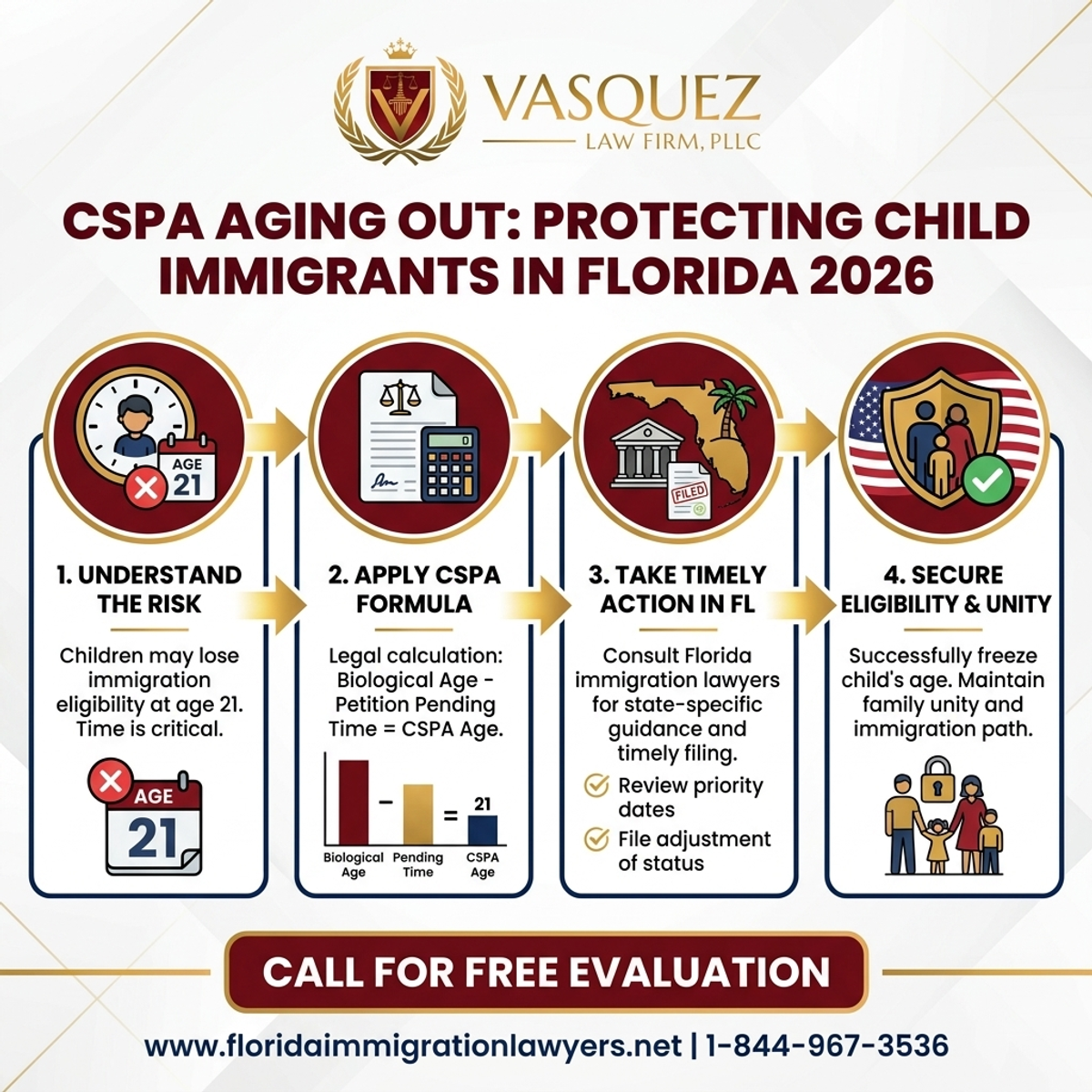
The formula is: Child's Age on Visa Availability Date - (Petition Approval Date - Petition Filing Date) = CSPA Age. If this calculated CSPA age is under 21, the child may be protected. Furthermore, the child must 'seek to acquire' permanent residence within one year of the visa becoming available. This means filing Form I-485 (Adjustment of Status) if in the U.S., or submitting Form DS-260 (Immigrant Visa Application) if abroad. Failure to meet this one-year deadline is a common reason for CSPA denial.
Consider a family in Jacksonville, Florida. An LPR parent filed an I-130 petition for their child. The petition was filed on January 1, 2018, and approved on January 1, 2023 (5 years pending). The visa became available on January 1, 2026, and the child was biologically 22 years old on that date. Using the formula: 22 - (2023-01-01 - 2018-01-01) = 22 - 5 = 17. The CSPA age is 17, making the child eligible, provided they apply for adjustment of status or an immigrant visa by January 1, 2027.
Timeline and Processing Expectations (as of 2026)
Understanding typical processing times is crucial for CSPA planning, although actual times can vary significantly based on category, country of chargeability, and USCIS workload.
| Stage | Typical Timeframe | Notes |
|---|---|---|
| I-130 Petition Filing to Approval | 1-2 years (Immediate Relative) 2-10+ years (Family Preference) |
Varies by preference category (e.g., F2A, F2B), and country of origin. Check USCIS processing times. |
| Visa Availability | Highly Variable | Determined by the monthly Visa Bulletin. Can be immediate for some categories/countries, or decades for others. |
| AOS/IV Application (Sought to Acquire) | Within 1 year of visa availability | CRITICAL for CSPA eligibility. Must file I-485 or DS-260 within this timeframe. |
| Adjustment of Status (I-485) Processing | 6-24 months | Varies by USCIS field office (e.g., Miami, Orlando, Tampa) and case complexity. |
| Immigrant Visa (Consular Processing) | 3-12 months post-NVC processing | After NVC completes processing, interview scheduled at U.S. Embassy/Consulate abroad. |
What are the Eligibility Requirements for CSPA in Florida?
While the CSPA age calculation is central, it is only one piece of the eligibility puzzle. To benefit from CSPA, a child must meet several other crucial criteria. Understanding these requirements is essential for families in Florida seeking to ensure their children remain eligible for permanent residency.
The core requirements for CSPA eligibility include:
- Beneficiary of an Eligible Petition: The child must be the derivative beneficiary of a family-sponsored preference petition (e.g., F2A, F2B, F3, F4), an employment-based preference petition, a Diversity Visa petition, or an asylum/refugee application. Immediate relatives (spouses, minor children, and parents of U.S. citizens) are not generally CSPA protected because their visas are immediately available, meaning they do not 'age out' in the same way. However, if an immediate relative petition converts to a preference category, CSPA could become relevant.
- Unmarried Status: The child must remain unmarried at the time of applying for adjustment of status or an immigrant visa, and throughout the entire process until they receive their green card. Marriage at any point before becoming a lawful permanent resident will generally invalidate their 'child' status and CSPA protection.
- CSPA Age Under 21: As discussed, the calculated CSPA age must be under 21 on the date the visa becomes available.
- 'Sought to Acquire' Requirement: The child must 'seek to acquire' permanent residence within one year of the visa becoming available. This means taking affirmative steps such as filing Form I-485 (for adjustment of status if physically present in the U.S.) or submitting Form DS-260 (for consular processing abroad). This one-year window is strictly enforced and is a frequent point of failure for CSPA cases.
Special considerations apply when a petitioner naturalizes. For example, if an LPR parent petitions for an F2B child (unmarried adult child of an LPR) and then naturalizes, the petition automatically converts to an F1 category (unmarried adult child of a U.S. citizen). F1 is not CSPA protected. However, the CSPA allows the beneficiary to opt-out of this conversion and remain in the F2B category, preserving CSPA protection. This decision requires careful legal analysis.
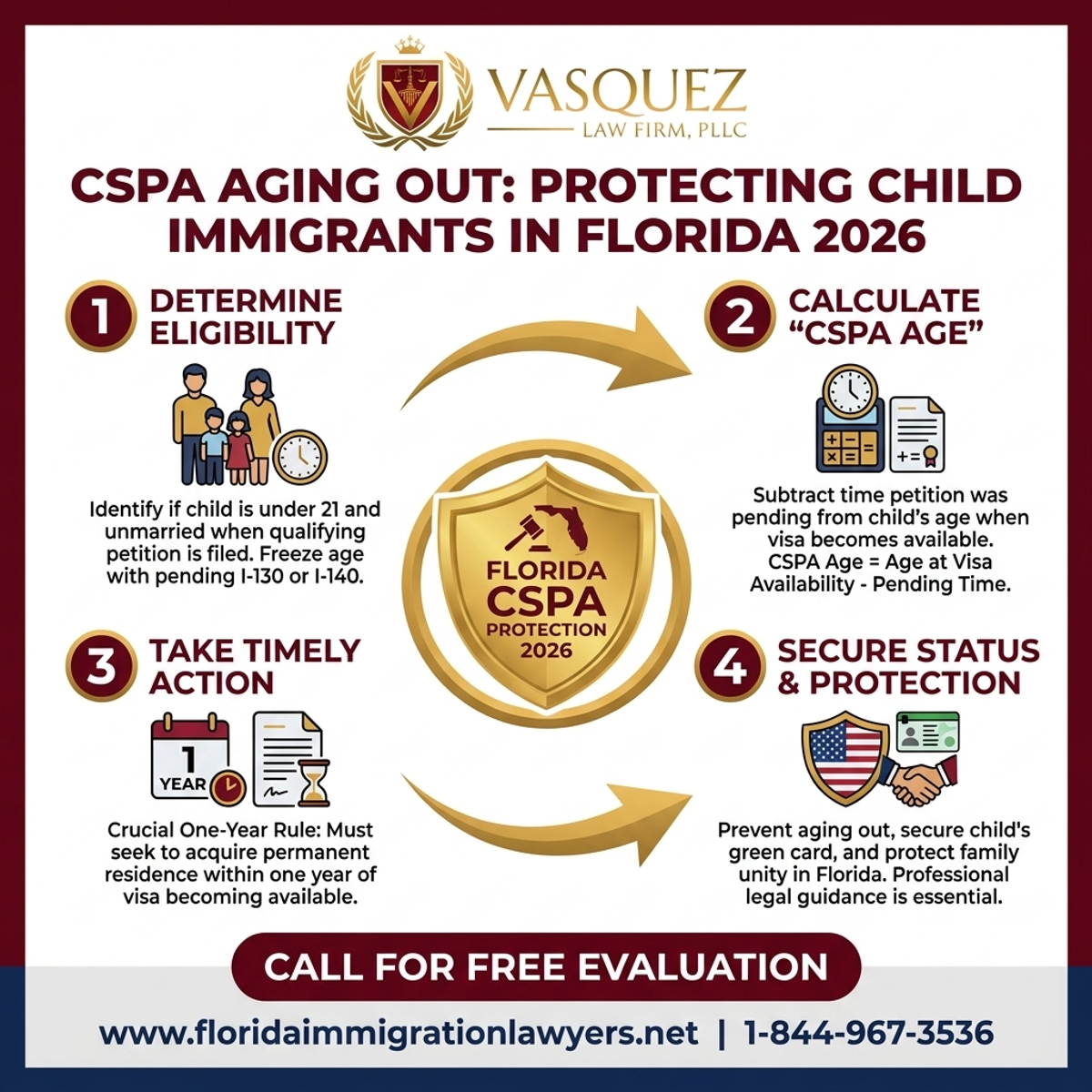
Step-by-Step Process — CSPA Aging Out: Protecting Child Immigrants in Florida 2026
Essential Document Checklist for CSPA Cases
Gathering the correct documentation is vital for a successful CSPA claim. While this is not an exhaustive list for the underlying petition, these documents are crucial for CSPA determination:
- Underlying Petition: Copy of Form I-130, I-140, I-360, I-589, or other relevant petition, including filing and approval notices (I-797).
- Child's Birth Certificate: Proving the child's biological age and relationship to the petitioner.
- Petitioner's Birth Certificate/Naturalization Certificate: To establish the petitioner's status.
- Marriage Certificate (of Parents): If applicable, to prove legitimate parent-child relationship.
- Visa Bulletin Records: Copies of the relevant Department of State Visa Bulletin to pinpoint the exact date the visa became available.
- Proof of 'Sought to Acquire': Receipt notices for Form I-485 or confirmation of DS-260 submission, clearly showing the filing date within the one-year window.
- Evidence of Unmarried Status: Affidavits, if required, though typically not an explicit document unless questioned.
- Any Previous Correspondence with USCIS/NVC: Including Requests for Evidence (RFEs) or notices of intent to deny.
What is the Step-by-Step Process to Invoke CSPA in Florida?
Invoking CSPA is not a separate application; rather, it is an eligibility determination made during the adjudication of the underlying immigrant visa or adjustment of status application. For those in Florida, understanding this process is key to successfully protecting a child's immigration pathway.
Here's a step-by-step guide on how CSPA is typically invoked:
- Monitor the Visa Bulletin: Regularly check the U.S. Department of State's monthly Visa Bulletin to determine when your specific visa preference category and country of chargeability become current. This is the crucial 'visa availability date' for your CSPA calculation.
- Calculate CSPA Age Promptly: On the exact date your visa becomes available (either the 'Final Action Date' or 'Dates for Filing,' depending on USCIS guidance for that month), immediately calculate the child's CSPA age using the formula: Child's Age on Visa Availability Date - (Petition Approval Date - Petition Filing Date).
- Meet the 'Sought to Acquire' Requirement: Within one year of the visa becoming available, the child MUST take active steps to pursue permanent residency. If the child is in the United States, this means filing Form I-485, Application to Register Permanent Residence or Adjust Status, with USCIS. If the child is abroad, this means submitting Form DS-260, Immigrant Visa Application, to the National Visa Center (NVC). This one-year period is a strict deadline and cannot be extended.
- Clearly State CSPA Eligibility: When filing Form I-485 or submitting Form DS-260, ensure that CSPA eligibility is explicitly noted. Provide all supporting documents, including birth certificates, petition approval notices, and a clear explanation of your CSPA age calculation.
- Prepare for Interview: Whether it's an adjustment of status interview at a Florida USCIS field office (such as in Orlando, Miami, or Tampa) or a consular interview abroad, be prepared to discuss the CSPA calculation and provide any requested documentation. The adjudicating officer will review your claim and make a final determination.
It is important to remember that CSPA is not a guarantee of approval. All other eligibility criteria for the underlying visa category must still be met, and the CSPA calculation itself must be accurate and timely. Seeking legal advice is highly recommended throughout this process.
Do not navigate this complex process alone. Contact Florida Immigration Lawyers today for guidance and support. Our team is dedicated to helping families across Florida understand and utilize the Child Status Protection Act effectively.
How Much Does it Cost to Apply for CSPA Protection in 2026?
It is important to clarify that there is no separate filing fee specifically for 'applying' for CSPA protection. CSPA is an eligibility determination made during the adjudication of an underlying immigration benefit. Therefore, the costs associated with CSPA are the standard fees for the primary immigration forms required to pursue permanent residency. As of 2026, these fees are subject to change by USCIS and the Department of State, but the structure remains consistent. Always check the official USCIS and Department of State websites for the most current fee schedule.
For families in Florida, these costs can add up, making financial planning an important part of the immigration journey. While the government fees are fixed, legal fees for assistance can vary based on the complexity of your case. Florida Immigration Lawyers offers free consultations to discuss your specific situation and potential costs involved.
Cost Factors and Fee Breakdown (as of 2026 - Subject to Change)
The following table outlines typical fees associated with the immigration process where CSPA eligibility would be determined. These are general figures and should be verified with official government sources.
Key Statistics — CSPA Aging Out: Protecting Child Immigrants in Florida 2026
| Item | Typical Fee | Notes |
|---|---|---|
| Form I-130, Petition for Alien Relative | USCIS Filing Fee | Paid by the petitioner (U.S. Citizen or LPR) for family-based petitions. |
| Form I-485, Application to Adjust Status | USCIS Filing Fee | Paid by the beneficiary if adjusting status in the U.S. Includes biometric services fee. |
| Immigrant Visa Application Processing (DS-260) | Department of State Fee | Paid by the beneficiary for consular processing abroad. |
| Medical Examination | Varies by Civil Surgeon/Panel Physician | Required for both adjustment of status and immigrant visa processing. Not a government fee. |
| Affidavit of Support (I-864) | No separate fee | Required for most family-based immigrants. No government filing fee for the form itself. |
| Attorney Fees | Varies by firm and case complexity | Highly recommended for CSPA cases due to the intricate calculations and deadlines. |
How Does CSPA Affect Derivative Beneficiaries in Family-Based Petitions?
The impact of CSPA is most profoundly felt by derivative beneficiaries in family-based preference categories. These are typically the children of a principal beneficiary (e.g., the child of an LPR, or the child of an adult son/daughter of a U.S. citizen). The law aims to keep families together, and CSPA is a critical mechanism for this goal, especially in populous states like Florida.
Let's examine how CSPA interacts with specific family-based preference categories:
- F2A Category (Spouses and Children of Lawful Permanent Residents): This is one of the most common categories where CSPA protection is vital. If an LPR parent petitions for their child, and the child turns 21 while the petition is pending, CSPA can freeze their age. A crucial scenario here is when the LPR petitioner naturalizes. If the parent naturalizes, the F2A petition automatically converts to an Immediate Relative (IR) petition for the child, if the child is still under 21. If the child's CSPA age is over 21, the petition converts to F1 (unmarried adult child of a U.S. citizen), which is NOT CSPA protected. However, if the child was an F2A beneficiary, they can often retain their F2A classification if it is more advantageous, especially if the F2A final action date is earlier than the F1 date. This 'opt-out' provision is critical for many families.
- F2B Category (Unmarried Sons and Daughters of Lawful Permanent Residents): CSPA also applies to this category. If the LPR parent naturalizes while the F2B petition is pending, the petition automatically converts to the F1 category. Unlike the F2A scenario, the F1 category does not offer CSPA protection for children over 21. Therefore, for F2B beneficiaries, it is almost always beneficial to 'opt-out' of the automatic conversion to F1 and request to remain in the F2B category, preserving CSPA eligibility. This election must be actively made to USCIS or the NVC.
- F3 Category (Married Sons and Daughters of U.S. Citizens) and F4 Category (Brothers and Sisters of U.S. Citizens): Children of the principal beneficiaries in these categories (i.e., the grandchildren, nieces, or nephews of the U.S. citizen petitioner) are also derivative beneficiaries and can benefit from CSPA protection. The same age calculation and 'sought to acquire' rules apply.
Consider a hypothetical family in Jacksonville, Florida. A lawful permanent resident parent filed an I-130 petition for their 19-year-old unmarried child (F2A category). The petition was pending for three years. The parent then naturalized, and the child's CSPA age was calculated to be 16 (19 - 3 = 16) on the date the visa became available. Because the child's CSPA age is under 21, the petition automatically converts to an Immediate Relative (IR) category, and the child can proceed without delay, avoiding aging out. If the child's CSPA age was 22, the petition would convert to F1, and the child would lose CSPA protection unless they were able to retain F2B status.
Common Mistakes to Avoid in CSPA Cases
The Child Status Protection Act, while beneficial, is notoriously complex. Even minor errors can lead to a child losing their eligibility, resulting in significant delays or even denial of permanent residency. Families in Florida should be acutely aware of these common pitfalls:
- Incorrect CSPA Age Calculation: This is perhaps the most frequent mistake. Using the wrong dates (e.g., petition approval date instead of visa availability date) or miscalculating the 'pending time' can lead to an inaccurate CSPA age, resulting in a false sense of security or an incorrect denial.
- Missing the 'Sought to Acquire' Deadline: Failing to file Form I-485 (Adjustment of Status) or submit Form DS-260 (Immigrant Visa Application) within one year of the visa becoming available is a critical error. This one-year window is a strict statutory requirement (8 U.S.C. § 1153(h)(1)(A)) and cannot be waived.
- Marriage Before Receiving Green Card: A child beneficiary must remain unmarried until they become a lawful permanent resident. Marriage at any point before receiving the green card will invalidate their 'child' status and CSPA protection, regardless of their age.
- Not Understanding Category Conversions: When an LPR petitioner naturalizes, certain family-based petitions automatically convert. For F2A beneficiaries, this conversion to IR is usually beneficial. For F2B beneficiaries, conversion to F1 can be detrimental, as F1 is not CSPA protected.
- Failing to 'Opt-Out' of F1 Conversion: For F2B beneficiaries whose parent naturalizes, it is crucial to actively request to remain in the F2B category if it preserves CSPA protection. Failure to make this election can result in the child aging out.
- Assuming CSPA Applies to All Categories: CSPA does not apply to all immigration categories. For example, immediate relatives (spouses, minor children, parents of U.S. citizens) do not generally need CSPA because their visas are always available.
- Incomplete or Insufficient Documentation: Not providing all necessary documents, such as birth certificates, petition approval notices, or proof of the 'sought to acquire' action, can lead to RFEs or denials.
- Ignoring Changes in Law or Policy: Immigration law is dynamic. Policy changes, new rulings, or updates to the USCIS Policy Manual (e.g., Volume 7, Part A, Chapter 7 for CSPA) can affect CSPA eligibility or interpretation. Staying informed is vital.
- Delaying Action: Procrastination in filing forms, responding to RFEs, or seeking legal advice can cause crucial deadlines to be missed, jeopardizing a child's immigration future.
- Not Consulting an Experienced Attorney: CSPA is one of the most complex areas of immigration law. An experienced immigration lawyer can provide accurate calculations, advise on category conversions, ensure timely filings, and represent your interests effectively.
When to Call a Florida Immigration Lawyer for CSPA Assistance
Navigating the Child Status Protection Act requires a deep understanding of immigration law, precise calculations, and strict adherence to deadlines. While this guide provides general information, every case is unique, and the stakes are incredibly high. For families across Florida, especially in areas like Jacksonville, Miami, and Orlando, seeking professional legal counsel is not just advisable—it's often essential to prevent costly mistakes and ensure the strongest possible outcome.
You should call Florida Immigration Lawyers if any of the following scenarios apply to you:
- You are unsure how to accurately calculate your child's CSPA age or interpret the Visa Bulletin.
- Your child is approaching their 21st birthday, and their petition is still pending.
- The petitioning parent has naturalized, and you need to understand the implications for your child's category conversion (e.g., F2A to IR, or F2B to F1).
- You need to make an 'opt-out' election to remain in a more favorable visa category (e.g., F2B).
- You have received a Request for Evidence (RFE) from USCIS related to your child's age or eligibility.
- Your child's petition has been denied, and you believe CSPA was incorrectly applied or overlooked.
- You have questions about the 'sought to acquire' requirement and ensuring timely filing of Form I-485 or DS-260.
- There are any complexities in your family structure, such as adoption or step-relationships, that might affect CSPA eligibility.
- You simply want peace of mind knowing that experienced professionals are handling your case.
Our dedicated team at Florida Immigration Lawyers understands the nuances of CSPA and other complex immigration laws. We serve clients throughout all of Florida, offering personalized strategies and diligent representation. Do not risk your child's future by trying to navigate these intricate rules alone.
About Florida Immigration Lawyers
Florida Immigration Lawyers is an immigration law firm dedicated to serving individuals and families across the entire state of Florida. With a deep commitment to our clients and a comprehensive understanding of U.S. immigration law, we provide legal guidance on a wide range of immigration matters, including family immigration, business immigration, deportation defense, asylum, and citizenship. Our experienced attorneys are passionate about helping immigrants achieve their American dreams and navigate the complex legal landscape with confidence.
We pride ourselves on offering compassionate, accessible, and effective legal services. Our firm is available 24/7, ensuring that you can reach us when you need us most. We offer free consultations to discuss your unique situation and provide clear, actionable advice. Whether you are in Orlando, or any other city in Florida, our team is ready to assist you. Call us today at 1-844-YO-PELEO or visit our website at Vasquez Law Firm to learn how we can help you achieve your immigration goals.
Sources and References
- U.S. Citizenship and Immigration Services (USCIS)
- U.S. Department of State Visa Bulletin
- Executive Office for Immigration Review (EOIR)
- 8 U.S.C. § 1153(h) - Child Status Protection Act (CSPA)
- Immigration and Nationality Act (INA) Section 203(h)
- 8 CFR 204.2(d)(2) - Petitions for alien relatives; Age-out protection
- USCIS Policy Manual Volume 7, Part A, Chapter 7 - Child Status Protection Act (CSPA)
Related services: immigration practice areas, family immigration services.
This article provides general legal information and is not intended as legal advice. Every case is unique, and outcomes depend on specific facts and circumstances. Contact an attorney for advice about your particular situation.
Protecting your child's immigration future is paramount. Do not let the complexities of the Child Status Protection Act lead to unnecessary delays or denials. Contact Florida Immigration Lawyers today for a free, confidential consultation. Call us at 1-844-YO-PELEO. Se Habla Español - Estamos aqui para ayudarle.
If you need legal assistance, learn more about our immigration law practice, or call us at 1-844-YO-PELEO for a free consultation.
Do Not Navigate This Process Alone
Our experienced immigration attorneys are ready to fight for you. Get a free, confidential case review today.
Se Habla Español
Or leave your details and we’ll call you:
Free Evaluation in 24 Hours
Or talk to us right now

AI voice assistant — available 24/7
FreeFrequently Asked Questions

William J. Vásquez
Founding Attorney · Vasquez Law Firm
U.S. Air Force veteran and immigration attorney with years of hands-on U.S. immigration experience. J.D., NCCU School of Law. AILA member. Admitted to the 4th, 5th, and 11th Circuit Courts.
Available 24/7 - Free Evaluations
Reviewed for legal accuracy by William J. Vásquez
Licensed in North Carolina; U.S. immigration is federal practice.
Related Legal Services
Our Florida immigration attorneys can help you with free immigration consultation, business immigration and deportation defense. Call today at 1-844-YO-PELEO for a free case review.
Related Links
Related Topics
Free Legal Case Review
Discuss your case with our experienced attorneys. We're available 24/7.
Se Habla Español - Estamos aquí para ayudarle.
Related Articles
DUI Immigration Consequences in Florida 2026
A DUI conviction in Florida can have severe immigration consequences, potentially leading to inadmissibility, deportation, or denial of immigration benefits. For non-citizens, a DUI is not just a traffic offense but a serious criminal matter that federal immigration law scrutinizes closely. Factors like multiple offenses, injury, or property damage can escalate a simple DUI to a Crime Involving Moral Turpitude (CIMT) or even an aggravated felony, triggering mandatory detention and removal proceedings. Understanding the specific nature of your Florida conviction and its interpretation under the Immigration and Nationality Act (INA) is crucial. This article outlines how DUIs impact immigration status, the grounds for inadmissibility and deportation, a step-by-step guide to navigating the process, essential documentation, and expected timelines for 2026. We also highlight common mistakes to avoid and when to seek legal counsel from an experienced immigration attorney. Florida Immigration Lawyers offers comprehensive support for individuals facing these challenging situations, providing expert guidance through complex legal landscapes.
Dual Citizenship Lawyer in Florida: What You Need to Know
For Florida residents, the concept of dual citizenship, or holding two passports, offers a compelling blend of opportunities and challenges. While the U.S. generally permits dual nationality, the path to achieving this status requires a meticulous understanding of both U.S. immigration laws and the citizenship policies of your country of origin. This guide explores the definition of dual citizenship, the detailed step-by-step process for U.S. naturalization, and the significant benefits and potential pitfalls involved. We cover essential documentation, typical timelines, and cost considerations for 2026, providing crucial insights for anyone in Orlando, Miami, or across Florida considering this important legal step. Learn about common mistakes to avoid and understand when to seek professional legal counsel to navigate this complex process successfully. Florida Immigration Lawyers is here to provide expert, bilingual support for your dual citizenship journey.
EAD Advance Parole Combo Card in Florida: What You Need
An EAD advance parole combo card allows individuals with pending adjustment applications to both work and travel abroad without jeopardizing their green card application. Learn how to apply in Florida, what documents you need, and common mistakes to avoid.
EAD Advance Parole Combo Card in Florida 2026
For individuals with a pending Form I-485, Application to Register Permanent Residence or Adjust Status, the EAD Advance Parole Combo Card is an essential document. This single card combines the authorization to work legally in the U.S. (Employment Authorization Document - EAD) with permission to travel internationally and re-enter without abandoning your green card application (Advance Parole). This guide from Florida Immigration Lawyers provides a comprehensive overview for applicants in Florida in 2026, covering eligibility, the step-by-step application process, required documents, expected processing times, and associated costs. We also highlight common mistakes to avoid and when to seek legal counsel to ensure a smooth and successful immigration journey. Understanding this vital card is key to maintaining stability while awaiting your permanent residency approval.