Citizenship Delay Florida: Navigating N-400 Processing
Experiencing a citizenship delay in Florida, particularly with N-400 processing, can be a source of significant stress and uncertainty. Understanding the reasons behind USCIS backlogs, knowing how to check your case status, and exploring options like expedite requests are crucial steps. This comprehensive guide from Florida Immigration Lawyers details the naturalization process, essential documents, common mistakes to avoid, and when to seek professional legal assistance. Whether you are in Hialeah, Miami, or anywhere in Florida, our firm offers expert guidance to navigate the complexities of your citizenship application and help you achieve your goal of becoming a U.S. citizen.

Experiencing a citizenship delay in Florida can be incredibly frustrating, but understanding the process and your options is crucial. While USCIS processing times for Form N-400, Application for Naturalization, vary significantly due to factors like caseloads, office location (e.g., Miami Field Office serving Hialeah), and case complexity, delays are common. You can check your case status online, submit an inquiry if your case is outside normal processing times, or consider an expedite request under specific circumstances. Consulting an experienced immigration attorney is often the best approach to address prolonged N-400 processing and explore all available avenues to advance your naturalization application.
- USCIS processing times for N-400 applications fluctuate; check the official website for current estimates.
- Delays can stem from USCIS backlogs, RFE responses, or security checks.
- Submit an online case inquiry if your application exceeds the normal processing range for your field office.
- Expedite requests are possible but require compelling humanitarian, financial, or national interest reasons.
- Legal counsel from Florida Immigration Lawyers can help navigate delays and advocate on your behalf.
Becoming a U.S. citizen is a monumental milestone, representing the culmination of years of hard work and dedication to building a life in America. For many residents of Florida, especially in diverse communities like Hialeah, the dream of naturalization is a powerful motivator. However, the path to citizenship is rarely straightforward, and encountering a citizenship delay can be one of the most disheartening challenges. You might be wondering why your N-400 application is taking so long, what steps you can take, or if there's anything you can do to speed up the process.
At Florida Immigration Lawyers, we understand the anxiety and uncertainty that comes with prolonged N-400 processing. Our mission is to provide clear guidance and robust legal support to individuals across Florida, from Miami to Orlando, who are striving to achieve their American dream. This comprehensive guide will delve into the common causes of naturalization delays, explain how to monitor your case, and outline strategies for addressing a stalled application. We are here to help you understand your rights and options. Do not navigate this complex process alone. Call Florida Immigration Lawyers at 1-844-967-3536 for a free consultation and let us assist you in overcoming your citizenship application challenges.
Understanding Citizenship Delays in Florida
A citizenship delay can impact applicants across the United States, and Florida is no exception. USCIS processing times are dynamic, influenced by a multitude of factors, including the volume of applications, staffing levels, and the complexity of individual cases. For applicants in Florida, particularly those served by the Miami Field Office, processing times can vary significantly compared to other regions. It is essential to remember that the posted processing times on the USCIS website are estimates, not guarantees. Your application may move faster or slower than the average.
Common reasons for a naturalization delay include extensive background checks and security clearances, which are a mandatory part of the process for every applicant. If there are discrepancies in your application, missing documents, or a need for additional evidence (Request for Evidence - RFE), your case will inevitably slow down. Furthermore, the sheer volume of applications contributes to the overall USCIS backlog, affecting everyone. Economic and political shifts can also impact resource allocation at USCIS, leading to unpredictable fluctuations in processing speeds. Understanding these underlying causes is the first step toward effectively managing your expectations and strategizing your next moves.
Florida is home to a vast immigrant population, with Hialeah being a prime example of a community where naturalization is a frequent goal. The high demand for citizenship services in such areas can naturally lead to longer waits. While frustrating, it's important not to lose hope or make impulsive decisions. Instead, focus on proactive steps and seeking informed legal advice. Our firm regularly assists clients from Hialeah, Miami, and throughout Florida in navigating these complex scenarios, ensuring their applications are as strong and complete as possible to minimize potential delays.
N-400 Processing: A Step-by-Step Guide for Florida Applicants
The Form N-400, Application for Naturalization, initiates your journey to U.S. citizenship. While the overall process is federally regulated, specific local factors in Florida can influence individual experiences. Understanding each stage can help you anticipate potential N-400 processing delays and prepare accordingly. This guide outlines the typical steps involved, providing a framework for what to expect as you pursue naturalization.
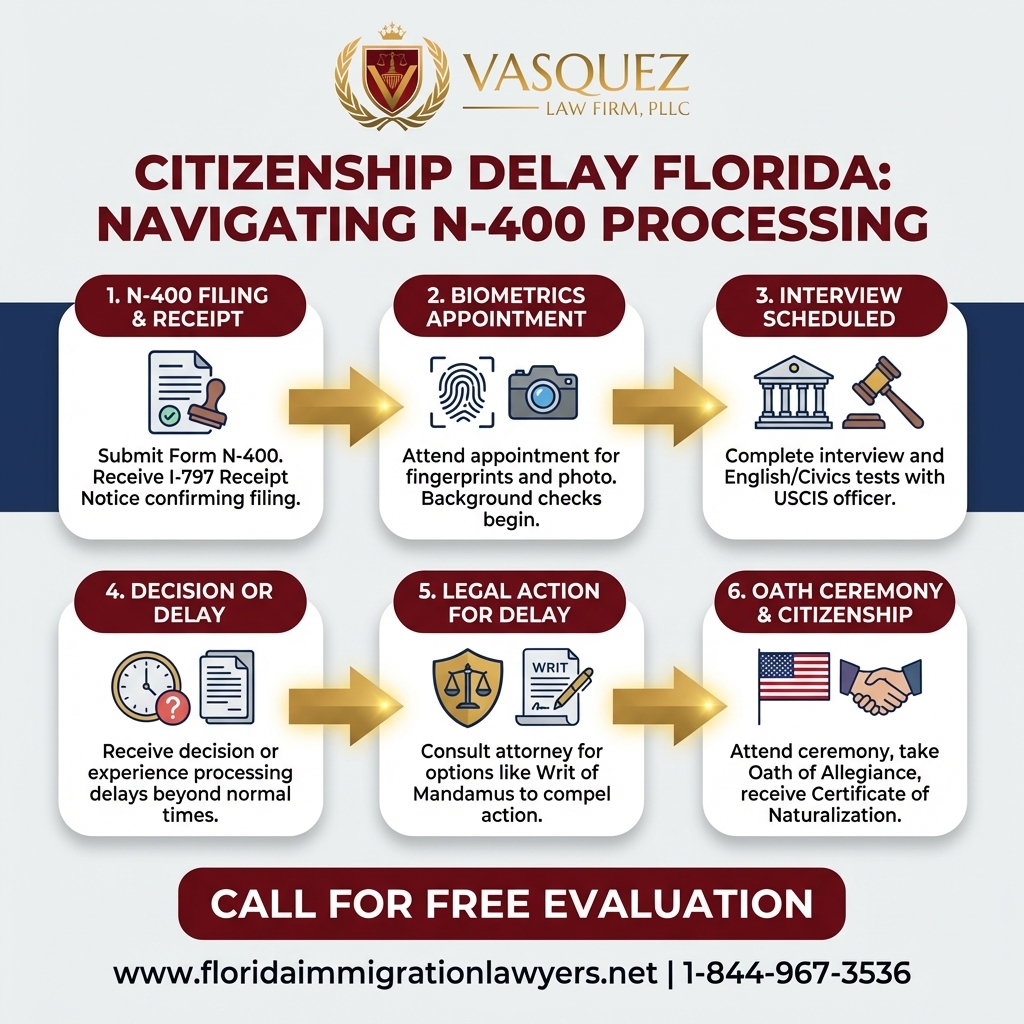
Step 1: Filing Form N-400
The first step involves accurately completing and submitting Form N-400, along with all required supporting documents and the correct filing fee. It is critical to ensure every question is answered truthfully and thoroughly. Any omissions or errors can lead to Requests for Evidence (RFEs), which significantly prolong processing times. For applicants in Florida, submitting a well-prepared package to USCIS from the outset is your best defense against early delays. This initial submission is foundational to a smooth process.
Step 2: Biometrics Appointment
After filing, you will receive an appointment notice for biometrics collection at an Application Support Center (ASC). This usually involves fingerprinting, photographs, and a signature. These biometrics are used for identity verification and background checks. Missing this appointment without proper rescheduling can cause significant delays or even lead to your application being considered abandoned. Ensure you attend promptly or reschedule appropriately if an unavoidable conflict arises.
Step 3: The Naturalization Interview
The naturalization interview is a crucial stage where a USCIS officer will review your application, test your English language proficiency, and assess your knowledge of U.S. history and government (civics). The interview is typically conducted at a USCIS field office, such as the Miami Field Office for many South Florida residents. Being well-prepared, honest, and having all original documents ready for review is paramount. An attorney can accompany you to this interview, providing essential support and clarification.
Step 4: Decision and Oath Ceremony
Following a successful interview, USCIS will issue a decision. If approved, you will receive a notice for your Oath of Allegiance Ceremony, where you will officially become a U.S. citizen. Sometimes, a decision might be delayed if the officer needs more time or additional information. If your application is denied, it is vital to understand the reasons and explore options for appeal or reapplication with legal guidance. The oath ceremony is the final step, a moment of profound significance for new citizens.
Essential Documents for Your Naturalization Application
A complete and accurate submission is your strongest tool against a citizenship delay. Gathering all necessary documents before filing your N-400 application is a critical step in streamlining your N-400 processing. Missing or incorrect documentation is a primary cause of Requests for Evidence (RFEs) and subsequent delays. Pay close attention to detail and ensure all copies are legible and current. While this is not an exhaustive list, it covers the most commonly required documents for naturalization.
- Form N-400: The completed and signed Application for Naturalization.
- USCIS Filing Fee: Check the current fee on the USCIS website; include payment (check, money order, or credit card information via Form G-1450).
- Green Card (Form I-551): Copy of both sides of your Permanent Resident Card.
- State-Issued Identification: Copy of your driver's license or state ID.
- Passport-Style Photos: Two identical color photographs if filing by mail (check current requirements).
- Marriage Certificate (if applicable): If applying based on marriage to a U.S. citizen, especially for the 3-year rule.
- Divorce Decrees or Annulment Records (if applicable): For all previous marriages of yourself and your spouse.
- Birth Certificates: For your children (if applicable).
- Tax Transcripts: For the past 3-5 years, demonstrating good moral character and financial responsibility.
- Court Disposition Records (if applicable): For any arrests, citations, or criminal charges, even if expunged or dismissed. This is crucial under 8 U.S.C. § 1101(f) regarding good moral character.
- Proof of Selective Service Registration (for males 18-26): If applicable.
- Travel Records: Documentation of all trips outside the U.S. since becoming a permanent resident.
- Proof of English Language Proficiency Waiver (if applicable): Such as Form N-648, Medical Certification for Disability Exceptions.
Always keep original documents secure and only send copies unless USCIS specifically requests originals. An attorney can help you compile a robust application packet, minimizing the chances of an RFE and keeping your application on track. This attention to detail is particularly important in busy USCIS jurisdictions like Florida.
Do not navigate this process alone. The complexities of immigration law, especially when facing a citizenship delay, demand experienced guidance. Contact Florida Immigration Lawyers today for a confidential, free consultation to discuss your specific situation and explore strategies for a successful naturalization outcome. We are here to advocate for you every step of the way.
Navigating USCIS Backlogs and Expedite Options
One of the most common and frustrating reasons for a citizenship delay is the pervasive USCIS backlog. The sheer volume of applications, coupled with resource limitations, can lead to extended processing times that often exceed published estimates. While you cannot directly control the backlog, understanding how to monitor your case and when to act can be empowering. For Floridians, especially those in high-volume areas like Hialeah or Miami, these backlogs are a daily reality. The Miami Field Office, for instance, serves a vast population, contributing to its processing times.
Common Reasons for Delays
Beyond general backlogs, individual cases can be delayed for specific reasons. These include incomplete applications, needing a Request for Evidence (RFE), or issues identified during background checks. Security checks, conducted by various federal agencies, are a critical component and can sometimes take months or even years to resolve, especially if there are name commonalities or past records that require deeper investigation. Furthermore, if you've moved and haven't updated your address with USCIS, important notices could be missed, causing further delays. This is why maintaining accurate contact information is vital.
Expedite Request Criteria
In certain compelling situations, you may be able to request an expedited processing of your N-400 application. USCIS considers expedite requests on a case-by-case basis, and the criteria are strict. You must demonstrate an urgent need, typically falling into one of these categories:
- Severe Financial Loss to a Company or Person: If the delay in naturalization would cause significant financial hardship.
- Urgent Humanitarian Reasons: Such as a critical medical condition requiring immediate travel or a severe illness of a close family member abroad.
- Compelling U.S. Government Interests: This could apply to individuals whose naturalization is vital for national security or other governmental objectives.
- Clear USCIS Error: If the delay is clearly due to a mistake made by USCIS.
Submitting an expedite request requires strong supporting documentation and a clear explanation of why your situation warrants special consideration. Without compelling evidence, such requests are typically denied. An immigration attorney can help you assess if your situation meets the criteria and assist in preparing a persuasive expedite request, significantly increasing your chances of success. This proactive step can be crucial when facing an unreasonable citizenship delay.
Timeline and What to Expect During Naturalization
The journey to U.S. citizenship through naturalization is a process with several distinct stages, each carrying its own approximate timeline. While USCIS provides general processing times, it's crucial to understand that these are averages, and individual experiences can vary significantly, especially for those experiencing a citizenship delay. For applicants in Florida, these times can be influenced by the specific USCIS field office handling their case, such as the Miami or Orlando offices. Generally, the entire process from filing to oath ceremony can take anywhere from 6 months to over 2 years.
After you submit your N-400 application, you will typically receive a receipt notice within 1-2 weeks. This confirms that USCIS has received your application. The next step, the biometrics appointment, usually occurs 3-5 weeks after the receipt notice. This appointment is quick, but the background checks that follow can take several months. The waiting period for your naturalization interview is often the longest phase, ranging from a few months to over a year, depending on the field office and current caseload. For instance, the Miami Field Office may have different processing times than others.
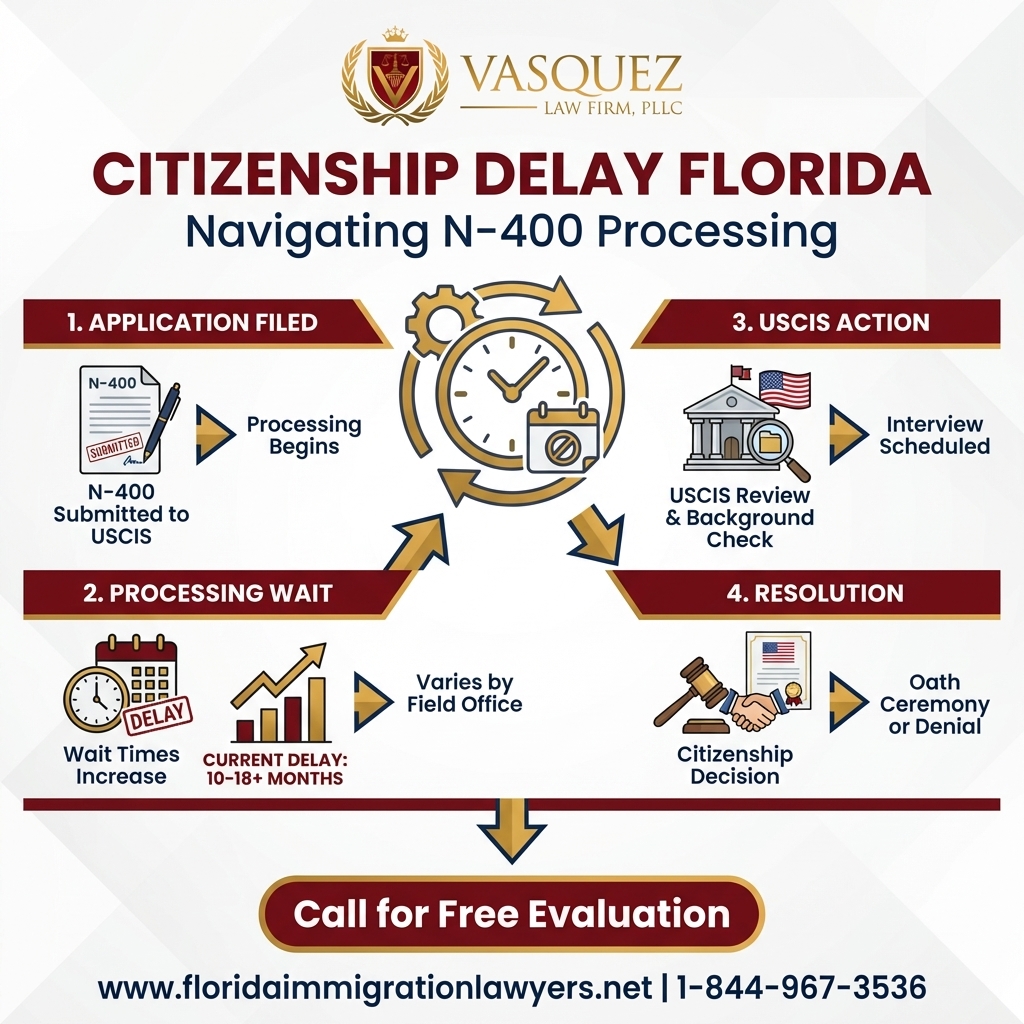
Following your interview, you might receive a decision immediately, or it could be delayed for weeks or months if the officer needs to review additional information or if security checks are still pending. If approved, the Oath of Allegiance Ceremony typically takes place within a few weeks to a few months after your interview. In some cases, same-day ceremonies are offered, but this is not guaranteed. It's important to monitor your case status regularly on the USCIS website and be prepared for potential fluctuations in these timelines. Patience and preparedness are key throughout this process, and legal assistance can provide invaluable support in managing expectations and addressing unforeseen challenges.
Cost Factors and Legal Assistance for Citizenship
Pursuing U.S. citizenship involves various costs, and understanding these financial obligations is essential for effective planning. The primary cost is the USCIS filing fee for Form N-400, which is subject to change. It's important to check the current fee on the official USCIS website before filing. Additionally, there may be a biometrics fee. Some applicants may be eligible for a fee waiver if they meet certain income-based criteria or receive public benefits. This can significantly reduce the financial burden of the application process. Beyond these official fees, applicants should also budget for expenses related to gathering supporting documents, such as obtaining birth certificates, marriage licenses, or court records, which may incur their own fees.
While some individuals choose to navigate the naturalization process independently, the value of legal assistance, especially when facing a citizenship delay or complex issues, cannot be overstated. An experienced immigration attorney can provide invaluable support in several ways:
- Application Preparation: Ensuring your N-400 is meticulously completed, minimizing errors that lead to RFEs and delays.
- Document Review: Helping you gather and organize all necessary supporting evidence, ensuring nothing is overlooked.
- Interview Preparation: Coaching you for the civics and English tests, and preparing you for potential questions from the USCIS officer.
- Addressing Delays: Strategically communicating with USCIS, submitting inquiries, or filing expedite requests on your behalf.
- Responding to RFEs: Crafting thorough and timely responses to Requests for Evidence.
- Appeals and Denials: Providing guidance and representation if your application is denied, helping you understand options like filing Form N-336, Request for a Hearing on a Decision in Naturalization Proceedings, or reapplying.
The cost of legal services varies depending on the complexity of your case and the services required. Many firms, including Florida Immigration Lawyers, offer free initial consultations to discuss your situation and provide transparent fee structures. Investing in legal expertise can save you time, reduce stress, and significantly increase your chances of a successful and timely naturalization. This is particularly true in a busy state like Florida, where local nuances and high caseloads can complicate matters. For residents of Hialeah and across Florida, our firm offers dedicated support throughout the entire process.
Common Mistakes to Avoid During Your Naturalization Process
Navigating the naturalization process requires careful attention to detail. Avoiding common pitfalls can significantly reduce the likelihood of a citizenship delay and increase your chances of a smooth journey to U.S. citizenship. Be mindful of these frequent errors:
- Incomplete or Inaccurate N-400 Application: Failing to answer all questions truthfully and thoroughly, or leaving sections blank, often leads to Requests for Evidence (RFEs) or even denial. This will inevitably cause a significant N-400 processing delay.
- Missing Supporting Documents: Not submitting all required evidence (e.g., tax records, marriage certificates, court dispositions) with your initial application. USCIS will issue an RFE, adding months to your wait time.
- Failure to Update Address with USCIS: If you move and do not inform USCIS using Form AR-11 or online, you might miss crucial notices, including interview appointments or RFEs, leading to processing issues or case abandonment.
- Lack of Good Moral Character: Engaging in certain criminal activities, failing to pay taxes, or not registering for Selective Service (for eligible males) can disqualify you for naturalization and result in denial.
- Insufficient English Language Proficiency or Civics Knowledge: Failing the English or civics test during the interview can lead to a re-interview and delay your approval.
- Not Disclosing All Arrests/Citations: Even minor infractions or expunged records must be disclosed. Failure to do so can be seen as a lack of good moral character and lead to denial, as per INA § 101(f).
- Excessive Absences from the U.S.: Spending too much time outside the U.S. can break the continuous residence requirement, making you ineligible for citizenship.
- Ignoring USCIS Communications: Failing to respond to RFEs or appointment notices in a timely manner can lead to the denial or closure of your case.
- Misunderstanding Eligibility Requirements: Applying before meeting the continuous residence, physical presence, or good moral character requirements, resulting in an immediate denial.
- Not Seeking Legal Counsel for Complex Cases: Attempting to navigate complicated scenarios (e.g., criminal history, long absences, previous denials) without an attorney can lead to irreversible mistakes and prolonged delays.
When to Call a Lawyer for Your Citizenship Application
While many N-400 applications are straightforward, certain circumstances warrant the immediate attention of an experienced immigration attorney. If you are experiencing a significant citizenship delay, or if any complexities arise during your N-400 processing, seeking legal counsel from Florida Immigration Lawyers can be invaluable. Our team specializes in citizenship and immigration law, providing tailored advice and representation.
You should consider calling a lawyer if:
- Your application has been pending significantly longer than the posted processing times for your field office, such as the Miami USCIS office, without a clear explanation.
- You have received a Request for Evidence (RFE) or a Notice of Intent to Deny (NOID), and you are unsure how to respond effectively.
- You have a criminal record, even minor infractions, or any past legal issues that might affect your good moral character determination.
- You have had extensive travel outside the U.S. since becoming a permanent resident, potentially impacting your continuous residence or physical presence requirements.
- You have received a denial of your naturalization application and wish to understand your options, including filing an appeal (Form N-336) or reapplying.
- You are concerned about your ability to pass the English or civics test, or you require a disability waiver (Form N-648).
- You have specific humanitarian or financial reasons that you believe warrant an expedite request for your application.
- You have an existing deportation defense case or have been placed in removal proceedings. Naturalization can sometimes offer protection, but this requires expert legal strategy.
Do not wait until a problem becomes insurmountable. Proactive legal intervention can often prevent a minor issue from escalating into a major setback, saving you time, money, and emotional distress. Our Florida Immigration Lawyers team is ready to assist you.
About Florida Immigration Lawyers
Florida Immigration Lawyers is a leading immigration law firm dedicated to serving individuals and families across the entire state of Florida. With offices strategically located to serve diverse communities like Hialeah, Miami, Orlando, and beyond, we are committed to providing exceptional legal representation and compassionate guidance. Our experienced attorneys specialize in a wide range of immigration matters, including family immigration, business immigration, asylum, deportation defense, and, critically, citizenship and naturalization. We understand the profound impact immigration decisions have on your life and your family's future.
We pride ourselves on our client-focused approach, offering personalized strategies tailored to your unique circumstances. Our team is fluent in both English and Spanish, ensuring that you can communicate comfortably and clearly about your case. We are available 24/7 to address your urgent concerns and offer free consultations to help you understand your options without financial commitment. When you choose Florida Immigration Lawyers, you gain a dedicated advocate who will fight tirelessly to protect your rights and help you achieve your immigration goals. Let us be your trusted partner on your journey to U.S. citizenship. Visit floridaimmigrationlawyers.net or call us at 1-844-967-3536 to schedule your free consultation today.
Sources and References
- U.S. Citizenship and Immigration Services (USCIS)
- Executive Office for Immigration Review (EOIR)
- 8 U.S.C. Chapter 12 - Immigration and Nationality Act (INA)
- 8 U.S.C. § 1101(f) - Definition of Good Moral Character
- 8 CFR Part 316 - General Requirements for Naturalization
- USCIS Policy Manual - Citizenship and Naturalization
Related services: citizenship test preparation, dual citizenship guidance, citizenship test resources.
This article provides general legal information and is not intended as legal advice. Every case is unique, and outcomes depend on specific facts and circumstances. Contact an attorney for advice about your particular situation. Immigration laws are complex and subject to change.
Do not let a citizenship delay jeopardize your American dream. The dedicated team at Florida Immigration Lawyers is ready to provide the expert guidance and representation you need. Take the first step towards resolving your naturalization issues. Call us today for a free consultation at 1-844-967-3536. Se Habla Español - Estamos aquí para ayudarle.
Do Not Navigate This Process Alone
Our experienced immigration attorneys are ready to fight for you. Get a free, confidential consultation today.
Se Habla Español
Frequently Asked Questions

William J. Vásquez
Founding Attorney · Vasquez Law Firm
U.S. Air Force veteran and immigration attorney with thousands of cases resolved. J.D., NCCU School of Law. AILA member. Admitted to the 4th, 5th, and 11th Circuit Courts.
Available 24/7 - Free Evaluations
Related Legal Services
Our Florida immigration attorneys can help you with business immigration, asylum protection and deportation defense. Call today at 1-844-967-3536 for a free consultation.
Related Links
Related Topics
Free Legal Consultation
Discuss your case with our experienced attorneys. We're available 24/7.
Se Habla Español - Estamos aquí para ayudarle.
Related Articles
Biometrics Appointment in Florida: What to Expect in 2026
Navigating a biometrics appointment in Florida is crucial for your USCIS process. Learn what to expect, how to prepare, and common pitfalls to avoid. Florida Immigration Lawyers are here to help with personalized guidance and support.
Withholding of Removal Explained: Florida Defense in 2026
For those in Florida facing deportation and fearing persecution or torture in their home country, understanding withholding of removal is critical. This form of protection prevents removal to a dangerous country, though it differs significantly from asylum in its eligibility criteria and benefits. It requires proving a "more likely than not" chance of persecution based on protected grounds or torture, a higher standard than asylum's "well-founded fear." While withholding of removal does not lead to a Green Card, it offers mandatory protection if the stringent criteria are met, even for some individuals barred from asylum. The process involves complex legal proceedings before an immigration judge, often in Miami or Orlando immigration courts. A comprehensive application, detailed testimony, and robust supporting evidence, including country conditions reports and affidavits, are essential. Given the high stakes and intricate legal requirements, securing the expertise of a Florida immigration lawyer is paramount to building a strong defense and navigating the path to safety.
US Visa Policy Changes July 2026: What Students in Florida
As of July 2026, international students in Florida seeking a change of status to an F-1 student visa must prepare for potential adjustments to U.S. visa policies. This comprehensive guide from Florida Immigration Lawyers explores the anticipated policy changes, detailing their potential impact on application requirements, processing times, and eligibility criteria. We provide a step-by-step overview of the change of status process, including a document checklist, expected timelines, and cost considerations. Understanding these complexities and avoiding common mistakes is crucial for a successful application. With potential changes approaching, proactive planning and expert legal guidance are more important than ever. Our firm is dedicated to helping students in Tampa and across Florida navigate these challenges, offering tailored advice and robust representation. Learn how to protect your academic future and ensure a smooth transition to F-1 student status.
Dual Citizenship Lawyer: Your 2026 Guide to Naturalization
Achieving U.S. citizenship is a profound milestone, but the path to naturalization, especially with dual citizenship in mind, is fraught with legal intricacies and a critical interview process. This comprehensive guide from Florida Immigration Lawyers demystifies the journey, offering essential citizenship interview tips and highlighting the invaluable role of a dual citizenship lawyer. We cover eligibility, document preparation, timelines, and common pitfalls, all tailored for Florida residents in areas like Pembroke Pines. Discover how expert legal counsel can prepare you for your naturalization interview, address dual nationality concerns, and ensure a smooth, successful application. From initial assessment to interview representation, we provide the support needed to navigate USCIS requirements confidently. Call Florida Immigration Lawyers for a free consultation to start your journey.
