Citizenship Application Delay in Florida: What to Know
Delays in citizenship application processing can be frustrating for Florida residents. Learn how to navigate these delays effectively with expert guidance from Florida Immigration Lawyers.

Citizenship Application Delay in Florida: What to Know
Applying for U.S. citizenship is a significant milestone, a journey often filled with hope and anticipation. However, for many applicants in Florida, this journey can be marred by frustrating and often inexplicable delays in the N-400 naturalization process. Understanding the reasons behind these delays, knowing how to monitor your case, and recognizing when to seek professional legal assistance are crucial steps in navigating this complex system. This comprehensive guide aims to shed light on the intricacies of citizenship application delays, specifically focusing on the challenges faced by applicants in the Sunshine State, and empowering you with the knowledge to take effective action.
Understanding N-400 Processing and Common Delay Factors
The N-400, Application for Naturalization, is the gateway to U.S. citizenship. While USCIS aims for efficient processing, various factors can contribute to significant delays. The national average processing time can fluctuate, but specific issues often prolong cases, particularly in high-volume states like Florida.
USCIS Backlog and Resource Constraints
One of the primary culprits for delays is the sheer volume of applications coupled with fluctuating USCIS resources. Field offices across Florida, including Miami, Orlando, Tampa, and Jacksonville, process thousands of applications annually. A surge in applications, coupled with budget constraints or staffing shortages, can create substantial backlogs, leading to extended waiting times for interviews, background checks, and final decisions. This systemic issue affects countless applicants, making it essential to understand that your delay might not be due to an issue with your specific application but rather the system itself.
Complex Background Checks and Security Clearances
Every naturalization applicant undergoes rigorous background checks by various federal agencies, including the FBI. These security clearances are a critical component of national security. While most checks are completed swiftly, certain factors can trigger extended reviews. These might include:
- Common Names: If your name is similar to someone on a watch list, it could lead to additional scrutiny.
- Extensive Travel History: Frequent international travel, especially to certain regions, might require more in-depth verification.
- Prior Law Enforcement Encounters: Even minor infractions that were dismissed or expunged might still appear in background checks and require clarification.
- Discrepancies in Records: Any inconsistencies between your application and existing government records can prompt further investigation.
These checks are often opaque, meaning applicants are rarely informed about the specific reasons for the delay, adding to the frustration. Patience is required, but proactive legal intervention can sometimes help to inquire about the status of these checks.
Requests for Evidence (RFEs) and Notices of Intent to Deny (NOIDs)
USCIS may issue an RFE if they determine that your initial application lacks sufficient supporting documentation or information. Common reasons for RFEs include:
- Insufficient proof of continuous residence or physical presence.
- Missing or incomplete tax records.
- Lack of evidence for good moral character (e.g., unresolved traffic tickets, minor arrests).
- Issues with marital history or divorce decrees.
A NOID, on the other hand, is a more serious communication, indicating that USCIS intends to deny your application unless you provide compelling evidence to overcome their concerns. Both RFEs and NOIDs significantly prolong the processing time, as they require careful and timely responses. Failing to respond adequately or on time can lead to a denial. This is where the expertise of an experienced immigration attorney becomes invaluable, as they can help you gather the necessary documentation and craft a persuasive response.
Interview Issues and Administrative Processing
Even after a successful interview, some cases enter "administrative processing." This often means that additional checks are being conducted, or a supervisor needs to review the case. Sometimes, an officer might request additional documents during the interview itself, leading to a follow-up RFE. In other instances, the interview might reveal complexities that require further investigation, such as issues related to past asylum claims, previous marriages, or criminal history. These post-interview delays can be particularly disheartening, as applicants often feel they are at the finish line.
Checking Your N-400 Case Status and What to Do About Delays
Staying informed about your application's status is crucial. USCIS provides several tools and avenues for applicants to monitor their progress and address potential delays.
Online Case Status Tool
The most accessible way to check your status is through the USCIS online case status tool. By entering your 13-character receipt number (e.g., EAC, WAC, LIN, SRC, NBC, MSC, or IOE followed by 10 numbers), you can view real-time updates on your application's journey. While this tool is helpful, it often provides generic updates and may not explain the specific reasons for a delay.
Making an InfoPass Appointment (now USCIS Contact Center)
Previously, InfoPass appointments allowed applicants to visit a local USCIS office for in-person assistance. While InfoPass has largely been replaced by the USCIS Contact Center, you can still call 1-800-375-5283 to speak with a representative. For complex issues, a representative might still schedule an in-person appointment if deemed necessary. Be prepared with your receipt number and any relevant documentation when you call.
Submitting an E-Request
If your case is outside the normal processing times, you can submit an "e-request" online through the USCIS website. This allows you to formally inquire about your case's status. USCIS is generally obligated to respond to these inquiries within a certain timeframe. However, the response might be a standard letter stating that your case is still undergoing review, which can be less than satisfying.
Congressional Inquiry
For persistent and unexplained delays, contacting your local U.S. Senator or Representative can be an effective strategy. Congressional offices have dedicated constituent services staff who can make inquiries on your behalf directly to USCIS. While they cannot expedite a case or influence a decision, their inquiries often prompt USCIS to review the case and provide a more detailed update. This can be particularly useful when other avenues have yielded no results.
Specific Considerations for Florida Applicants
Florida is a diverse state with several major USCIS field offices, each with its own processing nuances and caseloads. Understanding these specifics can help manage expectations.
USCIS Field Offices in Florida
- Miami Field Office: Handles a very high volume of cases, often leading to longer processing times. Serves South Florida, including Miami-Dade, Broward, and Palm Beach counties.
- Orlando Field Office: Covers Central Florida. While also busy, processing times can sometimes differ from Miami.
- Tampa Field Office: Serves the Tampa Bay area and surrounding regions.
- Jacksonville Field Office: Covers Northeast Florida.
Each office's processing times can vary based on staffing, local backlogs, and the complexity of cases they are handling. It's important to check the specific processing times for the field office that has jurisdiction over your application, which is typically determined by your residential address.
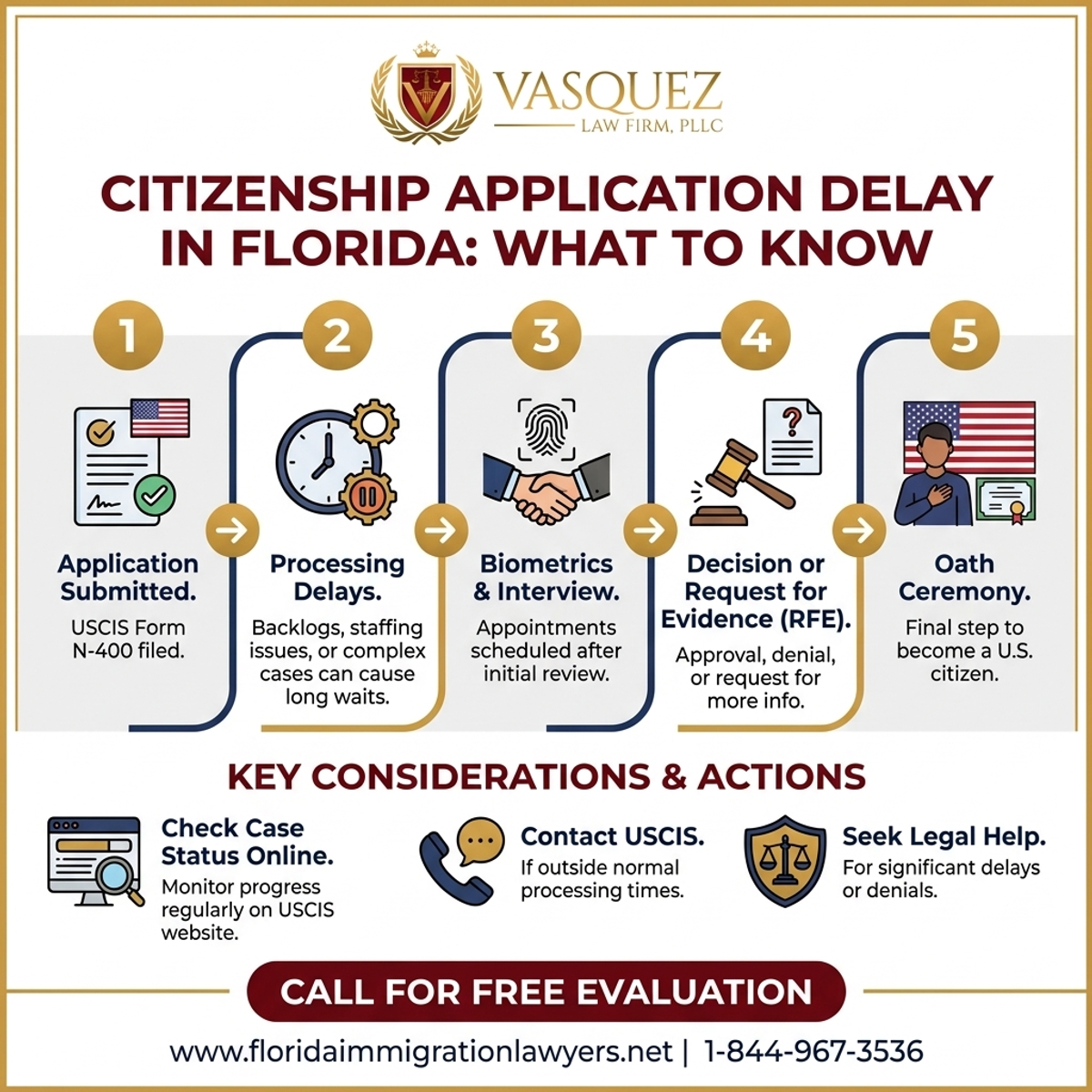
Step-by-Step Process — Citizenship Application Delay in Florida: What to Know
Impact of Local Factors
Beyond national trends, local factors in Florida can influence processing. For instance, natural disasters (like hurricanes) can temporarily disrupt operations. Additionally, the sheer diversity of Florida's immigrant population means that field offices handle a wide array of immigration cases, from family-based petitions to employment-based visas and naturalization, all competing for resources.
When to Consider Legal Action for N-400 Delays
While many delays resolve themselves over time, there comes a point when passive waiting is no longer sufficient. If your N-400 application has been pending significantly beyond the posted processing times, or if you've exhausted all other avenues of inquiry without a satisfactory explanation, it might be time to consider more assertive legal strategies. This is a critical juncture where the guidance of an experienced immigration attorney becomes not just helpful, but often essential.
Understanding "Unreasonable Delay"
There isn't a universally defined period that constitutes an "unreasonable delay" for every naturalization case. However, generally, if your application has been pending for more than two years from the filing date, or if it has been pending for more than 120 days after your naturalization interview without a decision, you may have grounds to take legal action. The specific timeframe can also depend on the average processing times for your particular USCIS field office and the complexity of your case. An attorney can assess your situation against current legal precedents and USCIS guidelines to determine if your delay meets the threshold for intervention.
The Mandamus Lawsuit (Complaint for Mandamus)
One of the most powerful legal tools available to combat unreasonable USCIS delays is a Mandamus lawsuit. This is a federal court action filed against USCIS (and often other federal agencies like the Department of Homeland Security) to compel them to perform a duty they are legally obligated to perform – in this case, to make a decision on your N-400 application. A Mandamus lawsuit does not ask the court to grant your citizenship, but rather to order USCIS to either approve or deny your application within a specific timeframe. The goal is to force a decision, thereby ending the indefinite waiting period.
Filing a Mandamus lawsuit typically involves:
- Thorough Case Review: An attorney will meticulously review your entire immigration history, application, and all correspondence with USCIS to build a strong case.
- Filing in Federal Court: The lawsuit is filed in a U.S. District Court.
- Service of Process: USCIS and other relevant agencies are formally served with the lawsuit.
- Negotiation and Resolution: Often, the mere act of filing a Mandamus lawsuit prompts USCIS to expedite a decision to avoid litigation costs and court intervention. Many cases are resolved through settlement, where USCIS agrees to issue a decision within a specified period.
While a Mandamus lawsuit can be highly effective, it is a complex legal procedure that requires specialized knowledge of federal litigation and immigration law. It should only be pursued with the guidance of a qualified attorney.
Seeking Assistance from an Experienced Immigration Attorney
Navigating citizenship delays, especially when considering legal action, is challenging without expert help. An immigration attorney can:
- Evaluate Your Case: Determine the best course of action based on the specifics of your delay and application.
- Communicate with USCIS: Make official inquiries, respond to RFEs/NOIDs, and follow up on your behalf.
- Identify Potential Issues: Proactively address any underlying problems that might be causing the delay, such as issues related to past deportation defense or complex criminal history.
- Represent You in Federal Court: If a Mandamus lawsuit is necessary, your attorney will handle all aspects of the litigation.
- Provide Peace of Mind: Knowing that a professional is advocating for you can significantly reduce stress during an already anxious time.
Don't let an indefinite delay jeopardize your dream of U.S. citizenship. Proactive legal assistance can often resolve issues more quickly and efficiently than trying to navigate the system alone.
Conclusion: Taking Control of Your Citizenship Journey
Citizenship application delays in Florida, while frustrating, are a common reality for many. However, they don't have to be a roadblock to your American dream. By understanding the potential causes of delays, actively monitoring your case, and knowing when to escalate your concerns through official channels or legal action, you can significantly influence the outcome of your naturalization process.
Remember, you have rights as an applicant, and there are avenues for recourse when delays become unreasonable. Whether it's through persistent inquiries to USCIS, leveraging congressional support, or pursuing federal litigation, taking proactive steps is key. If you are experiencing an N-400 delay in Florida and are unsure of your next steps, we encourage you to seek professional legal guidance. A consultation with an experienced immigration attorney can provide clarity, strategy, and peace of mind, helping you navigate the complexities of the USCIS system and work towards a timely resolution.
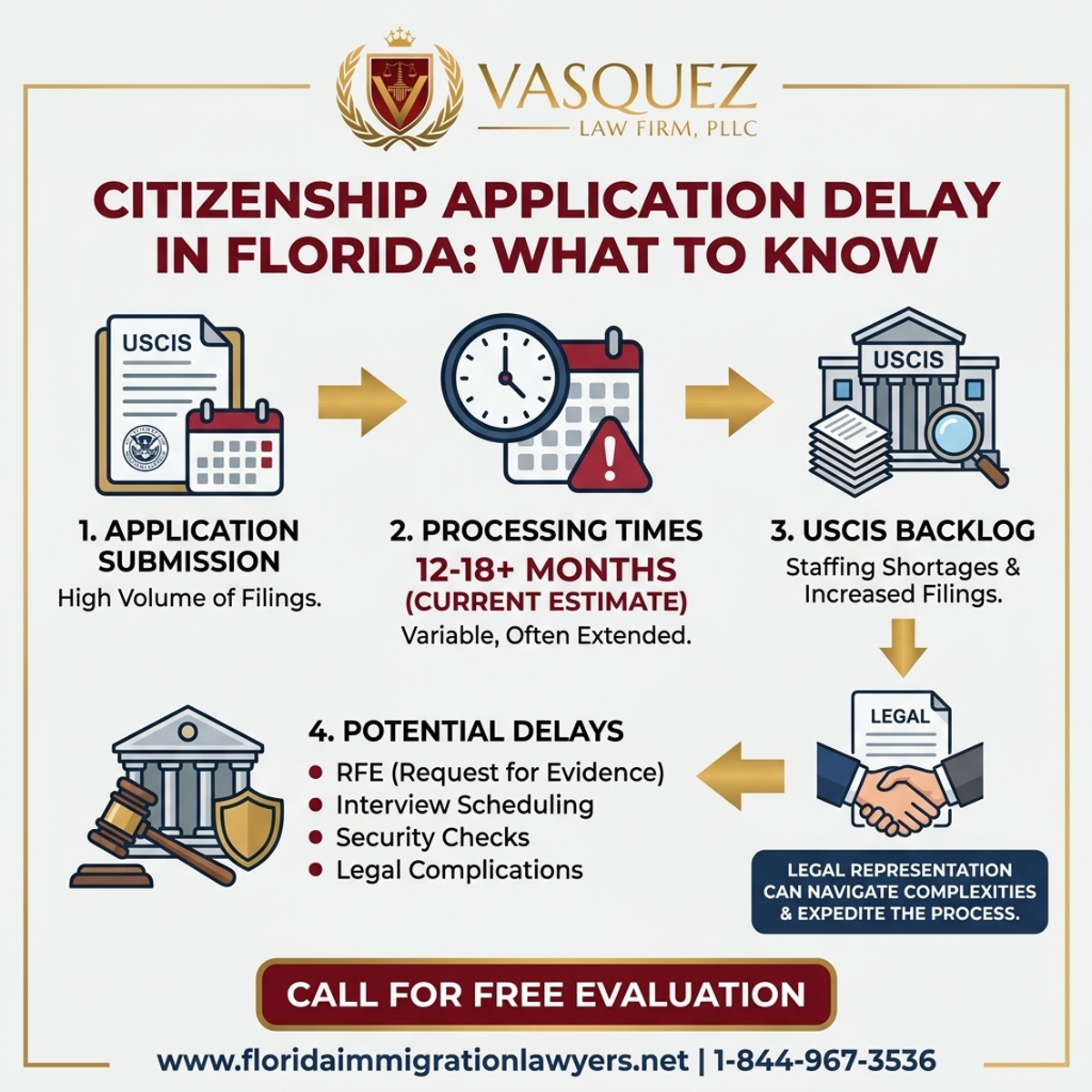
Key Statistics — Citizenship Application Delay in Florida: What to Know
Don't wait indefinitely. Contact us today for a free consultation to discuss your specific situation and explore the best path forward for your citizenship application.
Sources and References
- U.S. Citizenship and Immigration Services (USCIS)
- Executive Office for Immigration Review (EOIR)
- U.S. Department of State - Bureau of Consular Affairs
- Immigration and Nationality Act (INA), 8 U.S.C. Chapter 12
Do Not Navigate This Process Alone
Our experienced immigration attorneys are ready to fight for you. Get a free, confidential consultation today.
Se Habla Español
Frequently Asked Questions
Florida Immigration Lawyers
Immigration Attorney | Founder, Vasquez Law Firm
U.S. Air Force veteran and immigration attorney with thousands of cases resolved. J.D., NCCU School of Law. AILA member. Admitted to the 4th, 5th, and 11th Circuit Courts.
Available 24/7 - Free Evaluations
Related Legal Services
Our Florida immigration attorneys can help you with asylum protection, deportation defense and citizenship and naturalization. Call today at 1-844-967-3536 for a free consultation.
Related Links
Related Topics
Free Legal Consultation
Discuss your case with our experienced attorneys. We're available 24/7.
Se Habla Español - Estamos aquí para ayudarle.
Related Articles
E-2 Visa: Florida Business Investor Guide | VLF Florida
Explore how the E-2 investor visa facilitates business ventures in Florida, specifically in Hialeah. Learn about eligibility, application steps, and how Florida Immigration Lawyers can assist you.
Immediate Relative Petition in Florida: A Guide | VLF Florida
Learn how to file an immediate relative petition in Florida to reunite your family. Discover the steps, required documents, and common mistakes to avoid. Contact Florida Immigration Lawyers for expert guidance.
Understanding the Asylum One-Year Deadline in Florida
Navigating the asylum one-year deadline in Florida is crucial for those seeking refuge. Learn about Form I-589, exceptions, and how to avoid common mistakes. Consult with Florida Immigration Lawyers for expert guidance.
Immigration Medical Exam: Florida Civil Surgeons Guide
Immigrants in West Palm Beach, Florida, must undergo an immigration medical exam as part of the green card process. Learn about the steps, costs, and common mistakes to avoid. Call Florida Immigration Lawyers at 1-844-967-3536 for a free consultation.