Citizenship Application Delay Florida: What to Expect
A citizenship application delay in Florida can be a source of significant stress and uncertainty for aspiring U.S. citizens. Whether you've just decided to apply for citizenship or have been waiting for your N-400 application to process, understanding the reasons behind common delays is crucial. This comprehensive guide from Florida Immigration Lawyers explores the typical N-400 naturalization process timeline in 2026, the various factors that can cause prolonged waiting periods, and how to effectively monitor your case status. We also detail the essential documents you'll need, potential costs associated with delays, and the critical mistakes to avoid. Learn when it's time to seek legal counsel to advocate for your rights and help expedite your path to naturalization in Florida. Our firm offers free case reviews and is dedicated to guiding you through every step of this complex journey.
If your citizenship application (Form N-400, Application for Naturalization) is delayed in Florida, it typically means processing times have exceeded the standard estimates provided by USCIS. Common reasons include increased USCIS backlogs, complex background checks, requests for additional evidence (RFEs), or issues with your interview or biometrics. In 2026, applicants in Florida should regularly check their case status online and consider contacting USCIS or an attorney if delays become excessive. Understanding the specific cause of the delay is crucial for determining the next steps to take.
- USCIS backlogs and increased application volumes are primary causes of delays.
- Background checks and RFEs can significantly extend processing times.
- Regularly check your case status on the official USCIS website.
- Consider submitting an inquiry if your case is outside normal processing times.
- An immigration lawyer can help identify delay causes and advocate on your behalf.
Citizenship Application Delay Florida: What to Expect in 2026
Many individuals residing in Florida dream of becoming U.S. citizens, a significant milestone in their immigration journey. Perhaps you recently decided to apply for citizenship, inspired by your father's family history of contributing to this nation, or simply seeking the full rights and responsibilities that come with naturalization. You diligently prepared your Form N-400, Application for Naturalization, submitted all required documents, and began the waiting game.
However, what happens when that wait stretches beyond the typical processing times? A citizenship application delay in Florida can be incredibly frustrating, leaving you in limbo and uncertain about your future. You might be asking, "Why is my N-400 processing taking so long?" or "What can I do if my naturalization application is delayed?"
At Florida Immigration Lawyers, we understand the anxieties that come with immigration processing delays. Our dedicated team helps individuals across Florida navigate the complexities of the U.S. immigration system, including addressing prolonged naturalization processing times. This comprehensive guide will explore the common reasons for delays, how to monitor your case, and what legal options are available to you in 2026. If you are experiencing an unexpected delay with your citizenship application, do not hesitate to seek professional guidance. Call Florida Immigration Lawyers at 1-844-YO-PELEO for a free case review and let us help you understand your options.
Why is My Citizenship Application Delayed in Florida?
A citizenship application delay in Florida can be attributed to various factors, often a combination of internal USCIS challenges and individual case complexities. Understanding these reasons is the first step toward addressing the issue effectively.
As of 2026, common reasons for N-400 processing delays in Florida include increased USCIS backlogs, the need for additional evidence, extensive background checks, or administrative errors. These factors can prolong the naturalization timeline significantly, impacting applicants across Central Florida and beyond.
One of the most pervasive issues contributing to delays is the sheer volume of applications USCIS receives. This often leads to significant backlogs that can affect processing times nationwide, including at Florida field offices in Orlando, Miami, and Tampa. These backlogs are not uniform; some offices may experience longer delays than others due to staffing levels or local demand. For instance, an applicant in Orlando might experience different wait times compared to someone in South Florida served by the Miami Field Office.
Another frequent cause is the issuance of a Request for Evidence (RFE). If USCIS determines that your initial application lacked sufficient supporting documentation or required clarification, they will send an RFE. Responding promptly and thoroughly to an RFE is critical, but the review of your response will add to your overall processing time. Similarly, if your biometrics appointment is delayed or if the results of your fingerprinting require further review, this can stall your case. The FBI background check, a mandatory part of the process, can sometimes take longer than expected, especially if there are discrepancies or complex records to review. This security check is crucial for national security and can be a significant bottleneck.
Finally, administrative errors or procedural issues on the part of USCIS, though less common, can also lead to delays. These might include misfiled documents, incorrect data entry, or communication breakdowns within the agency. Personal circumstances, such as a change of address without proper notification to USCIS, or a criminal record that requires deeper scrutiny, can also contribute to a prolonged naturalization process. It is vital to ensure all your information is accurate and up-to-date with USCIS at all times.
What is the N-400 Naturalization Process Timeline in 2026?
The N-400 naturalization process involves several stages, each with its own typical timeframe. While USCIS provides estimates, actual processing can vary significantly, especially with a citizenship application delay in Florida.
As of 2026, the N-400 naturalization process typically takes between 8 to 18 months from filing to oath ceremony, though significant variations exist. This timeline can be impacted by the specific USCIS field office in Florida, the complexity of your case, and current processing backlogs.
Here is a general step-by-step guide to the naturalization process:
- File Form N-400: Submit your Application for Naturalization along with all required supporting documents and fees to USCIS.
- Receive Receipt Notice: USCIS sends Form I-797C, Notice of Action, acknowledging receipt of your application. This usually arrives within 2-4 weeks.
- Biometrics Appointment: You will receive a notice for a biometrics appointment at an Application Support Center (ASC) in Florida (e.g., Orlando ASC, Jacksonville ASC). This typically occurs 3-8 weeks after filing. Your fingerprints, photograph, and signature are taken for background checks.
- Interview Scheduling: Once background checks are cleared, USCIS schedules your naturalization interview. This stage can take several months, often 6-12 months after biometrics, depending on the field office workload.
- Naturalization Interview: Attend your interview at a USCIS field office in Florida. An officer will review your application, test your English and civics knowledge, and ask questions about your eligibility.
- Decision and Oath Ceremony Scheduling: After a successful interview, USCIS will issue a decision. If approved, you will typically receive a notice for an Oath of Allegiance Ceremony within 2-6 weeks.
- Oath of Allegiance Ceremony: Attend the ceremony, take the oath, and receive your Certificate of Naturalization, officially becoming a U.S. citizen.
Understanding these stages helps manage expectations. If any stage significantly exceeds the typical timeframe, it may indicate a delay. You can check the USCIS processing times tool for current estimates for your specific field office.
| Stage | Typical Timeframe (2026) | Notes |
|---|---|---|
| N-400 Filing to Receipt Notice | 2-4 Weeks | Confirmation of application submission. |
| Receipt Notice to Biometrics | 3-8 Weeks | Appointment at an Application Support Center (ASC). |
| Biometrics to Interview Scheduling | 6-12 Months | Varies greatly by field office and background check complexity. |
| Interview to Decision/Oath Ceremony | 2-6 Weeks (if approved) | Could be longer if an RFE or further review is needed post-interview. |
| Total Processing Time | 8-18 Months | Overall average, subject to significant fluctuation. |
What Documents Do I Need to Address a Citizenship Delay?
When facing a citizenship application delay in Florida, having immediate access to your complete documentation is paramount. This allows you to respond quickly to inquiries or to gather information for legal action.
To effectively address a citizenship delay, you will need all original N-400 application documents, copies of all correspondence with USCIS, proof of continuous residency, and any additional evidence requested by the agency. Organized documentation is key for any follow-up actions or legal intervention.
Here is a checklist of documents you should have readily available when inquiring about or addressing a delay:
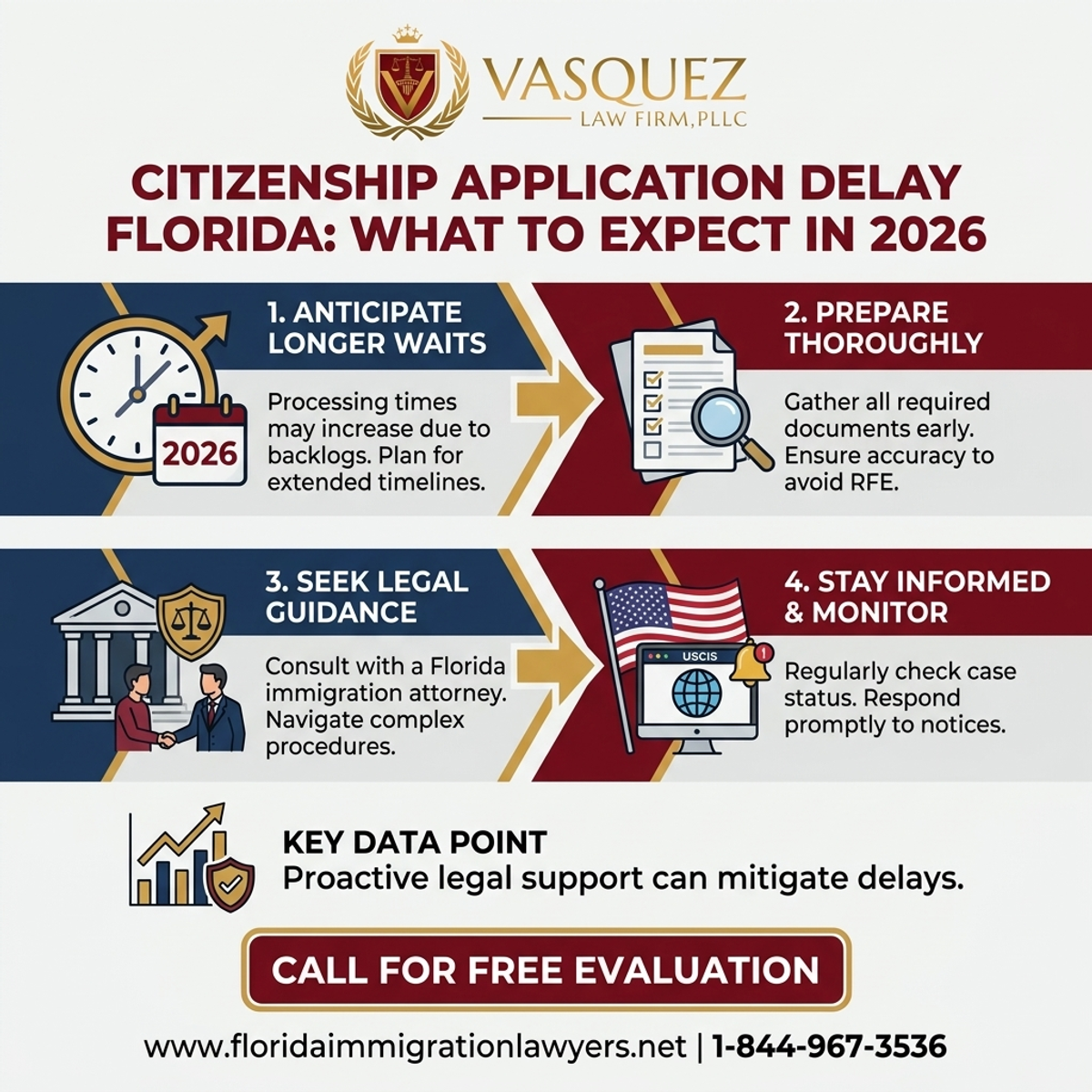
Step-by-Step Process — Citizenship Application Delay Florida: What to Expect in 2026
- Copy of Form N-400: Your complete application form as originally submitted.
- Form I-797C, Notice of Action: All receipt notices, interview notices, and any other correspondence from USCIS.
- Biometrics Appointment Notice: Proof of your biometrics appointment.
- Interview Notice: The notice for your naturalization interview.
- Proof of Identity: Your Permanent Resident Card (Green Card), passport, driver's license (especially a Florida driver's license).
- Proof of Continuous Residency and Physical Presence: Tax returns, utility bills, lease agreements, pay stubs, and employment letters for the required period (typically five years, or three years if married to a U.S. citizen).
- Marriage Certificate (if applicable): If applying based on marriage to a U.S. citizen.
- Birth Certificates of Children (if applicable): For any children listed on your application.
- Court Dispositions or Police Records (if applicable): For any arrests, citations, or criminal history.
- Selective Service Registration: If you are a male applicant between 18 and 26 years old.
- Any Requests for Evidence (RFEs) or Notices of Intent to Deny (NOIDs): And your corresponding responses.
- Proof of English and Civics Proficiency: If you claimed an exemption or submitted evidence.
Keeping these documents organized in a dedicated folder will save you time and stress should you need to reference them or provide them to an attorney. For those in Central Florida, having all your records complete can significantly streamline the process of addressing a delay with the Orlando USCIS Field Office.
How Can I Check My N-400 Case Status and Inquire About Delays?
Proactive monitoring of your N-400 case status is essential when dealing with a potential citizenship application delay in Florida. USCIS provides several tools and channels for applicants to inquire about their cases.
The primary method for checking your N-400 case status is the USCIS online case status tool. By entering your 13-digit receipt number (found on your Form I-797C, Notice of Action), you can view the most recent updates on your application. This tool provides real-time information, often indicating the stage of your application, such as "Case Was Received," "Biometrics Appointment Was Scheduled," or "Interview Was Scheduled." It is advisable to check this tool regularly.
If your case is outside of the normal processing times listed on the USCIS website for your specific field office, you may submit an e-Request for an "Outside Normal Processing Time" inquiry. This can be done online through the USCIS website. This formal inquiry prompts USCIS to review your case and provide an update. You should receive a response within 30 days. If the delay persists or the response is unhelpful, further action may be necessary.
For more complex or persistent delays, especially those involving extensive background checks, you may consider contacting the USCIS Contact Center directly. While often providing general information, they can sometimes offer more specific insights or escalate your inquiry. Another option is to seek assistance from your U.S. Senator or Congressional Representative. Their offices have liaisons with USCIS and can submit congressional inquiries on behalf of their constituents, sometimes prompting a faster review of delayed cases. This can be particularly effective for residents in Florida.
In extreme cases of unreasonable delay, an applicant may consider filing a Writ of Mandamus in federal court. This is a lawsuit that compels a government agency, like USCIS, to perform its duty – in this case, to process your application within a reasonable timeframe. This is a serious legal step and should only be pursued after consultation with an experienced immigration attorney. Legal precedents, such as those involving the Administrative Procedure Act (5 U.S.C. § 706), support judicial review of agency actions that are unlawfully withheld or unreasonably delayed.
What Are the Costs Associated with a Delayed Citizenship Application?
While the initial N-400 filing fee is standard, a citizenship application delay in Florida can introduce additional, unexpected costs. These can range from minor administrative fees to significant legal expenses.
Addressing a delayed citizenship application can incur costs beyond the initial filing fee, including potential fees for repeated biometrics, travel expenses for additional interviews, and significant legal fees if an attorney is retained to resolve the delay or file a mandamus action. These costs can add up, especially for prolonged cases.
The primary cost is the N-400 application fee itself, which covers processing your application and the biometrics services. As of 2026, applicants should refer to the official USCIS website for Form N-400 for the most current fee schedule, as these amounts are subject to change. Some applicants may be eligible for a fee waiver, but eligibility criteria are strict.
Beyond the initial filing fee, delays can lead to other expenses. For example, if you need to travel multiple times for rescheduled interviews or to an ASC for repeated biometrics due to expired fingerprints, these travel costs can accumulate, particularly for individuals living in remote areas of Florida. Lost wages from taking time off work for additional appointments can also be a hidden cost. Furthermore, if your Green Card expires while your naturalization application is pending, you may need to file Form I-90, Application to Replace Permanent Resident Card, to obtain a temporary extension stamp, which comes with its own filing fee.
The most significant potential cost associated with a delay is legal representation. While an initial consultation with Florida Immigration Lawyers is free, retaining an attorney to investigate the delay, submit inquiries, or file a Writ of Mandamus will involve legal fees. These fees vary depending on the complexity of your case and the services required. An attorney can help you understand the cost-benefit of pursuing legal action to expedite your case, ensuring that you are making informed decisions. For instance, the cost of filing a federal lawsuit for mandamus can be substantial, including court filing fees and attorney hourly rates, but it can be a necessary step when all other avenues have been exhausted.
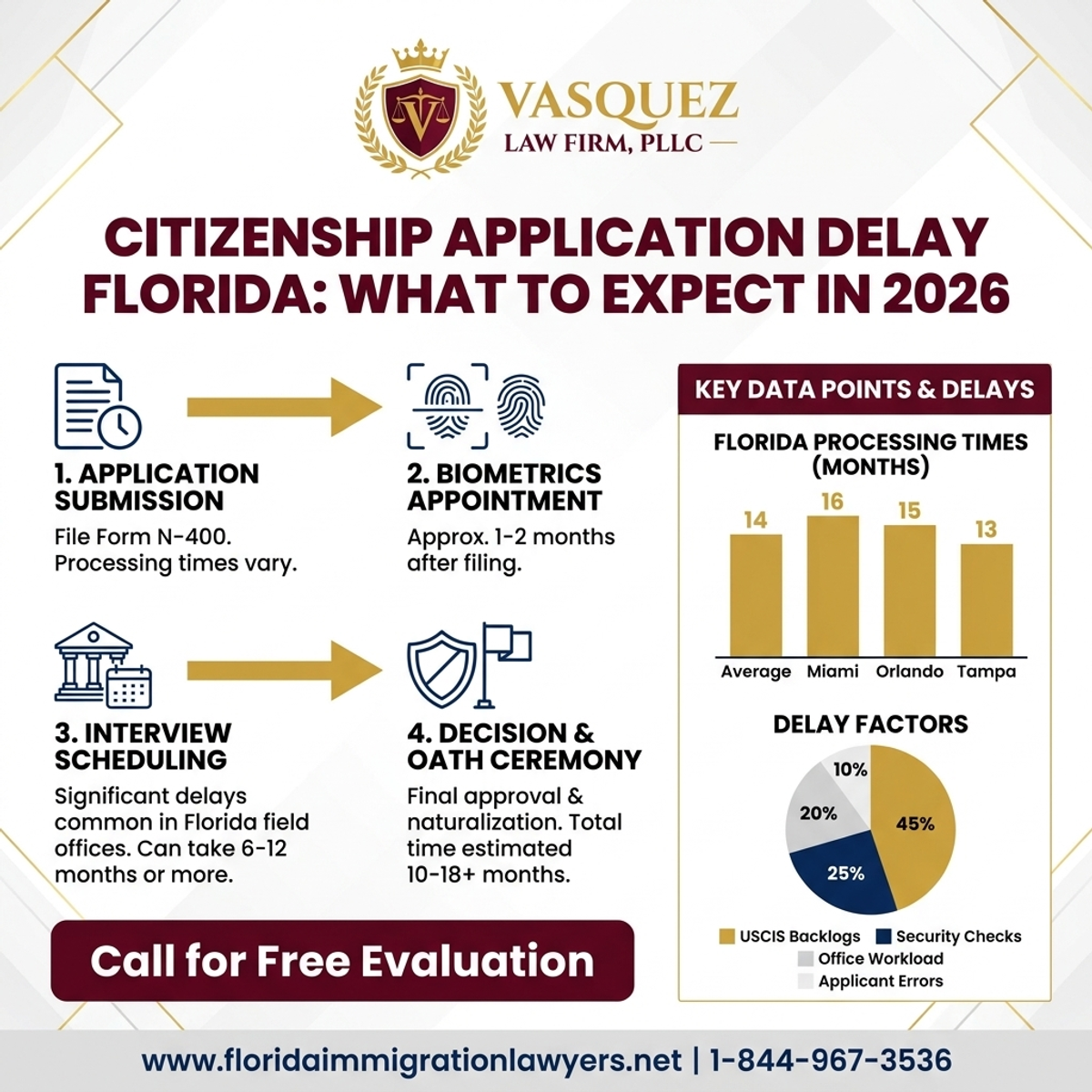
Key Statistics — Citizenship Application Delay Florida: What to Expect in 2026
| Item | Typical Fee (2026) | Notes |
|---|---|---|
| N-400 Application Fee | Varies (Check USCIS website) | Includes biometrics fee. Fee waivers possible for eligible applicants. |
| Form I-90 (Green Card Renewal) | Varies (Check USCIS website) | If Green Card expires during N-400 processing. |
| Attorney Consultation | Free (at Florida Immigration Lawyers) | Initial case review to assess delay and options. |
| Attorney Representation (Delay Resolution) | Varies significantly | Dependent on case complexity, services needed (inquiries, advocacy). |
| Federal Court Filing Fee (Mandamus) | Varies (e.g., ~$400) | For filing a lawsuit to compel USCIS action. |
| Travel/Miscellaneous Expenses | Variable | For appointments, document gathering, etc. |
Do not navigate this process alone. A citizenship application delay in Florida can be overwhelming, but you have options. Contact Florida Immigration Lawyers today for a free case review at 1-844-YO-PELEO. Our experienced attorneys are ready to provide the guidance and representation you need.
Common Mistakes to Avoid During a Citizenship Application Delay
Navigating a citizenship application delay can be tricky, and certain missteps can further complicate your case or prolong the wait. Avoid these common mistakes:
- Failing to Update Your Address: If you move, you must notify USCIS within 10 days using Form AR-11, Alien's Change of Address Card, and update your pending application. Failure to do so can lead to missed notices, interview cancellations, or even a denial.
- Ignoring Requests for Evidence (RFEs): Not responding to an RFE by the deadline, or providing incomplete information, will almost certainly lead to a denial. Always respond thoroughly and on time.
- Submitting Duplicate Applications: Filing a second N-400 application due to a delay can confuse USCIS, potentially leading to the denial of both applications and forfeiture of fees.
- Providing Inaccurate Information: Any false or misleading information, even unintentional errors, can be considered misrepresentation and lead to severe consequences, including denial and potential deportation proceedings under INA Section 212(a)(6)(C)(i).
- Traveling Internationally Without Caution: While your N-400 is pending, extensive or prolonged international travel can impact your continuous residency requirement, especially if you spend more than six months outside the U.S. without proper documentation.
- Missing Appointments: Failing to attend a biometrics appointment or naturalization interview without proper rescheduling can result in your application being considered abandoned.
- Not Checking Case Status Regularly: Relying solely on mail can be risky. Regularly checking the USCIS online tool for your case status ensures you are aware of any updates or actions required.
- Failing to Disclose Criminal History: Even minor offenses or arrests that were dismissed must be disclosed. USCIS will find out during background checks, and non-disclosure can lead to a denial for lack of good moral character.
- Not Seeking Legal Advice: Trying to resolve complex delays or legal issues without an attorney can lead to further complications, missed opportunities, or incorrect legal strategies.
- Giving Up Too Soon: While delays are frustrating, there are often legal avenues to explore, such as inquiries, congressional assistance, or mandamus actions, before abandoning your goal of citizenship.
When to Call a Lawyer for Your Citizenship Application Delay
While some N-400 delays are part of the normal processing fluctuations, certain situations warrant immediate legal intervention. Knowing when to call a lawyer can make a critical difference in the outcome of your citizenship application delay in Florida.
You should consider contacting Florida Immigration Lawyers if your case is significantly outside the normal processing times for your field office, if you receive an RFE or Notice of Intent to Deny, if you have a complex criminal history, or if you suspect an administrative error. Our attorneys can assess your situation and determine the best course of action.
Specifically, if your N-400 has been pending for an unreasonably long time – often more than 18-24 months without significant updates, or well beyond the posted USCIS processing times – an attorney can help investigate the cause. They can submit formal inquiries, escalate your case through appropriate channels, or even prepare for a Writ of Mandamus if necessary. If you receive a complex Request for Evidence (RFE) or a Notice of Intent to Deny (NOID), an attorney can help you craft a comprehensive and legally sound response, ensuring all requirements are met and your rights are protected.
Furthermore, if your eligibility for naturalization is complicated by factors such as a criminal record, extensive international travel, or issues with continuous residency or good moral character, an attorney can provide crucial guidance. They can help you understand the specific legal requirements under 8 U.S.C. § 1427 (INA 316) and navigate any potential pitfalls. For individuals in Central Florida facing these challenges, our citizenship attorneys in Orlando are well-versed in local USCIS procedures and can offer tailored advice. We can also assist if you have received an unfavorable decision and need to file an appeal or motion to reopen.
About Florida Immigration Lawyers
Florida Immigration Lawyers is a leading law firm dedicated to providing comprehensive immigration services to individuals and families across the entire state of Florida. With our main office in Orlando, we are strategically positioned to serve clients throughout Central Florida and beyond, offering expert legal guidance in all areas of immigration law.
Our experienced team of immigration attorneys is committed to helping you navigate the often-complex U.S. immigration system. We specialize in a wide range of practice areas, including family-based immigration, business immigration, asylum, deportation defense, and naturalization. We understand the profound impact immigration matters have on your life, and we approach every case with empathy, dedication, and a commitment to achieving the best possible outcome.
We pride ourselves on our client-focused approach, providing personalized attention and clear communication every step of the way. Our firm is available 24/7, and we offer free case reviews to help you understand your options without financial obligation. Se Habla Español. Let us be your trusted advocate in your immigration journey. Schedule a free consultation with us today.
Sources and References
- U.S. Citizenship and Immigration Services (USCIS)
- Executive Office for Immigration Review (EOIR)
- U.S. Department of State
- 8 U.S.C. Chapter 12 - Immigration and Nationality Act (INA)
- 8 U.S.C. § 1427 - Requirements for Naturalization
- 5 U.S.C. § 706 - Administrative Procedure Act (Judicial Review)
- 8 CFR Part 316 - General Requirements for Naturalization
Related services: citizenship test preparation, dual citizenship guidance, family-based immigration.
This article provides general legal information and is not intended as legal advice. Every case is unique, and outcomes depend on specific facts and circumstances. Contact an attorney for advice about your particular situation.
Do not let a citizenship application delay derail your American dream. Florida Immigration Lawyers is here to provide the expert legal support you need to navigate these challenges effectively. We are available 24/7 for a free case review. Call us today at 1-844-YO-PELEO. Se Habla Español - Estamos aquí para ayudarle.
Do Not Navigate This Process Alone
Our experienced immigration attorneys are ready to fight for you. Get a free, confidential case review today.
Se Habla Español
Or leave your details and we’ll call you:
Free Evaluation in 24 Hours
Or talk to us right now

AI voice assistant — available 24/7
FreeFrequently Asked Questions

William J. Vásquez
Founding Attorney · Vasquez Law Firm
U.S. Air Force veteran and immigration attorney with years of hands-on U.S. immigration experience. J.D., NCCU School of Law. AILA member. Admitted to the 4th, 5th, and 11th Circuit Courts.
Available 24/7 - Free Evaluations
Reviewed for legal accuracy by William J. Vásquez
Licensed in North Carolina; U.S. immigration is federal practice.
Related Legal Services
Our Florida immigration attorneys can help you with business immigration, deportation defense and family immigration services. Call today at 1-844-YO-PELEO for a free case review.
Related Links
Related Topics
Free Legal Case Review
Discuss your case with our experienced attorneys. We're available 24/7.
Se Habla Español - Estamos aquí para ayudarle.
Related Articles
PERM Labor Certification in Florida: A 2026 Guide
Learn all about the PERM labor certification process in Florida, essential for employers sponsoring green card applicants. Understand the steps, document requirements, and common mistakes to avoid in this 2026 guide.
Dual Citizenship Lawyer in Florida: What You Need to Know
For Florida residents, the concept of dual citizenship, or holding two passports, offers a compelling blend of opportunities and challenges. While the U.S. generally permits dual nationality, the path to achieving this status requires a meticulous understanding of both U.S. immigration laws and the citizenship policies of your country of origin. This guide explores the definition of dual citizenship, the detailed step-by-step process for U.S. naturalization, and the significant benefits and potential pitfalls involved. We cover essential documentation, typical timelines, and cost considerations for 2026, providing crucial insights for anyone in Orlando, Miami, or across Florida considering this important legal step. Learn about common mistakes to avoid and understand when to seek professional legal counsel to navigate this complex process successfully. Florida Immigration Lawyers is here to provide expert, bilingual support for your dual citizenship journey.
EAD Advance Parole Combo Card in Florida: What You Need
An EAD advance parole combo card allows individuals with pending adjustment applications to both work and travel abroad without jeopardizing their green card application. Learn how to apply in Florida, what documents you need, and common mistakes to avoid.
Immigration Lawyer Orlando Free Consultation in Florida
For individuals and families in Orlando, Florida, navigating the complexities of U.S. immigration law requires expert guidance. An immigration lawyer in Orlando offers crucial support for everything from visa applications and green card processes to naturalization and deportation defense. This comprehensive guide details what a free consultation covers, providing a step-by-step overview of immigration pathways, essential document checklists, and expected timelines in 2026. We also highlight common mistakes to avoid, discuss the critical role of legal counsel in deportation and asylum cases, and explain why choosing a local Orlando immigration attorney is beneficial. Florida Immigration Lawyers is dedicated to serving the diverse community of Orlando with compassionate, effective legal solutions, ensuring you receive personalized advice and robust representation for a successful immigration journey.