Change of Status Student Florida: Your F-1 Visa Guide...
For those in Florida looking to pursue higher education, understanding the F-1 student visa change of status process is crucial. This comprehensive guide from Florida Immigration Lawyers details the steps, eligibility requirements, and essential documents needed for a successful application in 2026. Learn about USCIS processing times, associated costs, and common pitfalls to avoid. Whether you're in Fort Lauderdale or elsewhere in the state, navigating immigration law can be complex. We provide insights into maintaining lawful status, preparing financial evidence, and demonstrating nonimmigrant intent. Discover how expert legal assistance can simplify your journey and help you achieve your academic dreams in the U.S. Contact Florida Immigration Lawyers for a free consultation to start your F-1 change of status today.

Changing your nonimmigrant status to an F-1 student visa in Florida allows you to pursue academic studies legally. This process involves submitting Form I-539 to USCIS, demonstrating financial capability, and proving intent to study. It's crucial to maintain your current lawful status throughout the application, which can take several months. Consulting an attorney can simplify this complex journey.
- Understand the eligibility requirements for an F-1 change of status.
- Follow a detailed step-by-step application guide.
- Prepare all necessary documents, including financial evidence.
- Be aware of current processing times and potential costs.
- Seek legal assistance to avoid common mistakes and ensure success.
Are you currently in Florida on a nonimmigrant visa, perhaps a B-1/B-2 visitor visa, and dreaming of pursuing higher education in the Sunshine State? Many individuals come to the U.S. with one purpose but later discover opportunities to study. Fortunately, the U.S. immigration system offers a pathway to transition your legal status without leaving the country. This process is known as a change of status.
This comprehensive guide from Florida Immigration Lawyers will walk you through everything you need to know about changing your nonimmigrant status to an F-1 student visa in Florida for 2026. We will cover eligibility, the application process, required documentation, timelines, and potential costs. Our goal is to provide you with clear, actionable information to help you understand this often-complex immigration journey. If you are ready to explore your options or need personalized guidance, Call Florida Immigration Lawyers at 1-844-967-3536 for a free consultation.
Navigating Your F-1 Student Visa Change of Status in Florida
A change of status allows an individual who is already lawfully present in the United States in one nonimmigrant classification to change to another nonimmigrant classification. For those aspiring to study, the F-1 student visa is the primary option. This status enables you to enroll in a full course of study at a U.S. academic institution certified by the Student and Exchange Visitor Program (SEVP).
The decision to pursue an F-1 change of status while in Florida can be a life-changing one. Florida boasts a vibrant educational landscape, attracting thousands of international students annually. From major universities in Fort Lauderdale, Miami, and Orlando to specialized colleges, the opportunities are vast. Understanding the legal framework for this transition is your first critical step.
Yes, F-1 students can indeed change their status in the USA. This is done by filing Form I-539 with U.S. Citizenship and Immigration Services (USCIS). The key is to demonstrate that you meet all eligibility criteria and maintain your lawful nonimmigrant status throughout the application process.
Eligibility for Change of Status
To be eligible for a change of status to an F-1 student visa, you must meet several key requirements. First, you must have been lawfully admitted to the United States in a nonimmigrant status. This means you entered the country legally with a valid visa or under a visa waiver program.
Second, you must have continuously maintained your lawful nonimmigrant status since your admission. Any period of unauthorized stay or violation of your current visa terms could disqualify you. Third, you must not have committed any acts that would render you ineligible for the F-1 status, such as engaging in unauthorized employment.
Finally, you must intend to depart the U.S. upon completion of your studies, demonstrating nonimmigrant intent. You must also be accepted by a SEVP-approved school, which will issue you a Form I-20. The legal basis for changing nonimmigrant status is found in Section 248 of the Immigration and Nationality Act (INA), codified at 8 U.S.C. § 1258, and further detailed in 8 CFR Part 248.
Key Considerations for Florida Applicants
For applicants in Florida, several factors warrant special attention. The state's large international population means USCIS field offices in Miami, Orlando, and Tampa process a significant volume of applications. This can sometimes impact processing times, making early and accurate filing even more critical.
You must ensure that the school you plan to attend in Fort Lauderdale or any other Florida city is SEVP-certified to issue an I-20. This certification is mandatory for all international students. Additionally, consider your current visa's expiration date in relation to your program start date. The so-called "5-month rule" for F-1 students refers to the general guideline that you cannot apply for a change of status more than 30 days before your program start date. If your current status expires more than 30 days before your F-1 program begins, you might need to apply for an extension of your current status first to "bridge the gap." This intricate timing highlights the importance of legal advice.
Step-by-Step Guide to Changing Status to F-1 in Fort Lauderdale
Navigating the change of status process can feel overwhelming, but breaking it down into manageable steps makes it clearer. Here is a detailed guide for prospective F-1 students in Fort Lauderdale and across Florida.
-
Get Accepted by a SEVP-Approved School: Your first step is to apply to and be accepted by a U.S. academic institution certified by SEVP. This could be a university, college, or language program in Florida.
The school will need to confirm your enrollment in a full-time program. Ensure the institution is listed on the Study in the States website as SEVP-certified.
-
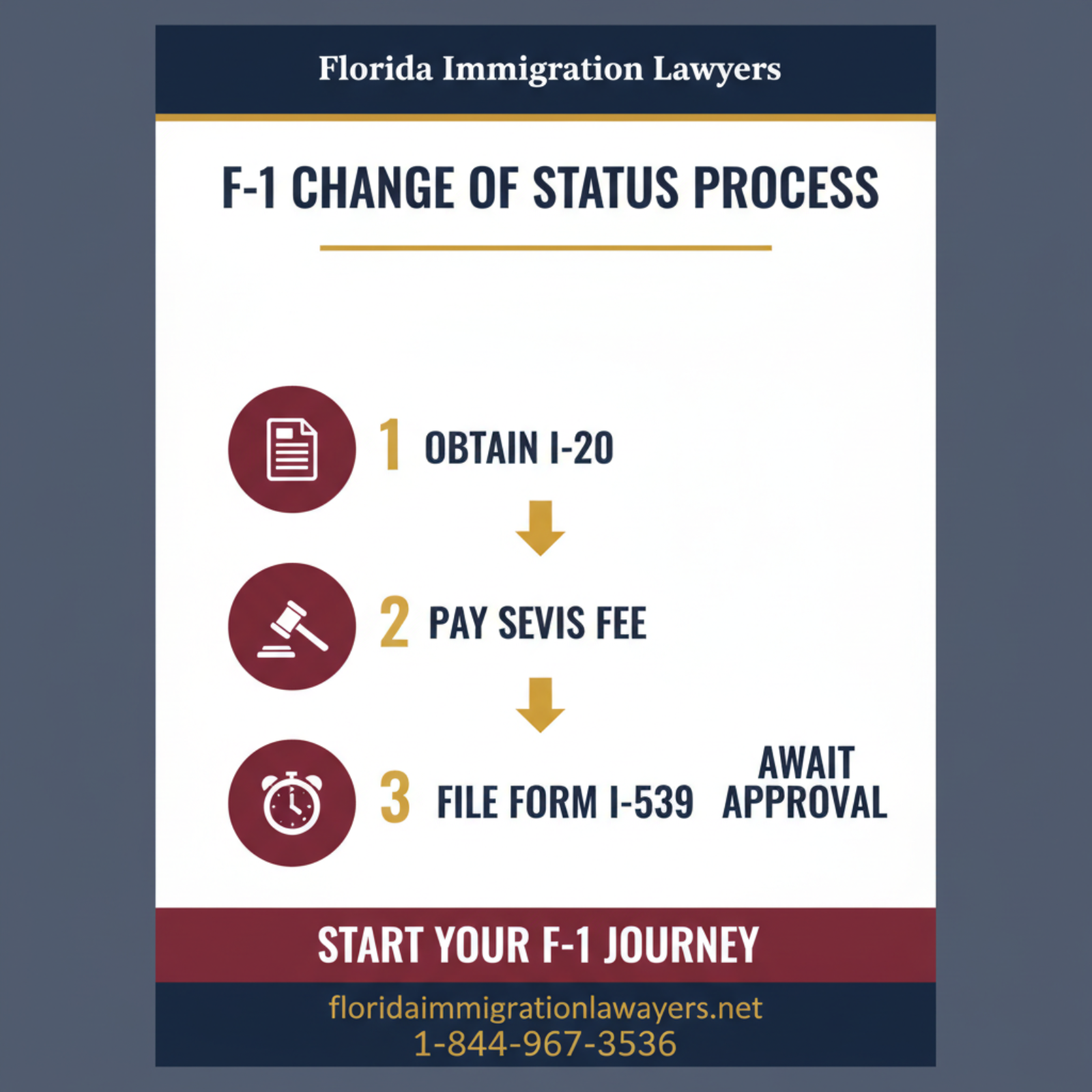
Obtain Form I-20, Certificate of Eligibility for Nonimmigrant Student Status: Once accepted, your designated school official (DSO) will issue you a Form I-20. This document is crucial as it certifies your eligibility for F-1 status and contains vital information about your program and estimated costs.
Review your I-20 carefully for any errors before proceeding. This form is central to your F-1 visa application.
-
Pay the SEVIS I-901 Fee: Before filing your change of status application, you must pay the Student and Exchange Visitor Information System (SEVIS) I-901 fee. This fee supports the SEVIS system, which tracks international students and exchange visitors.
You will need your SEVIS ID number from your Form I-20 to complete this payment online. Keep the payment receipt as proof.
-
Complete Form I-539, Application to Extend/Change Nonimmigrant Status: This is the primary application form for your change of status. Fill out Form I-539 accurately and completely, providing all requested personal and immigration history information.
Any discrepancies or missing information can lead to delays or denial. You may also include eligible dependents (F-2 status) on the same Form I-539.
-
Gather Supporting Documents: Compile all necessary supporting documentation as outlined in the "Essential Document Checklist" below. This includes financial evidence, academic records, and proof of your current lawful status.
Organize your documents clearly, preferably with cover sheets, to assist USCIS in processing your immigration process Florida application efficiently.
-
Submit Your Application to USCIS: Mail your completed Form I-539, all supporting documents, and the required filing fee to the appropriate USCIS service center. The correct filing address depends on your current nonimmigrant status and where you reside in Florida.
Always check the USCIS website for the most current filing addresses and instructions. Consider sending your application via certified mail with a return receipt for proof of delivery.
-
Attend Biometrics Appointment (if required): After filing, USCIS may send you an appointment notice for biometrics collection at an Application Support Center (ASC). This typically involves fingerprinting and photographing.
It is mandatory to attend this appointment. Failure to do so can result in the denial of your change of status application.
-
Await Decision: Once your application is submitted, you must maintain your lawful nonimmigrant status while USCIS processes your request. You are generally permitted to remain in the U.S. while your I-539 is pending, even if your original authorized stay expires.
However, you cannot begin your studies until your change of status to F-1 is approved. This is a critical point to remember.
-
Receive Approval: If your application is approved, USCIS will send you an I-797 Approval Notice. This notice will indicate your new F-1 status and the validity period. At this point, you can officially begin your academic program.
Keep this approval notice and your updated I-20 in a safe place. Your DSO will update your SEVIS record to reflect your new status.
Gathering Required Documentation
The success of your change of status application heavily relies on the completeness and accuracy of your supporting documents. Each piece of evidence helps USCIS understand your eligibility and intent. We cannot overstate the importance of meticulous preparation.
Essential Document Checklist for F-1 Change of Status
Preparing a comprehensive packet of documents is essential for a successful change of status application. Here is a checklist of typically required items:
- Completed and signed Form I-539, Application to Extend/Change Nonimmigrant Status.
- Filing fee for Form I-539 (check current fees on the USCIS website).
- Form I-20, Certificate of Eligibility for Nonimmigrant Student Status, issued by your SEVP-approved school in Florida.
- Proof of SEVIS I-901 fee payment (receipt).
- Copy of your passport biographical page, including expiration date.
- Copy of your current nonimmigrant visa (if applicable).
- Copy of your I-94 Arrival/Departure Record (print from CBP website).
- Proof of financial support, demonstrating sufficient funds to cover tuition, living expenses, and other costs for the duration of your program. This can include bank statements, scholarship letters, or an Affidavit of Support (Form I-864 or a similar document) from a sponsor.
- Academic transcripts, diplomas, and any other relevant educational records from previous institutions.
- A "Letter of Explanation" to USCIS detailing your reasons for requesting the change of status, explaining your intent to pursue studies, and how you have maintained lawful status.
- Proof of ties to your home country, such as property deeds, family obligations, or employment offers, to demonstrate nonimmigrant intent.
- Two passport-style photographs (2x2 inches) taken within 30 days of filing.
- Any other documents requested by USCIS or relevant to your specific situation.
Understanding F-1 Change of Status Timeline and Processing Expectations
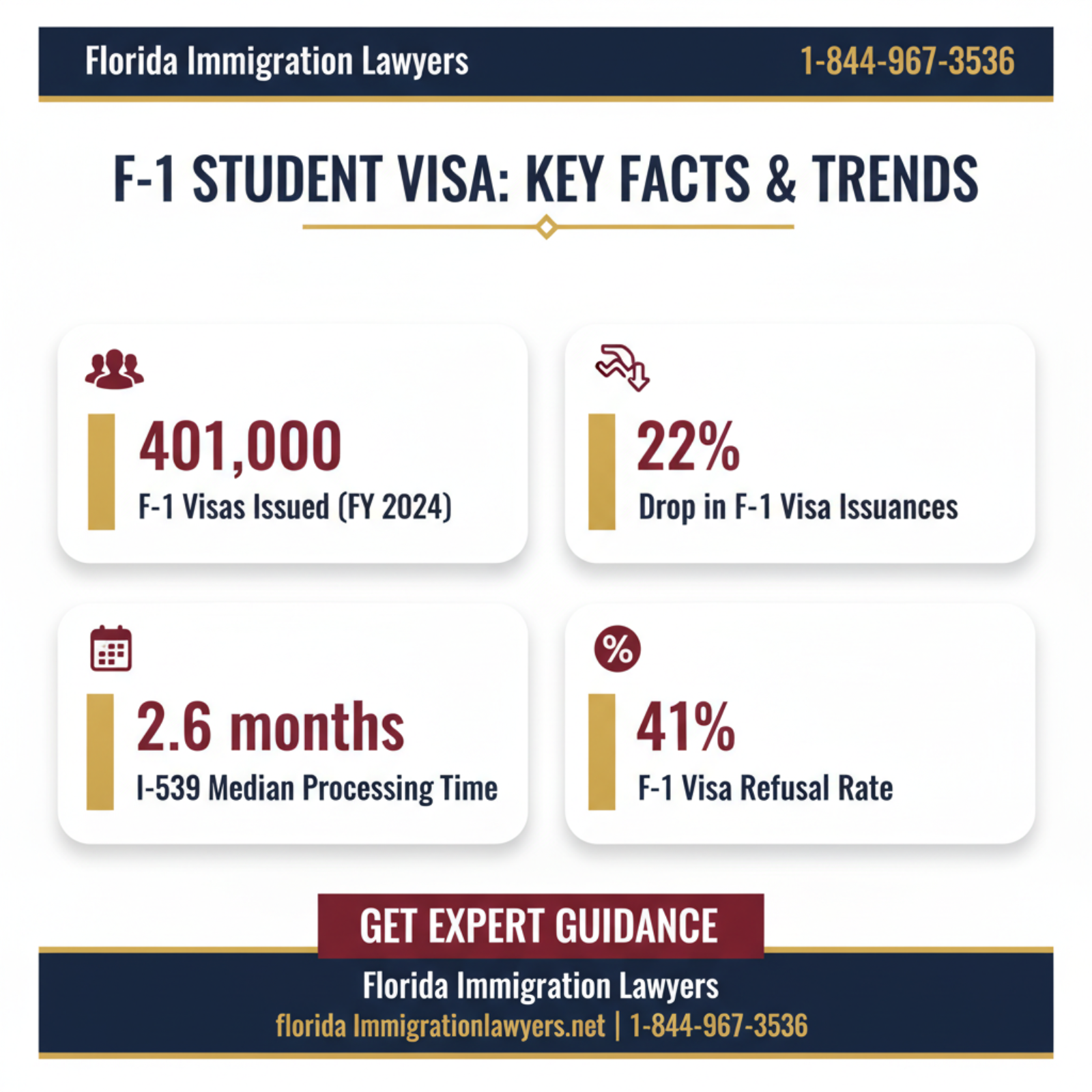
One of the most common questions regarding a change of status to F-1 is about the processing time. USCIS processing times can vary significantly based on the service center, the volume of applications, and the complexity of individual cases. It is important to manage your expectations and plan accordingly.
Generally, an F-1 change of status application can take several months to be processed. While there is no premium processing available for Form I-539, you can check current estimated processing times on the USCIS website. Simply select Form I-539 and the relevant service center to get an estimate. For example, applicants in Florida might have their cases processed at the California or Vermont Service Centers.
It is crucial to file your application well in advance of your current nonimmigrant status expiration date. This ensures you maintain lawful status while your application is pending. If your current status expires while your I-539 is still under review, you are generally considered to be in a "period of authorized stay" and will not accrue unlawful presence. However, you cannot begin your studies until the F-1 change of status is officially approved.
Cost Factors and Fee Breakdown for Your Florida F-1 Application
Understanding the financial commitment is a vital part of planning your change of status. The costs associated with an F-1 student visa application in Florida primarily include government filing fees and potential legal fees.
The main government fees are the USCIS filing fee for Form I-539 and the SEVIS I-901 fee. It is important to note that these fees are subject to change, and you should always verify the most current amounts on the official USCIS and SEVIS websites. USCIS fees are non-refundable, regardless of the outcome of your application.
Beyond government fees, you may incur other costs. These include fees for obtaining academic transcripts, translation services for foreign documents, and travel expenses for your biometrics appointment if one is required. Most importantly, engaging an experienced immigration attorney, such as those at Florida Immigration Lawyers, will involve legal fees. While this is an additional expense, it is an investment in ensuring your application is prepared correctly and strategically, minimizing the risk of denial and costly delays in your immigration process Florida.
Do not navigate this process alone. The complexities of immigration law require careful attention to detail and a deep understanding of current regulations. Contact Florida Immigration Lawyers today to ensure your F-1 change of status application is handled with expertise and care.
Common Mistakes to Avoid During Your F-1 Change of Status
Applying for a change of status to an F-1 student visa can be a complex journey, and even minor errors can lead to significant delays or denials. Being aware of these common pitfalls can help you avoid them:
-
Failing to Maintain Lawful Status: This is perhaps the most critical mistake. You must continuously maintain your current nonimmigrant status until your change of status to F-1 is approved. Allowing your previous status to expire without a pending I-539 application, or violating its terms, will render you ineligible.
Consequence: Denial of your application and potential accrual of unlawful presence, leading to future bars from re-entry.
-
Applying Too Late: Submitting your Form I-539 too close to the expiration of your current status can create issues. While a timely filed application generally allows you to remain in the U.S. during processing, it's best to apply with ample time.
Consequence: Stress, potential for status lapse if application is rejected for a minor error, and inability to start studies on time.
-
Insufficient Financial Evidence: USCIS requires robust proof that you can cover your tuition and living expenses without resorting to unauthorized employment. Vague or incomplete financial documentation is a common reason for denial.
Consequence: Request for Evidence (RFE) or denial, significantly delaying your F-1 visa application.
-
Incomplete or Incorrect Forms: Even small errors, such as unanswered questions, incorrect dates, or unsigned forms, can lead to your application being rejected or denied. This includes Form I-539 and your I-20.
Consequence: Delays, rejection of the application, and potentially missing deadlines for maintaining status.
-
Not Demonstrating Nonimmigrant Intent: As an F-1 student, you must demonstrate that you intend to return to your home country after completing your studies. Failing to provide sufficient ties to your home country can lead to denial, especially if you have a history of seeking other immigration benefits.
Consequence: Denial based on a perceived intent to immigrate, which contradicts the temporary nature of an F-1 visa.
-
Starting Studies Before Approval: You absolutely cannot begin your F-1 program until your change of status is officially approved by USCIS. Doing so is a violation of your nonimmigrant status.
Consequence: Denial of your application and immediate accrual of unlawful presence, jeopardizing future immigration opportunities.
-
Misunderstanding the 5-Month Rule Context: While not a strict rule for all change of status cases, if your current status expires significantly before your F-1 program starts, you might need an extension of your current status to avoid a gap. Failing to plan for this "bridge the gap" scenario is a mistake.
Consequence: Lapse of status, making you ineligible for the change of status.
-
Not Addressing Prior Immigration Violations: Any past overstays, unauthorized employment, or other immigration infractions must be disclosed and properly addressed. Hiding such information can be detrimental.
Consequence: Denial, and potentially more serious consequences for misrepresentation.
-
Failing to Update USCIS on Address Changes: If you move while your application is pending, you must inform USCIS within 10 days using Form AR-11. Failure to do so can result in missed notices and further complications.
Consequence: Missed requests for evidence or approval notices, leading to delays or denial due to lack of response.
-
Ignoring Legal Advice: Attempting to navigate the complex immigration system without professional guidance can lead to costly errors. An attorney can spot issues you might miss and provide strategic advice.
Consequence: Increased risk of denial, wasted time and money, and potential long-term immigration consequences.
When to Call a Lawyer for Your F-1 Change of Status in Florida
While this guide provides comprehensive information, the change of status process is inherently complex and can benefit greatly from professional legal assistance. Florida Immigration Lawyers specializes in helping individuals throughout Florida, including Fort Lauderdale, navigate these intricate pathways. Here are specific scenarios when contacting an attorney is highly recommended:
- Complex Case History: If you have a history of prior visa denials, overstays, unauthorized employment, or any other immigration violations, your case is not straightforward. An attorney can assess the impact of these issues and develop a strategy to address them effectively.
- Uncertainty About Eligibility: If you are unsure whether you meet all the eligibility requirements for an F-1 change of status, a lawyer can provide a clear assessment based on your specific circumstances.
- Concerns About Maintaining Status: If your current nonimmigrant status is nearing expiration or you are worried about maintaining it during the processing period, an attorney can advise on "bridge the gap" strategies or other solutions.
- Difficulty Gathering Documentation: Collecting all required documents, especially financial evidence or academic records, can be challenging. An attorney can guide you on what specific documents are needed and how to present them effectively to USCIS.
- Receiving a Request for Evidence (RFE) or Notice of Intent to Deny (NOID): If USCIS sends an RFE or NOID, it means there are deficiencies in your application. Responding correctly and comprehensively is crucial, and an attorney can help craft a strong response.
- Dependent Status Questions: If you are considering changing status from F-1 to F-2 for a dependent, or vice-versa, or have other family members involved, an attorney can clarify eligibility and application procedures for all parties. For example, changing from F-1 to F-2 (dependent status) is possible if you meet the criteria as a dependent of an F-1 principal.
- Need for Strategic Guidance: An experienced immigration attorney can offer strategic advice, anticipate potential issues, and help you prepare the strongest possible application. We understand the nuances of the immigration process Florida.
Our dedicated team at Florida Immigration Lawyers is here to provide the support and expertise you need. We serve clients across all of Florida, offering personalized attention to your unique immigration goals.
About Florida Immigration Lawyers
Florida Immigration Lawyers is a leading immigration law firm dedicated to serving individuals and families across the entire state of Florida. Our mission is to provide compassionate, effective, and ethical legal representation to those navigating the complexities of U.S. immigration law. We understand that immigration matters are often deeply personal and have significant impacts on your future, your family, and your dreams.
Our experienced attorneys specialize in a wide array of immigration services, including general immigration matters, asylum claims, deportation defense, citizenship applications, family-based petitions, and business immigration. We pride ourselves on our client-focused approach, ensuring that you are informed and supported at every stage of your legal journey.
Why choose Florida Immigration Lawyers? We offer round-the-clock availability, ensuring you can reach us when you need us most. We provide free consultations to discuss your case and assess your options without financial commitment. Our team is bilingual, with fluent Spanish speakers ready to assist you. With a deep understanding of federal immigration laws and specific insights into the needs of Florida's diverse communities, we are committed to achieving the best possible outcomes for our clients.
Contact us today to learn how we can assist you with your immigration needs. Our attorneys are ready to help. Visit our website at https://www.floridaimmigrationlawyers.net or call us at 1-844-967-3536.
Sources and References
- U.S. Citizenship and Immigration Services (USCIS) - Change My Nonimmigrant Status
- Study in the States (DHS) - Change of Status
- USCIS Policy Manual, Volume 2, Part F, Chapter 2 - Change of Status
- 8 U.S.C. § 1258 (Immigration and Nationality Act Section 248 - Change of Nonimmigrant Status)
- 8 CFR Part 248 (Code of Federal Regulations - Change of Nonimmigrant Classification)
This article provides general legal information and is not intended as legal advice. Every case is unique, and outcomes depend on specific facts and circumstances. Contact an attorney for advice about your particular situation.
Embarking on an F-1 change of status journey in Florida can open doors to incredible educational opportunities. While the path requires diligence and precision, you do not have to walk it alone. Florida Immigration Lawyers is here to provide the expert legal support you deserve. Let us help you turn your academic aspirations into reality.
Contact Florida Immigration Lawyers today for a free, confidential consultation. Call us at 1-844-967-3536. Se Habla Español - Estamos aquí para ayudarle.
Do Not Navigate This Process Alone
Our experienced immigration attorneys are ready to fight for you. Get a free, confidential consultation today.
Se Habla Español
Frequently Asked Questions
Florida Immigration Lawyers
Immigration Attorney | Founder, Vasquez Law Firm
U.S. Air Force veteran and immigration attorney with thousands of cases resolved. J.D., NCCU School of Law. AILA member. Admitted to the 4th, 5th, and 11th Circuit Courts.
Available 24/7 - Free Evaluations
Related Legal Services
Our Florida immigration attorneys can help you with deportation defense, citizenship and naturalization and family immigration services. Call today at 1-844-967-3536 for a free consultation.
Related Links
Related Topics
Free Legal Consultation
Discuss your case with our experienced attorneys. We're available 24/7.
Se Habla Español - Estamos aquí para ayudarle.
Related Articles
Stokes Interview: Navigating Marriage Fraud in Florida
A Stokes interview is a specialized, separate interview conducted by USCIS when there are suspicions of marriage fraud in a green card application. This rigorous process involves individual questioning of spouses, focusing on inconsistencies in their testimonies to determine the authenticity of their marital bond. For couples in Florida, navigating this high-stakes interview requires meticulous preparation, extensive documentation, and often the strategic guidance of an experienced immigration lawyer. Understanding the process, preparing for detailed questions, and presenting a strong case are crucial for overcoming marriage fraud allegations and securing your immigration future. Florida Immigration Lawyers stands ready to assist you.
Immigration Attorney Gainesville: North Florida Legal Help
For those in Gainesville, Alachua County, and throughout North Florida, navigating U.S. immigration law requires expert guidance. An experienced immigration attorney can simplify complex processes, from family-based petitions and employment visas to critical asylum claims and deportation defense. This comprehensive guide outlines the essential services provided by an immigration attorney, details necessary documentation, clarifies processing timelines, and discusses associated costs. We also highlight common mistakes to avoid and crucial scenarios where legal counsel is indispensable. Florida Immigration Lawyers serves all of Florida, including Gainesville and St. Petersburg, providing dedicated legal support to help you achieve your immigration goals. Contact us for a free consultation to discuss your specific needs.
Military Naturalization Expedited at Florida Bases
Explore expedited military naturalization processes for service members at Florida bases like MacDill. Learn about eligibility, steps, and common mistakes. Contact Florida Immigration Lawyers for a free consultation.
Protect Yourself from Immigration Scams in Florida
Learn how to protect against immigration scams in Florida, focusing on St. Petersburg. This guide covers identifying scams, verifying credentials, and getting legal help. Call Florida Immigration Lawyers at 1-844-967-3536 for assistance.
