BIA Remand Process for Immigration Appeals in Florida 2026
A BIA remand in an immigration appeal means the Board of Immigration Appeals sends your case back to the Immigration Judge for further review due to legal errors, new evidence, or procedural issues. This offers a vital second chance for immigrants in Florida to present their arguments and evidence, potentially leading to a more favorable outcome. Understanding the specific reasons for the remand and carefully preparing for new hearings are crucial. This guide explains the process, necessary documents, potential outcomes, and when legal counsel is essential to navigate this complex stage effectively. Florida Immigration Lawyers are here to provide expert assistance.

A BIA remand in an immigration appeal occurs when the Board of Immigration Appeals (BIA) sends a case back to the original Immigration Judge (IJ) for further proceedings. This typically happens if the BIA finds a legal error, new evidence needs consideration, or procedural issues arose during the initial hearing. For immigrants in Florida, a remand offers a crucial opportunity to present new arguments or evidence, potentially leading to a different outcome than the initial denial. It signifies that your case is not definitively closed and requires further review, often with legal guidance.
- BIA remand means your case returns to the Immigration Judge.
- It often indicates a legal error or new evidence requires review.
- This process provides a new chance for a favorable decision.
- Legal representation is crucial to navigate the remand effectively.
- Remands can lead to further appeals, including to a circuit court.
Facing an immigration appeal can be one of the most stressful experiences for individuals and families in Florida. The initial denial of a visa, green card, or asylum claim, or a final order of deportation, can feel like the end of the road. However, the U.S. immigration system provides avenues for review, and one such critical step is a BIA remand. When the Board of Immigration Appeals (BIA) remands your case, it means they have found reason to send it back to the Immigration Judge for further consideration, offering a potential second chance to present your arguments and evidence.
This comprehensive guide from Florida Immigration Lawyers will walk you through the intricacies of the BIA remand process, specifically tailored for individuals navigating the immigration system in Florida. We will cover everything from understanding what a remand means, to the step-by-step process, necessary documentation, potential outcomes, and when to consider a circuit court review. Our goal is to empower you with the knowledge needed to face this complex legal challenge.
Do not face the complexities of a BIA remand alone. If you have received a BIA decision remanding your case or are considering an immigration appeal, it is vital to seek experienced legal counsel immediately. Call Florida Immigration Lawyers at 1-844-YO-PELEO for a free case review and let our dedicated team assist you.
What is a BIA Remand in Immigration Appeals?
A BIA remand occurs when the Board of Immigration Appeals, the highest administrative body for interpreting and applying immigration laws, sends a case back to the Immigration Judge (IJ) who initially heard it. This action is not a final decision on the merits of your case but rather an instruction for the IJ to re-examine specific aspects. The BIA may issue a remand for several reasons, including procedural errors made by the IJ, the need to consider new evidence that was not available or properly presented before, or a misapplication of immigration law.
For example, if the BIA determines that the Immigration Judge failed to consider a critical piece of evidence or did not properly inform you of your rights, they may remand the case. This allows the IJ to correct the error or address the new information, ensuring a fair and lawful adjudication. A BIA remand essentially reopens the door for you to strengthen your case and present a more complete picture to the court. Understanding the specific reasons for the remand, as outlined in the BIA's decision, is paramount for devising an effective strategy moving forward. The BIA's authority to remand cases is outlined in regulations such as 8 CFR § 1003.1(d)(6), which governs their appellate jurisdiction and review powers. You can find more information about the EOIR and the BIA's role on the Executive Office for Immigration Review (EOIR) website.
How Does the BIA Remand Process Work in Florida?
The BIA remand process in Florida follows a structured legal path, offering a crucial opportunity to re-present your case before an Immigration Judge. As of 2026, the general steps involved are as follows, beginning once the BIA issues its remand order.
Once the BIA issues a remand order, your case is returned to the Immigration Court for further proceedings. The specific Immigration Judge who initially heard your case, or another judge if necessary, will then schedule new hearings to address the BIA's instructions, allowing for the presentation of new evidence or arguments.
The process begins with the BIA's written decision, which will explicitly state that the case is being remanded and often provides specific instructions to the Immigration Judge. This decision is then sent to the Immigration Court, such as the one in Miami or Orlando, where your case was originally heard. The court clerk will re-docket your case, and you or your attorney will receive a notice for a new hearing. These hearings are your opportunity to address the issues raised by the BIA, present additional evidence, or clarify legal arguments. It is critical to prepare thoroughly for these new proceedings, as they are often focused on specific points rather than a full re-hearing of the entire case. The goal is to correct the errors or omissions identified by the BIA, leading to a potentially favorable outcome. Navigating these proceedings effectively is key to a successful deportation defense.
- BIA Issues Remand Order: The BIA reviews your appeal and determines that the Immigration Judge's decision contained an error, lacked sufficient findings, or new evidence needs consideration. They issue a written order explicitly stating the remand.
- Case Returned to Immigration Court: The BIA's order is transmitted to the Immigration Court where your case was originally adjudicated. For Floridians, this typically means the Miami Immigration Court.
- Case Re-docketed and Scheduled: The Immigration Court clerk's office will re-docket your case under its original number and issue a Notice of Hearing (NOH) to you and your attorney. This notice will specify the date and time for your next appearance before the Immigration Judge.
- New Hearings Before Immigration Judge: The Immigration Judge will hold new hearings, strictly adhering to the BIA's instructions. This might involve taking new testimony, reviewing additional documents, allowing for new legal arguments, or making specific factual findings that were missing previously.
- Immigration Judge Issues New Decision: After considering all the information, the Immigration Judge will issue a new decision. This decision must comply with the BIA's remand order. The outcome could be the grant of relief, termination of proceedings, or a new denial, which can then be appealed again to the BIA.
What Documents are Needed for an Immigration Appeal Remand?
Successfully navigating a BIA remand requires meticulous organization and the strategic presentation of relevant documents. The specific documents needed will depend heavily on the reasons for the remand as outlined in the BIA's decision. However, generally, you will need to gather all original filings, the BIA's remand order, and any new evidence that supports your case or addresses the BIA's concerns. Preparing a comprehensive set of documents is vital for presenting a strong case to the Immigration Judge in Florida.
This includes all prior applications, petitions, and supporting evidence submitted during your initial proceedings. The BIA's remand order itself is a crucial document, as it dictates the scope of the new proceedings. If the remand is due to a lack of evidence, you will need to prepare and submit new, compelling documentation that fills those gaps. This could include updated affidavits, expert witness reports, medical records, financial statements, or country condition reports, especially relevant for asylum cases. Any documents not in English must be accompanied by certified translations. Always keep copies of everything you submit to the court and to USCIS. Your attorney can help you identify and organize the necessary documentation specific to your Florida case.
Document Checklist for a BIA Remand
- Copy of the BIA's Remand Order.
- All previously filed applications and petitions (e.g., I-589, I-485, I-130).
- All exhibits and evidence submitted during original Immigration Court proceedings.
- Transcripts of prior hearings.
- Any new evidence relevant to the BIA's remand instructions (e.g., updated medical records, new affidavits, expert reports, country conditions reports).
- Certified English translations for all non-English documents.
- Legal briefs or motions prepared for the new hearings.
- Proof of service for all documents filed with the court and opposing counsel.
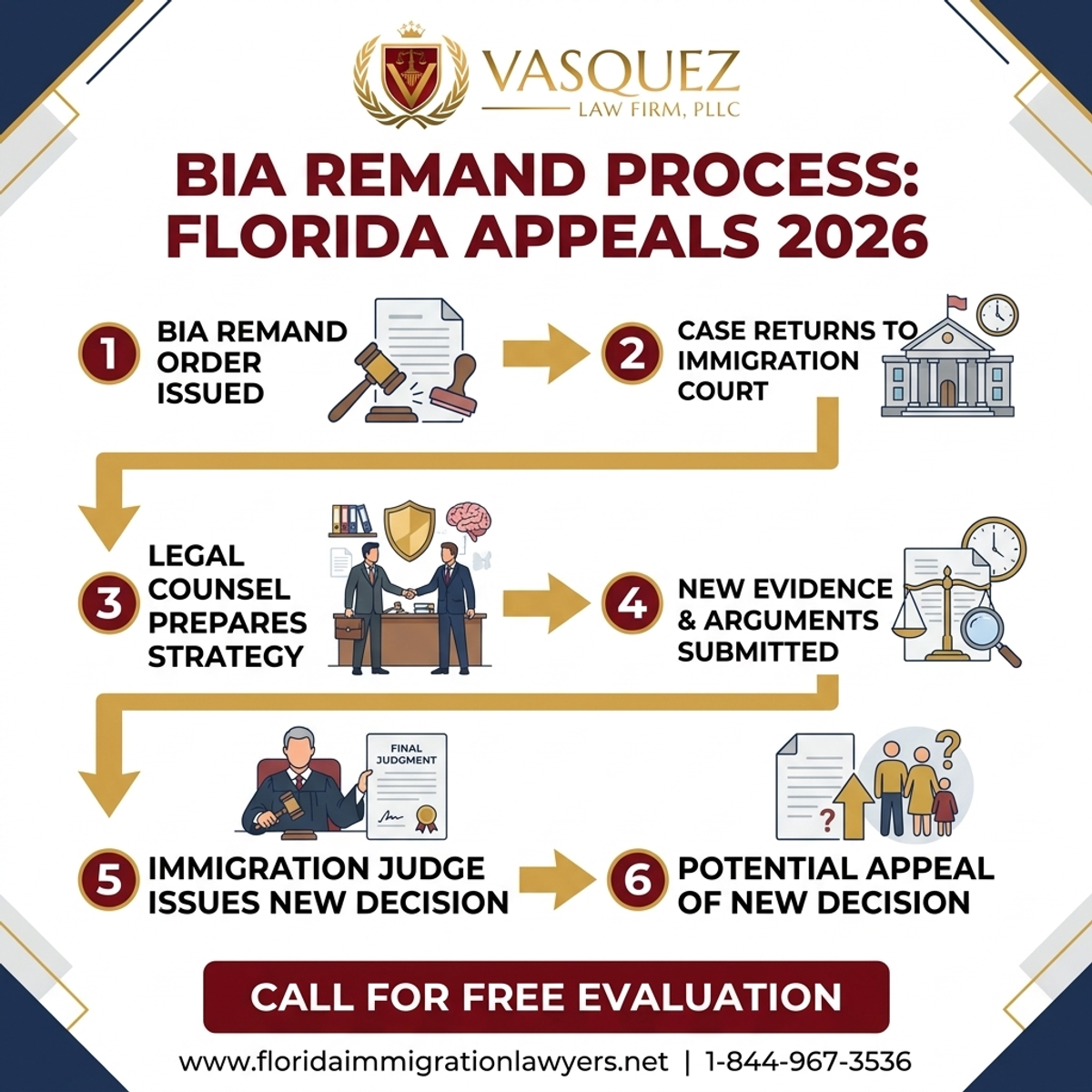
Step-by-Step Process — BIA Remand Process for Immigration Appeals in Florida 2026
Timeline and Processing Expectations for BIA Remands
As of 2026, the timeline for a BIA remand process can vary significantly based on court backlogs and the complexity of the case. Here is a general overview:
| Stage | Typical Timeframe | Notes |
|---|---|---|
| BIA Decision to Remand | 3-6 months from appeal filing | Can take longer in complex cases. |
| Case Re-docketing at Immigration Court | 1-3 months | Court processing time to assign new hearing dates. |
| New Hearings Before Immigration Judge | 6-18 months (initial hearing) | Depends on court calendar, judge's schedule, and case complexity in Florida. Multiple hearings may be scheduled. |
| Immigration Judge Issues New Decision | 1-6 months after final hearing | Judge's deliberation time to issue a written decision. |
| Potential for Further Appeal | 30 days to file appeal | If the new decision is unfavorable, another appeal to the BIA or Circuit Court may be possible. |
What are the Potential Outcomes of a BIA Remand?
A BIA remand opens up several potential outcomes for an immigrant's case, none of which are guaranteed but all offer a renewed opportunity. The specific result will largely depend on the reasons for the remand, the new evidence presented, and the legal arguments made during the subsequent hearings before the Immigration Judge.
Upon a BIA remand, the Immigration Judge will review the case as per the BIA's instructions. Potential outcomes include the grant of relief, termination of proceedings, or a new denial that can be appealed again.
One of the most favorable outcomes is the grant of relief, meaning the Immigration Judge approves the relief you sought, such as asylum, adjustment of status, or cancellation of removal. Another positive result could be the termination of proceedings, where the government decides to close your case, often because you have become eligible for an alternative form of relief or there are humanitarian considerations. However, it is also possible for the Immigration Judge to issue a new denial, especially if the BIA's instructions were followed, but the new evidence or arguments were insufficient. In such a scenario, you would typically have the right to file another appeal to the BIA, restarting the appellate process. Less commonly, the Immigration Judge might certify the case back to the BIA for clarification or a decision on a new legal issue that arises during the remand proceedings. Each outcome carries significant implications for your immigration status and future in Florida.
When Can a BIA Remand Lead to Circuit Court Review?
A BIA remand itself does not directly lead to a circuit court review. Instead, if the outcome of the remand proceedings before the Immigration Judge is unfavorable, and any subsequent appeal to the BIA is also denied, then the case may become eligible for review by a U.S. Circuit Court of Appeals. This is a critical distinction, as federal circuit courts only review final orders of removal, not interlocutory decisions like a remand.
If, after a BIA remand, the Immigration Judge issues a new decision that is unfavorable, and this decision is subsequently upheld by the BIA upon a second appeal, then you may have grounds to petition for review with the appropriate U.S. Circuit Court of Appeals. For cases arising in Florida, this would typically be the Eleventh Circuit Court of Appeals. This level of review is not an opportunity to present new evidence or re-litigate facts; rather, it is limited to questions of law, constitutional claims, and interpretations of statutes or regulations. The circuit court examines whether the BIA or IJ applied the law correctly and whether their findings were supported by substantial evidence. This process is governed by the Immigration and Nationality Act (INA) Section 242, codified as 8 U.S.C. § 1252. Understanding the strict jurisdictional limits of the circuit court is paramount, and it requires highly specialized legal expertise. Information on immigration forms and processes can be found on the USCIS website.
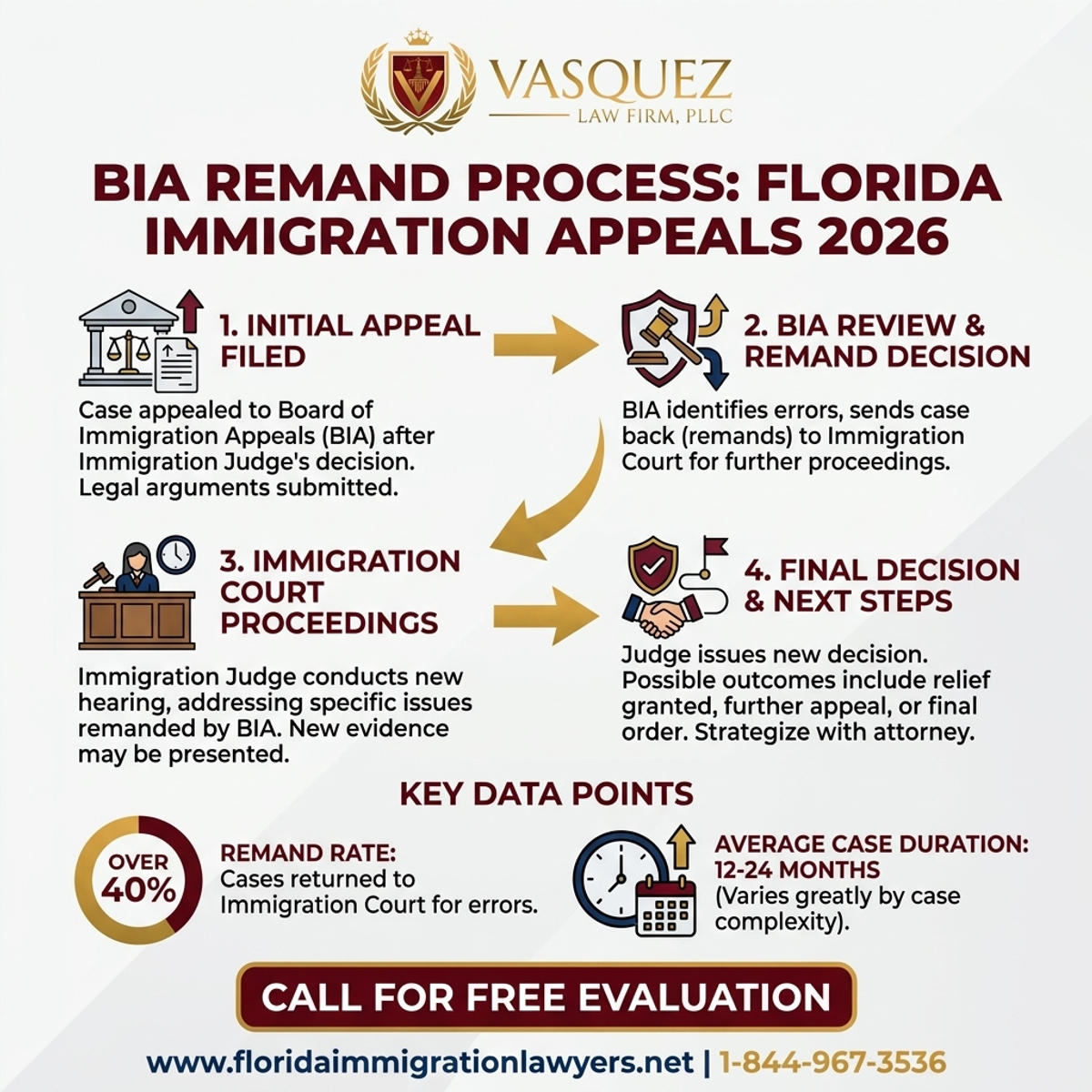
Key Statistics — BIA Remand Process for Immigration Appeals in Florida 2026
What are the Costs Associated with a BIA Remand Case?
The costs associated with a BIA remand case can vary significantly depending on the complexity of your situation, the amount of new evidence required, and the legal fees of your chosen attorney. While some filing fees are standard, the primary expense for many will be legal representation, which is highly recommended for navigating such intricate proceedings.
As of 2026, there is no separate filing fee specifically for a BIA remand itself, as it is a continuation of an existing appeal. However, if the Immigration Judge issues a new unfavorable decision after the remand, and you choose to appeal to the BIA again, then the standard BIA appeal filing fee would apply. This fee can be substantial, though fee waivers may be available for eligible individuals demonstrating financial hardship. Attorney fees constitute the most variable cost. Experienced immigration attorneys in Florida may charge an hourly rate or a flat fee for handling remand cases, depending on the anticipated work involved, including preparing new evidence, attending hearings, and drafting legal briefs. Other potential costs include obtaining certified translations of documents, expert witness fees if necessary, and travel expenses to attend hearings if you are not local to the Immigration Court. It is essential to discuss all potential costs transparently with your legal counsel during a free case review.
Cost Factors and Fee Breakdown for BIA Remand Cases
| Item | Typical Fee | Notes |
|---|---|---|
| BIA Appeal Filing Fee (if re-appealing) | Varies (check USCIS for current fees) | Required for new appeal to BIA post-remand; fee waivers available. |
| Attorney Fees (Remand Proceedings) | Varies widely ($3,000 - $10,000+) | Hourly or flat fee, depending on complexity, new evidence, and hearings required. Highly recommended. |
| Document Translation Fees | $20 - $50+ per page | Required for any non-English documents submitted as evidence. |
| Expert Witness Fees (if applicable) | Varies ($500 - $5,000+) | For psychological evaluations, country conditions experts, etc. |
| Miscellaneous Court Costs | Minimal ($0 - $100) | For certified copies, postage, etc. |
Do not navigate this process alone. A BIA remand can be a second chance, but it is also a complex legal challenge. Contact Florida Immigration Lawyers today to ensure your case receives the expert attention it deserves.
Common Mistakes to Avoid in a BIA Remand Case
Navigating a BIA remand requires careful attention to detail and adherence to strict legal procedures. Even minor errors can have significant negative consequences, potentially jeopardizing your opportunity for a favorable outcome. Here are some common mistakes to avoid:
- Missing Deadlines: Failing to respond to court notices, file motions, or submit evidence by the specified deadlines can lead to your case being dismissed or relief being denied. Strict adherence to court calendars is paramount.
- Not Understanding the Remand Order: Misinterpreting the BIA's specific instructions for the Immigration Judge can result in arguments or evidence that do not address the core issues, wasting valuable time and resources.
- Submitting Inadequate or Irrelevant New Evidence: If the remand is for new evidence, simply submitting a large volume of documents without clear relevance or proper organization can overwhelm the court and weaken your case. Evidence must directly address the BIA's concerns.
- Failing to Prepare for New Hearings: Assuming the remand means an automatic favorable outcome is a grave error. New hearings require thorough preparation, including witness testimony, legal arguments, and a clear strategy to address the BIA's directive.
- Not Seeking Legal Counsel: Attempting to navigate the complexities of a BIA remand without an experienced immigration attorney significantly reduces your chances of success. Lawyers understand the nuances of the law and court procedures.
- Ignoring Changes in Law or Policy: Immigration law is constantly evolving. Failing to stay updated on recent changes, such as those related to asylum or eligibility for relief, can lead to outdated legal strategies.
- Lack of Communication with Attorney: If you have legal representation, failing to provide all relevant information, documents, or updates to your attorney can hinder their ability to build the strongest possible case for you.
- Failing to Address Credibility Issues: If the BIA remanded the case due to credibility concerns, not actively working to overcome these issues with compelling and consistent evidence or testimony will likely lead to another denial.
When to Call a Lawyer for Your BIA Remand Case
A BIA remand is a pivotal moment in your immigration journey, offering a second chance that should not be squandered. Given the complexities of immigration law and the specific instructions from the BIA, having experienced legal counsel is not just advisable, it is often critical for a successful outcome. You should call an attorney immediately if your case has been remanded, or if you are considering an appeal that could lead to a remand.
Specific scenarios where legal intervention from Florida Immigration Lawyers is essential include:
- Complex Legal Issues: If the BIA's remand order cites intricate legal questions, statutory interpretations, or procedural errors that require specialized knowledge.
- New Evidence Requirements: When the remand necessitates gathering and presenting new, compelling evidence that requires legal expertise to identify, organize, and submit correctly.
- Tight Deadlines: Immigration proceedings often involve strict deadlines. An attorney can ensure all filings and responses are submitted on time, preventing costly delays or dismissals.
- Previous Denial: If your case has already been denied once, the stakes are higher. An attorney can analyze why and build a stronger case for the remand proceedings.
- Language Barriers: If English is not your primary language, an attorney can ensure effective communication with the court and proper translation of documents.
- Fear of Persecution (Asylum Cases): For individuals seeking asylum, a remand offers a critical opportunity to strengthen your claim, which an attorney can expertly guide.
Our experienced attorneys at Florida Immigration Lawyers are well-versed in handling BIA remands and can help you navigate the process in Central Florida, including Orlando, and across the state.
About Florida Immigration Lawyers
Florida Immigration Lawyers is a leading immigration law firm dedicated to serving individuals and families throughout Florida. With a deep understanding of U.S. immigration laws and a commitment to our clients, we provide compassionate yet aggressive legal representation for a wide range of immigration matters. Our firm prides itself on offering personalized attention, strategic advice, and unwavering support to help you achieve your immigration goals.
We specialize in areas such as family immigration, business immigration, deportation defense, asylum, naturalization, and complex appeals, including BIA remands. Located in Central Florida, our attorneys are available 24/7 to address your concerns and provide timely assistance. We offer free case reviews to assess your situation and outline the best path forward. When your future in the U.S. is on the line, trust the dedicated team at Florida Immigration Lawyers to fight for your rights. Schedule a free consultation today and experience the difference our expertise can make.
Sources and References
- U.S. Citizenship and Immigration Services (USCIS)
- Executive Office for Immigration Review (EOIR)
- U.S. Department of State
- 8 U.S.C. Chapter 12 - Immigration and Nationality Act (INA)
- 8 U.S.C. § 1252 - Judicial review of orders of removal
- 8 CFR § 1003.1(d)(6) - Appellate jurisdiction and powers of the Board of Immigration Appeals
Related services: immigration waivers, humanitarian protection programs, DACA renewal and applications, temporary protected status (TPS).
This article provides general legal information and is not intended as legal advice. Every case is unique, and outcomes depend on specific facts and circumstances. Contact an attorney for advice about your particular situation.
A BIA remand offers a critical opportunity to secure your future in the United States. Do not leave your case to chance. For expert guidance and dedicated representation, contact Florida Immigration Lawyers today. Call us at 1-844-YO-PELEO for a free case review. Se Habla Espanol - Estamos aqui para ayudarle.
If you need legal assistance, learn more about learn about our immigration practice, or call us at 1-844-967-3536 for a free case review.
Do Not Navigate This Process Alone
Our experienced immigration attorneys are ready to fight for you. Get a free, confidential case review today.
Se Habla Español
Or leave your details and we’ll call you:
Free Evaluation in 24 Hours
Or talk to us right now

AI voice assistant — available 24/7
FreeFrequently Asked Questions

William J. Vásquez
Founding Attorney · Vasquez Law Firm
U.S. Air Force veteran and immigration attorney with years of hands-on U.S. immigration experience. J.D., NCCU School of Law. AILA member. Admitted to the 4th, 5th, and 11th Circuit Courts.
Available 24/7 - Free Evaluations
Reviewed for legal accuracy by William J. Vásquez
Licensed in North Carolina; U.S. immigration is federal practice.
Related Legal Services
Our Florida immigration attorneys can help you with citizenship and naturalization, immigration practice areas and free immigration consultation. Call today at 1-844-YO-PELEO for a free case review.
Related Links
Related Topics
Free Legal Case Review
Discuss your case with our experienced attorneys. We're available 24/7.
Se Habla Español - Estamos aquí para ayudarle.
Related Articles
DUI Immigration Consequences in Florida 2026
A DUI conviction in Florida can have severe immigration consequences, potentially leading to inadmissibility, deportation, or denial of immigration benefits. For non-citizens, a DUI is not just a traffic offense but a serious criminal matter that federal immigration law scrutinizes closely. Factors like multiple offenses, injury, or property damage can escalate a simple DUI to a Crime Involving Moral Turpitude (CIMT) or even an aggravated felony, triggering mandatory detention and removal proceedings. Understanding the specific nature of your Florida conviction and its interpretation under the Immigration and Nationality Act (INA) is crucial. This article outlines how DUIs impact immigration status, the grounds for inadmissibility and deportation, a step-by-step guide to navigating the process, essential documentation, and expected timelines for 2026. We also highlight common mistakes to avoid and when to seek legal counsel from an experienced immigration attorney. Florida Immigration Lawyers offers comprehensive support for individuals facing these challenging situations, providing expert guidance through complex legal landscapes.
PERM Labor Certification in Florida: A 2026 Guide
Learn all about the PERM labor certification process in Florida, essential for employers sponsoring green card applicants. Understand the steps, document requirements, and common mistakes to avoid in this 2026 guide.
Immigration Lawyer Orlando Free Consultation in Florida
For individuals and families in Orlando, Florida, navigating the complexities of U.S. immigration law requires expert guidance. An immigration lawyer in Orlando offers crucial support for everything from visa applications and green card processes to naturalization and deportation defense. This comprehensive guide details what a free consultation covers, providing a step-by-step overview of immigration pathways, essential document checklists, and expected timelines in 2026. We also highlight common mistakes to avoid, discuss the critical role of legal counsel in deportation and asylum cases, and explain why choosing a local Orlando immigration attorney is beneficial. Florida Immigration Lawyers is dedicated to serving the diverse community of Orlando with compassionate, effective legal solutions, ensuring you receive personalized advice and robust representation for a successful immigration journey.
EAD Advance Parole Combo Card in Florida: What You Need
An EAD advance parole combo card allows individuals with pending adjustment applications to both work and travel abroad without jeopardizing their green card application. Learn how to apply in Florida, what documents you need, and common mistakes to avoid.