Asylum Application Florida: Your Guide to Seeking Safety...
For those fleeing persecution, the asylum application Florida process offers a critical pathway to safety. This comprehensive guide details how to apply for asylum in Florida, covering the I-589 form, eligibility criteria, required documentation, and what to expect regarding processing times and costs for 2026. Learn about the affirmative asylum process, common pitfalls to avoid, and when to seek professional legal assistance. Florida Immigration Lawyers provides expert guidance, ensuring your application is meticulously prepared and effectively presented. Understand the journey from filing your application to attending your asylum interview, and discover how our dedicated attorneys can support you every step of the way in Tallahassee, Miami, Orlando, and across Florida. Contact us for a free consultation.

Applying for asylum in Florida involves submitting Form I-589 to USCIS within one year of your last arrival, demonstrating a well-founded fear of persecution based on specific grounds. The process includes biometrics, an interview, and can take several years. Seeking legal counsel from Florida Immigration Lawyers is highly recommended to navigate this complex journey successfully.
- File Form I-589 within one year of arrival.
- Prove fear of persecution based on protected grounds.
- Attend biometrics and an asylum interview.
- Processing times can be extensive.
- Legal assistance is crucial for a strong case.
Imagine a life where returning home means facing unimaginable danger. Many individuals and families arrive in Florida seeking refuge, hoping to find safety and a new beginning. The asylum application Florida process offers a pathway for those fleeing persecution in their home countries. However, it is a complex legal journey requiring meticulous preparation and a deep understanding of U.S. immigration law.
This comprehensive guide will walk you through every critical step of seeking asylum in Florida for 2026. We will cover eligibility requirements, the filing process, necessary documentation, and what to expect regarding timelines and costs. Our goal is to empower you with the knowledge needed to pursue your asylum claim effectively.
Do not face this challenging process alone. For personalized guidance and expert legal representation, call Florida Immigration Lawyers at 1-844-967-3536 for a free consultation. Our experienced team is here to help you understand your options and build a strong case.
Understanding Asylum in Florida: A Path to Safety
Asylum is a form of protection granted to individuals who are unable or unwilling to return to their country of origin due due to a well-founded fear of persecution. This fear must be based on their race, religion, nationality, membership in a particular social group, or political opinion. The legal framework for asylum is found in the Immigration and Nationality Act (INA).
Specifically, Section 101(a)(42) of the Immigration and Nationality Act (INA), codified at 8 U.S.C. § 1101(a)(42), defines a refugee as someone who meets these criteria. Asylum seekers in the United States are essentially refugees already present in or seeking admission to the U.S. This protection allows them to remain legally in the country.
There are two primary ways to seek asylum: affirmative asylum and defensive asylum. Affirmative asylum is sought by individuals who are not currently in removal proceedings and file their application directly with U.S. Citizenship and Immigration Services (USCIS). Defensive asylum is sought by individuals who are already in removal proceedings before an immigration judge.
A crucial requirement for most asylum claims is the one-year filing deadline. You must generally file your Form I-589, Application for Asylum and for Withholding of Removal, within one year of your last arrival in the United States. There are limited exceptions to this rule, such as changed country conditions or extraordinary circumstances, but proving these exceptions can be challenging.
Florida, with its diverse population and geographical location, is a common destination for asylum seekers. Understanding the specific nuances of the asylum application Florida process is vital. Whether you arrived through a port of entry or are already residing in a Florida city like Tallahassee, Miami, or Orlando, the legal principles remain consistent, but local procedural details can vary.
Who Qualifies for Asylum?
To qualify for asylum, you must demonstrate a well-founded fear of persecution. This means showing that you have either suffered past persecution or have a reasonable possibility of future persecution if you return to your home country. The persecution must be on account of one of the five protected grounds mentioned above.
Persecution can take many forms, including physical harm, threats, detention, torture, or severe discrimination. It is essential to provide detailed and credible evidence linking your fear to one of the protected grounds. Your personal testimony is a critical piece of evidence, but it must be corroborated by other documentation whenever possible.
The Affirmative Asylum Application Florida Process: A Step-by-Step Guide
Navigating the affirmative asylum process in Florida involves several distinct steps. Each step requires careful attention to detail and adherence to specific deadlines. Florida Immigration Lawyers can assist you through each stage to ensure your application is as strong as possible.
- Prepare Form I-589, Application for Asylum and for Withholding of Removal: This is the cornerstone of your asylum claim. The form requires detailed information about your identity, family, travel history, and, most importantly, a comprehensive narrative explaining your fear of persecution. You must be truthful and thorough, as inconsistencies can jeopardize your case. Provide specific dates, locations, and individuals involved in the events you describe. Learn more about asylum applications with Florida Immigration Lawyers.
- Gather Supporting Documents: Collect all available evidence to support your claim. This includes identification documents, birth certificates, marriage certificates, and any documents proving the persecution you faced or fear. Examples include police reports, medical records, news articles, human rights reports, and affidavits from witnesses. Detailed evidence strengthens your credibility and corroborates your testimony.
- File Your Application with USCIS: Once your Form I-589 and supporting documents are complete, you must mail them to the appropriate USCIS Lockbox Facility. The filing location depends on your current mailing address. There is no fee to file Form I-589. However, any associated costs for translations or document retrieval are your responsibility. Ensure you keep copies of everything you submit.
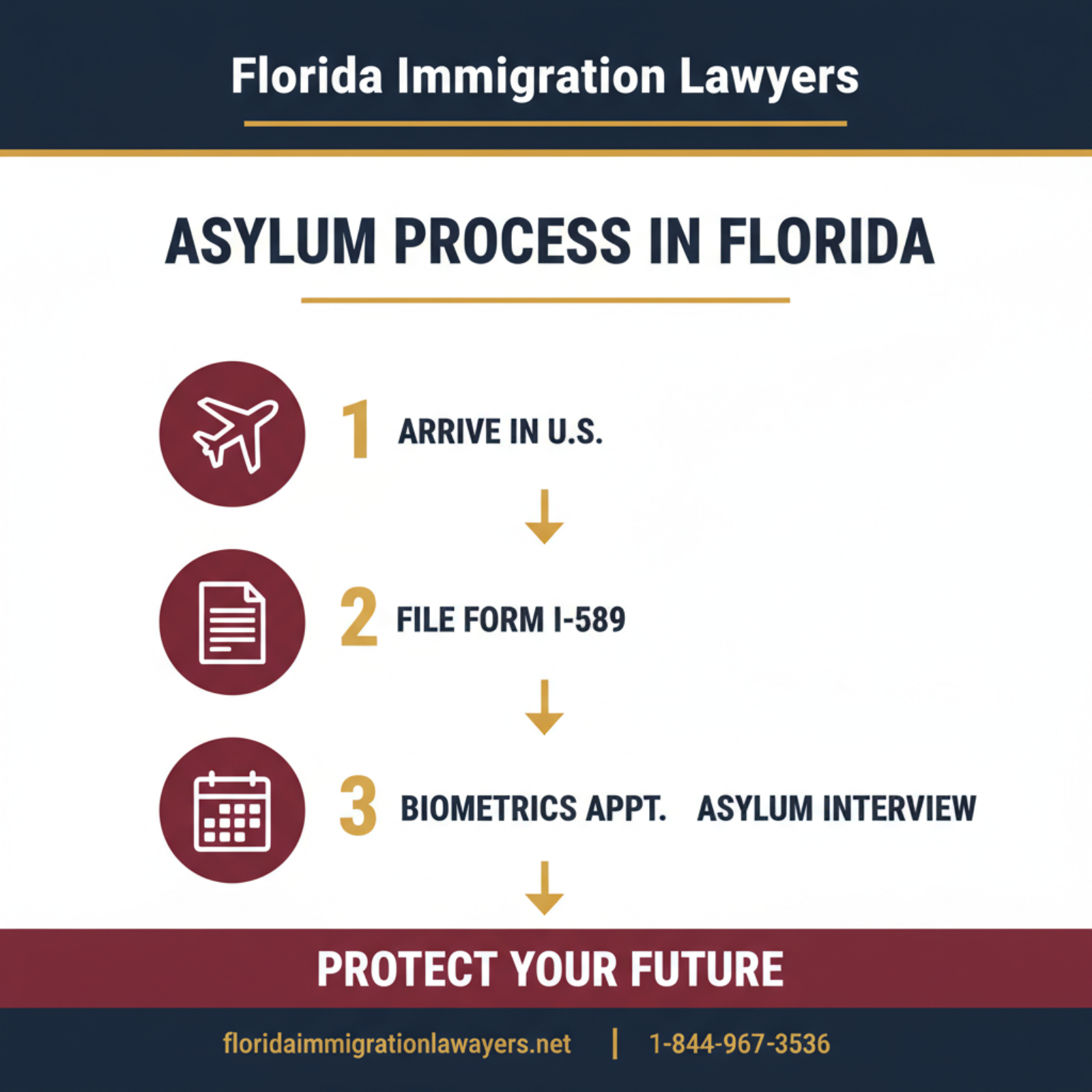
- Attend Your Biometrics Appointment: After filing, USCIS will send you a notice to attend a biometrics appointment at an Application Support Center (ASC). At this appointment, your fingerprints, photograph, and signature will be collected. These biometrics are used for background and security checks. It is mandatory to attend this appointment, and failure to do so can lead to the denial of your application.
- Receive Your Interview Notice: If your application is complete and you pass initial background checks, USCIS will schedule an asylum interview. The interview will typically take place at a USCIS Asylum Office. In Florida, this could be the Miami Asylum Office, or you might be directed to a field office in Orlando or Tampa depending on your residence. The notice will provide the date, time, and location of your interview. It is crucial to prepare thoroughly for this interview.
- Attend Your Asylum Interview: This is a critical stage where an Asylum Officer will question you under oath about your application and the basis of your fear. You have the right to have an attorney present with you during the interview. Your attorney can clarify questions, ensure fairness, and help you present your case effectively. Be honest, consistent, and provide clear answers. The interview may be conducted in English or with the help of an interpreter provided by USCIS.
- Receive a Decision: After the interview, the Asylum Officer will make a decision. If your application is approved, you will be granted asylum. This allows you to live and work permanently in the U.S. and eventually apply for a Green Card. If your application is not approved, and you are not in lawful immigration status, your case will typically be referred to an Immigration Judge for defensive asylum proceedings. This means you will enter removal proceedings, where you can present your asylum claim again before a judge. If you are already in status, your application may be denied without referral to court.
Essential Documents for Your Asylum Claim in Florida
A well-supported asylum application is key to success. Gathering comprehensive documentation is as important as your personal testimony. Here is a checklist of documents you should strive to collect and submit with your Form I-589:
- Form I-589: Completed and signed, with all required biographical information and the detailed narrative of your persecution fear.
- Identification Documents: Copies of your passport, national ID card, birth certificate, and any U.S. immigration documents (e.g., I-94 arrival record, visa).
- Evidence of Persecution:
- Police reports, court documents, or official records detailing incidents of harm or threats.
- Medical records or psychological evaluations documenting injuries or trauma suffered.
- News articles, human rights reports, or country condition reports from credible sources (e.g., U.S. Department of State, Amnesty International, Human Rights Watch) that corroborate the general situation in your home country and the specific type of persecution you fear.
- Affidavits or sworn statements from witnesses who can attest to your persecution or fear.
- Photographs, videos, or other media that support your claim.
Step-by-Step Process Guide - Proof of Membership in a Protected Group: Documents showing your race, religion, nationality, political affiliation, or membership in a particular social group (e.g., membership cards, letters from organizations, articles about your activism).
- Marriage and Birth Certificates: For you and any family members you wish to include in your application (spouse and unmarried children under 21).
- Translations: Any document not in English must be accompanied by a certified English translation. The translator must provide a statement certifying their competence and the accuracy of the translation.
- Personal Statement/Affidavit: A detailed, written account of your experiences, the reasons for your fear, and why you cannot return home. This often expands upon the narrative provided in Form I-589.
Asylum Application Florida Timeline and Processing Expectations
The asylum process in the United States, including Florida, is notoriously lengthy. There is no quick answer to how long your asylum application will take, as processing times vary significantly based on numerous factors. These include the volume of applications, staffing levels at USCIS and the immigration courts, and the complexity of individual cases.
After filing Form I-589, you will typically receive a receipt notice within a few weeks. The biometrics appointment usually follows within 1-3 months. However, the wait time for an asylum interview can range from several months to several years, especially at busy offices like the Miami Asylum Office.
USCIS aims to prioritize newer asylum applications to expedite processing, but backlogs persist. If your case is referred to an Immigration Judge, the court process can add several more years to the timeline, involving multiple hearings. It is not uncommon for an asylum case to take 3-5 years or even longer from initial filing to a final decision.
During this waiting period, many asylum seekers become eligible to apply for work authorization. After 180 days have passed since the filing of a complete asylum application, and as long as your application is still pending, you may apply for an Employment Authorization Document (EAD) by filing Form I-765. This allows you to legally work in the U.S. while your asylum case is being processed, providing much-needed financial stability.
It is crucial to remain patient and persistent throughout this extended period. Keeping your contact information updated with USCIS and the immigration court is vital. Any changes to your address must be reported promptly to ensure you receive important notices.
Cost Factors and Fees for Asylum Seekers in Florida
A common concern for asylum seekers is the financial burden associated with the application process. Fortunately, filing Form I-589, Application for Asylum and for Withholding of Removal, with USCIS is free. There are no government filing fees directly associated with seeking asylum itself.
However, while the core application is free, other costs can arise throughout the process. These may include:
- Translation Services: If any of your supporting documents are not in English, you will need to pay for certified translations. The cost varies depending on the document's length and complexity.
- Document Retrieval: You might incur fees to obtain official records, police reports, or medical records from your home country or other sources.
- Medical Examinations: While not typically required for the initial asylum application, a medical exam may be necessary later if you apply for adjustment of status to a Green Card after being granted asylum.
- Expert Witness Fees: In some complex cases, you might choose to hire an expert witness (e.g., a country conditions expert or a psychologist) to provide testimony or reports, which can be expensive.
- Legal Fees: This is often the most significant cost for asylum seekers. While legal representation is not mandatory, having an experienced immigration attorney greatly increases your chances of success. Attorneys charge for their time and expertise in preparing your application, gathering evidence, preparing you for the interview, and representing you at hearings. Florida Immigration Lawyers offers free initial consultations to discuss your case and potential legal costs.
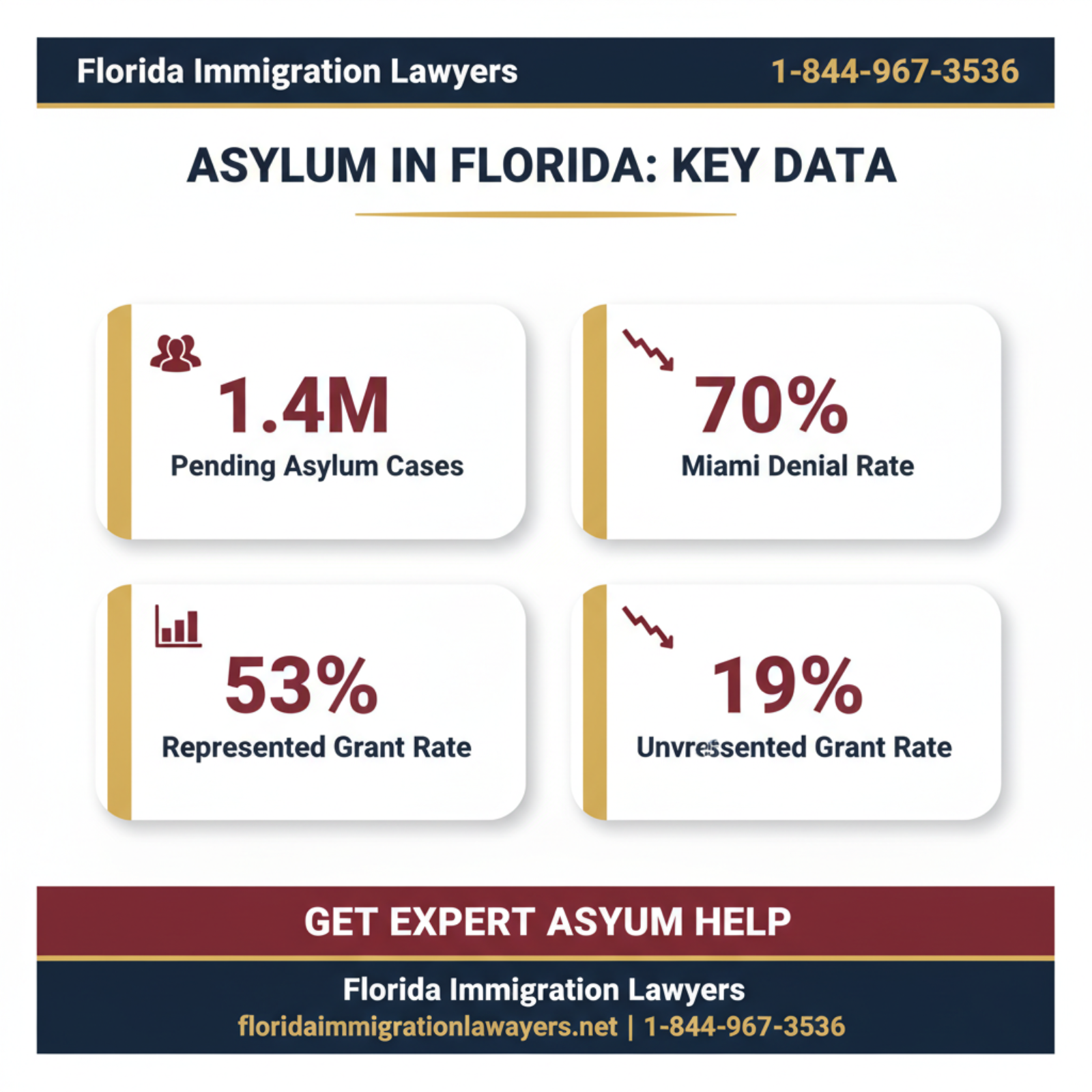
While the cost of legal representation can be a concern, consider it an investment in your future and safety. An attorney can help you avoid critical mistakes, present your case compellingly, and navigate the intricate legal system. Many firms, including ours, offer payment plans to make legal assistance more accessible. Do not let potential costs deter you from seeking essential legal help.
Do not navigate this process alone. Contact Florida Immigration Lawyers today to schedule your free consultation and learn how we can support your asylum claim. Visit our website at Florida Immigration Lawyers Contact.
Common Mistakes to Avoid During Your Asylum Application in Florida
The asylum application process is unforgiving of errors. Even small mistakes can lead to significant delays or even denial of your claim. Being aware of these common pitfalls can help you avoid them:
- Missing the One-Year Filing Deadline: This is perhaps the most common and devastating mistake. Failing to file Form I-589 within one year of your last arrival in the U.S. (without a valid exception) will almost certainly lead to a denial. Keep meticulous records of your entry dates.
- Inconsistent Testimony or Information: Any discrepancies between your written application, your interview testimony, and your supporting documents can severely undermine your credibility. Be truthful and consistent in all statements and documents.
- Insufficient or Weak Evidence: A strong claim needs strong evidence. Relying solely on your testimony without corroborating documents, country condition reports, or witness affidavits can weaken your case significantly. Gather all possible proof.
- Failing to Disclose All Prior Immigration History or Arrests: Attempting to conceal past immigration violations, arrests, or criminal convictions can be grounds for denial and even lead to accusations of fraud. Full disclosure, even of negative information, is always the best approach.
- Not Updating Your Address with USCIS and EOIR: If you move, you must notify USCIS and the Executive Office for Immigration Review (EOIR) immediately. Missing crucial notices for interviews or hearings due to an outdated address can result in automatic denial or a removal order.
- Traveling Outside the U.S. While Your Asylum Application is Pending: Leaving the country without specific permission (Advance Parole) can be seen as an abandonment of your asylum claim. Consult an attorney before any international travel.
- Not Preparing Thoroughly for Your Asylum Interview: The interview is your chance to clearly articulate your story. Failing to review your application, recall details, or anticipate questions can lead to a poor performance and a negative outcome.
- Filing an Incomplete or Incorrect Form I-589: Leaving sections blank, answering questions incorrectly, or failing to sign the form can lead to rejection or delays. Every field must be addressed accurately.
- Not Understanding "Particular Social Group": This ground for asylum is complex. Many applicants fail to adequately define or prove their membership in a particular social group that is persecuted. Legal guidance is often essential here.
- Overlooking Defensive Asylum if in Removal Proceedings: If you are placed in removal proceedings, you must understand that you can still apply for asylum defensively. Failing to do so can result in deportation. Explore deportation defense options with Florida Immigration Lawyers.
- Not Seeking Legal Counsel: While not legally required, attempting to navigate the intricate asylum process without an experienced attorney is a significant risk. An attorney provides invaluable expertise, guidance, and advocacy.
When to Call a Florida Asylum Lawyer
Given the complexities and high stakes involved in an asylum application, knowing when to seek legal assistance is crucial. While you can technically file an asylum application on your own, the chances of success are significantly higher with professional legal representation. Florida Immigration Lawyers are experts in this field.
You should consider calling a Florida asylum lawyer from Florida Immigration Lawyers in several specific scenarios:
- Before Filing Your Initial Application: An attorney can help you prepare a comprehensive and accurate Form I-589, gather compelling evidence, and ensure you meet the one-year filing deadline or qualify for an exception.
- If You Have Missed the One-Year Deadline: An attorney can assess if you have a valid exception to the one-year rule and help you gather the necessary evidence to prove it.
- If Your Case Involves Complex Issues: This includes claims based on a "particular social group," persecution by non-state actors, or situations where your fear is not immediately obvious.
- If You Have Prior Criminal History or Immigration Violations: These factors can complicate your asylum claim and may require advanced legal strategies to overcome.
- If You Receive a Notice to Appear (NTA): This indicates you are in removal proceedings, and you will need an attorney to represent you before an Immigration Judge for defensive asylum. Our firm specializes in deportation defense.
- Before Your Asylum Interview: An attorney can prepare you for the types of questions you will face, review your testimony, and accompany you to the interview to provide support and ensure fairness.
- If Your Application is Denied or Referred to Immigration Court: Legal counsel is essential for appealing a denial or effectively presenting your case in defensive asylum proceedings.
- If You Are Seeking Asylum for Family Members: An attorney can guide you through the process of including your spouse and children in your asylum application or petitioning for them later if you are granted asylum. Learn about family immigration services.
Florida Immigration Lawyers understands the unique challenges faced by asylum seekers in Tallahassee, Miami, Orlando, and across the state. We are dedicated to providing compassionate and effective legal representation. Our team is ready to help you navigate this critical journey and fight for your right to safety and freedom.
About Florida Immigration Lawyers
Florida Immigration Lawyers is a leading law firm dedicated to providing exceptional immigration legal services across the entire state of Florida. Our team of highly skilled and compassionate attorneys understands the profound impact immigration matters have on individuals and families. We are committed to achieving the best possible outcomes for our clients through diligent advocacy and personalized attention.
We offer a comprehensive range of immigration services, including asylum applications, deportation defense, family-based petitions, business immigration, citizenship and naturalization, and much more. Our attorneys are well-versed in the intricate and ever-changing landscape of U.S. immigration law, providing strategic advice tailored to your unique circumstances.
Choosing Florida Immigration Lawyers means choosing a partner who will stand by you every step of the way. We pride ourselves on our client-focused approach, ensuring you are informed and empowered throughout your legal journey. Our firm is available 24/7, offering accessible and reliable support when you need it most. We provide free consultations to help you understand your options without financial obligation.
For trusted legal guidance on your asylum application or any immigration matter, contact us today. Our dedicated attorneys are ready to provide the expert assistance you deserve. Visit us at https://www.floridaimmigrationlawyers.net or call 1-844-967-3536.
Frequently Asked Questions About Asylum in Florida
How to apply for asylum in Florida?
To apply for asylum in Florida, you must generally file Form I-589, Application for Asylum and for Withholding of Removal, with USCIS within one year of your last arrival in the U.S. You will then attend a biometrics appointment and an asylum interview. Gathering strong evidence and preparing a detailed narrative are crucial steps.
How long does the asylum process usually take?
The asylum process is typically lengthy. While a receipt notice and biometrics appointment occur relatively quickly, the wait for an asylum interview can be several months to several years. If your case is referred to an Immigration Judge, the entire process can extend to 3-5 years or even longer due to extensive backlogs.
How much money do you need to apply for asylum?
There is no government filing fee for Form I-589, the asylum application itself. However, you may incur costs for certified translations of documents, obtaining evidence, and potentially for expert witnesses. The most significant potential cost is legal fees for an experienced immigration attorney, though a free initial consultation is typically offered.
What are the new rules for asylum?
Immigration laws and policies, especially concerning asylum, are subject to frequent changes. While this article reflects current understanding for 2026, it is vital to stay informed about any new regulations or court decisions that may impact asylum eligibility or procedures. Consulting with an immigration attorney is the best way to get up-to-date information specific to your situation.
Sources and References
- U.S. Citizenship and Immigration Services (USCIS) - Form I-589
- U.S. Citizenship and Immigration Services (USCIS) - Asylum Information
- Executive Office for Immigration Review (EOIR)
- 8 U.S.C. Chapter 12 - Immigration and Nationality Act (INA) Section 101(a)(42)
- 8 U.S.C. § 1158 - Asylum
- 8 CFR § 208.4 - Application for asylum
- USCIS Policy Manual, Volume 7 - Asylum
This article provides general legal information and is not intended as legal advice. Every case is unique, and outcomes depend on specific facts and circumstances. Contact an attorney for advice about your particular situation.
Seeking asylum is a brave and often life-changing decision. While the process can be daunting, remember that you do not have to face it alone. Florida Immigration Lawyers is here to provide the expert legal guidance and unwavering support you need to navigate this journey successfully. Our commitment is to protect your rights and help you secure a safe future in Florida.
Take the first step towards safety and stability today. Call Florida Immigration Lawyers at 1-844-967-3536 for a free, confidential consultation. Se Habla Español - Estamos aquí para ayudarle.
Do Not Navigate This Process Alone
Our experienced immigration attorneys are ready to fight for you. Get a free, confidential consultation today.
Se Habla Español
Frequently Asked Questions
Florida Immigration Lawyers
Immigration Attorney | Founder, Vasquez Law Firm
U.S. Air Force veteran and immigration attorney with thousands of cases resolved. J.D., NCCU School of Law. AILA member. Admitted to the 4th, 5th, and 11th Circuit Courts.
Available 24/7 - Free Evaluations
Related Legal Services
Our Florida immigration attorneys can help you with asylum protection, deportation defense and citizenship and naturalization. Call today at 1-844-967-3536 for a free consultation.
Related Links
Related Topics
Free Legal Consultation
Discuss your case with our experienced attorneys. We're available 24/7.
Se Habla Español - Estamos aquí para ayudarle.
Related Articles
Stokes Interview: Navigating Marriage Fraud in Florida
A Stokes interview is a specialized, separate interview conducted by USCIS when there are suspicions of marriage fraud in a green card application. This rigorous process involves individual questioning of spouses, focusing on inconsistencies in their testimonies to determine the authenticity of their marital bond. For couples in Florida, navigating this high-stakes interview requires meticulous preparation, extensive documentation, and often the strategic guidance of an experienced immigration lawyer. Understanding the process, preparing for detailed questions, and presenting a strong case are crucial for overcoming marriage fraud allegations and securing your immigration future. Florida Immigration Lawyers stands ready to assist you.
Immigration Attorney Gainesville: North Florida Legal Help
For those in Gainesville, Alachua County, and throughout North Florida, navigating U.S. immigration law requires expert guidance. An experienced immigration attorney can simplify complex processes, from family-based petitions and employment visas to critical asylum claims and deportation defense. This comprehensive guide outlines the essential services provided by an immigration attorney, details necessary documentation, clarifies processing timelines, and discusses associated costs. We also highlight common mistakes to avoid and crucial scenarios where legal counsel is indispensable. Florida Immigration Lawyers serves all of Florida, including Gainesville and St. Petersburg, providing dedicated legal support to help you achieve your immigration goals. Contact us for a free consultation to discuss your specific needs.
Military Naturalization Expedited at Florida Bases
Explore expedited military naturalization processes for service members at Florida bases like MacDill. Learn about eligibility, steps, and common mistakes. Contact Florida Immigration Lawyers for a free consultation.
Protect Yourself from Immigration Scams in Florida
Learn how to protect against immigration scams in Florida, focusing on St. Petersburg. This guide covers identifying scams, verifying credentials, and getting legal help. Call Florida Immigration Lawyers at 1-844-967-3536 for assistance.