Adjustment of Status Guide in Florida for 2026
Explore the process of adjustment of status in Florida, including requirements, timelines, and common pitfalls. This comprehensive guide provides insights for immigrants seeking a green card without leaving the U.S. Call Florida Immigration Lawyers for personalized assistance.
Adjustment of status in Venice, Florida allows immigrants to apply for a green card without leaving the U.S. Key requirements include filing Form I-485, maintaining lawful status, and meeting eligibility criteria. This process offers a path to permanent residency.
- File Form I-485 for status adjustment.
- Stay updated on eligibility requirements.
- Understand processing timelines and fees.
- Consult legal advice when needed.
Introduction
For many immigrants in Florida, the adjustment of status is a crucial step towards achieving permanent residency. This process allows eligible individuals to apply for a green card without having to leave the United States. Understanding the nuances of this procedure is essential, especially for those residing in areas like Orlando and Venice, Florida. In this guide, we'll explore the steps, requirements, and common pitfalls of adjusting status in Florida. Call Florida Immigration Lawyers at 1-844-YO-PELEO for a free case review and personalized guidance.
Florida, with its vibrant multicultural communities and diverse immigrant population, sees a significant number of individuals seeking to formalize their residency. The adjustment of status offers a streamlined pathway compared to the often lengthier and more complex process of consular processing abroad. It allows applicants to remain with their families, continue their employment, and maintain their lives within the U.S. while their application is under review.
Navigating the U.S. immigration system can be daunting, with ever-evolving regulations and specific documentation requirements. This guide aims to demystify the adjustment of status process for Floridians, providing clear, actionable information. From initial eligibility checks to the final interview, each stage demands careful attention to detail. Our goal is to equip you with the knowledge needed to pursue your dream of permanent residency confidently.
What is Adjustment of Status in Florida?
Adjustment of status is a process that allows certain immigrants to apply for permanent residency from within the United States. As of 2026, applicants in Venice, Florida, can file Form I-485 to change their status. This option is preferable for those who wish to avoid international travel and the complexities of consular processing.
This unique immigration pathway grants eligible individuals the opportunity to transition from a non-immigrant status (such as a tourist, student, or work visa holder) or certain parolee statuses directly to lawful permanent resident status, commonly known as getting a Green Card. The primary advantage for residents across Florida, from Orlando to Miami, is the ability to stay in the U.S. throughout the application period, avoiding the need to travel to a U.S. embassy or consulate in their home country, which can be logistically challenging and emotionally taxing.
Eligibility for adjustment of status hinges on several key factors, including having a valid immigrant petition filed on your behalf (e.g., by a U.S. citizen spouse or employer), maintaining lawful admission or parole into the U.S., and not having violated certain immigration laws. For example, Maria, a Brazilian national living in Tampa on a valid work visa, married a U.S. citizen. Instead of returning to Brazil for her interview, she can pursue adjustment of status in Florida, allowing her to continue working and living with her husband during the process. Understanding these intricate requirements is paramount, and seeking expert advice from Florida Immigration Lawyers can make all the difference.
How Do I Apply for Adjustment of Status?
To apply for adjustment of status, you must follow a series of steps. First, confirm your eligibility based on your current visa status and family or employment ties. Next, file Form I-485 along with the required documents and fees. You may also need to attend a biometrics appointment and an interview at a USCIS office in Florida.
- Verify eligibility for adjustment of status.
- Complete and submit Form I-485.
- Attend biometrics appointment.
- Prepare for a USCIS interview if required.
- Receive a decision on your application.
Verifying your eligibility is the foundational step. This typically involves ensuring you have an approved immigrant petition (like Form I-130 for family-based or Form I-140 for employment-based immigration) and that an immigrant visa is immediately available to you. For immediate relatives of U.S. citizens, a visa is always available, often allowing for concurrent filing of the immigrant petition and Form I-485. For other preference categories, you must consult the monthly Visa Bulletin to determine if your priority date is current.
Once eligibility is confirmed, completing and submitting Form I-485 is critical. This application is often filed concurrently with other forms, such as Form I-765 for an Employment Authorization Document (EAD) and Form I-131 for Advance Parole (travel document). Filing these alongside your I-485 allows you to work and travel internationally while your green card application is pending, providing much-needed flexibility. Ensure all forms are the latest versions and accurately filled to avoid delays or Requests for Evidence (RFEs).
The biometrics appointment involves capturing your fingerprints, photograph, and signature for background checks. This is a mandatory step that USCIS schedules after receiving your application. Following this, if an interview is required, you'll receive a notice. Preparing thoroughly for the interview—reviewing your application, understanding your immigration history, and practicing potential questions—is crucial. An attorney from Florida Immigration Lawyers can help you prepare, ensuring you present your case clearly and confidently. Finally, receiving a decision marks the culmination of the process; an approval leads to your permanent resident card, while a denial may require an appeal or reapplication.
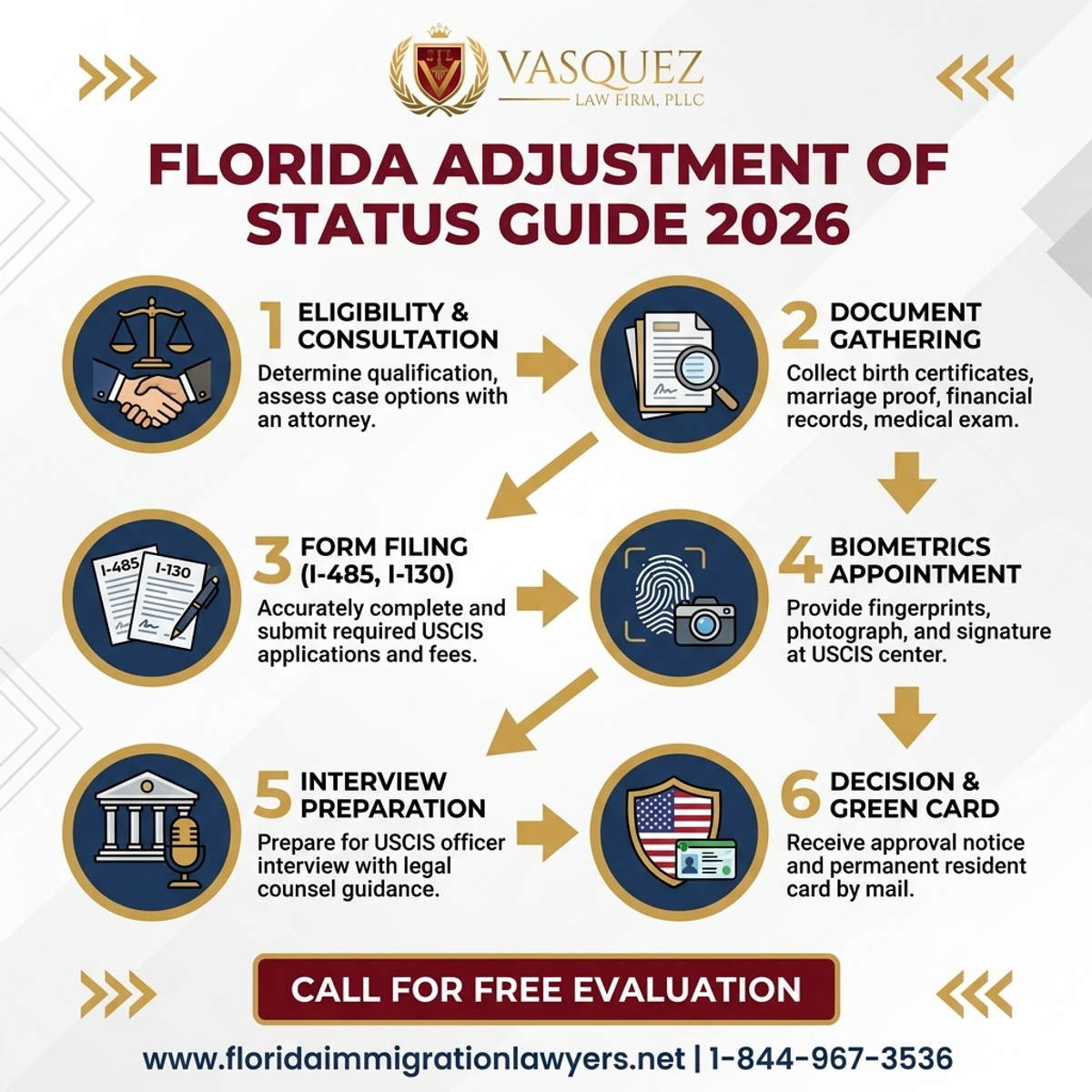
Step-by-Step Process — Adjustment of Status Guide in Florida for 2026
Processing times can vary, so it's advisable to check the latest updates on the USCIS website.
Document Checklist for Adjustment of Status
Gathering the correct documents is crucial for a successful adjustment of status application. Here is a checklist of what you typically need:
- Form I-485, Application to Register Permanent Residence or Adjust Status
- Proof of lawful entry into the U.S.
- Medical examination report
- Proof of financial support (Form I-864)
- Identity documents (passport, birth certificate)
Ensure all documents are current and complete to avoid delays.
Beyond the primary forms, a comprehensive set of supporting documents is essential. For instance, proof of lawful entry can include your I-94 Arrival/Departure Record, visa stamps in your passport, and copies of all previous visa pages. The medical examination, conducted by a USCIS-approved civil surgeon, must be submitted in a sealed envelope and includes vaccinations and health screenings. It's crucial to complete this exam accurately and ensure the civil surgeon is certified.
The Affidavit of Support (Form I-864) is a critical component for family-based applications, demonstrating that the applicant will not become a public charge. The U.S. citizen or permanent resident petitioner must prove they meet specific income thresholds or find a co-sponsor. Identity documents include not only your passport and birth certificate but also marriage certificates (if applicable), divorce decrees from previous marriages, and photographs meeting USCIS specifications. For those with prior immigration applications, copies of those filings and any associated approval notices should also be included.
Practical Tip: Organize your documents meticulously. Create a checklist and make copies of everything you submit. If any document is not in English, it must be accompanied by a certified English translation. Inconsistencies or missing documents are among the most common reasons for delays or Requests for Evidence (RFEs), which can significantly prolong the process. Consulting with Florida Immigration Lawyers can help you compile a robust and error-free application package, ensuring no critical document is overlooked.
Timeline and Processing Expectations
The timeline for processing an adjustment of status application can vary based on several factors. As of 2026, the typical processing time ranges from 8 to 14 months. Here's a breakdown:
| Stage | Typical Timeframe | Notes |
|---|---|---|
| Receipt of I-485 | 2-3 weeks | Receive a receipt notice from USCIS. |
| Biometrics Appointment | 3-5 weeks after filing | Fingerprints and photos taken. |
| Interview Scheduling | 6-8 months | Wait for an interview notice. |
| Final Decision | 8-14 months | Receive a decision on your application. |
Several factors can influence these processing times, including the specific USCIS service center handling your application, the volume of cases they are processing, the complexity of your individual case, and current immigration policies. For instance, family-based petitions for immediate relatives of U.S. citizens often have faster processing times than some employment-based or preference category applications, which may also depend on visa bulletin availability.
During the waiting period, applicants can often apply for an Employment Authorization Document (EAD) and Advance Parole (AP) concurrently with their I-485. The EAD allows you to legally work in the U.S. while your application is pending, and the AP permits you to travel internationally without abandoning your adjustment of status application. Obtaining these interim benefits can significantly ease the burden of the waiting period, providing stability and peace of mind.
Practical Tip: Stay informed by regularly checking your case status online using the receipt number provided by USCIS. You can also sign up for email and text message updates. If your case falls outside the normal processing times listed on the USCIS website, you may be able to submit an inquiry. While waiting, ensure you respond promptly to any Requests for Evidence (RFEs) or interview notices. Florida Immigration Lawyers can assist in monitoring your case and responding effectively to any USCIS communications.
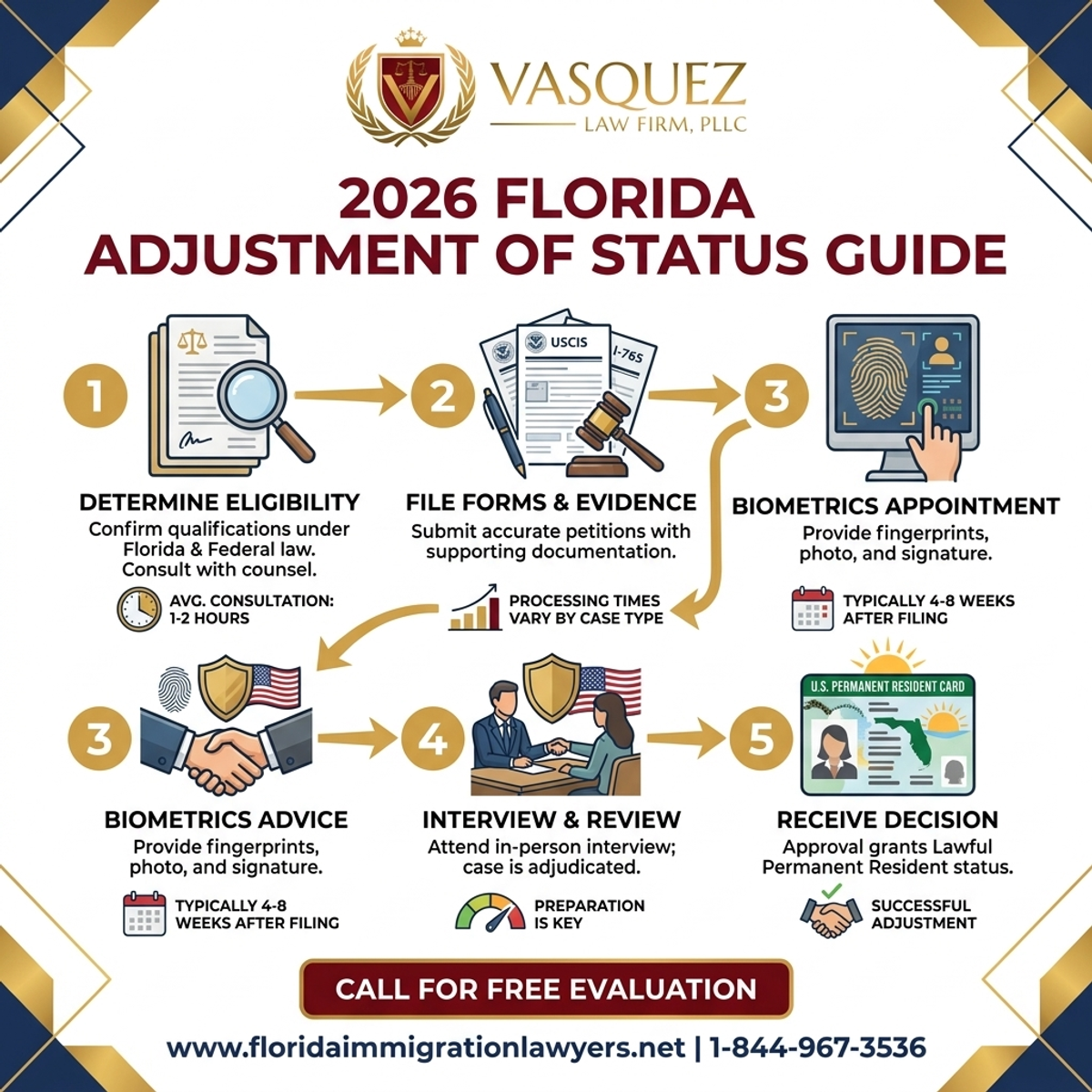
Key Statistics — Adjustment of Status Guide in Florida for 2026
Stay informed of any changes in processing times by visiting the EOIR website.
Cost Factors and Fee Breakdown for Adjustment of Status
Understanding the costs involved in adjusting your status is important for financial planning. Fees are subject to change, so always verify current amounts on the USCIS website. Here's a general idea:
| Item | Typical Fee | Notes |
|---|---|---|
| Form I-485 | Varies | Check USCIS for latest fees. |
| Biometrics Fee | Additional | For fingerprints and photos. |
| Medical Examination | Varies | Depends on provider. |
| Legal Assistance | Varies | Consult with a lawyer for specifics. |
The fee for Form I-485 often includes the biometrics service fee and, when filed concurrently, the fees for Form I-765 (Employment Authorization) and Form I-131 (Advance Parole). This bundled fee can be substantial, so it's essential to budget accordingly and confirm the exact amount on the USCIS website before filing. Incorrect fee payments are a common reason for application rejection or delays.
The medical examination fee is separate from USCIS fees and can vary significantly depending on the civil surgeon and the required vaccinations. It's advisable to call several USCIS-approved civil surgeons in your area of Florida to compare prices and ensure they can complete the exam promptly. Additionally, consider potential hidden costs such as travel expenses to appointments, mailing costs for large application packages, and fees for obtaining foreign documents or certified translations.
For applicants with limited financial resources, USCIS offers fee waivers for certain forms, including the I-485, under specific eligibility criteria. You can apply for a fee waiver by submitting Form I-912, Request for Fee Waiver, along with your application package. However, not all forms are eligible for a waiver, and proving eligibility can be complex. While the costs can seem high, consider legal assistance from Florida Immigration Lawyers as an investment; their expertise can prevent costly mistakes and increase your chances of a successful outcome, potentially saving you money in the long run by avoiding re-filing fees or delays.
Frequently Asked Questions (FAQs) About Adjustment of Status in Florida
Navigating the adjustment of status process can raise many questions. Here are some of the most common inquiries, along with practical advice to guide you:
What is Adjustment of Status?
Adjustment of Status is an immigration process allowing eligible foreign nationals already present in the U.S. to apply for lawful permanent residency (a Green Card) without leaving the country. This is often preferred over consular processing abroad due to convenience, reduced travel risks, and the ability to remain with family and employment in Florida. It's a critical step towards securing your long-term future in the United States.
Who is eligible for Adjustment of Status?
Eligibility primarily depends on having a valid immigrant visa petition approved on your behalf (e.g., family-based or employment-based) and an immigrant visa being immediately available. You must also have been lawfully admitted or paroled into the U.S. and generally maintained lawful status. Certain exceptions exist, like for immediate relatives of U.S. citizens, even with minor overstays. Consulting Florida Immigration Lawyers can clarify your specific eligibility.
What is the role of Form I-485?
Form I-485, Application to Register Permanent Residence or Adjust Status, is the core document for this process. It formally requests USCIS to change your immigration status from non-immigrant to lawful permanent resident. It compiles your personal, immigration, and biographical information, serving as the central piece of your application package to determine your eligibility for a Green Card.
Can I work while my Adjustment of Status application is pending?
Yes, if you file Form I-765 (Application for Employment Authorization) concurrently with your Form I-485, you can obtain an Employment Authorization Document (EAD). This EAD allows you to legally work in the U.S. while your Green Card application is being processed. It's a crucial benefit, providing financial stability during the often lengthy waiting period.
Can I travel outside the U.S. while my Adjustment of Status is pending?
Traveling internationally while your I-485 is pending without proper authorization can lead to abandonment of your application. To travel safely, you must apply for Advance Parole (Form I-131) concurrently with or after your I-485. Once approved, Advance Parole allows you to re-enter the U.S. without jeopardizing your adjustment of status application. Always secure this document before planning any international trips.
What happens if my I-485 is denied?
If your I-485 is denied, USCIS will provide a reason for the denial. Depending on the reason, you may have options such as filing a motion to reopen or reconsider, appealing the decision, or refiling the application if the underlying issue can be resolved. It's crucial to consult an experienced immigration attorney from Florida Immigration Lawyers immediately to assess your options and strategize the best course of action.
How do I know which USCIS office will process my application?
The USCIS service center that processes your I-485 application depends on the type of underlying petition (e.g., family-based vs. employment-based) and your state of residence. Generally, initial processing and biometrics are handled by specific service centers, while interviews (if required) are conducted at local field offices. Your receipt notice will indicate which service center is handling your case, allowing you to track progress online.
Is an interview always required for Adjustment of Status?
Not always. While most family-based adjustment of status applications require an interview, USCIS may waive the interview for certain cases, particularly for employment-based applications or for children adjusting status. However, USCIS retains the discretion to call any applicant for an interview if more information is needed or if there are concerns about eligibility or fraud. Always be prepared for an interview.
Common Mistakes to Avoid
The adjustment of status process is intricate, and even minor errors can lead to significant delays or outright denials. Being aware of common pitfalls is your first line of defense against complications.
- Failing to maintain lawful status: This can lead to denial of your application.
- Submitting incomplete documents: Missing paperwork can delay processing.
- Ignoring interview notices: Missing an interview can result in application denial.
- Incorrect fee payments: Make sure to pay the exact amount required.
- Failing to update address: This can cause missed communications from USCIS.
- Not preparing for the interview: Unpreparedness can affect your interview outcome.
- Overlooking medical exam requirements: This can delay your application.
- Submitting outdated forms: Ensure all forms are the latest versions.
- Providing inconsistent information: Inconsistencies can lead to application denial.
- Ignoring legal advice: Professional guidance can prevent costly mistakes.
Each of these mistakes can have serious repercussions, from requiring you to refile your entire application to potentially placing you in removal proceedings. For instance, failing to update your address with USCIS can mean missing crucial requests for evidence or interview notices, leading to an automatic denial without your knowledge. Similarly, providing inconsistent information across different forms or during an interview can raise red flags for immigration officers, prompting further scrutiny or even accusations of misrepresentation. The complexity of these requirements underscores the importance of a meticulous approach.
When to Call a Lawyer
If you're uncertain about your eligibility or have a complicated immigration history, consulting an immigration lawyer is wise. Florida Immigration Lawyers can assist with complex cases, appeals, and ensure all paperwork is correctly filed. Contact our team if you face any legal challenges or need expert guidance.
There are many scenarios where the expertise of an immigration lawyer becomes invaluable. If you have a history of overstaying a visa, previous immigration violations, a criminal record, or have ever been placed in removal proceedings, your case is inherently complex and requires professional navigation. Additionally, if you've received a Request for Evidence (RFE) or a Notice of Intent to Deny (NOID) from USCIS, a lawyer can help you craft a comprehensive and persuasive response.
An attorney can also provide strategic advice on concurrent filing, help gather difficult-to-obtain documents, and prepare you thoroughly for your USCIS interview, ensuring you present your case confidently and accurately. For residents in Florida, understanding local USCIS office nuances and potential processing variations is also a benefit of local legal counsel. Don't risk your future; Florida Immigration Lawyers at 1-844-YO-PELEO are ready to provide a free case review, offering clarity and strategic guidance tailored to your unique situation.
About Florida Immigration Lawyers
Florida Immigration Lawyers is a dedicated firm offering expert guidance on immigration matters. We provide services ranging from family immigration to deportation defense. Our team is available 24/7 and offers free case reviews. Choose us for our experience and commitment to serving immigrants across Central Florida. With a deep understanding of Florida's diverse communities and specific immigration trends, we are uniquely positioned to advocate for your rights and guide you through every step of the process. Schedule a free consultation with us today.
Sources and References
- U.S. Citizenship and Immigration Services (USCIS)
- Executive Office for Immigration Review (EOIR)
- 8 U.S.C. Chapter 12 - Immigration and Nationality Act
Related services: immigration practice areas, family immigration services, citizenship and naturalization.
This article provides general legal information and is not intended as legal advice. Every case is unique, and outcomes depend on specific facts and circumstances. Contact an attorney for advice about your particular situation.
Final CTA
Consider reaching out to us for personalized immigration assistance. Call 1-844-YO-PELEO for a free consultation. Se Habla Español - Estamos aquí para ayudarle.
If you need legal assistance, learn more about immigration lawyers in Florida, or call us at 1-844-967-3536 for a free case review.
Do Not Navigate This Process Alone
Our experienced immigration attorneys are ready to fight for you. Get a free, confidential case review today.
Se Habla Español
Or leave your details and we’ll call you:
Free Evaluation in 24 Hours
Or talk to us right now

AI voice assistant — available 24/7
FreeFrequently Asked Questions

William J. Vásquez
Founding Attorney · Vasquez Law Firm
U.S. Air Force veteran and immigration attorney with years of hands-on U.S. immigration experience. J.D., NCCU School of Law. AILA member. Admitted to the 4th, 5th, and 11th Circuit Courts.
Available 24/7 - Free Evaluations
Reviewed for legal accuracy by William J. Vásquez
Licensed in North Carolina; U.S. immigration is federal practice.
Related Legal Services
Our Florida immigration attorneys can help you with deportation defense, family immigration services and immigration lawyer cost in Florida. Call today at 1-844-YO-PELEO for a free case review.
Related Links
Related Topics
Free Legal Case Review
Discuss your case with our experienced attorneys. We're available 24/7.
Se Habla Español - Estamos aquí para ayudarle.
Related Articles
DUI Immigration Consequences in Florida 2026
A DUI conviction in Florida can have severe immigration consequences, potentially leading to inadmissibility, deportation, or denial of immigration benefits. For non-citizens, a DUI is not just a traffic offense but a serious criminal matter that federal immigration law scrutinizes closely. Factors like multiple offenses, injury, or property damage can escalate a simple DUI to a Crime Involving Moral Turpitude (CIMT) or even an aggravated felony, triggering mandatory detention and removal proceedings. Understanding the specific nature of your Florida conviction and its interpretation under the Immigration and Nationality Act (INA) is crucial. This article outlines how DUIs impact immigration status, the grounds for inadmissibility and deportation, a step-by-step guide to navigating the process, essential documentation, and expected timelines for 2026. We also highlight common mistakes to avoid and when to seek legal counsel from an experienced immigration attorney. Florida Immigration Lawyers offers comprehensive support for individuals facing these challenging situations, providing expert guidance through complex legal landscapes.
Dual Citizenship Lawyer in Florida: What You Need to Know
For Florida residents, the concept of dual citizenship, or holding two passports, offers a compelling blend of opportunities and challenges. While the U.S. generally permits dual nationality, the path to achieving this status requires a meticulous understanding of both U.S. immigration laws and the citizenship policies of your country of origin. This guide explores the definition of dual citizenship, the detailed step-by-step process for U.S. naturalization, and the significant benefits and potential pitfalls involved. We cover essential documentation, typical timelines, and cost considerations for 2026, providing crucial insights for anyone in Orlando, Miami, or across Florida considering this important legal step. Learn about common mistakes to avoid and understand when to seek professional legal counsel to navigate this complex process successfully. Florida Immigration Lawyers is here to provide expert, bilingual support for your dual citizenship journey.
EAD Advance Parole Combo Card in Florida: What You Need
An EAD advance parole combo card allows individuals with pending adjustment applications to both work and travel abroad without jeopardizing their green card application. Learn how to apply in Florida, what documents you need, and common mistakes to avoid.
EAD Advance Parole Combo Card in Florida 2026
For individuals with a pending Form I-485, Application to Register Permanent Residence or Adjust Status, the EAD Advance Parole Combo Card is an essential document. This single card combines the authorization to work legally in the U.S. (Employment Authorization Document - EAD) with permission to travel internationally and re-enter without abandoning your green card application (Advance Parole). This guide from Florida Immigration Lawyers provides a comprehensive overview for applicants in Florida in 2026, covering eligibility, the step-by-step application process, required documents, expected processing times, and associated costs. We also highlight common mistakes to avoid and when to seek legal counsel to ensure a smooth and successful immigration journey. Understanding this vital card is key to maintaining stability while awaiting your permanent residency approval.