2026 TPS Re-registration Deadlines in Florida | VLF Florida
Stay informed about the 2026 TPS re-registration deadlines in Florida to maintain your legal status. Call Florida Immigration Lawyers for guidance.

- TPS allows eligible individuals to stay in the U.S. without fear of deportation.
- Re-registration ensures continued lawful presence and work authorization.
- Deadlines are strict; missing them can lead to loss of status.
- Consult with a lawyer to avoid common pitfalls.
Introduction
Imagine living in Hialeah, Florida, under the protection of Temporary Protected Status (TPS). Life seems stable until you realize the 2026 re-registration deadline is fast approaching. Missing this deadline could drastically affect your ability to live and work in the U.S. This article explains the re-registration process, deadlines, and what you must do to maintain your status in Florida. Call Florida Immigration Lawyers at 1-844-967-3536 for a free consultation.
For thousands of individuals and families across Florida, particularly within the vibrant immigrant communities of Hialeah, TPS offers a critical safeguard against returning to unsafe conditions in their home countries. The continuous renewal of this status is not merely a bureaucratic step; it's a reaffirmation of their right to live, work, and contribute to American society without constant fear.
Understanding the nuances of the re-registration process, from gathering the correct documents to submitting your application on time, is paramount. This guide aims to demystify these steps, providing clear, actionable advice to help you navigate the system successfully. Remember, proactive engagement and accurate filing are your best allies in securing your future in the United States.
Understanding Temporary Protected Status
Temporary Protected Status (TPS) is a designation by the U.S. government for individuals from countries experiencing conditions that temporarily prevent safe return. This includes natural disasters, ongoing armed conflict, or other extraordinary conditions. TPS provides protection from deportation and work authorization.
In Florida, particularly in Hialeah, TPS is a lifeline for many immigrants. With a significant population of immigrants from TPS-designated countries, awareness of re-registration procedures is vital. The program is governed by the Immigration and Nationality Act (INA) and managed by the U.S. Citizenship and Immigration Services (USCIS).
The decision to designate a country for TPS is made by the Secretary of Homeland Security, often after careful consideration of humanitarian crises, environmental disasters, or widespread violence. Once designated, eligible nationals of that country who are already in the U.S. by a specific date can apply for TPS. This status is temporary and is typically granted for periods of 6, 12, or 18 months, subject to extension if the conditions in the home country do not improve.
Beyond protection from deportation and the ability to work legally, TPS recipients may also be eligible to apply for travel authorization (Advance Parole), allowing them to leave and re-enter the U.S. This can be crucial for visiting family abroad or for humanitarian purposes. However, it's essential to consult with an attorney like those at Florida Immigration Lawyers before traveling to ensure you understand all implications and requirements.
For many, TPS is not just a legal status; it represents stability and the chance to build a new life away from conflict or disaster. It allows individuals to contribute to the U.S. economy, support their families, and integrate into their communities, making the re-registration process an annual priority for their continued well-being.
Step-by-Step Guide to Re-registration
- Check Your Designation: Confirm if your country remains on the TPS list by visiting the USCIS website.
- Gather Documents: Collect necessary documents such as your current Employment Authorization Document (EAD), identity proof, and any prior TPS approval notices.
- Complete Forms: Fill out Form I-821, Application for Temporary Protected Status, and Form I-765, Application for Employment Authorization.
- Pay Fees: Prepare to pay the relevant fees unless you qualify for a fee waiver. Check USCIS for fee details.
- Submit Application: Send your application package to the designated USCIS address for Florida residents.
- Follow Up: Track your application status via the USCIS online portal.
Each step in the re-registration process is critical and requires careful attention to detail. For instance, when checking your country's designation, ensure you review the specific dates and eligibility criteria, as these can sometimes change with each extension. A common mistake is assuming that because your country was previously designated, it automatically will be again without checking the latest announcements.
When gathering documents, create a checklist and make multiple copies of everything. It's wise to keep an organized file of all your immigration documents, including previous applications, approval notices, and any correspondence from USCIS. This organized approach can save significant time and stress if additional information is requested or if you need to refer back to past submissions.
Completing Forms I-821 and I-765 accurately is paramount. Read all instructions thoroughly. Any discrepancies or missing information could lead to delays or even a denial. If you have any doubts about how to answer a specific question, or if your personal circumstances have changed since your last application (e.g., a new address, a minor criminal infraction), it is highly recommended to seek professional legal advice from Florida Immigration Lawyers to ensure everything is handled correctly.
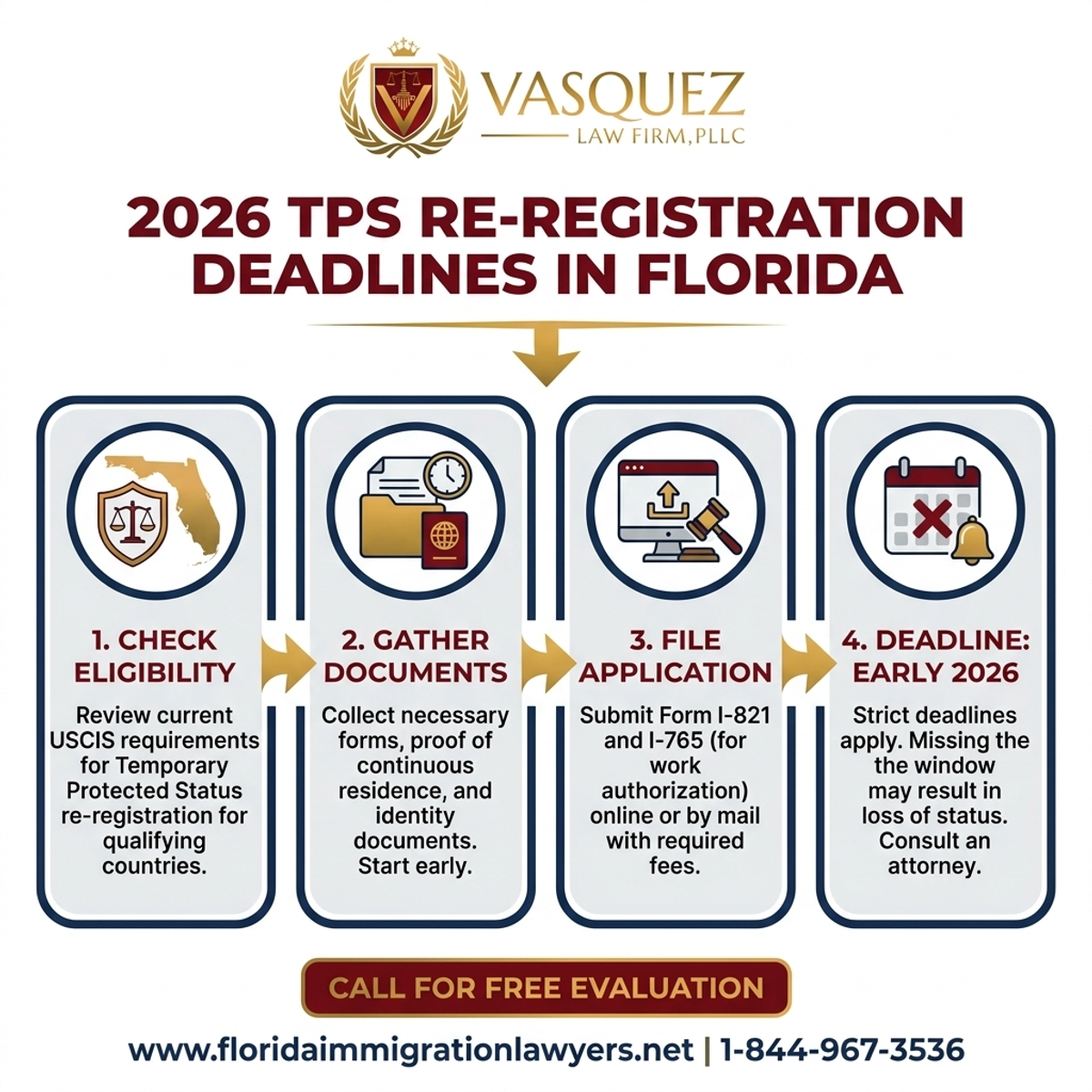
Step-by-Step Process — 2026 TPS Re-registration Deadlines in Florida
Document Checklist for TPS Re-registration
- Completed Form I-821
- Completed Form I-765
- Current Employment Authorization Document (EAD)
- Proof of identity (passport, birth certificate)
- Proof of residence in the U.S.
- Any prior TPS approval notices
- Filing fee or fee waiver request
Ensuring you have every item on this checklist is not just a formality; it's a critical step in preventing delays or outright rejection of your application. For instance, when providing proof of identity, ensure the documents are current and clearly legible. For proof of residence, utility bills, rental agreements, or bank statements showing your name and address in the U.S. are generally accepted. The goal is to demonstrate continuous physical presence in the U.S. since your last TPS designation.
It's also crucial to include copies of all prior TPS approval notices. These documents serve as a historical record of your status and help USCIS verify your eligibility for re-registration. Before mailing your package, double-check that every form is signed and dated, as unsigned forms are a common reason for applications being returned. Consider having a trusted friend or legal professional review your package before submission to catch any overlooked details.
Timeline and Processing Expectations
Re-registration for TPS must be completed within the set deadlines. Typically, the re-registration period opens 60 days before the current TPS expiration date. Processing times can vary, but most applications are processed within 3-6 months. Delays can occur if additional documentation is required.
In Hialeah, Florida, it's advisable to start re-registration early to account for any unforeseen delays. Regularly check the USCIS website for updates and processing timelines.
While USCIS strives to process applications efficiently, various factors can influence the timeline. These include the volume of applications received, the complexity of individual cases, and whether you are asked to provide additional evidence (Request for Evidence - RFE). If you receive an RFE, it's crucial to respond promptly and accurately, ideally with the assistance of an immigration attorney, to avoid further delays or potential denial.
During the waiting period, you can often check the status of your application online using the receipt number provided by USCIS. It's also important to ensure that USCIS has your most current mailing address. If you move, you must update your address with USCIS immediately through their online change of address form. Failure to do so could mean missing important notices or RFEs, which could jeopardize your TPS status. Florida Immigration Lawyers can help you manage these updates and track your application.
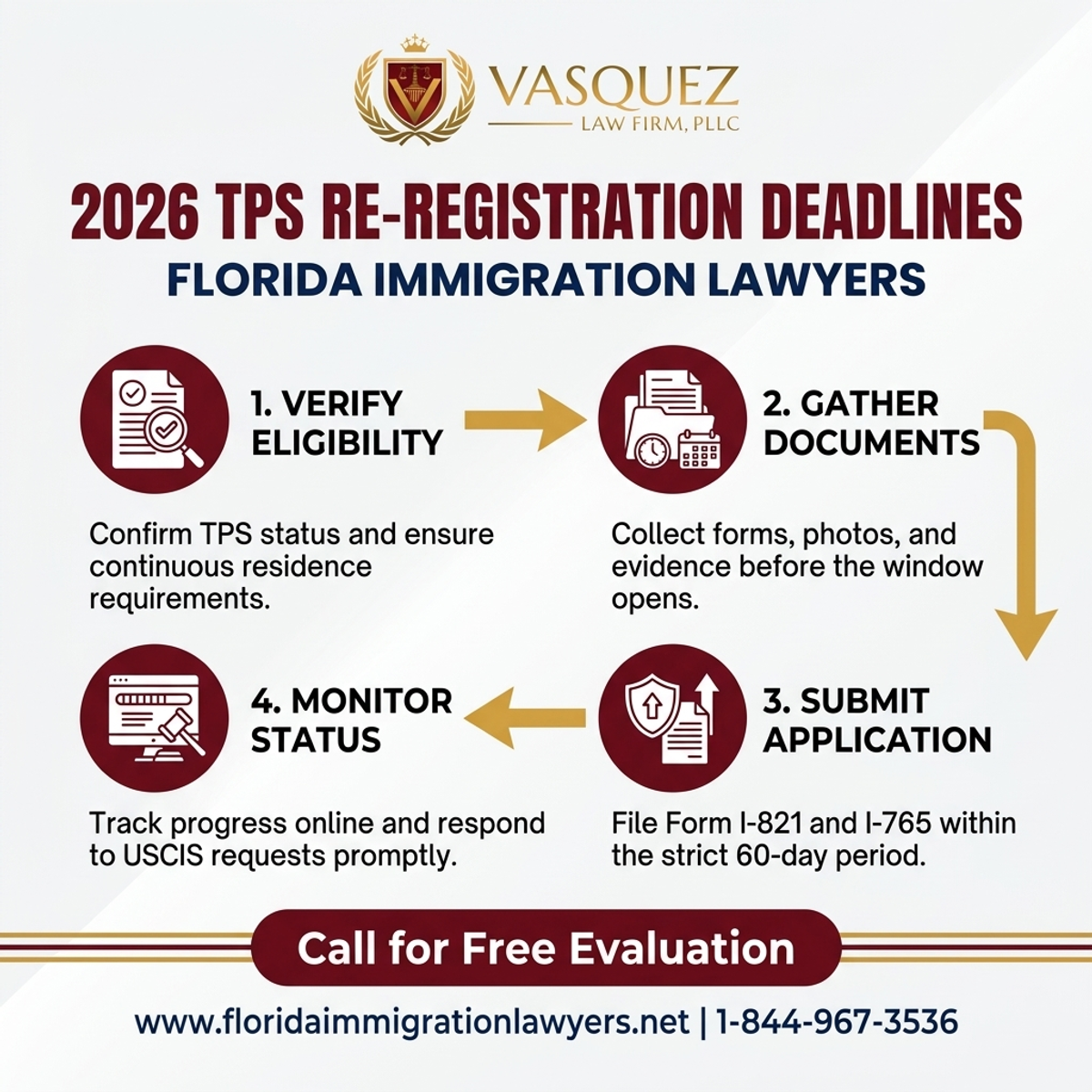
Key Statistics — 2026 TPS Re-registration Deadlines in Florida
Cost Factors and Fee Breakdown
While TPS application fees can change, they generally cover form processing and biometrics services. Fee waivers are available for those who qualify based on income or other criteria. Always verify current fees on the USCIS website before submitting your application.
Costs can also include legal assistance fees if you choose to consult an immigration attorney, which is highly recommended to avoid errors and ensure compliance with all requirements.
The fees associated with TPS re-registration typically include a filing fee for Form I-821 (Application for Temporary Protected Status) and a fee for Form I-765 (Application for Employment Authorization), along with a biometrics services fee. These fees are subject to change, so always consult the USCIS website for the most current fee schedule. For individuals facing financial hardship, USCIS offers a fee waiver process, which involves submitting Form I-912, Request for Fee Waiver, along with supporting documentation demonstrating inability to pay.
While the direct government fees are a primary consideration, it's important to also factor in potential costs for professional legal assistance. Investing in an experienced immigration attorney, such as those at Florida Immigration Lawyers, can be invaluable. They can help ensure your application is complete, accurate, and submitted on time, significantly reducing the risk of delays or denials that could cost you more in the long run, both financially and in terms of your immigration status. Think of legal fees as an investment in peace of mind and the security of your future in the U.S.
Do not navigate this process alone. Contact Florida Immigration Lawyers today.
Common Mistakes to Avoid
- Missing Deadlines: Failing to file within the re-registration period can lead to loss of TPS.
- Incomplete Applications: Missing information can cause application delays or denials.
- Incorrect Fees: Paying the wrong amount can result in application rejection.
- Not Updating Address: Failure to notify USCIS of address changes can result in lost communication.
- Ignoring Requests for Evidence: Not responding to USCIS requests can halt your application.
- Relying on Unauthorized Advice: Following incorrect guidance can jeopardize your status.
- Submitting False Information: Providing inaccurate details can lead to severe legal consequences.
- Neglecting to Renew Work Authorization: Overlooking EAD renewal can disrupt employment.
- Forgetting to Check Status: Regularly track your application to catch issues early.
- Assuming Automatic Renewal: TPS is not automatically extended; re-registration is mandatory.
Avoiding these common pitfalls is crucial for a smooth re-registration process. Many of these mistakes, while seemingly minor, can have significant repercussions, including the loss of your protected status and work authorization. For example, missing the re-registration deadline, even by a day, can be extremely difficult to overcome without compelling circumstances, potentially leading to a loss of status and increased risk of deportation. Always treat deadlines as firm and aim to submit your application well in advance.
Another critical error is neglecting to update your address with USCIS. If USCIS sends an RFE or an approval notice to an old address, and you don't receive it, your application could be denied without your knowledge. Maintaining accurate contact information is a simple yet vital step in ensuring continuous communication and successful re-registration. When in doubt about any aspect of your application, remember that Florida Immigration Lawyers are available to provide expert guidance and prevent these common errors.
When to Call a Lawyer
Consider consulting an immigration lawyer if you face complex issues such as criminal history, previous immigration violations, or need clarification on TPS eligibility. Legal assistance ensures accurate application and compliance with immigration laws. Florida Immigration Lawyers offer expertise in navigating TPS processes, providing peace of mind and professional support.
Beyond the common scenarios, you should also seek legal counsel if your case involves any past immigration denials, deportation orders, or if you've ever had issues with law enforcement, even minor ones. These complexities can significantly impact your eligibility and require a nuanced understanding of immigration law that only an experienced attorney can provide. Attempting to navigate such issues alone could inadvertently lead to severe consequences for your status.
Furthermore, if you are considering applying for other immigration benefits while holding TPS, such as adjustment of status to a lawful permanent resident, or if you need to travel internationally and require Advance Parole, consulting with a lawyer is essential. These processes are often intertwined and require careful planning to ensure your TPS status is not jeopardized. The team at Florida Immigration Lawyers is adept at handling these intricate situations, providing tailored advice and robust representation to protect your interests.
A lawyer can also be invaluable if you receive a Request for Evidence (RFE) or a Notice of Intent to Deny (NOID) from USCIS. These notices indicate that USCIS has questions about your application or intends to deny it. Responding effectively to an RFE or NOID often requires legal expertise to provide the correct documentation and arguments within strict deadlines. Don't hesitate to call 1-844-967-3536 for a free consultation if you encounter any of these challenging circumstances.
About Florida Immigration Lawyers
Florida Immigration Lawyers is dedicated to guiding you through the complexities of immigration law. Our team offers services in TPS re-registration, asylum, deportation defense, citizenship, and more. With a focus on personalized service, we are available 24/7 for free consultations. Call us at 1-844-967-3536 or visit our website to learn more. Serving all of Florida, we are here to help you achieve your immigration goals.
Our firm understands that immigration matters are deeply personal and often life-changing. That's why we commit to providing compassionate, comprehensive, and culturally sensitive legal assistance to our diverse clientele across Florida. From the initial consultation to the final resolution of your case, we prioritize clear communication and strategic planning to navigate the often-intimidating landscape of U.S. immigration law.
Whether you are seeking to renew your TPS, defend against deportation, or embark on the path to U.S. citizenship, our experienced attorneys bring a wealth of knowledge and a track record of success. We stay abreast of the latest changes in immigration policy and law to ensure our clients receive the most current and effective legal strategies. Your journey towards a stable future in the United States is our priority, and we are here to support you every step of the way.
Frequently Asked Questions About TPS Re-registration
What happens if I miss the TPS re-registration deadline?
Missing the re-registration deadline can lead to the loss of your Temporary Protected Status, making you vulnerable to deportation. USCIS generally has strict rules, and late filing is only excused under very limited, extraordinary circumstances. It's crucial to file within the designated window to maintain your lawful presence and work authorization in the U.S. If you have missed the deadline, contact Florida Immigration Lawyers immediately to explore any possible remedies.
Can I travel outside the U.S. while on TPS?
Yes, TPS beneficiaries can travel outside the U.S., but only if they first apply for and receive an Employment Authorization Document (EAD) with an Advance Parole endorsement or a separate Advance Parole document (Form I-131) from USCIS. Traveling without this authorization can result in being denied re-entry into the U.S. and potentially losing your TPS status. Always consult with an attorney before making travel plans to ensure compliance.
Is TPS a path to a Green Card or U.S. citizenship?
TPS itself does not directly lead to a Green Card (lawful permanent residency) or U.S. citizenship. However, holding TPS can sometimes provide a pathway to pursue other forms of immigration relief, such as adjustment of status, if you meet additional eligibility requirements (e.g., marriage to a U.S. citizen, or eligibility for another visa category). It's a complex area, and a consultation with Florida Immigration Lawyers can help you understand your options.
What documents do I need to prove continuous residence in the U.S. for TPS?
To prove continuous residence, you'll need documents like utility bills, rental agreements, bank statements, employment records, school records, medical records, or affidavits from friends/family attesting to your presence. These documents should cover the entire period required by your country's TPS designation. The more comprehensive your evidence, the stronger your case. Organize everything clearly and chronologically for USCIS review.
What if my home country's TPS designation ends?
If your home country's TPS designation ends, your protected status will terminate on the specified date. This means you will no longer have protection from deportation or work authorization based on TPS. It's critical to explore other immigration options well before the termination date, such as asylum, family-based visas, or other forms of relief. Florida Immigration Lawyers can help assess your individual situation and identify alternative pathways.
Sources and References
- U.S. Citizenship and Immigration Services (USCIS)
- Executive Office for Immigration Review (EOIR)
- 8 U.S.C. Chapter 12 - Immigration and Nationality Act
Related services: immigration practice areas, family immigration services, citizenship and naturalization.
This article provides general legal information and is not intended as legal advice. Every case is unique, and outcomes depend on specific facts and circumstances. Contact an attorney for advice about your particular situation.
Seize control of your future by staying informed about your TPS status. Call Florida Immigration Lawyers at 1-844-967-3536 for a free consultation. Se Habla Español - Estamos aquí para ayudarle.
If you need legal assistance, learn more about get immigration legal help today, or call us at 1-844-967-3536 for a free consultation.
Do Not Navigate This Process Alone
Our experienced immigration attorneys are ready to fight for you. Get a free, confidential consultation today.
Se Habla Español
Frequently Asked Questions
Florida Immigration Lawyers
Immigration Attorney | Founder, Vasquez Law Firm
U.S. Air Force veteran and immigration attorney with thousands of cases resolved. J.D., NCCU School of Law. AILA member. Admitted to the 4th, 5th, and 11th Circuit Courts.
Available 24/7 - Free Evaluations
Related Legal Services
Our Florida immigration attorneys can help you with deportation defense, citizenship and naturalization and family immigration services. Call today at 1-844-967-3536 for a free consultation.
Related Links
Related Topics
Free Legal Consultation
Discuss your case with our experienced attorneys. We're available 24/7.
Se Habla Español - Estamos aquí para ayudarle.
Related Articles
OPT STEM Extension for Florida Graduates | VLF Florida
Explore the OPT STEM extension for Florida's STEM graduates. Understand eligibility, application steps, and common pitfalls. Call 1-844-967-3536 for a consultation.
Motion to Reopen Immigration Case in Florida | VLF Florida
Understanding how to file a motion to reopen an immigration case in Florida can be critical if facing deportation. Learn the process, avoid common pitfalls, and know when to seek legal help. Contact Florida Immigration Lawyers for a free consultation.
Immigration Attorney in West Palm Beach | VLF Florida
Facing immigration challenges in West Palm Beach? Our team at Florida Immigration Lawyers is here to help. Learn about the role of an immigration attorney, steps to hire one, and common pitfalls to avoid. Call 1-844-967-3536 for a free consultation.
Green Card Renewal Process in Florida | VLF Florida
Renew your green card smoothly in Florida by following our comprehensive guide. Understand the process, avoid common pitfalls, and know when to seek legal help. Contact Florida Immigration Lawyers at 1-844-967-3536 for assistance.
