Re-Entry Permit: Avoid Green Card Abandonment | VLF Florida
Learn how a re-entry permit can prevent green card abandonment for LPRs in Florida. Call us for a free consultation!

A re-entry permit, also known as Form I-131, is essential for lawful permanent residents (LPRs) in Florida who plan to travel abroad for an extended period. It helps prevent the abandonment of your green card status. Key takeaways include:
- A re-entry permit is valid for up to two years.
- It must be applied for while still in the U.S.
- Helps maintain LPR status while abroad.
Introduction
Imagine you are a lawful permanent resident in Pembroke Pines, Florida, and you need to travel abroad for an extended period. You may worry about abandoning your green card status. In this article, we explain how a re-entry permit can help protect your status and what steps you need to take. Call Florida Immigration Lawyers at 1-844-967-3536 for a free consultation.
Maintaining your lawful permanent resident (LPR) status is paramount, especially when international travel becomes a necessity. Many LPRs, often referred to as green card holders, are unaware of the potential risks associated with prolonged absences from the United States. Without proper planning, a trip that lasts longer than anticipated can inadvertently lead to the presumption that you have abandoned your U.S. residency, creating significant hurdles upon your return.
This comprehensive guide will delve into the intricacies of the re-entry permit, outlining its purpose, the application process, required documentation, and crucial tips to ensure a smooth journey and return. Our aim is to equip you with the knowledge needed to navigate this process confidently, safeguarding your hard-earned green card status while fulfilling your personal or professional commitments abroad.
Understanding Re-Entry Permits
A re-entry permit is a travel document that allows LPRs to leave the United States for up to two years without risking their permanent resident status. This is particularly important for individuals who have family or business obligations that require extended travel.
While a green card generally allows for international travel, absences exceeding six months can raise questions at the port of entry, and absences of one year or more without a re-entry permit are typically considered an abandonment of LPR status. The re-entry permit serves as official proof to U.S. Customs and Border Protection (CBP) that you intend to return to the U.S. and maintain your permanent residency, even during a lengthy stay overseas. It essentially acts as a waiver for the usual one-year abandonment rule.
It's crucial to understand that a re-entry permit is not merely a formality; it's a vital tool for LPRs who foresee needing to spend significant time outside the U.S. Whether you're caring for an ailing family member, pursuing an international education, or managing an overseas business venture, this document provides peace of mind and legal protection. Without it, you could face intense scrutiny, lengthy interviews, or even denial of re-entry by immigration officials upon your return to Florida.
Why You Need a Re-Entry Permit
Without a re-entry permit, extended absences from the U.S. may lead to the presumption of abandonment of your green card. This can result in complications when trying to re-enter the country. It's crucial to apply for this permit to safeguard your residency.
The presumption of abandonment means that if you spend more than a year outside the U.S. without a re-entry permit, immigration officials at the port of entry can assume you no longer intend to make the U.S. your permanent home. This places the burden of proof on you to demonstrate strong ties to the U.S. and a clear intent to return, which can be challenging and stressful. Even absences between six months and a year can trigger questions and require you to provide evidence of your intent to maintain residency.
Consider a scenario: An LPR from Miami travels to their home country for nine months to attend to a family emergency. Upon return, without a re-entry permit, they might be subjected to secondary inspection, asked to provide extensive documentation, and potentially face a Notice to Appear (NTA) in immigration court to prove they did not abandon their green card. A re-entry permit explicitly states your intent to return, providing a clear and official document that facilitates your re-entry and significantly reduces such risks and complications. It’s a proactive measure that saves you from potential legal battles and the ultimate loss of your LPR status.
Step-by-Step Guide to Applying for a Re-Entry Permit
- Complete Form I-131, Application for Travel Document. Ensure all sections are filled out accurately.
- Submit the application to the USCIS before leaving the U.S. Remember, you must be physically present in the country when applying.
- Attend a biometrics appointment, which is typically scheduled within a few weeks of submission.
- Wait for approval, which can take several months. Check processing times on the USCIS website.
- Receive your re-entry permit, carry it during your travels, and show it upon re-entry to the U.S.
Let's elaborate on each step to ensure a seamless application process. When completing Form I-131, precision is key. Any discrepancies or incomplete sections can lead to delays or even denial. Double-check all personal information, dates, and addresses. If you're unsure about any question, it's always best to consult with an immigration attorney from Florida Immigration Lawyers to avoid common pitfalls.
The requirement to be physically present in the U.S. when you file Form I-131 is non-negotiable. While you may be able to depart after filing, you must remain in the U.S. long enough to attend your biometrics appointment. This appointment, typically held at a local Application Support Center (ASC), involves capturing your fingerprints, photograph, and signature. Missing this appointment without rescheduling can lead to your application being denied, so mark your calendar and prioritize it.
After your biometrics, the waiting period begins. USCIS processing times can fluctuate significantly, so regularly checking the official USCIS website for current processing times for Form I-131 is highly recommended. Once approved, your re-entry permit will be mailed to the address provided on your application, or to your attorney if you have legal representation. Before embarking on your international travel, make sure you have the physical permit in hand, as a copy will not suffice for re-entry. It is your official proof of intent to return and should be presented to CBP officers when you re-enter the U.S. at any Florida port of entry.
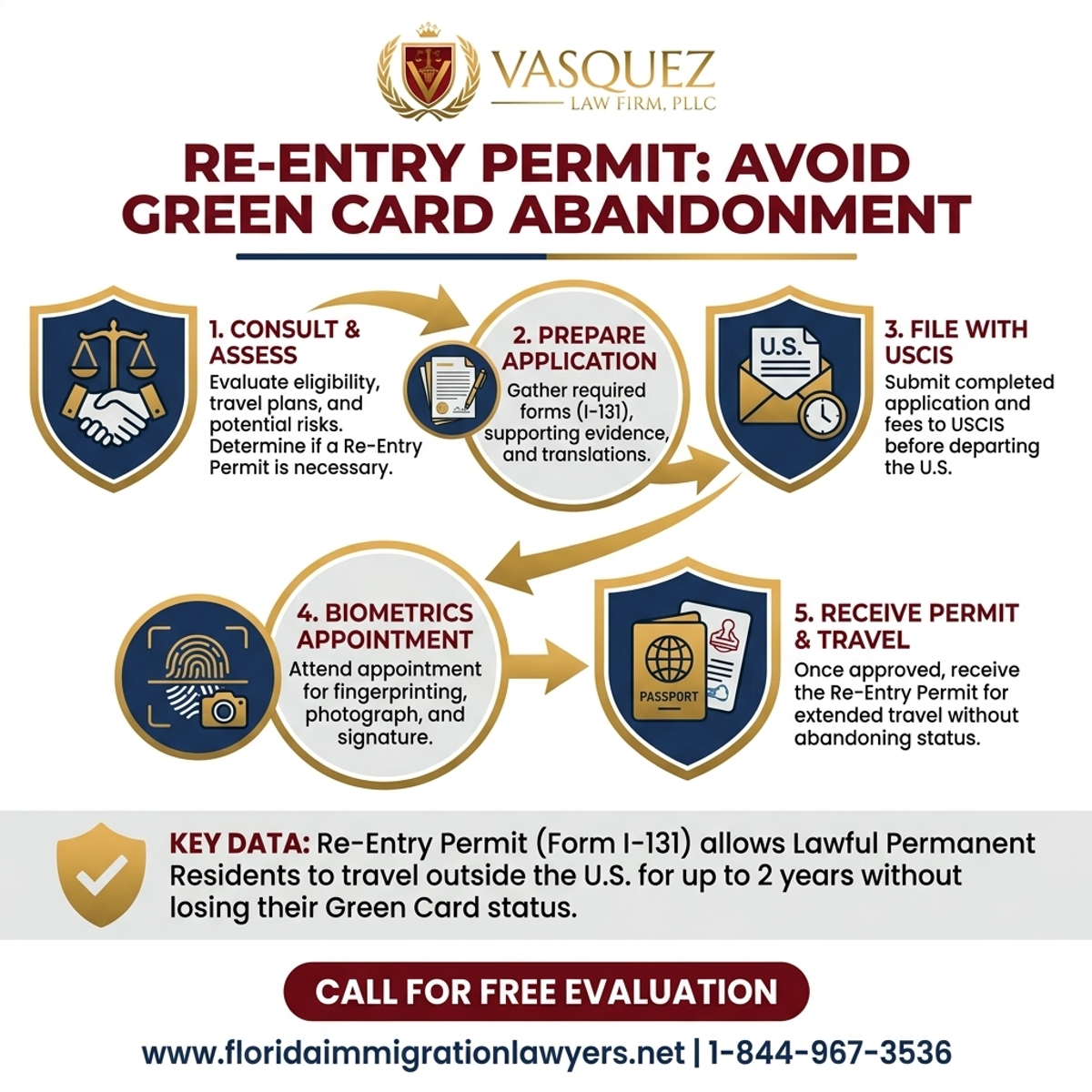
Step-by-Step Process — Re-Entry Permit: Avoid Green Card Abandonment
Document Checklist for Re-Entry Permit
- Completed Form I-131
- Copy of your current green card
- Two passport-style photos
- Proof of residency, such as utility bills or a lease
- Evidence of ties to Florida, like family or employment documentation
Beyond the basic requirements, compiling a thorough set of supporting documents can significantly strengthen your application and prevent potential requests for evidence (RFEs). For your green card copy, ensure it's legible and includes both front and back. The passport-style photos must meet strict USCIS specifications regarding size, background, and head position, so it's advisable to have them taken by a professional service.
When it comes to proof of residency, providing multiple forms of evidence is always better. This could include recent utility bills (electricity, water, internet) in your name at your Florida address, a current lease agreement or property deed, bank statements showing a Florida address, and even state-issued identification like a Florida driver's license. These documents collectively demonstrate your continued domicile in the U.S.
Evidence of ties to Florida is critical for proving your intent to return. This might include employment letters or pay stubs from a U.S. employer, school enrollment records for your children, mortgage statements, car registrations, tax returns filed as a U.S. resident, and even membership in local community organizations. If you have close family members (spouse, children) who are U.S. citizens or LPRs residing in Florida, include their documentation as well. The more evidence you can provide to show your life is rooted in the U.S., the stronger your case for a re-entry permit. A consultation with Florida Immigration Lawyers can help you identify all relevant documents for your specific situation.
Timeline and Processing Expectations
The processing time for a re-entry permit varies but generally takes several months. It's advisable to apply at least six months before your planned departure. The State Department provides updates on processing times.
While the State Department provides general travel information, for specific USCIS processing times related to Form I-131, it's best to consult the USCIS website directly. Processing times can fluctuate based on the volume of applications, staffing levels, and changes in policy. Factors such as the accuracy of your application, the completeness of your supporting documents, and whether an RFE is issued can also impact how long it takes to receive a decision.
Given the potential for lengthy processing times, meticulous planning is essential. If you anticipate needing to travel for an extended period, initiating your re-entry permit application well in advance—ideally 6 to 12 months before your intended departure—is a wise strategy. This allows ample time for filing, attending the biometrics appointment, and receiving the approved permit before you need to leave the country. Should your travel plans be urgent or arise unexpectedly, consulting with Florida Immigration Lawyers at 1-844-967-3536 can help you explore any expedited options or strategies to mitigate risks associated with shorter timelines.
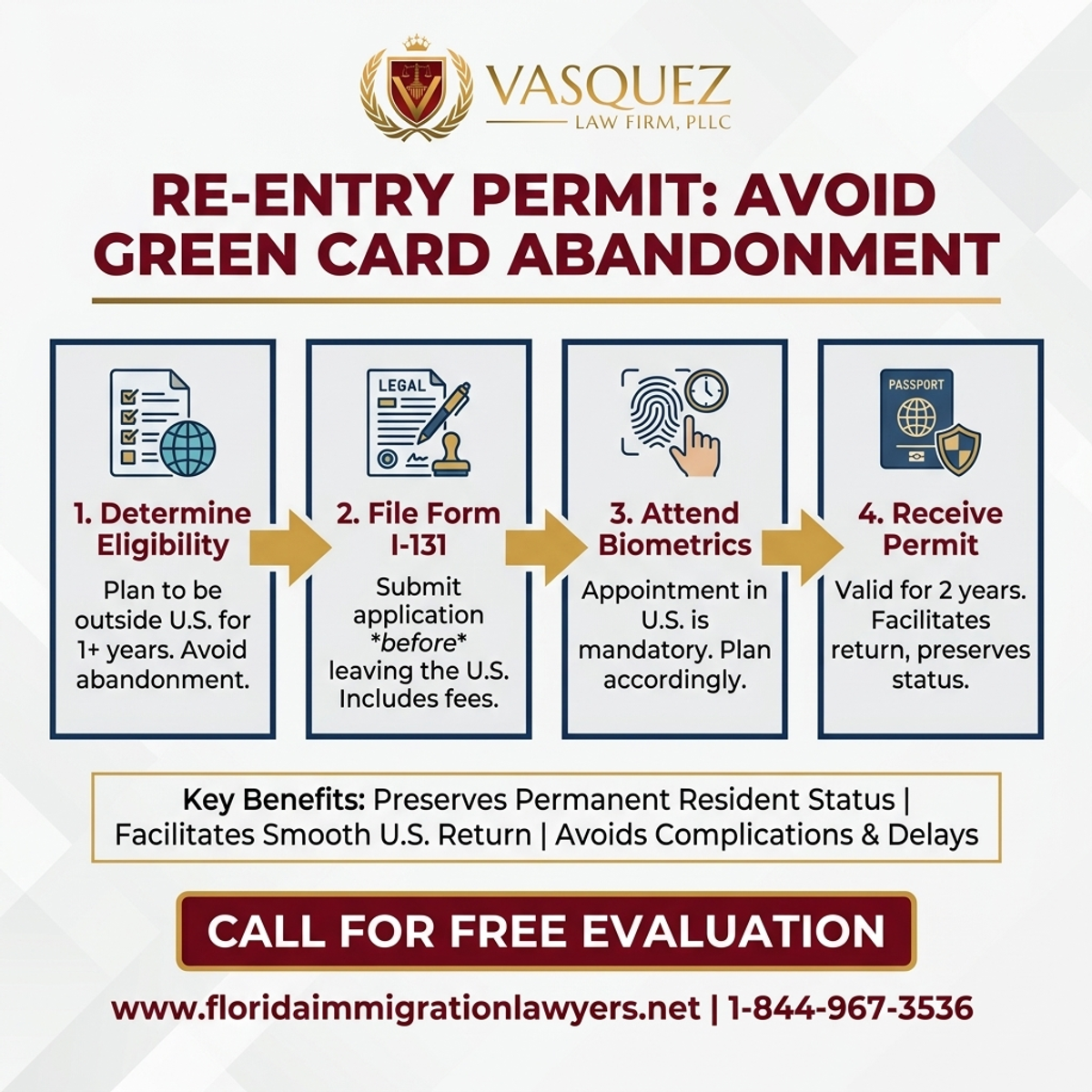
Key Statistics — Re-Entry Permit: Avoid Green Card Abandonment
Cost Factors and Fee Breakdown
The application fee for a re-entry permit may vary. Additional costs may include biometrics services and travel expenses for attending appointments. Always check the latest fee structure on the USCIS website.
As of the most recent updates, the total fee for Form I-131 typically includes the filing fee for the application itself, plus a separate biometrics services fee for applicants aged 14 through 79. These fees are subject to change, so it is absolutely critical to verify the current amounts on the USCIS website or through a reliable immigration attorney before submitting your application. Payments must be made in the exact amount and in the acceptable format specified by USCIS, usually via money order, personal check, cashier's check, or by credit card using Form G-1450.
Beyond the direct USCIS fees, applicants should also budget for other potential expenses. These can include professional passport photo services, photocopying costs for supporting documents, postage for mailing the application, and travel expenses if you need to drive or fly to an Application Support Center for your biometrics appointment. For those seeking expert guidance, legal fees for consulting with or hiring Florida Immigration Lawyers to prepare and file the application can be a worthwhile investment to ensure accuracy and reduce the risk of delays or denials. While these costs add up, they are a small price to pay for the security and peace of mind that a re-entry permit provides for your LPR status.
Middle CTA
Do not navigate this process alone. Contact Florida Immigration Lawyers today.
Common Mistakes to Avoid
- Not applying for a re-entry permit before leaving the U.S. can jeopardize your LPR status.
- Filling out Form I-131 incorrectly may delay processing.
- Missing the biometrics appointment can result in denial.
- Failing to carry your re-entry permit while traveling may lead to issues at the border.
- Assuming short trips negate the need for a permit; cumulative time outside the U.S. matters.
- Not keeping a copy of your application for your records.
- Ignoring legal changes that may affect your status.
Let's delve deeper into these common pitfalls to help you steer clear of them. The most critical mistake is departing the U.S. without having filed Form I-131. Remember, you must be physically present in the U.S. when you file, and ideally, when you attend your biometrics appointment. Leaving prematurely can invalidate your application or prevent you from completing the necessary steps, leaving you vulnerable to abandonment claims upon return.
Incorrectly completing Form I-131 is another frequent issue. Simple errors like misspelled names, incorrect dates of birth, or missing signatures can cause significant delays or lead to a Request for Evidence (RFE), prolonging the processing time. Always review your application thoroughly, and consider having an immigration professional from Florida Immigration Lawyers review it before submission.
Furthermore, many LPRs underestimate the importance of cumulative time spent outside the U.S. Even if individual trips are less than six months, if your total time abroad over several years approaches or exceeds the time you've spent in the U.S., it could still raise questions about your intent to maintain permanent residency. A re-entry permit provides a stronger defense against such inquiries. Always keep a complete copy of your submitted application, all supporting documents, and the receipt notice for your records. This documentation is invaluable if any issues arise during processing or upon your re-entry.
When to Call a Lawyer
If you plan to travel abroad for an extended period, it's wise to consult an immigration attorney. Legal advice is crucial if you have complex circumstances, such as criminal history or previous immigration violations. Florida Immigration Lawyers can help navigate these challenges.
Beyond complex circumstances, there are several scenarios where legal counsel becomes indispensable. For instance, if you have previously spent significant time outside the U.S. without a re-entry permit, or if you have any doubts about your eligibility, an attorney can assess your situation and advise on the best course of action. They can help you gather the strongest evidence of your ties to the U.S. and properly articulate your intent to return, which is vital for a successful application.
An immigration lawyer can also assist with preparing and reviewing your Form I-131 application, ensuring all information is accurate and all required documents are included. This significantly reduces the risk of RFEs or denials due to technical errors. Furthermore, if your application faces unexpected delays, a denial, or if you encounter issues at the port of entry despite having a permit, Florida Immigration Lawyers can advocate on your behalf, providing expert representation and guidance. Don't hesitate to call 1-844-967-3536 for a free consultation if you have any concerns about your re-entry permit application or LPR status.
About Florida Immigration Lawyers
Florida Immigration Lawyers is dedicated to assisting clients with all immigration needs, from re-entry permits to family and business immigration. With a team of experienced attorneys, we offer personalized services across Florida. Contact us at 1-844-967-3536 or visit our website for a free consultation.
Sources and References
- U.S. Citizenship and Immigration Services (USCIS)
- Executive Office for Immigration Review (EOIR)
- 8 U.S.C. Chapter 12 - Immigration and Nationality Act
Related services: immigration practice areas, family immigration services, citizenship and naturalization.
This article provides general legal information and is not intended as legal advice. Every case is unique, and outcomes depend on specific facts and circumstances. Contact an attorney for advice about your particular situation.
Final CTA
For assistance with your re-entry permit, call Florida Immigration Lawyers at 1-844-967-3536 for a free consultation. Se Habla Español - Estamos aquí para ayudarle.
If you need legal assistance, learn more about learn about our immigration practice, or call us at 1-844-967-3536 for a free consultation.
Do Not Navigate This Process Alone
Our experienced immigration attorneys are ready to fight for you. Get a free, confidential consultation today.
Se Habla Español
Frequently Asked Questions
Florida Immigration Lawyers
Immigration Attorney | Founder, Vasquez Law Firm
U.S. Air Force veteran and immigration attorney with thousands of cases resolved. J.D., NCCU School of Law. AILA member. Admitted to the 4th, 5th, and 11th Circuit Courts.
Available 24/7 - Free Evaluations
Related Legal Services
Our Florida immigration attorneys can help you with asylum protection, deportation defense and citizenship and naturalization. Call today at 1-844-967-3536 for a free consultation.
Related Links
Related Topics
Free Legal Consultation
Discuss your case with our experienced attorneys. We're available 24/7.
Se Habla Español - Estamos aquí para ayudarle.
Related Articles
F-1 Visa Guide for Florida Universities | VLF Florida
Learn how to successfully apply for an F-1 student visa to attend universities in Florida. Discover essential steps, common pitfalls, and get expert advice tailored to Pembroke Pines and surrounding areas.
L-1 Visa Transfer: Florida Companies Guide | VLF Florida
Discover how the L-1 visa facilitates intracompany transfers to Florida companies. Our guide covers eligibility, process, and common pitfalls. Contact Florida Immigration Lawyers at 1-844-967-3536 for a free consultation and expert assistance.
Immigration Lawyer Cost in Florida 2026 | VLF Florida
Explore the cost of hiring an immigration lawyer in Florida in 2026. Learn about the factors influencing fees, common mistakes to avoid, and when to seek legal assistance. Contact Florida Immigration Lawyers for a free consultation.
Green Card Through Marriage in Florida: A Complete Guide
Learn how to navigate the complex process of obtaining a green card through marriage in Florida. From filing forms to preparing for interviews, this guide covers it all. Call Florida Immigration Lawyers at 1-844-967-3536 for assistance.
