F-1 Visa Guide for Florida Universities
Learn how to successfully apply for an F-1 student visa to attend universities in Florida. Discover essential steps, common pitfalls, and get expert advice tailored to Pembroke Pines and surrounding areas.
Applying for an F-1 visa to study at a Florida university involves several key steps. Understanding the process is crucial for international students aiming to study in the U.S. Here are essential points:
- F-1 visas allow international students to attend school in the U.S.
- Applicants must be accepted by a Student and Exchange Visitor Program (SEVP)-approved school.
- Proper documentation and financial proof are required.
- USCIS and Florida-specific immigration information is critical.
Introduction
Studying in Florida, especially in Pembroke Pines or surrounding areas, can provide a transformative educational experience. However, navigating the F-1 student visa process is complex and requires careful attention to detail. This guide will walk you through the key aspects of obtaining an F-1 visa to study at Florida universities, providing essential steps, timelines, and expert advice to ensure a smooth application process.
Florida's vibrant culture, diverse economy, and world-renowned universities make it a prime destination for international students. Cities like Pembroke Pines offer a unique blend of urban amenities and natural beauty, providing an enriching environment for academic pursuits. The state boasts institutions known for innovation in fields ranging from aerospace to hospitality, attracting students globally.
However, the journey to studying in the Sunshine State begins long before you pack your bags. The F-1 visa application is a detailed process that demands precision and foresight. Starting early, gathering every required document, and understanding each step can significantly reduce stress and improve your chances of success. It's not just about getting accepted; it's about navigating the legal framework to ensure your academic dreams can become a reality.
For personalized assistance, call Florida Immigration Lawyers at 1-844-967-3536 for a free consultation.
Understanding the F-1 Visa
The F-1 visa is a non-immigrant student visa that allows international students to pursue academic studies in the United States. It is specifically designed for students attending a full-time program at a Student and Exchange Visitor Program (SEVP)-approved school. In Florida, a variety of universities and colleges offer such programs, making the state a popular destination for international students.
To be eligible, students must show they have sufficient financial support to complete their studies without needing to work illegally. They must also demonstrate strong ties to their home country, ensuring they intend to return after completing their studies.
A core requirement for the F-1 visa is demonstrating 'non-immigrant intent.' This means you must convince the consular officer that you intend to return to your home country after completing your studies. Evidence of strong ties to your home country, such as family, property, or job prospects, is crucial in this regard. This intent is evaluated during your visa interview and throughout your application.
Once granted, maintaining F-1 status requires adherence to specific regulations, including maintaining a full course of study, not working illegally, and notifying your Designated School Official (DSO) of any changes in your academic program or personal information. Florida universities have dedicated international student offices to help you navigate these requirements, but understanding them proactively is key to avoiding complications.
Beyond academic pursuits, the F-1 visa offers opportunities for practical training, such as Curricular Practical Training (CPT) during your studies and Optional Practical Training (OPT) after graduation. These programs allow students to gain valuable work experience in their field of study, further enhancing their educational journey and career prospects. Understanding these benefits and how to qualify for them can be a significant advantage.
Step-by-Step Guide to Apply for an F-1 Visa
Embarking on your F-1 visa application journey can seem daunting, but breaking it down into manageable steps makes the process clearer. Each stage is critical and requires careful attention to detail. Skipping a step or making an error can lead to significant delays or even denial. Here’s a more detailed look at the essential steps:
- Acceptance by a SEVP-Approved School: Obtain admission from a SEVP-certified school in Florida. Before you can even think about a visa, you must secure admission to a Student and Exchange Visitor Program (SEVP)-certified institution. This means the school is authorized by the U.S. government to enroll international students. When researching universities in Florida, always verify their SEVP certification. Acceptance letters are not enough; the school must issue you a Form I-20 after you've been admitted and confirmed your intent to enroll.
- Receive Form I-20: Get the Form I-20 from your chosen institution, which is crucial for your visa application. The Form I-20, 'Certificate of Eligibility for Nonimmigrant Student Status,' is arguably the most vital document for your F-1 visa application. Issued by your chosen SEVP-approved school, it contains critical information about your program of study, expected start and end dates, and estimated costs. Review every detail on your Form I-20 carefully for accuracy; any discrepancies could cause issues during your visa interview. This document proves your legitimate intent to study in the U.S.
- Pay the SEVIS Fee: Pay the SEVIS I-901 fee to maintain your student status. The Student and Exchange Visitor Information System (SEVIS) is a government database that tracks F-1 students. A non-refundable SEVIS I-901 fee is mandatory to activate your record in this system. You must pay this fee before your visa interview. Keep the payment receipt safe, as you'll need to present it during your interview and possibly upon entry to the U.S. This fee ensures your compliance with federal regulations governing international students.
- Complete the DS-160 Form: Fill out the Online Nonimmigrant Visa Application form (DS-160). The Online Nonimmigrant Visa Application form (DS-160) is a comprehensive online form that collects your personal, family, educational, and travel history. Accuracy is paramount here; any false or misleading information can lead to severe penalties, including permanent visa ineligibility. Take your time, gather all necessary information beforehand, and double-check every entry. Once submitted, print the confirmation page, as it's required for your interview.
- Schedule and Attend Visa Interview: Schedule your visa interview at the U.S. Embassy or Consulate in your country and prepare extensively for it. After submitting your DS-160 and paying the fees, you'll schedule an interview at the U.S. Embassy or Consulate in your home country. This interview is your opportunity to demonstrate your genuine intent to study and your strong ties to your home country. Prepare extensively by reviewing your application, understanding your academic goals, and practicing answers to common questions. Dress professionally and be honest and concise in your responses. Consular officers are trained to assess your credibility and intent.
- Provide Supporting Documents: Gather all necessary documentation, including financial evidence, academic records, and ties to your home country. Gathering all necessary documentation is crucial. This includes not only the required forms but also robust financial evidence (bank statements, scholarship letters, sponsor affidavits), academic records (transcripts, diplomas, test scores), and compelling evidence of ties to your home country (property deeds, family ties, job offers). Organize these documents meticulously to present a clear and convincing case during your interview. Incomplete documentation is a leading cause of visa delays or denials.
Each of these steps builds upon the last, forming a complete picture of your eligibility and intent. While the process is standardized, individual circumstances can introduce complexities. For any questions or concerns, particularly if you encounter unusual delays or requests, contacting Florida Immigration Lawyers at 1-844-967-3536 can provide invaluable guidance.
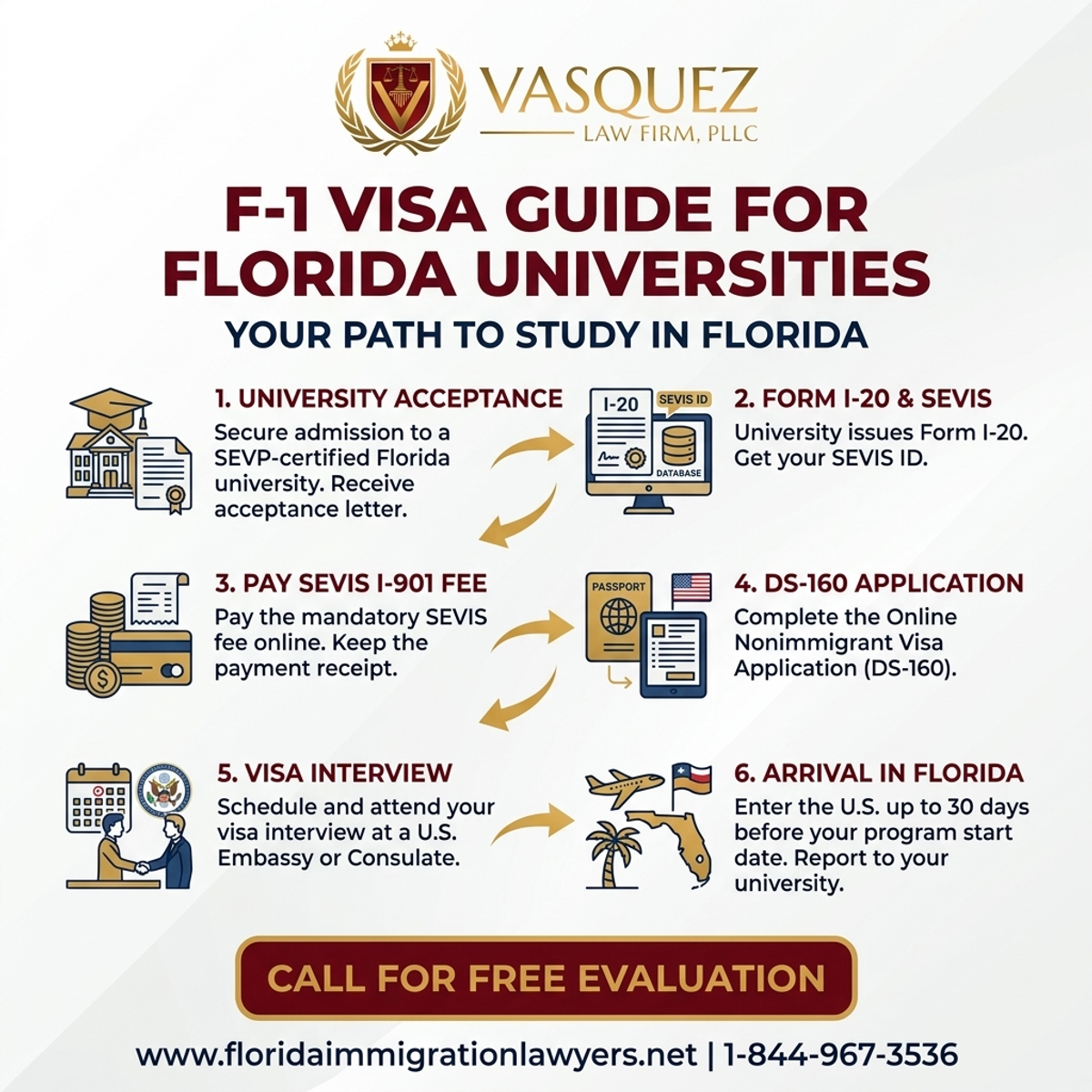
Step-by-Step Process — F-1 Visa Guide for Florida Universities
Document Checklist for F-1 Visa
A thorough document checklist is your best friend in the F-1 visa application process. Having all required documents organized and readily accessible will streamline your application and interview. Ensure each document is current, valid, and accurately reflects your information. Here's an expanded look at the essential documents you'll need:
- Valid passport: Your passport must be valid for at least six months beyond your intended period of stay in the U.S. If your passport is nearing expiration, renew it before starting your visa application. It's also wise to have a few blank pages for visa stamps.
- Form I-20: As mentioned, this is your 'Certificate of Eligibility.' Ensure the program start date, school information, and your personal details are correct. It must be signed by both you and your Designated School Official (DSO).
- DS-160 confirmation page: This page, with its barcode, confirms you've completed and submitted your online visa application. You'll need it to enter the embassy or consulate for your interview.
- SEVIS fee receipt: Proof that you've paid the I-901 SEVIS fee. This is critical for showing you've registered with the Student and Exchange Visitor Information System.
- Visa application fee receipt: Proof of payment for the non-refundable visa application fee (MRV fee). The payment method and receipt vary by country, so follow local embassy instructions carefully.
- Financial evidence: This is perhaps the most scrutinized document. You must demonstrate you have sufficient funds to cover your tuition, living expenses, and other costs for your entire period of study, or at least for the first year. Acceptable evidence includes original bank statements, scholarship letters, financial aid awards, or an affidavit of support from a sponsor with their bank statements and employment verification. The funds must be readily accessible.
- Academic transcripts and diplomas: Official transcripts from all previously attended institutions, along with diplomas or degree certificates, are essential. These prove your academic history and eligibility for your chosen program in Florida. If not in English, ensure they are accompanied by certified translations.
- Standardized test scores (if necessary): Include scores from tests like TOEFL, IELTS, SAT, GRE, or GMAT, as required by your chosen Florida university. These demonstrate your English proficiency and academic aptitude.
- Photographs: Recent passport-style photographs meeting specific U.S. visa requirements (usually 2x2 inches, white background, no glasses). Check the embassy website for precise specifications.
- Evidence of ties to home country: While not always explicitly listed, consular officers will look for evidence that you intend to return home. This can include property deeds, family certificates, letters from employers offering future employment, or strong family ties. A well-prepared applicant will have these ready.
Organizing these documents into a clear folder, perhaps with tabs, will make your interview process smoother and demonstrate your preparedness to the consular officer. If you have any doubts about what constitutes sufficient proof, especially for financial evidence or ties to your home country, consulting with Florida Immigration Lawyers can provide clarity and ensure you're fully prepared.
Timeline and Processing Expectations
The F-1 visa application process can vary in length, depending on your home country and the time of year. Typically, students should start the process 3-5 months before their intended start date. Visa interviews can be scheduled 120 days before the start date listed on your Form I-20.
While 3-5 months is a general guideline, it's often safer to begin your application even earlier, especially if you're applying from a country with high demand or if you anticipate needing additional security clearances. For example, students from certain regions might experience longer administrative processing times, which are unpredictable.
You can schedule your visa interview up to 120 days before the program start date listed on your Form I-20. However, you cannot enter the U.S. on an F-1 visa more than 30 days before this start date. This 30-day window allows for settling in and attending orientation, but it's crucial not to arrive too early.
Once the interview is complete, visa processing may take several weeks. Several factors can influence the overall processing time, including the volume of applications at a particular embassy or consulate, local holidays, and the need for additional security checks (administrative processing). Peak seasons, typically in the spring and summer leading up to fall admissions, often see increased wait times for interview appointments and visa issuance. Always check the specific embassy or consulate's website for their current estimated wait times.
It is crucial to apply early to avoid delays, especially considering new federal immigration memos that might affect processing times. To minimize stress and potential disruptions to your academic plans, it's highly recommended to apply as soon as you receive your Form I-20 and pay the SEVIS fee. Keep a close eye on your application status through the embassy's online portal. If you encounter unexpected delays or requests for additional information, do not hesitate to contact Florida Immigration Lawyers at 1-844-967-3536 for expert advice on how to proceed.
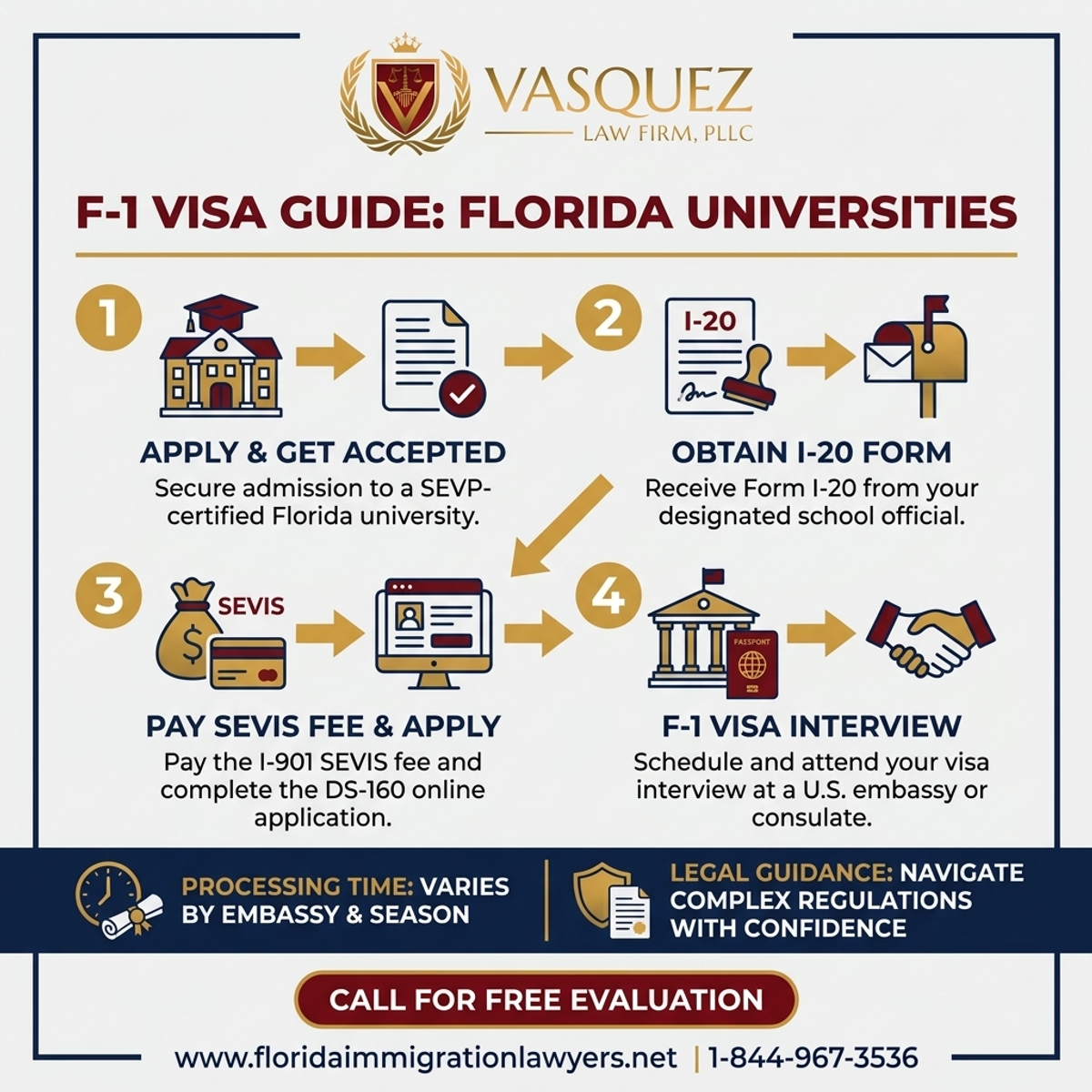
Key Statistics — F-1 Visa Guide for Florida Universities
Cost Factors and Fee Breakdown
Several costs are associated with the F-1 visa application, including the SEVIS fee, visa application fee, and possible additional costs for document preparation or travel. Understanding the financial commitment involved in obtaining an F-1 visa is crucial for proper budgeting. The primary fees include the SEVIS I-901 fee, which is currently $350, and the DS-160 visa application fee (MRV fee), typically $185. These fees are non-refundable, regardless of the outcome of your visa application.
Beyond these mandatory government fees, applicants should budget for other potential expenses. These might include costs for obtaining certified academic transcripts and diplomas, professional translation services for documents not in English, travel expenses to and from the U.S. Embassy or Consulate for your interview, and potentially fees for passport photos. Some students also opt for expedited courier services for document delivery.
While specific amounts may vary, it is important to budget for these expenses in advance. It's also important to factor in the cost of preparing for your studies in Florida, including airfare, initial accommodation, and health insurance, which is often mandatory for international students. A comprehensive financial plan will alleviate stress and ensure you can focus on your studies. If you have questions about financial requirements or need assistance understanding the documentation needed for proof of funds, Florida Immigration Lawyers can offer guidance to ensure your financial evidence meets USCIS standards.
Do not navigate this process alone. Contact Florida Immigration Lawyers today.
Common Mistakes to Avoid
The F-1 visa application process is stringent, and even minor errors can lead to significant setbacks, including delays or outright denials. Being aware of common pitfalls can help you navigate the process more smoothly and increase your chances of success. Here are some critical mistakes international students often make and how to avoid them:
- Incomplete Documentation: Missing documents can delay processing and result in denial. Submitting an application with missing documents is a primary reason for delays and denials. For instance, forgetting a bank statement or a required academic transcript will halt your application. Always use a checklist, and make sure every required document is present, current, and correctly formatted.
- Incorrect Form Details: Errors on forms like DS-160 can lead to complications. Even a small typo on your DS-160 form, such as an incorrect date of birth or passport number, can flag your application for further review or rejection. Double-check all personal information, dates, and addresses. It's advisable to have someone else review your forms for accuracy before submission, or seek professional review from Florida Immigration Lawyers.
- Insufficient Financial Proof: Failing to provide adequate financial documentation can result in a visa denial. This is a frequent reason for denial. Consular officers need clear, undeniable evidence that you can cover your tuition and living expenses without resorting to unauthorized employment. Simply stating you have funds is not enough; you must provide official bank statements, scholarship letters, or detailed affidavits of support from sponsors, demonstrating sufficient liquid assets. A common mistake is showing funds that are not readily accessible or are insufficient for the full period of study.
- Poor Interview Preparation: Not preparing for the visa interview can lead to failure in convincingly demonstrating ties to your home country. The interview is your chance to articulate your academic goals and demonstrate non-immigrant intent. Fumbling answers, showing uncertainty about your study plan, or failing to clearly explain your ties to your home country can lead to denial. Practice answering questions about your chosen program, why you picked Florida, your career aspirations, and how you plan to support yourself. Be confident, honest, and concise.
- Late Application: Applying too late can lead to processing delays that may affect your ability to start your studies on time. Waiting until the last minute to apply can be disastrous. Processing times are unpredictable and can be affected by various factors, including seasonal demand and administrative processing. Applying too close to your program start date risks missing your enrollment deadline, forcing you to defer your admission. Start your application as soon as you receive your Form I-20.
- Overlooking SEVP Certification: Choosing a non-SEVP-approved school can invalidate your visa eligibility. Some students mistakenly apply to schools that are not authorized to enroll international students. Always verify that your chosen Florida university is SEVP-certified before you commit. Attending a non-SEVP school means you cannot obtain an F-1 visa, and any efforts made toward that school will be wasted.
- Failure to Understand Immigration Laws: Ignorance of U.S. immigration laws can lead to unintentional violations and legal issues. Ignorance of U.S. immigration laws is not an excuse for non-compliance. Violating F-1 visa rules, such as working without authorization, failing to maintain a full course load, or overstaying your visa, can lead to severe consequences, including deportation and future bars from entering the U.S. Stay informed, communicate regularly with your school's DSO, and if in doubt, consult with Florida Immigration Lawyers to ensure continuous compliance.
Avoiding these common mistakes requires diligence and a clear understanding of the F-1 visa requirements. When in doubt, or if you encounter a complex situation, remember that legal expertise can be invaluable. Florida Immigration Lawyers are available to review your application, prepare you for your interview, and address any potential issues to help you achieve a successful outcome.
When to Call a Lawyer
If you face difficulties during the F-1 visa application process, such as a visa denial or issues with documentation, it is crucial to seek legal assistance. While many F-1 visa applications proceed smoothly, certain situations warrant the immediate attention of an experienced immigration attorney. If you receive a Request for Evidence (RFE) from USCIS, indicating that your application is incomplete or requires further clarification, a lawyer can help you formulate a robust and timely response. Similarly, if your visa is denied, understanding the specific reasons for denial and strategizing for a potential reapplication or appeal is crucial.
Complex cases involving prior immigration violations or legal issues should also be handled by a professional. Complex cases often involve previous immigration violations, such as overstaying a past visa, unauthorized employment, or issues with criminal records, even minor ones. These situations can significantly complicate your F-1 application and often require waivers or specialized legal arguments. Attempting to navigate these complexities alone can jeopardize your chances of success and lead to long-term immigration issues. A lawyer can assess your specific history and advise on the best course of action.
Even if you haven't encountered a problem yet, proactive legal consultation can be beneficial. For example, if you have a unique financial situation, unusual academic history, or concerns about demonstrating sufficient ties to your home country, a lawyer can help you prepare a stronger, more convincing application package. Florida Immigration Lawyers are here to guide you through these challenges, ensuring compliance with immigration laws and increasing your chances of success. Don't wait for a problem to arise; call 1-844-967-3536 for a free consultation to ensure peace of mind throughout your F-1 visa journey.
About Florida Immigration Lawyers
Florida Immigration Lawyers is a leading firm dedicated to assisting individuals with their immigration needs. We offer comprehensive services, including visa applications, asylum requests, deportation defense, and citizenship processes. Our firm is not just about F-1 visas; we offer a full spectrum of immigration services designed to meet diverse client needs. From assisting families with reunification through family immigration petitions to guiding individuals through the intricate processes of citizenship and naturalization, our expertise covers a broad range of immigration law. We also provide robust deportation defense for those facing removal proceedings, ensuring that every client receives zealous advocacy and protection of their rights.
Our experienced attorneys are available 24/7 to provide free consultations and serve clients across all of Florida. At Florida Immigration Lawyers, we understand the profound impact immigration matters have on individuals and families. Our commitment extends beyond legal advice; we strive to provide compassionate, culturally sensitive, and effective representation. Our team of experienced attorneys is available 24/7, recognizing that immigration challenges don't adhere to a 9-to-5 schedule. We proudly offer free consultations, allowing you to discuss your case without initial financial burden. With offices across Florida, we are strategically positioned to serve clients throughout the state, ensuring that expert legal help is always within reach.
Whether you're starting your F-1 visa application, facing a complex immigration issue, or exploring pathways to permanent residency, Florida Immigration Lawyers are your trusted partners. Contact us at 1-844-967-3536 or visit our website at https://www.floridaimmigrationlawyers.net to learn how we can assist you in achieving your immigration goals. Se Habla Espanol - Estamos aqui para ayudarle.
Sources and References
- U.S. Citizenship and Immigration Services (USCIS)
- Executive Office for Immigration Review (EOIR)
- 8 U.S.C. Chapter 12 - Immigration and Nationality Act
Related services: immigration practice areas,
Do Not Navigate This Process Alone
Our experienced immigration attorneys are ready to fight for you. Get a free, confidential consultation today.
Se Habla Español
Or leave your details and we’ll call you:
Free Evaluation in 24 Hours
Or talk to us right now
AI voice assistant — available 24/7
FreeFrequently Asked Questions
William J. Vásquez
Founding Attorney · Vasquez Law Firm
U.S. Air Force veteran and immigration attorney with years of hands-on U.S. immigration experience. J.D., NCCU School of Law. AILA member. Admitted to the 4th, 5th, and 11th Circuit Courts.
Available 24/7 - Free Evaluations
Reviewed for legal accuracy by William J. Vásquez
Licensed in North Carolina; U.S. immigration is federal practice.
Related Legal Services
Our Florida immigration attorneys can help you with business immigration, asylum protection and deportation defense. Call today at 1-844-967-3536 for a free consultation.
Related Links
Related Topics
Free Legal Consultation
Discuss your case with our experienced attorneys. We're available 24/7.
Se Habla Español - Estamos aquí para ayudarle.
Related Articles
Military Naturalization Expedited in Florida Bases
Explore military naturalization options for families at Florida bases, including parole in place benefits in Miami. Learn how to expedite your application with expert guidance from Florida Immigration Lawyers.
Immigration Lawyer Orlando Free Consultation 2026
Discover how Florida Immigration Lawyers can assist you with immigration matters in Orlando, Cape Coral, and Southwest Florida. Offering free consultations, our experienced attorneys are ready to guide you through the complex immigration process. Call us today to find out more.
Immigration Lawyer Orlando Free Consultation: Bond Hearings
Facing an immigration bond hearing in Orlando, Florida can be challenging. This comprehensive guide covers everything you need to know about the bond process, eligibility criteria, and how to prepare effectively. Discover the role of an immigration lawyer in improving your chances of release from detention. Call Florida Immigration Lawyers at 1-844-967-3536 for a free consultation.
Immediate Relative Petition Tampa: Your Guide in 2026
Discover how to file an immediate relative petition in Tampa, Florida, in 2026. Learn about the I-130 process, common mistakes, and when to seek legal help. Call Florida Immigration Lawyers at 1-844-967-3536 for personalized assistance.