Immediate Relative Petition Tampa: Your Guide in 2026
Discover how to file an immediate relative petition in Tampa, Florida, in 2026. Learn about the I-130 process, common mistakes, and when to seek legal help. Call Florida Immigration Lawyers at 1-844-967-3536 for personalized assistance.

- The I-130 form is crucial for this process.
- Immediate relatives include spouses, children, and parents.
- Processing times can vary; stay updated with USCIS.
- Legal assistance can streamline the process.
Introduction
In 2026, navigating the complexities of family immigration in Tampa, Florida, can be daunting. The immediate relative petition is a critical step for U.S. citizens who wish to bring their loved ones closer. This comprehensive guide will walk you through the essentials of filing an I-130 petition, highlight common pitfalls, and provide you with the practical knowledge you need to succeed. Call Florida Immigration Lawyers at 1-844-967-3536 for a free consultation.
Family reunification is a cornerstone of U.S. immigration policy, and the immediate relative category underscores this commitment by prioritizing the closest family members of U.S. citizens. For many families in Tampa, this process represents the hope of a shared future, free from the anxieties of separation. Understanding each phase, from initial paperwork to final approval, is crucial for a successful outcome.
This guide aims to demystify the process, offering clear, actionable advice tailored for residents of Tampa and beyond. We'll delve into the specific requirements, potential challenges, and strategic approaches that can help you avoid delays. Remember, while the journey can be intricate, with the right information and professional support from Florida Immigration Lawyers, you can confidently pursue your goal of bringing your family together.
What is an Immediate Relative Petition?
An immediate relative petition allows U.S. citizens to sponsor their closest family members for a green card. As of 2026, this includes spouses, unmarried children under 21, and parents. These relatives are given priority and do not have to wait for a visa number to become available.
The I-130 form, Petition for Alien Relative, is the initial step in this process. Filing this form establishes a qualifying relationship between the petitioner and the beneficiary. Understanding the nuances of this form is crucial to avoid delays or denials.
The unique advantage of the immediate relative category is its exemption from the annual visa quotas that apply to other family-based immigration categories. This means there is no waiting list for a visa number once the I-130 petition is approved, significantly shortening the overall processing time compared to other family preferences. This prioritization reflects the U.S. government's policy of supporting the immediate reunification of U.S. citizens with their closest family members.
For instance, if a U.S. citizen in Tampa wishes to sponsor their foreign-born spouse, that spouse is considered an immediate relative. Similarly, a U.S. citizen child over 21 can petition for their parent, or a U.S. citizen parent can petition for their unmarried child under 21. Each scenario requires specific documentation to prove the bona fide nature of the relationship, which is a key focus of USCIS during the review process. Gathering robust evidence, such as marriage certificates, birth certificates, and shared financial documents, is paramount.
Eligibility Criteria
To file an I-130, the petitioner must be a U.S. citizen. The beneficiary must fall into one of the immediate relative categories. Ensuring all documents are accurate and complete is vital for smooth processing.
Beyond the basic relationship, USCIS scrutinizes the legitimacy of the relationship. For spouses, this involves proving the marriage is bona fide and not entered into solely for immigration purposes. For children, it means demonstrating a legal parent-child relationship. This often requires submitting a comprehensive package of evidence, including photographs, joint bank accounts, shared leases, and affidavits from friends and family.
It's also important for the petitioner to meet certain financial requirements, demonstrating they can financially support the beneficiary to prevent them from becoming a public charge. This typically involves filing an Affidavit of Support (Form I-864) later in the process, which requires the petitioner's income to meet or exceed 125% of the federal poverty guidelines. Consulting with Florida Immigration Lawyers can help you understand these complex financial obligations.
How to File an I-130 Petition in Tampa?
Filing an I-130 petition involves several steps. Here's a streamlined guide to help you navigate the process effectively in Tampa.
- Complete Form I-130, ensuring all sections are accurately filled and supported by the necessary documentation.
- Submit the form and accompanying documents to the appropriate USCIS office. In Florida, you can reference the USCIS website for specific locations and instructions.
- Prepare for the USCIS receipt notice, which confirms your application is in process.
- Attend any required interviews or appointments as scheduled by USCIS.
The process may vary slightly depending on individual circumstances, so staying informed and prepared is essential.
When completing Form I-130, attention to detail is paramount. Every question must be answered truthfully and completely. Any discrepancies or omissions can lead to a Request for Evidence (RFE) or even a denial. It's advisable to review the form multiple times and have another person, preferably an immigration attorney, check it for accuracy before submission. Remember to sign the form in blue ink, and keep a complete copy for your records.
For submission, you'll mail your petition package to the USCIS Lockbox facility designated for your specific case type and location. Always use a trackable mailing service, such as certified mail with a return receipt, to ensure proof of delivery. This small step can save significant stress if there are questions about whether your petition was received. After submission, USCIS will send a Form I-797C, Notice of Action, confirming receipt and providing a case number, which you can use to track your petition's status online.
Should an interview be required, preparation is key. This typically applies to beneficiaries undergoing consular processing abroad or those adjusting status within the U.S. The interview aims to verify the information provided in the petition and assess the legitimacy of the relationship. Being truthful, consistent, and prepared to present original documents is crucial. Florida Immigration Lawyers can assist with interview preparation, ensuring you feel confident and ready to address USCIS officers' questions.
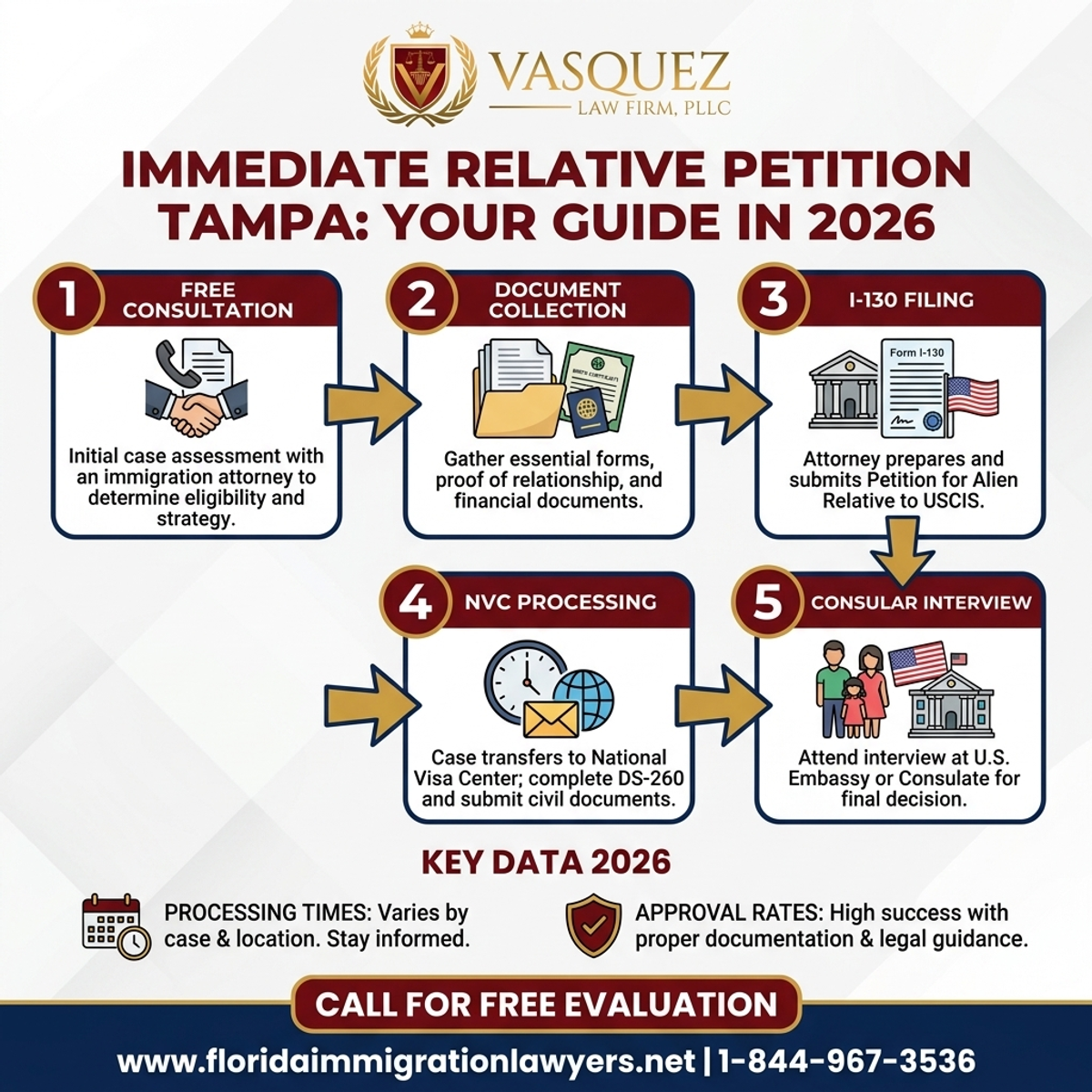
Step-by-Step Process — Immediate Relative Petition Tampa: Your Guide in 2026
Document Checklist
- Proof of U.S. citizenship (passport, birth certificate)
- Proof of relationship (marriage certificate, birth certificate)
- Passport photos of both petitioner and beneficiary
- Any prior immigration documents
In addition to the core documents, you should also consider including evidence that further substantiates the authenticity of your relationship. For spouses, this could mean joint bank statements, utility bills addressed to both, lease agreements or mortgage documents, shared health insurance, and photographs together over time. For parents and children, school records, medical records, and detailed birth certificates can be vital.
It is always recommended to submit copies of documents, not originals, unless specifically requested by USCIS. However, be prepared to present original documents at any interview. Providing certified translations for any documents not in English is also a mandatory requirement. Missing or improperly translated documents are a frequent cause of RFEs and delays, making careful preparation essential.
Processing Times and Expectations
The timeline for processing an immediate relative petition can vary. As of 2026, the following table outlines typical expectations:
| Stage | Typical Timeframe | Notes |
|---|---|---|
| Initial Processing | 6-12 months | Varies based on caseload |
| Interview Scheduling | 1-2 months | Dependent on USCIS office |
| Final Decision | 1-3 months | Post-interview processing |
It's important to regularly check the USCIS website for the most current processing times.
While the table provides general estimates, actual processing times can fluctuate significantly due to factors such as the specific USCIS service center handling your case, the volume of applications, and the completeness of your initial submission. A Request for Evidence (RFE) can add several months to the process, as USCIS waits for your response and then reviews the new information. Therefore, ensuring your initial petition is as thorough and accurate as possible is your best strategy for a swift resolution.
To manage expectations, it's wise to plan for the longer end of the estimated timeframes. Regularly checking the USCIS online case status tool using your receipt number is crucial. This tool provides real-time updates and can notify you of any actions required from your end. If you notice your case is taking longer than the posted processing times, you may be able to submit an inquiry with USCIS, though this is often best done with the guidance of an experienced attorney from Florida Immigration Lawyers.
Cost Factors and Fee Breakdown
Understanding the costs associated with filing an I-130 petition is crucial for financial planning. Here is a typical breakdown:
| Item | Typical Fee | Notes |
|---|---|---|
| Form I-130 Filing Fee | Subject to change | Check USCIS for updates |
| Biometrics Fee | Additional cost | May apply in some cases |
| Legal Fees | Varies | Consult an attorney |
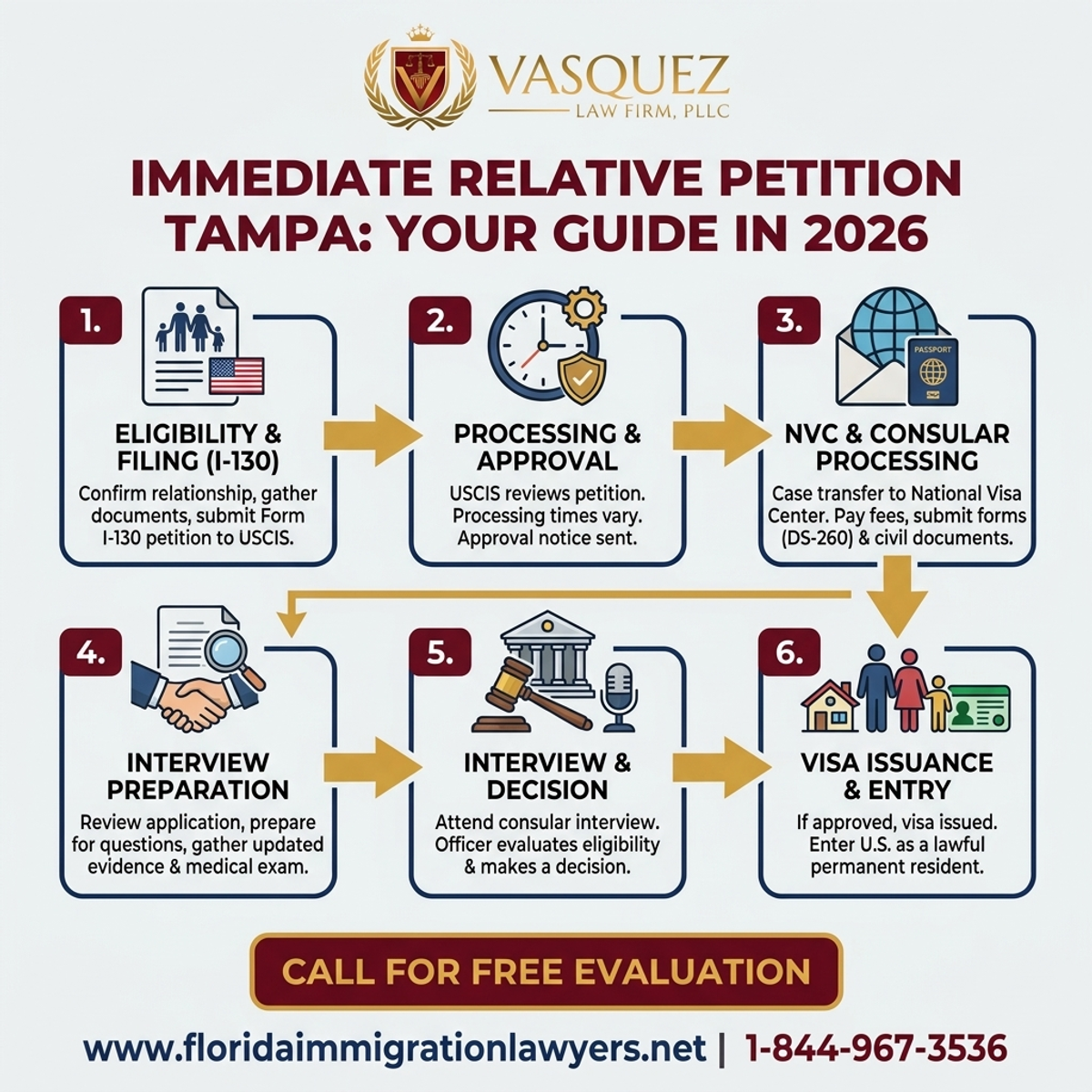
Key Statistics — Immediate Relative Petition Tampa: Your Guide in 2026
Fee amounts can change, so it's advised to verify with USCIS.
Beyond the direct USCIS filing fees, petitioners should budget for other potential expenses. These can include costs for obtaining necessary documents like birth or marriage certificates, professional translation services for foreign documents, and medical examination fees if the beneficiary is adjusting status in the U.S. or undergoing consular processing. Travel expenses for interviews, especially if the beneficiary is abroad, should also be considered.
It's important to note that USCIS fees are non-refundable, regardless of the outcome of your petition. Therefore, meticulous preparation to minimize errors is not just about saving time but also about protecting your financial investment. In certain circumstances, individuals with very low incomes may be eligible for fee waivers. You can check the USCIS website for detailed eligibility criteria and the necessary forms to request a waiver. Florida Immigration Lawyers can help assess your eligibility for such waivers and guide you through the application process.
Common Mistakes to Avoid
Filing an I-130 can be complex. Avoid these common mistakes to ensure a smoother process:
- Incomplete forms: Missing information can lead to delays.
- Incorrect fees: Always confirm current fees with USCIS.
- Insufficient evidence: Strong documentation is essential for approval.
- Missing deadlines: Late submissions can lead to denials.
- Ignoring USCIS notices: Always respond promptly to requests for information.
- Failure to update address: Keep USCIS informed of any changes.
- Not consulting an attorney: Professional guidance can prevent costly errors.
These common errors, though seemingly minor, can have significant repercussions, from lengthy delays to outright denials, forcing you to restart the entire process and incur additional costs. For example, simply forgetting to sign a form or submitting an outdated version can trigger an RFE, adding months to your waiting period. The stakes are high when it comes to family reunification, making diligence crucial.
To mitigate these risks, consider creating a checklist for your application package and double-checking every item before submission. When in doubt about any aspect of the process, from fee amounts to required evidence, it's always best to seek clarification. Florida Immigration Lawyers offers free consultations where you can get initial advice and ensure you're on the right track, preventing these common pitfalls before they occur.
When to Call a Lawyer
Engaging an immigration attorney can be invaluable in several situations:
- Complex family situations or prior immigration violations.
- If you receive a Request for Evidence (RFE) from USCIS.
- Difficulty in gathering required documentation.
Contacting Florida Immigration Lawyers can provide the support and expertise needed to navigate these challenges effectively.
Beyond these specific scenarios, a lawyer's expertise is beneficial if the beneficiary has a criminal record, past deportations, or any history of misrepresentation to immigration authorities. These issues can trigger grounds of inadmissibility, making the process significantly more complicated and often requiring waivers that only an experienced attorney can effectively prepare and argue. Proactive legal advice can identify potential problems early and develop strategies to address them.
Even in seemingly straightforward cases, an attorney can offer peace of mind by ensuring all forms are correctly filled, all necessary evidence is included, and deadlines are met. They can also represent you during interviews, communicate with USCIS on your behalf, and provide updates on policy changes that might affect your case. For residents of Tampa, Florida Immigration Lawyers stands ready to offer comprehensive support and guidance throughout your immediate relative petition process.
About Florida Immigration Lawyers
Florida Immigration Lawyers is dedicated to providing comprehensive immigration services throughout Florida. Our experienced attorneys specialize in family immigration, deportation defense, and more. We offer 24/7 support, free consultations, and bilingual services. Call us at 1-844-967-3536 or visit our website.
Our firm understands the profound impact immigration matters have on individuals and families. We are committed to offering compassionate, client-centered representation, ensuring that you feel supported and informed at every stage of your immigration journey. From the initial consultation to the final decision, our team works diligently to protect your rights and achieve the best possible outcome for your case.
With a deep understanding of U.S. immigration law and a strong local presence in Florida, we are uniquely positioned to assist clients in Tampa and across the state. Whether you are filing an immediate relative petition, seeking a fiancé visa, or navigating complex deportation proceedings, our bilingual attorneys are here to provide clear, effective legal strategies. Don't hesitate to reach out for your free consultation and let us help you build a brighter future.
FAQs
1. Can I file an I-130 if my spouse is already in the U.S.?
Yes, you can file an I-130 for your spouse even if they are already in the U.S. If they entered legally and are eligible, they may be able to adjust their status to a lawful permanent resident concurrently or after the I-130 is approved. This process, called Adjustment of Status (Form I-485), allows them to obtain a green card without leaving the country. Consult Florida Immigration Lawyers to determine eligibility and required forms.
2. What happens after my I-130 is approved?
After your I-130 is approved, the next steps depend on whether your relative is in the U.S. or abroad. If they are in the U.S. and eligible, they can file Form I-485 to adjust status. If they are abroad, the case will be forwarded to the National Visa Center (NVC) for consular processing, leading to an interview at a U.S. embassy or consulate in their home country. Florida Immigration Lawyers can guide you through either path.
3. Can an immediate relative petition be denied?
Yes, an immediate relative petition can be denied. Common reasons include insufficient evidence of a bona fide relationship, petitioner's inability to meet financial sponsorship requirements, or issues with the beneficiary's admissibility (e.g., criminal history, prior immigration fraud). Accurate and comprehensive documentation is crucial. If you receive a denial, contacting Florida Immigration Lawyers promptly is essential to explore options like appeals or refiling.
4. Do immediate relatives need to attend an interview?
Most immediate relatives will need to attend an interview. If the beneficiary is adjusting status in the U.S., both the petitioner and beneficiary typically attend an interview at a USCIS office. If the beneficiary is undergoing consular processing abroad, they will attend an interview at a U.S. embassy or consulate. The interview verifies the information provided and confirms the legitimacy of the relationship. Preparation with an attorney can be highly beneficial.
5. What if my relationship changes during the process (e.g., divorce)?
If your relationship changes (e.g., divorce from a spouse, or a child turns 21 and is no longer unmarried) before the green card is issued, it can significantly impact or even terminate the petition. For spouses, divorce invalidates the petition. For children, turning 21 or getting married can move them to a lower preference category with longer wait times. It's critical to inform USCIS of any changes and seek legal advice from Florida Immigration Lawyers immediately.
Sources and References
- U.S. Citizenship and Immigration Services (USCIS)
- Executive Office for Immigration Review (EOIR)
- 8 U.S.C. Chapter 12 - Immigration and Nationality Act
Related services: family petition process, family-based green cards, fiancé visa (K-1).
This article provides general legal information and is not intended as legal advice. Every case is unique, and outcomes depend on specific facts and circumstances. Contact an attorney for advice about your particular situation.
For professional guidance and support, contact Florida Immigration Lawyers at 1-844-967-3536. Se Habla Español - Estamos aquí para ayudarle.
If you need legal assistance, learn more about experienced family immigration attorneys, or call us at 1-844-967-3536 for a free consultation.
Do Not Navigate This Process Alone
Our experienced immigration attorneys are ready to fight for you. Get a free, confidential consultation today.
Se Habla Español
Or leave your details and we’ll call you:
Free Evaluation in 24 Hours
Or talk to us right now
AI voice assistant — available 24/7
FreeFrequently Asked Questions

William J. Vásquez
Founding Attorney · Vasquez Law Firm
U.S. Air Force veteran and immigration attorney with years of hands-on U.S. immigration experience. J.D., NCCU School of Law. AILA member. Admitted to the 4th, 5th, and 11th Circuit Courts.
Available 24/7 - Free Evaluations
Reviewed for legal accuracy by William J. Vásquez
Licensed in North Carolina; U.S. immigration is federal practice.
Related Legal Services
Our Florida immigration attorneys can help you with family immigration services, immigration practice areas and free immigration consultation. Call today at 1-844-967-3536 for a free consultation.
Related Links
Related Topics
Free Legal Consultation
Discuss your case with our experienced attorneys. We're available 24/7.
Se Habla Español - Estamos aquí para ayudarle.
Related Articles
Military Naturalization Expedited in Florida Bases
Explore military naturalization options for families at Florida bases, including parole in place benefits in Miami. Learn how to expedite your application with expert guidance from Florida Immigration Lawyers.
Immigration Lawyer Orlando Free Consultation 2026
Discover how an immigration lawyer in Orlando can help you through a free consultation. Learn about the services offered, costs, and recent immigration policy updates affecting your case.
USCIS Application Support Center (ASC) Jacksonville: 2026
The USCIS Application Support Center (ASC) in Jacksonville, Florida, is crucial for biometric data collection, a mandatory step for various immigration benefits like Green Cards and naturalization. This guide explains the ASC's role, how to prepare for appointments, and distinguishes it from broader USCIS Field Offices. We cover timelines, potential costs, and common mistakes to avoid, emphasizing the importance of accurate documentation and timely responses. For complex situations or any concerns regarding your immigration process in Florida, consulting an experienced attorney is highly recommended to ensure compliance and protect your rights. Florida Immigration Lawyers are ready to assist with expert legal advice.
Biometrics Appointment: What to Expect in Florida 2026
A biometrics appointment is a critical step in the U.S. immigration process, requiring fingerprints, photos, and signatures for identity verification and background checks. This guide for Florida residents explains what to expect, how to prepare, the necessary documents, and common mistakes to avoid in 2026. Understanding your USCIS biometrics appointment ensures a smoother path for your green card, work permit, or naturalization application. Learn about timelines, costs, and when to seek legal counsel from Florida Immigration Lawyers to protect your immigration future.