U Visa for Crime Victims in Florida: Essential Guide
Discover the essentials of the U visa for crime victims in Florida, a crucial immigration relief option. Learn about eligibility, application steps, and common pitfalls. Contact Florida Immigration Lawyers at 1-844-YO-PELEO for guidance.
The U Visa offers a beacon of hope for victims of certain crimes who have suffered substantial mental or physical abuse and are willing to assist law enforcement in the investigation or prosecution of criminal activity. In Florida, a state with a diverse population, understanding the nuances of this critical immigration relief option is essential for those seeking protection and a pathway to legal status. This comprehensive guide delves into the specifics of the U Visa program, its eligibility requirements, the application process, and why legal assistance is paramount for crime victims in the Sunshine State.
What is the U Visa and Who Qualifies?
The U Nonimmigrant Status (U Visa) was created by Congress to provide legal status to victims of certain crimes who have suffered substantial mental or physical abuse and who are helpful to law enforcement or government officials in the investigation or prosecution of criminal activity. This visa also aims to strengthen the ability of law enforcement agencies to investigate and prosecute cases of domestic violence, sexual assault, trafficking, and other crimes, while offering protection to vulnerable victims.
Eligibility Requirements for a U Visa
To qualify for a U Visa, applicants must meet several stringent criteria:
- Victim of a Qualifying Criminal Activity: The applicant must have been a victim of one of the specific criminal activities listed by USCIS. These include, but are not limited to, abduction, abusive sexual contact, blackmail, domestic violence, extortion, false imprisonment, felony assault, female genital mutilation, hostage taking, incest, involuntary servitude, kidnapping, murder, manslaughter, obstruction of justice, peonage, perjury, prostitution, rape, sexual assault, sexual exploitation, slave trade, stalking, torture, trafficking, and unlawful criminal restraint.
- Substantial Physical or Mental Abuse: The applicant must have suffered substantial physical or mental abuse as a result of having been a victim of the qualifying criminal activity. This is assessed on a case-by-case basis, considering the severity of the harm, the nature of the crime, and the duration of the abuse.
- Possession of Information and Helpfulness to Law Enforcement: The applicant must possess information concerning the criminal activity and have been helpful, is being helpful, or is likely to be helpful to a federal, state, or local law enforcement agency, prosecutor, judge, or other authorized official in the investigation or prosecution of the qualifying criminal activity. This often requires a certification from the investigating agency.
- Crime Occurred in the U.S. or Violated U.S. Law: The qualifying criminal activity must have occurred in the United States or violated U.S. laws.
Understanding these requirements is the first critical step. Given the complexity, consulting with an experienced immigration attorney in Florida is highly recommended to assess individual eligibility and gather the necessary documentation.
The Critical Role of Law Enforcement Certification
One of the most unique and challenging aspects of the U Visa application is obtaining certification from a qualifying law enforcement agency. This certification, typically Form I-918, Supplement B, "U Nonimmigrant Status Certification," confirms that the applicant was indeed a victim of a qualifying crime and has been, is being, or is likely to be helpful in the investigation or prosecution of that crime. Law enforcement agencies, including local police departments, sheriff's offices, state attorneys' offices, and federal agencies like the FBI or ICE, are authorized to sign these certifications.
The process of obtaining this certification can be daunting. Victims may be hesitant to approach law enforcement, especially if they have fears related to their immigration status or past experiences. However, the U Visa program is specifically designed to encourage cooperation by offering protection. Agencies are generally encouraged to sign certifications for eligible victims to aid in their crime-fighting efforts. An attorney can assist in preparing the request for certification, communicating with law enforcement, and ensuring all necessary information is provided to facilitate a positive response. This step is non-negotiable for a successful U Visa petition.
Benefits of U Nonimmigrant Status
Receiving U Nonimmigrant Status offers significant benefits to qualifying crime victims:
- Temporary Legal Status: A U Visa grants temporary legal status in the U.S., typically for a period of four years. This provides a crucial sense of security and stability for victims who might otherwise live in fear of deportation.
- Work Authorization: U Visa holders are eligible to apply for work authorization, allowing them to legally work in the United States and support themselves and their families. This is a vital component for rebuilding their lives after experiencing trauma.
- Protection from Deportation: For many undocumented victims, the U Visa provides protection from removal proceedings. This is particularly important for individuals who might otherwise face deportation due to their immigration status, allowing them to remain in the U.S. and continue cooperating with law enforcement.
- Path to Lawful Permanent Residence (Green Card): After three years in U nonimmigrant status, U Visa holders may be eligible to apply for lawful permanent residence (a Green Card), provided they meet certain conditions, such as continuous physical presence in the U.S. and demonstrating that their presence is justified on humanitarian grounds, to ensure family unity, or is in the public interest. This offers a long-term solution and a path to full integration into American society.
- Derivative Status for Family Members: Certain qualifying family members of the principal U Visa applicant may also be eligible for derivative U status. This can include spouses, children (unmarried and under 21), and in some cases, parents and unmarried siblings under 18. This provision is crucial for keeping families together and providing comprehensive relief.
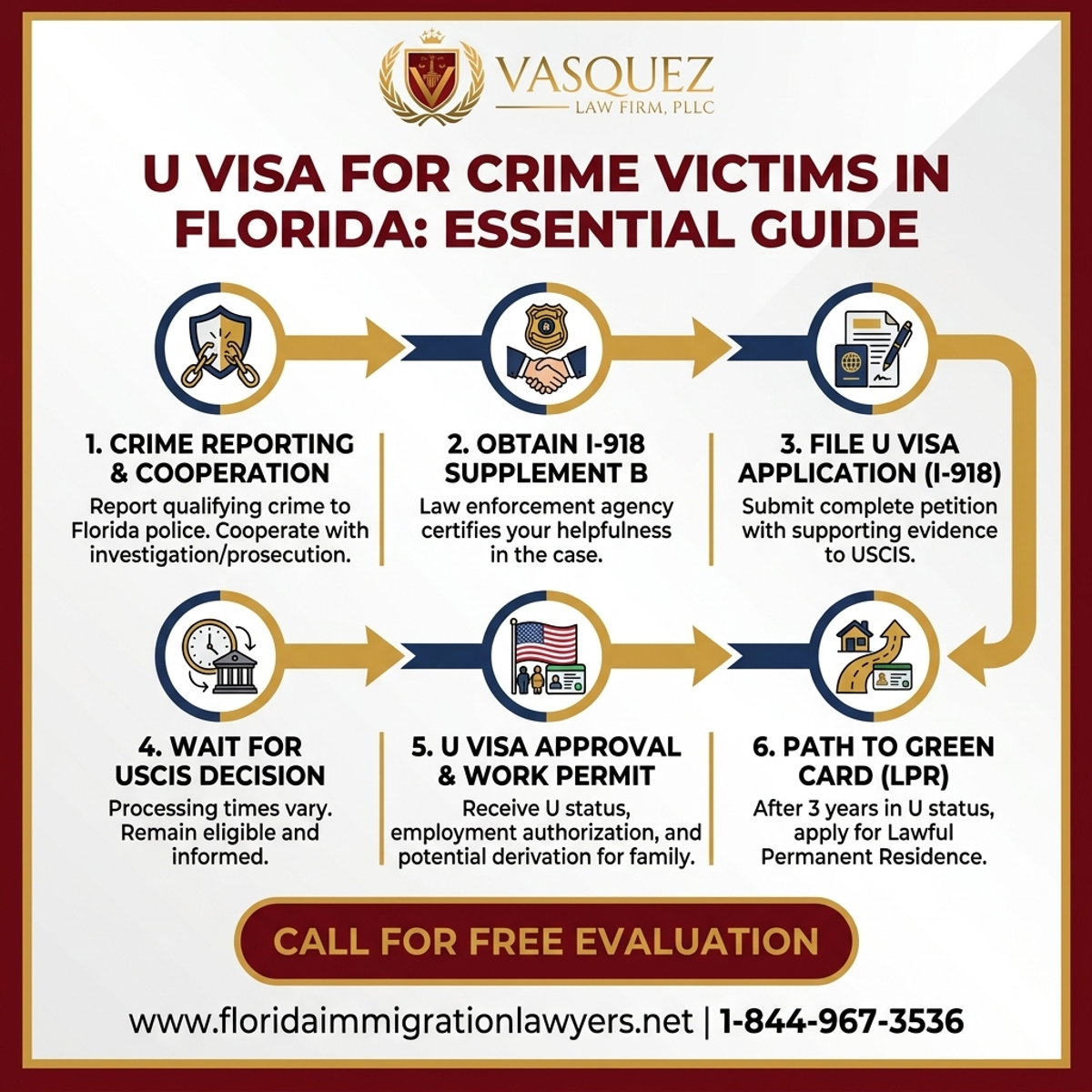
Step-by-Step Process — U Visa for Crime Victims in Florida: Essential Guide
These benefits collectively aim to empower crime victims, offering them not just legal status but also the tools to recover and thrive in a safe environment.
Understanding the U Visa Application Process: Step-by-Step Guide and Required Documentation
The U Visa application process, while offering significant relief, is detailed and requires meticulous preparation. Navigating this journey effectively often necessitates the guidance of an experienced immigration attorney. Here’s a step-by-step overview:
Step 1: Obtain Law Enforcement Certification (Form I-918, Supplement B)
As discussed, this is the foundational step. The victim or their attorney must request and secure a signed certification from a qualifying law enforcement agency. This form attests to the victim’s helpfulness in the investigation or prosecution of the crime. Without this certification, the U Visa petition cannot proceed. It's crucial to approach the correct agency and provide them with sufficient information about the crime and the victim's cooperation.
Step 2: Prepare and File Form I-918, Petition for U Nonimmigrant Status
This is the primary application form. It requires detailed information about the applicant, the qualifying crime, and how they meet the eligibility criteria. Along with Form I-918, applicants must submit:
- Personal Statement: A comprehensive personal statement detailing the crime, the abuse suffered, and the applicant's helpfulness to law enforcement. This narrative is critical for USCIS to understand the full scope of the victim's experience.
- Evidence of Substantial Physical or Mental Abuse: This can include medical records, psychological evaluations, police reports, affidavits from witnesses, and photos. The more evidence provided, the stronger the case.
- Evidence of Helpful Cooperation: In addition to the certification, any other evidence of cooperation with law enforcement, such as court documents, letters from prosecutors, or transcripts of interviews, should be included.
- Identity and Nationality Documents: Copies of passports, birth certificates, national identity cards, or other forms of identification.
- Proof of Relationship (for derivative applicants): Birth certificates, marriage certificates, or other official documents establishing the relationship between the principal applicant and derivative family members.
- Form I-192, Application for Advance Permission to Enter as a Nonimmigrant: If the applicant is inadmissible to the U.S. (e.g., due to unlawful presence, certain criminal convictions), they must file this waiver application. Many U Visa applicants require this waiver, as their circumstances often involve prior immigration violations.
Step 3: Submit the Application Package to USCIS
Once all forms and supporting documentation are meticulously prepared, the complete package is mailed to the USCIS Vermont Service Center. It is vital to keep copies of everything submitted. USCIS will then issue a receipt notice (Form I-797C, Notice of Action).
Step 4: Biometrics Appointment
After filing, applicants typically receive a notice to attend a biometrics appointment at an Application Support Center (ASC). Here, fingerprints, photos, and signatures are collected for background checks.
Step 5: Waiting Period and Bona Fide Determination
Due to the annual cap on U Visas (10,000 per fiscal year), there is often a significant waiting period. USCIS processes petitions in the order they are received. During this wait, USCIS may issue a "bona fide determination" (BFD) if they find the petition meets initial eligibility requirements. A BFD allows applicants to receive deferred action and work authorization while awaiting a final decision on their U Visa. This interim relief is incredibly important for victims.
Step 6: Interview (If Required) and Final Decision
While not all U Visa applicants are interviewed, USCIS may request one to clarify information or address discrepancies. If an interview is required, it is advisable to have legal counsel present. Finally, USCIS will issue a decision. If approved, the applicant receives U Nonimmigrant Status. If denied, there may be options for appeal or reconsideration, depending on the reasons for denial.
The entire process can take several years due to the cap and processing times. Throughout this period, maintaining communication with your attorney and adhering to all USCIS requests is crucial. For those facing immediate threats or complex situations, exploring other forms of humanitarian relief, such as asylum, might also be considered in parallel with the U Visa process, though each has distinct requirements.
This detailed understanding of the application journey underscores the importance of professional legal assistance. An attorney can help compile compelling evidence, draft persuasive statements, and navigate potential challenges, significantly increasing the likelihood of a successful outcome.
Common Challenges and How a Florida Immigration Attorney Can Help
Despite its protective intent, the U Visa application process is fraught with potential challenges. Victims often face language barriers, trauma-related memory issues, fear of authorities, and a lack of understanding of the complex legal requirements. Additionally, securing the law enforcement certification can be difficult if agencies are unfamiliar with the U Visa or are reluctant to sign. Misinterpretations of eligibility criteria, incomplete documentation, or errors in forms can lead to significant delays or outright denials.
This is where the expertise of a dedicated Florida immigration lawyer becomes invaluable. An attorney can:
- Assess Eligibility: Accurately determine if you meet all U Visa requirements and identify potential inadmissibility issues that need waivers.
- Gather Evidence: Help collect crucial evidence, including police reports, medical records, and witness affidavits, and assist in drafting a compelling personal statement that effectively conveys your experience.
- Navigate Law Enforcement: Strategically approach and communicate with law enforcement agencies to secure the necessary certification, often overcoming initial hurdles or misunderstandings.
- Prepare Forms and Waivers: Meticulously complete all USCIS forms, including the I-918 and any required waivers (Form I-192), ensuring accuracy and completeness to avoid delays.
- Protect Against Deportation: If you are in removal proceedings, a U Visa petition can often halt deportation defense efforts, providing a pathway to stay legally in the U.S.
- Represent You: Act as your advocate with USCIS, respond to Requests for Evidence (RFEs), and represent you in interviews if necessary.
- Provide Emotional Support: While not therapists, attorneys understand the sensitive nature of these cases and can provide compassionate guidance through a difficult process.
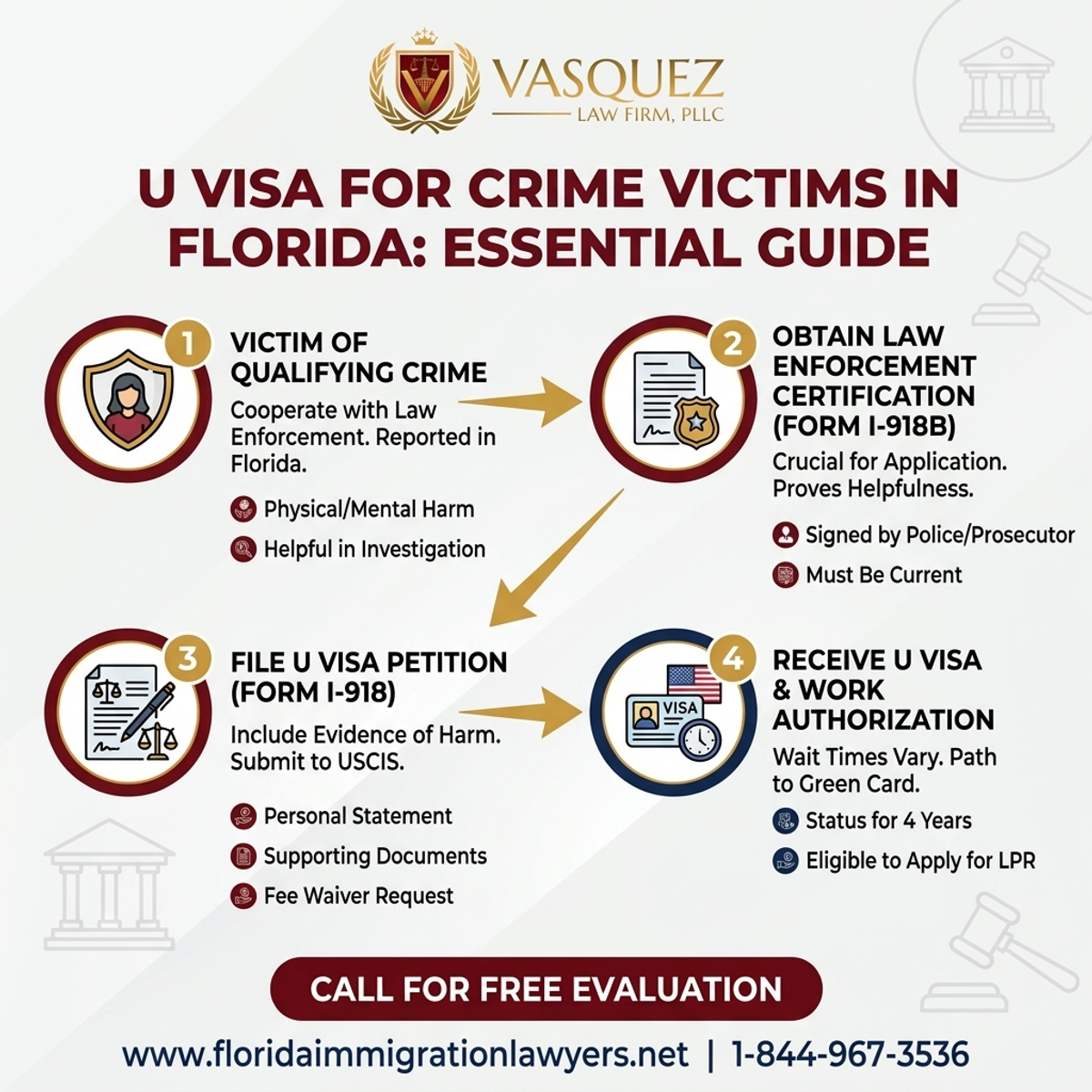
Key Statistics — U Visa for Crime Victims in Florida: Essential Guide
Choosing the right legal partner in Florida is crucial. Our experienced team of immigration lawyers is committed to assisting crime victims throughout the state, from Miami to Orlando, Tampa to Jacksonville. We understand the unique challenges faced by immigrants and are dedicated to providing comprehensive, compassionate, and effective legal representation.
Frequently Asked Questions About the U Visa
- What types of crimes qualify for the U Visa?
Crimes such as sexual assault, domestic violence, kidnapping, extortion, human trafficking, and other serious crimes that cause substantial physical or mental harm.
- Do I need a police report to apply for the U Visa?
Yes, a police report is crucial, as it helps demonstrate that you were the victim of a crime and is a key component in obtaining certification from the law enforcement agency.
- Can I apply for the U Visa if I do not have documents?
Yes, the U Visa is specifically designed for undocumented victims or those with irregular immigration status who have been victims of crimes and cooperate with authorities.
- How long does the U Visa process take?
The process can be lengthy, often taking several years, due to the annual visa cap. However, applicants may receive deferred action and work authorization while they wait.
- Can my family members get the U Visa with me?
Yes, your spouse and unmarried children under 21 can be included in your application. In some cases, parents and siblings under 18 may also qualify.
- What does substantial abuse mean?
It refers to significant physical or mental harm suffered as a result of the crime. It is evaluated on a case by case basis, considering the severity of the harm and the impact on the life of the victim.
- What happens if the police will not sign the certification?
An immigration attorney can help communicate with the agency, present the case, and advocate for the certification. Persistence and properly presenting evidence are key.
- Does the U Visa lead to a Green Card?
Yes, after three years in U status and meeting certain requirements, beneficiaries may be eligible to apply for lawful permanent residence, a Green Card.
Contact a Florida U Visa Attorney Today
If you or a loved one has been a victim of a qualifying crime in Florida and are considering applying for a U Visa, do not navigate this complex process alone. The stakes are high, and the legal landscape is intricate. Our firm is dedicated to helping crime victims secure the protection and stability they deserve. We offer free consultations to discuss your specific situation and outline the best path forward. Protect your rights and your future. Contact us today at 1-844-YO-PELEO for a confidential consultation. Let our experience guide you towards safety and legal status in the United States.
Sources and References
- U.S. Citizenship and Immigration Services (USCIS)
- Executive Office for Immigration Review (EOIR)
- U.S. Department of State - Bureau of Consular Affairs
- Immigration and Nationality Act (INA), 8 U.S.C. Chapter 12
Do Not Navigate This Process Alone
Our experienced immigration attorneys are ready to fight for you. Get a free, confidential case review today.
Se Habla Español
Or leave your details and we’ll call you:
Free Evaluation in 24 Hours
Or talk to us right now

AI voice assistant — available 24/7
FreeFrequently Asked Questions

William J. Vásquez
Founding Attorney · Vasquez Law Firm
U.S. Air Force veteran and immigration attorney with years of hands-on U.S. immigration experience. J.D., NCCU School of Law. AILA member. Admitted to the 4th, 5th, and 11th Circuit Courts.
Available 24/7 - Free Evaluations
Reviewed for legal accuracy by William J. Vásquez
Licensed in North Carolina; U.S. immigration is federal practice.
Related Legal Services
Our Florida immigration attorneys can help you with deportation defense, family immigration services and immigration lawyer cost in Florida. Call today at 1-844-YO-PELEO for a free case review.
Related Links
Related Topics
Free Legal Case Review
Discuss your case with our experienced attorneys. We're available 24/7.
Se Habla Español - Estamos aquí para ayudarle.
Related Articles
Immigration Lawyer Orlando Free Consultation in Florida
For individuals and families in Orlando, Florida, navigating the complexities of U.S. immigration law requires expert guidance. An immigration lawyer in Orlando offers crucial support for everything from visa applications and green card processes to naturalization and deportation defense. This comprehensive guide details what a free consultation covers, providing a step-by-step overview of immigration pathways, essential document checklists, and expected timelines in 2026. We also highlight common mistakes to avoid, discuss the critical role of legal counsel in deportation and asylum cases, and explain why choosing a local Orlando immigration attorney is beneficial. Florida Immigration Lawyers is dedicated to serving the diverse community of Orlando with compassionate, effective legal solutions, ensuring you receive personalized advice and robust representation for a successful immigration journey.
EAD Advance Parole Combo Card in Florida 2026
For individuals with a pending Form I-485, Application to Register Permanent Residence or Adjust Status, the EAD Advance Parole Combo Card is an essential document. This single card combines the authorization to work legally in the U.S. (Employment Authorization Document - EAD) with permission to travel internationally and re-enter without abandoning your green card application (Advance Parole). This guide from Florida Immigration Lawyers provides a comprehensive overview for applicants in Florida in 2026, covering eligibility, the step-by-step application process, required documents, expected processing times, and associated costs. We also highlight common mistakes to avoid and when to seek legal counsel to ensure a smooth and successful immigration journey. Understanding this vital card is key to maintaining stability while awaiting your permanent residency approval.
Employment Immigration Attorney in Florida: What You Need
Explore the complexities of employment immigration in Florida, including visa categories, required documents, and common pitfalls. Learn how an immigration attorney can assist you in navigating the legal landscape.
VAWA Immigration Relief for Abused Spouses in Florida
Discover how the Violence Against Women Act (VAWA) provides crucial immigration relief for abused spouses in Florida. Learn about eligibility, the application process, and how Florida Immigration Lawyers can assist you.