T Visa for Human Trafficking Victims in Florida: Your Guide
If you are a victim of human trafficking in Florida, the T visa offers crucial immigration protection, allowing you to live and work legally in the U.S. This guide from Florida Immigration Lawyers provides comprehensive information on eligibility, the application process, required documentation, and what to expect regarding processing times and costs. We cover the benefits, common mistakes to avoid, and scenarios when legal assistance is vital. Understanding the T visa is the first step toward safety and rebuilding your life, with a potential path to a green card. Learn how to navigate this complex process with expert legal support.

A T visa offers critical immigration protection to victims of severe forms of human trafficking in Florida and throughout the U.S. This nonimmigrant visa allows eligible individuals to remain in the United States, rebuild their lives, and cooperate with law enforcement. It provides a path to temporary legal status, work authorization, and eventually, a green card.
- The T visa protects victims of both labor and sex trafficking.
- Eligibility requires cooperation with law enforcement and demonstrating extreme hardship.
- Victims in Florida can seek legal assistance for their T visa application.
- The visa offers a pathway to lawful permanent residency.
- Derivative visas are available for certain family members.
Imagine being promised a better life, only to find yourself trapped in a cycle of exploitation, fear, and control. This devastating reality affects countless individuals, including many here in Florida, who fall victim to the severe crime of human trafficking. If you or someone you know has experienced this unimaginable ordeal, it is crucial to understand that you are not alone, and legal pathways to safety and recovery exist.
The U.S. government recognizes the unique vulnerabilities of trafficking victims and offers specific protections, primarily through the T nonimmigrant visa. This comprehensive guide will explain what a T visa is, outline the eligibility requirements, detail the application process, and provide essential information for victims seeking protection in Florida. We will cover everything from required documentation to common pitfalls to avoid, ensuring you are well-informed.
Your journey to safety and legal status can begin today. Do not hesitate to seek the legal guidance you deserve. Call Florida Immigration Lawyers at 1-844-967-3536 for a free consultation to discuss your specific situation. We are here to help you navigate this complex process with compassion and expertise.
Understanding the T Visa: A Lifeline for Trafficking Victims in Florida
Human trafficking is a grave crime involving the use of force, fraud, or coercion to exploit individuals for labor or commercial sex acts. Florida, with its extensive coastline, international airports, and diverse economy, unfortunately, serves as both a destination and transit point for trafficking operations. Recognizing this threat, the U.S. government created the T visa program to provide a crucial lifeline for victims.
The T visa, formally known as T nonimmigrant status, offers temporary immigration benefits to certain victims of severe forms of human trafficking. Its primary goal is to protect victims and encourage their cooperation with law enforcement in the investigation and prosecution of traffickers. This protection is vital for individuals who might otherwise fear deportation or further harm.
Eligibility for a T visa is defined by specific criteria outlined in the Immigration and Nationality Act (INA). A "severe form of trafficking in persons" involves sex trafficking where a commercial sex act is induced by force, fraud, or coercion, or in which the person induced to perform such act has not attained 18 years of age. It also includes labor trafficking, involving the recruitment, harboring, transportation, provision, or obtaining of a person for labor or services through the use of force, fraud, or coercion for the purpose of subjection to involuntary servitude, peonage, debt bondage, or slavery. (See 8 U.S.C. § 1101(a)(15)(T)(i)).
Benefits of the T Visa Status
Receiving a T visa provides several significant benefits for eligible victims. These benefits include temporary legal status in the United States, allowing you to live and work legally without fear. You will also receive employment authorization, which is crucial for financial independence and rebuilding your life. Access to certain public benefits may also be available to T visa holders.
Furthermore, the T visa provides a pathway to lawful permanent residency, commonly known as a green card, after a period of holding T nonimmigrant status. This is a critical step towards long-term stability and security in the U.S. Certain immediate family members, such as spouses, children, and sometimes parents or unmarried siblings under 18, may also be eligible for derivative T visas, ensuring family unity. Our firm can assist with family-based immigration matters. Discover more at floridaimmigrationlawyers.net/practice-areas/family-immigration. For a broader understanding of immigration processes, visit our main immigration practice area page: floridaimmigrationlawyers.net/practice-areas/immigration.
The Landscape of Human Trafficking in Florida
Florida's unique geographical position and diverse population make it particularly susceptible to human trafficking. Major metropolitan areas like Miami, Orlando, and Tampa are often identified as high-incidence locations due to their transient populations and large tourism industries. Victims in Florida come from all walks of life and various countries, often lured by false promises of work or a better future.
Local and state law enforcement agencies across Florida are actively working to combat human trafficking, but the cooperation of victims is paramount. The T visa program is designed to facilitate this cooperation by offering protection from deportation and other immigration consequences. Understanding your rights and available protections is the first step towards breaking free from exploitation.
Navigating the T Visa Application Process: A Detailed Guide
Applying for a T visa involves a series of specific steps and requires careful attention to detail. This process is designed to verify that you meet the eligibility criteria and to ensure your safety. Working with an experienced immigration attorney in Florida can significantly streamline this complex journey.
- Identify as a Victim of Human Trafficking: The first and most crucial step is recognizing that you have been a victim of a severe form of human trafficking. This includes both sex trafficking and labor trafficking, as defined by U.S. law. Understanding these definitions is essential for building a strong case.
- Meet the Eligibility Requirements: To be eligible for a T visa, you must demonstrate several key points. You must be a victim of a severe form of trafficking in persons, be physically present in the United States, American Samoa, or the Commonwealth of the Northern Mariana Islands (or at a port of entry thereto) on account of such trafficking. You must also have complied with any reasonable request for assistance in the investigation or prosecution of human trafficking, or be under 18 years of age. Additionally, you must show that you would suffer extreme hardship involving unusual and severe harm if you were removed from the United States.
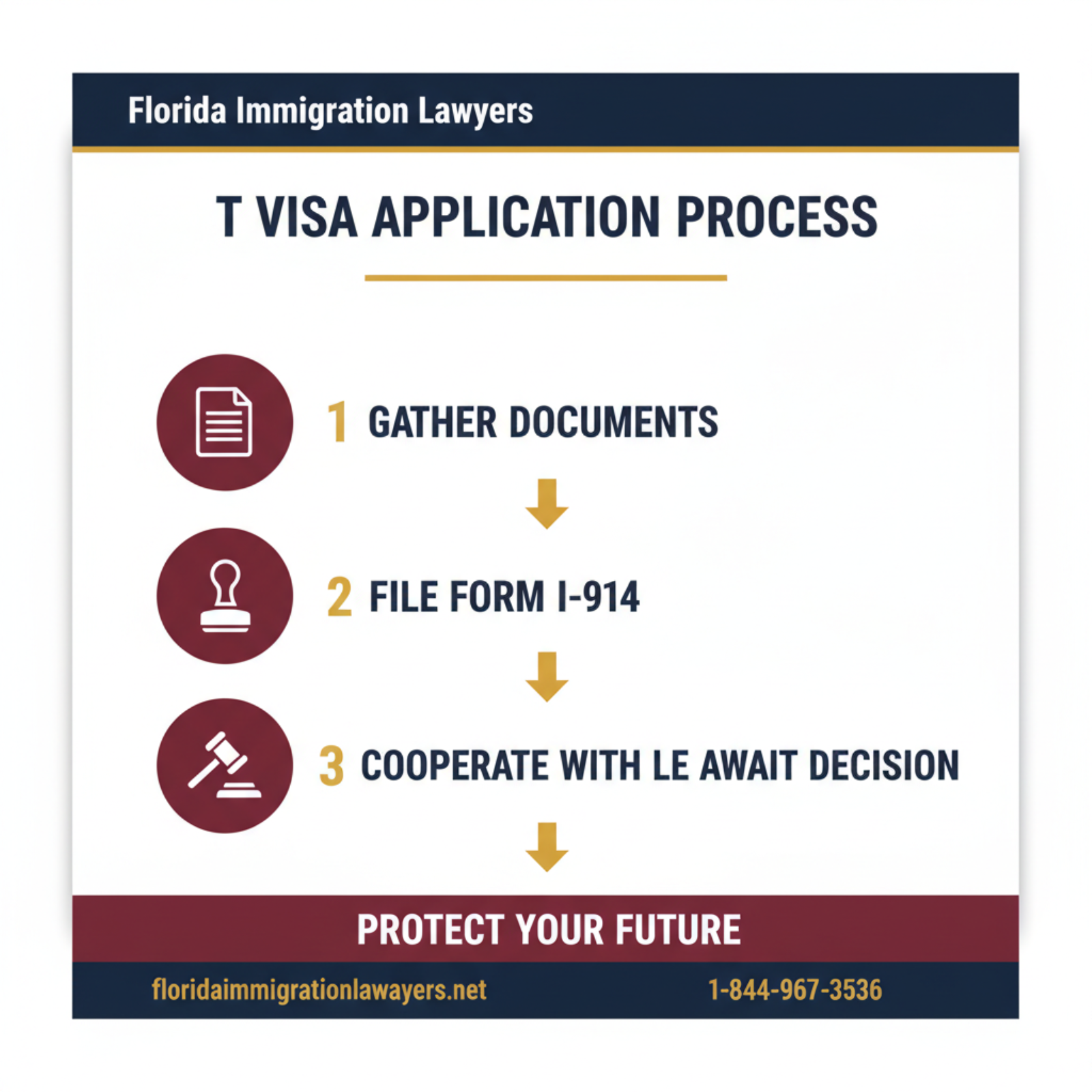
- Gather Evidence and Documentation: Collecting all necessary evidence is paramount. This includes personal statements, police reports, medical records, and any documentation that supports your claim of being a trafficking victim. Evidence of cooperation with law enforcement is also critical.
- Complete Form I-914, Application for T Nonimmigrant Status: This is the primary application form for the T visa. It is extensive and requires detailed information about your trafficking experience, your cooperation with law enforcement, and why you would suffer extreme hardship if removed. You will also file Form I-914, Supplement A, for qualifying family members.
- Obtain a Law Enforcement Endorsement (Optional but Recommended): While not strictly mandatory for all applicants, obtaining a Declaration of Law Enforcement Support (Form I-914, Supplement B) from a federal, state, or local law enforcement agency is highly recommended. This document strengthens your claim of cooperation and can significantly aid your application. Agencies like the Miami-Dade Police Department or the Florida Department of Law Enforcement may provide such support.
- Submit Your Application to USCIS: Once all forms and supporting documents are prepared, you will submit your complete package to the U.S. Citizenship and Immigration Services (USCIS) Vermont Service Center. This is the designated center for T visa applications.
- Attend Biometrics Appointment: After submitting your application, USCIS will send you a receipt notice (Form I-797C) and then a notice for a biometrics appointment. This appointment involves fingerprinting, photographs, and a signature collection for background checks. Local USCIS Application Support Centers (ASCs) in Florida, such as those in Miami or Orlando, conduct these appointments.
- Respond to Requests for Evidence (RFEs): USCIS may send you a Request for Evidence (RFE) if they need additional information or clarification to make a decision on your case. Responding thoroughly and promptly is crucial to avoid delays or denials.
- Receive a Decision: After reviewing your application and any requested evidence, USCIS will issue a decision. If approved, you will receive T nonimmigrant status, typically for a period of four years.
- Apply for a Green Card (Adjustment of Status): After holding T nonimmigrant status for three years, or if the investigation or prosecution of the trafficker is complete, you may be eligible to apply for lawful permanent residency by filing Form I-485, Application to Register Permanent Residence or Adjust Status. This is the final step towards securing your long-term future in the United States. The T visa offers a pathway to lawful permanent residency and eventually U.S. citizenship. Learn more about pursuing citizenship at floridaimmigrationlawyers.net/practice-areas/citizenship.
Cooperation with Law Enforcement
A key component of the T visa application for adult victims is demonstrating cooperation with law enforcement. This does not mean you must have put the trafficker in jail, but rather that you have complied with any reasonable requests for assistance. This could include providing information, testifying, or participating in interviews. If you are under 18, the cooperation requirement is generally waived, acknowledging the heightened vulnerability of minor victims. For more information on victim assistance, you can visit the Department of Justice's human trafficking resources at justice.gov/humantrafficking.
Essential Documents for Your T Visa Application
A comprehensive and well-organized set of documents is critical for a successful T visa application. Missing or insufficient documentation can lead to significant delays or even denial. Here is a general checklist of documents you will typically need to prepare:
- Completed Form I-914, Application for T Nonimmigrant Status.
- Completed Form I-914, Supplement A, if applying for derivative family members.
- Completed Form I-914, Supplement B, Declaration of Law Enforcement Support (highly recommended).
- Personal statement detailing your trafficking experience, including how you were trafficked, the methods used by traffickers, and the extreme hardship you would face if removed from the U.S.
- Evidence of your identity and nationality (e.g., passport, birth certificate, national identity card).
- Evidence of your physical presence in the United States on account of trafficking (e.g., travel tickets, witness affidavits, medical records).
- Evidence of the severe form of trafficking (e.g., police reports, court documents, affidavits from witnesses, medical records, employment records, pay stubs, bank statements, photos, emails, texts).
- Evidence of your cooperation with law enforcement (e.g., letters from law enforcement, police reports, court transcripts, copies of interviews). If you are under 18, explain that this requirement is waived.
- Evidence of extreme hardship if removed from the U.S. (e.g., medical records, psychological evaluations, evidence of lack of support in your home country, threats from traffickers).
- Two passport-style photographs.
- Any other supporting documentation that substantiates your claims.
It is essential to provide certified translations for any documents not in English. An immigration attorney can help you identify all necessary documents and ensure your application package is complete and accurate.
T Visa Processing Times and What to Expect
The processing time for a T visa application can vary significantly depending on several factors. These factors include the volume of applications USCIS receives, the complexity of your case, and how quickly you respond to any Requests for Evidence. While it is challenging to provide an exact timeline, understanding the typical stages can help manage expectations.
Generally, after filing Form I-914, you will first receive a receipt notice from USCIS. This confirms that your application has been received and is being processed. This initial step can take several weeks. Following this, you will typically receive a biometrics appointment notice within a few months. The actual adjudication of the T visa application, which includes background checks and a thorough review of your evidence, can take anywhere from 12 to 24 months, or even longer in some complex cases. USCIS aims to process these sensitive cases diligently, but the nature of the investigation and coordination with law enforcement can extend timelines.
Factors Affecting T Visa Processing Speed
Several elements can influence how quickly your T visa application is processed. A well-prepared application with all supporting documentation and a strong declaration of law enforcement support can often lead to faster processing. Conversely, incomplete applications, missing evidence, or the need for extensive background checks can prolong the waiting period. If you have any criminal history or prior immigration violations, these might also require additional review, potentially extending your processing time. We encourage applicants to check the USCIS website for the most current processing times specific to Form I-914. You can find general processing time information at uscis.gov/processing-times.
Understanding T Visa Application Costs
Navigating the immigration process often involves various fees, and understanding these costs is an important part of planning your T visa application. While the application for T nonimmigrant status itself (Form I-914) generally does not require a filing fee, other associated costs may arise throughout your journey.
One potential cost is the fee for an Employment Authorization Document (EAD), which allows you to work legally in the U.S. If you apply for an EAD (Form I-765) after your T visa is approved, there is typically a filing fee. However, victims of human trafficking may be eligible for a fee waiver for certain forms, including the EAD application, by filing Form I-912, Request for Fee Waiver. This waiver is often granted to individuals who demonstrate an inability to pay the fees.
Beyond government filing fees, you should also consider other potential expenses. These may include fees for obtaining necessary documents, such as birth certificates or police reports, especially if they are from your home country. Translation costs for documents not in English can also add up, as all foreign language documents must be accompanied by a certified English translation. Furthermore, travel expenses for biometrics appointments or potential interviews should be factored in.
The most significant potential cost for many applicants is legal representation. While not mandatory, retaining an experienced immigration attorney from Florida Immigration Lawyers can be an invaluable investment. Our attorneys ensure your application is accurate, complete, and strategically presented, significantly increasing your chances of success and reducing the likelihood of costly delays or denials. We offer free consultations to discuss your case and potential legal fees.
Do not navigate this complex and sensitive process alone. The stakes are too high to leave anything to chance. Contact Florida Immigration Lawyers today at 1-844-967-3536 to secure experienced legal representation and advocacy for your T visa application.
Common Mistakes to Avoid When Applying for a T Visa
Applying for a T visa is a sensitive and often complex process. Mistakes can lead to significant delays, requests for additional evidence, or even the denial of your application. Being aware of common pitfalls can help you avoid them and strengthen your case.
- Failing to Meet the Definition of Human Trafficking: Many applicants mistakenly believe their situation qualifies as trafficking when it does not meet the specific legal definitions of "severe form of trafficking in persons." This can lead to an immediate denial. Ensure your story aligns with the legal criteria for force, fraud, or coercion in labor or sex trafficking.
- Incomplete or Inaccurate Application Forms: Submitting forms with missing information, incorrect details, or unsigned sections is a very common reason for RFEs or rejections. Double-check every field and ensure all required signatures are present.
- Insufficient Supporting Documentation: A strong application relies on compelling evidence. Failing to provide enough documentation to corroborate your personal statement, prove your presence in the U.S. due to trafficking, or demonstrate extreme hardship can weaken your case significantly.
- Lack of Cooperation with Law Enforcement: For adult victims, a key requirement is cooperating with reasonable requests from law enforcement regarding the trafficking investigation or prosecution. If you fail to demonstrate this cooperation (unless you are under 18), your application may be denied.
- Missing Deadlines or Ignoring Requests for Evidence (RFEs): USCIS provides strict deadlines for responding to RFEs. Failing to respond on time, or providing an inadequate response, will almost certainly lead to a denial. Pay close attention to all communications from USCIS.
- Inconsistent or Contradictory Statements: Providing conflicting information across different parts of your application, or between your application and previous statements to authorities, can raise red flags for immigration officers and lead to credibility issues.
- Not Seeking Legal Counsel: Attempting to navigate the complex T visa process alone, especially as a trafficking survivor dealing with trauma, is incredibly challenging. Without legal guidance, you risk making critical errors that could jeopardize your future.
- Failing to Disclose All Relevant Information: While it might be tempting to omit certain details, especially if they are sensitive or potentially negative, full disclosure is generally the best policy. An attorney can help you present all facts in the most favorable light.
- Not Providing Certified Translations: Any document submitted to USCIS that is not in English must be accompanied by a complete and certified English translation. Failing to provide these will result in an RFE or rejection.
- Incorrectly Applying for Derivative Family Members: The rules for derivative T visas for family members can be complex, especially regarding age and relationship. Errors here can delay or deny family members' applications.
When to Call Florida Immigration Lawyers for T Visa Assistance
The journey to securing a T visa is profoundly personal and often emotionally taxing. While this guide provides general information, your specific circumstances are unique and require personalized legal attention. Knowing when to seek professional legal help is crucial for ensuring the best possible outcome for your case.
You should consider contacting Florida Immigration Lawyers immediately if any of the following scenarios apply to you:
- You are unsure if your experience qualifies as human trafficking: The legal definition is specific. Our attorneys can evaluate your situation against the criteria of 8 U.S.C. § 1101(a)(15)(T)(i) and help determine your eligibility.
- You have limited or no documentation: If you lack traditional forms of evidence due to the nature of your trafficking experience, our legal team can help you gather alternative forms of proof and build a strong case.
- You fear engaging with law enforcement: It is understandable to be hesitant. We can act as a liaison between you and law enforcement agencies, ensuring your rights are protected while facilitating necessary cooperation.
- You have prior immigration violations or a criminal record: Such issues can complicate your application. Our attorneys are skilled in addressing these challenges and exploring potential waivers or alternative strategies.
- You need help with derivative family member applications: Securing visas for your qualifying family members requires additional forms and evidence. We can ensure their applications are correctly prepared and submitted alongside yours.
- You have received a Request for Evidence (RFE) or a Notice of Intent to Deny (NOID): These indicate that USCIS requires more information or is considering denying your case. Immediate legal intervention is critical to respond effectively and prevent a denial.
- You are facing deportation or removal proceedings: A T visa can offer protection from deportation. If you are in removal proceedings, an attorney can help you present your T visa eligibility as a defense. Learn more about deportation defense at floridaimmigrationlawyers.net/practice-areas/deportation-defense.
- You simply feel overwhelmed by the process: The legal jargon, extensive forms, and emotional toll of recounting your experiences can be daunting. Let our compassionate team provide the support and expertise you need.
At Florida Immigration Lawyers, we understand the immense courage it takes to come forward. We are dedicated to providing empathetic, confidential, and effective legal representation to human trafficking victims in Florida. Our goal is to help you secure the protection and stability you deserve, guiding you every step of the way towards a brighter future, potentially even a path to U.S. citizenship via a green card. Explore our attorneys' profiles at floridaimmigrationlawyers.net/attorneys.
About Florida Immigration Lawyers
Florida Immigration Lawyers is a leading law firm dedicated to providing exceptional immigration legal services across the entire state of Florida. With a deep understanding of U.S. immigration law and a strong commitment to our clients, we stand as a beacon of hope for individuals and families navigating complex immigration challenges. Our firm is founded on principles of integrity, compassion, and tireless advocacy.
We specialize in a wide range of immigration matters, including T visas for victims of human trafficking, family-based immigration, business immigration, asylum claims, and deportation defense. Our experienced attorneys are well-versed in the nuances of federal immigration laws and have a proven track record of successfully assisting clients from diverse backgrounds. We understand the unique needs of immigrants in Florida, from Miami to Jacksonville, and are equipped to handle cases in all USCIS field offices and immigration courts throughout the state.
Choosing Florida Immigration Lawyers means choosing a partner who will stand by you. We offer free, confidential consultations to assess your case and provide clear, honest legal advice. Our team is available 24/7, recognizing that immigration issues often arise unexpectedly and require immediate attention. We pride ourselves on clear communication, keeping you informed at every stage of your case. Our dedication extends to ensuring that justice is served for vulnerable populations, including victims of human trafficking, by providing robust legal protection and guidance. Your future and safety are our priority.
Contact us today at 1-844-967-3536 or visit our website at https://www.floridaimmigrationlawyers.net to learn more about how we can assist you.
Sources and References
- U.S. Citizenship and Immigration Services (USCIS) - Human Trafficking and T Visas
- U.S. Department of Justice - Human Trafficking
- 8 U.S.C. Chapter 12 - Immigration and Nationality Act (INA)
- 8 U.S.C. § 1101(a)(15)(T)(i) - Definition of T Nonimmigrant
- 8 CFR Part 214.11 - T Nonimmigrant Status
- USCIS Policy Manual, Volume 3, Part B, Chapter 7 - T Nonimmigrant Status
This article provides general legal information and is not intended as legal advice. Every case is unique, and outcomes depend on specific facts and circumstances. Contact an attorney for advice about your particular situation.
If you or a loved one in Florida has been a victim of human trafficking, do not suffer in silence. The legal team at Florida Immigration Lawyers is here to offer the compassionate, expert assistance you need to secure your future through a T visa. Take the courageous step towards freedom and stability. Call us today for a free, confidential consultation at 1-844-967-3536. Se Habla Español - Estamos aquí para ayudarle.
Do Not Navigate This Process Alone
Our experienced immigration attorneys are ready to fight for you. Get a free, confidential consultation today.
Se Habla Español
Frequently Asked Questions
Florida Immigration Lawyers
Immigration Attorney | Founder, Vasquez Law Firm
U.S. Air Force veteran and immigration attorney with thousands of cases resolved. J.D., NCCU School of Law. AILA member. Admitted to the 4th, 5th, and 11th Circuit Courts.
Available 24/7 - Free Evaluations
Related Legal Services
Our Florida immigration attorneys can help you with deportation defense, citizenship and naturalization and family immigration services. Call today at 1-844-967-3536 for a free consultation.
Related Links
Related Topics
Free Legal Consultation
Discuss your case with our experienced attorneys. We're available 24/7.
Se Habla Español - Estamos aquí para ayudarle.
Related Articles
Stokes Interview: Navigating Marriage Fraud in Florida
A Stokes interview is a specialized, separate interview conducted by USCIS when there are suspicions of marriage fraud in a green card application. This rigorous process involves individual questioning of spouses, focusing on inconsistencies in their testimonies to determine the authenticity of their marital bond. For couples in Florida, navigating this high-stakes interview requires meticulous preparation, extensive documentation, and often the strategic guidance of an experienced immigration lawyer. Understanding the process, preparing for detailed questions, and presenting a strong case are crucial for overcoming marriage fraud allegations and securing your immigration future. Florida Immigration Lawyers stands ready to assist you.
Immigration Attorney Gainesville: North Florida Legal Help
For those in Gainesville, Alachua County, and throughout North Florida, navigating U.S. immigration law requires expert guidance. An experienced immigration attorney can simplify complex processes, from family-based petitions and employment visas to critical asylum claims and deportation defense. This comprehensive guide outlines the essential services provided by an immigration attorney, details necessary documentation, clarifies processing timelines, and discusses associated costs. We also highlight common mistakes to avoid and crucial scenarios where legal counsel is indispensable. Florida Immigration Lawyers serves all of Florida, including Gainesville and St. Petersburg, providing dedicated legal support to help you achieve your immigration goals. Contact us for a free consultation to discuss your specific needs.
Military Naturalization Expedited at Florida Bases
Explore expedited military naturalization processes for service members at Florida bases like MacDill. Learn about eligibility, steps, and common mistakes. Contact Florida Immigration Lawyers for a free consultation.
Protect Yourself from Immigration Scams in Florida
Learn how to protect against immigration scams in Florida, focusing on St. Petersburg. This guide covers identifying scams, verifying credentials, and getting legal help. Call Florida Immigration Lawyers at 1-844-967-3536 for assistance.
