SIJS for Minors in Florida: A Complete Guide
Special Immigrant Juvenile Status (SIJS) offers immigrant minors in Florida a pathway to lawful permanent residency. Learn the eligibility criteria, steps to apply, and common mistakes to avoid. Contact Florida Immigration Lawyers for guidance.
- SIJS is intended for minors under 21 years of age.
- Applicants must be declared dependent on a Florida court.
- Legal representation is highly recommended.
Introduction
In Florida, minors who have faced difficult circumstances such as abuse, abandonment, or neglect may find hope through Special Immigrant Juvenile Status (SIJS). This program allows eligible minors to apply for lawful permanent residency, offering a chance for stability and a brighter future. Navigating the complexities of SIJS can be challenging. Call Florida Immigration Lawyers at 1-844-YO-PELEO for a free consultation to guide you through this intricate process.
For many immigrant children, their journey to the United States is marked by unimaginable hardship, having endured severe abuse, neglect, or abandonment in their home countries or even within the U.S. borders. These vulnerable minors often arrive without adequate support systems, facing legal and emotional challenges that can feel insurmountable. Special Immigrant Juvenile Status (SIJS) stands as a critical lifeline, offering a pathway to safety and stability that recognizes their unique plight and provides a chance for a secure future away from harm.
In Florida, the legal framework for SIJS is particularly crucial, given its diverse immigrant population. The state's courts play a pivotal role in identifying and protecting these children, making a judicial determination that is foundational to the federal immigration application. However, navigating this dual legal system—state family court and federal immigration services—requires specialized knowledge. Florida Immigration Lawyers are dedicated to helping these young individuals and their caregivers understand their rights and meticulously prepare their cases, ensuring every step is handled with the utmost care and experience.
Understanding Special Immigrant Juvenile Status (SIJS)
SIJS is a federal designation aimed at providing relief to immigrant minors who cannot reunite with one or both parents due to abuse, neglect, or abandonment. Established under the Immigration and Nationality Act (INA), SIJS allows these minors to apply for lawful permanent residency. The process involves both state court findings and federal immigration applications, making it essential to understand both state and federal requirements.
SIJS is not merely an immigration benefit; it's a humanitarian protection designed to shield children from further trauma and exploitation. It recognizes that certain children cannot safely return to their home countries or be reunified with their parents due to severe maltreatment. This unique status allows them to bypass certain immigration requirements that typically apply to other applicants, acknowledging their exceptional circumstances and the dire need for protection.
The designation serves as a bridge between the state child welfare system and federal immigration law. A state court, typically a family or juvenile court, must first make specific findings about the child's dependency, the inability to reunify with parents, and the determination that it is not in the child's best interest to return to their country of origin. These state court findings are paramount, as they form the bedrock of the federal SIJS petition filed with U.S. Citizenship and Immigration Services (USCIS). Without a valid state court order, the federal application cannot proceed, underscoring the interconnectedness of these legal processes.
Eligibility Criteria for SIJS in Florida
To qualify for SIJS in Florida, the applicant must meet several criteria:
- Be under 21 years of age and unmarried.
- Declared dependent on a Florida state court or in the custody of an agency or department.
- Unable to reunite with one or both parents due to abuse, neglect, or abandonment.
- It is not in the minor's best interest to return to their home country.
The foundational eligibility hinges on the minor's age, requiring them to be under 21 years old and unmarried at the time of petitioning for SIJS. This extended age limit acknowledges the prolonged vulnerability faced by these young individuals. Crucially, the minor must also be declared dependent on a Florida state court, or placed in the custody of a state agency or department. This dependency establishes the state's oversight and protection, often stemming from a formal court proceeding where the child's welfare is deemed to require judicial intervention. For example, a child found living in unsafe conditions might be placed in foster care, establishing court dependency.
The core humanitarian aspect of SIJS is the finding that the minor cannot be reunited with one or both parents due to documented abuse, neglect, or abandonment. This involves substantial evidence presented to the state court, detailing the specific harms suffered or the willful failure of parental duties. Furthermore, the court must make a critical determination that it is not in the minor's best interest to return to their country of origin. This assessment considers the potential dangers and lack of protection they would face there, ensuring their safety and well-being are prioritized above all else. Florida Immigration Lawyers can assist in presenting this compelling evidence to the court.
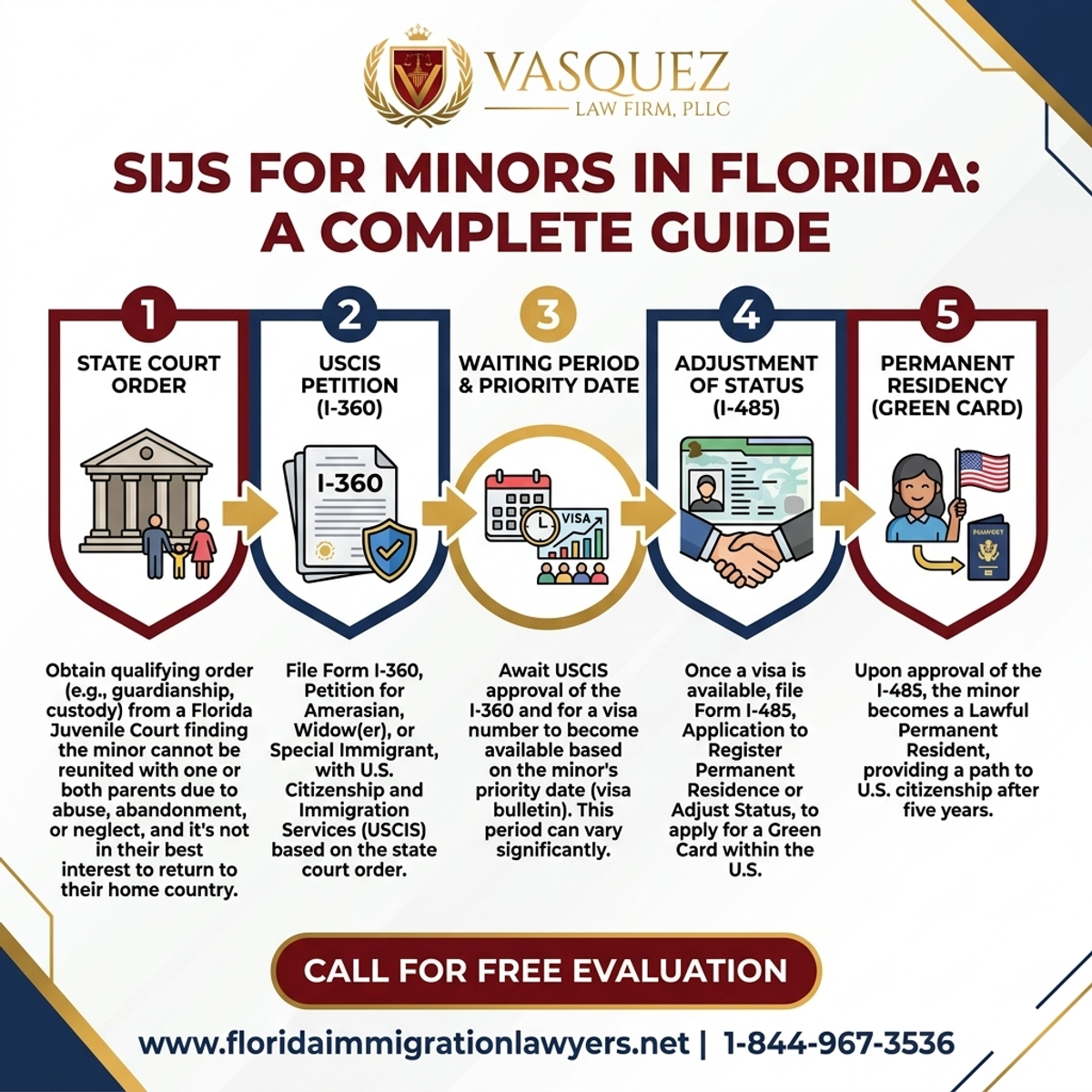
Step-by-Step Process — SIJS for Minors in Florida: A Complete Guide
Step-by-Step Guide to Applying for SIJS
Navigating the SIJS application process involves distinct stages, beginning with state court proceedings and culminating in federal immigration applications. Each step is crucial and requires careful attention to detail to ensure a successful outcome for the minor seeking protection.
- Obtain a Special Findings Order: File a petition in a Florida family court to obtain a special findings order.
The journey begins in a Florida family or juvenile court, where a petition is filed to establish dependency or guardianship. This legal action is crucial because it allows the state court to make the necessary 'special findings' required for SIJS. During this process, a judge will review evidence of abuse, neglect, or abandonment by one or both parents, and determine if it is in the child's best interest to remain in the U.S. A Guardian ad Litem may be appointed to represent the child's interests, ensuring their voice is heard. This state court order is the cornerstone of the entire SIJS application.
- File Form I-360: Once the state court order is obtained, file Form I-360, Petition for Amerasian, Widow(er), or Special Immigrant, with USCIS.
Once the Florida state court issues the special findings order, the next critical step is to file Form I-360, Petition for Amerasian, Widow(er), or Special Immigrant, with U.S. Citizenship and Immigration Services (USCIS). This federal petition formally requests SIJS classification. It must be accompanied by the state court order and other supporting documentation proving eligibility. Timely and accurate submission of this form is paramount, as any errors or missing information can lead to significant delays or even a denial. An experienced Florida Immigration Lawyer can ensure this complex form is meticulously prepared and filed correctly.
- File for Adjustment of Status: If eligible, concurrently file Form I-485, Application to Register Permanent Residence or Adjust Status.
After the I-360 is approved, or sometimes concurrently if a visa number is immediately available, the minor can file Form I-485, Application to Register Permanent Residence or Adjust Status. This is the application for the green card itself. Concurrent filing means both forms are submitted at the same time, often expediting the process. However, if a visa number is not immediately available (due to visa bulletin backlogs for certain countries), the minor may have to wait until one becomes available before filing the I-485. During this waiting period, they may be eligible for employment authorization and deferred action.
- Prepare for an Interview: Attend any required interviews or court appearances as part of the application process.
As part of the adjustment of status process, USCIS may require the minor to attend an interview. This interview is an opportunity for an immigration officer to verify the information provided in the applications and to ask questions about the child's background and experiences. It's vital to prepare thoroughly for this interview, ensuring the minor understands the questions they might be asked and can articulate their story clearly and consistently. Having legal representation from Florida Immigration Lawyers present at the interview can provide significant support and ensure the child's rights are protected.
- Receive Decision: USCIS will review the application and issue a decision. If approved, the minor will receive a green card.
Following the interview and a thorough review of all submitted documentation, USCIS will issue a decision. If the application is approved, the minor will receive their green card, officially granting them lawful permanent resident status in the United States. This is a life-changing moment, providing stability, access to education, and the opportunity to build a secure future. In the unfortunate event of a denial, it is crucial to understand the reasons for the denial and explore potential avenues for appeal or reconsideration, which an attorney can assist with.
Document Checklist for SIJS Applications
- Birth certificate or other proof of age
- Special findings order from Florida state court
- Form I-360, Petition for Amerasian, Widow(er), or Special Immigrant
- Proof of abuse, neglect, or abandonment
- Form I-485, if applying for adjustment of status
- Identity documents such as passport or ID
The success of any immigration application, especially SIJS, hinges on the completeness and accuracy of the supporting documentation. Each document serves as a piece of evidence, building a comprehensive picture of the minor's eligibility and their unique circumstances. Missing documents, outdated information, or inconsistencies can lead to requests for evidence (RFEs), which prolong processing times, or even outright denials. Therefore, meticulous organization and verification of every required item are non-negotiable.
Beyond the core documents listed, applicants should also consider including any additional evidence that strengthens their case. This might include school records demonstrating attendance and performance, letters from teachers or social workers attesting to the child's well-being and needs, or psychological evaluations detailing the impact of the abuse or neglect. All foreign language documents must be accompanied by certified English translations. A Florida Immigration Lawyer can provide a tailored document checklist and assist in gathering and preparing all necessary materials.
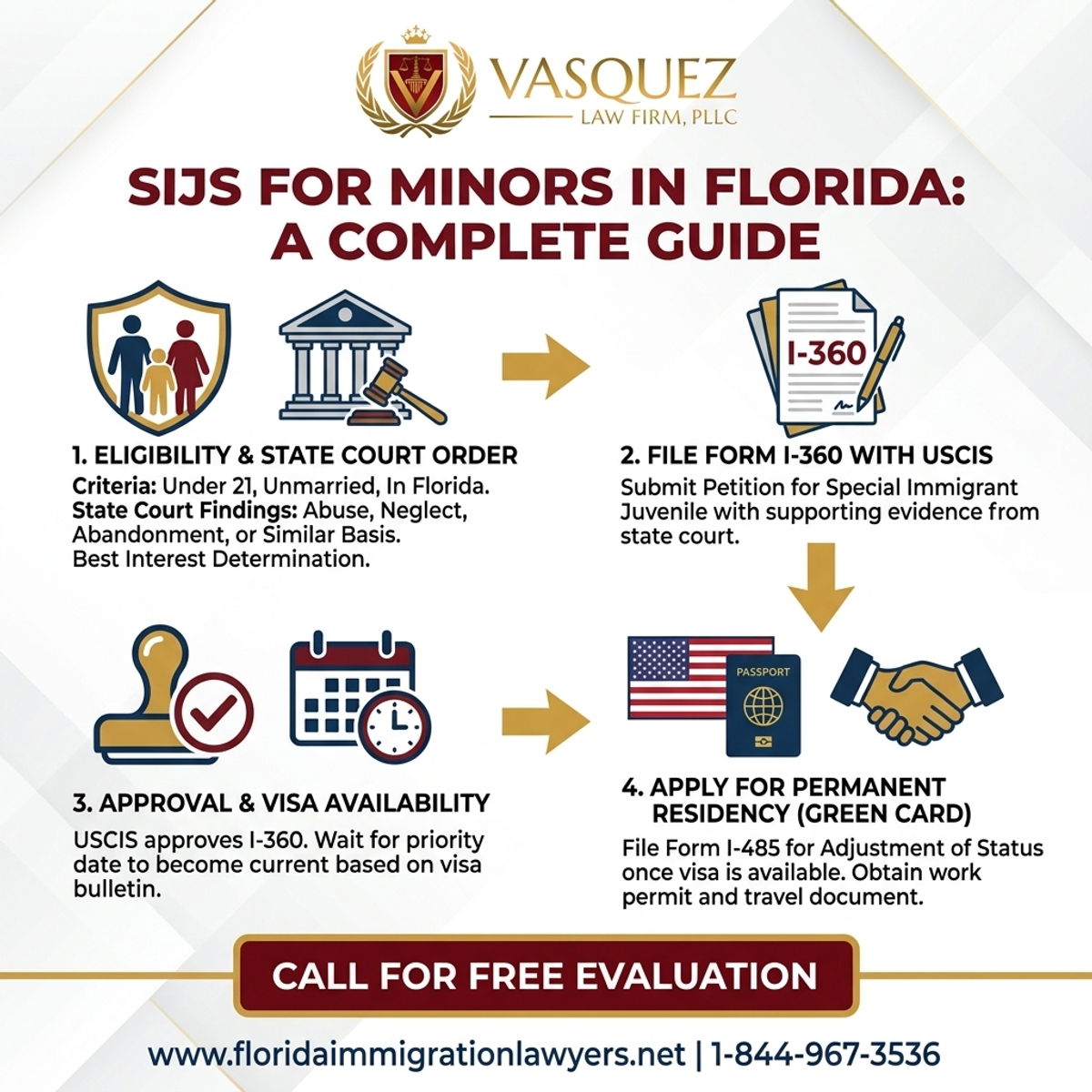
Key Statistics — SIJS for Minors in Florida: A Complete Guide
Timeline and Processing Expectations
The SIJS application process can vary in length. Typically, obtaining a special findings order from a Florida court may take several months. After filing Form I-360, the processing time with USCIS can also extend to several months or longer. It's important to prepare for potential delays and ensure all documentation is accurately submitted to prevent setbacks.
The SIJS process, while offering immense hope, is not typically a quick one. The initial phase of obtaining a special findings order from a Florida state court can vary significantly, depending on court dockets, the complexity of the child's case, and the availability of all parties involved. It might take anywhere from a few months to over a year to secure this crucial judicial order. Factors such as the need for investigations, the appointment of a Guardian ad Litem, and scheduling hearings all contribute to this variability.
Once the federal application (Form I-360 and potentially I-485) is submitted to USCIS, processing times can also fluctuate. USCIS publishes estimated processing times on its website, but these are only averages and can change. Factors like the specific service center handling the case, the volume of applications, and whether a Request for Evidence (RFE) is issued can all impact the timeline. Delays are not uncommon, and it's essential for applicants and their legal representatives to remain patient and proactive, responding promptly to any USCIS communications. Florida Immigration Lawyers stay abreast of current processing trends to provide the most accurate expectations.
Cost Factors and Fee Breakdown
Applying for SIJS involves several fees, including court filing fees, USCIS application fees,
Sources and References
- U.S. Citizenship and Immigration Services (USCIS)
- Executive Office for Immigration Review (EOIR)
- U.S. Department of State - Bureau of Consular Affairs
- Immigration and Nationality Act (INA), 8 U.S.C. Chapter 12
Do Not Navigate This Process Alone
Our experienced immigration attorneys are ready to fight for you. Get a free, confidential case review today.
Se Habla Español
Or leave your details and we’ll call you:
Free Evaluation in 24 Hours
Or talk to us right now

AI voice assistant — available 24/7
FreeFrequently Asked Questions

William J. Vásquez
Founding Attorney · Vasquez Law Firm
U.S. Air Force veteran and immigration attorney with years of hands-on U.S. immigration experience. J.D., NCCU School of Law. AILA member. Admitted to the 4th, 5th, and 11th Circuit Courts.
Available 24/7 - Free Evaluations
Reviewed for legal accuracy by William J. Vásquez
Licensed in North Carolina; U.S. immigration is federal practice.
Related Legal Services
Our Florida immigration attorneys can help you with asylum protection, citizenship and naturalization and immigration practice areas. Call today at 1-844-YO-PELEO for a free case review.
Related Links
Related Topics
Free Legal Case Review
Discuss your case with our experienced attorneys. We're available 24/7.
Se Habla Español - Estamos aquí para ayudarle.
Related Articles
DUI Immigration Consequences in Florida 2026
A DUI conviction in Florida can have severe immigration consequences, potentially leading to inadmissibility, deportation, or denial of immigration benefits. For non-citizens, a DUI is not just a traffic offense but a serious criminal matter that federal immigration law scrutinizes closely. Factors like multiple offenses, injury, or property damage can escalate a simple DUI to a Crime Involving Moral Turpitude (CIMT) or even an aggravated felony, triggering mandatory detention and removal proceedings. Understanding the specific nature of your Florida conviction and its interpretation under the Immigration and Nationality Act (INA) is crucial. This article outlines how DUIs impact immigration status, the grounds for inadmissibility and deportation, a step-by-step guide to navigating the process, essential documentation, and expected timelines for 2026. We also highlight common mistakes to avoid and when to seek legal counsel from an experienced immigration attorney. Florida Immigration Lawyers offers comprehensive support for individuals facing these challenging situations, providing expert guidance through complex legal landscapes.
Dual Citizenship Lawyer in Florida: What You Need to Know
For Florida residents, the concept of dual citizenship, or holding two passports, offers a compelling blend of opportunities and challenges. While the U.S. generally permits dual nationality, the path to achieving this status requires a meticulous understanding of both U.S. immigration laws and the citizenship policies of your country of origin. This guide explores the definition of dual citizenship, the detailed step-by-step process for U.S. naturalization, and the significant benefits and potential pitfalls involved. We cover essential documentation, typical timelines, and cost considerations for 2026, providing crucial insights for anyone in Orlando, Miami, or across Florida considering this important legal step. Learn about common mistakes to avoid and understand when to seek professional legal counsel to navigate this complex process successfully. Florida Immigration Lawyers is here to provide expert, bilingual support for your dual citizenship journey.
Immigration Lawyer Orlando Free Consultation in Florida
For individuals and families in Orlando, Florida, navigating the complexities of U.S. immigration law requires expert guidance. An immigration lawyer in Orlando offers crucial support for everything from visa applications and green card processes to naturalization and deportation defense. This comprehensive guide details what a free consultation covers, providing a step-by-step overview of immigration pathways, essential document checklists, and expected timelines in 2026. We also highlight common mistakes to avoid, discuss the critical role of legal counsel in deportation and asylum cases, and explain why choosing a local Orlando immigration attorney is beneficial. Florida Immigration Lawyers is dedicated to serving the diverse community of Orlando with compassionate, effective legal solutions, ensuring you receive personalized advice and robust representation for a successful immigration journey.
EAD Advance Parole Combo Card in Florida: What You Need
An EAD advance parole combo card allows individuals with pending adjustment applications to both work and travel abroad without jeopardizing their green card application. Learn how to apply in Florida, what documents you need, and common mistakes to avoid.