RFE Florida Response: Expert Guide for USCIS Requests
Receiving a Request for Evidence (RFE) from USCIS can be a critical moment for your immigration application in Florida. This guide breaks down what an RFE means, why USCIS issues them, and how to prepare a robust <strong>RFE Florida response</strong>. From understanding specific requirements and compiling essential documents to navigating processing timelines and avoiding common mistakes, we provide actionable advice. Whether you are in West Palm Beach or elsewhere in Florida, a well-crafted response is crucial. Learn when to seek expert legal assistance to ensure your application has the best chance of approval. Contact Florida Immigration Lawyers for comprehensive support.

A Request for Evidence (RFE) from USCIS means they need more information or clarification to decide on your immigration application or petition. Receiving an RFE is common and not necessarily a sign of denial, but it requires a timely, complete, and accurate response. Failing to respond adequately can lead to delays or even denial of your case. In Florida, navigating an RFE requires careful attention to detail and understanding of specific immigration laws. It is crucial to address every point raised by USCIS directly and provide compelling evidence to support your eligibility.
- An RFE indicates USCIS needs more information for your case.
- Respond fully and accurately within the given deadline.
- Incomplete or late responses can lead to denial.
- Seeking legal counsel significantly improves your chances of a successful outcome.
Receiving a letter from U.S. Citizenship and Immigration Services (USCIS) can often be a source of anxiety, especially when it is a Request for Evidence (RFE). If you are in Florida, particularly in areas like West Palm Beach, and have received an RFE, you might feel overwhelmed or unsure of the next steps. This critical document from USCIS indicates that your immigration application or petition lacks sufficient evidence or requires further clarification before a decision can be made. It is not an automatic denial, but rather an opportunity to strengthen your case with additional documentation and explanations.
Understanding the intricacies of an RFE and responding effectively is paramount to the success of your immigration journey. From family-based petitions to employment visas or adjustment of status applications, an RFE can touch upon various aspects of immigration law. This comprehensive guide will walk you through what an RFE entails, how to strategically prepare your RFE Florida response, common pitfalls to avoid, and when it is essential to seek professional legal assistance from experienced immigration attorneys. Our goal is to empower you with the knowledge needed to navigate this challenging phase confidently and successfully.
Do not let an RFE derail your immigration dreams. If you have received a request for evidence, call Florida Immigration Lawyers at 1-844-967-3536 for a free consultation. Our team is ready to provide the guidance and support you need.
Understanding the USCIS Request for Evidence (RFE) in Florida
A Request for Evidence (RFE) is a formal notice issued by USCIS when they determine that the initial evidence submitted with an immigration application or petition is insufficient. This insufficiency can stem from various reasons, such as missing documents, inconsistencies in information, or a need for additional proof to establish eligibility for the requested benefit. USCIS issues RFEs under the authority of 8 CFR 103.2(b)(8), which allows them to request more information before making a final decision.
For individuals and families in Florida, understanding the purpose of an RFE is the first step toward a successful response. It is not a denial but a pause, giving you a chance to provide the necessary evidence. The types of evidence requested can vary widely depending on the specific application. For example, a family-based petition (Form I-130) might receive an RFE for proof of a bona fide marriage, while an adjustment of status application (Form I-485) could require additional financial documents or proof of lawful entry. Failing to adequately address each point in the RFE can lead to delays or, worse, a denial.
The impact of an RFE on processing times can be significant. Once USCIS issues an RFE, your application processing is essentially paused until they receive and review your response. This can add several months to the overall processing timeline. In Florida, specific USCIS field offices, such as those in Miami, Orlando, Tampa, and Jacksonville, handle local interviews and applications. While RFEs are often issued by service centers, the ultimate impact on your case's timeline can be influenced by the workload and procedures of the relevant field office. Preparing a thorough and well-organized response is crucial to minimize further delays.
Decoding Your RFE: Types and Specific Requirements
Receiving an RFE can be unsettling, but understanding its specific nature is key to formulating an effective response. RFEs are not one-size-fits-all; they are tailored to the deficiencies or questions USCIS has about your particular application. Common types of RFEs often relate to employment-based petitions (e.g., H-1B, L-1), family-based petitions (e.g., I-130, I-485), or even asylum claims. For instance, an employment RFE might question the specialty occupation criteria or the employer-employee relationship, while a family RFE could seek stronger evidence of a genuine relationship or sufficient financial support.
The most critical step is to read your RFE meticulously, perhaps multiple times. Every RFE will explicitly state what information or documents are missing or require clarification. USCIS provides a deadline for your response, typically ranging from 30 to 87 days, though this can vary. Missing this deadline is one of the most severe mistakes an applicant can make, as it almost invariably leads to the denial of the application without further review. The RFE will also specify the format in which documents should be submitted, whether originals or certified copies, and any required translations.
For our clients in West Palm Beach and across Florida, we often see RFEs that delve into complex areas such as maintaining lawful status, proving financial stability, or addressing past immigration violations. For example, an RFE might ask for evidence of continuous lawful presence if there are gaps in your immigration history, or it could request a new Affidavit of Support (Form I-864) if the initial one was deemed insufficient. The consequences of not responding adequately extend beyond mere delays; an insufficient response is equivalent to not responding at all and will likely result in a denial. This underscores the need for a precise, comprehensive, and well-supported submission that directly addresses every single point raised by USCIS.
Step-by-Step Guide to Responding to an RFE
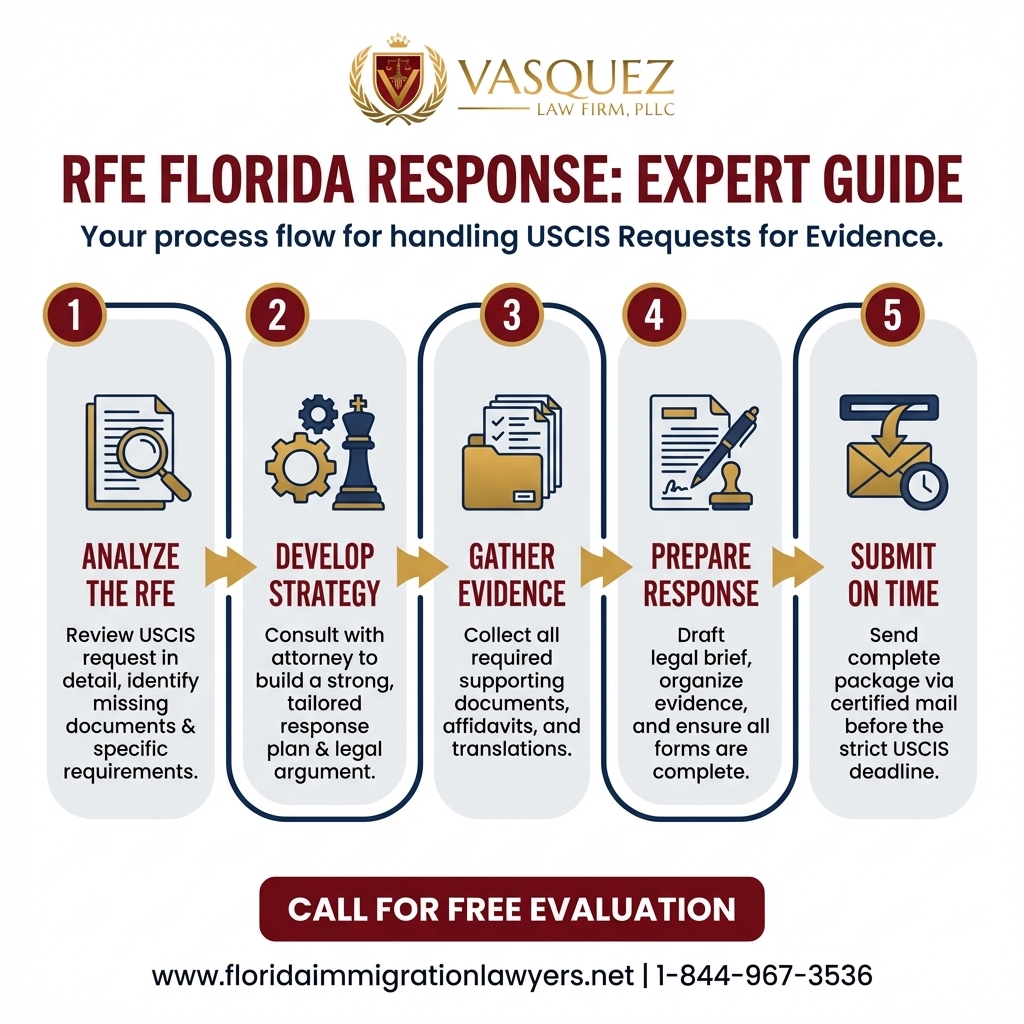
Responding to a Request for Evidence requires a methodical and strategic approach. Following a clear step-by-step process can help ensure you address all USCIS concerns effectively, particularly for those navigating the process in Florida. A well-prepared response significantly increases your chances of approval and avoids further delays or complications.
- Read the RFE Carefully and Completely: This is the foundational step. Do not skim. Read every sentence of the RFE to understand precisely what USCIS is asking for. Highlight or make notes on each specific request. Misinterpreting a request can lead to submitting incorrect or insufficient evidence, which could result in a denial. Pay close attention to the deadline provided; it is non-negotiable.
- Consult with an Experienced Immigration Attorney: Before gathering any documents, discuss the RFE with a lawyer. An attorney specializing in immigration law, like those at Florida Immigration Lawyers, can help you understand the legal implications of each request, identify potential challenges, and formulate a robust strategy. They can also ensure that your response aligns with current immigration laws (e.g., 8 U.S.C. Chapter 12 - Immigration and Nationality Act) and USCIS policy.
- Gather All Requested Documents and Evidence: Systematically collect every document USCIS has asked for. If an original document is requested, provide it (and keep a copy for yourself). If certified copies are sufficient, obtain those. Ensure all foreign language documents are accompanied by certified English translations. Do not submit extraneous documents unless they directly support a point made in the RFE. Quality and relevance are more important than quantity.
- Prepare a Comprehensive Cover Letter: A well-structured cover letter is vital. It should list all the documents you are submitting in response, cross-referencing them with each specific request from the RFE. This helps the USCIS officer quickly verify that all requests have been addressed. Clearly state your application type and receipt number.
- Organize and Submit Your Response: Arrange your documents neatly, ideally in the order listed in your cover letter and following the order of the RFE's requests. Use tabs or dividers for different sections of evidence. Include the original RFE notice on top of your submission. Mail your response to the USCIS address specified in the RFE before the deadline. We recommend using a mailing service with tracking capabilities.
- Keep Complete Copies: Before mailing, make a complete copy of everything you are submitting, including the RFE, your cover letter, and all supporting evidence. This personal record is crucial for your files and for any future reference or legal proceedings.
- Track Your Submission and Case Status: Once submitted, monitor the delivery of your response using the tracking number. Periodically check your USCIS case status online using your receipt number. While USCIS can take several weeks or months to process RFE responses, staying informed is important.
Essential Document Checklist for Your RFE Response
When preparing your RFE Florida response, compiling a precise and comprehensive document checklist is critical. The specific items will depend entirely on your RFE, but a general framework can help ensure you do not overlook any crucial piece of evidence. Remember, the goal is to provide exactly what USCIS has requested, and often, a little more to strengthen your case without overwhelming them with irrelevant information. This systematic approach is especially important for individuals in West Palm Beach and throughout Florida, where immigration processes can be complex.
Here is a general checklist of document categories that might be requested in an RFE:
- Original RFE Notice: Always include the original RFE notice on top of your response package. This helps USCIS quickly identify your case and the specific request.
- Comprehensive Cover Letter: Detail every document submitted, cross-referencing each item with the corresponding request number from the RFE. This letter acts as a roadmap for the USCIS officer.
- Identity and Relationship Proof: Birth certificates, marriage certificates, divorce decrees, national ID cards, passports, and adoption papers. For family-based petitions, provide extensive evidence of a bona fide relationship, such as joint bank statements, utility bills, leases, photos, affidavits from friends/family, and communication records.
- Financial Documentation: Latest tax returns (Form 1040, W-2s, 1099s), pay stubs, employment letters confirming salary and position, bank statements, and updated Affidavits of Support (Form I-864) with all required attachments. USCIS often requests more robust financial evidence under INA 212(a)(4) to ensure the applicant will not become a public charge.
- Educational and Professional Credentials: Diplomas, transcripts, professional licenses, letters of experience, and expert evaluations for employment-based petitions to prove specialty occupation requirements.
- Medical Records: Updated Form I-693 (Report of Medical Examination and Vaccination Record), especially if the initial one expired or was incomplete.
- Proof of Lawful Status: I-94 arrival/departure records, previous visa stamps, approval notices (I-797), and any documentation proving continuous lawful presence in the U.S.
- Criminal History Records: Certified court dispositions, arrest records, and police reports for any past interactions with law enforcement, even if charges were dropped or expunged.
- Certified Translations: Any document not in English must be accompanied by a complete and accurate English translation, certified by a translator. The certification must include a statement that the translator is competent to translate the foreign language into English and that the translation is complete and accurate.
- Photographs: Passport-style photos if requested, adhering strictly to USCIS specifications.
RFE Processing Timelines and What to Expect in Florida
After diligently preparing and submitting your RFE Florida response, understanding the subsequent processing timelines and what to expect is crucial for managing your expectations. The RFE itself will specify a deadline for your submission, typically ranging from 30 to 87 days from the date of issuance. It is imperative that your response is received by USCIS before this deadline. Missing it will almost certainly lead to a denial of your application or petition, such as an I-485 adjustment of status, without further consideration.
Once USCIS receives your RFE response, the clock on your application restarts. The processing time can vary significantly based on the specific application type, the service center handling your case, and the complexity of the additional evidence provided. Generally, you can expect your case to be reviewed again within a few weeks to several months. For example, some family-based petitions may see a decision within 60-90 days, while complex employment-based cases could take longer. USCIS aims to process RFE responses efficiently, but backlogs and staffing levels can influence actual timelines.
You can monitor the status of your application online using the receipt number provided on your original application notice (Form I-797C) and the RFE. The USCIS Case Status Online tool is an invaluable resource for tracking updates. For applicants in Florida, while RFEs are often issued by national service centers, the final adjudication of certain applications, particularly those requiring interviews like adjustment of status, will occur at local USCIS field offices such as the one serving West Palm Beach. The workload at these local offices can sometimes affect the overall timeline, especially if an interview is scheduled after the RFE response. It is important to remain patient but proactive in monitoring your case status and be prepared for potential further requests or an interview notice.
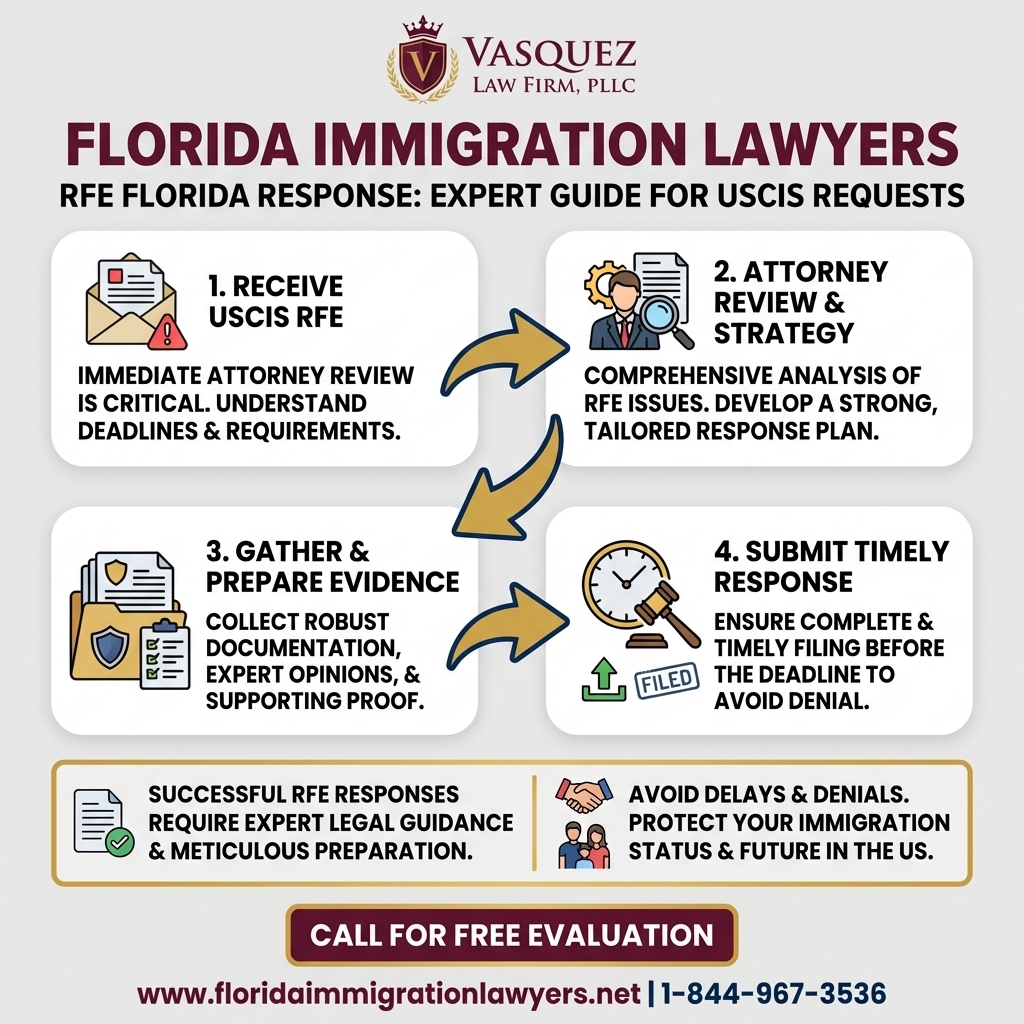
Do not navigate this complex process alone. Contact Florida Immigration Lawyers today for dedicated support and peace of mind. Our experienced attorneys are here to help you craft a compelling request for evidence response.
Cost Factors and Professional Fees for RFE Assistance
When you receive a Request for Evidence (RFE), it is natural to consider the associated costs, especially if you plan to seek legal assistance. It is important to note that USCIS itself does not charge an additional fee for submitting an RFE response. The filing fee you paid for your initial application or petition covers the entire adjudication process, including the review of any requested additional evidence. Therefore, you will not need to send another check to USCIS specifically for the RFE response.
However, while there is no direct USCIS RFE fee, there are several potential cost factors that applicants in Florida should consider. These primarily revolve around the gathering of evidence and, most significantly, the professional fees for legal representation. For instance, obtaining certified copies of documents, official records, or expert evaluations (such as those from psychologists for hardship waivers or professional credential evaluators for employment visas) will incur their own costs. Additionally, if any of your supporting documents are not in English, you will need to pay for certified translations, which vary in price depending on the length and complexity of the document.
The most substantial cost factor for many is the legal fee for an immigration attorney. While not mandatory, retaining legal counsel for an RFE response is highly recommended, especially for complex cases or those where eligibility is strongly questioned. Attorneys typically charge either an hourly rate or a flat fee for RFE assistance. A flat fee provides predictability, covering all work related to the RFE, from analyzing the request to preparing the cover letter and organizing the evidence. The value of this investment lies in the attorney's expertise in interpreting USCIS requests, knowing what evidence is most persuasive, and ensuring compliance with all legal requirements, thereby significantly reducing the risk of a denial. For residents of West Palm Beach and across Florida, Florida Immigration Lawyers offers transparent fee structures and free consultations to discuss your specific RFE needs and associated costs.
Common Mistakes to Avoid in Your RFE Response
Responding to a Request for Evidence (RFE) is a critical juncture in your immigration process. Even small errors can have significant consequences, leading to delays or even denial. Being aware of these common mistakes can help you navigate your RFE Florida response more effectively.
- Ignoring the RFE Entirely: The most critical mistake. Ignoring an RFE will lead to an automatic denial of your application. USCIS will not proceed without the requested information.
- Missing the Response Deadline: Every RFE comes with a strict deadline. Submitting your response even one day late will result in a denial, regardless of the quality of your evidence.
- Submitting Incomplete Documents: Failing to provide all the documents specifically requested in the RFE. Each item mentioned by USCIS must be addressed, even if you believe it is redundant.
- Submitting Unrequested or Irrelevant Documents: While it is good to provide supporting evidence, submitting a vast amount of irrelevant information can overwhelm USCIS officers and obscure the crucial evidence. Stick to what is requested and directly related.
- Providing False Information or Misrepresentation: Never provide fraudulent documents or knowingly false information. This can lead to severe immigration consequences, including permanent bars to immigration benefits under INA 212(a)(6)(C)(i).
- Not Keeping Copies of Your Submission: Always make a complete copy of your entire RFE response package, including the RFE notice, cover letter, and all evidence, before mailing it. This is vital for your records and for any future inquiries.
- Poor Organization of Documents: Sending a disorganized bundle of papers makes it difficult for USCIS to process your response efficiently. Organize documents with tabs, a clear cover letter, and in the order requested by the RFE.
- Failing to Seek Legal Advice: Attempting to interpret complex legal requests or gather specific evidence without an attorney's guidance. An experienced immigration lawyer understands the nuances of immigration law and USCIS expectations.
- Mailing to the Wrong Address: USCIS often specifies a particular address for RFE responses, which may differ from the initial application address. Sending it to the wrong place can cause delays or lead to it being considered late.
- Lack of Certified Translations: Submitting foreign language documents without proper, certified English translations. This renders the evidence unusable by USCIS.
- Overlooking Specific Instructions: RFEs can contain detailed instructions about formatting, labeling, or specific types of evidence. Ignoring these instructions can weaken your response.
- Assuming USCIS Has Prior Information: Do not assume USCIS will cross-reference with previous applications or forms. If an RFE asks for information you have previously provided, you must resubmit it as requested.
When to Call a Lawyer for Your RFE Response
While some RFEs might seem straightforward, many contain complex legal requests that are best handled by an experienced immigration attorney. Knowing when to call a lawyer can make a significant difference in the outcome of your case. If you are in Florida and have received a request for evidence, here are specific scenarios where seeking legal counsel from Florida Immigration Lawyers is highly advisable:
- Complex Legal Issues: If your RFE delves into complex legal questions, such as inadmissibility grounds (e.g., INA 212(a)), waivers, or issues related to maintaining lawful status, an attorney can provide the necessary expertise to address these challenges effectively.
- Short Response Deadline: If you have a very limited time to respond, an attorney can expedite the process, helping you gather and organize documents efficiently to meet the deadline.
- Criminal History or Prior Immigration Violations: Any RFE related to a criminal record, past deportation proceedings, or previous immigration violations requires careful legal analysis to avoid severe consequences.
- Unclear or Ambiguous Requests: If you are unsure about what USCIS is truly asking for, or if the language in the RFE is vague, an attorney can interpret the requests and guide you on the most appropriate evidence to submit.
- Lack of Required Documents: If you genuinely cannot obtain a document requested by USCIS, an attorney can help you explore alternative evidence or prepare a legal argument explaining why the document is unavailable and offering secondary evidence.
- Previous Application Denials: If you have had previous immigration applications denied, especially for reasons related to evidence, an RFE indicates a critical opportunity to overcome past issues.
- High Stakes Applications: For applications with significant life implications, such as adjustment of status to permanent residency or a critical employment visa, the risk of denial due to an inadequate RFE response is too high to take chances.
- Stress and Anxiety: The immigration process is inherently stressful. If the RFE is causing you significant anxiety or you feel overwhelmed, a lawyer can alleviate the burden and provide peace of mind.
Florida Immigration Lawyers has extensive experience assisting individuals throughout Florida, including West Palm Beach, with their RFE responses. Our attorneys understand the nuances of USCIS requirements and can help you build the strongest possible case.
About Florida Immigration Lawyers
Florida Immigration Lawyers is a leading immigration law firm dedicated to serving individuals, families, and businesses across the entire state of Florida. With offices located strategically to assist clients from cities like West Palm Beach to Miami, Orlando, and beyond, our firm is committed to providing compassionate, effective, and results-driven legal representation. We understand the profound impact immigration matters have on our clients' lives and approach each case with the personalized attention it deserves.
Our team of highly skilled attorneys specializes in a comprehensive range of immigration services, including family-based immigration, employment visas, asylum, deportation defense, citizenship, and navigating complex USCIS processes like RFE responses. We pride ourselves on our deep knowledge of immigration law, our unwavering advocacy, and our commitment to helping our clients achieve their American dreams. We offer free consultations to assess your unique situation and provide clear, actionable legal strategies. Our firm is available 24/7, ensuring that help is always within reach when you need it most. We are proud to offer bilingual services, with a team ready to assist clients in both English and Spanish.
Sources and References
- U.S. Citizenship and Immigration Services (USCIS)
- Executive Office for Immigration Review (EOIR)
- 8 U.S.C. Chapter 12 - Immigration and Nationality Act (INA)
- 8 CFR Part 103 - Adjudication of applications and petitions
- USCIS Policy Manual, Volume 1, Part B, Chapter 5 - Requests for Evidence and Notices of Intent to Deny
- 8 U.S.C. § 1182 (INA 212) - General Classes of Aliens Ineligible to Receive Visas and Admission; Waivers
- 8 U.S.C. § 1255 (INA 245) - Adjustment of Status of Nonimmigrant to That of Person Admitted for Permanent Residence
Related services: immigration practice areas, family immigration services.
This article provides general legal information and is not intended as legal advice. Every case is unique, and outcomes depend on specific facts and circumstances. Contact an attorney for advice about your particular situation. Immigration laws are subject to change, and this content reflects the general understanding as of 2026-04-14.
Do not let a request for evidence stand in the way of your immigration goals. The experienced attorneys at Florida Immigration Lawyers are here to guide you through every step of the process. Call us today at 1-844-967-3536 for a free, confidential consultation. Se Habla Espanol - Estamos aqui para ayudarle.
If you need legal assistance, learn more about learn about our immigration practice, or call us at 1-844-967-3536 for a free consultation.
Do Not Navigate This Process Alone
Our experienced immigration attorneys are ready to fight for you. Get a free, confidential consultation today.
Se Habla Español
Frequently Asked Questions

William J. Vásquez
Founding Attorney · Vasquez Law Firm
U.S. Air Force veteran and immigration attorney with thousands of cases resolved. J.D., NCCU School of Law. AILA member. Admitted to the 4th, 5th, and 11th Circuit Courts.
Available 24/7 - Free Evaluations
Related Legal Services
Our Florida immigration attorneys can help you with asylum protection, deportation defense and citizenship and naturalization. Call today at 1-844-967-3536 for a free consultation.
Related Links
Related Topics
Free Legal Consultation
Discuss your case with our experienced attorneys. We're available 24/7.
Se Habla Español - Estamos aquí para ayudarle.
Related Articles
Naturalization Ceremony Locations and Schedule 2026 in
For those seeking U.S. citizenship, understanding the naturalization ceremony locations and schedule for 2026 in Florida is the final step in a significant journey. This comprehensive guide from Florida Immigration Lawyers provides detailed information on the naturalization process, from eligibility to the Oath of Allegiance ceremony. We cover what to expect at each stage, including document requirements, typical timelines, and associated costs. Learn about USCIS field offices in Florida, the importance of your N-445 notice, and common pitfalls to avoid. Our aim is to help you navigate this complex process with clarity and confidence, ensuring you are well-prepared for your momentous day. Contact us for expert legal guidance.
Political Asylum Attorney: Requirements in Florida 2026
If you're seeking political asylum in Florida, understanding the legal requirements and process is crucial. This comprehensive guide covers essential information about securing asylum, including the steps involved, necessary documentation, and common mistakes to avoid. Learn how a political asylum attorney can assist you and what to expect during the process. Call Florida Immigration Lawyers at 1-844-967-3536 for a free consultation.
Biometrics Appointment in Florida: What to Expect in 2026
Navigating a biometrics appointment in Florida is crucial for your USCIS process. Learn what to expect, how to prepare, and common pitfalls to avoid. Florida Immigration Lawyers are here to help with personalized guidance and support.
Withholding of Removal Explained: Florida Defense in 2026
For those in Florida facing deportation and fearing persecution or torture in their home country, understanding withholding of removal is critical. This form of protection prevents removal to a dangerous country, though it differs significantly from asylum in its eligibility criteria and benefits. It requires proving a "more likely than not" chance of persecution based on protected grounds or torture, a higher standard than asylum's "well-founded fear." While withholding of removal does not lead to a Green Card, it offers mandatory protection if the stringent criteria are met, even for some individuals barred from asylum. The process involves complex legal proceedings before an immigration judge, often in Miami or Orlando immigration courts. A comprehensive application, detailed testimony, and robust supporting evidence, including country conditions reports and affidavits, are essential. Given the high stakes and intricate legal requirements, securing the expertise of a Florida immigration lawyer is paramount to building a strong defense and navigating the path to safety.
