Public Charge Rule: What Florida Immigrants Need to Know
The public charge rule is a vital consideration for immigrants in Florida seeking green cards or visas. This complex U.S. immigration law assesses whether an individual is likely to become primarily dependent on specific government benefits. Understanding which benefits count and how the "totality of the circumstances" test is applied is crucial for a successful application. This guide breaks down the current 1999 field guidance, explains how inadmissibility is determined, provides a step-by-step navigation, and outlines essential documents. Learn about processing timelines, cost factors, and common mistakes to avoid. Florida Immigration Lawyers offers legal advice to help you confidently address public charge concerns and protect your immigration journey. Schedule a free consultation to ensure your case is handled with precision and care.
The public charge rule is a complex immigration law that can make certain non-citizens inadmissible to the U.S. or ineligible for a green card if they are deemed likely to become primarily dependent on government assistance. For Florida immigrants, understanding this rule is crucial. While many public benefits, such as emergency medical care or disaster relief, do not count, relying on cash assistance for income maintenance or long-term institutional care can impact your immigration case. The current policy generally follows the 1999 guidance, focusing on a "totality of the circumstances" test, which considers factors like age, health, family status, assets, resources, financial status, education, and skills. Seeking legal advice from experienced Florida immigration lawyers is highly recommended to navigate these rules effectively and protect your immigration journey.
- The public charge rule assesses if an immigrant is likely to become dependent on specific government benefits.
- Most non-cash benefits, like WIC or SNAP, do not trigger public charge inadmissibility.
- Cash assistance for income maintenance and long-term institutional care are the primary concerns.
- A "totality of the circumstances" test is used, evaluating various personal and financial factors.
- Legal counsel is essential for immigrants in Florida to understand and address public charge concerns.
Navigating the U.S. immigration system can feel like moving through a maze, especially when complex regulations like the public charge rule come into play. For immigrants across Florida, from the bustling streets of Jacksonville to the vibrant communities of Miami, this rule often raises significant concerns. Many individuals worry that seeking essential assistance, perhaps during a difficult time, could jeopardize their dreams of obtaining a green card or visa.
The public charge rule has a long history and has seen various interpretations over the years, causing confusion and anxiety. This comprehensive guide aims to demystify the public charge rule, providing clarity on what it means for you and your family in Florida. We will cover the current policies, the factors considered, common pitfalls, and how legal guidance can make a critical difference in your case.
Understanding these nuances is not just about avoiding inadmissibility; it is about ensuring your path to a secure future in the U.S. is as smooth as possible. Do not let uncertainty about the public charge rule deter you from pursuing your immigration goals. Our team at Florida Immigration Lawyers is here to provide the clarity and support you need. Call Florida Immigration Lawyers at 1-844-YO-PELEO for a free consultation and let us help you understand your options.
Understanding the Public Charge Rule in Florida
The public charge rule is a ground of inadmissibility under U.S. immigration law, specifically found in Section 212(a)(4) of the Immigration and Nationality Act (INA), codified at 8 U.S.C. § 1182(a)(4). This rule prevents individuals from entering the United States or adjusting their status to lawful permanent resident if they are deemed likely to become a "public charge." Essentially, it assesses whether a non-citizen is likely to primarily depend on the government for subsistence.
Historically, the interpretation of the public charge rule has varied. While a stricter version was implemented in 2019, the Biden administration reverted to the 1999 field guidance in 2021. This means that, as of 2026, the focus is generally on whether an individual has received, or is likely to receive, specific cash benefits for income maintenance or long-term institutional care at government expense. Most non-cash benefits, such as Supplemental Nutrition Assistance Program (SNAP), housing assistance, or most forms of Medicaid, are generally not considered for public charge purposes under the current guidance. This is a crucial distinction for many families in Florida who may rely on these programs for basic needs.
For Florida's diverse immigrant population, including those in Jacksonville, Orlando, and Tampa, understanding these specific definitions is vital. The rule is not designed to punish those who have accessed necessary support but rather to identify individuals who are likely to become *primarily* dependent on government assistance. Our experienced attorneys can help you navigate the complexities of this rule as it applies to your specific situation in Florida, ensuring you understand which benefits might be relevant to your immigration application. Learn more about general immigration processes on our Immigration practice area page.
How Public Charge Inadmissibility is Determined
Determining whether someone is likely to become a public charge involves a comprehensive evaluation known as the "totality of the circumstances" test. U.S. Citizenship and Immigration Services (USCIS) officers or consular officers abroad assess a range of factors to predict future dependency. This is not based on a single factor but on a holistic review of an applicant's life circumstances. The key factors considered include: age, health, family status (e.g., number of dependents), assets, resources, financial status, education, and skills.
For instance, a young, healthy applicant with a stable job in Jacksonville, significant savings, and no dependents would likely be viewed differently than an elderly individual with chronic health issues, no assets, and no foreseeable income. The presence of a legally binding Affidavit of Support (Form I-864), typically filed by a U.S. citizen or lawful permanent resident sponsor, is also a critical factor. This affidavit demonstrates that a sponsor is willing and able to financially support the applicant, mitigating public charge concerns.
USCIS field offices in Florida, such as those in Miami, Orlando, and Tampa, apply these same guidelines. They will review all submitted documentation and may ask additional questions during an interview to fully understand an applicant's situation. The officer must make a forward-looking determination, meaning they are predicting the likelihood of future dependency. This subjective element makes thorough preparation and clear presentation of evidence paramount, especially for immigrants in Florida who may have complex financial or family situations.
Step-by-Step Guide: Navigating Public Charge Concerns for Florida Applicants
Navigating the public charge rule requires careful planning and a thorough understanding of current policies. For Florida applicants, following these steps can help mitigate potential issues:
-
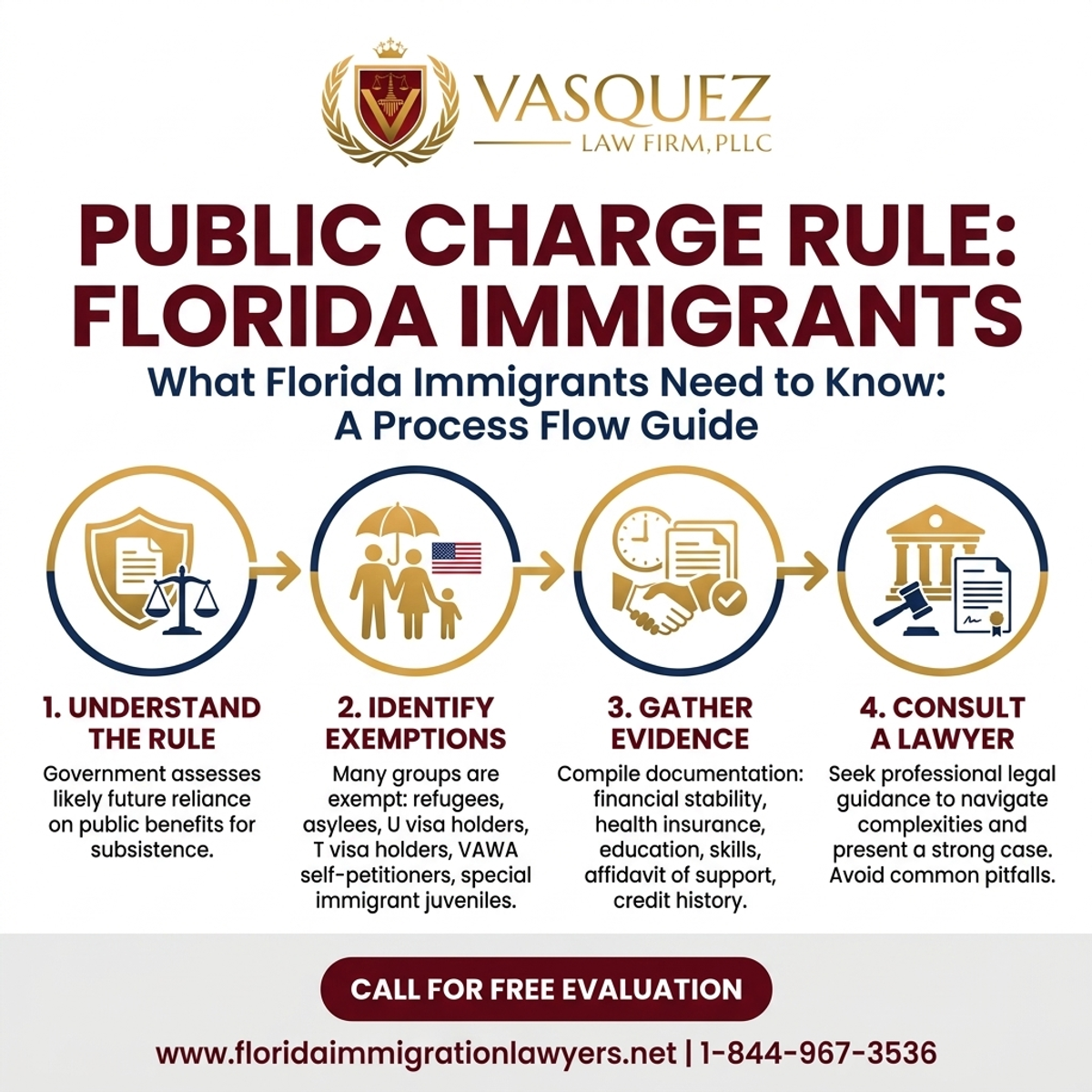
Understand the Current Rule: Familiarize yourself with the 1999 field guidance that is currently in effect. This guidance primarily focuses on cash assistance for income maintenance (e.g., SSI, TANF) and long-term institutional care at government expense. Most non-cash benefits, including SNAP, WIC, Medicaid (unless for long-term institutional care), and housing assistance, are generally not considered. Staying informed about the latest regulations is crucial, as policies can change. You can find detailed information on the official USCIS Policy Manual on Public Charge.
-
Identify Relevant Benefits: Review any public benefits you or your family members have received. Differentiate between benefits that are counted (cash assistance, long-term care) and those that are not. Remember that benefits received by U.S. citizen children or other family members, without the applicant being the direct beneficiary, generally do not count against the applicant.
-
Gather Comprehensive Financial Documents: Prepare documentation that demonstrates your financial stability and self-sufficiency. This includes proof of employment, income, assets (savings, property), and health insurance. The more evidence you can provide to show you are not likely to become primarily dependent on the government, the stronger your case will be.
-
Prepare a Strong Affidavit of Support (Form I-864): If you are applying for a family-based green card, your sponsor must file Form I-864. Ensure your sponsor meets the income requirements and provides all necessary supporting documentation. A robust Affidavit of Support is one of the most significant factors in overcoming public charge concerns.
Step-by-Step Process — Public Charge Rule: What Florida Immigrants Need to Know
-
Seek Legal Counsel: Before filing any application, especially if you have used public benefits or have complex financial circumstances, consult with an experienced immigration attorney. A lawyer can assess your specific situation, identify potential red flags, and help you prepare a compelling case that addresses public charge concerns proactively. This is particularly important for applicants in Florida, where local USCIS offices may have specific document preferences.
-
Be Honest and Thorough: Always provide accurate and complete information on your application forms and during interviews. Any misrepresentation can lead to serious immigration consequences, including findings of inadmissibility or even fraud. Transparency, combined with proper legal guidance, is your best approach.
Document Checklist for Public Charge Review
When applying for a green card or visa, especially if the public charge rule might be a factor, organizing your documentation meticulously is essential. For Florida immigrants, having a comprehensive set of documents can significantly strengthen your case and demonstrate your self-sufficiency. Here is a checklist of critical documents typically required or highly recommended:
- Proof of Income and Employment: Recent pay stubs, employment verification letters, W-2 forms, 1099 forms, and tax returns (for the last three years) are crucial. If self-employed, provide business licenses, profit and loss statements, and bank statements.
- Evidence of Assets and Resources: Bank statements for checking and savings accounts, investment statements, property deeds (for real estate in Florida or elsewhere), vehicle titles, and any other evidence of significant financial resources.
- Health Insurance Information: Proof of private health insurance coverage or the ability to obtain it. This demonstrates you are unlikely to rely on government-funded long-term healthcare.
- Education and Skills Documentation: Diplomas, degrees, vocational training certificates, and professional licenses. These show your earning potential and ability to secure employment.
- Affidavit of Support (Form I-864) and Sponsor's Documents: If applicable, the completed and signed Form I-864 from your U.S. citizen or green card holder sponsor, along with their tax returns, pay stubs, and proof of U.S. domicile.
- Family Status Information: Birth certificates of dependents, marriage certificates, and any legal documents related to family composition.
- Medical Examination Results: Required as part of the immigration process, this helps assess your general health condition.
- Any Evidence of Past Self-Sufficiency: If you have previously used public benefits, provide documentation showing how you transitioned off them or how you maintained self-sufficiency despite receiving aid.
Preparing these documents can be overwhelming, but it is a vital step. Our team at Florida Immigration Lawyers can help you compile and organize your documentation efficiently, ensuring all necessary evidence is presented clearly. For assistance with your application and document preparation, please contact us today.
Timeline and Processing Expectations for Public Charge Review
It is important to understand that there is no separate "public charge" timeline. Instead, the assessment of public charge inadmissibility is integrated into the broader processing of your immigration application, whether it is an application for adjustment of status (Form I-485) filed with USCIS in Florida or an immigrant visa application processed at a U.S. consulate abroad. The timeline for this review will therefore align with the overall processing times for your specific type of application.
For adjustment of status applicants in Florida, processing times for Form I-485 can vary significantly by USCIS field office (e.g., Miami, Orlando, Tampa) and service center. These times are regularly updated on the USCIS website. If a USCIS officer has concerns about public charge, they may issue a Request for Evidence (RFE) or a Notice of Intent to Deny (NOID). Responding promptly and thoroughly to an RFE or NOID is critical and can add several months to the overall processing time. Failure to adequately address these concerns can lead to a denial of your application.
For those applying for an immigrant visa through consular processing, the public charge assessment occurs during the interview at a U.S. embassy or consulate. The National Visa Center (NVC) processing and interview scheduling can take many months, and a public charge determination is part of that final interview. If the consular officer has concerns, they may issue a 221(g) refusal, requesting additional documentation or information, which will delay the visa issuance. You can learn more about the immigrant visa process on the State Department's website. Proactive preparation with an attorney can help streamline this process and minimize delays due to public charge concerns.
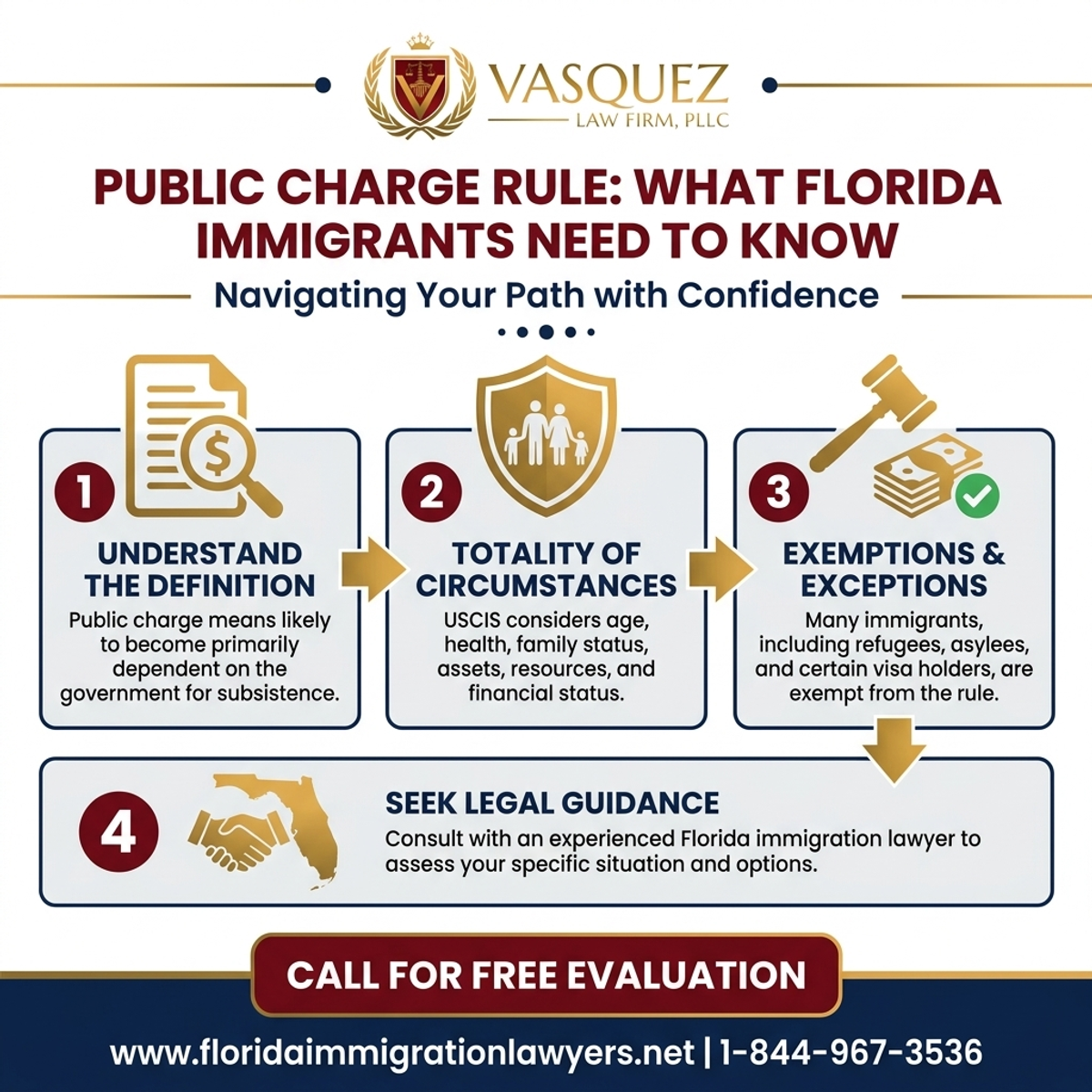
Key Statistics — Public Charge Rule: What Florida Immigrants Need to Know
Do not navigate this process alone. Contact Florida Immigration Lawyers today.
Cost Factors and Legal Fees in Public Charge Cases
Understanding the financial aspects of your immigration journey, especially when the public charge rule is a factor, is crucial for planning. While government filing fees are standard for most immigration applications, additional costs can arise in cases involving public charge concerns. It is important to note that specific filing fee amounts are subject to change by the government, so always check the latest USCIS fee schedule.
Beyond government fees for applications like Form I-485 (Adjustment of Status) or Form I-130 (Petition for Alien Relative), you may encounter other expenses. These can include mandatory medical examination fees, which are paid directly to an authorized civil surgeon. Translation costs for any foreign-language documents are also common. If you need to obtain additional records, such as school transcripts or property appraisals, there may be associated fees.
Attorney fees represent another significant cost factor, but they are an investment in your case's success. For public charge cases, legal fees can vary depending on the complexity of your situation. For instance, if you have a history of using public benefits, a complex financial background, or receive an RFE or NOID, your attorney will need to dedicate more time to strategizing, gathering evidence, and drafting detailed legal arguments. This specialized work ensures your case is presented in the strongest possible light, mitigating risks associated with the public charge rule.
At Florida Immigration Lawyers, we believe in transparent fee structures. We offer free consultations to discuss your case and provide a clear understanding of potential costs. Investing in experienced legal counsel can save you time, stress, and potentially prevent a costly denial. Our dedicated attorneys are committed to providing high-quality, efficient representation for immigrants across Florida.
Common Mistakes to Avoid
Navigating the public charge rule can be tricky, and even minor missteps can have significant consequences for your immigration application. For immigrants in Florida, being aware of these common mistakes is crucial to a successful outcome:
-
Misunderstanding Which Benefits Count: Many applicants mistakenly believe that *any* use of public benefits will trigger public charge inadmissibility. Under current guidance, only specific cash benefits for income maintenance (like SSI or TANF) and long-term institutional care count. Using WIC, SNAP, most Medicaid, or housing assistance generally does not. Misinformation can lead to unnecessary fear or, conversely, overconfidence.
-
Not Providing a Robust Affidavit of Support: For family-based petitions, the I-864 Affidavit of Support is paramount. Failing to provide a financially strong sponsor or complete all sections accurately can lead to an RFE or denial. This document is a primary tool to overcome public charge concerns.
-
Hiding Information or Being Dishonest: Attempting to conceal past benefit use or other relevant information can be detrimental. USCIS and consular officers have access to various databases. Any misrepresentation can lead to findings of fraud or material misrepresentation, resulting in permanent bars from the U.S.
-
Failing to Address RFEs Promptly and Thoroughly: If USCIS issues a Request for Evidence (RFE) regarding public charge, ignoring it or providing incomplete information can lead to a denial. RFEs have strict deadlines, and a rushed, inadequate response can be as damaging as no response.
-
Not Understanding Sponsor's Responsibilities: Sponsors often underestimate the long-term financial commitment involved in signing an I-864. This can lead to issues if the sponsor's financial situation changes or if they become unwilling to provide necessary documentation.
-
Assuming All Family Members are Exempt: While certain categories of applicants are exempt from public charge review (e.g., refugees, asylees, U-visa applicants), not everyone is. Incorrectly assuming an exemption can lead to unpreparedness and potential denial.
-
Relying on Outdated Information: The public charge rule has changed several times. Relying on old news articles or advice from several years ago can lead to critical errors. Always ensure your information is current and from official sources or experienced legal professionals.
-
Not Seeking Legal Advice Early: Many immigrants wait until they receive an RFE or a denial to consult an attorney. Proactive legal advice can help identify and mitigate public charge risks before an application is even filed, saving time, money, and stress.
-
Ignoring Minor Health Issues: While a single health issue may not be disqualifying, a pattern of chronic illness requiring significant medical intervention, especially if uninsured, could raise concerns if it suggests a likelihood of future long-term institutionalization at government expense.
-
Lack of Proper Documentation for Assets/Income: Vague or incomplete financial documentation makes it difficult for officers to assess self-sufficiency. Ensure all bank statements, tax returns, and employment letters are clear, consistent, and up-to-date.
When to Call a Lawyer
While this guide provides general information, the complexities of the public charge rule often necessitate personalized legal advice. You should contact an experienced immigration attorney, especially if any of the following scenarios apply to you or your family in Florida:
- You have received or are currently receiving cash assistance for income maintenance (e.g., SSI, TANF) or long-term institutional care at government expense.
- You have a complex financial history, including periods of unemployment, significant debt, or limited assets.
- You have received a Request for Evidence (RFE) or a Notice of Intent to Deny (NOID) from USCIS or a U.S. consulate, specifically mentioning public charge concerns.
- Your sponsor for the Affidavit of Support (Form I-864) has a questionable financial history or income that barely meets the poverty guidelines.
- You have significant health issues that may require extensive medical care in the future, particularly if you do not have private health insurance.
- You are unsure whether certain benefits you or a family member received could impact your application.
- You are applying for a green card or visa and want to ensure all aspects of your application, including public charge, are thoroughly addressed and documented to prevent delays or denials.
Florida Immigration Lawyers has extensive experience helping individuals and families navigate the intricacies of U.S. immigration law, including public charge issues. Whether you are in Jacksonville, Orlando, or anywhere else in the state, we can provide strategic guidance and robust representation. We also offer robust deportation defense services should public charge concerns lead to removal proceedings.
About Florida Immigration Lawyers
Florida Immigration Lawyers is an immigration law firm dedicated to serving individuals and families throughout the state of Florida. With a deep understanding of U.S. immigration law and its impact on diverse communities, we provide comprehensive legal services tailored to your unique needs. Our team of experienced attorneys is committed to offering compassionate and effective representation, guiding you through every step of your immigration journey.
We focus on a wide range of immigration matters, including family-based petitions, employment visas, naturalization, asylum, and deportation defense. Our firm prides itself on its client-centered approach, ensuring that you receive personalized attention and clear communication. We understand the stakes involved in immigration cases and work tirelessly to achieve the strongest possible outcomes for our clients.
When you choose Florida Immigration Lawyers, you gain a dedicated advocate who will fight for your rights and help you achieve your American dream. We are available 24/7 for consultations and serve all of Florida. Call us today at 1-844-YO-PELEO or visit our website at https://www.floridaimmigrationlawyers.net to schedule your free consultation. We are here to help.
Sources and References
- U.S. Citizenship and Immigration Services (USCIS)
- Executive Office for Immigration Review (EOIR)
- U.S. Department of State
- 8 U.S.C. § 1182(a)(4) - Immigration and Nationality Act (INA) Section 212(a)(4)
- 8 CFR 212.21 - Public Charge Inadmissibility (or relevant historical CFR guidance)
- USCIS Policy Manual, Volume 8, Part G, Chapter 3 - Public Charge
Related services: immigration practice areas, family immigration services, citizenship and naturalization, asylum protection.
This article provides general legal information and is not intended as legal advice. Every case is unique, and outcomes depend on specific facts and circumstances. Laws are subject to change. Contact an attorney for advice about your particular situation.
The public charge rule is a critical aspect of U.S. immigration law that demands careful attention. Do not let fear or misunderstanding prevent you from pursuing your immigration goals. Our dedicated team at Florida Immigration Lawyers is ready to provide the guidance and representation you need to navigate this complex process successfully. We serve clients across Florida, offering personalized strategies and unwavering support.
Take the first step towards securing your future. Contact Florida Immigration Lawyers today at 1-844-YO-PELEO for a free, confidential consultation. Se Habla Espanol - Estamos aqui para ayudarle.
Do Not Navigate This Process Alone
Our experienced immigration attorneys are ready to fight for you. Get a free, confidential case review today.
Se Habla Español
Or leave your details and we’ll call you:
Free Evaluation in 24 Hours
Or talk to us right now
AI voice assistant — available 24/7
FreeFrequently Asked Questions

William J. Vásquez
Founding Attorney · Vasquez Law Firm
U.S. Air Force veteran and immigration attorney with years of hands-on U.S. immigration experience. J.D., NCCU School of Law. AILA member. Admitted to the 4th, 5th, and 11th Circuit Courts.
Available 24/7 - Free Evaluations
Reviewed for legal accuracy by William J. Vásquez
Licensed in North Carolina; U.S. immigration is federal practice.
Related Legal Services
Our Florida immigration attorneys can help you with experienced immigration attorneys, asylum protection and citizenship and naturalization. Call today at 1-844-YO-PELEO for a free case review.
Related Links
Related Topics
Free Legal Case Review
Discuss your case with our experienced attorneys. We're available 24/7.
Se Habla Español - Estamos aquí para ayudarle.
Related Articles
DUI Immigration Consequences in Florida 2026
A DUI conviction in Florida can have severe immigration consequences, potentially leading to inadmissibility, deportation, or denial of immigration benefits. For non-citizens, a DUI is not just a traffic offense but a serious criminal matter that federal immigration law scrutinizes closely. Factors like multiple offenses, injury, or property damage can escalate a simple DUI to a Crime Involving Moral Turpitude (CIMT) or even an aggravated felony, triggering mandatory detention and removal proceedings. Understanding the specific nature of your Florida conviction and its interpretation under the Immigration and Nationality Act (INA) is crucial. This article outlines how DUIs impact immigration status, the grounds for inadmissibility and deportation, a step-by-step guide to navigating the process, essential documentation, and expected timelines for 2026. We also highlight common mistakes to avoid and when to seek legal counsel from an experienced immigration attorney. Florida Immigration Lawyers offers comprehensive support for individuals facing these challenging situations, providing expert guidance through complex legal landscapes.
Dual Citizenship Lawyer in Florida: What You Need to Know
For Florida residents, the concept of dual citizenship, or holding two passports, offers a compelling blend of opportunities and challenges. While the U.S. generally permits dual nationality, the path to achieving this status requires a meticulous understanding of both U.S. immigration laws and the citizenship policies of your country of origin. This guide explores the definition of dual citizenship, the detailed step-by-step process for U.S. naturalization, and the significant benefits and potential pitfalls involved. We cover essential documentation, typical timelines, and cost considerations for 2026, providing crucial insights for anyone in Orlando, Miami, or across Florida considering this important legal step. Learn about common mistakes to avoid and understand when to seek professional legal counsel to navigate this complex process successfully. Florida Immigration Lawyers is here to provide expert, bilingual support for your dual citizenship journey.
EAD Advance Parole Combo Card in Florida 2026
For individuals with a pending Form I-485, Application to Register Permanent Residence or Adjust Status, the EAD Advance Parole Combo Card is an essential document. This single card combines the authorization to work legally in the U.S. (Employment Authorization Document - EAD) with permission to travel internationally and re-enter without abandoning your green card application (Advance Parole). This guide from Florida Immigration Lawyers provides a comprehensive overview for applicants in Florida in 2026, covering eligibility, the step-by-step application process, required documents, expected processing times, and associated costs. We also highlight common mistakes to avoid and when to seek legal counsel to ensure a smooth and successful immigration journey. Understanding this vital card is key to maintaining stability while awaiting your permanent residency approval.
Immigration Lawyer Orlando Free Consultation in Florida
For individuals and families in Orlando, Florida, navigating the complexities of U.S. immigration law requires expert guidance. An immigration lawyer in Orlando offers crucial support for everything from visa applications and green card processes to naturalization and deportation defense. This comprehensive guide details what a free consultation covers, providing a step-by-step overview of immigration pathways, essential document checklists, and expected timelines in 2026. We also highlight common mistakes to avoid, discuss the critical role of legal counsel in deportation and asylum cases, and explain why choosing a local Orlando immigration attorney is beneficial. Florida Immigration Lawyers is dedicated to serving the diverse community of Orlando with compassionate, effective legal solutions, ensuring you receive personalized advice and robust representation for a successful immigration journey.