Why is Form N-600 Taking So Long in Florida?
Form N-600 delays are a common challenge for parents seeking citizenship certificates for their children in Florida. Learn about the causes of these delays, ways to expedite the process, and when to seek legal assistance.

- Check USCIS processing times regularly
- Keep your contact information updated with USCIS
- Consult an immigration lawyer for complex cases
Introduction
Imagine waiting eagerly for your child's citizenship certificate, only to find the process dragging on for months. If you're in Hollywood, Florida, and dealing with Form N-600 delays, you're not alone. This blog post will explore why these delays happen, how to prevent them, and what steps to take if you're affected. Call Florida Immigration Lawyers at 1-844-967-3536 for a free consultation.
Securing a Certificate of Citizenship for your child is a monumental step, affirming their place in the nation and unlocking numerous opportunities. However, the path to obtaining this document can sometimes be fraught with unexpected delays, leading to frustration and uncertainty for families. Understanding the intricacies of the N-600 application process is key to navigating it successfully.
In this comprehensive guide, we'll delve deep into the common pitfalls and complexities that can prolong your N-600 application, offering practical advice and expert insights. Our goal is to empower you with the knowledge needed to prepare a robust application, respond effectively to USCIS queries, and understand when professional legal assistance from Florida Immigration Lawyers can make all the difference.
Why is Form N-600 Taking So Long?
As of 2026, Form N-600 processing times can extend due to several factors, including increased application volumes and limited USCIS resources. Factors contributing to delays include:
- High application volumes
- Staff shortages
- Policy changes impacting processing priorities
These challenges are compounded by localized issues at Florida USCIS offices, where Miami and Tampa handle significant caseloads.
The sheer volume of immigration applications submitted annually places immense pressure on USCIS resources. Each N-600 application requires meticulous review, background checks, and often an interview, all of which are time-consuming processes. When the number of incoming applications far outstrips the capacity of available staff, backlogs inevitably build, pushing processing times beyond typical expectations.
Furthermore, shifts in immigration policy, whether at the federal level or in response to global events, can significantly alter USCIS's processing priorities. For instance, a policy change might direct resources towards other urgent immigration matters, inadvertently slowing down the processing of N-600 applications. These policy nuances, combined with ongoing staff shortages, create a challenging environment for applicants seeking timely decisions. Understanding these systemic issues can help manage expectations, though it doesn't alleviate the stress of waiting.
Specific to Florida, the state's diverse population and status as a major immigration hub mean that USCIS field offices in cities like Miami, Orlando, and Tampa are consistently among the busiest in the country. This regional demand further exacerbates national processing challenges. For families in Hollywood, Florida, this means that their N-600 application might be competing for attention with a vast number of other immigration cases, contributing to longer waits. Enlisting the help of Florida Immigration Lawyers can provide localized expertise to navigate these regional complexities effectively.
How to Expedite the N-600 Process
To expedite your Form N-600, ensure thorough preparation. The following steps can help:
- Complete the application accurately, avoiding errors.
- Submit all required documents, such as your child's birth certificate and your citizenship proof.
- Check processing times on the USCIS website.
- Respond promptly to any USCIS requests for additional information.
- Consider filing a request for expedited processing if eligible.
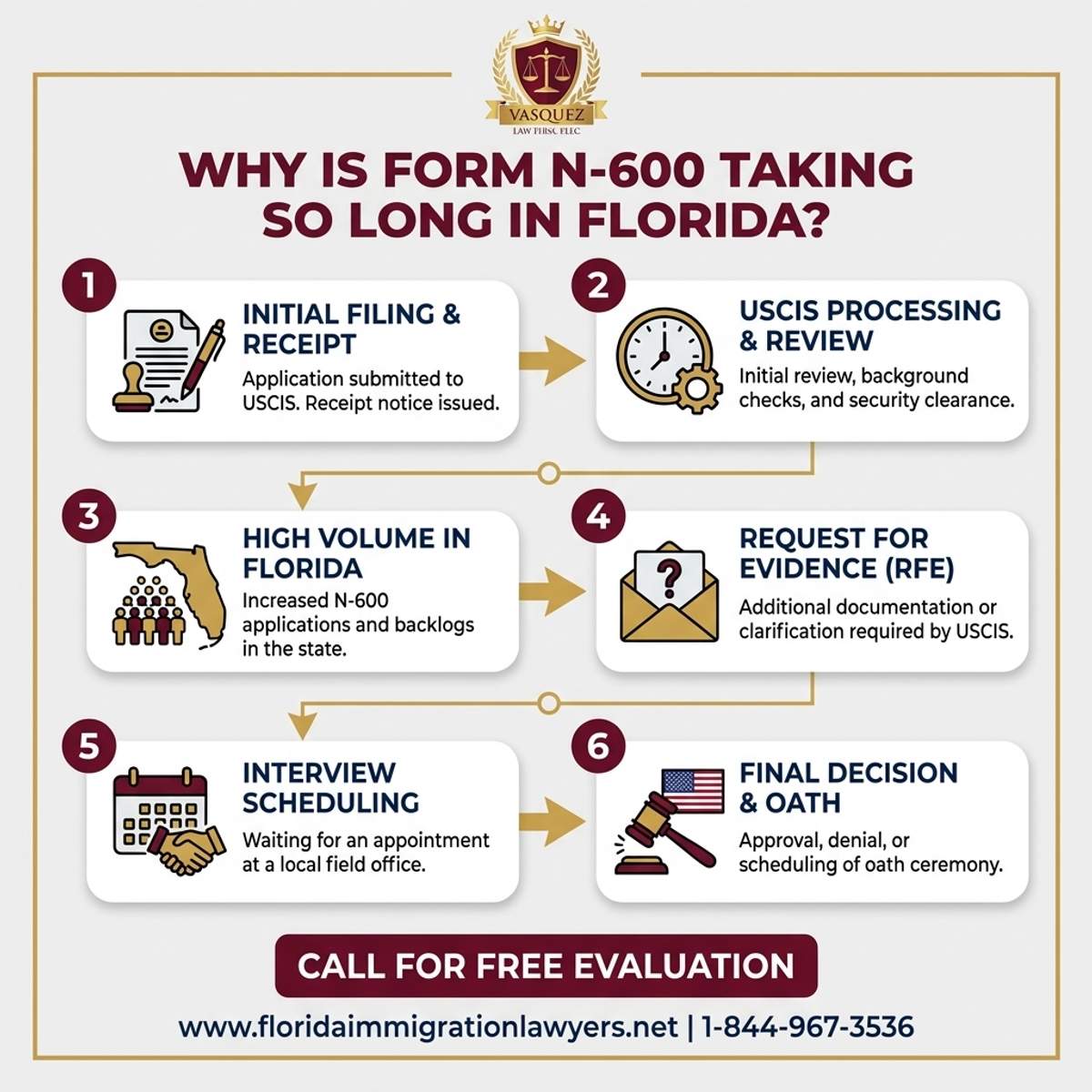
Step-by-Step Process — Why is Form N-600 Taking So Long in Florida?
Engaging an immigration attorney can streamline this process significantly.
Accuracy and completeness are paramount when submitting your N-600 application. Even minor errors or omissions can lead to a Request for Evidence (RFE) or, worse, a denial, significantly delaying the process. Double-check every field, ensure all signatures are present, and make sure any supporting documents are legible and properly organized. A well-prepared application reduces the chances of USCIS needing to ask for more information, which is a major cause of delays.
Beyond initial submission, proactive monitoring and quick responses are crucial. Regularly checking the USCIS website for updated processing times and your case status will keep you informed. If USCIS sends an RFE or a notice for an interview, responding immediately and thoroughly is essential. Delays in responding can cause your application to be put on hold or even denied. In complex scenarios, or if you believe your case warrants special consideration, discussing eligibility for expedited processing with Florida Immigration Lawyers at 1-844-967-3536 can be a strategic move.
Expedited processing is typically reserved for urgent situations, such as severe financial loss to a company or individual, urgent humanitarian reasons, or compelling U.S. government interests. While not every N-600 case qualifies, understanding the criteria and presenting a strong argument for expedition can sometimes shorten your wait. An experienced immigration attorney can assess your situation, help gather the necessary evidence to support an expedite request, and communicate effectively with USCIS on your behalf, maximizing your chances of a faster resolution.
Document Checklist for N-600 Applications
Ensure you have the following documents ready when applying for a Certificate of Citizenship:
- Child’s birth certificate
- Proof of parent’s U.S. citizenship
- Completed Form N-600
- Two passport-style photos
- Any relevant court orders or adoption records
Check the latest document requirements on USCIS Form N-600 page.
The child's birth certificate is fundamental, establishing their identity and parentage. Ensure it's an original or certified copy, and if it's not in English, it must be accompanied by a certified English translation. Similarly, proof of the parent's U.S. citizenship is critical, typically demonstrated through a U.S. birth certificate, naturalization certificate, or a U.S. passport. The quality and authenticity of these documents are scrutinized, so meticulous attention to detail is vital.
Beyond these core documents, any legal documentation relating to name changes, marriage, divorce, or adoption must be included to establish the familial relationship and eligibility for citizenship. For adopted children, the adoption decree and evidence of legal and physical custody are particularly important. Passport-style photos must meet specific USCIS requirements regarding size, background, and recency. Providing incorrect or outdated photos can lead to an RFE, adding unnecessary delays to your application.
It's advisable to create a comprehensive checklist and make copies of all submitted documents for your records. Organizing your application packet clearly, with tabs or separators for different document categories, can also aid USCIS officers in their review. If you have any doubts about the sufficiency or format of your documents, contacting Florida Immigration Lawyers can provide clarity and ensure your submission is flawless, preventing common pitfalls that lead to processing delays.
Typical Timeline for N-600 Processing
| Stage | Typical Timeframe | Notes |
|---|---|---|
| Application Submission | 1-2 weeks | Receive confirmation notice |
| Initial Review | 3-6 months | Background checks and document verification |
| Interview Scheduling | 1-3 months | Varies by location |
| Decision | 1-2 months | Receive certificate if approved |
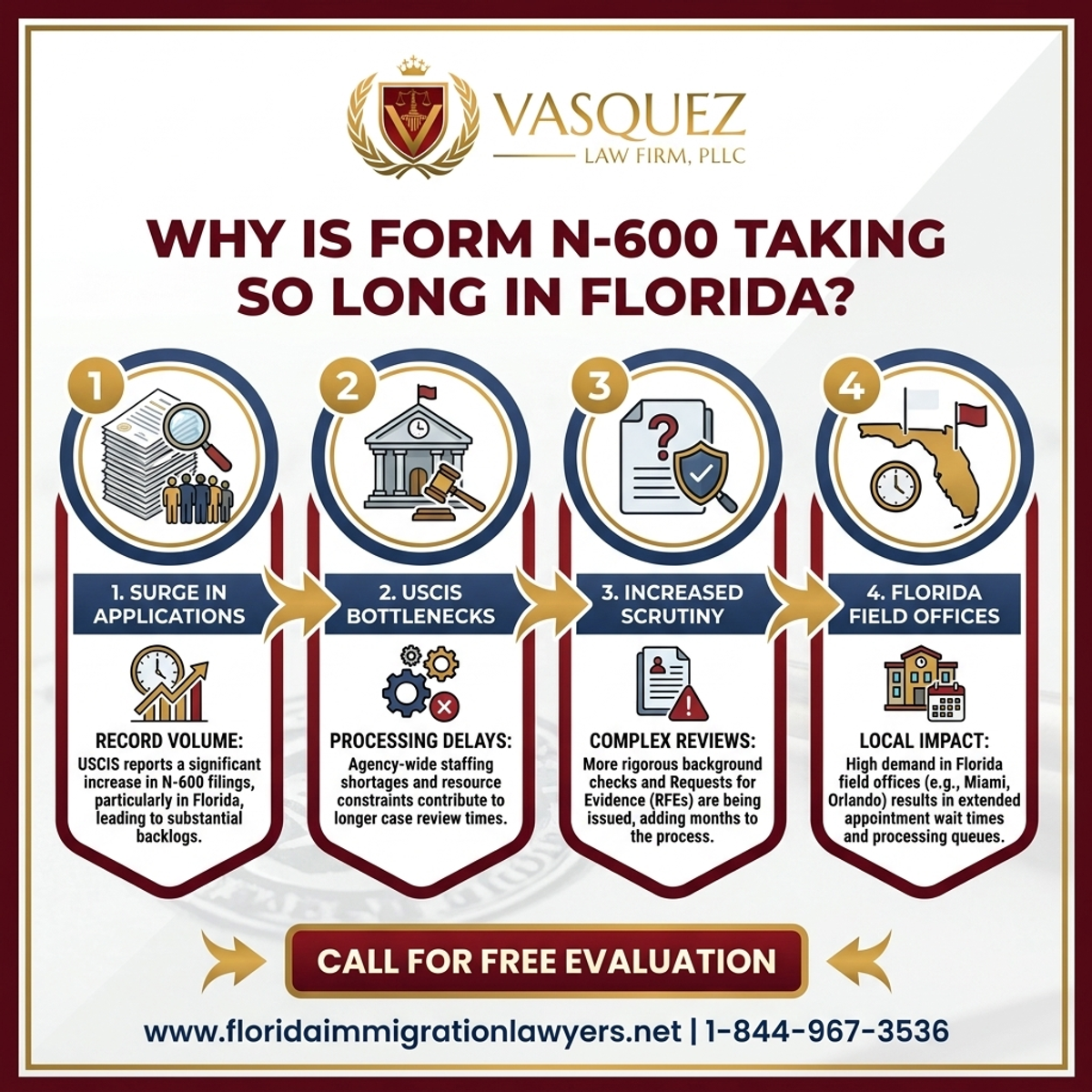
Key Statistics — Why is Form N-600 Taking So Long in Florida?
After submitting your Form N-600, the initial few weeks involve USCIS acknowledging receipt of your application, usually with a Form I-797C, Notice of Action. This notice contains your receipt number, which is crucial for tracking your case online. Following this, your application enters the initial review phase, where background checks are conducted, and documents are verified. This stage often takes the longest, as it involves coordination with various agencies and extensive data processing.
Once the initial review is complete, if an interview is deemed necessary, you will receive a notice for interview scheduling. The wait time for an interview can vary significantly based on the caseload of your local USCIS field office. For instance, offices in high-volume areas like Miami or Orlando might have longer wait times compared to less busy locations. The interview itself is typically brief, focusing on confirming the information provided in your application and clarifying any ambiguities.
Finally, after the interview (if conducted) and all necessary reviews are complete, a decision will be rendered. If approved, your child will receive their Certificate of Citizenship. While the table provides typical timeframes, it's important to remember these are averages, and individual cases can take longer. Staying informed through the USCIS online case status tool and consulting with Florida Immigration Lawyers can help you understand your specific timeline and address any unusual delays.
Cost Factors and Fee Breakdown
Understanding the costs involved can prepare you for the financial aspects of the N-600 process. Typical fees include:
| Item | Typical Fee | Notes |
|---|---|---|
| Form N-600 Filing Fee | Consult USCIS for current rates | Check for fee waivers if applicable |
| Attorney Fees | Varies | Depends on case complexity |
For the most updated fee information, visit the State Department’s website.
The filing fee for Form N-600 is a mandatory expense, and it's critical to ensure you submit the correct amount. USCIS fees can change, so always verify the current fee on the official USCIS website before mailing your application. Submitting an incorrect fee is a common mistake that leads to application rejection and significant delays. In certain circumstances, applicants may be eligible for a fee waiver, typically based on income or receipt of means-tested benefits. Exploring this option can alleviate the financial burden for eligible families.
Beyond the USCIS filing fee, other potential costs include fees for obtaining certified copies of documents (birth certificates, marriage licenses, court orders), translation services if documents are not in English, and passport-style photos. While these individual costs may seem minor, they can add up. Planning for these expenses in advance can prevent last-minute financial stress.
Engaging an immigration attorney, such as Florida Immigration Lawyers, involves legal fees that vary depending on the complexity of your case and the services required. While this is an additional cost, the value of expert legal guidance often outweighs the expense. An attorney can help avoid costly mistakes, prepare a robust application, represent you at interviews, and address any unforeseen challenges, ultimately saving you time and potential heartache. For a clear understanding of potential legal fees and how they relate to your specific N-600 application, call 1-844-967-3536 for a free consultation.
Do not navigate this process alone. Contact Florida Immigration Lawyers today.
Common Mistakes to Avoid
- Missing deadlines: Results in application denial.
- Incomplete forms: Causes processing delays.
- Incorrect fees: Leads to application rejection.
- Lack of proper documentation: Stalls your application.
- Ignoring USCIS requests: May result in denial.
- Providing outdated contact information: Delays correspondence.
- Not seeking legal advice: Misses potential issues.
- Assuming automatic approval: Misunderstanding eligibility can be costly.
- Failing to track your application: Overlooked status changes can delay action.
- Submitting false information: Leads to severe penalties.
Navigating the Form N-600 process can be intricate, and even small oversights can lead to significant setbacks. The list above highlights critical errors that frequently cause delays or even outright denials. For instance, a common mistake is providing a photocopy of a document when USCIS specifically requires an original or certified copy, or failing to include a certified English translation for documents in another language.
Avoiding these common pitfalls requires diligent attention to detail and a thorough understanding of USCIS requirements. It's not just about submitting documents, but submitting the *right* documents in the *correct* format. When in doubt, it's always best to err on the side of caution and seek professional guidance. Florida Immigration Lawyers can review your application packet before submission, ensuring it is complete, accurate, and compliant with all current regulations, thereby significantly reducing the risk of these common mistakes.
When to Call a Lawyer
Legal assistance is crucial if you face complex issues, such as disputed citizenship claims, application denials, or unusual delays. A lawyer can navigate these challenges effectively and ensure compliance with all legal requirements. Contact Florida Immigration Lawyers to explore your options.
While some N-600 applications proceed smoothly, many benefit from the expertise of an immigration attorney. You should particularly consider legal counsel if your child's citizenship claim is not straightforward. This could include situations involving parents who naturalized after the child's birth but before they turned 18, complex adoption scenarios, or cases where the child was born abroad to U.S. citizen parents but did not acquire citizenship automatically at birth.
Furthermore, if your application has been pending for an unusually long time beyond the published processing times, or if you've received an RFE that seems complex, an attorney can intervene. They can communicate directly with USCIS, clarify the issues, and provide a robust response, often preventing further delays or a potential denial. If your N-600 application has already been denied, an attorney can help you understand the reasons for denial and explore options for appeal or refiling. Don't hesitate to call Florida Immigration Lawyers at 1-844-967-3536 for a free consultation to discuss your specific situation.
Having a legal professional on your side can also be invaluable if there are any past immigration issues, criminal records, or other factors that might complicate the case for either the child or the petitioning parent. An attorney can assess these potential red flags, advise on how to address them proactively, and prepare you for any questions that might arise during an interview. Their expertise ensures that all legal avenues are explored, and your child's best interests are protected throughout the entire process.
Frequently Asked Questions About N-600 Delays
Understanding the N-600 process can be complex, and many applicants have similar questions regarding delays and best practices. Here are some frequently asked questions with practical advice.
About Florida Immigration Lawyers
Florida Immigration Lawyers is dedicated to assisting clients across Florida with all immigration matters, including citizenship, asylum, and deportation defense. Our experienced attorneys offer personalized attention and are available 24/7. Call 1-844-967-3536 for a free consultation or visit our website.
Sources and References
- U.S. Citizenship and Immigration Services (USCIS)
- Executive Office for Immigration Review (EOIR)
- 8 U.S.C. Chapter 12 - Immigration and Nationality Act
Related services: naturalization process, citizenship test preparation, dual citizenship guidance, family-based immigration.
This article provides general legal information and is not intended as legal advice. Every case is unique, and outcomes depend on specific facts and circumstances. Contact an attorney for advice about your particular situation.
Seize the opportunity to secure your child's future. Call Florida Immigration Lawyers at 1-844-967-3536 for a free consultation. Se Habla Español - Estamos aquí para ayudarle.
If you need legal assistance, learn more about speak with a citizenship lawyer, or call us at 1-844-967-3536 for a free consultation.
Do Not Navigate This Process Alone
Our experienced immigration attorneys are ready to fight for you. Get a free, confidential consultation today.
Se Habla Español
Or leave your details and we’ll call you:
Free Evaluation in 24 Hours
Or talk to us right now

AI voice assistant — available 24/7
FreeFrequently Asked Questions

William J. Vásquez
Founding Attorney · Vasquez Law Firm
U.S. Air Force veteran and immigration attorney with years of hands-on U.S. immigration experience. J.D., NCCU School of Law. AILA member. Admitted to the 4th, 5th, and 11th Circuit Courts.
Available 24/7 - Free Evaluations
Reviewed for legal accuracy by William J. Vásquez
Licensed in North Carolina; U.S. immigration is federal practice.
Related Legal Services
Our Florida immigration attorneys can help you with experienced immigration attorneys, business immigration and asylum protection. Call today at 1-844-967-3536 for a free consultation.
Related Links
Related Topics
Free Legal Consultation
Discuss your case with our experienced attorneys. We're available 24/7.
Se Habla Español - Estamos aquí para ayudarle.
Related Articles
K-3 Visa Timeline in Florida: What to Expect
Learn the K-3 visa timeline process in Florida, including steps, costs, and documentation. Understand your options in 2026 with guidance from Florida Immigration Lawyers.
Military Naturalization Expedited in Florida Bases
Explore military naturalization options for families at Florida bases, including parole in place benefits in Miami. Learn how to expedite your application with expert guidance from Florida Immigration Lawyers.
Finding Immigration Legal Help in North Florida
Discover how to find an immigration lawyer in Orlando offering a free consultation. Understand the services available and why choosing Florida Immigration Lawyers can make a difference in your case.
CR-1 Visa Attorney Orlando: Spousal Immigration Experts
Navigating the CR-1 and IR-1 visa process in Orlando can be challenging. Learn about the steps, requirements, and how Florida Immigration Lawyers can assist you with your spouse's immigration journey.