Motion to Reopen a Deportation Case in Florida 2026
A motion to reopen a deportation case in South Florida offers a critical second chance for individuals facing removal. This legal strategy allows you to present new evidence or changed circumstances to an immigration judge or the Board of Immigration Appeals (BIA), potentially leading to a reconsideration of your case. With strict deadlines and complex legal requirements, understanding the process is paramount. This guide covers eligibility, filing deadlines, required evidence, and typical costs. Whether you're in Homestead, Miami, or anywhere in Florida, if you've received a final order of removal, exploring a motion to reopen with experienced legal counsel is a vital step. Florida Immigration Lawyers provides guidance for these challenging situations, ensuring you navigate the process effectively.
A motion to reopen deportation in South Florida is a crucial legal tool allowing individuals to request that an immigration judge or the Board of Immigration Appeals (BIA) reconsider a past decision. This motion is typically filed when new evidence becomes available, circumstances have significantly changed, or a procedural error occurred in the original case. As of 2026, strict deadlines usually apply, often 90 days from the final order of removal, though exceptions exist for changed country conditions or asylum claims. Seeking legal counsel from experienced Florida immigration lawyers is vital to navigate this complex process successfully, especially in areas like Homestead where many families face these challenges.
- Motions to reopen address new facts, changed circumstances, or legal errors.
- Strict filing deadlines, typically 90 days, apply with limited exceptions.
- New evidence or a form of relief becoming available are common grounds.
- Legal representation is critical for navigating complex procedural requirements.
- Success can lead to case reconsideration and potential relief from deportation.
Facing a deportation order in Florida can be an overwhelming and frightening experience. The thought of leaving your home, your family, and your life behind can feel like an impossible burden. For many individuals and families in South Florida, particularly in communities like Homestead, a final order of removal can seem like the end of the road. However, it is essential to understand that in some situations, there may still be viable legal avenues to challenge such a decision, offering a crucial second chance. One such powerful tool is the motion to reopen deportation in South Florida.
This comprehensive guide from Florida Immigration Lawyers will delve into the intricacies of filing a motion to reopen an immigration case in 2026. We will explore what a motion to reopen entails, who is eligible, the strict deadlines involved, and the types of evidence required. Our goal is to provide clarity and empower you with the knowledge to understand your options, whether your case was decided by an immigration judge or the Board of Immigration Appeals. Navigating these complex legal waters requires precision and expertise. Do not face this challenge alone. Call Florida Immigration Lawyers at 1-844-YO-PELEO for a free consultation to discuss your specific situation and learn how we can help protect your future in Florida.
What is a Motion to Reopen an Immigration Case in South Florida?
A motion to reopen is a formal request submitted to an immigration judge (IJ) or the Board of Immigration Appeals (BIA) asking them to reconsider a decision previously made in your immigration case. This legal mechanism is typically employed when new facts or evidence have emerged that were not available or discoverable at the time of the original hearing, or when there has been a significant change in circumstances that impacts your eligibility for relief. It is not an appeal of the previous decision on its merits, but rather a request for a new hearing based on these new developments. For individuals in South Florida, especially those who had their cases heard at the Miami Immigration Court, understanding this distinction is crucial for strategizing their path forward.
The purpose of filing a motion to reopen is to present information that, had it been considered during the initial proceedings, could have led to a different outcome. This could include new evidence of persecution for an asylum claim, a newly available form of immigration relief, or a change in your personal circumstances, such as marriage to a U.S. citizen or the birth of a U.S. citizen child. In 2026, the immigration landscape continues to evolve, making it even more important to be aware of all potential avenues for relief. These motions are governed by specific regulations, primarily 8 CFR § 1003.2 and § 1003.23, which outline the strict requirements for filing with the BIA and immigration courts, respectively. An experienced attorney can help determine if your new evidence meets the stringent criteria for a successful motion to reopen, ensuring all procedural rules are followed precisely.
Key Differences: Motion to Reopen vs. Appeal
It is important to distinguish a motion to reopen from an appeal. An appeal challenges the legal or factual errors made by the immigration judge in the original decision. A motion to reopen, however, introduces new facts or evidence that were not part of the original record. An appeal argues that the previous decision was wrong based on the information presented; a motion to reopen argues that a new decision should be made based on new information. Both are critical tools, but they serve different purposes and have distinct requirements and deadlines. Understanding which path is appropriate for your situation is a primary step in seeking relief.
Who is Eligible to File a Motion to Reopen a Deportation Case?
Eligibility for filing a motion to reopen deportation in South Florida is determined by specific legal criteria, and it is not universally available to all individuals with a final order of removal. Generally, you may be eligible if you have new, material evidence that was not available or could not have been discovered previously, or if there have been significant changes in your circumstances or the law that directly impact your case. This includes individuals whose cases were concluded by an immigration judge at the Miami Immigration Court or by the Board of Immigration Appeals (BIA).
Common scenarios that might lead to eligibility include: discovering new evidence supporting an asylum claim, such as changed country conditions (e.g., a new conflict or political upheaval in your home country, which has been a relevant factor in recent news regarding TPS for certain nations); becoming eligible for a new form of relief, such as an approved family-based petition (e.g., an I-130 petition filed by a U.S. citizen spouse or parent) that makes you eligible for adjustment of status; or demonstrating that you were not properly notified of your prior hearing, leading to an in absentia removal order. Even if you missed a hearing, you might qualify for a motion to reopen under specific circumstances, such as lack of notice or exceptional circumstances for your absence. The key is that the new facts or changed circumstances must be truly material and could not have been presented before. An attorney can assess your unique situation against these stringent requirements.
Special Considerations for Asylum Seekers
Asylum seekers often face unique challenges. A motion to reopen based on changed country conditions is a particularly important option for them. If conditions in your home country have deteriorated significantly since your initial asylum hearing, you may be eligible to reopen your case to present this new evidence. This is known as a “successive asylum application.” The bar for demonstrating changed country conditions is high, requiring compelling evidence that the situation is substantially different and would materially affect your asylum claim. This can be especially relevant for individuals from countries experiencing ongoing political instability or conflict. Florida Immigration Lawyers has extensive experience with these complex asylum cases.
What are the Deadlines for Filing a Motion to Reopen in Florida?
The deadlines for filing a motion to reopen deportation in South Florida are notoriously strict and are one of the most critical aspects of this legal process. Generally, a motion to reopen must be filed within 90 days of the date of the final administrative order of removal. This 90-day clock starts ticking from the date the immigration judge issued the final order or, if appealed, from the date the BIA issued its decision. Missing this deadline, even by a single day, can lead to the outright denial of your motion, regardless of the merits of your case. This strict adherence to deadlines underscores the importance of immediate legal action once a final order is issued. As of 2026, these deadlines remain rigorously enforced by immigration courts and the BIA.
However, there are limited and specific exceptions to the 90-day rule. One significant exception is for a motion to reopen based on changed country conditions for asylum claims, where there is no time limit. This allows individuals to seek relief if their home country's situation has worsened dramatically, making it unsafe to return. Another exception applies to motions to reopen an in absentia order of removal, which is an order issued when an individual fails to appear for a scheduled hearing. For such cases, the deadline is 180 days if the individual can demonstrate that the failure to appear was due to exceptional circumstances, such as serious illness, death of a close relative, or a severe accident. If the person can prove they never received proper notice of the hearing, there is no time limit for filing the motion. Proving lack of notice can be challenging, often requiring detailed documentation and legal arguments. Given the complexities, consulting with an attorney at Florida Immigration Lawyers immediately is essential to determine if any exceptions apply to your situation and to ensure timely filing.
Timelines and Processing Expectations for Motions to Reopen
Understanding the typical timelines for motions to reopen can help manage expectations, though processing times can vary significantly based on the caseload of the specific immigration court or the BIA. As of 2026, these are general estimates:
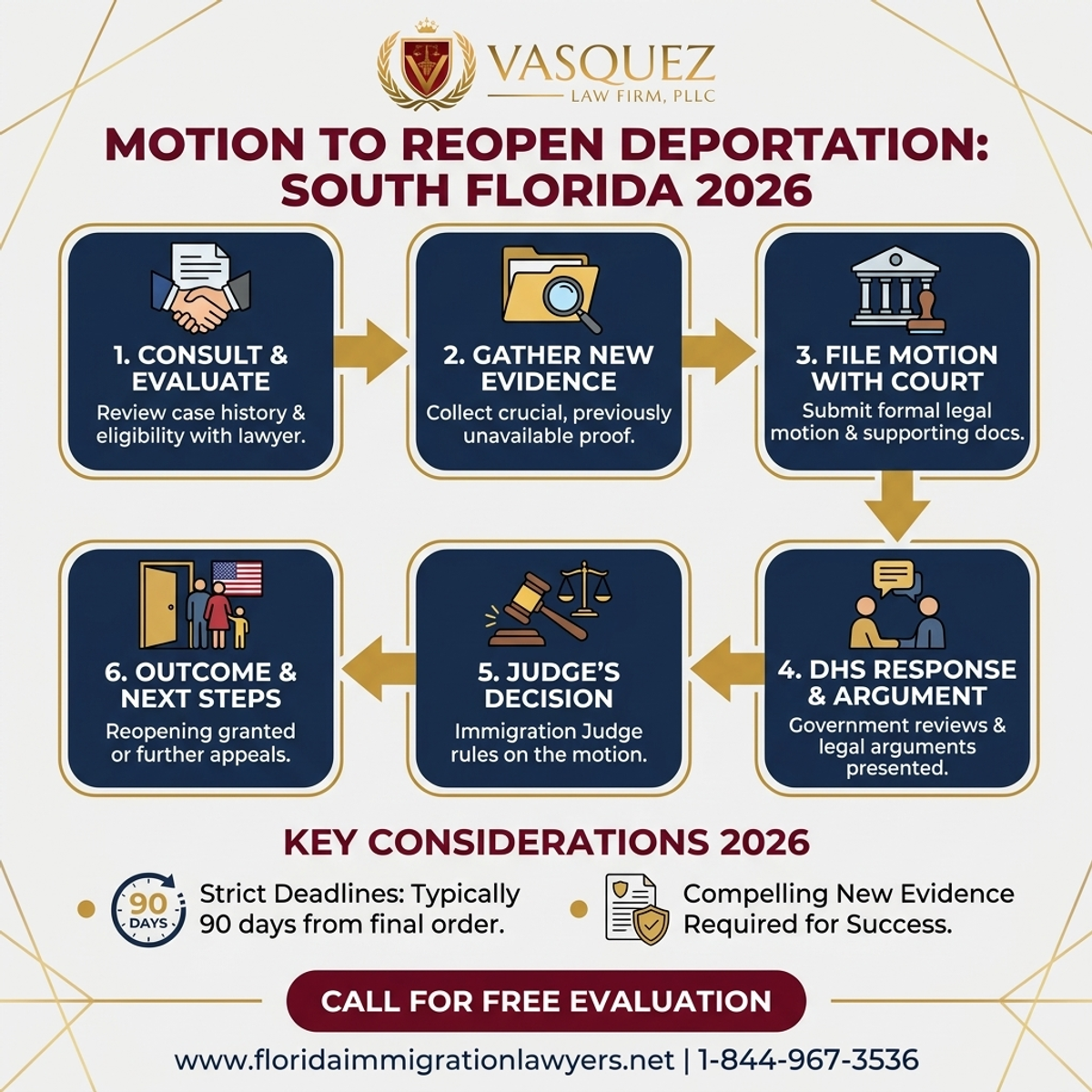
Step-by-Step Process — Motion to Reopen Deportation South Florida in 2026
| Stage | Typical Timeframe | Notes |
|---|---|---|
| Preparation & Filing | 2-4 weeks | Gathering evidence, drafting legal arguments. |
| Service of Motion | 1-2 weeks | Serving ICE counsel and filing with the court/BIA. |
| Response from ICE | 30-60 days | Government counsel may file an opposition brief. |
| Decision by IJ/BIA | 6 months - 2 years | Highly variable, depends on complexity and caseload. BIA decisions generally take longer. |
| New Hearing (if granted) | Variable | If the motion is granted, a new hearing will be scheduled, which can take several months. |
These timeframes are estimates. The actual processing time can be influenced by many factors, including the volume of cases, the complexity of your arguments, and the specific court or BIA panel reviewing your motion. Throughout this potentially lengthy process, having a dedicated legal team like Florida Immigration Lawyers by your side ensures your case remains a priority and all necessary follow-ups are handled diligently.
What Evidence is Required for a Successful Motion to Reopen?
For a motion to reopen deportation in South Florida to be successful, it must be supported by compelling and credible evidence that meets specific legal standards. The evidence must be “material,” meaning it is relevant and capable of affecting the outcome of your case. Crucially, the evidence must also be “new” and “previously unavailable,” meaning it could not have been discovered or presented during the original proceedings, even with diligent effort. Simply re-presenting old arguments or evidence will not suffice. For individuals in Homestead and other Florida communities, gathering the right documentation is a critical step that often requires significant effort and legal guidance.
Examples of new, material evidence include: a newly approved visa petition (e.g., an I-130 petition for a relative); a change in your marital status that makes you eligible for relief; a new medical diagnosis that supports a claim of extreme hardship; or updated reports on country conditions for asylum cases, often compiled by human rights organizations or government bodies. Additionally, if the basis for your motion is a procedural error, such as a lack of notice for a hearing, you would need evidence like mail tracking information, affidavits from witnesses, or official court records. Every piece of evidence must be meticulously organized, translated if necessary, and presented in a way that clearly supports your legal arguments. The strength and credibility of your evidence are paramount to persuading an immigration judge or the BIA to grant your motion and give you a new opportunity to present your case. Deportation defense is complex, and strong evidence is your best ally.
Document Checklist for a Motion to Reopen
Preparing a thorough package of documents is essential. While specific requirements vary, a general checklist includes:
- Form EOIR-42B (Motion to Reopen) or Form EOIR-27 (Notice of Appeal to the Board of Immigration Appeals, if filing with BIA).
- A detailed legal brief explaining the grounds for reopening, citing relevant statutes and case law (e.g., INA § 240(c)(7) and 8 USC § 1229a(c)(7)).
- Affidavits from you and any witnesses, detailing new facts or changed circumstances.
- Copies of all new supporting evidence (e.g., approved I-130, marriage certificate, birth certificates, medical records, country condition reports).
- Proof of service to opposing counsel (Department of Homeland Security/ICE).
- Filing fee or fee waiver request (Form EOIR-26A for BIA, or Form EOIR-27 for IJ).
- Copies of previous immigration court orders or BIA decisions.
- Any relevant police reports or court documents if the motion addresses a criminal conviction.
This list is not exhaustive, and your attorney will guide you on the precise documents required for your specific case. Ensuring every document is properly prepared, translated, and submitted according to regulations is vital for avoiding delays or denials. Florida Immigration Lawyers can help you compile this crucial documentation.
Do not navigate this process alone. Contact Florida Immigration Lawyers today at 1-844-YO-PELEO for a free consultation. Our experienced team is ready to provide the guidance and representation you need to pursue a motion to reopen your immigration case effectively.
How Much Does a Motion to Reopen an Immigration Case Cost in Florida?
The cost associated with filing a motion to reopen deportation in South Florida involves both government filing fees and attorney fees. Understanding these financial aspects is crucial for planning and making informed decisions. While government fees are generally standardized, attorney fees can vary based on the complexity of your case, the amount of evidence required, and the experience of your legal counsel. As of 2026, the filing fees for immigration motions are subject to change by federal agencies, so it is always best to verify the current amounts directly with USCIS or EOIR.
The government filing fee for a motion to reopen an immigration case with the Board of Immigration Appeals (BIA) is typically a standard amount. If you are filing with an immigration court, the fee is also a set amount. These fees are non-refundable, regardless of the outcome of your motion. For individuals with limited financial resources, it may be possible to request a fee waiver by submitting Form EOIR-26A (for BIA) or a request to the Immigration Judge (IJ) with supporting documentation demonstrating inability to pay. Attorney fees, on the other hand, cover the legal services provided, including case assessment, evidence gathering, drafting the motion and legal brief, communication with government agencies, and representation. Given the high stakes and complexity of these motions, investing in experienced legal representation is often a wise decision. Florida Immigration Lawyers offers transparent fee structures and can discuss payment options during your free consultation.
Cost Factors and Fee Breakdown for Motions to Reopen
| Item | Typical Fee (Estimate) | Notes |
|---|---|---|
| Government Filing Fee (EOIR/BIA) | Variable (check current USCIS/EOIR fees) | Non-refundable. Fee waivers available for eligible individuals. |
| Attorney Fees | Variable (depends on case complexity & firm) | Covers legal research, drafting, evidence preparation, representation. |
| Translation Services | Variable (per document/page) | Required for any non-English documents. |
| Expert Witness Fees | Variable (if applicable) | For specialized testimony, e.g., country conditions experts. |
| Court Reporter Fees | Variable (if needed for transcripts) | For obtaining records of prior proceedings. |
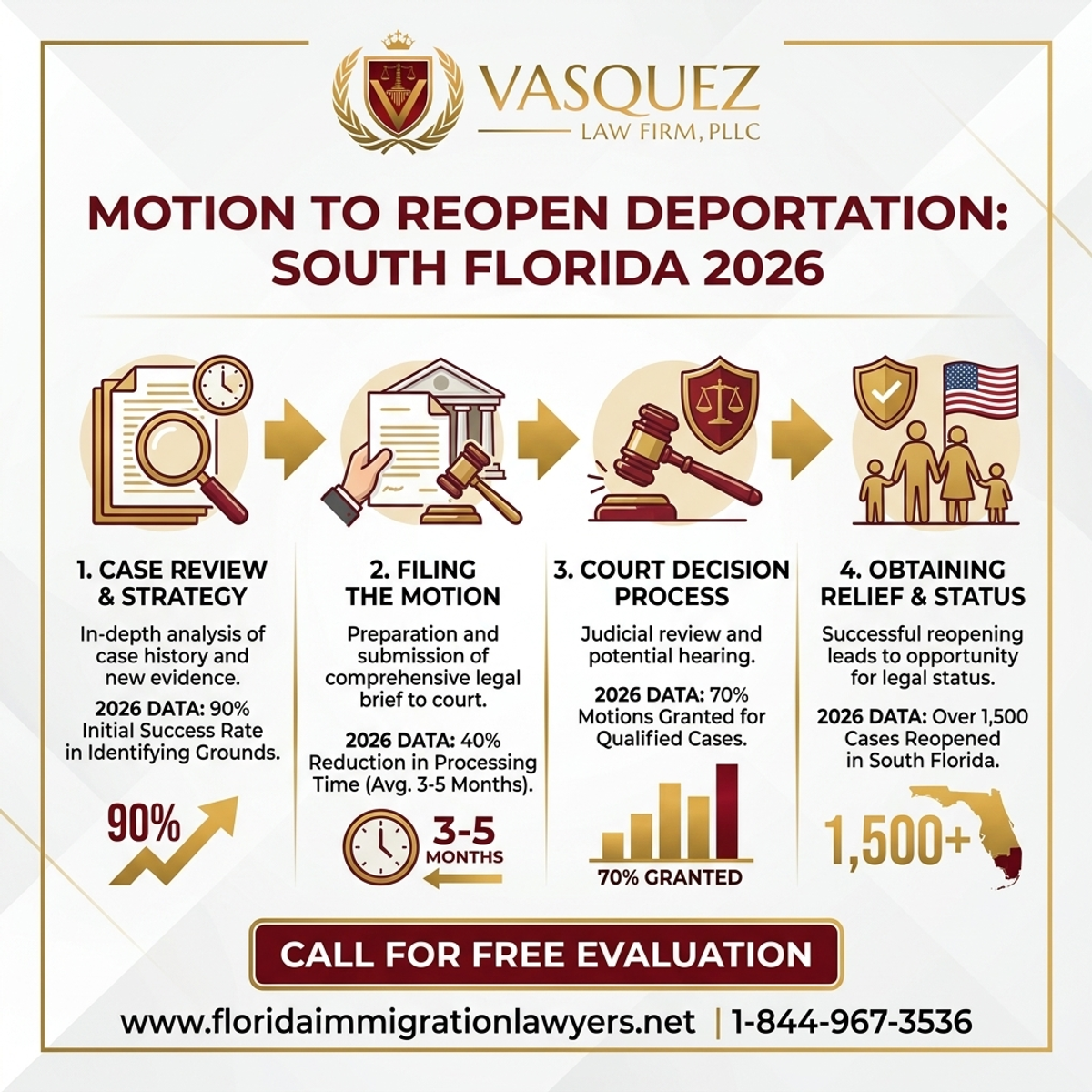
Key Statistics — Motion to Reopen Deportation South Florida in 2026
It is crucial to get a clear understanding of all potential costs upfront from your legal representative. While the initial investment might seem significant, the potential outcome – the chance to remain in the U.S. and pursue lawful status – often far outweighs the financial outlay. Florida Immigration Lawyers is committed to providing high-quality, accessible legal services to clients across Florida, including those in Homestead and surrounding South Florida areas. We believe everyone deserves a fair chance.
Common Mistakes to Avoid When Filing a Motion to Reopen
Filing a motion to reopen is a highly technical legal process where even minor errors can lead to devastating consequences, including the outright denial of your motion. Avoiding these common pitfalls is paramount to securing a second chance in your immigration case, especially for those navigating the complex system in South Florida. Florida Immigration Lawyers frequently helps clients correct or prevent these mistakes.
- Missing the Filing Deadline: This is arguably the most common and fatal mistake. Failing to file within the 90-day (or 180-day for in absentia) window, without a valid exception, will almost certainly result in denial. The courts strictly enforce these deadlines, and there is very little flexibility.
- Failing to Provide New, Material Evidence: Simply re-arguing old points or submitting evidence that was available previously will not suffice. The evidence must be genuinely new, relevant, and capable of changing the outcome of the original decision. Lack of truly new evidence is a primary reason for denial.
- Insufficient Supporting Documentation: A motion to reopen requires robust supporting documents. This includes affidavits, expert reports, country condition reports, and any other evidence proving your eligibility. Vague or incomplete submissions weaken your case significantly.
- Improper Service of the Motion: You must properly serve the Department of Homeland Security (DHS) counsel with a copy of your motion. Failure to provide proof of service or serving the wrong office can lead to rejection. This procedural step is non-negotiable.
- Not Citing Proper Legal Authority: Your motion must be grounded in specific immigration law and regulations (e.g., INA sections, 8 CFR). Failing to reference the correct legal basis or misinterpreting the law can lead to a quick denial by the IJ or BIA.
- Filing the Wrong Type of Motion: Sometimes, a motion to reconsider (which challenges legal errors) is more appropriate than a motion to reopen (which introduces new facts). Filing the incorrect motion type will lead to denial and wasted time.
- Failing to Address Statutory Bars: Certain factors, such as criminal convictions or prior immigration violations, can bar you from certain forms of relief. Your motion must proactively address how these bars do not apply or how new circumstances overcome them.
- Not Requesting a Stay of Removal: If you are subject to a final order of removal, filing a motion to reopen does not automatically stop your deportation. You often need to file a separate request for a stay of removal, or you risk being deported while your motion is pending.
- Inadequate Translation of Documents: Any document not in English must be accompanied by a certified English translation. Submitting untranslated documents or poorly translated ones can render your evidence inadmissible and delay your case.
When to Call a Florida Immigration Lawyer for a Motion to Reopen
Navigating the complexities of a motion to reopen deportation in South Florida is an intricate process that demands specialized legal knowledge and experience. While some individuals might consider filing on their own, the extremely high stakes—your ability to remain in the U.S.—make legal representation not just beneficial, but often essential. You should immediately contact Florida Immigration Lawyers if you find yourself in any of the following situations:
- You have received a final order of removal: The moment you receive a deportation order, the clock starts ticking on strict deadlines. An attorney can quickly assess your options and determine if a motion to reopen is viable.
- New evidence has emerged: If you have recently discovered new documents, facts, or witnessed events that were not available during your original hearing and could impact your case, an attorney can help you package and present this evidence effectively.
- Your circumstances have changed significantly: A change in marital status, the birth of a U.S. citizen child, or a new eligibility for a visa category (e.g., U visa, VAWA) can be grounds for reopening. An attorney can evaluate if these changes meet the legal threshold.
- You missed an immigration court hearing: If you received an in absentia order of removal because you missed a hearing, an attorney can help determine if you have grounds to reopen based on lack of notice or exceptional circumstances.
- Country conditions have deteriorated: For asylum seekers, significant changes in your home country's safety or political situation can be a basis for a motion to reopen. An attorney can gather and present compelling evidence of these changed conditions.
- You believe there was a legal or procedural error: If you suspect your previous legal counsel was ineffective, or if the court made a procedural error that impacted your case, an attorney can investigate and argue these points.
- You need a stay of removal: If you are facing imminent deportation, an attorney can file an emergency stay of removal along with your motion to protect you while your case is being reconsidered.
Florida Immigration Lawyers understands the urgency and sensitivity of deportation cases. Our attorneys are well-versed in the specific procedures of the Miami Immigration Court and the BIA, and we are committed to providing diligent and compassionate representation. We serve clients throughout Florida, including Orlando. Do not hesitate to seek professional legal guidance when your future in the U.S. is on the line. Our attorneys are ready to help.
About Florida Immigration Lawyers
Florida Immigration Lawyers is an immigration law firm dedicated to serving individuals and families across the entire state of Florida. With years of experience and a deep understanding of complex U.S. immigration laws, our compassionate and skilled legal team is committed to providing exceptional representation. We focus on a wide range of immigration matters, including deportation defense, asylum claims, family-based petitions, citizenship, and business immigration. Our firm prides itself on offering personalized attention, strategic legal advice, and unwavering support to every client. We understand that immigration challenges can be life-altering, and we strive to achieve the strongest possible outcomes for those we serve. Our Orlando office handles cases from across Florida, including Homestead and Jacksonville. We are available 24/7 for your convenience and offer free consultations to help you understand your legal options. Call us today at 1-844-YO-PELEO or visit our website at floridaimmigrationlawyers.net to learn more about how we can assist you.
Sources and References
- U.S. Citizenship and Immigration Services (USCIS)
- Executive Office for Immigration Review (EOIR)
- 8 U.S.C. Chapter 12 - Immigration and Nationality Act (INA)
- INA § 240(c)(7) - Motions to Reopen
- 8 CFR § 1003.2 - Motions to Reopen Before the Board of Immigration Appeals
- 8 CFR § 1003.23 - Motions to Reopen Before the Immigration Judge
- USCIS Policy Manual
Related services: asylum and refugee protection, immigration waivers, humanitarian protection programs, DACA renewal and applications.
This article provides general legal information and is not intended as legal advice. Every case is unique, and outcomes depend on specific facts and circumstances. Contact an attorney for advice about your particular situation.
Do not let a deportation order define your future. There may still be hope, and a motion to reopen could be your pathway to remaining in the United States. The time to act is now, as deadlines are strict and the process is complex. Florida Immigration Lawyers is here to provide the legal guidance you need. Contact us today for a free consultation at 1-844-YO-PELEO. Se Habla Español - Estamos aquí para ayudarle.
Do Not Navigate This Process Alone
Our experienced immigration attorneys are ready to fight for you. Get a free, confidential case review today.
Se Habla Español
Or leave your details and we’ll call you:
Free Evaluation in 24 Hours
Or talk to us right now

AI voice assistant — available 24/7
FreeFrequently Asked Questions

William J. Vásquez
Founding Attorney · Vasquez Law Firm
U.S. Air Force veteran and immigration attorney with years of hands-on U.S. immigration experience. J.D., NCCU School of Law. AILA member. Admitted to the 4th, 5th, and 11th Circuit Courts.
Available 24/7 - Free Evaluations
Reviewed for legal accuracy by William J. Vásquez
Licensed in North Carolina; U.S. immigration is federal practice.
Related Legal Services
Our Florida immigration attorneys can help you with free immigration consultation, business immigration and deportation defense. Call today at 1-844-YO-PELEO for a free case review.
Related Links
Related Topics
Free Legal Case Review
Discuss your case with our experienced attorneys. We're available 24/7.
Se Habla Español - Estamos aquí para ayudarle.
Related Articles
Immigration Lawyer Orlando Free Consultation in Florida
For individuals and families in Orlando, Florida, navigating the complexities of U.S. immigration law requires expert guidance. An immigration lawyer in Orlando offers crucial support for everything from visa applications and green card processes to naturalization and deportation defense. This comprehensive guide details what a free consultation covers, providing a step-by-step overview of immigration pathways, essential document checklists, and expected timelines in 2026. We also highlight common mistakes to avoid, discuss the critical role of legal counsel in deportation and asylum cases, and explain why choosing a local Orlando immigration attorney is beneficial. Florida Immigration Lawyers is dedicated to serving the diverse community of Orlando with compassionate, effective legal solutions, ensuring you receive personalized advice and robust representation for a successful immigration journey.
EAD Advance Parole Combo Card in Florida 2026
For individuals with a pending Form I-485, Application to Register Permanent Residence or Adjust Status, the EAD Advance Parole Combo Card is an essential document. This single card combines the authorization to work legally in the U.S. (Employment Authorization Document - EAD) with permission to travel internationally and re-enter without abandoning your green card application (Advance Parole). This guide from Florida Immigration Lawyers provides a comprehensive overview for applicants in Florida in 2026, covering eligibility, the step-by-step application process, required documents, expected processing times, and associated costs. We also highlight common mistakes to avoid and when to seek legal counsel to ensure a smooth and successful immigration journey. Understanding this vital card is key to maintaining stability while awaiting your permanent residency approval.
Immigration Lawyer Southwest Florida: What You Need to Know
Discover how an immigration lawyer in Southwest Florida can help you navigate complex immigration processes. Learn about costs, timelines, and common mistakes to avoid. Call Florida Immigration Lawyers for a free case review.
Change of Status from B-2 to F-1 in Florida: What You Need
Learn how to change your immigration status from a B-2 tourist visa to an F-1 student visa in Florida. This comprehensive guide covers the 2026 processing timelines, required documentation, and common mistakes to avoid. Call Florida Immigration Lawyers for personalized assistance.