K-3 Visa Timeline for Florida Spouses
Learn the ins and outs of the K-3 visa process for spouses in Florida. Navigate the timeline and avoid common pitfalls with expert guidance.

K-3 Visa Timeline for Florida Spouses | VLF Florida
Navigating the complex world of U.S. immigration can be daunting, especially when you're trying to reunite with your loved one. For U.S. citizens married to foreign nationals, the K-3 nonimmigrant visa offers a pathway for spouses to enter the United States while their permanent resident visa petition (Form I-130) is pending. This comprehensive guide will walk you through the K-3 visa timeline specifically for spouses in Florida, helping you understand each crucial step, potential challenges, and how expert legal assistance can streamline the process.
What is the K-3 Visa? Understanding its Purpose and Benefits
The K-3 visa was created by the Legal Immigration Family Equity (LIFE) Act to shorten the separation period for U.S. citizens and their foreign spouses. It allows the foreign spouse to enter the U.S. as a nonimmigrant and apply for adjustment of status to a lawful permanent resident from within the country, rather than waiting abroad for their immigrant visa to be processed. This can be particularly beneficial if the I-130 processing times are lengthy, as it allows families to be together sooner. It's important to understand that the K-3 is a nonimmigrant visa, meaning it's a temporary status, but it facilitates the transition to permanent residency by allowing the spouse to reside in the U.S. while the immigrant visa process concludes. This contrasts with the CR-1/IR-1 immigrant visa, where the spouse waits abroad for full immigrant visa approval before entering. For comprehensive assistance with various immigration matters, including family-based visas and other complex cases, you can explore our extensive immigration practice areas.
Eligibility Requirements for the K-3 Visa: Who Qualifies?
To be eligible for a K-3 visa, both the U.S. citizen petitioner and the foreign national spouse must meet specific criteria established by U.S. Citizenship and Immigration Services (USCIS) and the Department of State:
- Valid Marriage: You must be legally married to a U.S. citizen. The marriage must be valid in the place where it occurred, and both parties must have been free to marry at the time.
- Pending I-130 Petition: The U.S. citizen spouse must have already filed Form I-130, Petition for Alien Relative, on behalf of their foreign spouse with USCIS. Crucially, the I-130 must be pending and not yet approved at the time the K-3 petition (I-129F) is filed. If the I-130 is approved before the I-129F, the K-3 visa may become unnecessary or be denied.
- U.S. Citizen Petitioner: The petitioner must be a U.S. citizen. Green Card holders (Lawful Permanent Residents) are not eligible to petition for a K-3 visa.
- Foreign Spouse Abroad: The foreign spouse must reside outside the U.S. at the time of filing the K-3 petition.
- Intent to Reside in U.S.: Both spouses must genuinely intend for the foreign spouse to reside permanently in the United States and establish a life together.
- No Prior Immigration Violations: The foreign spouse must generally be admissible to the U.S., meaning they do not have certain criminal records, health issues, or prior immigration violations that would make them ineligible for entry.
Gathering all necessary documentation, such as certified marriage certificates, proof of U.S. citizenship (e.g., birth certificate or passport), divorce decrees from previous marriages (if applicable), and compelling evidence of a bona fide marriage (e.g., joint bank accounts, shared leases, photos, communication records), is critical for a smooth application process. Our experienced attorneys at VLF Florida can help you prepare these documents meticulously and ensure your petition is as strong as possible.
The K-3 Visa Application Timeline: A Step-by-Step Guide for Florida Spouses
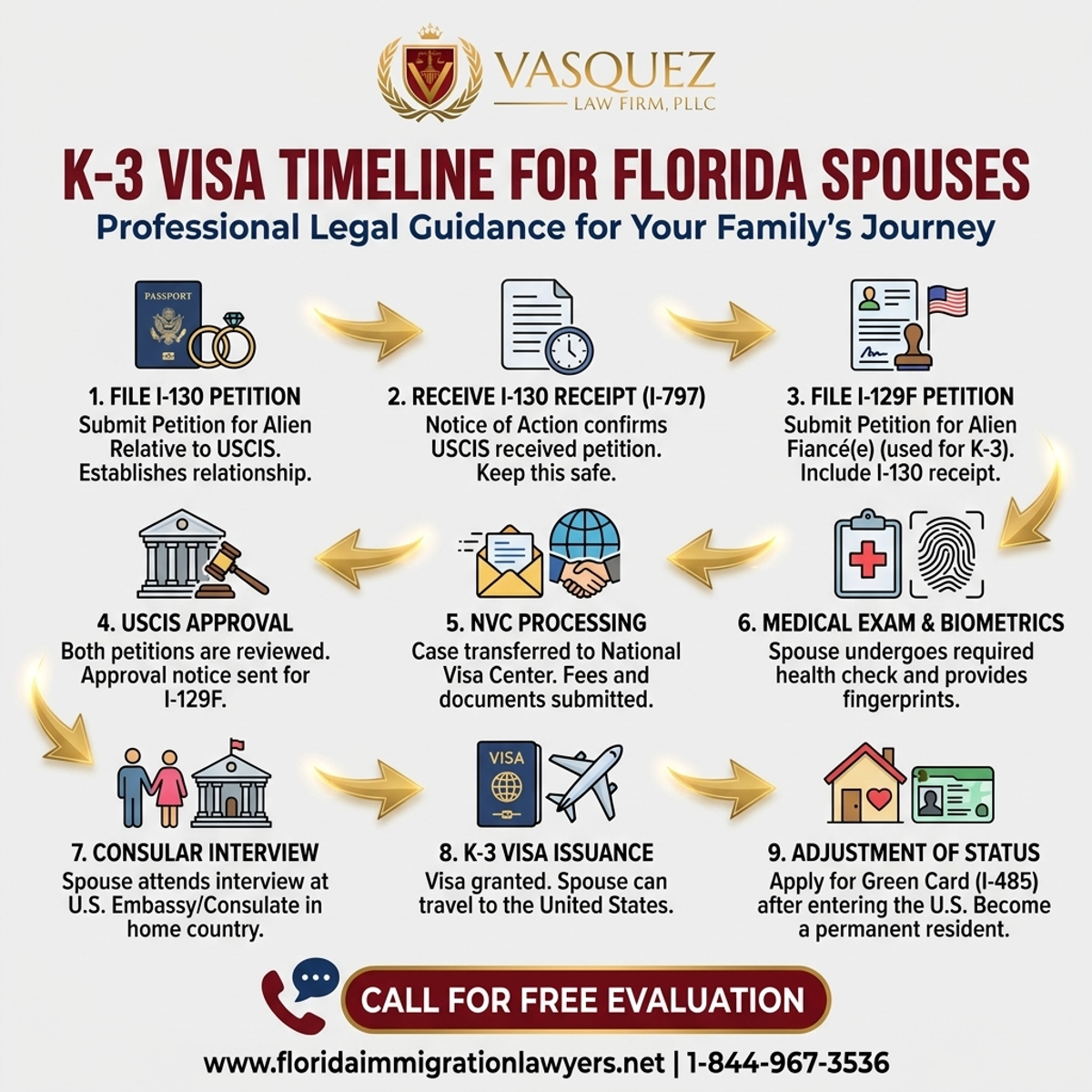
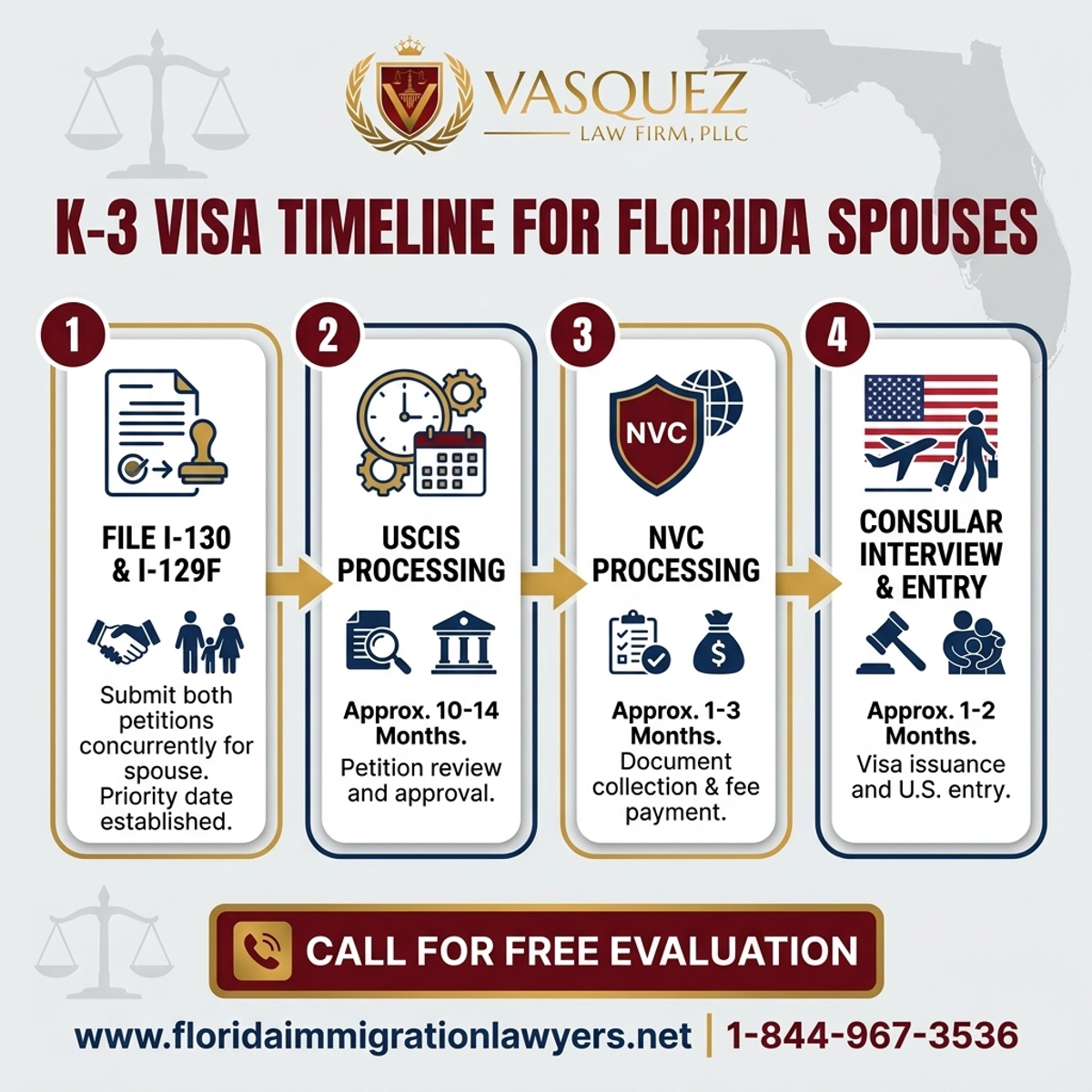
The K-3 visa process involves several distinct stages, each with its own processing times and requirements. While timelines can vary significantly based on USCIS and NVC workloads, here's a general overview of what Florida spouses can expect:
Step 1: File Form I-130, Petition for Alien Relative
The U.S. citizen spouse initiates the process by filing Form I-130, Petition for Alien Relative, with USCIS. This petition establishes the bona fide marital relationship between the U.S. citizen and the foreign national spouse. It is the foundational petition for all family-based immigration. Once filed, you will receive a receipt notice (Form I-797C, Notice of Action) from USCIS, confirming that your petition has been received and is being processed. This receipt notice contains crucial information, including your case number, which you will need for the next step. It's vital to keep this document safe.
Step 2: File Form I-129F, Petition for Nonimmigrant Spouse
After filing the I-130 and receiving the receipt notice, the U.S. citizen can then file Form I-129F, Petition for Nonimmigrant Spouse, with USCIS. This petition specifically requests the K-3 visa. You must include a copy of the I-130 receipt notice with your I-129F petition as proof that the immigrant petition has been filed. It's crucial that the I-130 is still pending when you file the I-129F. If the I-130 is approved before the I-129F is filed or processed, the K-3 visa may not be necessary or processed, as the immigrant visa path (CR-1/IR-1) would then become the primary route. USCIS will review your I-129F petition for eligibility. If approved, they will send an approval notice (Form I-797, Notice of Action) and forward the petition to the National Visa Center (NVC).
Step 3: National Visa Center (NVC) Processing
Once the NVC receives the approved I-129F petition from USCIS, they will assign a case number and begin their processing. The NVC acts as a liaison between USCIS and the U.S. embassy or consulate where the foreign spouse will have their interview. During this stage, the NVC will collect necessary documents and fees before scheduling the interview. This typically involves:
- Fee Payment: The applicant will be instructed to pay the required visa application fees.
- Document Submission: The foreign spouse and U.S. citizen petitioner must submit various civil documents (e.g., birth certificates, marriage certificates, police certificates from all countries lived in for more than six months) and financial documents (e.g., Affidavit of Support, Form I-864, demonstrating the U.S. citizen's ability to financially support the spouse).
Step-by-Step Process — K-3 Visa Timeline for Florida Spouses | VLF Florida
Once all documents and fees are processed, the NVC will forward the approved petition and supporting documentation to the appropriate U.S. embassy or consulate in the foreign spouse's country of residence.
Step 4: Visa Interview at U.S. Embassy or Consulate
The foreign spouse will be scheduled for an interview at the U.S. embassy or consulate in their home country. Before the interview, they must undergo a medical examination by an authorized physician designated by the embassy. During the interview, a consular officer will review the application, verify all submitted documents, and ask questions to determine eligibility, confirm the bona fides of the marriage, and ensure the applicant is not inadmissible to the U.S. It's important to answer truthfully, be prepared to provide any additional requested documentation, and demonstrate a clear understanding of the K-3 visa's purpose.
Step 5: K-3 Visa Issuance and Entry to the U.S.
If the interview is successful and the consular officer determines the applicant is eligible, the K-3 visa will be stamped in the foreign spouse's passport. They can then travel to the United States. Upon arrival at a U.S. port of entry, a Customs and Border Protection (CBP) officer will inspect their documents, including the K-3 visa, and admit them into the country in K-3 nonimmigrant status. The K-3 visa is typically valid for two years, allowing the spouse to remain in the U.S. while awaiting the finalization of their permanent residency.
Transitioning to Permanent Residency (Green Card)
Once the K-3 spouse is in the U.S., the next critical step is to apply for adjustment of status to become a lawful permanent resident (Green Card holder). This typically involves filing Form I-485, Application to Register Permanent Residence or Adjust Status, with USCIS. This application can usually be filed concurrently with other necessary forms, such as Form I-765 for employment authorization (allowing the K-3 spouse to work legally in the U.S.) and Form I-131 for advance parole (a travel document allowing the K-3 spouse to travel internationally and re-enter the U.S. while their I-485 is pending).
Required Documents for I-485:
- Form I-485, Application to Register Permanent Residence or Adjust Status
- Copy of I-797 approval notice for I-130 (if already approved)
- Copy of I-797 approval notice for I-129F
- Copy of K-3 visa and I-94 arrival/departure record
- Birth certificate
- Marriage certificate
- Medical examination report (Form I-693) from a USCIS-approved civil surgeon
- Affidavit of Support (Form I-864) from the U.S. citizen petitioner
- Extensive proof of bona fide marriage (e.g., joint financial documents, shared property, photos, affidavits)
- Passport photos
- Any other supporting documents requested by USCIS
After filing, the applicant will attend a biometrics appointment (fingerprints and photos) and may be called for an interview with a USCIS officer. During this interview, the officer will verify the information provided and confirm the legitimacy of the marriage. If approved, the spouse will receive their Green Card, granting them lawful permanent resident status in the United States.
Challenges and Common Pitfalls in the K-3 Visa Process
While the K-3 visa offers a valuable pathway to family reunification, applicants often encounter challenges that can lead to significant delays or even denials. Understanding these common pitfalls is crucial for a successful application. One significant challenge is the evolving nature of immigration policy and processing times. USCIS and NVC processing times can fluctuate dramatically, making it difficult to predict a precise timeline. Applicants must be prepared for potential lengthy waits, which can be emotionally taxing for separated families. Staying updated on current processing times and policy changes is essential, and an experienced attorney can provide invaluable insights.
Another common pitfall involves incomplete or inaccurate documentation. Even minor errors, missing signatures, or failure to provide all requested evidence can result in a Request for Evidence (RFE) from USCIS, significantly prolonging the process. RFEs require prompt and thorough responses, and any misstep can lead to further delays or even denial. It's essential to meticulously review all forms and supporting documents before submission, ideally with professional legal guidance. Furthermore, demonstrating a "bona fide" marriage is paramount. USCIS scrutinizes marriage petitions to prevent fraud. Applicants must provide compelling and consistent evidence of a legitimate, ongoing relationship, such as joint bank accounts, shared leases, utility bills in both names, shared insurance policies, photos together over time, communication records, and affidavits from friends and family who can attest to the marriage. A lack of sufficient, diverse evidence can raise red flags and lead to intense scrutiny.
Key Statistics — K-3 Visa Timeline for Florida Spouses | VLF Florida
Financial sponsorship is another critical area. The U.S. citizen petitioner must meet specific income requirements (typically 125% of the federal poverty guidelines) to sponsor their spouse, demonstrating they can financially support the immigrant and prevent them from becoming a public charge. Failure to meet these requirements, or submitting an incomplete or incorrect Form I-864 (Affidavit of Support), can cause significant delays. Lastly, previous immigration violations, criminal records, or certain health-related issues of the foreign spouse can lead to inadmissibility. While some waivers may be available for certain grounds of inadmissibility, these situations add layers of complexity and often require specialized legal guidance. Navigating these complexities alone can be overwhelming, which is why seeking expert advice from an immigration law firm like VLF Florida is highly recommended. Our team is adept at handling complex cases, including those that might involve deportation defense or other challenging situations, ensuring your application is as strong as possible and you are prepared for any potential hurdles.
Why Choose the K-3 Visa? Comparing with CR-1/IR-1 Immigrant Visas
Many individuals and families wonder why one would choose a K-3 visa when the CR-1 (Conditional Resident) or IR-1 (Immediate Relative) immigrant visas also exist. The primary advantage of the K-3 visa is its potential to allow the foreign spouse to enter the U.S. sooner. With a K-3, the spouse can come to the U.S. while the I-130 petition is still pending, thus reducing the time spent apart. Once in the U.S., they can apply for adjustment of status. This means families can be reunited physically much earlier than if they waited for the full immigrant visa process to conclude abroad.
In contrast, with CR-1/IR-1 visas, the foreign spouse must remain outside the U.S. until the I-130 is approved and an immigrant visa is issued through consular processing. This means they enter the U.S. as a permanent resident directly, bypassing the adjustment of status process. However, if the I-130 is processed very quickly by USCIS, the K-3 might become redundant, as the I-130 approval could precede or coincide with the K-3 processing, making the CR-1/IR-1 route more direct and potentially faster in some instances. The choice between K-3 and CR-1/IR-1 often depends on current processing times for both I-130 and I-129F petitions, the urgency of family reunification, and the specific circumstances of the couple. It's crucial to consult with an experienced immigration attorney to determine the best and most efficient path for your specific circumstances.
The Role of an Experienced Immigration Attorney in Your K-3 Journey
The K-3 visa process, like all immigration matters, is intricate, involves numerous forms, and is subject to frequent changes in law and policy. An experienced immigration attorney can be an invaluable asset throughout this complex journey, providing guidance, expertise, and peace of mind. They can:
- Assess Eligibility and Strategy: Determine if the K-3 visa is the most appropriate and advantageous option for your specific situation, or if another path like the CR-1/IR-1 visa might be more suitable.
- Prepare and File Petitions: Ensure all forms (I-130, I-129F, I-485, etc.) are correctly filled out, all supporting documents are meticulously prepared, and petitions are filed accurately and on time, minimizing the risk of errors or RFEs.
- Respond to RFEs: Help you understand and respond effectively to Requests for Evidence from USCIS, ensuring all necessary information is provided in a timely and comprehensive manner.
- Prepare for Interviews: Provide thorough guidance and conduct mock interviews for both the consular interview abroad and the adjustment of status interview with USCIS, helping you feel confident and prepared.
- Address Complexities: Navigate challenging issues like previous immigration violations, criminal history, or other potential inadmissibility grounds, exploring available waivers or alternative strategies. We also handle complex cases such as asylum claims, demonstrating our broad expertise in immigration law.
- Monitor Progress: Keep track of your petition's status, communicate with USCIS or the NVC on your
Sources and References
- U.S. Citizenship and Immigration Services (USCIS)
- Executive Office for Immigration Review (EOIR)
- U.S. Department of State - Bureau of Consular Affairs
- Immigration and Nationality Act (INA), 8 U.S.C. Chapter 12
Do Not Navigate This Process Alone
Our experienced immigration attorneys are ready to fight for you. Get a free, confidential consultation today.
Se Habla Español
Frequently Asked Questions
Florida Immigration Lawyers
Immigration Attorney | Founder, Vasquez Law Firm
U.S. Air Force veteran and immigration attorney with thousands of cases resolved. J.D., NCCU School of Law. AILA member. Admitted to the 4th, 5th, and 11th Circuit Courts.
Available 24/7 - Free Evaluations
Related Legal Services
Our Florida immigration attorneys can help you with immigration practice areas, free immigration consultation and experienced immigration attorneys. Call today at 1-844-967-3536 for a free consultation.
Related Links
Related Topics
Free Legal Consultation
Discuss your case with our experienced attorneys. We're available 24/7.
Se Habla Español - Estamos aquí para ayudarle.
Related Articles
Understanding BIA Remand in Florida Immigration Appeals
Explore the complexities of BIA remand in Florida immigration appeals. Learn what it means, the process, and how Florida Immigration Lawyers can assist you. Call 1-844-967-3536 for a free consultation.
Public Charge Rule: What Florida Immigrants Need to Know
The public charge rule is a vital consideration for immigrants in Florida seeking green cards or visas. This complex U.S. immigration law assesses whether an individual is likely to become primarily dependent on specific government benefits. Understanding which benefits count and how the "totality of the circumstances" test is applied is crucial for a successful application. This guide breaks down the current 1999 field guidance, explains how inadmissibility is determined, provides a step-by-step navigation, and outlines essential documents. Learn about processing timelines, cost factors, and common mistakes to avoid. Florida Immigration Lawyers offers expert legal advice to help you confidently address public charge concerns and protect your immigration journey. Schedule a free consultation to ensure your case is handled with precision and care.
Fraud Waiver Immigration in Florida: What You Need to Know
Navigating the I-601 fraud waiver process in Florida can be complex. Learn about eligibility, documentation, and how to avoid common mistakes. Contact Florida Immigration Lawyers for expert guidance.
Asylum Interview Preparation in Florida: Key Steps
Preparing for your asylum interview in Florida can make the difference in securing protection. Learn the essential steps and tips to succeed. Call Florida Immigration Lawyers for a free consultation.