Jerome Rothschild: Understanding CSPA & Aging Out
The Child Status Protection Act (CSPA) is a critical U.S. immigration law designed to prevent children from "aging out" of eligibility for immigration benefits due to lengthy processing delays. For families across Florida, including Orlando, understanding CSPA means protecting a child's right to a green card. This comprehensive guide explores how CSPA works, how to calculate a child's adjusted age, the necessary documentation, and typical timelines in 2026. We also highlight common mistakes to avoid and emphasize the importance of timely legal counsel. Whether you are a U.S. citizen or a lawful permanent resident petitioning for your child, or a derivative beneficiary yourself, navigating CSPA requires precision and prompt action. Florida Immigration Lawyers are here to provide the expert guidance needed to ensure your child's future in the United States is secure.
The Child Status Protection Act (CSPA) is a crucial U.S. immigration law designed to protect certain derivative beneficiaries (children) from "aging out" of eligibility for immigration benefits due to processing delays. If a child turns 21 before their visa petition is approved or their green card becomes available, CSPA provides a formula to calculate an "adjusted" age. This adjusted age determines if they remain a "child" for immigration purposes, allowing them to retain their place in line for a green card. Understanding CSPA is vital for families navigating the complex immigration system in Florida, especially as processing times can be lengthy and variable.
- CSPA prevents children from losing immigration eligibility by "aging out" at 21.
- An adjusted CSPA age is calculated using a specific formula.
- Eligibility often depends on the type of visa petition and prompt action by the applicant.
- CSPA applies to certain family-based and employment-based visa petitions.
- Consulting an experienced Florida immigration lawyer is crucial for CSPA cases.
Many families in Florida, like hypothetical individual Jerome Rothschild, face the complex challenge of navigating U.S. immigration law, particularly when it comes to ensuring their children can remain eligible for immigration benefits. The process can be lengthy, and a child's age can become a critical factor. When a child beneficiary of an immigration petition turns 21 before their green card or visa is issued, they risk "aging out," meaning they are no longer considered a "child" under immigration law and may lose their eligibility for the original petition. This situation can be devastating for families who have waited years for their immigration journey to progress.
Fortunately, the Child Status Protection Act (CSPA) was enacted to provide relief in many of these situations. This vital law offers a mechanism to "freeze" a child's age for immigration purposes, protecting them from the adverse effects of administrative delays. Understanding the nuances of CSPA is paramount for families in Orlando, Miami, Tampa, and across Florida, who are pursuing family-based immigration. This comprehensive guide will delve into what CSPA is, how it works, eligibility requirements, the calculation methods, and common pitfalls to avoid. We will also explore Florida-specific considerations and emphasize why expert legal guidance from Florida Immigration Lawyers is indispensable.
Do not let processing delays jeopardize your family's future. If you are concerned about your child potentially aging out, it is critical to seek professional legal advice immediately. Call Florida Immigration Lawyers at 1-844-YO-PELEO for a free consultation to discuss your specific situation and understand your options under the Child Status Protection Act.
What is the Child Status Protection Act (CSPA) and How Does it Work in Florida?
The Child Status Protection Act (CSPA) is a federal law enacted in 2002 that helps preserve immigration eligibility for derivative beneficiaries (unmarried children under 21) whose age would otherwise "age out" during the lengthy immigration process. It works by providing a specific formula to calculate an applicant's "CSPA age," which can be less than their biological age, thus allowing them to retain their status as a child for visa petition purposes. This protection is vital for many families in Florida facing long waits.
The CSPA primarily aims to mitigate the adverse impact of USCIS and State Department processing delays on children who are beneficiaries of family-based or employment-based visa petitions. Before CSPA, if a child turned 21 before their priority date became current and their visa was available, they would often lose their eligibility as a derivative beneficiary, requiring a new petition and a potentially much longer wait. With CSPA, a child's age is calculated differently, often allowing them to continue their immigration journey with their family. This is particularly relevant in Florida, where a significant volume of immigration cases are processed annually through USCIS field offices in cities like Orlando and Miami, and through various immigration courts.
Understanding "Aging Out"
"Aging out" occurs when a child, who is a derivative beneficiary of a parent's visa petition, reaches their 21st birthday before their immigration visa becomes available. Under the Immigration and Nationality Act (INA), a "child" is generally defined as an unmarried person under 21 years of age. Once they turn 21, they are no longer considered a "child" for most immigration purposes and may be reclassified into a less favorable, often much slower, visa category. For example, an unmarried child under 21 of a lawful permanent resident (LPR) is in the F2A category, which typically has a shorter wait time than the F2B category for unmarried adult sons and daughters over 21. CSPA seeks to prevent this reclassification by essentially "freezing" the child's age.
Key Provisions of CSPA
CSPA applies to several categories of visa petitions, including immediate relatives of U.S. citizens (though their age is generally frozen on the date the petition is filed), family-preference categories, and certain employment-based categories. To qualify, the child must remain unmarried. The CSPA calculation itself subtracts the time a visa petition was pending from the child's biological age on the date the visa became available. Furthermore, the child must seek to acquire lawful permanent resident status within one year of a visa becoming available. This "one-year filing requirement" is a critical component of CSPA eligibility and often overlooked. For families in Florida, particularly those dealing with the Orlando Immigration Court or the Hialeah Field Office, understanding these provisions and acting promptly is essential to protect a child's immigration future.
How Do You Calculate Your CSPA Age for Immigration Purposes?
Calculating your CSPA age involves a specific formula that subtracts the time your visa petition was pending from your biological age on the date your visa became available. This calculation determines if you remain under 21 for immigration purposes. The exact calculation depends on the specific family-based or employment-based category.
The CSPA age calculation is not simply your current age. It's a precise formula designed to account for government processing delays. As of 2026, the general formula for family-preference and employment-based categories is: CSPA Age = (Applicant's Age on Date Visa Becomes Available) - (Number of Days Visa Petition Was Pending). The "date visa becomes available" refers to the first day of the month when your priority date becomes current according to the Department of State Visa Bulletin's Final Action Dates chart, or when the petition is approved, whichever is later. The "number of days visa petition was pending" is calculated from the date USCIS received the petition until the date USCIS approved it. It is crucial to remember that the child must also have sought to acquire lawful permanent residence within one year of the visa becoming available, either by filing an Adjustment of Status application (Form I-485) or by applying for an immigrant visa through consular processing. Missing this crucial deadline can lead to loss of CSPA protection, a common mistake for applicants in Florida.
- Determine the Petition Filing Date: This is the date USCIS officially received your I-130 (Petition for Alien Relative) or I-140 (Immigrant Petition for Alien Worker).
- Determine the Petition Approval Date: This is the date USCIS officially approved your I-130 or I-140 petition.
- Calculate Petition Pending Time: Subtract the petition filing date from the petition approval date. This gives you the number of days the petition was pending with USCIS.
- Identify the Visa Availability Date: Check the Department of State's monthly Visa Bulletin for the "Final Action Dates" chart. Find the first date your priority date became current for your specific visa category. If your petition was approved *after* your priority date became current, your visa availability date is the petition approval date.
- Determine Your Age on Visa Availability Date: Calculate your biological age on the exact date your visa became available.
- Apply the CSPA Formula: Subtract the "Petition Pending Time" (from step 3) from your "Age on Visa Availability Date" (from step 5). The result is your CSPA age.
- Check for One-Year Filing: Confirm that you (or your parent on your behalf) took action to pursue lawful permanent residence (filed I-485 or applied for immigrant visa) within one year of your visa becoming available. This is a non-negotiable requirement for CSPA protection. If this step is missed, CSPA protection may be lost, regardless of the calculated age. For families in Orlando and across Florida, timely action is paramount, and an experienced immigration attorney can help ensure all deadlines are met.
What Documents Are Needed to Prove CSPA Eligibility in Florida?
To prove CSPA eligibility, you will need a range of documents that establish your identity, relationship to the petitioner, the timeline of the immigration petition, and your marital status. These documents are critical for USCIS or the State Department to accurately calculate your CSPA age and confirm your eligibility. Gathering these documents meticulously is a key step in any CSPA case in Florida.
The documentation required for CSPA eligibility is extensive and must be accurate to avoid delays or denials. When applying for adjustment of status in Florida through a USCIS field office, or pursuing consular processing abroad, you will need to submit evidence that clearly demonstrates how your CSPA age calculation works in your favor. This includes official government records that establish dates of birth, marriage, and petition filings and approvals. Any discrepancies or missing information can significantly complicate the process. Given the strict nature of immigration requirements, especially in high-volume areas like Florida, it is highly recommended to work with an experienced immigration lawyer to ensure your documentation is complete and correctly presented. They can help you navigate specific requirements from the U.S. Citizenship and Immigration Services (USCIS) or the National Visa Center (NVC).
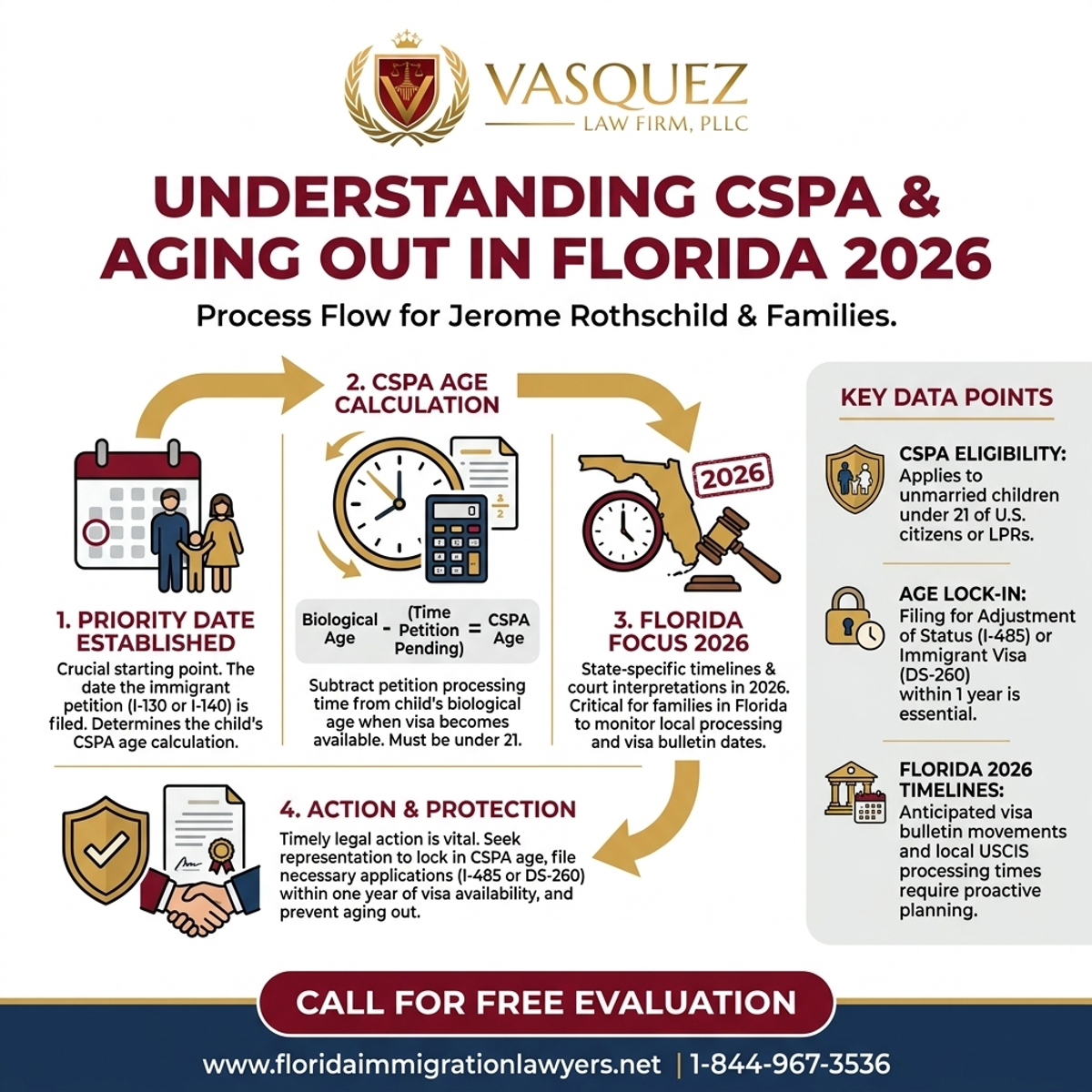
Step-by-Step Process — Jerome Rothschild: Understanding CSPA & Aging Out in Florida 2026
- Birth Certificate: Your official birth certificate, clearly showing your date of birth, is fundamental.
- Parent's Birth Certificate and Marriage Certificate: To establish the qualifying parent-child relationship.
- I-130 or I-140 Petition Receipt Notice (Form I-797C): This document proves the filing date of the visa petition.
- I-130 or I-140 Petition Approval Notice (Form I-797): This document indicates the approval date of the visa petition.
- Passport: Your current passport for identity verification.
- Visa Bulletin Records: Evidence of the month your priority date became current, often obtained from the Department of State's historical Visa Bulletins.
- Proof of Timely Filing: If applicable, the I-485 (Application to Register Permanent Residence or Adjust Status) receipt notice or evidence of immigrant visa application submission (e.g., DS-260 confirmation) within one year of visa availability.
- Proof of Unmarried Status: Affidavits, if necessary, confirming that you have remained unmarried since the petition was filed.
- Prior Immigration History Documents: Any previous visas, entry stamps, or immigration applications that might be relevant to your status in Florida.
What Are the Typical Timelines for CSPA Cases in 2026?
The timeline for CSPA cases in 2026 is highly variable and depends on several factors, including the specific visa category, the country of chargeability, and the current processing backlogs at USCIS and the National Visa Center. While CSPA helps prevent aging out, it does not necessarily speed up the underlying visa petition process itself. Families should be prepared for potentially long waits.
As of 2026, processing times for family-based immigration petitions, which are most commonly affected by CSPA, can range from several months to over a decade. The initial I-130 petition processing by USCIS typically takes 1-2 years, but this can fluctuate significantly. Once the petition is approved, the wait for a visa to become available depends on the specific preference category and the Visa Bulletin's final action dates. For example, some categories, particularly for certain countries, have decades-long backlogs. After a visa becomes available and CSPA eligibility is confirmed, the adjustment of status (I-485) process in Florida, involving interviews at local USCIS field offices like Orlando or Hialeah, can take another 1-3 years. Consular processing abroad also has its own set of timelines, often influenced by the specific U.S. Embassy or Consulate. Proactive monitoring of the Visa Bulletin and USCIS processing times is crucial. An immigration attorney can provide more precise expectations based on your specific case details and current trends affecting Florida residents.
| Stage | Typical Timeframe (As of 2026) | Notes |
|---|---|---|
| I-130 Petition Filing & Approval | 12-36 months | Varies by service center and relationship category. |
| Visa Availability (Priority Date Current) | Months to 10+ years | Depends on visa category, country of chargeability, and Visa Bulletin. This is the critical date for CSPA calculation. |
| CSPA Age Determination & Confirmation | Concurrent with visa processing | USCIS/NVC will review CSPA eligibility once visa becomes available. |
| Adjustment of Status (I-485) Filing & Interview (in Florida) | 18-36 months (after visa availability) | Includes biometrics, interview at local USCIS field office (e.g., Orlando, Hialeah). |
| Consular Processing (abroad) | 6-18 months (after visa availability) | Varies by embassy/consulate; includes NVC processing and interview. |
| Green Card Issuance | Immediately after approval | Upon successful completion of adjustment of status or consular processing. |
How Much Does it Cost to File a CSPA-Related Immigration Petition?
The costs associated with a CSPA-related immigration petition primarily stem from the underlying visa petition (e.g., Form I-130) and the subsequent application for lawful permanent residence (Form I-485 or consular processing fees). There is no separate CSPA filing fee; CSPA is a legal protection applied to existing petitions. However, attorney fees for expert guidance are a crucial consideration.
As of 2026, USCIS filing fees are subject to change, and it is always advisable to check the official USCIS website for the most current amounts. For most family-based petitions, the primary costs include the Form I-130 petition fee, and then later, either the Form I-485 Application to Register Permanent Residence or Adjust Status fee (which includes biometrics) or the immigrant visa application processing fees for consular processing. These government fees are mandatory and non-refundable. Beyond government fees, a significant investment is often made in legal representation. An experienced immigration lawyer in Florida can help ensure proper CSPA calculation, timely filing, and accurate document submission, which can prevent costly delays or denials. While these legal fees vary, they are an investment in the successful outcome of your case, providing peace of mind and expert navigation through complex regulations. Additional costs may include medical examinations, translation services, and travel expenses, especially for consular processing.
| Item | Typical Fee (Government, As of 2026) | Notes |
|---|---|---|
| Form I-130 (Petition for Alien Relative) | Check USCIS website | Required for family-based petitions. |
| Form I-485 (Adjustment of Status) | Check USCIS website | Includes biometrics fee. For applicants adjusting status within the U.S. |
| Immigrant Visa Application Processing (DS-260) | Check State Department website | For applicants undergoing consular processing abroad. |
| Affidavit of Support (I-864) | No fee (if filed with I-485) | Required for most family-based immigrants. |
| Medical Examination | Varies by physician | Required for both adjustment of status and consular processing. |
| Attorney Fees | Varies by case complexity and firm | Investment in expert legal guidance to navigate CSPA and the overall immigration process. |
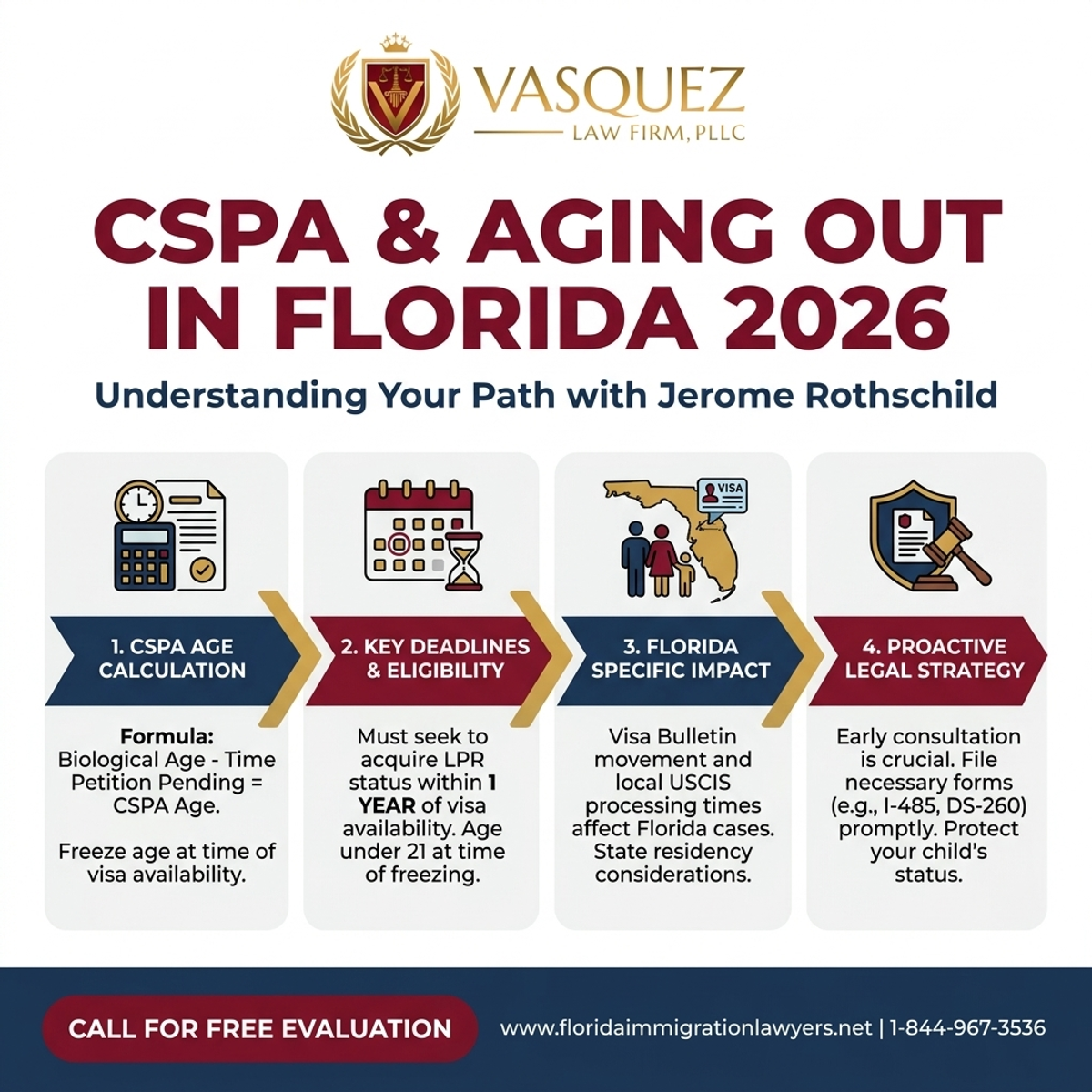
Key Statistics — Jerome Rothschild: Understanding CSPA & Aging Out in Florida 2026
Do not navigate this complex process alone. The stakes are too high for your family's future. Contact Florida Immigration Lawyers today for a free consultation to ensure your child's eligibility for immigration benefits is protected under CSPA. Our experienced team serves clients across Florida, including Orlando.
Common Mistakes to Avoid in CSPA Cases
Navigating CSPA can be fraught with potential errors that could jeopardize your child's immigration eligibility. Avoiding these common mistakes is crucial for a successful outcome.
- Miscalculating the CSPA Age: The formula is precise. Even a small error in counting days can lead to an incorrect CSPA age and potential denial. Many individuals mistakenly use the biological age at the time of petition filing or approval, rather than the age on the date the visa becomes available.
- Missing the One-Year Filing Requirement: This is arguably the most common and devastating mistake. After a visa becomes available, the child (or their parent) must "seek to acquire" lawful permanent residence within one year. This means filing Form I-485 or submitting the immigrant visa application package (e.g., DS-260) to the NVC. Failure to do so, even by one day, can lead to the loss of CSPA protection.
- Assuming CSPA Applies to All Categories: CSPA does not apply to all immigration categories. For instance, it generally does not apply to children of asylum seekers or refugees unless they are derivative beneficiaries of a separate family-based petition. Understanding which categories are covered is vital.
- Failing to Remain Unmarried: For CSPA to apply, the child must remain unmarried. If they marry before obtaining lawful permanent residence, they lose CSPA protection and often their eligibility under the original petition.
- Not Monitoring the Visa Bulletin: The Visa Bulletin, published monthly by the Department of State, determines when a visa becomes available. Failing to regularly check the bulletin means you might miss the crucial "visa availability date" and, consequently, the one-year filing window.
- Ignoring Retrogression: Sometimes, a visa category can "retrogress," meaning the priority date that was once current becomes unavailable again. This can complicate CSPA calculations and the one-year filing requirement. Expert guidance is necessary during retrogression.
- Submitting Incomplete or Inaccurate Documentation: Missing birth certificates, incorrect petition dates, or insufficient proof of relationship can lead to Requests for Evidence (RFEs) or outright denials, causing significant delays.
- Delaying Legal Consultation: Waiting until the last minute to consult an immigration attorney in Florida can be detrimental. Early intervention allows for proactive planning, accurate calculations, and timely submission of all necessary forms and documents.
- Not Understanding Immediate Relative vs. Preference Categories: The CSPA calculation differs for immediate relatives of U.S. citizens versus preference categories. Immediate relatives' age is generally locked on the petition filing date, while preference categories use the more complex formula involving visa availability.
- Neglecting to Follow Up on USCIS/NVC Notices: Ignoring or misunderstanding notices from USCIS or the National Visa Center can lead to missed deadlines or requests for additional information, potentially impacting CSPA eligibility.
When to Call a Lawyer for Your CSPA Case in Florida
Given the complexities and potential pitfalls of CSPA, calling an experienced immigration lawyer is not just recommended, it's often essential for a successful outcome. The stakes are incredibly high, as your child's future in the U.S. depends on accurate calculations and timely actions. Florida Immigration Lawyers are well-versed in CSPA regulations and can provide invaluable assistance.
You should consider contacting an attorney if:
- You are unsure about your child's CSPA age calculation. The formula is intricate, and errors can be costly. An attorney can perform the calculation accurately and verify eligibility.
- Your child is approaching their 21st birthday, and their visa is not yet available. Proactive planning is key. An attorney can assess your situation and advise on the best course of action before the "aging out" date.
- You have received a Request for Evidence (RFE) or a Notice of Intent to Deny (NOID) related to CSPA. These notices indicate that USCIS or the NVC has questions or concerns about your eligibility. An attorney can help you formulate a robust response.
- You are confused by the Visa Bulletin or a retrogression. These can significantly impact CSPA eligibility and the one-year filing rule. Legal counsel can help interpret these complex updates.
- You need assistance with the one-year filing requirement. Ensuring timely submission of the I-485 or immigrant visa application is critical. An attorney can help you meet this deadline and gather necessary documents.
- Your case involves complex circumstances, such as prior immigration issues, changes in marital status, or different petition types. These factors can complicate CSPA eligibility and require expert legal analysis.
- You are processing a case through the Orlando Immigration Court or Miami USCIS Field Office. Local expertise in Florida's immigration landscape can be a significant advantage.
Florida Immigration Lawyers offer comprehensive services, from initial eligibility assessment and precise CSPA age calculation to document preparation and representation before USCIS or the NVC. We understand the nuances of the Child Status Protection Act and are committed to helping families in Florida protect their children's immigration future.
About Florida Immigration Lawyers
Florida Immigration Lawyers is a leading law firm dedicated to providing comprehensive and compassionate immigration legal services to individuals and families across the entire state of Florida. With years of experience and a deep understanding of U.S. immigration law, our team is committed to guiding clients through every step of their immigration journey, from visa applications to complex deportation defense cases. We pride ourselves on our client-focused approach, ensuring that each case receives personalized attention and strategic advocacy.
Our firm specializes in a wide range of immigration matters, including family-based immigration, employment visas, asylum, naturalization, and removal defense. We understand the unique challenges faced by immigrants in Florida, including those in Orlando, Tampa, and Miami, and we are dedicated to achieving the best possible outcomes for our clients. Our bilingual team is available 24/7 to provide free consultations, offering accessible and expert legal support when you need it most. When you choose Florida Immigration Lawyers, you gain a trusted partner committed to protecting your rights and securing your future in the United States.
Contact us today: 1-844-YO-PELEO | Website: https://www.floridaimmigrationlawyers.net
Sources and References
- U.S. Citizenship and Immigration Services (USCIS)
- U.S. Department of State Visa Bulletin
- Executive Office for Immigration Review (EOIR)
- 8 U.S.C. § 1153 - Allocation of immigrant visas
- 8 U.S.C. § 1154 - Procedure for granting immigrant status
- 8 U.S.C. § 1201 - Issuance of visas
- Child Status Protection Act (Public Law 107-208, 116 Stat. 927)
- 22 CFR § 40.1 - Definitions (for visa purposes)
Related services: immigration practice areas, family immigration services.
This article provides general legal information and is not intended as legal advice. Every case is unique, and outcomes depend on specific facts and circumstances. Contact an attorney for advice about your particular situation.
Protecting your child's immigration future is paramount. Do not leave their eligibility to chance. Contact Florida Immigration Lawyers today for a free, confidential consultation. Our dedicated team is ready to provide the expert guidance you need. Call us now at 1-844-YO-PELEO. Se Habla Espanol - Estamos aqui para ayudarle.
If you need legal assistance, learn more about experienced immigration attorneys in Orlando, or call us at 1-844-YO-PELEO for a free consultation.
Do Not Navigate This Process Alone
Our experienced immigration attorneys are ready to fight for you. Get a free, confidential case review today.
Se Habla Español
Or leave your details and we’ll call you:
Free Evaluation in 24 Hours
Or talk to us right now
AI voice assistant — available 24/7
FreeFrequently Asked Questions

William J. Vásquez
Founding Attorney · Vasquez Law Firm
U.S. Air Force veteran and immigration attorney with years of hands-on U.S. immigration experience. J.D., NCCU School of Law. AILA member. Admitted to the 4th, 5th, and 11th Circuit Courts.
Available 24/7 - Free Evaluations
Reviewed for legal accuracy by William J. Vásquez
Licensed in North Carolina; U.S. immigration is federal practice.
Related Legal Services
Our Florida immigration attorneys can help you with asylum protection, citizenship and naturalization and immigration practice areas. Call today at 1-844-YO-PELEO for a free case review.
Related Links
Related Topics
Free Legal Case Review
Discuss your case with our experienced attorneys. We're available 24/7.
Se Habla Español - Estamos aquí para ayudarle.
Related Articles
Immigration Lawyer Orlando Free Consultation in Florida
For individuals and families in Orlando, Florida, navigating the complexities of U.S. immigration law requires expert guidance. An immigration lawyer in Orlando offers crucial support for everything from visa applications and green card processes to naturalization and deportation defense. This comprehensive guide details what a free consultation covers, providing a step-by-step overview of immigration pathways, essential document checklists, and expected timelines in 2026. We also highlight common mistakes to avoid, discuss the critical role of legal counsel in deportation and asylum cases, and explain why choosing a local Orlando immigration attorney is beneficial. Florida Immigration Lawyers is dedicated to serving the diverse community of Orlando with compassionate, effective legal solutions, ensuring you receive personalized advice and robust representation for a successful immigration journey.
EAD Advance Parole Combo Card in Florida 2026
For individuals with a pending Form I-485, Application to Register Permanent Residence or Adjust Status, the EAD Advance Parole Combo Card is an essential document. This single card combines the authorization to work legally in the U.S. (Employment Authorization Document - EAD) with permission to travel internationally and re-enter without abandoning your green card application (Advance Parole). This guide from Florida Immigration Lawyers provides a comprehensive overview for applicants in Florida in 2026, covering eligibility, the step-by-step application process, required documents, expected processing times, and associated costs. We also highlight common mistakes to avoid and when to seek legal counsel to ensure a smooth and successful immigration journey. Understanding this vital card is key to maintaining stability while awaiting your permanent residency approval.
O-1 Visa Extraordinary Ability in Florida: What You Need
Explore the O-1 visa for extraordinary ability in Florida. Learn about eligibility, application process, and common mistakes to avoid. Contact Florida Immigration Lawyers for expert assistance.
Green Card Holders Issued New Warning in Florida
Green card holders face new warnings in Florida. Learn about marriage-based green cards, spouse visas, and avoid common pitfalls. Contact Florida Immigration Lawyers for guidance.