Immigration Documents Checklist for Florida
Navigating immigration processes in Florida, particularly in Homestead, involves careful preparation and document organization. This comprehensive guide outlines everything you need to ensure your application is complete, accurate, and timely. From obtaining the right USCIS forms to avoiding common pitfalls, we cover all aspects to make your journey smoother. Contact Florida Immigration Lawyers for expert assistance.

Organizing immigration documents is crucial for a smooth process in Florida. Ensure you have all necessary paperwork, understand timelines, and avoid common mistakes.
- Collect relevant USCIS forms
- Understand timelines and costs
- Avoid common documentation errors
- Seek legal guidance when needed
Immigration Documents Checklist for Florida
In Homestead, Florida, navigating the immigration process can be overwhelming. Every step requires specific documents and careful attention to detail. Forgetting a single form can delay your application or even lead to rejection. Whether you're applying for a visa, green card, or citizenship, having a comprehensive checklist is essential.
In this guide, we cover everything you need for your immigration paperwork in Florida. We will provide a step-by-step guide, a document checklist, and tips on avoiding common mistakes.
Overview of Immigration Paperwork
Immigration documents serve as proof of your eligibility for various statuses and benefits in the United States. In Florida, particularly in areas like Homestead, understanding local demographics and regulations is crucial. According to recent statistics, Florida hosts a significant immigrant population, making it vital to streamline your paperwork process.
These documents are not just bureaucratic hurdles; they are the foundation of your legal status in the U.S. They verify your identity, relationships, financial stability, and good moral character, all of which are essential for USCIS (U.S. Citizenship and Immigration Services) to make an informed decision on your case. Without accurate and complete documentation, even the most straightforward application can face significant delays or outright denial.
Given Florida's diverse population and its role as a major port of entry, immigration cases here often present unique complexities. From family-based petitions in Miami-Dade County to employment visas in Orlando, each region might have specific nuances in terms of local resources or common challenges. Staying organized is your first line of defense against potential issues, ensuring that your journey through the immigration system is as smooth and efficient as possible.
Step-by-Step Guide to Organizing Documents
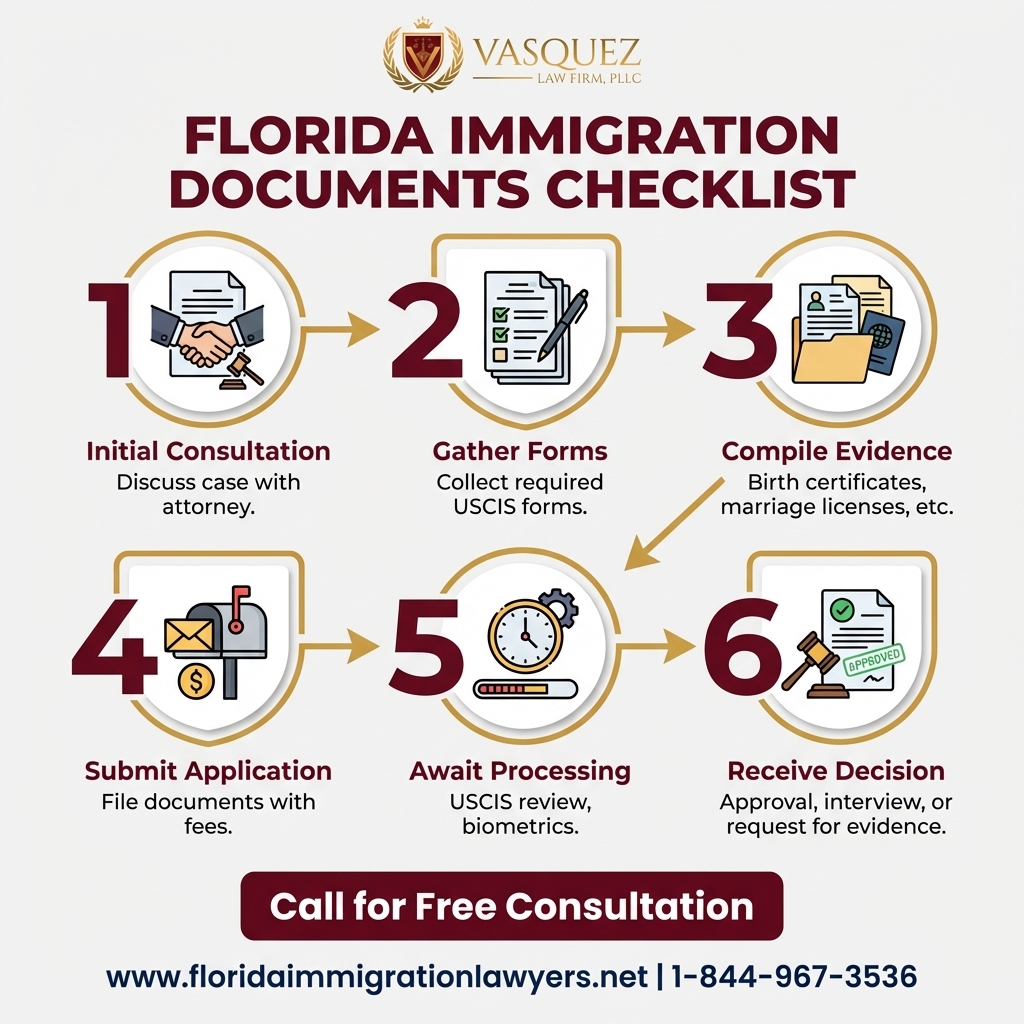
- Identify Your Immigration Goal: Determine whether you're applying for a visa, green card, asylum, or citizenship. Each requires different forms and documentation.
- Collect Required Forms: Visit USCIS.gov to download necessary forms. Common forms include I-130 for family immigration and I-485 for status adjustment.
- Gather Supporting Documents: Collect birth certificates, marriage certificates, and any previous immigration documents.
- Verify Information Accuracy: Double-check all data on your forms to prevent delays.
- Consult with an Attorney: Reach out to Florida Immigration Lawyers for guidance.
Before gathering a single document, clearly define your immigration objective. Are you seeking to reunite with family members, pursue employment opportunities, escape persecution, or become a U.S. citizen? Each path—be it a family-based petition (e.g., for a spouse or parent), an employment-based visa, asylum, or naturalization—has its own distinct set of forms, eligibility criteria, and required supporting evidence. Understanding your specific goal from the outset will prevent you from collecting irrelevant documents and save valuable time and effort.
For example, a person applying for a family-based green card will focus heavily on proving their relationship to a U.S. citizen or lawful permanent resident, while someone seeking an employment visa will need extensive documentation from their employer. This initial clarity is paramount and sets the stage for the entire document collection process. If you're unsure of your immigration goal or the best path forward, a consultation with Florida Immigration Lawyers can provide invaluable clarity.
Once your goal is clear, proceed to the official USCIS website to download the most current versions of all necessary forms. It is critical to use the latest editions, as USCIS frequently updates forms, and older versions will be rejected. Pay close attention to the instructions for each form, as they provide detailed guidance on how to complete the application, what supporting documents are needed, and where to file. For instance, Form I-765 for Employment Authorization and Form I-131 for Travel Document (Advance Parole) are often filed concurrently with Form I-485, depending on your situation.
Carefully read through every question and ensure all fields are completed accurately and legibly. Any missing information or inconsistencies can lead to a Request for Evidence (RFE) or even a denial. If a question does not apply to you, write "N/A" (not applicable) rather than leaving it blank. Double-check all signatures, as unsigned forms are an immediate cause for rejection. Remember, the instructions are your roadmap; deviating from them can cause significant setbacks.
Beyond the primary USCIS forms, a robust collection of supporting documents is crucial to substantiate your claims. This typically includes official government-issued identity documents like passports, birth certificates, and marriage certificates. For family-based petitions, you'll need extensive proof of the bona fides of your relationship, such as joint bank statements, utility bills, photographs, and affidavits from friends and family. For employment-based cases, educational degrees, professional licenses, and letters from employers are vital.
Additionally, gather financial records like tax returns, pay stubs, and bank statements to demonstrate financial stability and ensure you won't become a public charge. If you have any criminal history, even minor infractions, you must provide certified court dispositions. Any document not in English must be accompanied by a certified English translation. This comprehensive package of evidence helps USCIS evaluate your eligibility thoroughly and efficiently, minimizing the need for further inquiries.
Accuracy is paramount in immigration applications. A seemingly small error, such as a misspelled name, an incorrect date of birth, or an outdated address, can trigger significant delays, RFEs, or even a denial. Before submitting your application, meticulously review every single field on every form and cross-reference it with your supporting documents. Ensure consistency across all submitted materials. For example, your name should appear exactly the same on your birth certificate, passport, and all USCIS forms.
Consider having a trusted friend or family member review your application as well, as a fresh pair of eyes can often spot errors you might have overlooked. This thorough verification process is a critical safeguard against common pitfalls that can derail your immigration journey. Investing time in this step upfront can save you months of waiting and potential frustration later on.
While this guide provides a solid framework, immigration law is incredibly complex and constantly evolving. Consulting with an experienced immigration attorney is not just an option but often a necessity, especially for intricate cases or if you encounter any challenges. An attorney can help you identify the correct forms, ensure all documentation is complete and accurate, and anticipate potential issues before they arise. They can also represent you in interviews and respond to RFEs or Notices of Intent to Deny (NOIDs) effectively.
For residents of Florida, Florida Immigration Lawyers offers expert guidance through every stage of the process. Their knowledge of local USCIS field office procedures and federal immigration laws is invaluable. Don't hesitate to contact them at 1-844-967-3536 for a free consultation to discuss your specific circumstances and ensure your application is as strong as possible.
Document Checklist
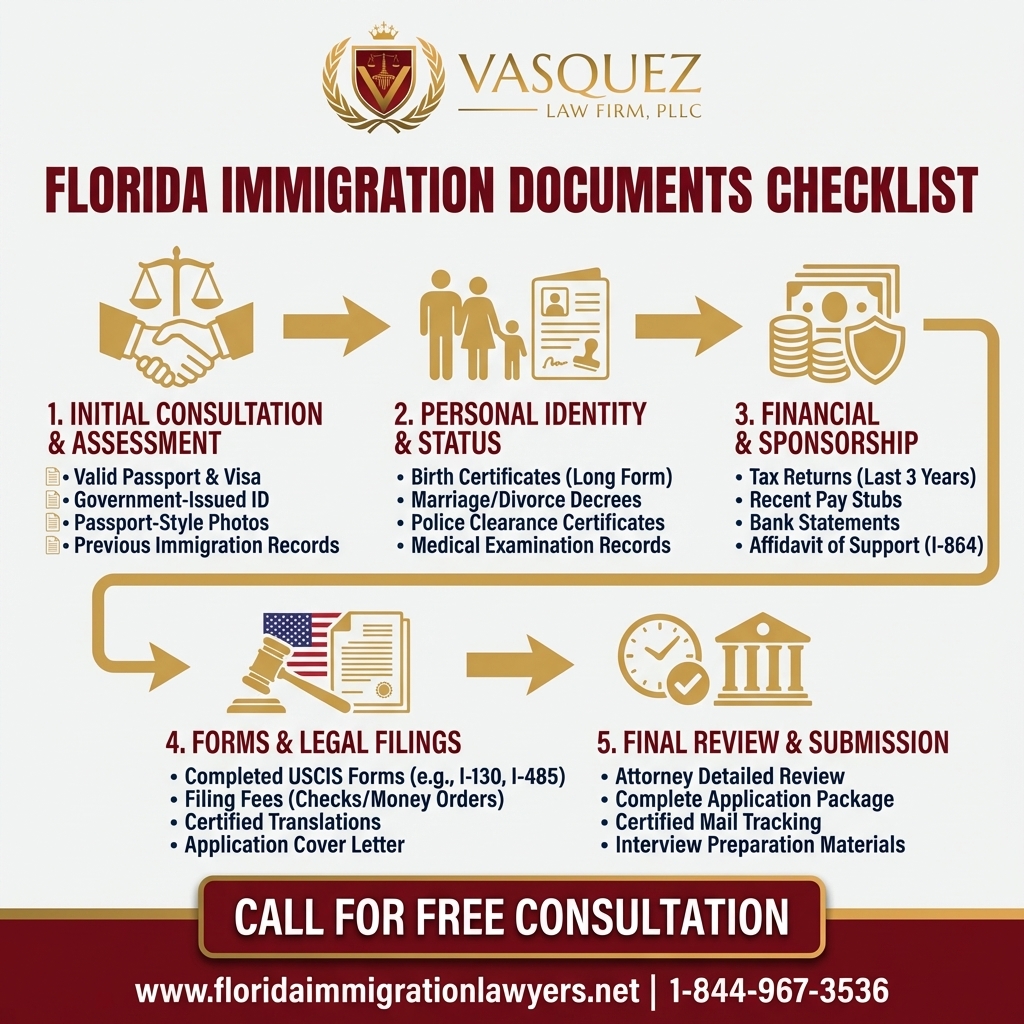
- Completed USCIS forms
- Proof of identity (passport, ID)
- Photographs (as specified by USCIS)
- Financial statements
- Proof of relationship (for family immigration)
- Medical Examination Results (Form I-693)
- Police Clearance Certificates
- Educational and Employment History
- Travel History and Previous Immigration Documents
Ensure all forms are filled out completely, accurately, and legibly. Use black ink, and if a question doesn't apply, write "N/A." Double-check that all required signatures are present, as unsigned forms are automatically rejected. Make sure you are using the most current version of each form from the USCIS website.
Provide copies of your valid passport, national identity card, birth certificate, and any other government-issued identification. Ensure these documents are current and clearly show your name, date of birth, and photograph. USCIS often requires copies of all pages of your passport with visas and entry stamps.
Submit recent passport-style photographs that meet USCIS specifications: 2x2 inches, white background, full-face view, no glasses, taken within the last six months. Attach them securely to the forms as instructed, often by placing them in a small envelope or stapling them to the designated area.
These are crucial for demonstrating financial stability and preventing you from becoming a public charge. Include bank statements, tax returns (Form W-2, 1099, 1040), letters of employment, pay stubs, and an Affidavit of Support (Form I-864) if applicable. These documents prove you have the means to support yourself or that a sponsor can support you.
For family-based petitions, provide comprehensive evidence of a genuine relationship. This includes marriage certificates, birth certificates, adoption decrees, joint bank accounts, joint utility bills, shared leases, photographs of the couple/family over time, affidavits from friends and family, and any other evidence demonstrating a legitimate relationship. The more evidence, the stronger your case.
Applicants for adjustment of status (green card) typically need to undergo a medical examination by a USCIS-approved civil surgeon. The sealed envelope containing Form I-693, Report of Medical Examination and Vaccination Record, must be submitted with your application or brought to your interview. Ensure all required vaccinations are up-to-date.
Depending on your immigration history and country of origin, you may need to provide police clearance certificates from any country you've lived in for a certain period since turning 16. These documents demonstrate your good moral character and lack of serious criminal history. Consult USCIS instructions for specific requirements.
For employment-based visas or certain other applications, detailed educational transcripts, diplomas, professional licenses, and letters of employment verifying your skills and experience are essential. These documents validate your qualifications for the role or benefit you are seeking.
Include copies of all previous visas, I-94 arrival/departure records, previous immigration petitions, and any other documents related to your past entries and stays in the U.S. This helps USCIS understand your complete immigration record and ensures consistency with your current application.
Timeline and Processing Expectations
Processing times vary based on application type and volume at the USCIS Florida Field Office. Generally, expect several months for initial processing. Stay informed via USCIS website updates.
Several factors can influence how long your application takes, including the specific type of petition (e.g., family-based often takes longer than some employment-based categories), the service center handling your case, the current caseload, and whether you submit a complete and accurate application from the start. A Request for Evidence (RFE) can significantly prolong the process, sometimes adding several months to the timeline. It's also important to note that processing times are estimates and can fluctuate based on government priorities and resources.
To manage expectations, regularly check the USCIS website's "Check Case Processing Times" tool, which provides updated estimates for each form type at various service centers and field offices. While waiting can be frustrating, maintaining a copy of your submitted application and all correspondence is crucial. If your case falls outside the normal processing times, you may be able to submit an inquiry. For personalized advice on managing your timeline, especially if you experience unusual delays, contacting Florida Immigration Lawyers at 1-844-967-3536 can provide much-needed clarity and potential intervention strategies.
Cost Factors and Fee Breakdown
Costs depend on the type of application. Fees can include form filing, biometrics, and attorney’s fees. Visit USCIS for current fee structures.
Beyond the primary filing fees for each USCIS form, applicants must budget for several other potential expenses. Biometrics fees, which cover fingerprinting and background checks, are standard for many applications. You might also incur costs for obtaining supporting documents, such as birth certificates, marriage licenses, or police clearance certificates from various agencies. If any of your documents are not in English, you'll need to pay for certified translations, which can add up depending on the volume of paperwork.
Furthermore, medical examination fees, required for most adjustment of status applicants, are paid directly to the civil surgeon and can vary. Lastly, legal fees for an experienced immigration attorney, while an investment, can be invaluable in navigating complex cases, ensuring accuracy, and avoiding costly mistakes that could lead to delays or denials. Florida Immigration Lawyers offers transparent fee structures and free consultations to help you understand the full financial scope of your immigration journey.
It's important to review the USCIS fee schedule carefully, as fees can change periodically. Some applicants may be eligible for fee waivers based on their income or receipt of certain public benefits. Understanding the full financial commitment upfront allows you to plan accordingly and avoid unexpected expenses that could impede your application process. Always keep receipts for all fees paid, as they serve as proof of submission.
Do not navigate this process alone. Contact Florida Immigration Lawyers today.
Common Mistakes to Avoid
- Missing Deadlines: Late submissions can result in application denial.
- Incorrect Form Selection: Using the wrong form can delay processing.
- Inaccurate Information: Mistakes in personal details can trigger rejections.
- Insufficient Documentation: Lack of evidence can stall applications.
- Not Keeping Copies: Always retain copies of submitted documents.
- Failing to Respond to USCIS: Ignoring requests for additional information can be fatal.
- Not Seeking Legal Advice: A lawyer can help avoid costly mistakes.
Missing a deadline is one of the most critical errors in immigration applications. USCIS and immigration courts operate on strict timelines, and late submissions can lead to automatic denial, additional fees, or even deportation proceedings. Always mark your calendar with submission deadlines, interview dates, and RFE response due dates. Consider sending documents with tracking to confirm delivery before the deadline. If you anticipate difficulty meeting a deadline, consult with Florida Immigration Lawyers immediately to explore any possible remedies or extensions.
Each immigration goal has specific forms. Submitting an incorrect form, such as using an old version or one for a different immigration category, will result in rejection and significant delays. Always verify the form number and edition date on the USCIS website before completing and submitting. For example, using Form I-130 for employment-based immigration instead of family immigration would be a critical error. Double-check the instructions to ensure you select the precise form for your unique situation.
Even minor inaccuracies, such as a misspelled name, an incorrect date of birth, or an outdated address, can cause major headaches. USCIS relies on precise data for identity verification and background checks. Inconsistencies across documents or errors on forms will lead to Requests for Evidence (RFEs), interviews, or even denials. Always cross-reference all personal details with official documents like passports and birth certificates before submission, and ensure consistency throughout your entire application package.
USCIS operates under the principle that the burden of proof lies with the applicant. Failing to provide all required supporting documents or submitting weak evidence can lead to RFEs or denials. For example, in a marriage-based green card application, simply providing a marriage certificate is usually not enough; you need extensive proof of a bona fide marriage. Always gather more evidence than you think is necessary, and ensure each piece directly supports your claims.
This is a fundamental rule for any legal process. Always make a complete copy of your entire application package, including all forms, supporting documents, and checks, before mailing it to USCIS. These copies are invaluable for your records, for preparing for interviews, for responding to RFEs, or if your original application is lost. They also serve as a crucial reference if you need to consult with an attorney or re-file your application in the future.
If USCIS sends you a Request for Evidence (RFE) or a Notice of Intent to Deny (NOID), it is imperative to respond promptly and thoroughly. Ignoring these notices or providing an incomplete response will almost certainly lead to a denial of your application. Read the request carefully, gather all requested documentation, and submit it before the deadline. If you receive such a notice, immediately contact Florida Immigration Lawyers for expert assistance in formulating a comprehensive and timely response.
Trying to navigate the complex immigration system alone, especially with limited English proficiency or in complicated cases, significantly increases the risk of errors. An experienced immigration attorney can provide expert guidance, ensure all forms are correctly filled, gather appropriate documentation, and represent your best interests. This proactive step can save you time, money, and emotional distress in the long run. Florida Immigration Lawyers offers a free consultation to assess your case and help you avoid common pitfalls.
When to Call a Lawyer
If your case involves complex issues, such as deportation defense or asylum, legal assistance is crucial. Warning signs include receiving a Notice to Appear or complex family immigration scenarios. Contact Florida Immigration Lawyers for expert help.
Beyond the obvious scenarios like deportation, there are many situations where legal counsel becomes indispensable. If you have a criminal record, even a minor one, it can have severe immigration consequences, and an attorney can assess the impact and advise on waivers. Similarly, if you've had a previous visa denial, an attorney can help understand the reasons and strategize for future applications. Complex family cases, such as those involving step-parents, adopted children, or non-traditional relationships, also benefit immensely from legal expertise.
Furthermore, if you are applying for asylum, seeking a waiver of inadmissibility, or have been a victim of crime (U-Visa) or trafficking (T-Visa), the legal nuances are significant, and errors can be detrimental. Even seemingly straightforward applications can become complicated if you have extensive travel history, multiple entries to the U.S., or any inconsistencies in your records. Don't wait until a problem arises; a proactive consultation with Florida Immigration Lawyers can identify potential pitfalls early and ensure your application is robust and compliant with all regulations. Call 1-844-967-3536 for peace of mind.
About Florida Immigration Lawyers
Florida Immigration Lawyers is dedicated to providing comprehensive immigration assistance. We specialize in family immigration, deportation defense, and citizenship processes. Our experienced attorneys are available 24/7 to help you navigate complex legal landscapes. Call us at 1-844-967-3536 or visit our website for a free consultation.
With a deep understanding of both federal immigration law and the unique challenges faced by immigrants in Florida, our firm offers unparalleled expertise. We pride ourselves on a client-centered approach, ensuring that each individual receives personalized attention and strategic legal advice tailored to their specific circumstances. Our team is committed to guiding you through every step of your immigration journey, from initial application preparation to representation in court, always striving for the best possible outcome.
Whether you are seeking to unite your family, defend against deportation, or achieve the dream of U.S. citizenship, Florida Immigration Lawyers stands ready to advocate for your rights and interests. Our 24/7 availability underscores our commitment to being there for you when you need us most. We understand the stakes are high, and we are dedicated to providing compassionate, effective, and accessible legal support to the diverse communities throughout Florida. Contact us today to learn how we can help you achieve your immigration goals.
Frequently Asked Questions (FAQs)
Q: How do I know which USCIS forms I need?
A: The best way to determine the correct forms is to identify your specific immigration goal (e.g., green card, citizenship, work visa). Then, visit the official USCIS website (uscis.gov) and use their search function or navigation to find the relevant section. Each immigration benefit has a dedicated page listing required forms and detailed instructions. Consulting with Florida Immigration Lawyers can also provide clarity and ensure you select the appropriate forms for your unique situation.
Q: What if my documents are not in English?
A: Any document submitted to USCIS that is not in English must be accompanied by a complete and accurate English translation. The translator must provide a certification stating they are competent to translate from the foreign language into English and that the translation is accurate. This certification should include the translator's name, signature, address, and date. Do not attempt to translate documents yourself, as this will not be accepted by USCIS.
Q: Can I file my immigration application online?
A: Many USCIS forms can now be filed online through the USCIS online account system. This includes forms like I-90 (Green Card Renewal), I-130 (Petition for Alien Relative), and I-765 (Employment Authorization). However, not all forms are available for online filing, and some applications, especially those requiring extensive supporting documentation, may still be best filed by mail. Always check the specific form instructions on uscis.gov to determine the accepted filing method.
Q: What is a Request for Evidence (RFE), and how should I respond?
A: An RFE is a notice from USCIS requesting additional information or documentation to support your application. It means your initial submission was incomplete or lacked sufficient proof. You must respond by the deadline provided, supplying all requested items. Gather the documents carefully, ensure they are accurate, and provide a cover letter. If you receive an RFE, it's highly advisable to consult Florida Immigration Lawyers at 1-844-967-3536 to help craft a comprehensive and timely response to avoid denial.
Q: How often do USCIS fees change?
A: USCIS fees are subject to change periodically. The agency reviews its fee structure to ensure it covers the costs of processing applications and petitions. These changes are usually announced well in advance on the USCIS website and in the Federal Register. It's crucial to always check the most current fee schedule on uscis.gov before submitting your application to ensure you pay the correct amount, as incorrect fees will lead to rejection.
Sources and References
- U.S. Citizenship and Immigration Services (USCIS)
- Executive Office for Immigration Review (EOIR)
- 8 U.S.C. Chapter 12 - Immigration and Nationality Act
- Code of Federal Regulations (CFR)
Related services: immigration practice areas, family immigration services, citizenship and naturalization.
This article provides general legal information and is not intended as legal advice. Every case is unique, and outcomes depend on specific facts and circumstances. Contact an attorney for advice about your particular situation.
Ready to take the next step? Call Florida Immigration Lawyers at 1-844-967-3536 for a free consultation. Se Habla Español - Estamos aquí para ayudarle.
If you need legal assistance, learn more about learn about our immigration practice, or call us at 1-844-967-3536 for a free consultation.
Do Not Navigate This Process Alone
Our experienced immigration attorneys are ready to fight for you. Get a free, confidential consultation today.
Se Habla Español
Frequently Asked Questions

William J. Vásquez
Founding Attorney · Vasquez Law Firm
U.S. Air Force veteran and immigration attorney with thousands of cases resolved. J.D., NCCU School of Law. AILA member. Admitted to the 4th, 5th, and 11th Circuit Courts.
Available 24/7 - Free Evaluations
Related Legal Services
Our Florida immigration attorneys can help you with business immigration, asylum protection and deportation defense. Call today at 1-844-967-3536 for a free consultation.
Related Links
Related Topics
Free Legal Consultation
Discuss your case with our experienced attorneys. We're available 24/7.
Se Habla Español - Estamos aquí para ayudarle.
Related Articles
E-2 Visa for Florida Business Investors | VLF Florida
Learn about the E-2 investor visa for Florida business opportunities, tailored for Fort Lauderdale entrepreneurs. Discover the process, requirements, and common pitfalls. Contact Florida Immigration Lawyers for expert assistance.
Immigration Documents Checklist for Florida | VLF Florida
Navigating immigration processes in Florida requires a comprehensive checklist of documents. This guide helps you gather all necessary paperwork to ensure a successful application. Consult Florida Immigration Lawyers for personalized assistance.
Immigration Attorney West Palm Beach Guide | VLF Florida
Navigate the complexities of immigration in West Palm Beach with a trusted attorney. Learn what to expect, common pitfalls, and how to choose the right legal help.
Dual Citizenship in Florida: What You Need to Know
Explore dual citizenship in Florida, understand the process, and learn how to apply. Discover the benefits and complexities involved with having two passports and navigating immigration laws. Call Florida Immigration Lawyers for expert guidance.
