Fiance Visa K-1 Process in Florida | FL Immigration Lawyers
Learn how to navigate the K-1 fiance visa process in Florida. This guide covers the steps, documents needed, and common mistakes to avoid. Call Florida Immigration Lawyers for a free consultation.
Fiance Visa K-1 Process in Florida | FL Immigration Lawyers
Navigating the complex world of U.S. immigration law can be daunting, especially when your heart is set on bringing your loved one to Florida. The K-1 Fiance Visa offers a pathway for U.S. citizens to bring their foreign fiances to the United United States with the express purpose of marriage. This visa is a unique non-immigrant visa that allows the foreign fiance to enter the U.S. for 90 days, during which time they must marry the U.S. citizen petitioner. At Florida Immigration Lawyers, we understand the emotional and legal intricacies involved in this process. Our dedicated team is here to guide you through every step, ensuring a smooth and successful journey to uniting with your fiance in the Sunshine State. We are committed to providing comprehensive legal assistance for all your immigration needs.
What is a K-1 Fiance Visa?
The K-1 Fiance Visa is a special non-immigrant visa issued by the U.S. government that allows a foreign citizen fiance(e) of a U.S. citizen to travel to the United States and marry their U.S. citizen petitioner within 90 days of arrival. After the marriage, the foreign spouse can then apply for Adjustment of Status to become a lawful permanent resident (Green Card holder). This visa category is distinct from a spousal visa (IR-1/CR-1) because it is granted *before* marriage, making it a crucial first step for many international couples. It requires a genuine, bona fide relationship and a clear intent to marry. Understanding the nuances of this visa is critical, as any misstep can lead to significant delays or even denial.
Eligibility Requirements for the K-1 Fiance Visa
To qualify for a K-1 Fiance Visa, both the U.S. citizen petitioner and the foreign fiance(e) must meet specific criteria established by U.S. Citizenship and Immigration Services (USCIS). These requirements are designed to ensure the legitimacy of the relationship and the financial stability of the intending immigrant.
- U.S. Citizen Petitioner: The petitioner must be a U.S. citizen. Lawful Permanent Residents (Green Card holders) are not eligible to petition for a K-1 visa.
- Bona Fide Relationship: You and your fiance(e) must have a genuine, ongoing relationship. USCIS will look for evidence such as photographs, communication records (emails, chat logs, call records), travel itineraries, and joint activities.
- Intent to Marry: Both parties must intend to marry each other within 90 days of the foreign fiance(e)'s entry into the U.S. This intent must be sincere and demonstrable.
- Prior Meeting in Person: You must have met each other in person at least once within the two years immediately preceding the filing of the petition. There are very limited exceptions to this rule, typically involving extreme hardship or cultural practices that prohibit such a meeting.
- Legal Capacity to Marry: Both parties must be legally free to marry. This means any previous marriages must have been legally terminated through divorce, annulment, or death, and proof of such termination must be provided.
- Financial Support: The U.S. citizen petitioner must demonstrate the ability to financially support their fiance(e) at 125% above the poverty line. This is typically shown through Form I-134, Affidavit of Support, and supporting financial documents.
Our firm can help you gather and present all necessary documentation to satisfy these stringent requirements, strengthening your petition.
The K-1 Visa Application Process: Step-by-Step
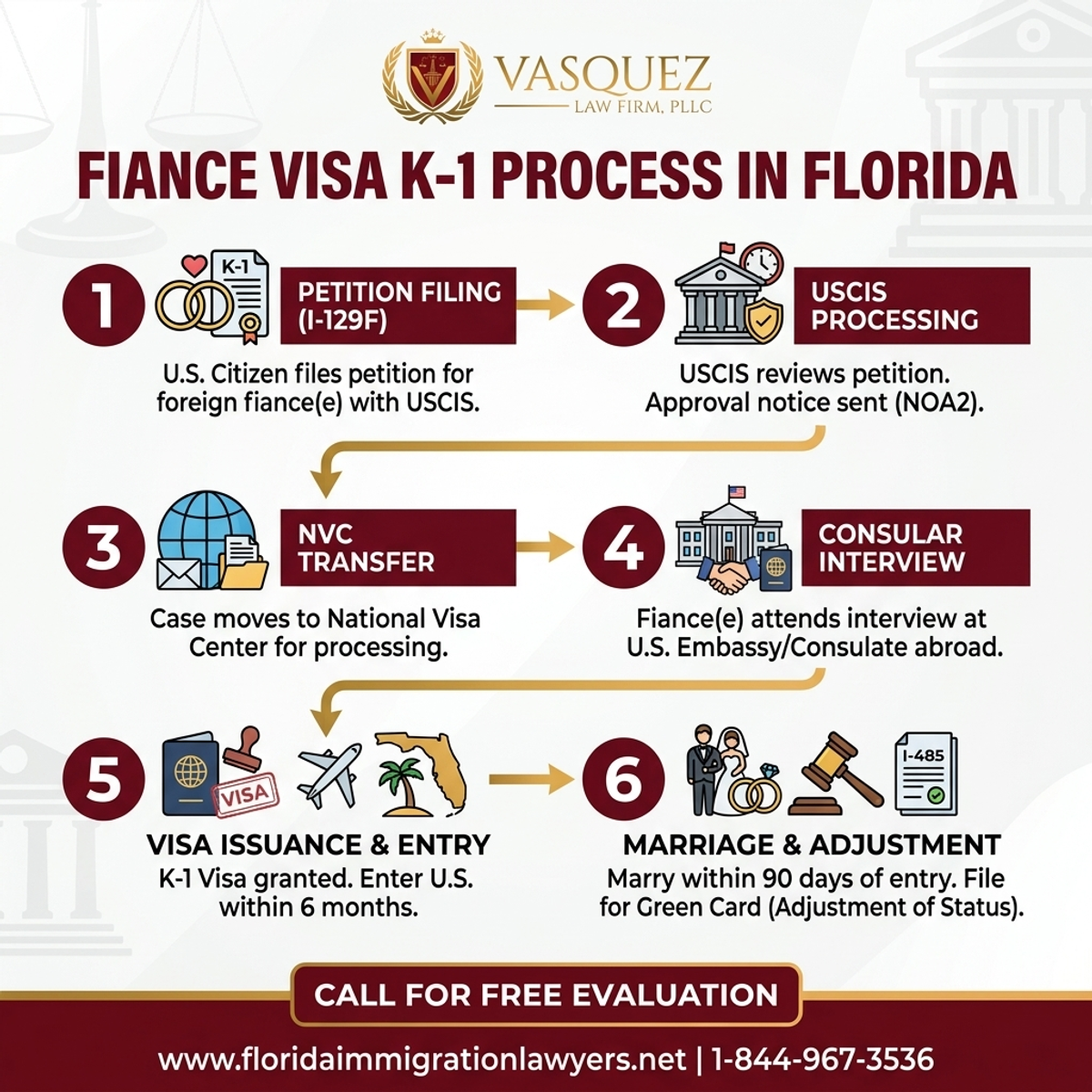
The K-1 visa process involves several stages, beginning with the U.S. citizen filing a petition and culminating in the foreign fiance's entry into the United States. Each step requires meticulous attention to detail and adherence to specific guidelines.
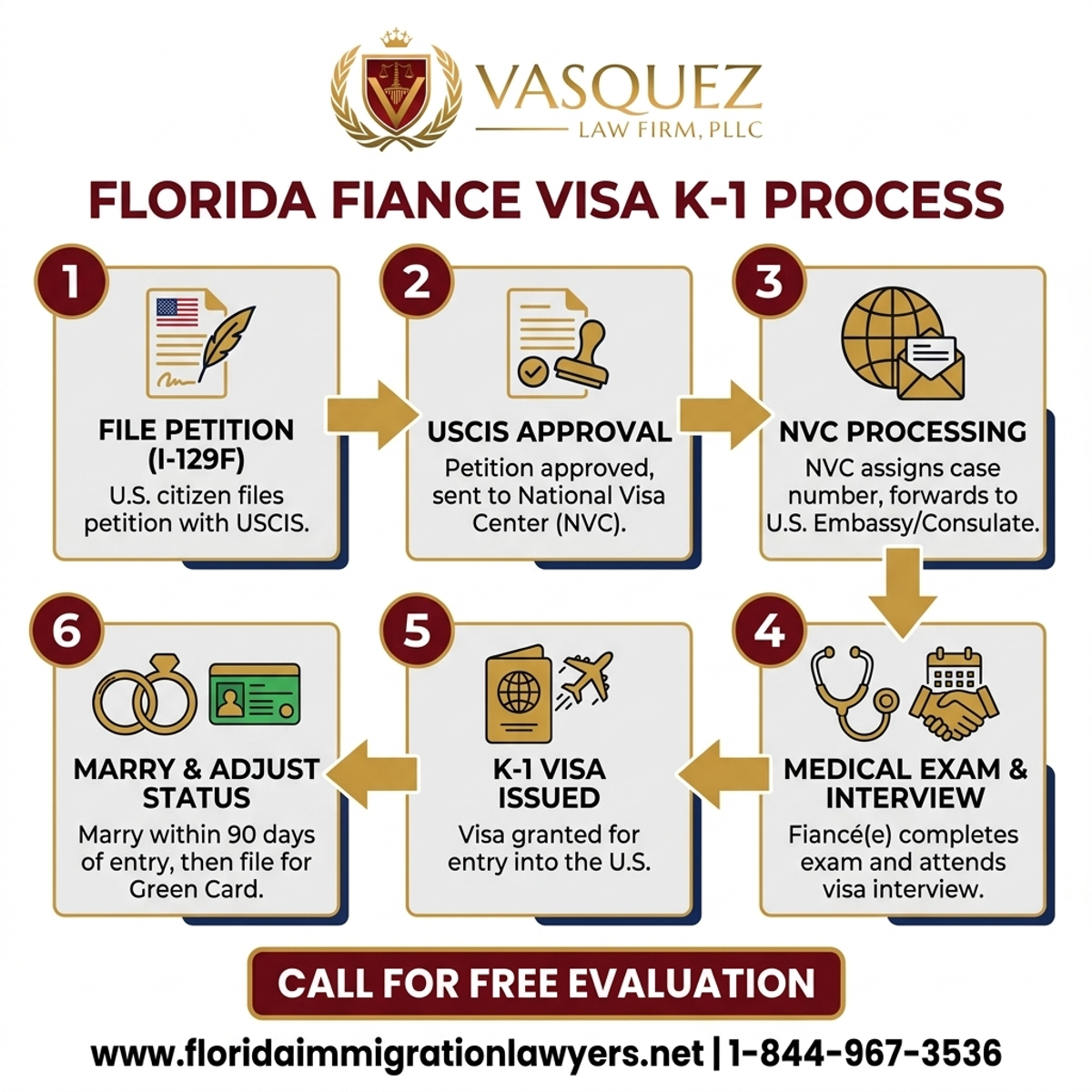
- File Form I-129F, Petition for Alien Fiance(e): The U.S. citizen petitioner initiates the process by filing Form I-129F with USCIS. This petition establishes the bona fide nature of the relationship and the intent to marry. Supporting documents, such as proof of U.S. citizenship, evidence of the relationship, and proof of meeting in person, must be included.
- USCIS Processing and Approval: USCIS reviews the I-129F petition. If approved, USCIS sends an approval notice (Form I-797) and forwards the petition to the National Visa Center (NVC).
- NVC Forwarding to Embassy/Consulate: The NVC assigns a case number and then forwards the approved petition to the U.S. Embassy or Consulate in the foreign fiance(e)'s country of residence.
- DS-160 Online Nonimmigrant Visa Application: The foreign fiance(e) then completes the online DS-160 application form, pays the visa fee, and schedules an interview at the U.S. Embassy or Consulate.
- Medical Examination: Before the interview, the foreign fiance(e) must undergo a medical examination by an authorized panel physician. This examination checks for certain communicable diseases and other health-related grounds of inadmissibility.
- K-1 Visa Interview: The foreign fiance(e) attends an interview at the U.S. Embassy or Consulate. The consular officer will ask questions about the relationship, intent to marry, and general background to determine eligibility and ensure the relationship is genuine.
- Visa Approval and Entry to U.S.: If the interview is successful, the K-1 visa is issued. The foreign fiance(e) can then travel to the U.S. and must marry the U.S. citizen petitioner within 90 days of entry.
Step-by-Step Process — Fiance Visa K-1 Process in Florida | FL Immigration Lawyers
Throughout this intricate process, having experienced legal counsel can prevent common pitfalls and ensure all documentation is correctly prepared and submitted.
Required Documents for Your K-1 Visa Application
The success of your K-1 visa application heavily relies on providing a comprehensive set of documents. Missing or incorrect documentation is a leading cause of delays and denials.
- Proof of U.S. Citizenship: Birth certificate, passport, or naturalization certificate of the petitioner.
- Proof of Identity: Passports for both the petitioner and beneficiary.
- Birth Certificates: For both the petitioner and beneficiary.
- Proof of Termination of Prior Marriages: Divorce decrees, annulment papers, or death certificates, if applicable, for both parties.
- Evidence of Bona Fide Relationship: Photos together, communication records (emails, text messages, call logs, social media interactions), travel itineraries, joint bank statements (if any), affidavits from friends/family.
- Form I-134, Affidavit of Support: Along with supporting financial documents such as tax returns, W-2s, pay stubs, and bank statements, to demonstrate the petitioner's ability to support the beneficiary.
- Police Certificates: From all countries where the beneficiary has lived for more than six months since the age of 16.
- Medical Examination Results: From an authorized panel physician.
- DS-160 Confirmation Page.
- Photographs: Passport-style photos for both the petitioner and beneficiary.
Our attorneys will help you compile and organize these documents, ensuring your application is complete and compelling.
The K-1 Visa Interview Process
The visa interview is a critical stage where the consular officer assesses the legitimacy of your relationship and your eligibility for the K-1 visa. It's essential to be well-prepared.
During the interview, the consular officer will ask questions about your relationship, how you met, your future plans, and your general background. They are looking for consistency in your story and genuine intent to marry. Be honest, straightforward, and provide clear answers. It's advisable to review your petition and supporting documents beforehand to ensure your answers align with the information provided. While the U.S. citizen petitioner does not attend this interview, their involvement and the consistency of information are paramount. Being calm and confident can significantly impact the outcome.
Key Statistics — Fiance Visa K-1 Process in Florida | FL Immigration Lawyers
After K-1 Visa Approval: Entering the U.S.
Once the K-1 visa is approved, the foreign fiance(e) will receive their visa packet. They can then travel to the United States. Upon arrival at a U.S. port of entry, a Customs and Border Protection (CBP) officer will inspect their documents and officially admit them into the country. It is crucial to remember that the K-1 visa is valid for a limited period, and the marriage to the U.S. citizen petitioner must occur within 90 days of entry. Failure to marry within this timeframe will result in the foreign fiance(e) falling out of status, making them subject to removal from the U.S. and potentially facing future immigration bars. After marriage, the next step is to apply for Adjustment of Status to obtain a Green Card.
Adjusting Status After K-1 Entry: The Green Card Process
After your K-1 fiance has entered the U.S. and you have legally married within the 90-day window, the next crucial step is for your now-spouse to apply for Adjustment of Status (AOS) to become a Lawful Permanent Resident (Green Card holder). This process converts their non-immigrant status to immigrant status. This is not an automatic process and requires a new application to USCIS.
The primary form for Adjustment of Status is Form I-485, Application to Register Permanent Residence or Adjust Status. Along with this, you will typically need to file several other forms:
- Form I-864, Affidavit of Support: This is a legally binding contract where the U.S. citizen spouse (petitioner) agrees to financially support the immigrant spouse. This is more comprehensive than the I-134 filed for the K-1 visa.
- Form I-765, Application for Employment Authorization: Allows the immigrant spouse to work legally while the AOS application is pending.
- Form I-131, Application for Travel Document: Allows the immigrant spouse to travel outside the U.S. while the AOS application is pending without abandoning their application.
- Form I-130, Petition for Alien Relative: Although you previously filed an I-129F, USCIS often requires an I-130 to be filed concurrently with the I-485 for K-1 adjustees, or to confirm the marriage.
Supporting documents will include marriage certificates, birth certificates, medical examination results (if not already submitted or if expired), and proof of the ongoing bona fide marriage. After filing, USCIS will typically schedule a biometrics appointment and then an interview for the Adjustment of Status. Both spouses usually attend this interview, where an officer will again verify the legitimacy of the marriage. If approved, the immigrant spouse will receive a conditional Green Card, valid for two years. Our firm specializes in guiding couples through this final, critical phase of their immigration journey, ensuring all forms are correctly filed and preparing you thoroughly for the interview.
Common Reasons for K-1 Visa Delays or Denials and How to Avoid Them
While the K-1 visa offers a direct path to marriage in the U.S., the process is not without its challenges. Understanding common pitfalls can help you avoid unnecessary delays or even a denial of your petition.
- Incomplete or Incorrect Documentation: This is perhaps the most frequent reason for delays. Missing forms, lack of required evidence, or errors in information can lead to Requests for Evidence (RFEs) or outright denials. Ensure every field is filled, and all supporting documents are included and properly translated if necessary.
- Insufficient Proof of Bona Fide Relationship: USCIS and consular officers are vigilant about detecting fraudulent marriages. If your evidence of a genuine relationship is weak or inconsistent, your petition may be questioned. Provide a wide range of evidence, including photos, communication logs, travel records, and affidavits.
- Failure to Meet Financial Requirements: The U.S. citizen petitioner must demonstrate the ability to support their fiance(e) financially. If the I-134 Affidavit of Support is not sufficient or lacks proper documentation, it can lead to issues.
- Criminal History or Prior Immigration Violations: Any criminal record for either party, or previous immigration violations (such as overstaying a visa or misrepresentation), can lead to inadmissibility. These issues often require waivers and complex legal arguments. In severe cases, this could even lead to deportation proceedings.
- Inconsistencies During the Interview: Discrepancies between your application and your interview answers can raise red flags. Be honest and consistent.
- Failure to Meet the In-Person Meeting Requirement: Unless a waiver is granted due to extreme hardship or cultural reasons, you must have met your fiance(e) in person within the last two years.
Proactive preparation and meticulous attention to detail are your best defenses against these issues. Consulting with an experienced immigration attorney can help identify and mitigate potential problems before they arise, significantly increasing your chances of a smooth approval.
The K-2 Visa: Bringing Children on a Fiance Visa
For U.S. citizens petitioning for a K-1 visa for their fiance(e), a common question arises regarding children from prior relationships. Fortunately, the K-2 visa allows the unmarried children (under 21 years of age) of a K-1 visa applicant to accompany or follow to join their parent in the U.S. This provides a pathway for families to immigrate together, ensuring that children are not left behind in the process.
To qualify for a K-2 visa, the child must be listed on the Form I-129F petition filed by the U.S. citizen. The child must be the biological child or legally adopted child of the K-1 visa applicant. The K-2 visa application process generally mirrors that of the K-1, requiring the child to complete their own DS-160 application, undergo a medical examination, and attend an interview at the U.S. Embassy or Consulate. It's important to note that the K-2 visa is dependent on the K-1 visa. If the K-1 visa is denied, the K-2 visa will also be denied. Similarly, if the K-1 visa holder does not marry the U.S. citizen petitioner within 90 days of entry, the K-2 visa holder will also fall out of status.
Once in the U.S. and after the K-1 parent marries the U.S. citizen, the K-2 child can also apply for Adjustment of Status to become a Lawful Permanent Resident. This process involves filing Form I-485 for each child, along with supporting documents. Our legal team can help ensure that all family members are properly included in the K-1 petition and guide you through the K-2 visa and subsequent adjustment of status process for your children, facilitating a complete family reunification.
When to Seek Legal Counsel for Your K-1 Visa
While some individuals attempt to navigate the K-1 visa process independently, the complexities of immigration law often necessitate professional legal assistance. Our firm recommends seeking legal counsel in various situations to safeguard your application and ensure the best possible outcome.
- Complex Relationship History: If either party has been married multiple times, has a significant age difference, or has a relationship that might appear unconventional to immigration officials.
- Criminal History: Any past arrests or convictions for either the petitioner or beneficiary can trigger inadmissibility issues, requiring waivers or specialized legal strategies. This is particularly crucial if there's any risk of deportation.
- Previous Visa Denials or Immigration Violations: If either party has had prior visa denials, overstayed a visa, or has any history of immigration violations.
- Financial Challenges: If the petitioner's income is borderline or requires a co-sponsor, an attorney can help ensure the Affidavit of Support is robust.
- Lack of Strong Evidence of Relationship: If you have limited physical evidence of your relationship due to distance, cultural norms, or other factors.
- Concerns about Interview Preparation: An attorney can conduct mock interviews and prepare you for the types of questions you might face.
- Seeking Other Immigration Options: If the K-1 visa isn't the right fit, we can explore other avenues, including asylum or family-based visas.
Our experienced attorneys provide personalized guidance, helping you anticipate challenges and present the strongest possible case.
Why Choose Florida Immigration Lawyers for Your K-1 Visa?
At Florida Immigration Lawyers, we pride ourselves on providing compassionate, effective, and results-driven legal representation for individuals and families navigating the K-1 Fiance Visa process. Our team of seasoned immigration attorneys possesses a deep understanding of U.S. immigration law and the specific requirements for K-1 visas in Florida. We offer:
- Expert Guidance: From the initial petition to the Adjustment of Status, we provide clear, step-by-step guidance.
- Thorough Preparation: We meticulously prepare all forms and supporting documents, ensuring accuracy and completeness to minimize delays.
- Interview Readiness: We prepare both the petitioner and beneficiary for their respective interviews, helping them feel confident and ready to answer questions.
- Personalized Attention: We understand that every relationship and case is unique. We offer tailored strategies to address your specific circumstances and concerns.
- Accessibility: Our team is always available to answer your questions and provide updates on your case.
Let us put our expertise to work for you, helping you overcome legal hurdles and achieve your dream of starting a new life together in Florida. Our commitment is to your success and peace of mind.
Frequently Asked Questions About the K-1 Fiance Visa
Here are some common questions we receive regarding the K-1 Fiance Visa process:
- Q: How long does the K-1 visa process typically take? A: The processing times can vary significantly depending on USCIS caseloads and the specific embassy/consulate. It can range from 6 months to over a year.
- Q: Can my fiance(e) work in the U.S. on a K-1 visa? A: No, not immediately. Your fiance(e) must apply for work authorization (EAD) after arriving in the U.S. and filing for Adjustment of Status.
- Q: What if we don't marry within 90 days? A: If you do not marry within 90 days, your fiance(e) will fall out of status and must leave the U.S. or face severe immigration consequences.
- Q: Can I travel outside the U.S. while my K-1 petition is pending? A: Yes, as the U.S. citizen petitioner, you can travel. The foreign fiance(e) should generally not travel to the U.S. on other visas (like a tourist visa) once the K-1 petition is filed, as it can complicate the process.
- Q: What if my fiance(e) has children? A: Children under 21 who are unmarried can apply for a K-2 visa to accompany or follow to join their parent.
- Q: Do we need to have a wedding ceremony or just get legally married? A: You must be legally married according to Florida state law within the 90-day period. A large ceremony is not required for immigration purposes, but proof of legal marriage is.
- Q: What happens if the K-1 visa is denied? A: If the K-1 visa is denied, you may be able to appeal the decision or refile the petition, depending on the reason for denial. Consulting an attorney is crucial in this situation.
- Q: Can I apply for a K-1 visa if I'm a Green Card holder? A: No, only U.S. citizens can petition for a K-1 fiance visa. Green Card holders must first become U.S. citizens to file this petition, or they can petition for a spouse (not fiance) through the family-based immigration process.
Contact Florida Immigration Lawyers Today
Bringing your fiance to the U.S. on a K-1 visa is a journey of love and commitment, but it requires careful legal navigation. Don't leave your future to chance. Our experienced immigration attorneys are here to provide the expert legal support you need to make your dream a reality. We offer comprehensive services, from initial petition filing to the final adjustment of status. Contact us today for a free consultation to discuss your specific situation and learn how we can help you unite with your loved one in Florida. Call us at (844) to get started on your path to family reunification.
Sources and References
- U.S. Citizenship and Immigration Services (USCIS)
- Executive Office for Immigration Review (EOIR)
- U.S. Department of State - Bureau of Consular Affairs
- Immigration and Nationality Act (INA), 8 U.S.C. Chapter 12
Do Not Navigate This Process Alone
Our experienced immigration attorneys are ready to fight for you. Get a free, confidential consultation today.
Se Habla Español
Frequently Asked Questions
Florida Immigration Lawyers
Immigration Attorney | Founder, Vasquez Law Firm
U.S. Air Force veteran and immigration attorney with thousands of cases resolved. J.D., NCCU School of Law. AILA member. Admitted to the 4th, 5th, and 11th Circuit Courts.
Available 24/7 - Free Evaluations
Related Legal Services
Our Florida immigration attorneys can help you with deportation defense, citizenship and naturalization and family immigration services. Call today at 1-844-967-3536 for a free consultation.
Related Links
Related Topics
Free Legal Consultation
Discuss your case with our experienced attorneys. We're available 24/7.
Se Habla Español - Estamos aquí para ayudarle.