Immigration Court in Florida: Your Guide to Removal Proceedings
Navigating immigration court proceedings in Florida can be a daunting and complex experience. This comprehensive guide from Florida Immigration Lawyers breaks down the intricacies of removal proceedings, explains the role of an immigration judge, and outlines critical steps for individuals facing deportation. We provide essential information, from initial notices to appeals, offering clarity and practical advice. Learn how to protect your rights and understand the process, especially in areas like Fort Lauderdale. If you or a loved one are in this situation, understanding your legal options is paramount to achieving a favorable outcome. Our firm is dedicated to providing robust defense strategies and ensuring you are not alone in this journey. Contact us for a free consultation.
Navigating immigration court proceedings in Florida involves complex legal steps initiated by a Notice to Appear (NTA) from the Department of Homeland Security. These removal proceedings determine if an individual can legally remain in the U.S. An immigration judge, under the Executive Office for Immigration Review (EOIR), presides over these cases, which can lead to deportation if not properly defended. Understanding your rights and the specific procedures at Florida courts, such as those in Miami or Orlando, is crucial for a favorable outcome. Legal representation is highly recommended to present a strong case and explore all available relief options.
- An NTA formally begins removal proceedings Florida.
- Cases are heard by an immigration judge within the EOIR Florida system.
- Individuals have rights, including the right to legal counsel.
- Various forms of relief from removal may be available.
- Legal representation significantly improves defense strategies.
Immigration Court in Florida: Your Guide to Removal Proceedings
Receiving a Notice to Appear (NTA) from the Department of Homeland Security can be an incredibly daunting and anxiety-inducing experience. For many individuals and families in Florida, this document signals the beginning of immigration court proceedings, a complex legal journey that could determine their future in the United States. Whether you are in Fort Lauderdale, Miami, Orlando, or any other part of the Sunshine State, understanding the intricacies of these proceedings is paramount.
This comprehensive guide from Florida Immigration Lawyers aims to demystify the process of removal proceedings Florida. We will walk you through the roles of the immigration judge and the Executive Office for Immigration Review (EOIR), detail the necessary steps, highlight essential documents, and discuss potential relief options. Our goal is to provide clarity and empower you with the knowledge needed to face these challenges effectively. Do not navigate this complex legal landscape alone. Call Florida Immigration Lawyers at 1-844-YO-PELEO for a free consultation and let our experienced team assist you.
What are Immigration Court Proceedings in Florida?
Immigration court proceedings are formal legal actions initiated by the U.S. government to determine whether a non-citizen should be removed or deported from the country. These proceedings fall under the jurisdiction of the Executive Office for Immigration Review (EOIR), a component of the U.S. Department of Justice, distinct from U.S. Citizenship and Immigration Services (USCIS). In Florida, individuals facing these proceedings will typically appear before an immigration judge at courts located in cities like Miami or Orlando. The primary purpose of these hearings is to assess an individual's admissibility to the U.S. or their removability under U.S. immigration law, specifically the Immigration and Nationality Act (INA).
The process begins when an individual is served with a Notice to Appear (NTA), which outlines the allegations regarding their immigration status and the legal grounds for their potential removal. This document is a critical first step, and understanding its contents is vital. Unlike criminal courts, immigration courts are administrative bodies, but the decisions made by an immigration judge have profound, life-altering consequences. Therefore, seeking qualified legal counsel specializing in deportation defense Florida is essential from the outset. Our firm is deeply familiar with the nuances of these proceedings across Florida's courts, including those serving the Fort Lauderdale area.
Navigating Removal Proceedings in Florida: A Step-by-Step Guide
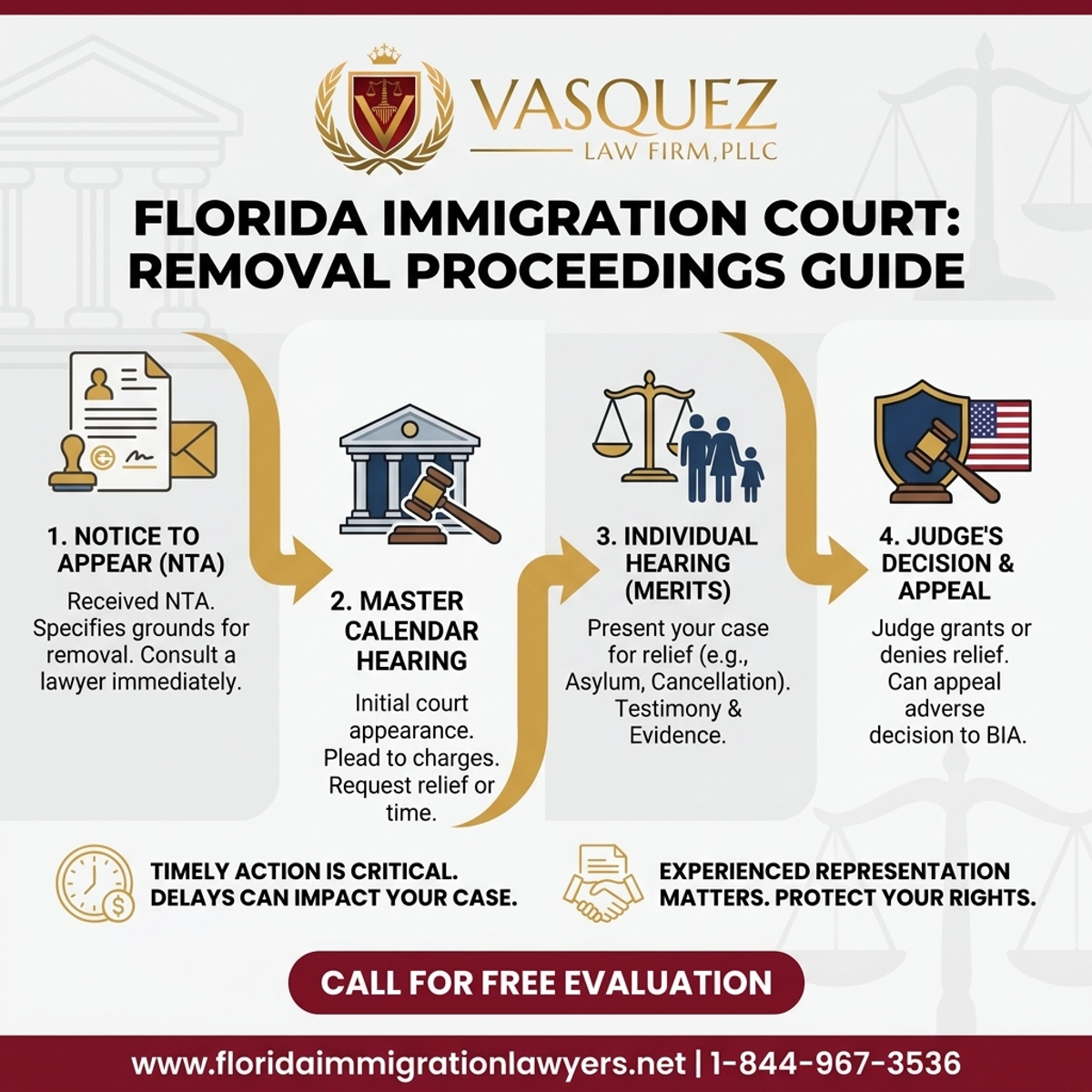
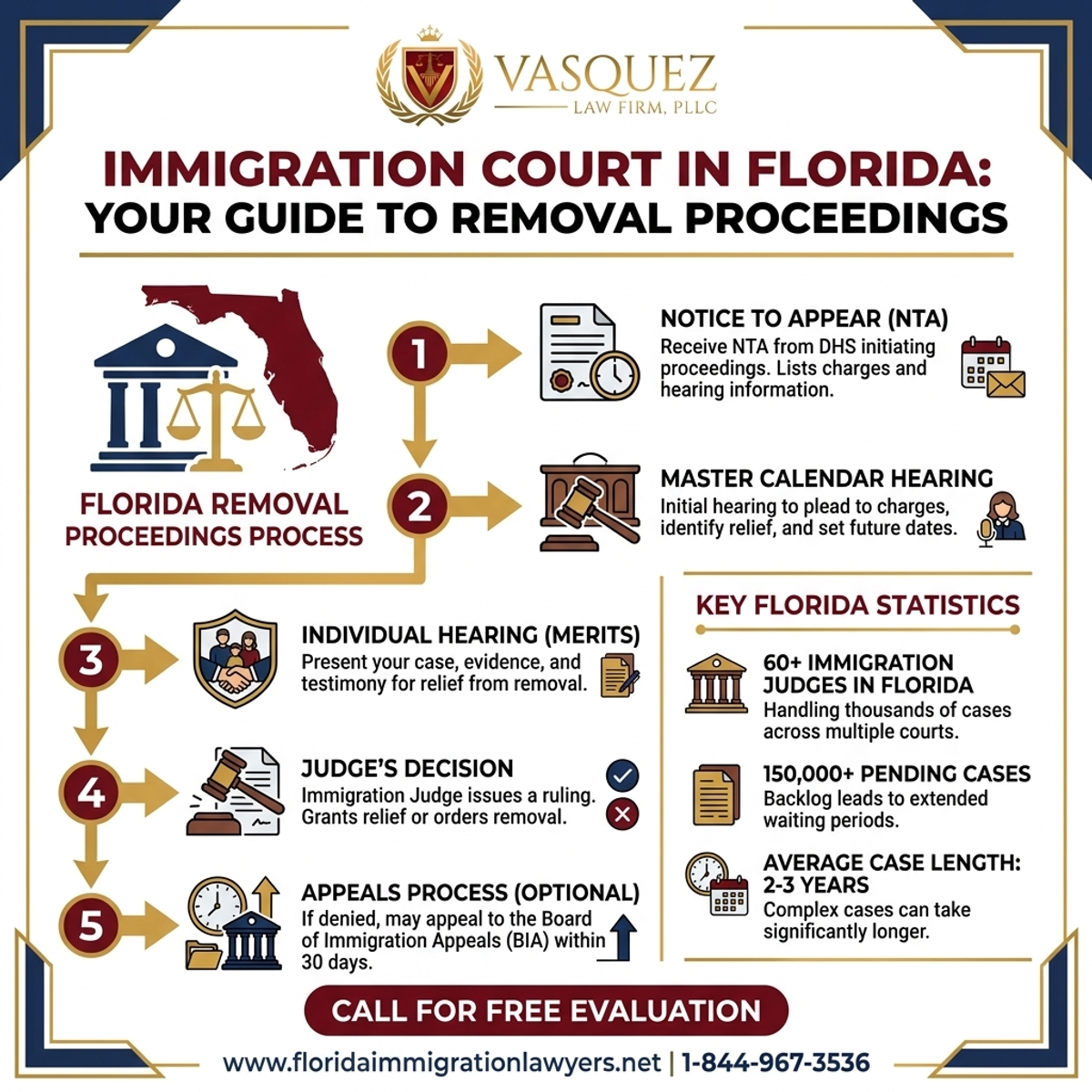
Understanding the stages of removal proceedings Florida can help alleviate some of the stress involved. While each case is unique, the general flow follows a predictable path. Being prepared for each step is crucial, and having a knowledgeable attorney by your side can make a significant difference in the outcome.
- Receipt of the Notice to Appear (NTA): This official document marks the initiation of your case in immigration court. It details the government's allegations about why you are removable and specifies the date and location of your first hearing. It is imperative not to miss this initial court date, as doing so can result in an in absentia removal order.
- Master Calendar Hearing (MCH): This is your initial appearance before an immigration judge. During the MCH, the judge will confirm your identity, ensure you understand the allegations in the NTA, and ask you to plead to those allegations. You will also be asked to designate a country for removal if your case is unsuccessful. Importantly, you or your attorney will inform the court of any applications for relief from removal you intend to file, and the judge will set deadlines for filing documents and schedule future hearings.
- Individual Hearing (Merits Hearing): This is the main trial where you present your case for relief from removal. You and your witnesses will testify, and your attorney will present evidence to support your application for relief. The Department of Homeland Security (DHS) attorney will also present their case. This hearing can be lengthy and requires thorough preparation, including gathering all necessary documentation and preparing for cross-examination.
- Decision by the Immigration Judge: After all evidence has been presented and arguments made, the immigration judge will issue a decision. This decision may be delivered orally at the end of the individual hearing or in writing at a later date. The judge will either order your removal or grant your requested form of relief, allowing you to remain in the U.S.
- Appeals Process: If either you or the DHS attorney disagrees with the immigration judge's decision, you have the right to appeal to the Board of Immigration Appeals (BIA). The BIA is the highest administrative body for interpreting and applying immigration laws. Further appeals may be possible to a U.S. Circuit Court of Appeals. The appeals process is highly technical and requires strict adherence to deadlines and legal procedures, making legal representation indispensable.
Essential Documents for Your Immigration Court Case
Successful navigation of immigration court proceedings Florida heavily relies on presenting a well-organized and comprehensive set of documents. The specific documents required will vary based on the nature of your case and the type of relief you are seeking, but a general checklist can help you prepare. Gathering these materials early can save significant time and stress during your removal proceedings.
- Notice to Appear (NTA): Your original NTA is the foundational document for your case.
- Proof of Identity and Nationality: Birth certificates, passports, national ID cards.
- Marriage Certificates and Divorce Decrees: If your case involves family-based relief or if marital status is relevant.
- Birth Certificates of Children: Especially if they are U.S. citizens or LPRs.
- Proof of Residence: Utility bills, leases, mortgage statements demonstrating continuous presence in Florida or elsewhere.
- Financial Documents: Tax returns, bank statements, employment letters, pay stubs, demonstrating financial stability or hardship.
- Police Records and Court Dispositions: For any arrests or convictions, even if expunged. Full disclosure is critical.
- Affidavits: Sworn statements from family members, friends, employers, or community leaders attesting to your character, hardships, or other relevant facts.
- Medical Records: If you are seeking asylum based on medical conditions or if your health is a factor in your relief application.
- Expert Witness Reports: Psychological evaluations, country condition reports, or other expert testimony relevant to your case.
- Proof of Hardship: Documents demonstrating extreme and unusual hardship to a qualifying relative if you are seeking Cancellation of Removal.
- Application for Relief: The specific forms you are filing (e.g., Form I-589 for Asylum, Form EOIR-42B for Non-LPR Cancellation of Removal).
Step-by-Step Process — Immigration Court in Florida: Your Guide to Removal Proceedings
Organizing these documents thoroughly and ensuring their accuracy is a critical step in building a strong deportation defense Florida. Your attorney at Florida Immigration Lawyers will help you identify exactly which documents are needed for your specific situation and ensure they are presented correctly to the immigration judge.
Understanding Timelines, Costs, and Processing Expectations
The journey through immigration court proceedings in Florida is rarely quick or inexpensive. Understanding the typical timelines, potential costs, and processing expectations is crucial for managing your expectations and preparing effectively. Backlogs within the EOIR Florida system mean that cases can often take years to resolve, creating prolonged periods of uncertainty for individuals and families.
Timelines and Processing Expectations
The duration of removal proceedings can vary significantly based on the complexity of the case, the specific immigration court (e.g., Miami or Orlando), the immigration judge's docket, and current government policies. A Master Calendar Hearing might be scheduled a few months after receiving an NTA, but individual hearings can be set years into the future. Appeals to the BIA can add another year or more, and federal court appeals even longer. Factors like changes in immigration law, policy priorities, and court staffing can also impact processing times. For up-to-date information on case status, individuals can sometimes check the Executive Office for Immigration Review (EOIR) website.
Cost Factors and Legal Fees
While most applications filed directly with the immigration court in removal proceedings do not have government filing fees (unlike those filed with USCIS), the primary cost factor will be legal fees. Hiring an experienced immigration attorney is a significant investment, but it is often the most critical one you can make. Legal fees can vary depending on the complexity of your case, the amount of time required, and the attorney's experience. Other potential costs might include fees for obtaining documents, translation services, expert witness fees, and travel expenses to court hearings. Florida Immigration Lawyers offers transparent fee structures and can discuss payment options during your free consultation. Investing in skilled legal counsel for your deportation defense Florida can prevent far greater financial and personal costs in the long run.
The Role of the Immigration Judge and EOIR in Florida
The immigration judge is the central figure in any immigration court proceeding. These judges are administrative judges appointed by the Attorney General, operating under the Executive Office for Immigration Review (EOIR). Their primary responsibility is to conduct hearings fairly, apply U.S. immigration laws, and make decisions on whether a non-citizen is removable and whether they qualify for any forms of relief from removal. In Florida, judges preside over cases in courts like the Miami Immigration Court and the Orlando Immigration Court, serving residents from areas including Fort Lauderdale and beyond.
The EOIR Florida system oversees these courts, ensuring the orderly administration of justice in immigration matters. An immigration judge has significant authority, including the power to administer oaths, receive evidence, interrogate witnesses, rule on motions, and issue decisions. Their role is to be an impartial arbiter, weighing the evidence presented by both the respondent (the non-citizen) and the Department of Homeland Security (DHS) attorney. Understanding the judge's authority and the procedures of the court, as outlined in 8 CFR, is crucial. A skilled attorney understands the particularities of individual judges and court procedures, which can be invaluable in preparing and presenting your case effectively. The decisions of an immigration judge Fort Lauderdale or any other Florida court are legally binding unless successfully appealed to the BIA.
Key Statistics — Immigration Court in Florida: Your Guide to Removal Proceedings
Defenses Against Removal and Relief Options
Facing removal proceedings in Florida does not automatically mean deportation. There are various legal defenses and forms of relief available that, if successfully pursued, can allow you to remain in the United States. Identifying and applying for the correct form of relief is a complex task that requires the expertise of an experienced immigration attorney. Our firm focuses on tailoring robust deportation defense Florida strategies to your unique circumstances.
Some common forms of relief and defenses include:
- Asylum (INA § 208): For individuals who fear persecution in their home country based on race, religion, nationality, political opinion, or membership in a particular social group. Recent studies, like one highlighted by WPEC, show that asylum-seeking workers significantly contribute to Florida's economy, underscoring the importance of this protection.
- Withholding of Removal: Similar to asylum, but with a higher burden of proof and fewer benefits.
- Relief under the Convention Against Torture (CAT): For individuals who fear torture in their home country.
- Cancellation of Removal: Available in two forms: for certain lawful permanent residents (LPRs) who have lived in the U.S. for many years, and for certain non-LPRs who have been in the U.S. for at least 10 years, have good moral character, and can show extreme and unusual hardship to a qualifying U.S. citizen or LPR spouse, parent, or child.
- Adjustment of Status: If you are eligible for a green card through a family petition or employment, you may be able to adjust your status while in removal proceedings, provided certain conditions are met.
- Waivers of Inadmissibility/Removability: Various waivers (e.g., I-601, I-212) exist to overcome certain grounds of inadmissibility or deportability.
- Voluntary Departure: Allows an individual to leave the U.S. voluntarily at their own expense, often without the negative consequences of a formal removal order.
Each of these options has specific eligibility requirements and stringent deadlines. An attorney from Florida Immigration Lawyers can assess your case, determine your eligibility for various forms of relief, and prepare a compelling argument before the immigration judge.
Common Mistakes to Avoid in Immigration Court Proceedings
Making even a small error during immigration court proceedings can have severe consequences, potentially leading to a removal order. Being aware of these common pitfalls can help you protect your rights and improve your chances of a favorable outcome in removal proceedings Florida.
- Missing Court Dates: Failing to appear for a Master Calendar or Individual Hearing is perhaps the most serious mistake. An immigration judge can issue an in absentia removal order, often without the possibility of reopening the case.
- Not Understanding the Notice to Appear (NTA): Many individuals fail to fully grasp the allegations against them or the charges of removability. This lack of understanding can lead to incorrect pleas or missed opportunities for defense.
- Providing False Information: Lying or misrepresenting facts to an immigration officer or an immigration judge can lead to severe penalties, including a permanent bar from future immigration benefits. Honesty is always the best policy.
- Failing to Gather All Necessary Documents: Incomplete documentation can weaken your case significantly. All required evidence must be submitted by the deadlines set by the court.
- Not Seeking Legal Counsel: Representing yourself in immigration court is extremely difficult. The law is complex, and a non-citizen is at a distinct disadvantage against a trained DHS attorney.
- Failing to Disclose Criminal History: Even minor arrests or convictions, including those that were expunged or occurred many years ago, must be disclosed. Immigration law has different rules regarding criminal offenses than state or federal criminal law.
- Missing Filing Deadlines: Strict deadlines apply to all applications for relief and submissions of evidence. Missing a deadline can result in the denial of your application or even the dismissal of your case.
- Not Preparing for Testimony: Your testimony before an immigration judge is crucial. Failing to prepare for questions, both from your attorney and the DHS attorney, can undermine your credibility.
- Leaving the U.S. Without Permission: If you are in removal proceedings, leaving the country without obtaining proper authorization can be considered self-deportation and may trigger a permanent bar to re-entry.
- Assuming All Cases Are the Same: Immigration law is highly individualized. What worked for a friend or family member may not apply to your unique situation. Generic advice can be detrimental.
- Ignoring Changes in Law or Policy: Immigration law is dynamic. New policies or court decisions can affect your case. An experienced attorney stays current with these changes.
When to Call a Lawyer for Immigration Court Proceedings in Florida
The moment you receive a Notice to Appear (NTA) is the moment you should contact an experienced immigration attorney. However, there are many other situations where legal counsel becomes indispensable during immigration court proceedings in Florida. Navigating this system without professional guidance is like trying to cross a minefield blindfolded. An attorney from Florida Immigration Lawyers can provide crucial assistance from the very beginning.
Consider calling us immediately if:
- You have received a Notice to Appear (NTA) for removal proceedings Florida.
- You are detained by ICE and facing deportation.
- You have a criminal record, even a minor one, that could impact your immigration status.
- You believe you qualify for asylum, withholding of removal, or other forms of relief.
- You have been denied an immigration benefit by USCIS and are now in court.
- You need to appeal a decision made by an immigration judge.
- Your case involves complex legal issues or has been pending for a long time.
- You are seeking to re-open a previously closed removal case.
- You are uncertain about any aspect of your immigration status or court process.
Our attorneys at Florida Immigration Lawyers are adept at handling complex deportation defense Florida cases, including those involving criminal grounds of removability, asylum claims, and family-based petitions. We understand the local court procedures in Miami, Orlando, and other Florida jurisdictions, including the specific practices of various immigration judges. Do not delay; your future in the U.S. depends on proactive and informed legal action.
About Florida Immigration Lawyers
Florida Immigration Lawyers is an immigration law firm dedicated to serving individuals and families across the entire state of Florida. With a deep understanding of U.S. immigration law and a commitment to our clients, we provide comprehensive legal representation for a wide range of immigration matters. Our experienced attorneys focus on deportation defense, asylum, family-based immigration, business immigration, and citizenship processes.
We pride ourselves on offering personalized, compassionate, and aggressive advocacy. We understand the profound impact immigration issues have on lives, and we work tirelessly to achieve the strongest possible outcomes for our clients. From navigating complex immigration court proceedings in Florida to assisting with visa applications, our team is equipped to handle your unique needs. We offer free consultations, are available 24/7, and are ready to stand by your side. Call us today at 1-844-YO-PELEO or visit our website at Vasquez Law Firm to learn how we can help you.
Sources and References
- U.S. Citizenship and Immigration Services (USCIS)
- Executive Office for Immigration Review (EOIR)
- 8 U.S.C. Chapter 12 - Immigration and Nationality Act (INA)
- INA § 208 - Asylum
- INA § 240 - Removal Proceedings
- 8 CFR (Code of Federal Regulations) - Executive Office for Immigration Review
Related services: asylum and refugee protection, immigration waivers, humanitarian protection programs, DACA renewal and applications.
This article provides general legal information and is not intended as legal advice. Every case is unique, and outcomes depend on specific facts and circumstances. Contact an attorney for advice about your particular situation.
If you or a loved one are facing immigration court proceedings Florida, do not delay in seeking legal assistance. The team at Florida Immigration Lawyers is here to protect your rights and guide you through every step. Call us for a free consultation at 1-844-YO-PELEO. Se Habla Español - Estamos aqui para ayudarle.
If you need legal assistance, learn more about Florida deportation defense legal team, or call us at 1-844-YO-PELEO for a free consultation.
Do Not Navigate This Process Alone
Our experienced immigration attorneys are ready to fight for you. Get a free, confidential case review today.
Se Habla Español
Or leave your details and we’ll call you:
Free Evaluation in 24 Hours
Or talk to us right now

AI voice assistant — available 24/7
FreeFrequently Asked Questions

William J. Vásquez
Founding Attorney · Vasquez Law Firm
U.S. Air Force veteran and immigration attorney with years of hands-on U.S. immigration experience. J.D., NCCU School of Law. AILA member. Admitted to the 4th, 5th, and 11th Circuit Courts.
Available 24/7 - Free Evaluations
Reviewed for legal accuracy by William J. Vásquez
Licensed in North Carolina; U.S. immigration is federal practice.
Related Legal Services
Our Florida immigration attorneys can help you with deportation defense, family immigration services and immigration lawyer cost in Florida. Call today at 1-844-YO-PELEO for a free case review.
Related Links
Related Topics
Free Legal Case Review
Discuss your case with our experienced attorneys. We're available 24/7.
Se Habla Español - Estamos aquí para ayudarle.
Related Articles
EAD Advance Parole Combo Card in Florida: What You Need
An EAD advance parole combo card allows individuals with pending adjustment applications to both work and travel abroad without jeopardizing their green card application. Learn how to apply in Florida, what documents you need, and common mistakes to avoid.
PERM Labor Certification in Florida: A 2026 Guide
Learn all about the PERM labor certification process in Florida, essential for employers sponsoring green card applicants. Understand the steps, document requirements, and common mistakes to avoid in this 2026 guide.
Dual Citizenship Lawyer in Florida: What You Need to Know
For Florida residents, the concept of dual citizenship, or holding two passports, offers a compelling blend of opportunities and challenges. While the U.S. generally permits dual nationality, the path to achieving this status requires a meticulous understanding of both U.S. immigration laws and the citizenship policies of your country of origin. This guide explores the definition of dual citizenship, the detailed step-by-step process for U.S. naturalization, and the significant benefits and potential pitfalls involved. We cover essential documentation, typical timelines, and cost considerations for 2026, providing crucial insights for anyone in Orlando, Miami, or across Florida considering this important legal step. Learn about common mistakes to avoid and understand when to seek professional legal counsel to navigate this complex process successfully. Florida Immigration Lawyers is here to provide expert, bilingual support for your dual citizenship journey.
Immigration Lawyer Orlando Free Consultation in Florida
For individuals and families in Orlando, Florida, navigating the complexities of U.S. immigration law requires expert guidance. An immigration lawyer in Orlando offers crucial support for everything from visa applications and green card processes to naturalization and deportation defense. This comprehensive guide details what a free consultation covers, providing a step-by-step overview of immigration pathways, essential document checklists, and expected timelines in 2026. We also highlight common mistakes to avoid, discuss the critical role of legal counsel in deportation and asylum cases, and explain why choosing a local Orlando immigration attorney is beneficial. Florida Immigration Lawyers is dedicated to serving the diverse community of Orlando with compassionate, effective legal solutions, ensuring you receive personalized advice and robust representation for a successful immigration journey.