Immigration Backlog Solutions in Florida 2026
The immigration backlog in Florida is a pressing concern in 2026, causing significant delays for thousands of individuals and families. This comprehensive guide from Florida Immigration Lawyers explores the root causes of these USCIS delays, from increased application volumes to resource constraints and policy changes, and details their profound impact on immigrants statewide. We outline actionable strategies to mitigate these challenges, including meticulous application preparation, strategic use of expedite requests, and when appropriate, judicial intervention through mandamus actions. Discover typical processing timelines for various immigration forms and understand the associated costs, including USCIS fees and legal expenses. Learn about common mistakes to avoid that could further jeopardize your case and identify specific scenarios where the expertise of an immigration attorney is indispensable. Florida Immigration Lawyers stands ready to provide dedicated legal representation and personalized solutions to help you navigate the complexities of the immigration system in Florida, offering free case reviews and bilingual services across the state. Take the first step towards resolving your immigration backlog challenges by contacting our experienced team today.
The immigration backlog in Florida, mirroring national trends, is a significant challenge in 2026, driven by increased application volumes, staffing shortages at USCIS and EOIR, and complex policy shifts. These delays can lead to prolonged family separation, job insecurity, and status uncertainty for thousands of immigrants in the Sunshine State. Solutions involve proactive case management, strategic use of expedite requests, and, in some instances, judicial intervention like mandamus actions. Consulting an experienced immigration attorney is crucial to navigate these complexities, identify eligible relief, and advocate effectively for your case amidst extensive processing times.
- Backlogs stem from high demand, resource limitations, and policy changes.
- Delays impact family reunification, employment, and status stability.
- Proactive steps, like accurate filing and monitoring, are essential.
- Expedite requests and legal challenges offer potential avenues for relief.
- An immigration lawyer provides critical guidance and advocacy.
Navigating the U.S. immigration system can often feel like an arduous journey through a labyrinth of forms, interviews, and seemingly endless waiting periods. For many individuals and families in Florida, the challenge is compounded by the persistent and growing immigration backlog. As of 2026, these delays are not just statistics; they represent real lives on hold, dreams deferred, and an immense source of stress for those seeking a future in the United States.
Whether you're waiting for a family petition, an employment-based visa, or a citizenship application to be processed, understanding the causes of these delays, their profound impact, and the potential solutions is paramount. This comprehensive guide, crafted by Florida Immigration Lawyers, aims to demystify the complexities of USCIS delays and provide actionable strategies for immigrants across the state, from Orlando to Miami, to navigate these challenging times effectively. We believe that informed applicants are empowered applicants, and knowing your options is the first step toward a successful outcome.
Do not let the complexities of the immigration system overwhelm you. For personalized guidance and a clear path forward, call Florida Immigration Lawyers at 1-844-YO-PELEO for a free case review today. Our dedicated team is ready to assist you.
What Causes the Immigration Backlog in Florida and Nationwide?
The immigration backlog is a multifaceted issue driven by a confluence of factors, including surging application volumes, persistent resource constraints within immigration agencies, and dynamic policy changes. These elements collectively contribute to extensive processing delays for various immigration benefits, affecting applicants across Florida and the entire nation.
Several critical factors contribute to the current immigration backlog. Firstly, there has been a significant increase in the volume of applications across nearly all categories, from family-based petitions (Form I-130) to naturalization applications (Form N-400). This surge in demand often outpaces the processing capacity of the U.S. Citizenship and Immigration Services (USCIS) and the Executive Office for Immigration Review (EOIR), which oversees immigration courts. Secondly, resource limitations, including staffing shortages and outdated technological infrastructure, plague these agencies. Despite efforts to modernize, the sheer scale of the workload continues to overwhelm the available personnel and systems. Many offices, including the USCIS Orlando Field Office and the Miami Field Office, face immense pressure due to the high volume of cases originating from Florida's diverse immigrant population.
Policy shifts and administrative changes also play a substantial role. Each new administration often introduces new priorities or stricter vetting procedures, which, while intended to enhance security or streamline processes, can inadvertently slow down case adjudication. For instance, increased scrutiny in certain visa categories or more extensive background checks, as outlined in the Immigration and Nationality Act (INA) 8 U.S.C. Chapter 12, can add months or even years to processing times. The COVID-19 pandemic further exacerbated these issues, leading to office closures, reduced in-person services, and a mountain of deferred cases that agencies are still working to clear. Understanding these underlying causes is the first step toward appreciating the complexity of the current immigration landscape.
How Do USCIS Delays Impact Immigrants in Florida in 2026?
USCIS delays significantly impact immigrants in Florida in 2026 by prolonging family separations, creating job insecurity, causing status uncertainty, and imposing immense emotional and financial strain. These extensive processing times affect every aspect of an applicant's life, from personal well-being to professional stability.
The ripple effects of extended USCIS delays are profoundly felt by Florida's immigrant communities. One of the most heartbreaking consequences is prolonged family separation. Families waiting for I-130 petitions to be processed often endure years apart, with children growing up without a parent or spouses living in different countries. This emotional toll is immeasurable. For those awaiting employment authorization (Form I-765) or a green card (Form I-485), delays can lead to job insecurity, missed career opportunities, and financial hardship. An expired Employment Authorization Document (EAD) can mean losing a job, impacting livelihoods across Central Florida's agricultural and tourism sectors.
Furthermore, status uncertainty creates immense stress. Individuals may worry about their legal standing, the ability to travel, or the expiration of their current visa while awaiting a new one. This can affect decisions about education, housing, and long-term planning. For asylum seekers, particularly those whose cases are heard at the Orlando Immigration Court, delays can mean years of living in limbo, with constant fear and limited access to stable resources. The mental health burden of living under such uncertainty cannot be overstated. These delays are not merely administrative inconveniences; they are deeply personal challenges that impact the fabric of countless lives throughout Florida.
Understanding Different Types of Processing Delays
Processing delays manifest differently depending on the type of application and the specific USCIS service center or field office involved. For instance, family-based petitions (I-130) often face extensive backlogs due to visa bulletin quotas, which limit the number of available visas per country each year, as stipulated by the INA. Adjustment of Status (I-485) applications can be delayed by the need for interviews, background checks, and the availability of underlying visa numbers. Naturalization (N-400) processing can be affected by local field office interview backlogs and FBI name checks.
Employment-based petitions, such as H-1B visas, also experience significant delays, often due to high demand and lottery systems. Recent news regarding proposed substantial fee increases for H-1B visas, though still in proposal stages as of 2026, highlights the dynamic and often challenging environment for employment immigration. These varied delays underscore the importance of understanding the specific factors affecting your unique case and preparing accordingly.
What Are the Key Strategies to Mitigate Immigration Backlogs?
Mitigating the impact of immigration backlogs requires a multi-pronged approach, combining meticulous application preparation with strategic legal actions. Proactive engagement and legal guidance are essential to navigate the complexities and potentially expedite your case.
While the broader systemic issues causing the immigration backlog are beyond an individual's control, there are several key strategies applicants can employ to navigate and potentially mitigate their personal case delays. These strategies often involve careful preparation, proactive communication, and, when appropriate, legal intervention. The goal is to minimize any factors within your control that could contribute to further delays and to explore all available avenues for faster processing. This is especially crucial for individuals in Florida who may be facing specific local office backlogs.
Step-by-Step Guide to Proactive Case Management
-
Accurate and Complete Filing: The most fundamental step is to ensure your application is meticulously prepared, accurate, and complete. Any missing information, incorrect forms, or insufficient supporting documentation will almost certainly lead to Requests for Evidence (RFEs) or even denials, significantly extending processing times. Double-check every field, sign all necessary documents, and include all required evidence as outlined in the form instructions and 8 CFR.
-
Prompt Responses to RFEs and NOIDs: If USCIS issues a Request for Evidence (RFE) or a Notice of Intent to Deny (NOID), respond promptly and comprehensively. Gather all requested documentation thoroughly. Delaying your response or submitting incomplete information will only prolong your case. An attorney can help you understand exactly what is being asked and provide the strongest possible response.
-
Monitor Case Status Regularly: Utilize the USCIS online case status tool (USCIS website) to keep track of your application's progress. While this won't speed up your case, it will keep you informed of any updates, allowing you to react quickly if further action is required. Note any changes in processing times for your specific form and service center.
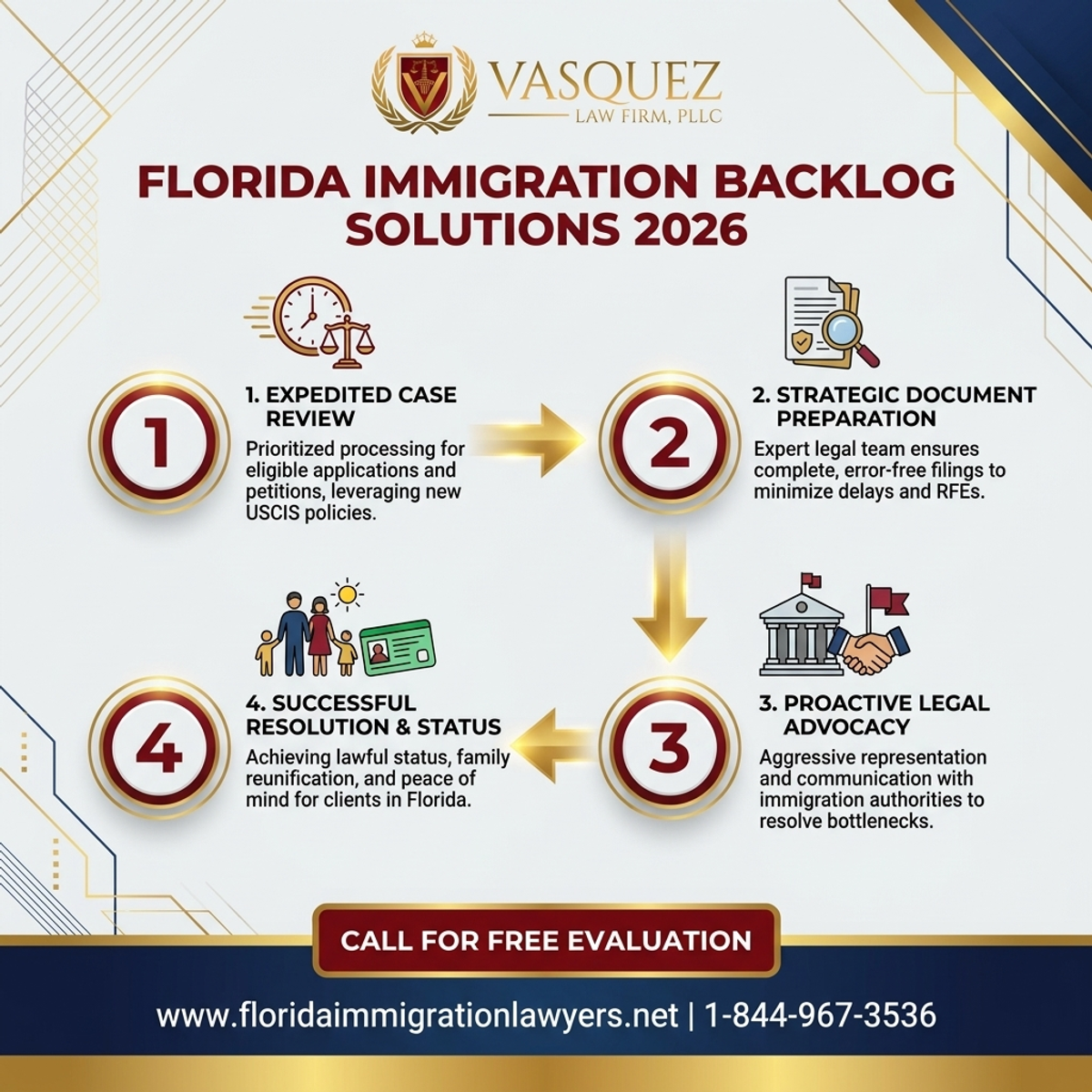
Step-by-Step Process — Immigration Backlog Solutions in Florida 2026
-
Submit Expedite Requests: In certain dire circumstances, USCIS may consider expediting a case. Criteria for expedite requests are strict and typically include severe financial loss to a company or individual, urgent humanitarian reasons, compelling U.S. government interests, or clear agency error. Submitting a well-documented expedite request can sometimes accelerate processing, but approval is not guaranteed. An attorney can help determine if your situation meets the stringent criteria.
-
Consider Mandamus Actions: If your case is experiencing an unreasonably long delay without justification, and all other avenues have been exhausted, a Writ of Mandamus lawsuit in federal court may be an option. This legal action, based on 28 U.S.C. § 1361, compels a government agency to perform its legal duty. This is a complex and serious legal step that should only be pursued with experienced legal counsel, particularly if your case is stuck at the Orlando or Miami field offices or the National Benefits Center.
-
Congressional Inquiry: As a last resort, contacting your local Congressional representative or Senator can sometimes lead to an inquiry with USCIS on your behalf. While not a guarantee of expedited processing, a Congressional inquiry can sometimes prompt a review of your case and provide valuable information.
What is the Typical Timeline for Immigration Processing in Florida?
As of 2026, the typical timeline for immigration processing in Florida varies significantly based on the application type, the specific USCIS service center or field office involved, and individual case complexities. While some forms might be processed in months, others can take several years, making precise predictions challenging.
Understanding the processing expectations is crucial for planning your future. However, it's important to note that these are general estimates and actual times can fluctuate widely. USCIS provides online processing times, but even these can be dynamic. For applicants in Florida, cases are typically processed by the Vermont Service Center, Nebraska Service Center, Texas Service Center, California Service Center, or the National Benefits Center, with interviews often conducted at local field offices such as the USCIS Orlando Field Office or the Miami Field Office. Asylum cases are often processed at the Asylum Office in Orlando or through the EOIR immigration courts.
Typical Immigration Processing Timelines (As of 2026)
| Stage | Typical Timeframe | Notes |
|---|---|---|
| I-130 (Family Petition) | 10-36+ Months | Varies significantly by relationship category (immediate relative vs. preference category) and country of origin. |
| I-485 (Adjustment of Status) | 12-48+ Months | Highly dependent on underlying visa availability, local field office backlog (e.g., Orlando, Miami), and interview requirements. |
| I-765 (Employment Authorization) | 3-12+ Months | Often tied to I-485 or asylum applications. Renewal processing can also face delays. |
| N-400 (Naturalization) | 8-24+ Months | Varies by local field office capacity (e.g., Orlando Field Office) and complexity of background checks. |
| I-140 (Employment Petition) | 6-18+ Months | Can be expedited with Premium Processing for an additional fee. |
| Asylum Interview (affirmative) | 6-60+ Months | Significant backlog, particularly at the Orlando Asylum Office. |
What Are the Costs Associated with Navigating Immigration Backlogs?
Navigating immigration backlogs involves various costs, including USCIS filing fees, attorney fees, and additional expenses for medical exams, translations, and travel. These financial burdens can be substantial, especially when cases are prolonged by delays.
The financial aspect of immigration can be a significant concern, especially when cases are caught in the immigration backlog. Beyond the emotional toll, the monetary costs can accumulate over time, making it even more challenging for individuals and families. It's crucial to budget for these expenses and understand where your money is going. USCIS fees, for example, are subject to change and are generally non-refundable, regardless of the outcome or processing time of your case. These fees are vital for funding the operations of the agency, as outlined in 8 U.S.C. § 1356, which established the Immigration Examinations Fee Account.
Attorney fees represent another significant investment. While some firms charge flat fees for specific services, others may bill hourly. The complexity of your case, the need for expedite requests, or the necessity of a mandamus action will all influence the total legal costs. Additionally, there are other miscellaneous expenses that can add up, such as fees for medical examinations required for adjustment of status, translation services for foreign documents, travel costs for interviews at USCIS field offices or consular interviews abroad (which might involve fees from the State Department), and fees for obtaining certified copies of documents. Staying informed about these potential costs is essential for financial planning during your immigration journey.
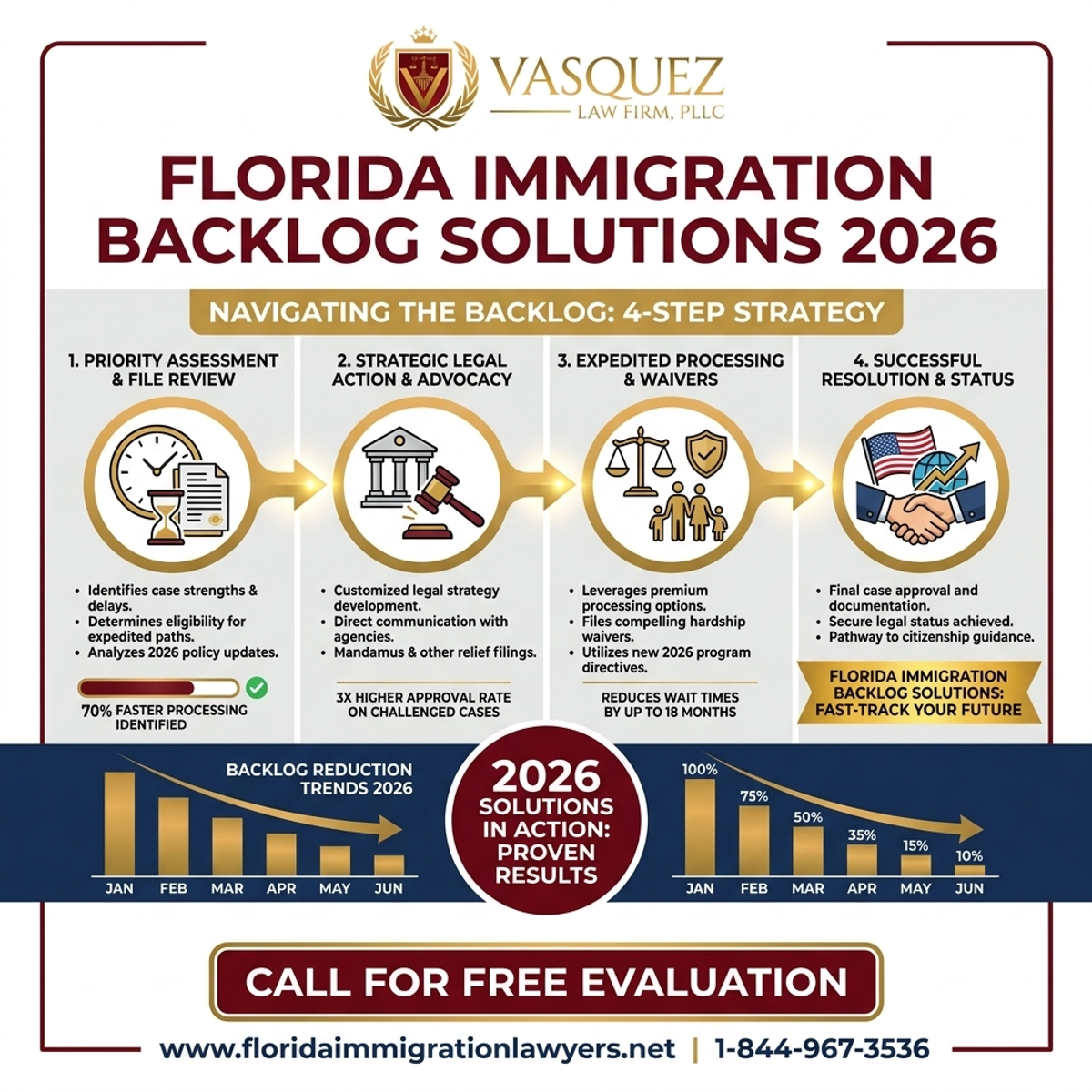
Key Statistics — Immigration Backlog Solutions in Florida 2026
Typical Immigration-Related Costs (As of 2026)
| Item | Typical Fee | Notes |
|---|---|---|
| USCIS Filing Fees | Varies by form ($500 - $1,500+) | Subject to change; consult official USCIS website for current fees. Examples: I-485, N-400, I-130. |
| Attorney Fees (Basic) | $3,000 - $10,000+ | For standard applications (e.g., family petitions, naturalization). Varies by complexity and firm. |
| Attorney Fees (Complex/Litigation) | $10,000 - $30,000+ | For appeals, mandamus actions, deportation defense, or highly complex cases. |
| Medical Examination | $200 - $500 | Required for Adjustment of Status (I-485). Must be performed by a USCIS-approved civil surgeon. |
| Document Translation | $20 - $50 per page | For non-English documents. Must be certified. |
| Biometrics Fee | $85 (often included in filing fee) | For fingerprinting and background checks. |
| Premium Processing | $2,805 (as of 2026) | Optional fee for faster processing of certain employment-based petitions (e.g., I-140). This fee is subject to statutory adjustments. |
Do not navigate this process alone. The financial and emotional stakes are too high. Contact Florida Immigration Lawyers today to understand your options and secure legal representation.
Common Mistakes to Avoid When Facing Immigration Backlogs
Navigating the immigration system, especially with significant backlogs, is fraught with potential pitfalls. Avoiding common mistakes can prevent further delays or even adverse outcomes for your case.
-
Submitting an Incomplete or Inaccurate Application: This is perhaps the most frequent mistake. Any missing information, unsigned forms, or incorrect details will almost guarantee an RFE or denial, forcing you to restart or significantly delay your process. USCIS requires absolute precision, and even minor errors can have major consequences.
-
Failing to Update Your Address with USCIS: If you move, you must inform USCIS within 10 days using Form AR-11. Failing to do so can result in missed notices, interview appointments, or RFEs, which could lead to your case being denied without your knowledge. This is a common issue for mobile populations in Florida.
-
Ignoring Requests for Evidence (RFEs) or Notices of Intent to Deny (NOIDs): These critical notices from USCIS demand a timely and thorough response. Ignoring them or providing an insufficient response will likely result in a denial of your application. Always read these documents carefully and seek legal advice immediately.
-
Misrepresenting Facts or Providing False Information: Any attempt to deceive USCIS, whether intentionally or unintentionally, can lead to severe penalties, including permanent inadmissibility to the U.S. Honesty and integrity are paramount throughout the entire immigration process.
-
Traveling Internationally Without Advance Parole: If you have a pending Adjustment of Status application (I-485), leaving the U.S. without an approved Advance Parole document can be considered abandonment of your application, leading to its denial. Always consult an attorney before making travel plans.
-
Missing Deadlines: Every immigration process has strict deadlines, whether for filing an application, responding to an RFE, or appearing for an interview. Missing a deadline can lead to case closure, denial, or even a deportation order, especially in the context of the Orlando Immigration Court.
-
Attempting to Navigate Complex Cases Alone: While some straightforward applications can be managed independently, cases involving criminal history, previous denials, or complex legal questions should always involve an attorney. The stakes are too high to risk a misstep due to a lack of legal expertise.
-
Not Keeping Copies of All Submitted Documents: Always retain copies of every form, document, and piece of evidence you submit to USCIS. This creates a personal record of your application and can be invaluable if documents are lost, or if you need to appeal a decision.
-
Failing to Disclose All Relevant Information: Even seemingly minor details, like a past arrest that was expunged, must be disclosed. Failure to disclose can be interpreted as misrepresentation and lead to severe consequences. Transparency is always the best policy.
-
Not Seeking an Expedite or Mandamus When Justified: If you meet the strict criteria for an expedite request due to humanitarian concerns or severe financial loss, or if your case is facing unreasonable delays warranting a mandamus action, failing to explore these options means missing potential solutions to your backlog issue.
When to Call a Lawyer for Immigration Backlog Solutions
Given the complexities of the U.S. immigration system and the persistent nature of the immigration backlog, knowing when to seek professional legal assistance is crucial. While some basic applications might seem straightforward, many situations warrant the expertise of an experienced immigration attorney, especially in Florida where cases can be diverse and challenging.
You should consider calling Florida Immigration Lawyers for a free case review if you encounter any of the following scenarios: your case is experiencing unusually long delays beyond the posted processing times, you've received an RFE or NOID and are unsure how to respond, you have a criminal history or previous immigration violations, or your family member is facing deportation defense at the Orlando Immigration Court or other EOIR facilities. Furthermore, if you are considering an expedite request or believe a mandamus action might be necessary due to excessive delays, legal counsel is indispensable.
Our experienced immigration attorneys can assess the specifics of your situation, identify any potential red flags, and advise on the most strategic path forward. We can help you gather and organize documentation, prepare compelling arguments for expedite requests, and represent you effectively in all interactions with USCIS or immigration courts. Don't let uncertainty or frustration prolong your wait. Our team is well-versed in navigating complex cases, including those involving deportation defense and asylum applications, and is dedicated to protecting your rights and advocating for your immigration goals in Florida. We offer comprehensive services for all our immigration practice areas.
About Florida Immigration Lawyers
Florida Immigration Lawyers is an immigration law firm dedicated to serving individuals and families across the entire state of Florida. With a deep understanding of U.S. immigration law and a compassionate approach, our attorneys are committed to providing exceptional legal representation and personalized service. We understand the challenges and anxieties that come with navigating the complex immigration system, especially when dealing with the pervasive immigration backlog.
Our firm focuses on a wide range of immigration matters, including family-based immigration, employment visas, deportation defense, asylum, naturalization, and complex litigation. We pride ourselves on our client-focused philosophy, ensuring that each client receives clear communication, strategic advice, and vigorous advocacy. Located in Central Florida, our team is available 24/7 to provide free case reviews, helping you understand your options and develop a tailored strategy. When you choose Florida Immigration Lawyers, you gain a dedicated partner committed to achieving the strongest possible outcome for your immigration journey. Contact us today at 1-844-YO-PELEO to schedule a free consultation and let our experienced team guide you.
Sources and References
- U.S. Citizenship and Immigration Services (USCIS)
- Executive Office for Immigration Review (EOIR)
- U.S. Department of State
- 8 U.S.C. Chapter 12 - Immigration and Nationality Act (INA)
- 8 CFR - Code of Federal Regulations (Title 8, Aliens and Nationality)
- 28 U.S.C. § 1361 - Action to compel an officer of the United States to perform his duty (Mandamus)
- USCIS Policy Manual
Related services: family immigration services, citizenship and naturalization.
This article provides general legal information and is not intended as legal advice. Every case is unique, and outcomes depend on specific facts and circumstances. Contact an attorney for advice about your particular situation.
Don't let the immigration backlog define your future. Take control of your case with legal representation. Contact Florida Immigration Lawyers at 1-844-YO-PELEO for a free, confidential case review. Se Habla Espanol - Estamos aqui para ayudarle.
Do Not Navigate This Process Alone
Our experienced immigration attorneys are ready to fight for you. Get a free, confidential case review today.
Se Habla Español
Or leave your details and we’ll call you:
Free Evaluation in 24 Hours
Or talk to us right now
AI voice assistant — available 24/7
FreeFrequently Asked Questions

William J. Vásquez
Founding Attorney · Vasquez Law Firm
U.S. Air Force veteran and immigration attorney with years of hands-on U.S. immigration experience. J.D., NCCU School of Law. AILA member. Admitted to the 4th, 5th, and 11th Circuit Courts.
Available 24/7 - Free Evaluations
Reviewed for legal accuracy by William J. Vásquez
Licensed in North Carolina; U.S. immigration is federal practice.
Related Legal Services
Our Florida immigration attorneys can help you with experienced immigration attorneys, asylum protection and citizenship and naturalization. Call today at 1-844-YO-PELEO for a free case review.
Related Links
Related Topics
Free Legal Case Review
Discuss your case with our experienced attorneys. We're available 24/7.
Se Habla Español - Estamos aquí para ayudarle.
Related Articles
EAD Advance Parole Combo Card in Florida: What You Need
An EAD advance parole combo card allows individuals with pending adjustment applications to both work and travel abroad without jeopardizing their green card application. Learn how to apply in Florida, what documents you need, and common mistakes to avoid.
PERM Labor Certification in Florida: A 2026 Guide
Learn all about the PERM labor certification process in Florida, essential for employers sponsoring green card applicants. Understand the steps, document requirements, and common mistakes to avoid in this 2026 guide.
Dual Citizenship Lawyer in Florida: What You Need to Know
For Florida residents, the concept of dual citizenship, or holding two passports, offers a compelling blend of opportunities and challenges. While the U.S. generally permits dual nationality, the path to achieving this status requires a meticulous understanding of both U.S. immigration laws and the citizenship policies of your country of origin. This guide explores the definition of dual citizenship, the detailed step-by-step process for U.S. naturalization, and the significant benefits and potential pitfalls involved. We cover essential documentation, typical timelines, and cost considerations for 2026, providing crucial insights for anyone in Orlando, Miami, or across Florida considering this important legal step. Learn about common mistakes to avoid and understand when to seek professional legal counsel to navigate this complex process successfully. Florida Immigration Lawyers is here to provide expert, bilingual support for your dual citizenship journey.
Immigration Lawyer Orlando Free Consultation in Florida
For individuals and families in Orlando, Florida, navigating the complexities of U.S. immigration law requires expert guidance. An immigration lawyer in Orlando offers crucial support for everything from visa applications and green card processes to naturalization and deportation defense. This comprehensive guide details what a free consultation covers, providing a step-by-step overview of immigration pathways, essential document checklists, and expected timelines in 2026. We also highlight common mistakes to avoid, discuss the critical role of legal counsel in deportation and asylum cases, and explain why choosing a local Orlando immigration attorney is beneficial. Florida Immigration Lawyers is dedicated to serving the diverse community of Orlando with compassionate, effective legal solutions, ensuring you receive personalized advice and robust representation for a successful immigration journey.