Immediate Relative Petition in Florida: A Guide | VLF Florid
Explore how to file an immediate relative petition in Florida, focusing on Form I-130. Learn about eligibility, timelines, and common mistakes. Call us at 1-844-967-3536 for a free consultation.

Navigating the complex world of U.S. immigration law can be daunting, especially when you're trying to reunite with loved ones. For U.S. citizens looking to bring their close family members to the United States, the Immediate Relative Petition is often the most direct and efficient pathway. This comprehensive guide from VLF Florida will walk you through the intricacies of the I-130 petition process, focusing on the specific requirements and considerations for families in Florida. Understanding each step is crucial for a successful outcome, and our goal is to provide clarity and expert insight.
Understanding Immediate Relative Petitions
An Immediate Relative Petition is a special category within U.S. immigration law reserved for certain close family members of U.S. citizens. Unlike other family-sponsored categories, immediate relatives are not subject to numerical quotas, meaning a visa is always immediately available once the petition is approved. This makes it a significantly faster process for eligible individuals. The U.S. government recognizes the importance of family unity, and this category reflects that priority.
Who Qualifies as an Immediate Relative?
The definition of an "immediate relative" is very specific and includes:
- Spouses of U.S. Citizens: This includes legally married husbands and wives. The marriage must be valid in the place where it occurred and must be a bona fide (real) marriage, not entered into solely for immigration purposes.
- Unmarried Children Under 21 of U.S. Citizens: This category covers biological children, stepchildren (if the marriage creating the step-parent relationship occurred before the child turned 18), and adopted children (if the adoption meets specific legal requirements).
- Parents of U.S. Citizens: The U.S. citizen petitioner must be at least 21 years old to file for a parent.
It's important to note that siblings, married children, or children over 21 are not considered immediate relatives and fall into other preference categories, which are subject to visa bulletin backlogs.
The I-130 Petition Process: A Step-by-Step Guide
The journey to obtaining a Green Card for an immediate relative begins with filing Form I-130, Petition for Alien Relative, with U.S. Citizenship and Immigration Services (USCIS). This form establishes the qualifying relationship between the U.S. citizen petitioner and their foreign national beneficiary. The process generally involves several key stages:
- Filing the I-130 Petition: The U.S. citizen files Form I-130 along with all required supporting documentation and the appropriate filing fee. The accuracy and completeness of this initial submission are paramount to avoid delays.
- USCIS Review and Receipt Notice: Once filed, USCIS reviews the petition. You will receive a Form I-797C, Notice of Action, confirming receipt of your application. This notice contains your receipt number, which you can use to track the status of your case online.
- Request for Evidence (RFE) or Approval: USCIS may issue a Request for Evidence (RFE) if they need more information or clarification regarding the relationship or other aspects of the petition. Responding to an RFE promptly and thoroughly is critical. If satisfied, USCIS will approve the I-130 petition.
- National Visa Center (NVC) Processing (for Consular Processing): If the beneficiary is outside the U.S., the approved petition is sent to the National Visa Center (NVC) for further processing. The NVC collects visa application fees, immigrant visa application forms (DS-260), and civil documents.
- Adjustment of Status (for Beneficiaries in the U.S.): If the beneficiary is already in the U.S. and entered legally, they may be eligible to file Form I-485, Application to Register Permanent Residence or Adjust Status, concurrently with or after the I-130 approval. This allows them to obtain a Green Card without leaving the country.
Each step requires meticulous attention to detail and a thorough understanding of immigration regulations. Seeking guidance from an experienced immigration attorney can significantly streamline this process and prevent common pitfalls.
Essential Documentation for Your I-130 Petition
The success of an Immediate Relative Petition heavily relies on submitting a comprehensive set of documents that prove both the U.S. citizenship of the petitioner and the bona fide qualifying relationship. Missing or incorrect documents are a leading cause of delays and RFEs.
- Proof of U.S. Citizenship: This can include a U.S. birth certificate, naturalization certificate, or a valid U.S. passport.
- Proof of Relationship:
- For Spouses: Marriage certificate, birth certificates of any children born to the marriage, joint financial documents (bank accounts, taxes), joint leases/mortgages, utility bills in both names, photographs, affidavits from friends/family, and other evidence demonstrating a real, ongoing marital relationship.
- For Children: Child's birth certificate showing the U.S. citizen as a parent. For stepchildren, the marriage certificate of the U.S. citizen to the child's biological parent and the child's birth certificate. For adopted children, the final adoption decree.
- For Parents: U.S. citizen's birth certificate showing the parent's name. If the parent's name on the birth certificate differs from current identification, additional documentation like a marriage certificate or legal name change document may be required.
- Financial Support Documents (Affidavit of Support): The U.S. citizen petitioner must demonstrate the financial ability to support the immigrant by filing Form I-864, Affidavit of Support. This involves providing tax returns, W-2s, and other income evidence to show they meet the federal poverty guidelines.
- Biographic Information: Copies of passports, visas, I-94 records, and any previous immigration applications for both the petitioner and beneficiary.
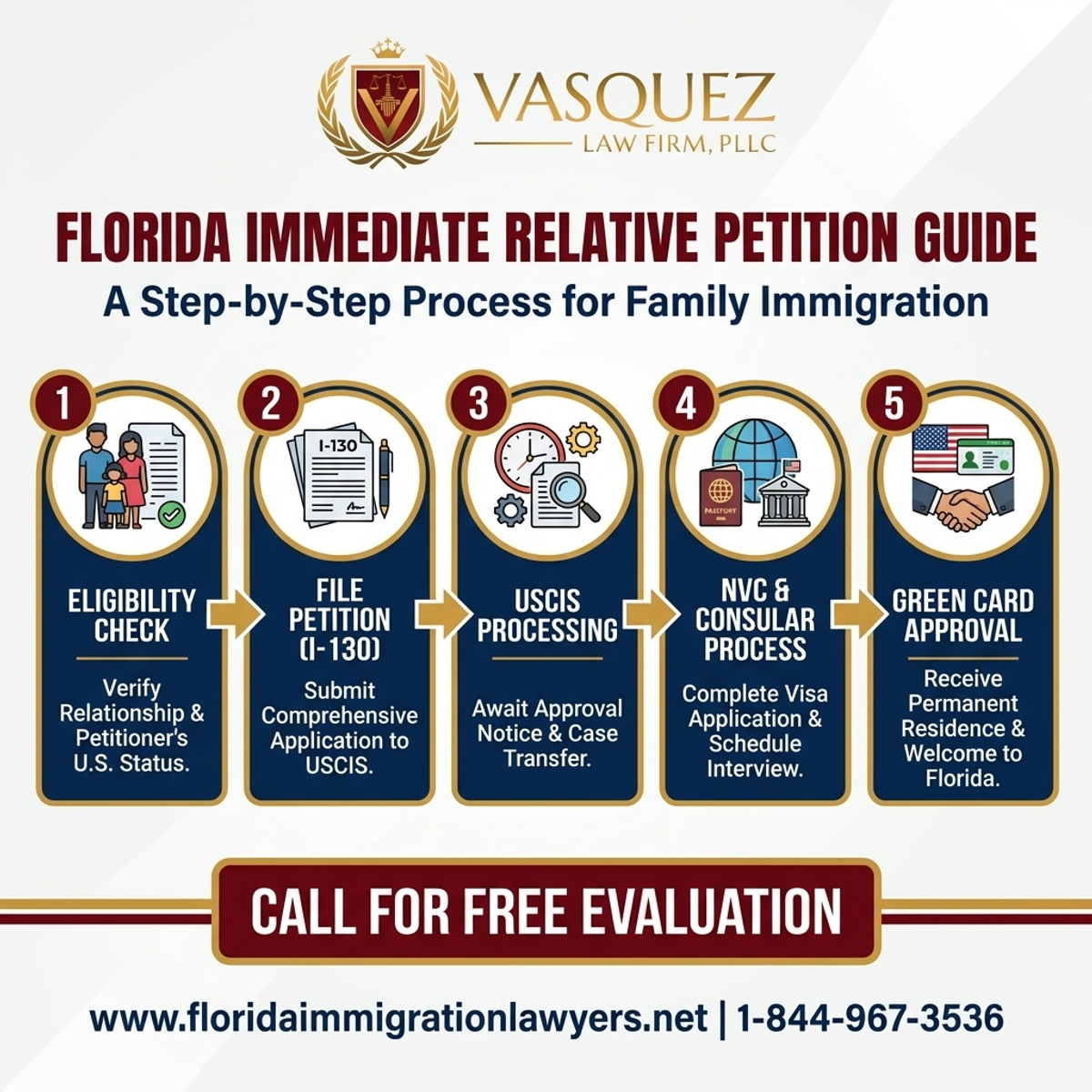
Step-by-Step Process — Immediate Relative Petition in Florida: A Guide | VLF Florida
Organizing and presenting these documents correctly is a crucial part of the application. An attorney can help ensure all necessary evidence is gathered and submitted in the proper format.
Adjustment of Status vs. Consular Processing: Choosing the Right Path
Once an I-130 petition is approved, the next critical step for the immediate relative is to apply for their Green Card. The path they take depends primarily on whether they are physically present in the United States or residing abroad. This choice dictates whether they will undergo Adjustment of Status (AOS) or Consular Processing (CP).
Adjustment of Status (AOS)
Adjustment of Status allows an eligible foreign national who is already in the U.S. to apply for lawful permanent resident status without having to leave the country. To qualify for AOS as an immediate relative, the beneficiary must have entered the U.S. legally (e.g., with a valid visa or through the Visa Waiver Program) and generally must maintain a lawful status or be an immediate relative who is "grandfathered" under certain provisions even if they overstayed. The application for AOS (Form I-485) is typically filed concurrently with or after the I-130 approval. The process involves submitting extensive documentation, attending a biometrics appointment, and often an interview at a USCIS field office. A key advantage of AOS is that the applicant can remain in the U.S. with their family during the processing time, and they can apply for work authorization (EAD) and advance parole (travel document) while their I-485 is pending. However, certain factors like unlawful entry, criminal history, or previous immigration violations can make an individual ineligible for AOS, potentially leading to deportation defense issues.
Consular Processing (CP)
Consular Processing is the pathway for immediate relatives who are living outside the United States or who are ineligible for Adjustment of Status. After the I-130 is approved by USCIS, the case is forwarded to the National Visa Center (NVC). The NVC collects all necessary immigrant visa application forms (DS-260), civil documents, and affidavit of support documents. Once all documents are submitted and reviewed, the NVC schedules an interview at the U.S. Embassy or Consulate in the beneficiary's home country. During the interview, a consular officer will review the application, verify the relationship, and determine eligibility for the immigrant visa. If approved, the beneficiary receives an immigrant visa stamp in their passport, which allows them to enter the U.S. as a lawful permanent resident. While CP requires the beneficiary to travel abroad for the interview, it can be a more straightforward process for those who are already outside the U.S. or who have eligibility issues preventing AOS. It's crucial to understand the implications of each path, as choosing the wrong one can lead to significant delays or even denial. Our experienced attorneys can help you determine the most appropriate and efficient route for your specific circumstances.
The Interview Process: What to Expect
Whether you're adjusting status in the U.S. or undergoing consular processing abroad, an interview is a standard part of the Green Card application for immediate relatives. This interview is designed to verify the information provided in your petition and application, and most importantly, to confirm the bona fide nature of the relationship.
For Spouses:
Spousal interviews are particularly focused on proving the authenticity of the marriage. Both the U.S. citizen petitioner and the foreign national beneficiary are typically interviewed together. Questions will delve into various aspects of your life together: how you met, daily routines, shared finances, future plans, and intimate details of your relationship. Officers are trained to detect fraudulent marriages, so consistency in answers and compelling evidence are key. Be prepared to bring original copies of all supporting documents, even those already submitted.
For Children and Parents:
Interviews for children and parents tend to be less intensive regarding the relationship's bona fides, as these relationships are generally easier to prove with birth certificates. However, the officer will still verify all information, check for any inadmissibility issues, and ensure the petitioner meets the financial requirements. For children, particularly stepchildren or adopted children, the focus might be on the legality and timing of the relationship's formation.
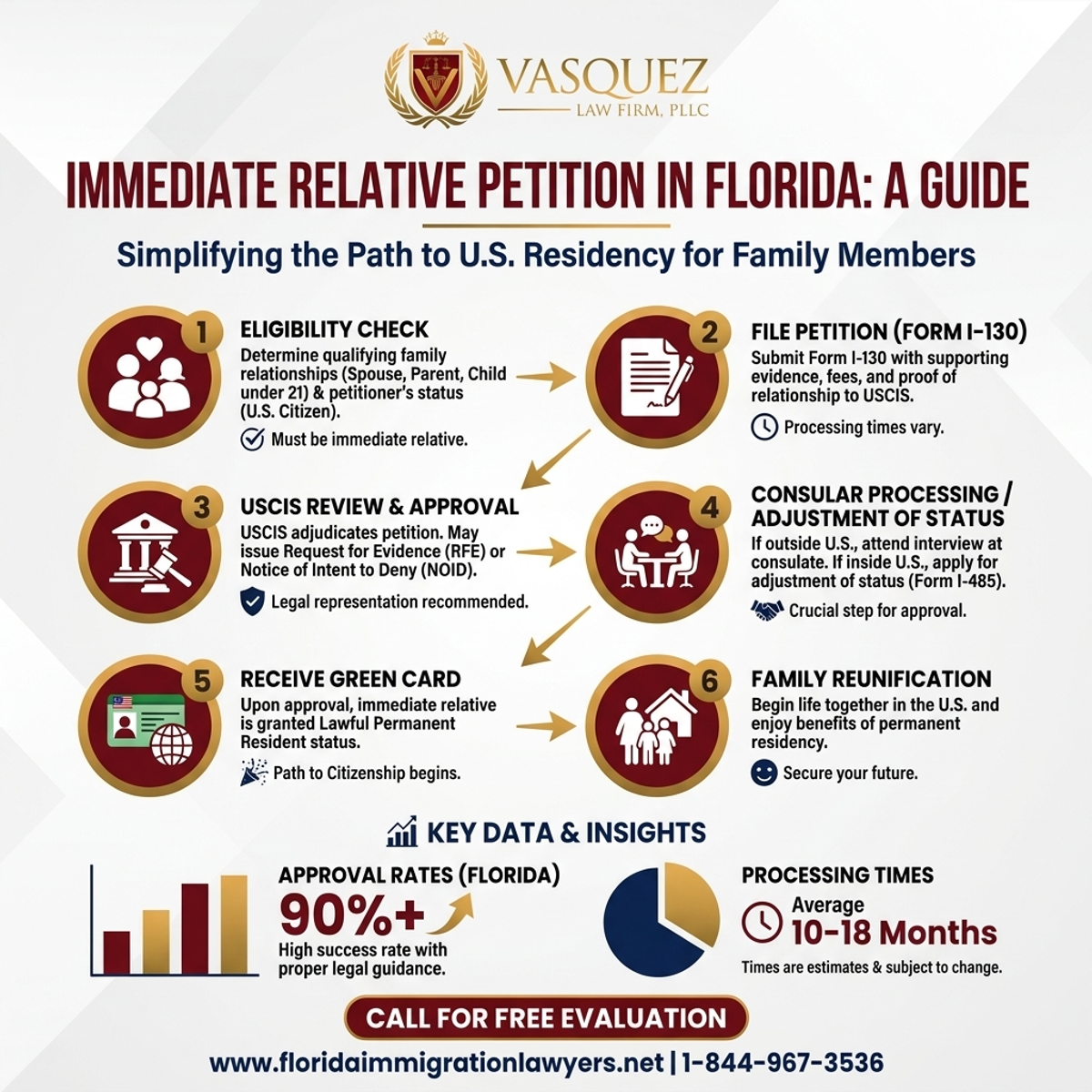
Key Statistics — Immediate Relative Petition in Florida: A Guide | VLF Florida
Preparation is paramount. Review your application, understand the timeline of your relationship, and gather all original documents. An attorney can conduct mock interviews and prepare you for potential questions, significantly increasing your confidence and readiness.
Common Challenges and How to Overcome Them
Even with a seemingly straightforward case, immediate relative petitions can encounter various hurdles. Being aware of these challenges and knowing how to address them is vital for a smooth process.
- Requests for Evidence (RFEs): These are common when USCIS requires more information or clarification. A well-prepared response with clear, organized documentation is essential.
- Proving Bona Fide Marriage: For spouses, this is often the biggest challenge. Lack of joint documents, significant age differences, or previous immigration history can raise red flags.
Sources and References
- U.S. Citizenship and Immigration Services (USCIS)
- Executive Office for Immigration Review (EOIR)
- U.S. Department of State - Bureau of Consular Affairs
- Immigration and Nationality Act (INA), 8 U.S.C. Chapter 12
Do Not Navigate This Process Alone
Our experienced immigration attorneys are ready to fight for you. Get a free, confidential consultation today.
Se Habla Español
Frequently Asked Questions
Florida Immigration Lawyers
Immigration Attorney | Founder, Vasquez Law Firm
U.S. Air Force veteran and immigration attorney with thousands of cases resolved. J.D., NCCU School of Law. AILA member. Admitted to the 4th, 5th, and 11th Circuit Courts.
Available 24/7 - Free Evaluations
Related Legal Services
Our Florida immigration attorneys can help you with experienced immigration attorneys, business immigration and asylum protection. Call today at 1-844-967-3536 for a free consultation.
Related Links
Related Topics
Free Legal Consultation
Discuss your case with our experienced attorneys. We're available 24/7.
Se Habla Español - Estamos aquí para ayudarle.
Related Articles
Understanding the I-864 Affidavit of Support in Florida
Learn about the I-864 Affidavit of Support and how it affects sponsorship in Florida. Understand the requirements and common pitfalls. Contact Florida Immigration Lawyers for expert guidance.
Refugee Resettlement in Florida: Key Steps | VLF Florida
Discover the essential steps for refugee resettlement in Florida, focusing on areas like Hollywood. Learn about the process, common mistakes, and when to seek legal advice. Call Florida Immigration Lawyers at 1-844-967-3536 for a free consultation.
Immediate Relative Petition in Florida: What to Know
Learn how to file an immediate relative petition in Florida with ease. Our guide covers eligibility, steps, and common mistakes. Contact Florida Immigration Lawyers for expert advice.
Understanding the Public Charge Rule in Florida | VLF Florida
Explore the public charge rule affecting immigrants in Florida, especially in Tampa. Learn how this rule impacts green card eligibility and the importance of proper preparation. Florida Immigration Lawyers can help guide you through this complex process. Call us today for a free consultation.
