Understanding the Public Charge Rule in Florida
Explore the public charge rule affecting immigrants in Florida, especially in Tampa. Learn how this rule impacts green card eligibility and the importance of proper preparation. Florida Immigration Lawyers can help guide you through this complex process. Call us today for a free consultation.
Understanding the Public Charge Rule in Florida | VLF Florida
The public charge rule is a critical component of U.S. immigration law that can significantly impact individuals seeking to enter or remain in the United States. For Florida residents and those aspiring to move to the Sunshine State, understanding this complex regulation is paramount. At VLF Florida, we believe in empowering our community with clear, accurate information to navigate the often-confusing landscape of immigration policies. This comprehensive guide will delve deep into the public charge rule, its historical context, recent changes, and how it specifically affects immigrants in Florida.
What is the Public Charge Rule?
The public charge rule is a ground of inadmissibility in U.S. immigration law. This means that if an individual is deemed likely to become a "public charge" – primarily dependent on the government for subsistence – they may be denied a visa, admission to the U.S., or adjustment of status to lawful permanent resident (Green Card holder). The core principle behind this rule is to ensure that immigrants are self-sufficient and do not become a burden on the U.S. taxpayer.
Historically, the concept of a "public charge" has been part of U.S. immigration law for over a century, with its roots in the Immigration Act of 1882. The rule aims to identify individuals who might require extensive public assistance, thereby preventing them from becoming permanent residents. While the fundamental concept has remained, the interpretation and application of the rule have evolved significantly over time, leading to periods of confusion and concern within immigrant communities.
It's crucial to understand that not all public benefits make someone a public charge. The rule specifically targets individuals who are primarily dependent on certain government cash assistance programs for income maintenance or long-term institutionalization at government expense. This distinction is vital for families who might be using some benefits but are otherwise self-sufficient.
Who is Affected by the Public Charge Rule?
The public charge rule primarily applies to individuals applying for:
- An immigrant visa from outside the U.S.
- Adjustment of status to lawful permanent resident (Green Card) from within the U.S.
- Certain non-immigrant visas (though less common).
However, many categories of immigrants are exempt from the public charge rule. These exemptions are critical and often misunderstood. They include:
- Refugees and Asylees: Individuals granted asylum or refugee status are not subject to the public charge rule. This is because their status is based on persecution, not economic self-sufficiency.
- Afghan and Ukrainian parolees.
- Special Immigrant Juveniles.
- Victims of human trafficking (T visa holders) and victims of certain crimes (U visa holders).
- Certain other humanitarian programs.
Understanding whether you fall into an affected or exempt category is the first step in assessing your situation. If you are unsure about your specific circumstances, consulting with an experienced immigration attorney is highly recommended.
What Benefits Are Considered for Public Charge Determinations?
Under the current policy, which reverted to the 1999 field guidance in 2021, the benefits that are considered in a public charge determination are narrowly defined. These include:
- Cash assistance for income maintenance: This primarily refers to Supplemental Security Income (SSI), Temporary Assistance for Needy Families (TANF), and state or local cash assistance programs.
- Long-term institutionalization at government expense: This refers to individuals residing in a nursing home or mental health institution where the government is the primary payer.
It is extremely important to note what benefits are *NOT* considered. The vast majority of public benefits that many families rely on are *not* counted against an applicant. These include:
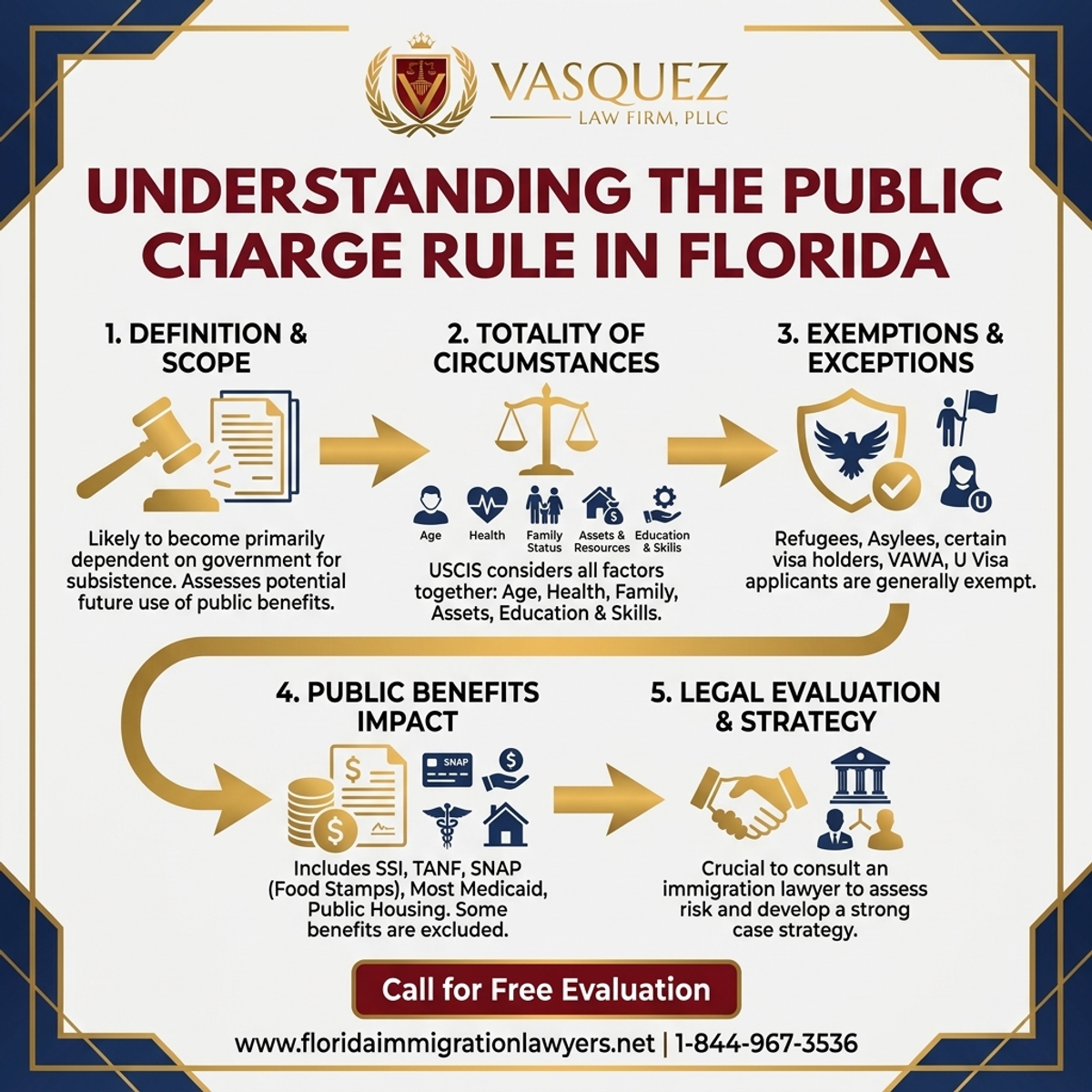
Step-by-Step Process — Understanding the Public Charge Rule in Florida | VLF Florida
- Medicaid (except for long-term institutionalization).
- Children's Health Insurance Program (CHIP).
- Food Stamps (SNAP).
- Housing assistance (Section 8, public housing).
- Child care services.
- Emergency medical care.
- Disaster relief.
- Immunizations and testing for communicable diseases.
- School lunch programs.
- WIC (Special Supplemental Nutrition Program for Women, Infants, and Children).
- Unemployment benefits.
- Social Security benefits (earned benefits).
- Earned income tax credits.
This distinction is critical to prevent a "chilling effect," where immigrants avoid seeking necessary healthcare or food assistance out of fear that it will jeopardize their immigration status. The current policy aims to reassure individuals that utilizing these essential services will not negatively impact their public charge assessment.
The "Totality of the Circumstances" Test
When making a public charge determination, immigration officials do not just look at benefit usage. They employ a "totality of the circumstances" test, which means they consider several factors to predict whether an individual is likely to become a public charge in the future. These factors include:
- Age: Younger and older applicants might be scrutinized differently.
- Health: Any medical conditions that could require extensive public medical care.
- Family Status: The size of the household and the number of dependents.
- Assets, Resources, and Financial Status: Income, savings, property, and other financial holdings.
- Education and Skills: English language proficiency, educational attainment, and job skills that indicate employability.
- Affidavit of Support: For many family-sponsored immigrants, a U.S. citizen or lawful permanent resident must sign an Affidavit of Support (Form I-864), promising to financially support the immigrant. This is a crucial factor and often the most significant mitigating element against a public charge finding.
No single factor is determinative. Officials weigh all these elements together to make a comprehensive assessment. For instance, a young, healthy individual with strong job skills and a robust Affidavit of Support is unlikely to be deemed a public charge, even if they have used some non-cash benefits.
Recent Changes and Updates to the Public Charge Rule: What Florida Residents Need to Know
The public charge rule has been a subject of significant policy shifts in recent years, causing considerable confusion and anxiety among immigrant communities, including those in Florida. Understanding these changes is crucial for anyone navigating the U.S. immigration system.
In August 2019, the previous administration implemented a much broader and more restrictive public charge rule. This rule expanded the list of benefits considered to include certain non-cash benefits like Medicaid, SNAP (food stamps), and housing assistance. It also placed greater emphasis on factors like English proficiency and credit scores, making it significantly harder for many lower-income individuals to obtain Green Cards. This policy created a widespread "chilling effect," where many eligible immigrants, out of fear, dis-enrolled themselves or their children from vital health, nutrition, and housing programs, even if they were exempt or the benefits were not counted. The impact on public health and well-being was immediate and severe, particularly in states with large immigrant populations like Florida.
However, in March 2021, the Biden administration reverted to the long-standing 1999 public charge field guidance. This change effectively rescinded the 2019 rule and returned to a narrower definition of what constitutes a "public charge." Under the current policy, only cash assistance for income maintenance (like TANF and SSI) and long-term institutional care paid for by the government are considered. As detailed earlier, critical programs like Medicaid (excluding long-term care), SNAP, housing assistance, and many others are explicitly excluded from public charge determinations.
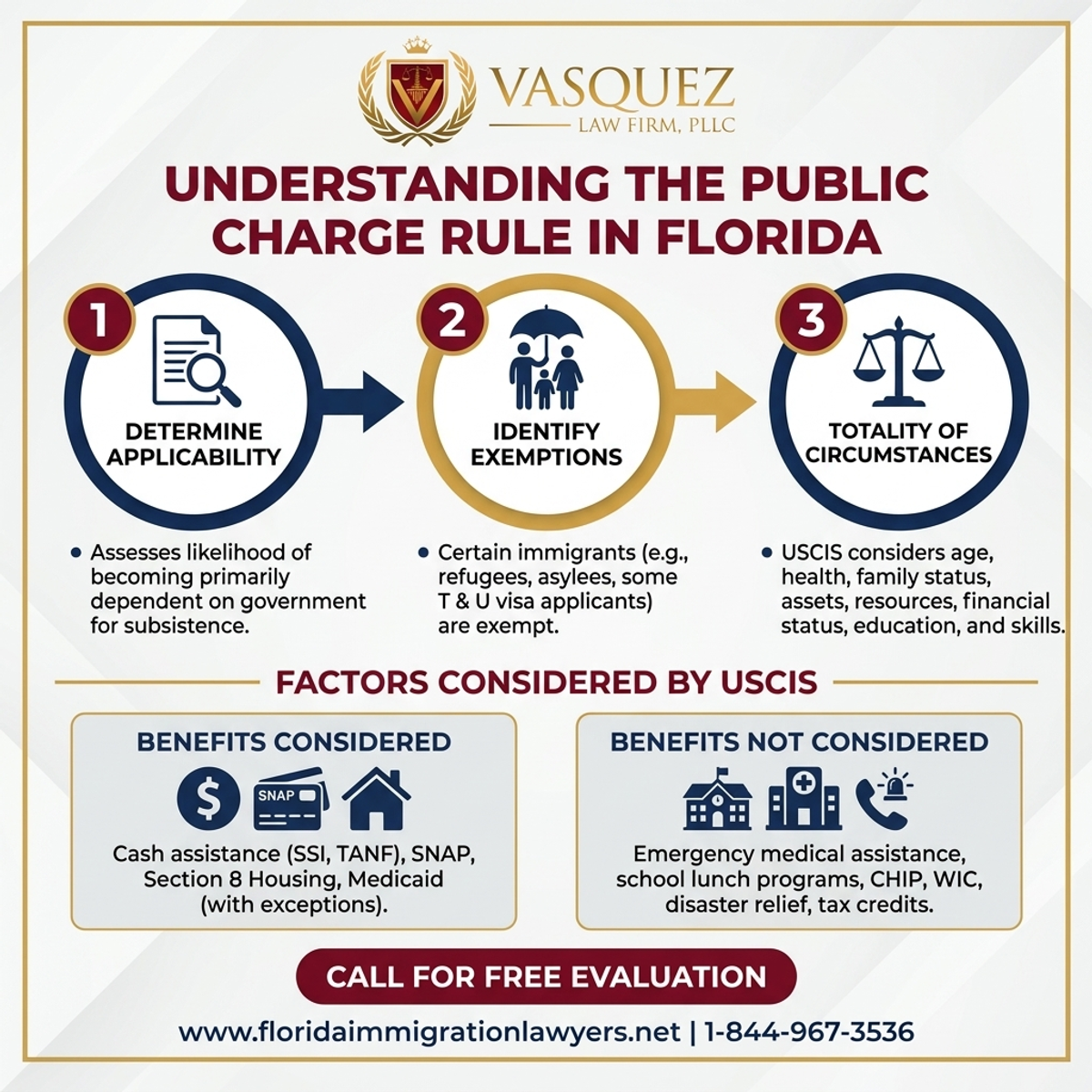
Key Statistics — Understanding the Public Charge Rule in Florida | VLF Florida
For Florida residents, this reversal brought much-needed clarity and relief. It means that using essential services like food assistance or medical care will generally not jeopardize an individual's immigration application. This is particularly important in a diverse state like Florida, where many families rely on these programs to meet basic needs. The return to the 1999 guidance aims to encourage immigrants to access necessary services without fear, promoting public health and economic stability for all residents. Despite the clarity, lingering fears from the 2019 rule persist, underscoring the importance of accurate information and legal guidance.
It is vital for Florida immigrants and their families to stay informed about these policy changes. While the current policy is more favorable, immigration laws can change. Consulting with an experienced immigration attorney is the best way to ensure you have the most up-to-date information and personalized advice for your specific situation. An attorney can help you understand how these rules apply to your application and address any concerns you may have about past or future benefit usage. This is especially true if you are facing potential deportation defense issues where any inadmissibility ground, including public charge, could be raised.
How Can an Immigration Attorney Help?
Navigating the complexities of the public charge rule and the broader U.S. immigration system can be daunting. An experienced immigration attorney can provide invaluable assistance at every step of the process. Here’s how VLF Florida can help:
- Personalized Assessment: We can evaluate your specific circumstances, including your health, financial status, education, and family situation, to assess your potential risk under the public charge rule.
- Guidance on Documentation: We help you gather and present the necessary documentation, such as financial records, employment history, and affidavits of support, to demonstrate self-sufficiency.
- Addressing Concerns: If you have previously received public benefits, we can advise you on how to address these concerns in your application and present your case effectively.
- Preparing for Interviews: We can help you prepare for interviews with immigration officials, ensuring you understand the types of questions you might face regarding public charge and how to answer them accurately and confidently.
- Appeals and Waivers: In some cases, it may be possible to apply for a waiver if you are found inadmissible on public charge grounds. Our attorneys can assess your eligibility for waivers and guide you through the application process.
- Staying Updated: Immigration laws are constantly evolving. Our team stays abreast of the latest policy changes and legal precedents, ensuring you receive the most current and accurate advice. This is particularly important given the recent shifts in public charge policy.
- Comprehensive Immigration Support: Beyond the public charge rule, VLF Florida offers a wide range of immigration services, including assistance with family-based petitions, employment visas, asylum claims, and deportation defense. We provide holistic support to ensure all aspects of your immigration journey are handled professionally.
Don't let fear or misinformation prevent you from pursuing your immigration goals. Contact VLF Florida today for a free consultation. Our dedicated team is ready to provide the legal guidance you need to navigate the public charge rule and achieve your dreams in the United States. Reach out to us to schedule your appointment.
Frequently Asked Questions About the Public Charge Rule
Q: What is the public charge rule? A: The public charge rule is a ground of inadmissibility in U.S. immigration law. It allows immigration officials to deny visas or Green Cards to individuals deemed likely to become "primarily dependent" on the government for subsistence through certain cash assistance programs or long-term institutional care at government expense. Q: Which benefits are considered under the current public charge policy? A: Under the current policy (which reverted to 1999 guidance), only cash assistance for income maintenance (like SSI, TANF, and state/local cash assistance) and long-term institutionalization at government expense are considered. Q: Which benefits are NOT considered for public charge? A: The vast majority of public benefits are NOT considered, including Medicaid (except for long-term care), SNAP (food stamps), housing assistance, CHIP, WIC, school lunch programs, emergency medical care, and many others. Q: Does the public charge rule apply to all immigrants? A: No. Refugees, asylees, victims of human trafficking (T visa holders), victims of certain crimes (U visa holders), and certain other humanitarian categories are exempt from the public charge rule. Q: What is the "totality of the circumstances" test? A: This test means immigration officials consider multiple factors to predict future self-sufficiency, including age, health, family status, assets, resources, financial status, education, skills, and the presence of an Affidavit of Support. Q: How does an Affidavit of Support help? A: For many family-sponsored immigrants, a U.S. citizen or lawful permanent resident must sign an Affidavit of Support (Form I-864), promising to financially support the immigrant. This is a very strong positive factor that can significantly mitigate public charge concerns. Q: I used food stamps in the past. Will this affect my Green Card application? A: Under the current policy, using non-cash benefits like SNAP (food stamps) will generally NOT negatively impact your Green Card application. Only specific cash assistance programs and long-term institutionalization are considered. Q: How can VLF Florida assist me with public charge concerns? A: Our experienced attorneys can provide personalized assessments, help you gather documentation, prepare for interviews, address past benefit usage, and offer comprehensive legal guidance for your immigration case, including deportation defense and asylum applications. We encourage you to contact us for a free consultation.Sources and References: Understanding the Public Charge Rule in Florida
- U.S. Citizenship and Immigration Services (USCIS)
- Executive Office for Immigration Review (EOIR)
- U.S. Department of State - Bureau of Consular Affairs
- Immigration and Nationality Act (INA), 8 U.S.C. Chapter 12
Do Not Navigate This Process Alone
Our experienced immigration attorneys are ready to fight for you. Get a free, confidential case review today.
Se Habla Español
Or leave your details and we’ll call you:
Free Evaluation in 24 Hours
Or talk to us right now

AI voice assistant — available 24/7
FreeFrequently Asked Questions

William J. Vásquez
Founding Attorney · Vasquez Law Firm
U.S. Air Force veteran and immigration attorney with years of hands-on U.S. immigration experience. J.D., NCCU School of Law. AILA member. Admitted to the 4th, 5th, and 11th Circuit Courts.
Available 24/7 - Free Evaluations
Reviewed for legal accuracy by William J. Vásquez
Licensed in North Carolina; U.S. immigration is federal practice.
Related Legal Services
Our Florida immigration attorneys can help you with asylum protection, citizenship and naturalization and immigration practice areas. Call today at 1-844-YO-PELEO for a free case review.
Related Links
Related Topics
Free Legal Case Review
Discuss your case with our experienced attorneys. We're available 24/7.
Se Habla Español - Estamos aquí para ayudarle.
Related Articles
Certificate of Eligibility for Expungement in Florida 2026
For non-U.S. citizens in Florida, understanding how a state expungement impacts immigration status is critical. A certificate of eligibility for expungement in Florida allows a criminal record to be sealed or expunged under state law. However, federal immigration agencies often disregard such state-level relief, still considering the original criminal offense as a conviction for immigration purposes. This can have severe implications for visa applications, green card eligibility, naturalization, and even lead to deportation. This guide clarifies the Florida expungement process, its limited effect on federal immigration law, and key steps to protect your status in 2026. Learn about common mistakes, required documents, timelines, and when to seek expert legal counsel from Florida Immigration Lawyers to navigate these complex issues effectively.
Immigration Lawyer Orlando Free Consultation in Florida
For individuals and families in Orlando, Florida, navigating the complexities of U.S. immigration law requires expert guidance. An immigration lawyer in Orlando offers crucial support for everything from visa applications and green card processes to naturalization and deportation defense. This comprehensive guide details what a free consultation covers, providing a step-by-step overview of immigration pathways, essential document checklists, and expected timelines in 2026. We also highlight common mistakes to avoid, discuss the critical role of legal counsel in deportation and asylum cases, and explain why choosing a local Orlando immigration attorney is beneficial. Florida Immigration Lawyers is dedicated to serving the diverse community of Orlando with compassionate, effective legal solutions, ensuring you receive personalized advice and robust representation for a successful immigration journey.
How to Apply for VAWA in Florida: A 2026 Guide
Discover how to apply for VAWA in Florida, offering crucial immigration relief for abuse victims. Learn the process, requirements, and how Florida Immigration Lawyers can assist you.
USCIS Office Near Me: Florida Locations & Appointments 2026
Navigating USCIS processes in Florida can be complex, from finding the right field office to preparing for critical appointments. This comprehensive guide provides essential information for individuals seeking immigration services in 2026, including a step-by-step process for locating your nearest USCIS office in Florida, understanding its services, and efficiently scheduling appointments. We detail the necessary documents for interviews, outline typical processing timelines, and break down associated costs. Furthermore, we highlight common pitfalls to avoid and crucial situations when consulting an experienced Florida immigration lawyer is indispensable. Whether you're in Orlando or elsewhere, empower your immigration journey with expert advice and practical strategies. Learn how Florida Immigration Lawyers can assist you.