USCIS Combo Card EAD Advance Parole I-485 in 2026
For individuals in Florida with a pending Form I-485, the USCIS combo card is an indispensable document. It combines the ability to legally work in the U.S. (Employment Authorization Document, EAD) and travel internationally without abandoning your green card application (Advance Parole, AP). This guide from Florida Immigration Lawyers provides a comprehensive overview of the combo card for 2026, including eligibility, step-by-step application instructions, required documents, typical processing times, and cost factors. We also highlight critical mistakes to avoid, such as traveling without Advance Parole, and emphasize when to seek legal counsel for complex cases. Understanding this crucial document ensures stability and flexibility throughout your adjustment of status journey in Florida.

A USCIS combo card is a single document issued by U.S. Citizenship and Immigration Services (USCIS) that combines employment authorization (EAD) and advance parole (AP) for applicants with a pending Form I-485, Application to Register Permanent Residence or Adjust Status. This card allows individuals in Florida to legally work in the United States and travel internationally while their green card application is being processed. It is a critical document for maintaining stability and flexibility during the often lengthy adjustment of status journey. Having a combo card prevents work disruptions and facilitates emergency travel without abandoning the I-485 application.
- Combines Employment Authorization Document (EAD) and Advance Parole (AP).
- Issued to individuals with a pending Form I-485, Adjustment of Status application.
- Authorizes legal employment in the U.S. and international travel.
- Prevents abandonment of I-485 application during international travel.
- Provides stability and flexibility during the green card process.
Navigating the complex landscape of U.S. immigration can be a daunting experience, especially when your future hinges on crucial documents like the USCIS combo card. For individuals in Florida with a pending Form I-485, Application to Register Permanent Residence or Adjust Status, this card represents more than just a piece of plastic; it's a gateway to continued employment and the freedom to travel internationally without jeopardizing your green card application. Understanding its nuances, eligibility requirements, and application process is paramount to a successful immigration journey.
Whether you reside in Naples, Miami, Orlando, or any other part of the Sunshine State, the wait for an I-485 decision can be lengthy. During this period, the combo card ensures you can maintain your livelihood and address personal or family matters abroad. This comprehensive guide from Florida Immigration Lawyers will demystify the combo card, detailing its components, eligibility, application steps, and what to expect in 2026. We will also highlight critical mistakes to avoid and when professional legal guidance becomes indispensable. Your path to permanent residency is significant, and we are here to help you every step of the way.
Do not let uncertainty cloud your future. For personalized guidance on your adjustment of status or combo card application, call Florida Immigration Lawyers at 1-844-967-3536 for a free consultation. Our experienced team is ready to assist you.
What is a USCIS Combo Card and Why is it Essential for I-485 Applicants in Florida?
The USCIS combo card is a highly sought-after document for many immigrants in Florida who are awaiting a decision on their Form I-485. This single card serves a dual purpose, combining the benefits of an Employment Authorization Document (EAD) and Advance Parole (AP). The EAD, also known as a work permit, grants you legal permission to work for any employer in the United States while your adjustment of status application is pending. This is vital for maintaining financial stability and contributing to the economy in communities across Florida, from Jacksonville to Fort Lauderdale.
Simultaneously, the Advance Parole component of the combo card allows you to travel outside the U.S. and re-enter without abandoning your pending I-485 application. Without Advance Parole, leaving the country while your I-485 is pending would typically be considered an abandonment of your application, leading to severe consequences. The combo card provides peace of mind, enabling individuals to visit family abroad or attend to emergencies without fear of jeopardizing their path to a green card. As of 2026, USCIS continues to issue these cards to eligible applicants, recognizing the practical needs of those undergoing the adjustment of status process.
For many, particularly those who have lived and worked in Florida for years, the combo card is indispensable. It bridges the gap between filing the I-485 and receiving a green card, which can take several years depending on the specific visa category and USCIS processing times. This document ensures continuity in employment and the ability to maintain family ties globally. Understanding the importance of this card is the first step in effectively managing your immigration journey.
Who is Eligible for a Combo Card with a Pending I-485 and How to Apply in 2026?
Generally, you are eligible for a USCIS combo card if you have a properly filed and pending Form I-485, Application to Register Permanent Residence or Adjust Status, and you are not otherwise inadmissible to the United States. This eligibility extends to various categories of applicants, including those adjusting status through family-based petitions, employment-based petitions, or asylum claims. The key is that your I-485 application must be actively under review by USCIS. As of 2026, there have been no significant changes to these fundamental eligibility criteria, ensuring a consistent pathway for applicants across Florida.
Applying for a combo card involves filing two separate forms concurrently or sequentially: Form I-765, Application for Employment Authorization, and Form I-131, Application for Travel Document. When filed together with or after your Form I-485, these applications are typically fee-exempt if your I-485 filing fee was already paid. USCIS will then process both requests, and if approved, will issue a single card that indicates both EAD and Advance Parole authorization. This streamlined approach simplifies the process for applicants, allowing them to manage their work and travel needs with one document.
- File Form I-485: Ensure your Application to Register Permanent Residence or Adjust Status is properly filed and accepted by USCIS. This is the foundational requirement.
- Prepare Forms I-765 and I-131: Complete Form I-765 for employment authorization and Form I-131 for advance parole. Make sure all sections are filled accurately and completely.
- Gather Supporting Documents: Collect all necessary documents, including copies of your I-94 arrival/departure record, passport, previous EAD/AP cards (if any), two passport-style photos, and evidence of your pending I-485 application (e.g., I-485 receipt notice).
- Submit Your Applications: Mail your completed Forms I-765 and I-131, along with all supporting documents, to the appropriate USCIS Lockbox facility. Refer to the USCIS website for the most current mailing addresses. It is crucial to include a copy of your I-485 receipt notice to confirm your pending adjustment of status application.
- Attend Biometrics Appointment: After filing, you will receive an appointment notice for biometrics (fingerprints and photo) at a local Application Support Center (ASC) in Florida, such as the one in Fort Myers or Orlando. Attending this appointment is mandatory.
- Monitor Your Case Status: Use the receipt numbers provided by USCIS to track the status of your applications online via the USCIS Case Status website. You will receive approval notices and eventually your combo card in the mail.
Required Documents and Processing Timelines for Your Combo Card Application in 2026
Successfully applying for a USCIS combo card requires meticulous attention to detail in gathering all necessary documentation. A complete application package helps prevent delays and requests for evidence (RFEs) that can prolong your wait. For Florida residents, ensuring your paperwork is in order before submission is a critical step. The following checklist outlines the essential documents you will need when filing Forms I-765 and I-131 concurrently with or after your I-485 application.
Document Checklist for EAD & Advance Parole (I-765 & I-131)
- Two identical passport-style photographs (taken within 30 days of filing).
- Copy of government-issued photo identification (e.g., passport identity page or driver's license).
- Copy of Form I-94, Arrival/Departure Record (front and back, if applicable).
- Copy of your last EAD card (if applicable).
- Copy of your last Advance Parole document (if applicable).
- Copy of your birth certificate.
- Copy of your visa stamp (if applicable).
- Copy of your I-485 receipt notice (Form I-797C, Notice of Action) to prove pending adjustment of status.
- For EAD, ensure you use category (c)(9) on Form I-765.
The processing times for a USCIS combo card can vary significantly based on the service center handling your application, the volume of cases, and individual case complexities. As of 2026, USCIS aims to process these applications efficiently, but applicants in Florida should prepare for potential wait times. These times are estimates and can fluctuate; checking the USCIS processing times website is always recommended for the most current information.
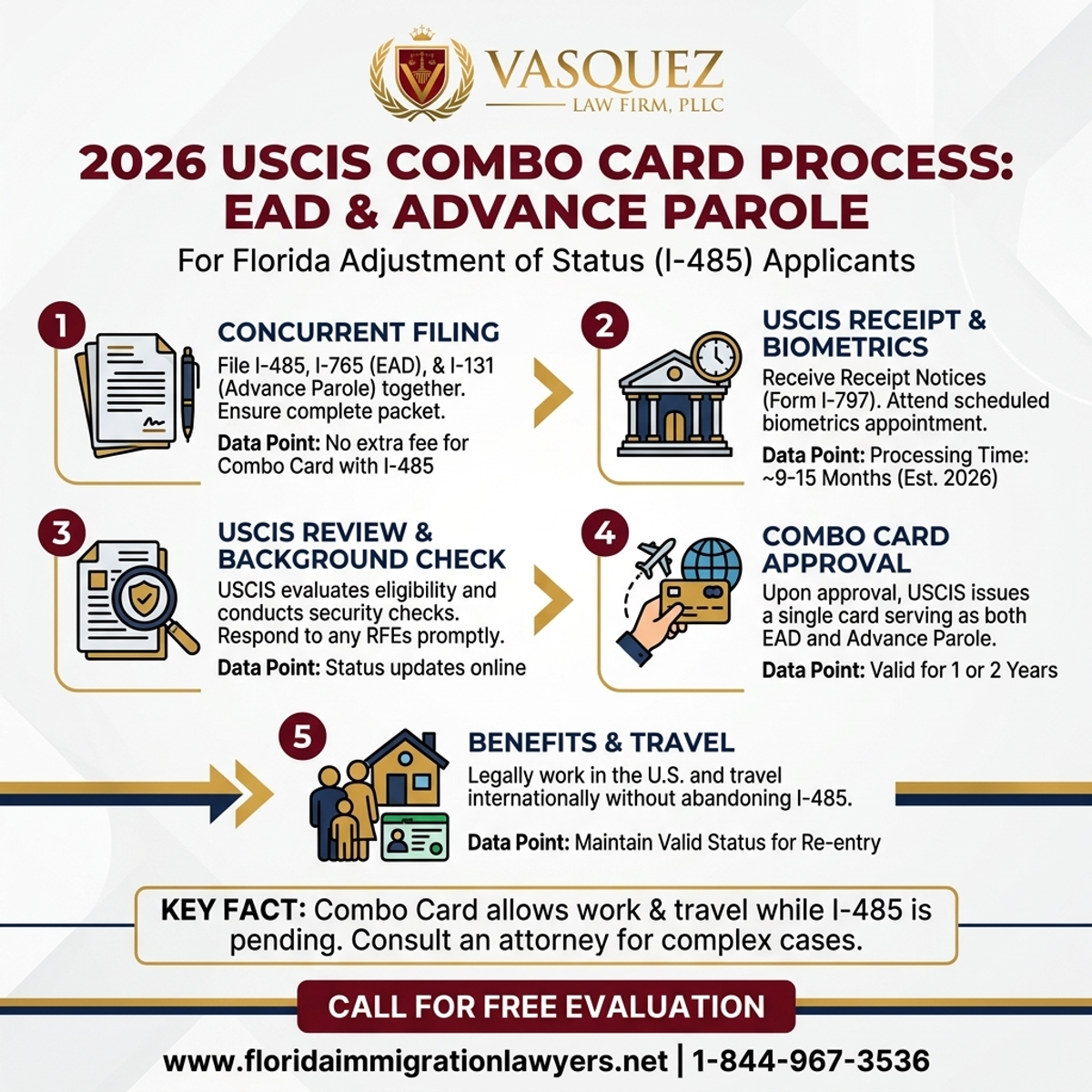
Step-by-Step Process — USCIS Combo Card EAD Advance Parole I-485 in 2026
Typical Combo Card Processing Timelines (as of 2026)
| Stage | Typical Timeframe | Notes |
|---|---|---|
| Receipt Notice for I-765/I-131 | 2-4 weeks | Confirmation that USCIS received your application. |
| Biometrics Appointment | 4-8 weeks after filing | Scheduled at a local Application Support Center (ASC). |
| Case Review & Decision | 8-14 months (or more) | Highly variable; can depend on service center workload. |
| Card Production & Delivery | 1-2 weeks after approval | Once approved, card is printed and mailed. |
Navigating the Costs and Avoiding Common Mistakes with Your Combo Card Application
Understanding the financial aspects of your immigration journey is crucial for applicants in Florida. While the initial filing fee for Form I-485 typically covers the fees for associated Forms I-765 (EAD) and I-131 (Advance Parole) when filed concurrently or subsequently, it's important to be aware of the overall costs involved in the adjustment of status process. As of 2026, USCIS fees are subject to change, so always verify the latest fee schedule on the official USCIS website before filing. The following table provides a general overview of typical fees, but remember that these are illustrative and can be updated by USCIS.
Typical Fees for I-485 and Associated Forms (as of 2026)
| Item | Typical Fee | Notes |
|---|---|---|
| Form I-485 | Varies by age | Includes biometrics fee for most applicants. |
| Form I-765 (EAD) | $0 (with pending I-485) | No separate fee if filed with or after I-485. |
| Form I-131 (Advance Parole) | $0 (with pending I-485) | No separate fee if filed with or after I-485. |
| Medical Examination (I-693) | Varies by physician | Required for I-485; not a USCIS fee. |
| Attorney Fees | Varies by case complexity | Legal representation can be a significant investment. |
Beyond the fees, avoiding common pitfalls can save you time, money, and immense stress. Many applicants, particularly in a diverse state like Florida, make avoidable errors that lead to delays or even denials. These mistakes often stem from a lack of understanding of the intricate immigration laws, such as those found in the Immigration and Nationality Act (INA) Section 245(a) (8 U.S.C. 1255(a)) regarding adjustment of status. Careful preparation and attention to detail are paramount to ensuring a smooth application process for your USCIS combo card and I-485.
Working and Traveling with Your Combo Card: Rights, Limitations, and Important Considerations for Florida Residents
Once you receive your USCIS combo card, you gain significant flexibility regarding employment and travel. The Employment Authorization Document (EAD) portion allows you to legally work for virtually any employer in the U.S., including those in Florida's booming tourism, agriculture, or tech sectors. This is a crucial right, as it enables you to support yourself and your family while awaiting your green card. You can change jobs without needing a new work permit, as long as your EAD remains valid. It's important to always carry your combo card as proof of your work authorization and be prepared to present it to employers as required by federal law.
The Advance Parole (AP) component grants you permission to travel internationally and re-enter the U.S. without abandoning your pending I-485. This is particularly beneficial for Florida residents with international family ties or business obligations. However, possessing an AP does not guarantee re-entry into the U.S. Upon your return, you will still be inspected by U.S. Customs and Border Protection (CBP) officers, who have the final say on your admission. Individuals with certain criminal histories or past immigration violations may face issues, even with a valid AP. It is always wise to consult with an immigration attorney before any international travel, especially if you have complex circumstances.
It is also crucial to understand the limitations and important considerations. For instance, while your combo card is valid, you must ensure your underlying I-485 application remains active and on track. If your I-485 is denied, your EAD and AP will typically become invalid. Furthermore, if you travel internationally, ensure you return before your Advance Parole expires. Overstaying outside the U.S. beyond the validity of your AP can lead to serious complications upon re-entry. Always keep copies of your combo card and travel documents, and consider enrolling in the Smart Traveler Enrollment Program (STEP) if traveling abroad.
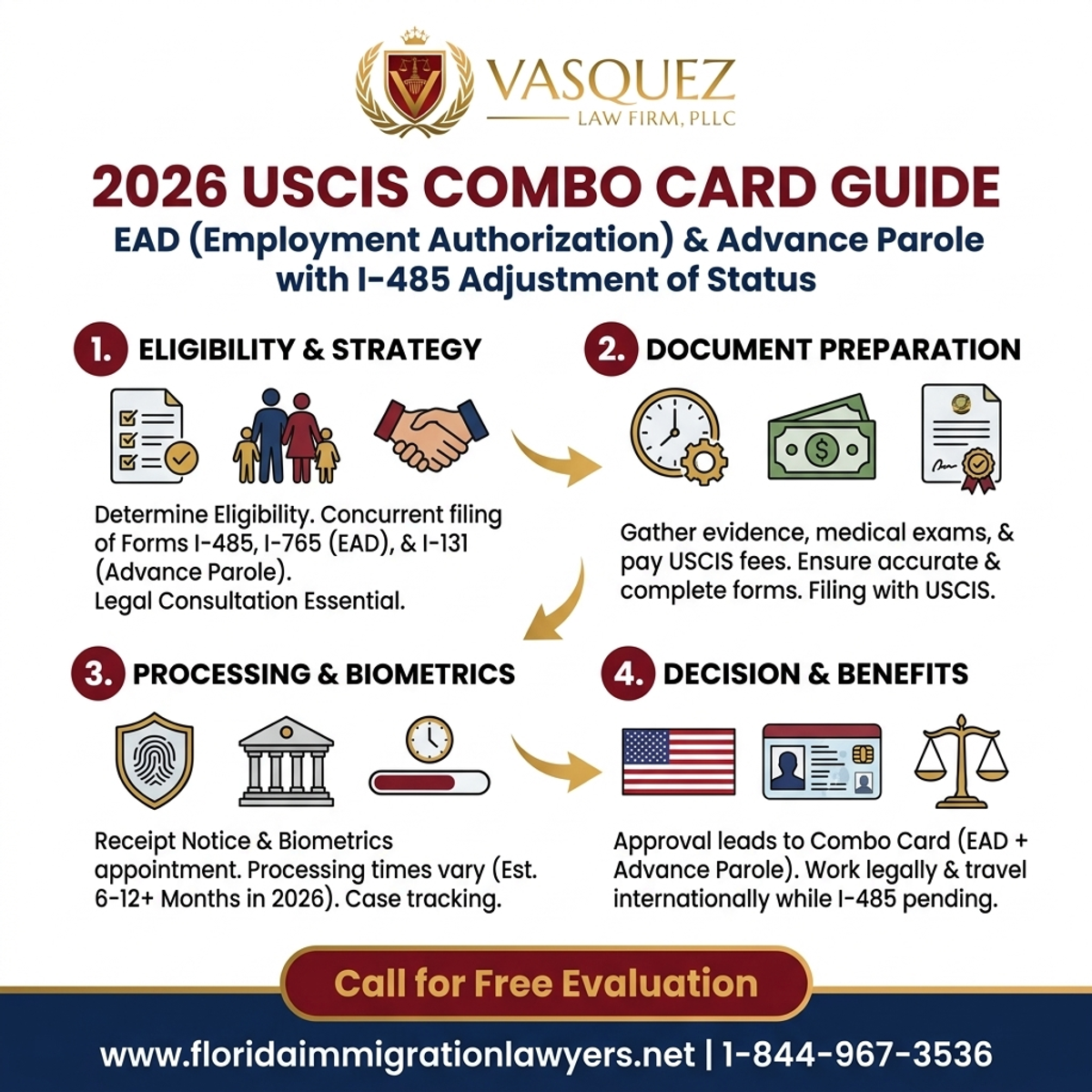
Key Statistics — USCIS Combo Card EAD Advance Parole I-485 in 2026
Do not navigate this process alone. The complexities of immigration law require expert guidance. Contact Florida Immigration Lawyers today to ensure your application is handled correctly and your rights are protected.
Common Mistakes to Avoid with Your Combo Card Application
- Filing Incomplete Applications: Submitting Forms I-765 or I-131 without all required fields completed or without necessary supporting documentation will lead to delays, RFEs, or even rejection. Ensure every question is answered and all evidence is attached.
- Incorrectly Calculating Fees: Although combo card applications are often fee-exempt with a pending I-485, some situations (e.g., standalone EAD renewals without I-485) require fees. Sending the wrong fee amount or no fee when one is due will result in rejection.
- Traveling Internationally Without Advance Parole: Leaving the U.S. while your I-485 is pending without a valid Advance Parole document will almost certainly result in your I-485 being considered abandoned. This is one of the most severe mistakes an applicant can make.
- Letting Your EAD Expire: Allowing your EAD to expire before filing for a renewal can lead to a lapse in work authorization, making you unable to legally work until the new card is approved. File for renewal well in advance (typically 120-180 days before expiration).
- Ignoring Requests for Evidence (RFEs): Failing to respond to an RFE from USCIS by the deadline provided will likely result in the denial of your application. Respond promptly and comprehensively.
- Providing Inconsistent Information: Any discrepancies between your current application and previous immigration filings can raise red flags with USCIS, leading to scrutiny, interviews, or denials. Always be truthful and consistent.
- Failing to Update Address Changes: Not notifying USCIS of a change of address within 10 days of moving can result in missed notices, RFEs, or even denial of your application because you didn't receive crucial correspondence.
- Misunderstanding Eligibility for AP: Certain individuals, such as those in removal proceedings or with specific criminal records, may not be eligible for Advance Parole. Traveling with AP when ineligible can lead to serious issues upon re-entry, including detention and removal proceedings at an EOIR immigration court.
- Overlooking the "Public Charge" Rule: While current policy has shifted, historical immigration policies, such as the public charge rule, have made immigrants who use certain public benefits potentially inadmissible. Though the 2019 rule was rescinded, it's crucial to understand current guidelines and avoid actions that might negatively impact your adjustment of status.
- Assuming Automatic Renewal: The EAD and AP are not automatically renewed. You must proactively file renewal applications for both to maintain continuous authorization.
When to Call a Lawyer for Your Combo Card and I-485 Application
While the process for obtaining a USCIS combo card may seem straightforward, certain situations warrant the immediate attention of an experienced immigration attorney. If your case involves any complexities, a legal professional can provide invaluable guidance, ensuring your application is robust and compliant with all regulations. Florida Immigration Lawyers are adept at handling a wide array of immigration challenges, offering peace of mind to applicants across the state.
You should consider contacting an attorney if you have a criminal record, past immigration violations, previous denials of immigration benefits, or if you entered the U.S. without inspection. These factors can significantly complicate your adjustment of status and combo card applications. Additionally, if you receive a Request for Evidence (RFE) or a Notice of Intent to Deny (NOID), an attorney can help you craft a comprehensive and timely response. Our team can also assist if you experience unusually long processing delays, ensuring your case is not overlooked.
Furthermore, if you are unsure about your eligibility, the specific forms to file, or the required documentation, a free consultation with Florida Immigration Lawyers can clarify your options. Navigating legal citations like 8 CFR Part 274a (Employment Authorization) or 8 CFR Part 223 (Travel Documents) can be overwhelming. We understand the nuances of these laws and apply them to your unique situation, whether you are in Naples, Tampa, or anywhere else in Florida. Let us protect your interests and guide you through this critical stage of your immigration journey.
About Florida Immigration Lawyers
Florida Immigration Lawyers is a leading law firm dedicated to providing comprehensive and compassionate immigration legal services across the entire state of Florida. With a deep understanding of U.S. immigration law, our experienced attorneys are committed to helping individuals and families achieve their American dreams. We pride ourselves on offering personalized attention and strategic solutions tailored to each client's unique circumstances. From family-based petitions and employment visas to deportation defense and citizenship applications, we cover a wide spectrum of immigration needs.
Our firm is known for its unwavering advocacy, ethical practice, and commitment to achieving the best possible outcomes for our clients. We understand the emotional and practical challenges that come with immigration processes, and we strive to make your journey as smooth as possible. We offer free consultations to discuss your case and provide clear, actionable advice. Our team is available 24/7, ensuring that help is always just a phone call away. Trust Florida Immigration Lawyers to be your dedicated partner in navigating the complexities of immigration law. We serve all of Florida, including Naples, Miami, Orlando, and Jacksonville.
Sources and References
- U.S. Citizenship and Immigration Services (USCIS)
- Form I-485, Application to Register Permanent Residence or Adjust Status - USCIS
- Form I-765, Application for Employment Authorization - USCIS
- Form I-131, Application for Travel Document - USCIS
- Adjustment of Status - U.S. Department of State
- Executive Office for Immigration Review (EOIR) - Immigration Court Practice Manual
- Immigration and Nationality Act (INA) Section 245(a) (8 U.S.C. 1255(a)) - Adjustment of Status
- 8 CFR Part 274a - Control of Employment of Aliens
- 8 CFR Part 223 - Reentry Permits, Refugee Travel Documents, and Advance Parole Documents
Related services: immigration practice areas, family immigration services, citizenship and naturalization.
This article provides general legal information and is not intended as legal advice. Every case is unique, and outcomes depend on specific facts and circumstances. Contact an attorney for advice about your particular situation.
Your journey towards permanent residency is too important to leave to chance. Ensure every step is handled with precision and expertise. Contact Florida Immigration Lawyers today at 1-844-967-3536 for a free consultation. Se Habla Espanol - Estamos aqui para ayudarle.
If you need legal assistance, learn more about immigration lawyers in Florida, or call us at 1-844-967-3536 for a free consultation.
Do Not Navigate This Process Alone
Our experienced immigration attorneys are ready to fight for you. Get a free, confidential consultation today.
Se Habla Español
Or leave your details and we’ll call you:
Free Evaluation in 24 Hours
Or talk to us right now

AI voice assistant — available 24/7
FreeFrequently Asked Questions

William J. Vásquez
Founding Attorney · Vasquez Law Firm
U.S. Air Force veteran and immigration attorney with years of hands-on U.S. immigration experience. J.D., NCCU School of Law. AILA member. Admitted to the 4th, 5th, and 11th Circuit Courts.
Available 24/7 - Free Evaluations
Reviewed for legal accuracy by William J. Vásquez
Licensed in North Carolina; U.S. immigration is federal practice.
Related Legal Services
Our Florida immigration attorneys can help you with family immigration services, immigration practice areas and free immigration consultation. Call today at 1-844-967-3536 for a free consultation.
Related Links
Related Topics
Free Legal Consultation
Discuss your case with our experienced attorneys. We're available 24/7.
Se Habla Español - Estamos aquí para ayudarle.
Related Articles
Military Naturalization Expedited in Florida Bases
Explore military naturalization options for families at Florida bases, including parole in place benefits in Miami. Learn how to expedite your application with expert guidance from Florida Immigration Lawyers.
Immigration Lawyer Orlando Free Consultation 2026
Discover how an immigration lawyer in Orlando can help you through a free consultation. Learn about the services offered, costs, and recent immigration policy updates affecting your case.
USCIS Combo Card EAD Advance Parole I-485 in 2026
For individuals with a pending I-485 adjustment of status in Florida, including Gainesville, the USCIS Combo Card is a pivotal document. This card combines an Employment Authorization Document (EAD) with Advance Parole, allowing recipients to work legally and travel internationally without abandoning their green card application. Understanding the application process for Forms I-765 and I-131, associated costs, and critical travel restrictions is essential for a smooth immigration journey. This guide details the benefits, application steps, processing times, and common pitfalls to avoid for those seeking a USCIS Combo Card EAD Advance Parole I-485 in 2026. Florida Immigration Lawyers offers expert guidance to help you navigate these complexities and ensure compliance with all immigration regulations.
Dual Citizenship Lawyer: Navigating Naturalization in
For many immigrants in Hialeah, Florida, dual citizenship offers both opportunity and security. Navigating this process involves understanding eligibility, legal requirements, and the benefits of consulting a dual citizenship lawyer. This guide provides comprehensive insights into obtaining dual citizenship, from eligibility to documentation and when to seek legal advice. Call Florida Immigration Lawyers at 1-844-967-3536 for a free consultation.