Immediate Relative Petition Tampa: What You Need to Know
Learn how to file an immediate relative petition in Tampa, Florida, including steps and required documents. Understand the process to reunite with family members and avoid common pitfalls. Contact Florida Immigration Lawyers for professional assistance.
Filing an immediate relative petition in Tampa, Florida, involves understanding eligibility, preparing necessary documents, and following the correct procedures. Immediate relatives include spouses, parents, and unmarried children under 21 of U.S. citizens. The process typically involves filing Form I-130. Key points:
- Immediate relatives have priority for visas.
- Accurate documentation is crucial.
- Legal guidance can prevent common mistakes.
Introduction
If you're living in Tampa or anywhere in Florida and want to bring a family member to the United States, filing an immediate relative petition is crucial. This process is designed to help U.S. citizens reunite with their immediate family members, such as spouses, parents, and unmarried children under 21. Navigating the complexities of immigration law can be challenging. Call Florida Immigration Lawyers at 1-844-YO-PELEO for a free case review.
The path to family reunification is not just a legal one; it's deeply personal and often filled with anticipation. For U.S. citizens in Tampa, sponsoring an immediate relative means opening the door to a new life for a loved one. While the process is designed to be straightforward for immediate relatives, the nuances of federal immigration law can be daunting. Understanding each step is vital to avoid unnecessary delays and heartbreak.
Whether you're sponsoring a spouse, a parent, or an unmarried child under 21, the goal is to navigate the system effectively to achieve permanent residency. Florida Immigration Lawyers are here to simplify this journey, offering expert guidance from initial consultation to the final approval. Don't hesitate to call 1-844-YO-PELEO for a free case review and let our experienced team help you reunite with your family.
What is an Immediate Relative Petition?
An immediate relative petition is a process for U.S. citizens to sponsor certain family members for immigration to the United States. These relatives include spouses, unmarried children under 21, and parents. This petition is filed using Form I-130, Petition for Alien Relative, which is the first step in obtaining a green card for your family member.
Immediate relatives are given priority status in the immigration process, meaning they do not have to wait for a visa number to become available. This can significantly expedite the process compared to other family-based immigration categories.
The 'immediate relative' category is a cornerstone of U.S. family-based immigration, reflecting the nation's commitment to keeping families together. Unlike other family preference categories, which are subject to annual numerical limits and often lengthy waiting lists (as seen in the monthly Visa Bulletin), immediate relatives are exempt from these quotas. This means that once USCIS approves the I-130 petition, a visa number is immediately available, significantly shortening the overall processing time.
This distinction is critical for many families, as it means their loved ones can potentially join them in the U.S. much faster. For instance, a U.S. citizen sponsoring a sibling (a preference category) might face a wait of many years, whereas a U.S. citizen sponsoring a spouse can typically complete the process within a year or two. The I-130 petition serves as the formal request to USCIS to recognize the qualifying family relationship, a fundamental step before the relative can apply for a green card, either through adjustment of status within the U.S. or consular processing abroad.
How to File an Immediate Relative Petition in Florida?
To file an immediate relative petition in Florida, you must complete and submit Form I-130 to the U.S. Citizenship and Immigration Services (USCIS). Here’s how you can do it:
- Complete Form I-130 accurately, including all required information about you and your relative.
- Gather supporting documents such as proof of U.S. citizenship, relationship evidence, and any additional forms as required.
- Pay the appropriate filing fee, which can be found on the USCIS website.
- Submit the form and supporting documents to the correct USCIS Lockbox or Service Center, depending on your location.
- Await a receipt notice from USCIS, which will include your case number for tracking purposes.
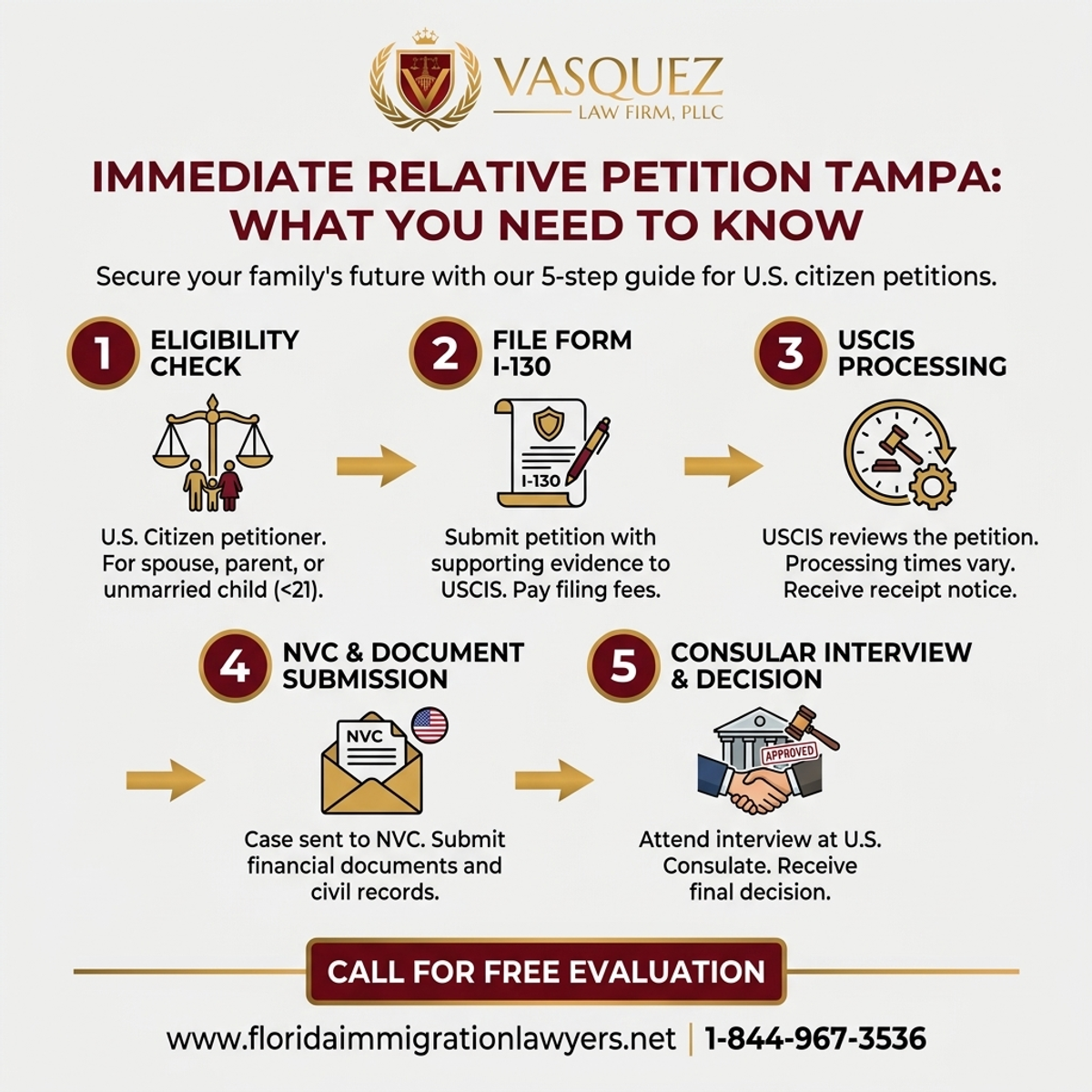
Step-by-Step Process — Immediate Relative Petition Tampa: What You Need to Know
It is important to follow each step carefully to avoid delays or rejections. Professional legal assistance can be invaluable in this process.
The geographical location within Florida typically dictates which USCIS Lockbox or Service Center will process your petition. It's crucial to consult the USCIS website for the most current filing addresses, as these can change. Submitting your petition to the wrong address can lead to significant delays, sometimes even rejection and the need to refile, incurring additional time and potentially fees.
Beyond simply mailing the documents, consider how you present your case. Organize all supporting evidence clearly, using cover letters and tabs if necessary. This meticulous approach can help USCIS officers quickly review your petition, reducing the likelihood of a Request for Evidence (RFE) due to disorganized submissions. For complex cases or those where documentation might be less straightforward, securing the assistance of Florida Immigration Lawyers can be a game-changer, ensuring every detail is perfect.
What Documents Are Needed for the I-130 Petition?
When filing Form I-130, you must include several key documents:
- Proof of U.S. citizenship (birth certificate, passport, or naturalization certificate).
- Proof of relationship (marriage certificate, birth certificates, or adoption papers).
- Photographs of both petitioner and beneficiary.
- Completed G-325A forms (if applicable).
- Any previous divorce decrees or death certificates, if relevant.
Ensure all documents are up-to-date and translated into English if necessary.
Proving a bona fide relationship is paramount, especially for marriage-based petitions. Beyond the marriage certificate, USCIS looks for evidence that the marriage is real and not solely for immigration purposes. This can include joint bank accounts, joint leases or mortgages, utility bills in both names, shared health or life insurance policies, photographs together over time, affidavits from friends and family, and even evidence of shared travel or communication.
For parent-child relationships, birth certificates linking the U.S. citizen to the parent are typically sufficient, but if the relationship is through adoption, official adoption decrees are required. It's also vital to include certified copies of any divorce decrees or death certificates for prior marriages of either the petitioner or the beneficiary, proving that all previous marriages have been legally terminated. Any document not in English must be accompanied by a certified English translation, a detail often overlooked but critical for petition acceptance.
What is the Timeline for an Immediate Relative Petition?
The timeline for an immediate relative petition can vary based on several factors. As of 2026, here’s what you can generally expect:
| Stage | Typical Timeframe | Notes |
|---|---|---|
| Filing I-130 | 2-4 weeks | Receive receipt notice |
| USCIS Processing | 5-12 months | Depends on service center |
| Consular Processing (if applicable) | 3-6 months | Varies by consulate |
| Total Time | 8-18 months | Variable based on circumstances |
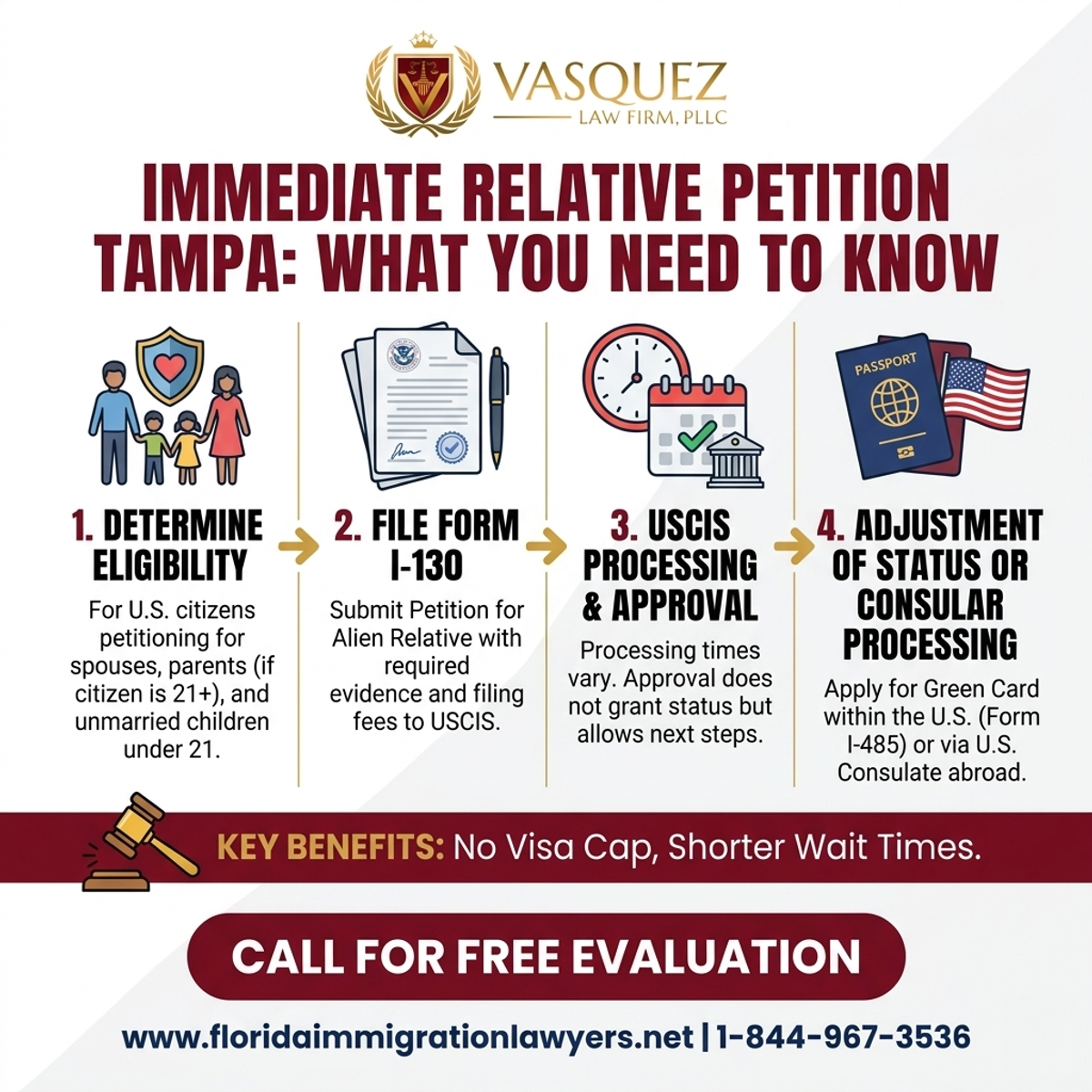
Key Statistics — Immediate Relative Petition Tampa: What You Need to Know
These timeframes are estimates and can change. Checking with USCIS regularly is advised.
What are the Costs Involved in the I-130 Process?
The costs associated with filing an I-130 petition can vary. Here’s a breakdown:
| Item | Typical Fee | Notes |
|---|---|---|
| Form I-130 | Check USCIS website | Subject to change |
| Attorney Fees | Varies | Depends on complexity |
| Translation/Notary Services | Varies | If necessary |
Fees are subject to change, and it’s important to verify current rates on the USCIS website.
Middle CTA
Do not navigate this process alone. Contact Florida Immigration Lawyers today.
Common Mistakes to Avoid
- Incomplete Forms: Missing information can lead to delays.
- Incorrect Fees: Paying the wrong amount can result in rejection.
- Insufficient Documentation: Failing to provide adequate evidence of relationship can lead to denial.
- Not Updating USCIS: Failing to inform USCIS of address changes can lead to missed notifications.
- Ignoring Deadlines: Missing deadlines can derail the process.
- Mistakes on Forms: Errors can cause delays.
- Not Seeking Legal Help: Navigating this process without professional help can increase the risk of errors.
One of the most frequent errors is submitting an incomplete Form I-130 or failing to sign it. USCIS will reject unsigned forms or those with missing critical information, sending them back and forcing you to restart the process, losing valuable time. Similarly, incorrect filing fees, whether too much or too little, will also lead to rejection. Always double-check the current fee on the USCIS website or consult with Florida Immigration Lawyers to ensure accuracy.
Insufficient documentation of the relationship is another major pitfall, especially for marriage-based petitions. Merely submitting a marriage certificate is rarely enough; USCIS requires compelling evidence of a bona fide marital union. Failing to update USCIS with address changes can result in missed notices, RFEs, or even denial if you don't respond in time. Proactively managing your case and seeking professional advice from Florida Immigration Lawyers can help you sidestep these common issues, ensuring a smoother journey.
When to Call a Lawyer
Consider hiring an attorney if your case involves complex issues, such as prior immigration violations, criminal history, or if you need assistance with the documentation. Professional guidance can help avoid costly mistakes and ensure your petition is handled efficiently. Florida Immigration Lawyers are here to assist you with your immigration needs.
While some straightforward cases might seem manageable alone, the complexities of immigration law often warrant professional intervention. If either the petitioner or beneficiary has a criminal history, previous immigration violations (like overstaying a visa or prior deportations), or if there are any doubts about the authenticity of the relationship (e.g., a large age gap, cultural differences, or a short marriage), legal counsel becomes indispensable.
An experienced immigration attorney can identify potential red flags early, help gather robust evidence, and prepare you for interviews, significantly increasing your chances of a successful outcome. Florida Immigration Lawyers possess deep expertise in navigating these intricate scenarios, providing peace of mind and strategic representation. Our team at 1-844-YO-PELEO is ready to assess your unique situation and provide the guidance needed to protect your family's future.
About Florida Immigration Lawyers
Florida Immigration Lawyers is dedicated to providing comprehensive immigration services to residents of Central Florida and beyond. Our experienced attorneys are ready to assist with family immigration, deportation defense, asylum, and more. Available 24/7, we offer free case reviews and are committed to serving the diverse needs of our community. Schedule a free consultation or explore our immigration practice areas today.
Sources and References
- U.S. Citizenship and Immigration Services (USCIS)
- Executive Office for Immigration Review (EOIR)
- 8 U.S.C. Chapter 12 - Immigration and Nationality Act
Related services: family petition process, family-based green cards, fiancé visa (K-1), marriage-based immigration.
This article provides general legal information and is not intended as legal advice. Every case is unique, and outcomes depend on specific facts and circumstances. Contact an attorney for advice about your particular situation.
Final CTA
For expert guidance on your immigration journey, contact Florida Immigration Lawyers at 1-844-YO-PELEO. Se Habla Español - Estamos aquí para ayudarle.
If you need legal assistance, learn more about experienced family immigration attorneys, or call us at 1-844-967-3536 for a free case review.
Do Not Navigate This Process Alone
Our experienced immigration attorneys are ready to fight for you. Get a free, confidential case review today.
Se Habla Español
Or leave your details and we’ll call you:
Free Evaluation in 24 Hours
Or talk to us right now

AI voice assistant — available 24/7
FreeFrequently Asked Questions

William J. Vásquez
Founding Attorney · Vasquez Law Firm
U.S. Air Force veteran and immigration attorney with years of hands-on U.S. immigration experience. J.D., NCCU School of Law. AILA member. Admitted to the 4th, 5th, and 11th Circuit Courts.
Available 24/7 - Free Evaluations
Reviewed for legal accuracy by William J. Vásquez
Licensed in North Carolina; U.S. immigration is federal practice.
Related Legal Services
Our Florida immigration attorneys can help you with experienced immigration attorneys, asylum protection and citizenship and naturalization. Call today at 1-844-YO-PELEO for a free case review.
Related Links
Related Topics
Free Legal Case Review
Discuss your case with our experienced attorneys. We're available 24/7.
Se Habla Español - Estamos aquí para ayudarle.
Related Articles
EB-5 Investor Green Card in Florida: A 2026 Guide
Explore how to obtain an EB-5 investor green card in Florida. Learn about the investment requirements, processes, and benefits of participating in this program. Discover how Florida's economic landscape can be an ideal setting for your investment. Contact Florida Immigration Lawyers for a free case review.
Certificate of Eligibility for Expungement in Florida 2026
For non-U.S. citizens in Florida, understanding how a state expungement impacts immigration status is critical. A certificate of eligibility for expungement in Florida allows a criminal record to be sealed or expunged under state law. However, federal immigration agencies often disregard such state-level relief, still considering the original criminal offense as a conviction for immigration purposes. This can have severe implications for visa applications, green card eligibility, naturalization, and even lead to deportation. This guide clarifies the Florida expungement process, its limited effect on federal immigration law, and key steps to protect your status in 2026. Learn about common mistakes, required documents, timelines, and when to seek expert legal counsel from Florida Immigration Lawyers to navigate these complex issues effectively.
Immigration Lawyer Orlando Free Consultation in Florida
For individuals and families in Orlando, Florida, navigating the complexities of U.S. immigration law requires expert guidance. An immigration lawyer in Orlando offers crucial support for everything from visa applications and green card processes to naturalization and deportation defense. This comprehensive guide details what a free consultation covers, providing a step-by-step overview of immigration pathways, essential document checklists, and expected timelines in 2026. We also highlight common mistakes to avoid, discuss the critical role of legal counsel in deportation and asylum cases, and explain why choosing a local Orlando immigration attorney is beneficial. Florida Immigration Lawyers is dedicated to serving the diverse community of Orlando with compassionate, effective legal solutions, ensuring you receive personalized advice and robust representation for a successful immigration journey.
Immigration Lawyer in Central Florida 2026 Guide
Explore the importance of hiring an immigration lawyer in Central Florida. Learn about services, timelines, and tips to avoid common mistakes. Contact Florida Immigration Lawyers for expert advice.