Updated Form I-864 Affidavit of Support in Florida 2026
The Form I-864, Affidavit of Support, is a vital document for many immigrants seeking lawful permanent residency in Florida. As of 2026, sponsors must meet strict income requirements, typically 125% of the Federal Poverty Guidelines, to demonstrate financial capability. This legally binding contract ensures the immigrant will not become a public charge, requiring meticulous preparation and accurate documentation, including tax returns and employment verification. Our comprehensive guide covers who needs to file, income calculations, required documents, processing timelines, and cost factors. Learn to avoid common mistakes and understand when legal assistance from an experienced Florida immigration lawyer is essential for a smooth application process. Florida Immigration Lawyers offers free consultations to guide you through every step.
The Form I-864, Affidavit of Support, is a legally binding contract required for most family-based immigrants and some employment-based immigrants to demonstrate they will not become a public charge in the United States. As of 2026, the sponsor must meet specific income requirements, typically 125% of the Federal Poverty Guidelines for their household size, unless they are on active duty in the U.S. armed forces. This crucial document ensures the immigrant has adequate financial support, preventing reliance on government assistance. Navigating its complexities in Florida requires careful attention to detail and current regulations.
- Purpose: Legally binds a sponsor to financially support an immigrant.
- Eligibility: Sponsor must meet income thresholds (125% of poverty guidelines, or 100% for active military).
- Key Documents: Tax returns, employment verification, asset statements.
- Duration: Obligation typically lasts until the immigrant becomes a U.S. citizen or has 40 quarters of work.
- Florida Context: Domicile and local processing considerations are important for Florida residents.
Moving to the United States is a significant life event, often filled with anticipation and complex legal requirements. For many individuals pursuing family-based immigration or certain employment-based visas in Florida, one of the most critical hurdles involves demonstrating adequate financial support. This is where the Form I-864, Affidavit of Support, plays a pivotal role. This legally binding document ensures that the immigrant will not become a 'public charge,' meaning they won't primarily rely on government assistance after entering the U.S. Understanding the nuances of the I-864 Affidavit of Support is essential for both sponsors and beneficiaries in Florida.
As immigration laws and policies evolve, staying informed about the most current requirements for the I-864 Affidavit of Support, especially in 2026, is paramount. This comprehensive guide will walk you through who needs to file, the strict income requirements, necessary documentation, and potential pitfalls to avoid. Whether you are a U.S. citizen or lawful permanent resident living in Tallahassee or elsewhere in Florida, sponsoring a loved one, or an immigrant beneficiary, accurate preparation of this form is non-negotiable for a successful immigration journey. Do not navigate this intricate process alone; call Florida Immigration Lawyers at 1-844-967-3536 for a free consultation today.
What is the Purpose of the Form I-864 Affidavit of Support?
The Form I-864, Affidavit of Support, serves as a legally enforceable contract where an individual, known as the sponsor, agrees to financially support an immigrant who is seeking to become a lawful permanent resident (green card holder) of the United States. This crucial document is mandated by Section 212(a)(4) of the Immigration and Nationality Act (INA), which addresses the 'public charge' ground of inadmissibility. Its primary purpose is to ensure that immigrants do not become a financial burden on the U.S. government by relying on public assistance programs.
By signing the I-864 Affidavit of Support, the sponsor pledges to provide financial support to the intending immigrant, maintaining them at an annual income level of at least 125% of the Federal Poverty Guidelines. This obligation generally remains in effect until the immigrant becomes a U.S. citizen, has worked for 40 quarters (approximately 10 years), departs the U.S. permanently, or passes away. For Florida residents, this means a long-term commitment to the sponsored individual. Should the immigrant receive certain means-tested public benefits, the government agency providing those benefits can seek reimbursement from the sponsor. Understanding these long-term implications is vital for anyone considering signing an affidavit of support, especially given the diverse economic landscape across Florida communities like Miami, Orlando, and Tallahassee.
Who Needs to File the Form I-864 and What Are the Requirements in 2026?
As of 2026, the Form I-864 Affidavit of Support is generally required for most family-based immigrants, including immediate relatives (spouses, unmarried children under 21, and parents of U.S. citizens) and family preference immigrants. It is also required for certain employment-based immigrants where a relative filed the immigrant petition or has a significant ownership interest in the petitioning entity. Without a properly filed and approved I-864, the immigrant will likely be deemed inadmissible on public charge grounds.
The primary sponsor must be a U.S. citizen or a lawful permanent resident (green card holder), be at least 18 years of age, and be domiciled in the United States or a U.S. territory. For those living in Florida, this means your primary residence must be within the state. The sponsor must also demonstrate that their household income meets or exceeds 125% of the Federal Poverty Guidelines for their household size. For active duty U.S. military personnel petitioning for their spouse or minor children, the income requirement is reduced to 100% of the Federal Poverty Guidelines. If the primary sponsor's income is insufficient, a joint sponsor may be required, or the sponsor can use assets to make up the difference. The process is stringent, designed to protect both the immigrant and the public interest.
Key Sponsor Eligibility Criteria:
- Citizenship/Residency: Must be a U.S. citizen or Lawful Permanent Resident.
- Age: Must be at least 18 years old.
- Domicile: Must reside in the U.S. or a U.S. territory. For Florida residents, this means proof of your Florida address.
- Income: Must meet 125% of Federal Poverty Guidelines (or 100% for active military sponsoring spouse/child).
- Relationship: Must be the petitioner or a joint sponsor.
How Do I Calculate My Income for the I-864 Affidavit of Support?
Calculating your household income for the I-864 Affidavit of Support involves more than just looking at your last paycheck. As of 2026, USCIS considers your total household income, which includes your gross income (before taxes and deductions) from your most recent federal income tax return, as well as income from other household members who are willing to combine their income with yours and are related by birth, marriage, or adoption. This calculation is crucial to determine if you meet the 125% (or 100% for military) Federal Poverty Guidelines.
First, identify your household size. This includes yourself, the intending immigrant(s), any dependents listed on your most recent tax return, and any other individuals you have previously sponsored on an I-864 who are still under obligation. For example, a sponsor in Tallahassee petitioning for their spouse and two minor children would have a household size of four. Once your household size is determined, you compare your total household income to the corresponding Federal Poverty Guidelines for that year, which are updated annually. If your income falls short, you may include the value of significant assets, such as real estate (excluding your primary residence, up to a certain value), bank accounts, or stocks, which must be readily convertible to cash within one year and be at least five times the difference between your income and the poverty guideline. A joint sponsor, who must also meet all eligibility criteria, can also combine their income if necessary.
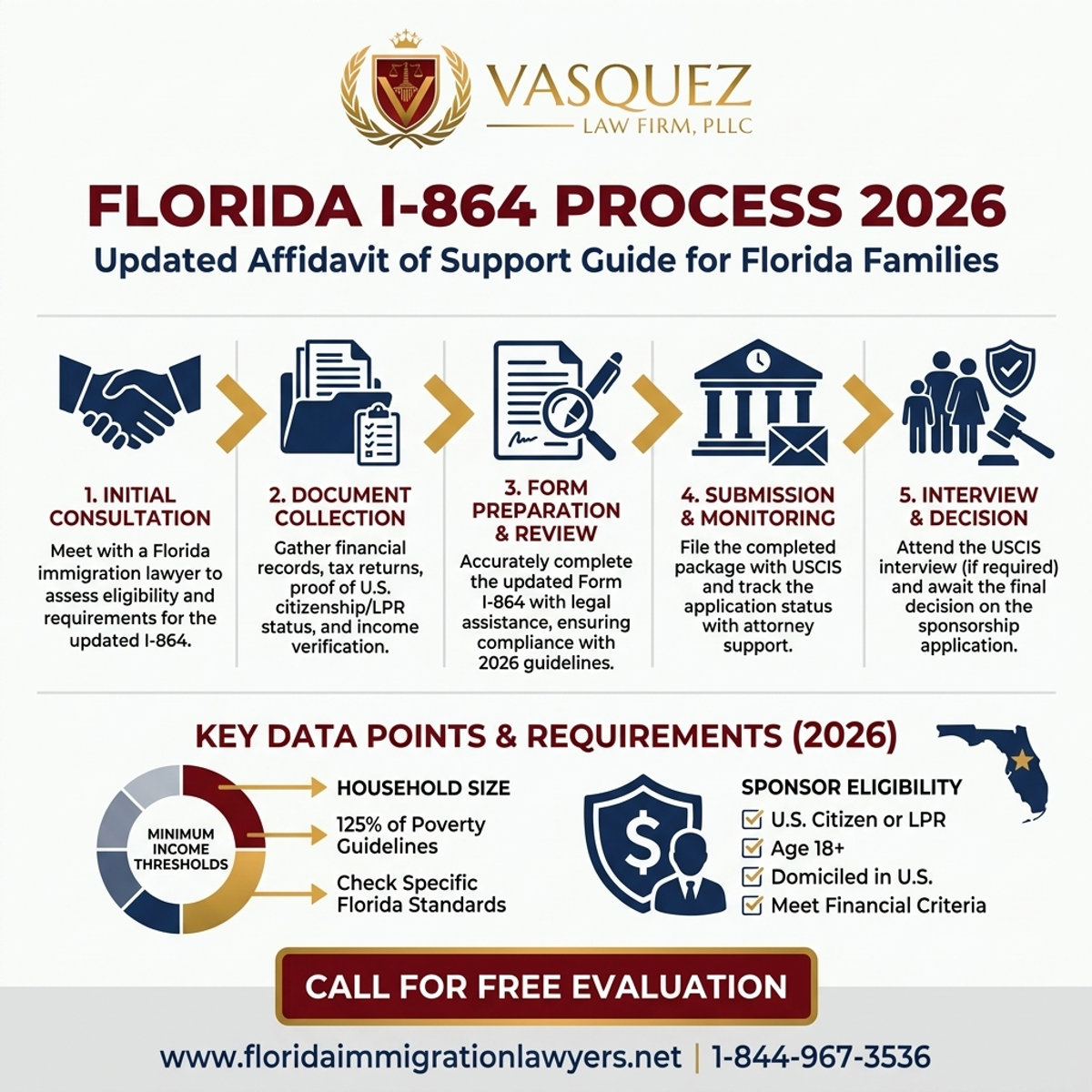
Step-by-Step Process — Updated Form I-864 Affidavit of Support in Florida 2026
What Documents Are Required for the I-864 Affidavit of Support?
Submitting a complete and accurate set of documents is paramount when filing the I-864 Affidavit of Support. As of 2026, USCIS requires a comprehensive package to verify the sponsor's financial capability and eligibility. Missing or incorrect documentation is a leading cause of delays or rejections for applicants across Florida and beyond. Carefully gathering these items will streamline your immigration process.
The core documents include your most recent federal income tax return (Form 1040) with all supporting schedules, W-2s, and/or 1099s. If you were not required to file a tax return, you must provide a detailed explanation. You will also need current employment verification, such as a letter from your employer stating your position, salary, and duration of employment, along with recent pay stubs. For those using assets to meet the income requirement, bank statements, property deeds, and stock certificates are necessary. Any joint sponsor or household member whose income is being used must also provide their tax returns and proof of income. Ensure all copies are clear and legible. This detailed checklist helps ensure compliance with immigration regulations in Florida, whether you're filing through the National Benefits Center or a local USCIS office.
I-864 Document Checklist:
- Completed and signed Form I-864 (or I-864EZ, I-864W, I-864A, as applicable).
- Copy of your most recent Federal Income Tax Return (Form 1040) with all schedules.
- Copies of all W-2s and/or 1099s for the most recent tax year.
- Proof of current employment (e.g., employment verification letter, recent pay stubs).
- Proof of U.S. citizenship or lawful permanent resident status (e.g., birth certificate, U.S. passport, green card).
- Proof of domicile in the U.S. (e.g., utility bills, driver's license for Florida residents).
- For joint sponsors or household members: Form I-864A (Contract Between Sponsor and Household Member) and their respective tax returns/income proof.
- If using assets: Documentation proving ownership, location, and value (e.g., bank statements, property appraisals).
- Any other evidence requested by USCIS or the Department of State.
What is the Timeline and Processing Expectation for Form I-864?
The processing timeline for the Form I-864 Affidavit of Support itself doesn't have a standalone timeframe, as it's part of a larger immigration application. As of 2026, its review is integrated into the overall processing of the immigrant visa or adjustment of status application. The efficiency of this review heavily depends on the completeness and accuracy of the submitted documentation. Any requests for additional evidence (RFEs) can significantly prolong the process for applicants in Florida and nationwide.
For immigrant visa applications processed at a U.S. consulate abroad, the National Visa Center (NVC) typically reviews the I-864 and supporting documents before forwarding the case to the embassy or consulate for the interview. This NVC review can take several months. For adjustment of status applications filed with USCIS within the U.S., the I-864 is reviewed as part of the Form I-485 application. USCIS processing times vary widely by service center and case type, and these can be checked on the USCIS website. Ensuring that your affidavit of support is perfect from the outset can prevent delays that might otherwise add months to your loved one's journey to Florida.
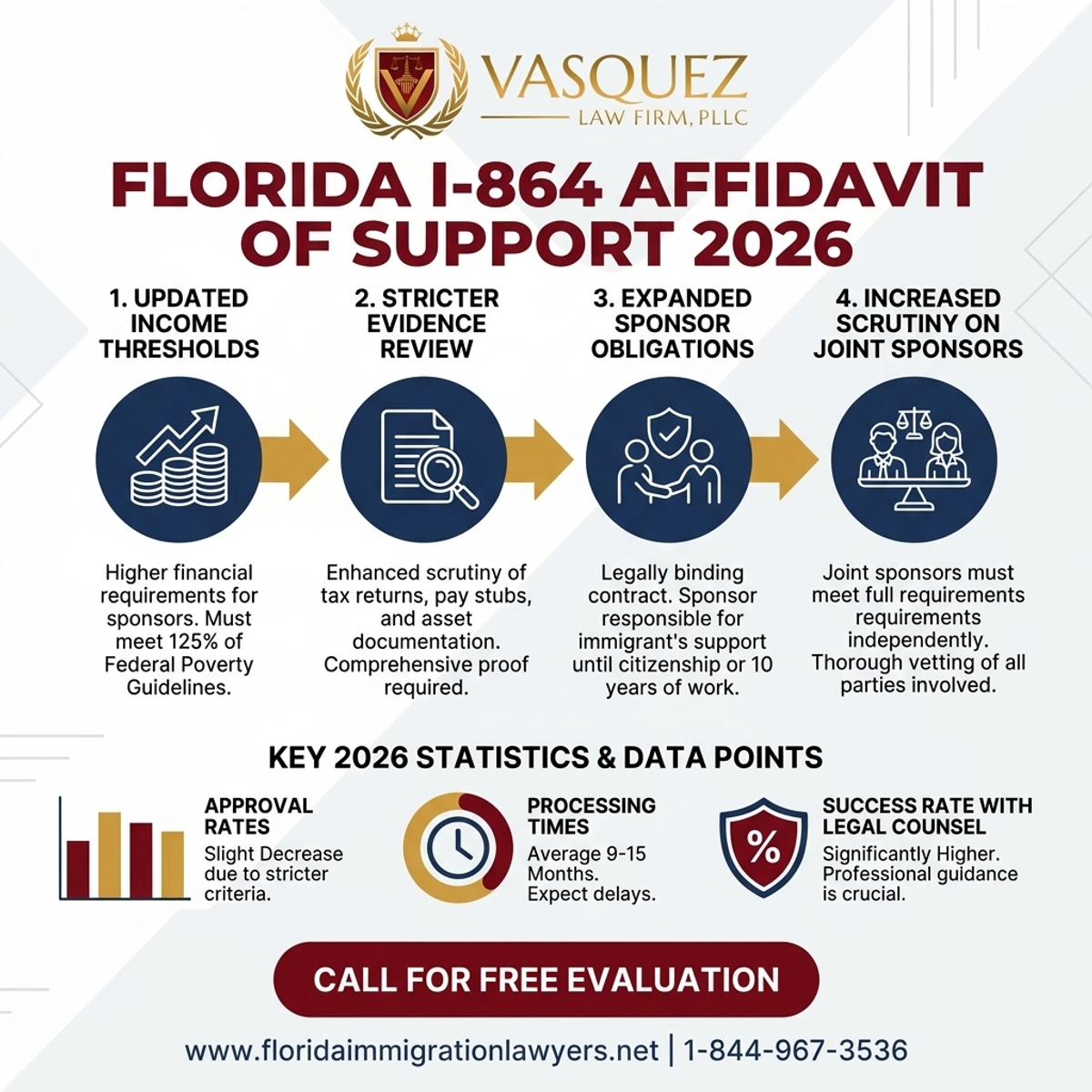
Key Statistics — Updated Form I-864 Affidavit of Support in Florida 2026
| Stage | Typical Timeframe (As of 2026) | Notes |
|---|---|---|
| Sponsor Preparation & Document Gathering | 2-4 weeks | Collecting tax returns, employment letters, asset proofs. |
| National Visa Center (NVC) Review (for Consular Processing) | 2-6 months | Initial review of I-864 and civil documents. RFEs can extend this. |
| USCIS Review (for Adjustment of Status) | Varies (6-24+ months) | Integrated into I-485 processing. Depends on service center workload. |
| Interview (Consular or USCIS) | 1-2 months after NVC/USCIS review | Sponsor may be asked questions about the I-864. |
| Final Decision | Immediately post-interview or within weeks | Approval of green card/immigrant visa. |
What Are the Cost Factors for Filing an I-864 Affidavit of Support?
Fortunately, there is no separate filing fee for the Form I-864 Affidavit of Support itself when submitted to USCIS or the Department of State. The costs associated with this form are typically indirect, stemming from the overall immigration application process. However, it's important to budget for potential related expenses that can arise during the preparation and submission of the affidavit of support, especially for residents in Florida.
While the form itself is free, you may incur costs for obtaining necessary supporting documents. These could include fees for requesting official tax transcripts from the IRS, securing certified copies of birth or marriage certificates, or paying for professional translations of foreign documents if applicable. Furthermore, if your financial situation is complex or if you require a joint sponsor, consulting with an experienced immigration attorney is a wise investment to ensure all requirements are met correctly. An attorney can help you understand the Federal Poverty Guidelines, calculate your income accurately, and prepare a robust application, potentially saving you significant time and preventing costly delays or denials. Florida Immigration Lawyers offers free consultations to discuss your specific situation and potential legal fees. This proactive approach can be particularly beneficial in a state with a large immigrant population like Florida, where many different scenarios may arise.
| Item | Typical Fee (As of 2026) | Notes |
|---|---|---|
| Form I-864 Filing Fee | $0 | No direct fee for the form itself. |
| IRS Tax Transcripts | $0 (if requested directly from IRS) | Necessary for proof of income. |
| Certified Copies of Documents | Varies ($10-$30 per document) | Birth certificates, marriage licenses, etc., from state/local agencies. |
| Document Translation Services | Varies ($20-$50+ per page) | If documents are not in English, certified translations are required. |
| Immigration Attorney Consultation/Services | Varies (Free initial consult, then hourly/flat fees) | Highly recommended for complex cases or ensuring accuracy. |
Do not navigate this process alone. The complexities of the I-864 Affidavit of Support and the broader immigration system can be daunting. Contact Florida Immigration Lawyers today at 1-844-967-3536 for a free consultation to discuss your specific needs and ensure a smooth application process.
Common Mistakes to Avoid with the I-864 Affidavit of Support
The I-864 Affidavit of Support is a critical document, and even minor errors can lead to significant delays or even denial of an immigration petition. Avoiding these common mistakes is crucial for a successful outcome, especially for those navigating the process in Florida's busy immigration landscape.
- Incorrect Household Size Calculation: Miscalculating the number of individuals dependent on the sponsor can lead to failing the income requirement. Ensure all sponsored immigrants, dependents, and previously sponsored individuals are counted.
- Insufficient Income: Simply meeting the poverty line is not enough; sponsors must meet 125% of the Federal Poverty Guidelines (or 100% for specific military cases). Failing to meet this threshold without a qualified joint sponsor or sufficient assets will result in a denial.
- Missing or Outdated Tax Returns: USCIS requires the most recent federal income tax return, including all schedules and W-2s/1099s. Submitting only the 1040 form or older returns is a common mistake.
- Failure to Prove Domicile: The sponsor must prove they are domiciled in the U.S. or a U.S. territory. Florida residents must provide clear evidence of their residence in the state, such as a driver's license or utility bills.
- Incomplete Form I-864A for Household Members: If a household member's income is being used, they must also complete and sign Form I-864A, Contract Between Sponsor and Household Member. Forgetting this form is a frequent oversight.
- Not Providing Certified Translations: Any supporting documents not in English must be accompanied by a certified English translation. Uncertified translations will be rejected.
- Unsigned Forms: All required forms, including the I-864 and I-864A, must be properly signed by the sponsor and any household members. Digital or unsigned forms are unacceptable.
- Using Estimated Income: USCIS wants proof of past income, primarily through tax returns. Relying solely on future income projections without substantial current proof can be problematic.
- Ignoring Public Charge Rule Updates: While some changes have been rescinded, the underlying public charge inadmissibility ground remains. Staying updated on current policies, especially as of 2026, is vital.
- Not Utilizing a Joint Sponsor When Necessary: If the primary sponsor's income is insufficient, proactively seeking a qualified joint sponsor can prevent delays. Waiting for an RFE can add months to the process.
When to Call a Florida Immigration Lawyer for Your I-864 Affidavit of Support
While the instructions for the I-864 Affidavit of Support seem straightforward, the consequences of errors can be severe, potentially leading to delays, Requests for Evidence (RFEs), or even denial of a green card application. If you are in Florida and encounter any of the following scenarios, it is highly advisable to seek legal guidance from an experienced immigration attorney at Florida Immigration Lawyers:
- Your income is borderline or below the required 125% of the Federal Poverty Guidelines.
- You need to use assets to meet the income requirement, which can be complex to document.
- You require a joint sponsor, or you are acting as a joint sponsor, and need to understand the liabilities.
- You have a complex financial situation, such as self-employment, fluctuating income, or income from foreign sources.
- You have previously sponsored other immigrants, and need to understand your ongoing obligations.
- You have received a Request for Evidence (RFE) from USCIS or the NVC regarding your I-864.
- You have questions about your domicile, especially if you have lived outside the U.S. recently.
- The immigrant has received public benefits, and you are concerned about reimbursement claims.
- You are an immigrant beneficiary and are unsure if your sponsor meets the requirements.
Florida Immigration Lawyers has extensive experience with the I-864 Affidavit of Support and all aspects of family-based immigration. Our team can help you navigate these complexities, ensuring your application is complete, accurate, and compliant with all current regulations. We serve clients across Florida, including those in Tallahassee, Miami, Orlando, and Tampa.
About Florida Immigration Lawyers
Florida Immigration Lawyers is a leading immigration law firm dedicated to serving individuals and families throughout the entire state of Florida. With a deep understanding of U.S. immigration law and a commitment to our clients, we provide compassionate, effective, and results-driven legal representation. Our experienced attorneys specialize in a wide range of immigration matters, including family-based visas, adjustment of status, naturalization, asylum, and deportation defense.
We understand that immigration processes can be overwhelming and stressful. That's why we strive to make the legal journey as smooth as possible for our clients. Our firm is proud to offer bilingual services, with attorneys and staff fluent in both English and Spanish, ensuring clear and effective communication. We are available 24/7 to address your concerns and offer free consultations to help you understand your options. When you choose Florida Immigration Lawyers, you choose a partner committed to protecting your rights and achieving your immigration goals. Visit our website at floridaimmigrationlawyers.net or call us at 1-844-967-3536 to schedule your free consultation today.
Sources and References
- U.S. Citizenship and Immigration Services (USCIS) - Form I-864, Affidavit of Support
- USCIS Policy Manual - Volume 8, Part 2, Chapter 2 (Affidavit of Support)
- U.S. Department of State - National Visa Center (NVC) Processing
- 8 U.S.C. § 1182(a)(4) - Immigration and Nationality Act (INA) Section 212(a)(4) - Public Charge
- 8 CFR § 213a - Affidavits of Support on Behalf of Immigrants
- Federal Poverty Guidelines, U.S. Department of Health and Human Services (HHS)
Related services: immigration practice areas, family immigration services, citizenship and naturalization.
This article provides general legal information and is not intended as legal advice. Every case is unique, and outcomes depend on specific facts and circumstances. Contact an attorney for advice about your particular situation.
Navigating the complexities of the I-864 Affidavit of Support is a critical step in many immigration journeys. Ensure your application is handled with precision and care. For expert legal assistance with your immigration case in Florida, contact Florida Immigration Lawyers at 1-844-967-3536 for a free consultation. Se Habla Espanol - Estamos aqui para ayudarle.
If you need legal assistance, learn more about get immigration legal help today, or call us at 1-844-967-3536 for a free consultation.
Do Not Navigate This Process Alone
Our experienced immigration attorneys are ready to fight for you. Get a free, confidential consultation today.
Se Habla Español
Or leave your details and we’ll call you:
Free Evaluation in 24 Hours
Or talk to us right now
AI voice assistant — available 24/7
FreeFrequently Asked Questions

William J. Vásquez
Founding Attorney · Vasquez Law Firm
U.S. Air Force veteran and immigration attorney with years of hands-on U.S. immigration experience. J.D., NCCU School of Law. AILA member. Admitted to the 4th, 5th, and 11th Circuit Courts.
Available 24/7 - Free Evaluations
Reviewed for legal accuracy by William J. Vásquez
Licensed in North Carolina; U.S. immigration is federal practice.
Related Legal Services
Our Florida immigration attorneys can help you with asylum protection, deportation defense and citizenship and naturalization. Call today at 1-844-967-3536 for a free consultation.
Related Links
Related Topics
Free Legal Consultation
Discuss your case with our experienced attorneys. We're available 24/7.
Se Habla Español - Estamos aquí para ayudarle.
Related Articles
Immigration Lawyer Orlando Free Consultation 2026
Discover how to find an immigration lawyer in Orlando offering a free consultation. Understand the services available and why choosing Florida Immigration Lawyers can make a difference in your case.
Military Naturalization Expedited in Florida Bases
Explore military naturalization options for families at Florida bases, including parole in place benefits in Miami. Learn how to expedite your application with expert guidance from Florida Immigration Lawyers.
K-3 Visa Timeline in Florida: What to Expect
Learn the K-3 visa timeline process in Florida, including steps, costs, and documentation. Understand your options in 2026 with guidance from Florida Immigration Lawyers.
TPS Eligibility in Florida 2026: What You Need to Know
For Florida residents, understanding Temporary Protected Status (TPS) in 2026 is crucial for temporary legal relief. This comprehensive guide details TPS eligibility, designated countries, and the application process, focusing on the unique challenges in Florida's evolving immigration landscape. Learn about the step-by-step application, required documents, processing timelines, and associated costs. We also highlight common mistakes to avoid and when it's critical to seek professional legal assistance. With potential policy changes and strict deadlines, having expert guidance is paramount. Florida Immigration Lawyers offers free consultations to help you protect your status and navigate these complexities.