TPS Eligibility in Florida 2026: What You Need to Know
For Florida residents, understanding Temporary Protected Status (TPS) in 2026 is crucial for temporary legal relief. This comprehensive guide details TPS eligibility, designated countries, and the application process, focusing on the unique challenges in Florida's evolving immigration landscape. Learn about the step-by-step application, required documents, processing timelines, and associated costs. We also highlight common mistakes to avoid and when it's critical to seek professional legal assistance. With potential policy changes and strict deadlines, having expert guidance is paramount. Florida Immigration Lawyers offers free consultations to help you protect your status and navigate these complexities.

Temporary Protected Status (TPS) provides a temporary safe haven for eligible foreign nationals in the United States who cannot safely return to their home countries due to ongoing armed conflict, environmental disaster, or other extraordinary and temporary conditions. As of 2026, eligibility is contingent upon the U.S. Secretary of Homeland Security's designation of specific countries, which is reviewed periodically. For Florida residents, meeting the criteria involves continuous physical presence in the U.S. since the last designation date and applying within the registration period. TPS offers work authorization and protection from deportation, but it does not lead directly to permanent residency.
- TPS offers temporary protection from deportation and work authorization.
- Eligibility depends on country designation and continuous U.S. presence.
- Designated countries and deadlines are subject to change by DHS.
- Re-registration is crucial to maintain TPS benefits.
- Consulting an immigration lawyer is vital for complex cases.
Introduction: Understanding Temporary Protected Status (TPS) in Florida for 2026
Navigating the complexities of U.S. immigration law can be a daunting challenge, especially when seeking temporary relief from unstable conditions in your home country. For many individuals and families residing in Florida, understanding Temporary Protected Status (TPS) is a critical step towards securing a temporary legal foothold in the United States. TPS offers a lifeline, preventing deportation and providing work authorization for foreign nationals from specific countries deemed unsafe for return.
As we look to 2026, the landscape of immigration policy continues to evolve. Recent discussions around visa bonds and increased enforcement underscore the importance of staying informed and seeking expert legal guidance. This comprehensive guide will explain what TPS is, which countries may be eligible for designation in 2026, the application process for Florida residents, and crucial mistakes to avoid. Our goal is to empower you with the knowledge to protect your status and navigate this vital program effectively.
If you are a Florida resident seeking to understand your TPS options or need assistance with an application, do not hesitate to reach out. Call Florida Immigration Lawyers at 1-844-967-3536 for a free consultation. We are here to help you understand your eligibility and guide you through every step of the process.
What is Temporary Protected Status (TPS) and Who is Eligible in Florida?
Temporary Protected Status (TPS) is a humanitarian immigration benefit provided by the United States government. It allows eligible foreign nationals from certain countries experiencing ongoing armed conflict, environmental disasters, or other extraordinary and temporary conditions to live and work legally in the U.S. for a designated period. This status protects individuals from deportation and grants them the ability to apply for work authorization, often referred to as an Employment Authorization Document (EAD).
Eligibility for TPS is determined by several factors, including your nationality, your continuous physical presence in the United States since a specific date, and your ability to meet certain admissibility requirements. As of 2026, the U.S. Secretary of Homeland Security designates countries for TPS based on prevailing conditions. Individuals must generally have been present in the U.S. on the date the country was designated and have maintained continuous physical presence and continuous residence. For Florida residents, this means that even if your country is designated, you must still meet all individual eligibility criteria, including criminal background checks and other security screenings. It is not a path to a green card, but it provides essential temporary relief.
The Legal Basis for TPS
TPS is authorized under Section 244 of the Immigration and Nationality Act (INA), found at 8 U.S.C. § 1254a. This statute outlines the conditions under which the Secretary of Homeland Security can designate a country for TPS. Regulations governing TPS applications are detailed in 8 CFR Part 244. These legal frameworks ensure that the program operates within defined parameters, providing a consistent approach to humanitarian relief while maintaining national security. Understanding these foundational legal principles is crucial for anyone considering a TPS application.
Which Countries Are Designated for TPS in 2026?
As of 2026, the list of countries designated for Temporary Protected Status (TPS) is subject to review and potential extension or termination by the Secretary of Homeland Security. While specific designations can change, countries like Honduras have historically been, and may continue to be, designated due to ongoing conditions. Other countries that have previously held or may hold TPS status include El Salvador, Nicaragua, Haiti, Sudan, South Sudan, Nepal, Syria, Venezuela, and Afghanistan, among others. It is critical for Florida residents to consult the official USCIS website for the most current list of designated countries and their respective registration periods, as these can be updated frequently.
The decision to designate or extend TPS for a country is based on a thorough assessment of conditions such as armed conflict, environmental disasters like earthquakes or hurricanes, or other extraordinary circumstances that prevent a safe return. For example, if Honduras continues to face significant challenges related to natural disasters or political instability in 2026, its TPS designation may be extended. Conversely, if conditions are deemed to have improved sufficiently, a country's designation could be terminated. This dynamic nature of TPS designations means that applicants in Florida must remain vigilant about official announcements and deadlines. The U.S. Department of State also provides country-specific information that informs these designations.
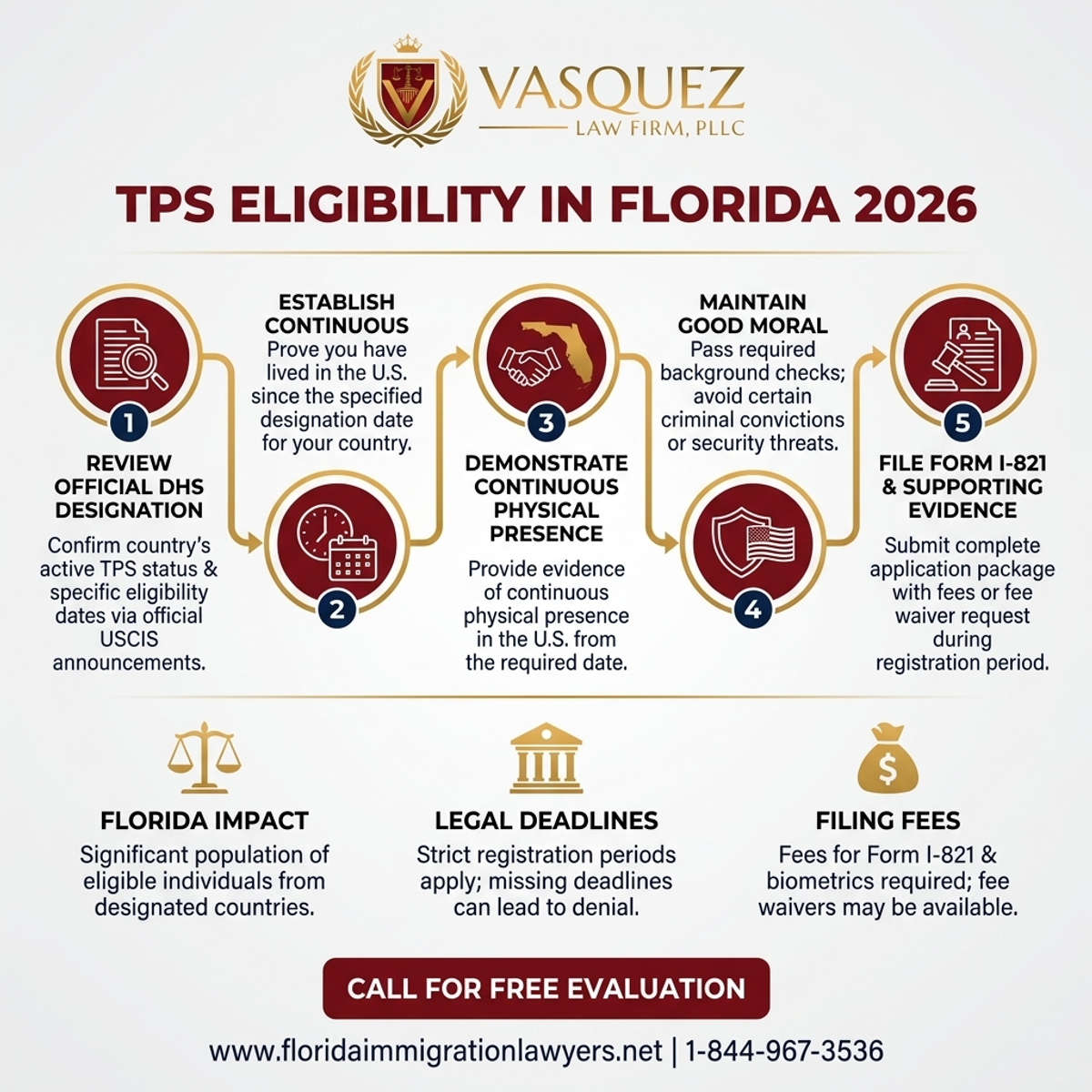
Step-by-Step Process — TPS Eligibility in Florida 2026: What You Need to Know
Impact on Florida's Diverse Communities
Florida is home to a vibrant and diverse immigrant population, with significant communities from many TPS-designated countries, including a large number of Honduran nationals. For these residents, especially those in areas like Jacksonville, Miami, and Orlando, the status of TPS designations directly impacts their lives and futures. An extension offers continued stability, allowing individuals to work and contribute to Florida's economy without fear of deportation. A termination, however, can create immense uncertainty and pressure, potentially forcing individuals into difficult decisions about their presence in the U.S. or seeking other forms of relief. Staying informed through reliable legal channels is paramount for these communities.
How Do I Apply for TPS in Florida? A Step-by-Step Guide
Applying for Temporary Protected Status (TPS) in Florida involves a detailed process that requires careful attention to deadlines and documentation. As of 2026, the general application steps remain consistent, though specific forms and fees can be updated by USCIS. The process typically begins with filing Form I-821, Application for Temporary Protected Status, and often concurrently Form I-765, Application for Employment Authorization, to obtain a work permit. Additionally, some applicants may need to file Form I-601, Application for Waiver of Grounds of Inadmissibility, if specific issues arise.
It is crucial to file your application within the designated registration period for your country, which is usually published on the USCIS website. Missing this deadline can result in denial. After submitting your forms and fees, you will typically receive a receipt notice, followed by an appointment for biometrics (fingerprints and photos) at a local Application Support Center (ASC), such as those serving Jacksonville, Orlando, or Miami. USCIS will then review your application, which may involve background checks and security screenings. Following this, you will receive a decision notice regarding your TPS application. For those in Florida, understanding these steps is essential for a successful application.
- Determine Eligibility: Confirm your nationality is from a currently designated TPS country and that you meet the continuous physical presence and continuous residence requirements in the U.S. as of the specified dates for your country's designation.
- Gather Required Documents: Collect all necessary identity, nationality, residence, and entry documents. This includes passports, birth certificates, proof of U.S. residence, and any other supporting evidence.
- Complete Forms I-821 and I-765: Fill out Form I-821, Application for Temporary Protected Status, and Form I-765, Application for Employment Authorization (if you need a work permit). Ensure all sections are completed accurately and truthfully.
- Pay Filing Fees: Submit the required filing fees for Form I-821, Form I-765 (unless you qualify for a fee waiver), and the biometrics services fee. Fees are subject to change, so verify the current amounts on the USCIS fee schedule.
- Mail Your Application: Send your complete application package to the correct USCIS lockbox facility. The mailing address depends on your state of residence (Florida in this case) and the form you are filing. Check USCIS instructions carefully.
- Attend Biometrics Appointment: After filing, you will receive an appointment notice for biometrics at an Application Support Center. This involves capturing fingerprints, photographs, and a signature. Ensure you attend this appointment.
- Respond to Requests for Evidence (RFE): USCIS may send an RFE if they need additional information or clarification. Respond promptly and thoroughly to avoid delays or denial.
- Receive Decision: USCIS will mail you a decision notice regarding your TPS application. If approved, you will receive an approval notice and, if applicable, your Employment Authorization Document (EAD).
What Documents Do I Need for a TPS Application?
A successful Temporary Protected Status (TPS) application in Florida hinges on submitting a comprehensive set of documents that prove your identity, nationality, and continuous presence in the United States. As of 2026, the requirements typically include primary identity documents, evidence of your nationality from a designated country, and extensive proof of your physical presence in the U.S. since the specified eligibility date. Failing to provide adequate documentation can lead to delays, Requests for Evidence (RFEs), or even denial of your application. It is advisable to organize all documents clearly and provide certified translations for any non-English records.
Beyond basic identity, you must demonstrate that you have continuously resided in the U.S. since the date specified for your country's TPS designation. This often requires accumulating a variety of records over an extended period. For instance, if you have been living in Jacksonville, Florida, since 2015, you would need documentation spanning from that time to the present. Gathering these documents can be time-consuming, so it is best to start early and seek legal assistance to ensure your submission is complete and robust. The more evidence you can provide, the stronger your case for meeting the eligibility criteria.
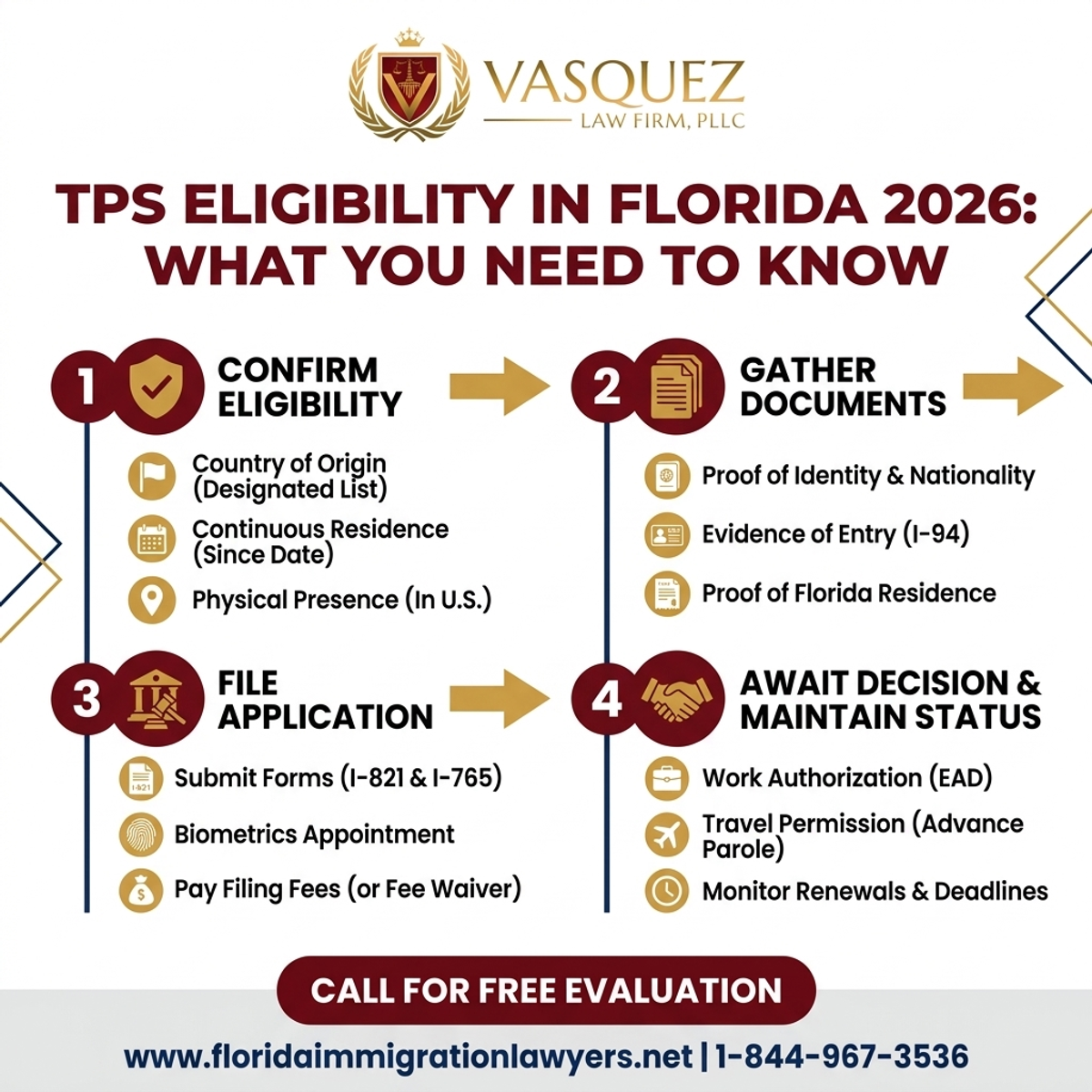
Key Statistics — TPS Eligibility in Florida 2026: What You Need to Know
- Passport or national identity card from your country of origin.
- Birth certificate with photo identification.
- Any U.S. immigration document (e.g., I-94 Arrival/Departure Record, previous EAD, visa).
- Proof of continuous physical presence in the U.S. since the designated date (e.g., utility bills, rent receipts, school records, employment records, medical records, bank statements, affidavits from friends/employers).
- Marriage certificate (if applicable).
- Divorce decree (if applicable).
- Proof of any name change (if applicable).
- Two passport-style photos.
- Any criminal records or court dispositions (if applicable).
- Evidence of any previous immigration applications or proceedings.
What is the Timeline and Processing Expectation for TPS Applications in 2026?
The timeline for Temporary Protected Status (TPS) applications in 2026, particularly for residents in Florida, can vary significantly based on USCIS caseloads, the complexity of individual cases, and current processing priorities. As of this year, applicants should generally prepare for processing times that could range from several months to over a year from the initial filing date. While some straightforward cases may be resolved more quickly, others requiring additional review or Requests for Evidence (RFEs) will naturally take longer. It is important to manage expectations and understand that there is no guaranteed processing time.
USCIS endeavors to process applications efficiently, but the volume of applications and the need for thorough background checks can lead to delays. The USCIS website provides estimated processing times, which are regularly updated and can give applicants a general idea of what to expect. For those in Florida, particularly in areas served by the Orlando, Miami, or Jacksonville Field Offices, specific local factors might also influence processing. During this waiting period, applicants are generally protected from deportation and, if they applied for an EAD, may receive an interim work authorization in certain circumstances. Continuous communication with your legal counsel is vital during this phase.
| Stage | Typical Timeframe (As of 2026) | Notes |
|---|---|---|
| Application Filing | Immediate | Must be within designated registration period. |
| Receipt Notice | 2-4 weeks | Confirmation that USCIS received your application. |
| Biometrics Appointment | 4-8 weeks after receipt | Scheduled at a local Application Support Center (ASC). |
| Request for Evidence (RFE) | Variable (if issued) | Requires prompt and thorough response, adds processing time. |
| Interview (rare for initial TPS) | Variable (if required) | More common for re-registration or complex cases. |
| Decision on I-821 (TPS) | 6-18 months | Can vary based on case complexity and USCIS workload. |
| Decision on I-765 (EAD) | 3-12 months | Often processed concurrently with I-821; EAD may be issued sooner. |
| EAD Delivery | 1-2 weeks after approval | Physical card delivered to your mailing address. |
What Are the Costs Associated with a TPS Application?
Applying for Temporary Protected Status (TPS) involves several government filing fees that applicants in Florida must consider. As of 2026, these fees are subject to change, but generally include a filing fee for Form I-821, Application for Temporary Protected Status, and a biometrics services fee. If you are also applying for an Employment Authorization Document (EAD) using Form I-765, there will be an additional filing fee for that form. It is important to note that USCIS does not refund filing fees, even if your application is denied, so ensuring accuracy and eligibility before filing is paramount.
While USCIS provides options for fee waivers for certain low-income applicants, not everyone qualifies. If you do not qualify for a fee waiver, you must submit the full payment with your application. Beyond the government fees, applicants in Florida should also budget for potential legal fees if they choose to hire an immigration attorney. While not mandatory, legal representation can significantly increase the chances of a successful outcome, especially for complex cases or those requiring extensive documentation. Additionally, there might be costs for obtaining necessary documents, translations, or travel to biometrics appointments. Always check the official USCIS website for current fees before submitting your application.
| Item | Typical Fee (As of 2026, check USCIS) | Notes |
|---|---|---|
| Form I-821 (TPS Application) | Varies (may be waived for initial applicants) | Required for all TPS applicants. |
| Form I-765 (EAD Application) | Varies (unless filing for fee waiver) | Required if you need a work permit. |
| Biometrics Services Fee | Varies (required for applicants 14 and older) | Covers fingerprinting and background checks. |
| Attorney Fees | Variable (e.g., $1,500 - $5,000+) | Highly recommended for expert guidance and complex cases. |
| Document Translation Costs | Variable (e.g., $20 - $50 per page) | For any non-English documents. |
| Postage/Shipping | Minimal | For sending application to USCIS. |
Navigating TPS Challenges in Florida's Immigration Landscape
The immigration landscape in Florida, like the rest of the U.S., is continually shaped by policy changes and enforcement priorities. For TPS holders and applicants, recent discussions about increased visa bond requirements and heightened immigration enforcement, as referenced in current news, underscore the need for vigilance and robust legal preparation. These policy shifts can create a more challenging environment for immigrants, making it even more crucial to ensure your TPS application is flawless and your status is consistently maintained. Understanding the local context, including operations at immigration courts like those in Orlando or Miami, is also important.
Florida's diverse population means that many TPS-eligible individuals reside throughout the state, from the bustling communities of Miami to the growing cities like Jacksonville. Changes in national immigration policy, such as those targeting asylum-seekers or increasing deportation efforts, can indirectly impact the stability and peace of mind for TPS beneficiaries. While TPS offers protection from deportation, it is a temporary status, and its future is always subject to political and humanitarian developments. This means that Florida residents holding TPS should always be exploring long-term immigration strategies with qualified legal counsel. Proactive planning and staying informed are your best defenses against an unpredictable immigration environment.
Do not navigate this complex process alone. Contact Florida Immigration Lawyers today at 1-844-967-3536 for comprehensive legal support.
Common Mistakes to Avoid in Your TPS Application
Applying for Temporary Protected Status (TPS) can be a detailed process, and even minor errors can lead to significant delays or outright denial. For Florida residents, understanding and avoiding common pitfalls is crucial to a successful application. Many of these mistakes stem from a lack of understanding of the legal requirements or insufficient attention to detail. Being meticulous and seeking professional guidance can save you time, stress, and potential legal complications.
- Missing the Registration Deadline: This is perhaps the most critical mistake. TPS has strict initial registration and re-registration periods. Missing these deadlines, even by a day, can result in an automatic denial of benefits. Always check the USCIS website for current deadlines.
- Failing to Prove Continuous Physical Presence (CPP) and Continuous Residence (CR): Applicants must provide compelling evidence that they have been physically present and continuously residing in the U.S. since the specified dates for their country's designation. Insufficient documentation for these criteria is a common reason for denial.
- Submitting Incomplete or Inaccurate Forms: Any missing information, incorrect dates, or inconsistent answers on Form I-821 or I-765 can trigger a Request for Evidence (RFE) or rejection. Double-check every field and ensure consistency with supporting documents.
- Not Paying the Correct Fees (or Forgetting a Fee Waiver Request): USCIS fees change periodically. Submitting an incorrect payment amount or failing to properly request a fee waiver (if eligible) will cause your application to be rejected or delayed. Always verify current fees on the USCIS website.
- Failing to Disclose Criminal History: Attempting to hide any arrests, charges, or convictions, even minor ones, can lead to serious consequences, including a finding of inadmissibility and denial of TPS. Always be truthful and provide certified court dispositions.
- Not Attending Biometrics Appointment: If you miss your scheduled biometrics appointment without proper rescheduling, USCIS may consider your application abandoned. It is essential to attend or reschedule promptly.
- Providing Uncertified Translations: Any document not in English must be accompanied by a complete and accurate English translation, certified by the translator. Uncertified translations are often rejected.
- Submitting Expired Documents: Ensure all identity documents, especially passports, are valid at the time of submission. Expired documents can render your application incomplete.
- Ignoring Requests for Evidence (RFEs): If USCIS sends an RFE, it means they need more information. Failing to respond fully and on time will almost certainly lead to a denial. Read RFEs carefully and address all points.
- Believing TPS is a Path to a Green Card: TPS is a temporary status and does not directly lead to permanent residency or U.S. citizenship. Misunderstanding this can lead to incorrect long-term planning.
- Not Re-registering for TPS: Even after initial approval, TPS status must be re-registered periodically to maintain benefits. Failing to re-register means losing your protected status and work authorization.
- Failing to Consult with an Experienced Immigration Attorney: Navigating TPS requirements can be complex, especially with evolving policies. An attorney can help identify potential issues, ensure proper documentation, and represent your best interests, significantly reducing the risk of mistakes.
When to Call a Lawyer for Your TPS Application in Florida
While some individuals may attempt to file a Temporary Protected Status (TPS) application independently, the complexities of immigration law and the evolving policy landscape make legal counsel invaluable, especially for Florida residents. You should strongly consider contacting an experienced immigration lawyer if your situation involves any of the following scenarios. An attorney from Florida Immigration Lawyers can provide personalized advice, help you gather the correct documentation, and navigate potential pitfalls.
It is particularly important to seek legal help if you have a criminal record, even a minor one, as this can affect your eligibility. Similarly, if you have any prior immigration violations, such as overstaying a visa or having a deportation order, a lawyer can assess your options and advise on potential waivers. If you are unsure about your continuous physical presence or continuous residence, or if your documents are incomplete or difficult to obtain, an attorney can help strategize. Furthermore, if your country's TPS designation is nearing termination or if you need to re-register, legal guidance ensures you meet all deadlines and requirements. Don't risk your future by navigating these critical issues alone; seek expert advice.
About Florida Immigration Lawyers
Florida Immigration Lawyers is a leading law firm dedicated to providing comprehensive and compassionate immigration legal services to individuals and families across the entire state of Florida. With a deep understanding of U.S. immigration law and a commitment to our clients, we strive to achieve the best possible outcomes in every case. Our team of experienced attorneys specializes in a wide range of immigration matters, including Temporary Protected Status (TPS), asylum, deportation defense, family immigration, business immigration, and naturalization.
We pride ourselves on offering personalized attention, clear communication, and strategic advocacy. We understand the unique challenges faced by immigrants in Florida, from Jacksonville to Miami, and are here to provide the support you need. Our firm offers free consultations, is available 24/7, and our bilingual staff is ready to assist you. When you choose Florida Immigration Lawyers, you gain a dedicated partner committed to protecting your rights and helping you achieve your immigration goals. Call us today at 1-844-967-3536 or visit www.floridaimmigrationlawyers.net to learn more.
Sources and References
- U.S. Citizenship and Immigration Services (USCIS)
- Executive Office for Immigration Review (EOIR)
- U.S. Department of State (Travel.State.Gov)
- Immigration and Nationality Act (INA) Section 244 (8 U.S.C. § 1254a) - Temporary Protected Status
- Code of Federal Regulations (CFR) Part 244 (8 CFR Part 244) - Regulations for Temporary Protected Status
Related services: immigration practice areas, family immigration services.
This article provides general legal information and is not intended as legal advice. Every case is unique, and outcomes depend on specific facts and circumstances. Contact an attorney for advice about your particular situation.
Secure Your Future in Florida with Expert Legal Guidance
Understanding and applying for Temporary Protected Status (TPS) is a critical step for many individuals seeking safety and stability in the United States. While this guide provides comprehensive information for Florida residents, the intricacies of immigration law require personalized attention. The deadlines are strict, the documentation is extensive, and the consequences of error can be severe. Don't leave your future to chance.
Florida Immigration Lawyers is here to provide the expert legal guidance you need. We offer free consultations and are available 24/7 to discuss your specific circumstances. Our dedicated team is committed to helping you navigate the TPS application process with confidence. Contact us today for a free consultation.
Call Florida Immigration Lawyers at 1-844-967-3536 to schedule your free consultation. Se Habla Español - Estamos aquí para ayudarle.
If you need legal assistance, learn more about Florida immigration legal team, or call us at 1-844-967-3536 for a free consultation.
Do Not Navigate This Process Alone
Our experienced immigration attorneys are ready to fight for you. Get a free, confidential consultation today.
Se Habla Español
Or leave your details and we’ll call you:
Free Evaluation in 24 Hours
Or talk to us right now

AI voice assistant — available 24/7
FreeFrequently Asked Questions

William J. Vásquez
Founding Attorney · Vasquez Law Firm
U.S. Air Force veteran and immigration attorney with years of hands-on U.S. immigration experience. J.D., NCCU School of Law. AILA member. Admitted to the 4th, 5th, and 11th Circuit Courts.
Available 24/7 - Free Evaluations
Reviewed for legal accuracy by William J. Vásquez
Licensed in North Carolina; U.S. immigration is federal practice.
Related Legal Services
Our Florida immigration attorneys can help you with deportation defense, citizenship and naturalization and family immigration services. Call today at 1-844-967-3536 for a free consultation.
Related Links
Related Topics
Free Legal Consultation
Discuss your case with our experienced attorneys. We're available 24/7.
Se Habla Español - Estamos aquí para ayudarle.
Related Articles
Immigration Lawyer Orlando Free Consultation 2026
Discover how to find an immigration lawyer in Orlando offering a free consultation. Understand the services available and why choosing Florida Immigration Lawyers can make a difference in your case.
Military Naturalization Expedited in Florida Bases
Explore military naturalization options for families at Florida bases, including parole in place benefits in Miami. Learn how to expedite your application with expert guidance from Florida Immigration Lawyers.
K-3 Visa Timeline in Florida: What to Expect
Learn the K-3 visa timeline process in Florida, including steps, costs, and documentation. Understand your options in 2026 with guidance from Florida Immigration Lawyers.
TN Visa for Florida Professionals: Your 2026 Guide
For Canadian and Mexican professionals eyeing career growth in Florida, the TN visa under USMCA offers a valuable pathway. This comprehensive guide for 2026 breaks down everything from eligibility requirements and the application process to essential documentation and common pitfalls. Learn how to navigate the specific steps for Canadian port-of-entry applications or Mexican consular processing. We also cover typical processing times and associated costs. With Florida's thriving job market, especially in cities like Tampa, understanding the TN visa is crucial. Florida Immigration Lawyers provides expert guidance to ensure a smooth application, helping professionals achieve their goals in the Sunshine State. Call us for a free consultation.